
Electric Shaver vs. 4-in-1 Kit: A Two-SKU Range Decision
For most B2B buyers planning a grooming range, the JM-901 dedicated shaver and the JM-708 4-in-1 grooming kit are not substitutes — they are two different slots. The JM-901, a rechargeable reciprocating electric shaver, is the repeat-purchase core item: one job, one price point, one replacement cycle. The JM-708 is a four-tool kit — shaver, hair clipper, nose trimmer and eyebrow trimmer — and it earns its place in gift sets, hypermarket promotions, travel retail and chain-store seasonal programs. Planning both usually beats choosing between them, provided each SKU is assigned a job before volume is negotiated.
This head-to-head guide follows the decision the way a range planner actually makes it: what each product is, how the supplied specifications compare, what the certification file supports today, and how cost, MOQ and lead time interact when two SKUs share one purchase order. Both models are supplied by Ningbo Jinmi Electrical Appliance Technology Co., Ltd., a Ningbo-based personal-care appliance manufacturer that supplies electric shavers, hair clippers and nose hair trimmers through OEM and ODM programs, according to the company's own capability record.
The range problem: two SKUs competing for one shelf slot
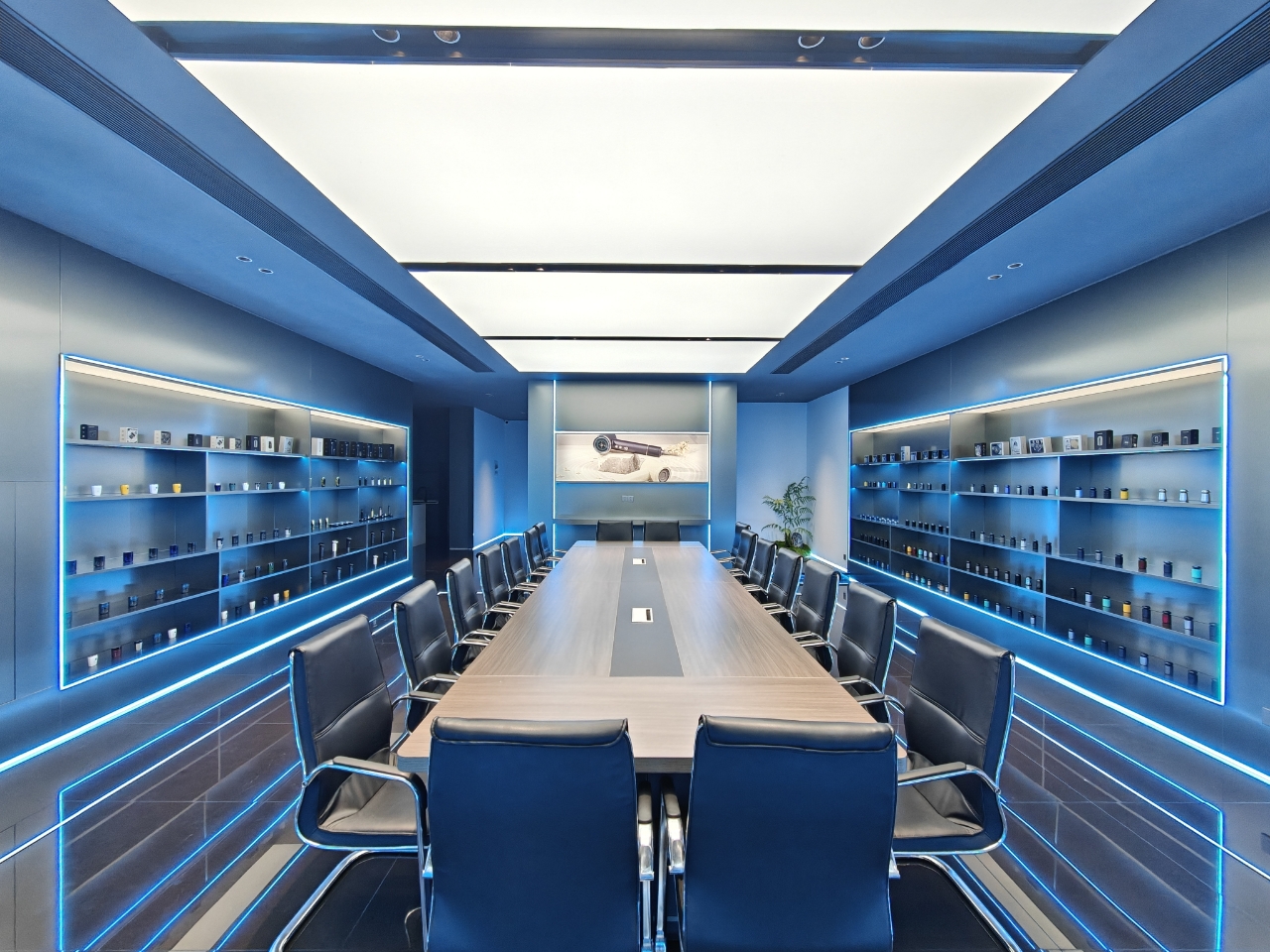
A range decision is not a product-preference decision. When a distributor or private-label owner adds grooming hardware, the shelf, the warehouse bin and the promotional calendar each hold a limited number of positions, and every SKU added has to justify its position against the SKU next to it.
The recurring mistake is to treat the 4-in-1 kit as an upgraded shaver. It is not: it is a different purchase occasion. A shopper replacing a worn-out razor buys a shaver. A shopper buying a birthday gift, a corporate giveaway or a travel kit buys a multi-tool set. Those two shoppers rarely compare the same products, so placing only one of the two SKUs on shelf leaves one of the two occasions unserved — and handing the occasion to a competitor.
The second mistake runs the other way: stocking the kit as the headline item and the dedicated shaver as an accessory. That inverts the replacement economics. The dedicated shaver is the item a repeat customer returns for; the kit is the item a first-time or gift buyer picks up. A range that carries the kit without a dedicated shaver has no natural reorder path.
So the question worth answering is narrower than "which is better": which SKU carries which job, which one absorbs the promotional calendar, and which one the buyer reorders. Everything below is organised around that.
What the 2026 market data changes about range planning
Two published data points frame the commercial context, and both point toward value-per-unit differentiation rather than pure volume growth.
China's exports of electric shavers under HS 851010 reached USD 359 million for January to August 2026, according to the General Administration of Customs of China (GACC) statistics query, accessed 25 October 2026. Separately, the U.S. electric shaver market is projected to reach USD 4.94 billion by 2033, growing at a 5.5% CAGR over 2025–2033, as reported by Grand View Research in March 2026.
Read together — and this is analysis, not a reported finding — a mature export base plus a forecast growing in value rather than units implies that buyers are being asked to differentiate on specification and configuration: body material, waterproofing, tool count, noise, and the documentation that lets a product enter a regulated market. That is precisely where a two-SKU structure helps. One SKU competes on the essentials of shaving; the other competes on breadth of grooming jobs in one package.
For EU and U.S. channels, the compliance baseline is also fixed. Household shavers and similar appliances rated at not more than 250 V — including battery-operated models — fall inside the scope of IEC 60335-2-8:2022, the current edition that replaced the 2012 edition and its amendments. Electromagnetic compatibility is handled separately: EN IEC 55014-1:2021 and EN IEC 55014-2:2021 for the EU, and FCC Part 15 Subpart B with ANSI C63.4 for the United States. Both SKUs in this comparison sit in that battery-operated, low-voltage category.
The two products on paper
JM-901: one job, executed as a dedicated shaver
The JM-901 is a rechargeable reciprocating electric shaver built for face shaving. Its documented specification set lists a 14,000 vibrations-per-minute reciprocating drive, IPX7 waterproofing, an aluminum alloy and ABS body, a 300 mAh battery and a 5 V/1 A charging input.
For a range planner, each of those is a positioning decision rather than a data point. IPX7 supports wet-and-dry use and rinse-clean messaging, which is the single most requested feature in bathroom-grooming listings. An aluminum alloy and ABS body supports a mid-to-premium price tier and gives the packaging something concrete to describe. A 300 mAh battery and 5 V/1 A input define the charging accessory and travel-pouch bundle you will need to plan; the supplied specification set does not state runtime or charging time, so shelf claims about battery life should follow the SKU datasheet rather than an assumed figure.
JM-708: four tools, one purchase
The JM-708 is a 4-in-1 grooming kit combining a shaver, a hair clipper, a nose trimmer and an eyebrow trimmer. Its commercial value is not that it shaves better than a dedicated shaver — that claim is not established by the evidence here — but that it collapses four purchase decisions into one box.
That makes it a gift-set and promotion item by construction. It is also the SKU with the heavier packaging, the higher component count and the more complex instruction leaflet, which affects landed cost and after-sales exposure. Those are the trade-offs to price, not the shaving head.
Head-to-head comparison table
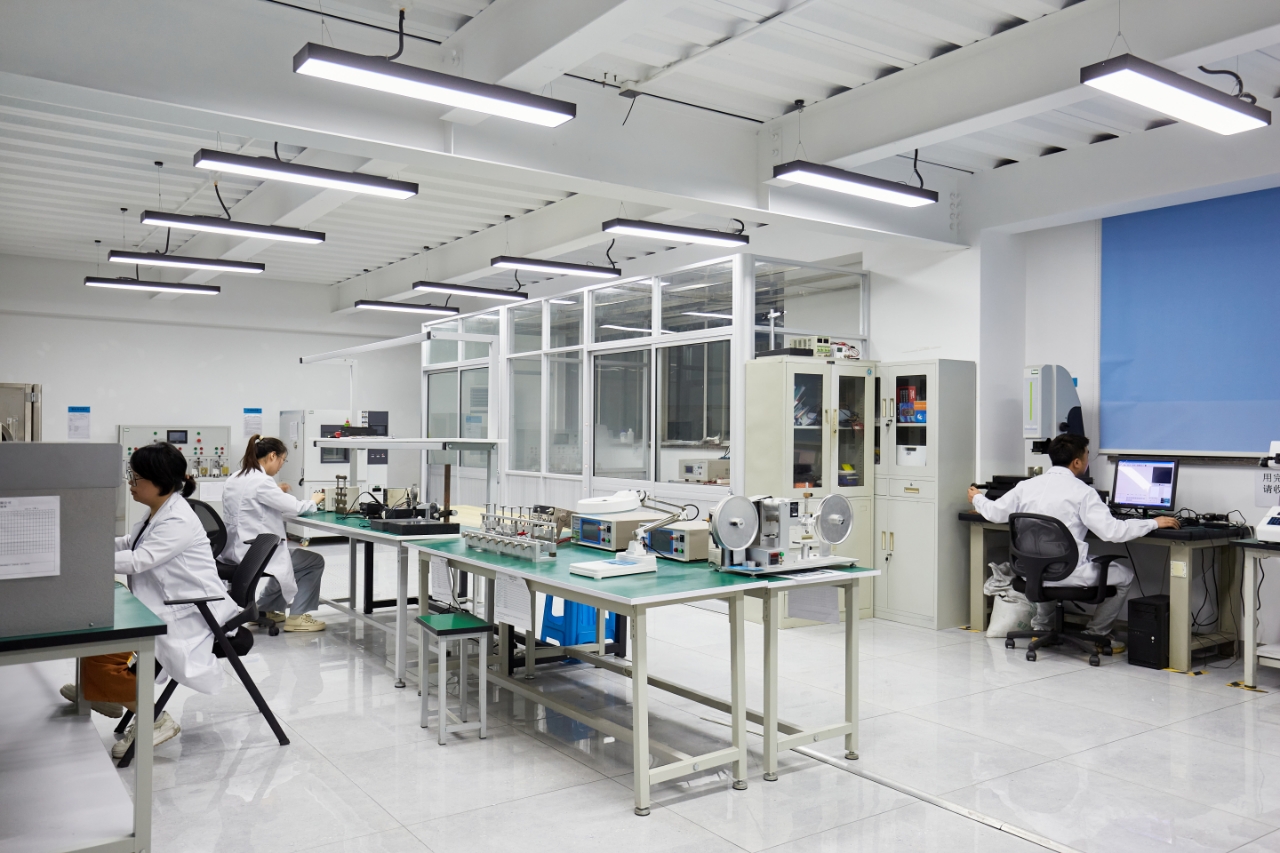
The table below compares the two models only on dimensions that change a range plan. Specification values follow the set supplied for this comparison.
| Decision dimension | JM-901 dedicated shaver | JM-708 4-in-1 grooming kit | What it changes for the buyer |
|---|---|---|---|
| Core job | Face and beard shaving | Shaving, hair clipping, nose trimming, eyebrow trimming | Shaver competes for replacement cycles; kit competes for gift and first-purchase occasions |
| Drive | Reciprocating, 14,000 vibrations per minute | Reciprocating shaver head inside a four-tool kit | Sample the kit's shaver head before assuming parity with the dedicated unit |
| Waterproofing | IPX7 | IPX7 | Both can carry wet/dry and rinse-clean messaging |
| Body | Aluminum alloy and ABS | Aluminum alloy and ABS | Material story supports a mid-to-premium tier for both |
| Battery and charging | 300 mAh; 5 V/1 A input | 300 mAh; 5 V/1 A input | One charger profile simplifies accessory and travel-pouch planning |
| Documented certification | No certificate record included in this evidence set | CE-EMC XH251203102985R1; FCC XH251203102986R1; RoHS XH251203102987R1 (all issued 8 January 2026) | The kit can move to EU/US paperwork faster; the shaver's own pack must be requested first |
| Program terms | 3,000-unit MOQ; 30–45 day lead time; 100% testing | Same program terms | Two SKUs share one production slot and one MOQ negotiation |
| Best-fit channel | Everyday retail, travel, replacement | Gift sets, hypermarket promotions, chain-store programs | Assign slots by channel before setting the volume split |
Specification note: the set supplied for this comparison lists IPX7 waterproofing, an aluminum alloy/ABS body, a 300 mAh battery, a 5 V/1 A charging input and 14,000 vibrations per minute as the core electrical specification for the pair. Confirm the individual SKU datasheet before those values are printed on packaging or listing copy.
A five-step range decision process
- Assign one job per SKU. Write the sentence the shopper would say. "I need a shaver" belongs to the JM-901. "I need a grooming set for a gift or a trip" belongs to the JM-708. If your channel's customers only ever say the first sentence, the kit is a promotion item, not a permanent listing.
- Count the grooming jobs in your market. Beard only, or beard plus hair, nose and eyebrows? Single-job markets favour the dedicated shaver as the volume SKU. Multi-job and gift-heavy markets give the kit a permanent slot instead of a seasonal one.
- Build the compliance file per SKU, not per supplier. Certificates attach to a model and a scope, not to a catalogue. The JM-708 file is documented; the JM-901 file is not part of this evidence set. Request both before you commit listing dates.
- Model unit economics at the same MOQ and Incoterm. The kit carries four tool heads, more packaging and a heavier instruction leaflet; the shaver carries one head and a smaller carton. Comparing a kit quotation to a shaver quotation without normalising MOQ and freight produces a number that will not survive the second order.
- Validate with samples before the range is locked. Test the shaver head, the waterproofing routine and the noise in a real bathroom, not a meeting room. IEC 61254:2026 provides methods for the subjective evaluation of user experience and user satisfaction for men's household shavers and trimmers, and explicitly does not specify safety or performance requirements — so use it alongside your own acceptance checklist, not instead of it.
Where each SKU earns its place: scenario map
Business travel. The dedicated shaver wins on pack size and simplicity: one head, one charging routine. The kit wins only where the traveller also clips hair or trims between appointments. Where both are stocked, the shaver is the everyday travel item and the kit is the upgrade.
Gift sets and hypermarket promotions. The kit's four-tool configuration is the merchandising story. A box that shows four heads justifies a promotional price point in a way that a single-head shaver cannot, which is why gift-set programs are the kit's natural home.
Brick-and-mortar chains. Chains need a price ladder. A two-SKU structure gives an opening price point and a step-up without adding a third supplier or a third certification file to manage.
Replacement and repeat purchase. The dedicated shaver carries the reorder logic. A customer who bought a kit for the shaver head has no obvious reason to return for a second kit; a customer who bought a dedicated shaver does.
This allocation is not theoretical. The supplier's case record describes a program of 300,000 units over five years for hypermarket, gift-set and brick-and-mortar chain-store applications, with personal-care OEM clients in China, Iran, Japan, Portugal, Russia, Spain, France and the United Kingdom. The documented result is stable operation, with the products noted for low noise, sharp cutting performance and plug-and-play installation.
Certification: what is documented, and what still needs a file
For the JM-708 multi-functional trimmer, three records are documented. All three were issued on 8 January 2026 by Shenzhen Xuhang Detect Certification Co., Ltd.
- CE-EMC, certificate XH251203102985R1, to EN IEC 55014-1:2021 and EN IEC 55014-2:2021, for the European Union market.
- FCC, certificate XH251203102986R1, to FCC Part 15 Subpart B and ANSI C63.4, for the United States market.
- RoHS, certificate XH251203102987R1, to the IEC 62321 series (parts 3-1, 4, 5, 6, 7-1, 7-2 and 8), for the European Union market.

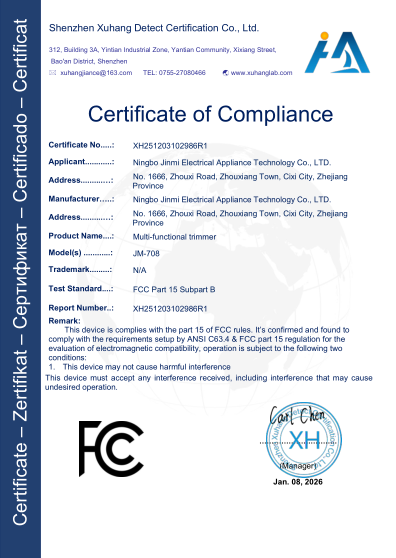

No equivalent certificate record for the JM-901 was included in the evidence set used for this article. That is a documentation gap to close, not a finding that the shaver lacks certification. Ask the supplier for the shaver's own EMC and safety test reports, check that the certificate scope names the exact model and configuration you are ordering, and remember that a certificate is evidence of a test, not by itself proof of market access — national adoption, battery-transport rules and charger requirements still apply in the destination market.
Cost, capacity and MOQ: the commercial layer
The commercial layer is where a two-SKU range is won or lost, because both models draw on the same production program.
The stated OEM/ODM program runs at a 3,000-unit minimum order quantity with a 30–45 day lead time, against a stated monthly capacity of 100,000 units. Customization is offered at logo and nameplate level, quality control is described as 100% testing, and after-sales support is handled remotely. Company-reported capacity figures add context: a 28,000 m² factory, around 300 employees, a 25-engineer R&D team, an annual output of 12 million units and a 70% export ratio.
On cost positioning, the data supplied for this comparison places the JM-901 at 10% lower cost than Laifen, with lower noise. Two cautions belong beside that figure. First, it is a supplier positioning number for range planning, not an independently audited benchmark, and it should be confirmed against your own quotation and sample evaluation. Second, it applies to the shaver — it does not automatically extend to the JM-708, which carries four tools and heavier packaging.
Practically, this means the two SKUs should be negotiated as one program but costed as two lines. A combined order reduces the number of production slots and shipments you manage; a combined cost sheet hides the fact that the kit's bill of materials is structurally different from the shaver's. Keep the split visible.
Boundaries of this comparison
Several decision inputs are not covered by the evidence set supplied here, and buyers should treat them as open items rather than settled advantages: measured runtime and charging time for the 300 mAh battery; unit weight and packed dimensions; drop and durability test data; independent noise measurement; and any head-to-head user trial of the kit's shaver head against the dedicated shaver. The 10% cost and lower-noise positioning against Laifen is supplier data. None of these gaps blocks a range decision, but each one belongs in the sample-evaluation checklist before packaging copy is written.
Frequently asked questions
Do the JM-901 and the JM-708 carry the same certification documentation for EU and US channels?
Not in the evidence supplied for this comparison. The documented records cover the JM-708 multi-functional trimmer: CE-EMC certificate XH251203102985R1 to EN IEC 55014-1:2021 and EN IEC 55014-2:2021 for the EU, FCC certificate XH251203102986R1 to FCC Part 15 Subpart B and ANSI C63.4 for the United States, and RoHS certificate XH251203102987R1 to the IEC 62321 series, all issued on 8 January 2026 by Shenzhen Xuhang Detect Certification Co., Ltd. No equivalent JM-901 certificate record was included, so request the shaver's own test reports and certificates before listing it in EU or US channels.
Can the JM-901 and the JM-708 be produced within one OEM/ODM program?
Yes, according to the supplier's capability record. Ningbo Jinmi Electrical Appliance Technology Co., Ltd. runs OEM and ODM programs with logo and nameplate customization, 100% testing, a stated monthly capacity of 100,000 units and remote after-sales support. Both models sit in the same personal-care appliance portfolio, so a two-SKU order can be scheduled together; confirm component-level tooling and packaging differences in the quotation.
Which SKU is cheaper, and where does the 10% cost gap against Laifen come from?
The positioning data supplied for this comparison puts the JM-901 at 10% lower cost than Laifen, with lower noise. Treat that as a planning hypothesis: it is a supplier positioning figure, not an audited benchmark, and it does not automatically extend to the JM-708, which carries four tools and more packaging. Budget the kit separately and compare landed cost per unit at the same MOQ and Incoterm.
How should a buyer sample-test the pair before committing to a range?
Order samples of both SKUs and test them against the jobs you are assigning: face shaving on the JM-901, and face, hair, nose and eyebrow trimming on the JM-708. Check IPX7 washing behaviour, the 5 V/1 A charging routine your channel will use, body finish, and noise in a normal bathroom setting. IEC 61254:2026 provides methods for subjective evaluation of user experience and satisfaction for household shavers and trimmers, and explicitly does not set safety or performance requirements, so pair it with your own acceptance checklist.
What lead time and MOQ should go into the range plan?
The stated OEM/ODM program runs at a 3,000-unit minimum order quantity with a 30–45 day production lead time, against a stated monthly capacity of 100,000 units. Add sample approval, artwork and packaging, and certification-document review before the first shipment date. If you are building a two-SKU range, share the split between shaver and kit volumes early so the production slot can be reserved in one pass.
Conclusion
The head-to-head answer is a split decision, and that is the point. Stock the JM-901 as the dedicated, repeat-purchase shaver that carries IPX7 waterproofing, an aluminum alloy and ABS body, a 300 mAh battery with 5 V/1 A charging and a 14,000 vibrations-per-minute drive. Stock the JM-708 as the four-tool kit for gift sets, hypermarket promotions and chain-store programs, and lean on its documented CE-EMC, FCC and RoHS records to shorten the paperwork path. Assign each SKU a job, build a compliance file per model rather than per supplier, normalise the cost comparison, and validate both with samples before the range is locked.
Product catalogue for both models and the wider portfolio: Ningbo Jinmi product catalogue (PDF).
Have Questions or Need More Details?
Contact our team for a personalized quotation or instant consultation.
Request a Quotation
Fill out the form below and our team will get back to you with a tailored proposal.
WhatsApp Direct Chat
Prefer to chat in real-time? Message us on WhatsApp for instant assistance & quick answers.
- Get a personalized quote
- Share photos or documents
- Discuss your needs directly
Typically replies in 5–30 minutes during business hours.