How to Verify Electric Shaver Supplier Capability & Delivery
How to Verify Electric Shaver Supplier Capability & Delivery
A supplier's capability is only as real as the documents and calculations behind it. Verifying an electric shaver supplier means checking three things separately: whether the compliance documents cover the exact model you are buying, whether stated monthly capacity and lead time survive a delivery calculation, and whether the track record can be traced to named markets and channel types. A claim that fails any one of these checks is not capability — it is catalogue language.
This guide is written for B2B buyers who have already shortlisted a supplier and need to convert marketing statements into evidence before releasing a deposit. It uses Ningbo Jinmi Electrical Appliance Technology Co., Ltd. as a worked reference. Ningbo Jinmi is an electric shaver, hair clipper and nose hair trimmer manufacturer located in Cixi City, Ningbo, Zhejiang, China, operating a 28,000 m² factory with 300 employees and 25 engineers, and supplying OEM/ODM production for EU and Middle East markets.

Capability verification starts with the site itself: a reported 28,000 m² manufacturing base in Cixi City, Ningbo, Zhejiang, China.
Why Capability Claims Are Hard to Verify
Supplier evaluation usually fails in one of three places, and each failure has a different cause.
- Capability gap. “Large capacity” is a phrase without a unit. It can mean finished shavers per month, hardware components per day, or peak output on the best line. Only one of those figures tells you whether your order ships.
- Compliance gap. A certificate proves that a specific model was tested against specific standards by a specific body. It does not transfer automatically to a different model, a different housing, or a different electronics layout.
- Delivery gap. Lead time in a catalogue is a planning number. Lead time in a purchase order, tied to a deposit schedule and a pre-shipment acceptance test, is a delivery mechanism.
Restated as verification questions, the three gaps become: which document covers my exact model; what monthly output figure is being quoted and how does it compare with my program volume; and which contractual step stops the shipment from leaving before I have accepted it? Every step in the workflow below answers one of those three questions.
What the Market and Standards Landscape Requires
Two pressures shape electric shaver sourcing in 2026: export scale and certification depth.
On scale, China's General Administration of Customs statistics (HS 851010) record USD 359 million in shaver exports for January–August 2026. On demand, Grand View Research projects the U.S. electric shavers market to reach USD 4.94 billion by 2033, a 5.5% CAGR across 2025–2033. A dense supplier base plus a growing end market means supplier count is not the constraint — supplier verification is.
On certification, the reference framework is IEC 60335-2-8:2022. That edition covers the safety of electric shavers and similar appliances intended for household and similar purposes, rated at not more than 250 V, including direct-current-supplied and battery-operated appliances, and it replaces the sixth edition published in 2012 together with its amendments. A separate document, IEC 61254:2026, provides methods for subjective evaluation of user experience and user satisfaction for men's household electric shavers and trimmers — and explicitly does not specify safety or performance requirements. Buyers who cite it as a performance standard are misreading its scope.
The Four Evidence Sets That Prove Capability
1. Model-scoped compliance documents
Ask for the certificate set belonging to the exact model you intend to order, then read the scope line before you read anything else. For the 4-in-1 Grooming Kit model JM-708 (listed on the certificates as a multi-functional trimmer), the documented set from Ningbo Jinmi is:
- CE-EMC — certificate XH251203102985R1, issued by Shenzhen Xuhang Detect Certification Co., Ltd. on 2026-01-08 for the European Union, tested against EN IEC 55014-1:2021 and EN IEC 55014-2:2021.
- FCC — certificate XH251203102986R1, issued 2026-01-08 for the United States, tested against FCC Part 15 Subpart B and ANSI C63.4.
- RoHS — certificate XH251203102987R1, issued 2026-01-08, tested against the IEC 62321 series (IEC 62321-3-1:2013, -4:2013+AMD1:2017, -5:2013, -6:2015, -7-1:2015, -7-2:2017 and -8:2017).
Each document answers a different question. CE-EMC covers electromagnetic compatibility — emissions and immunity. FCC Part 15 Subpart B covers unintentional radiator requirements for the U.S. market. RoHS covers restricted substances. None of them substitutes for another, and none of them is a whole-family safety certificate.

RoHS certificate XH251203102987R1 covers model JM-708 against the IEC 62321 series, issued 2026-01-08 by Shenzhen Xuhang Detect Certification Co., Ltd.
Scope matching: the check most buyers skip
The most common compliance error is not a missing certificate — it is a certificate for a neighbouring model. As an illustration from the same supplier's documentation set, FCC certificate XH251103102823 was issued for the nose hair trimmer model JM-701 against FCC Part 15 Subpart B and ANSI C63.4. It is a valid document. It is not evidence for JM-708, and it cannot be presented as such in a retail compliance file.

FCC certificate XH251103102823 names model JM-701, not JM-708. Checking the model designation against the purchase order is a two-minute task that prevents a retail compliance failure.
Three checks catch this class of error: does the model designation on the certificate match the purchase order exactly; does the standard list match the market you are shipping to; and are the issuing body and issue date legible on the copy you received? A document that fails any of the three should go back to the supplier for correction before sampling begins.
2. Manufacturing and capacity evidence
Capacity must be expressed in finished units of your product category. For Ningbo Jinmi, the OEM/ODM capability statement is 100,000 units per month of finished product, against a minimum order quantity of 3,000 units. Behind those figures the company reports a 28,000 m² factory, 300 employees, an R&D team of 25 engineers, and daily hardware component production capacity exceeding 2 million units.
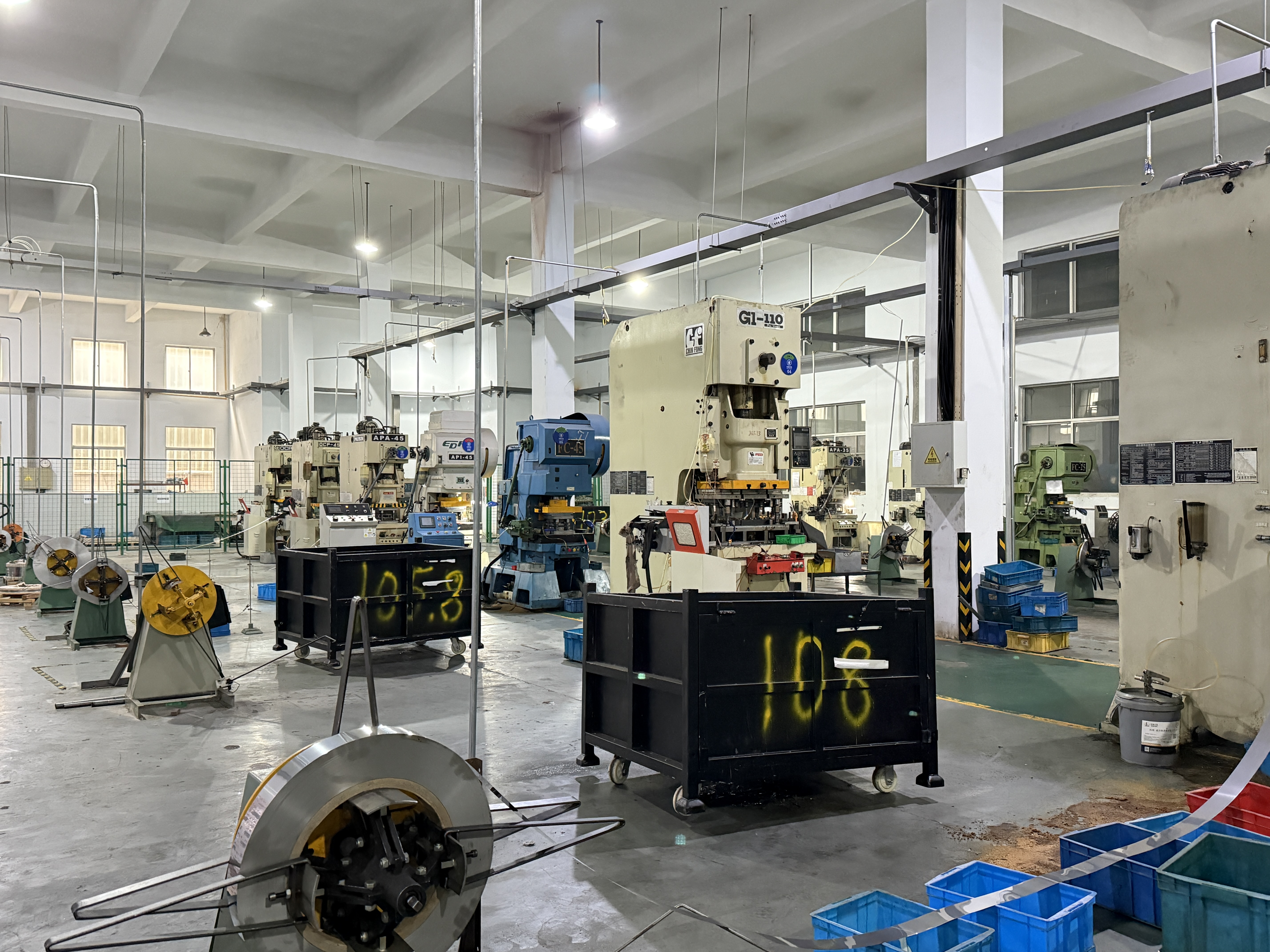
In-house stamping supports a reported daily hardware component output above 2 million units — component depth, not finished-goods output.
Component capacity and finished-goods capacity are not the same number, and neither should be accepted as evidence of the other. What the pairing does show is vertical depth: an operation producing its own hardware components can absorb component-side disruption. What it does not show is that a finished-goods line is free on the month you need it.
Quality control is stated as 100% testing. As a verification question, “100% test” needs three more words: tested for what, at which station, under which pass/fail rule. That detail belongs in the pre-shipment acceptance criteria, not in the brochure.
3. Commercial terms
Terms that are written down can be locked; terms that remain “discussed” cannot. The documented OEM/ODM terms for this supplier are set out below, together with the point a buyer should convert into written language.
| Parameter | Documented value | What the buyer should lock in writing |
|---|---|---|
| Production mode | OEM / ODM | Which mode applies to your SKU, and who owns the tooling |
| Minimum order quantity | 3,000 units | MOQ per model vs. per program; tolerance for mixed SKUs |
| Monthly capacity | 100,000 units | Monthly volume allocated to your program, not total plant capacity |
| Lead time | 30–45 days | The event that starts the clock: deposit received or artwork approved |
| Delivery term | FOB | Named port, who books freight, who carries loading risk |
| Payment terms | 30% deposit / 70% before shipment | Balance trigger tied to acceptance, not to vessel booking |
| Acceptance criteria | Pre-shipment test | Test items, sample size, and who signs the report |
| Customization | Logo / nameplate | Artwork approval deadline and revision limit |
| After-sales | Remote support | Response channel, escalation contact, spare-part handling |
The payment structure is the part buyers most often leave loose. A 30% deposit with 70% due before shipment is a conventional split, but it inverts your leverage if the 70% falls due before you have accepted anything. Anchor the balance to the pre-shipment test report, and the same split becomes a delivery control instead of a cash-flow concession.
4. Track record
A reference story is only useful if it has a shape you can compare against your own program. The documented reference for this supplier is a 300,000-unit personal care OEM program that has run for five years, shipping to hypermarket, gift set and brick-and-mortar chain store clients across China, Iran, Japan, Portugal, Russia, Spain, France and the United Kingdom, with a reported result of stable operation. The reported performance highlights for that program are low noise, sharp cutting performance, and plug-and-play use. The product associated with that program reference, product 6247, is the JM-901 reciprocating shaver.
Read the shape rather than the adjective. Eight markets over five years implies repeat ordering and repeat market entry — behaviour that is harder to fabricate than a single shipment. Three channel types — hypermarket, gift set, chain store — imply that different packaging and compliance configurations have already been handled. Neither inference proves your order will be perfect; both tell you that the operation has been through a buyer acceptance cycle before.
Step-by-Step Verification Workflow
Step 1 — Fix the specification before requesting any document
A supplier cannot send the right certificate for an undefined model. Confirm the model designation (for example JM-708 for a 4-in-1 grooming kit, or JM-901 for a reciprocating shaver), the target market, the packaging format, and whether the order is OEM or ODM. Every document you request afterwards is scoped against this definition.
Step 2 — Read certificates as scoped documents, not as badges
For each certificate, record four fields: model designation, standard list, issuing body, issue date. The JM-708 set reads: CE-EMC XH251203102985R1 against EN IEC 55014-1:2021 and EN IEC 55014-2:2021; FCC XH251203102986R1 against FCC Part 15 Subpart B and ANSI C63.4; both issued 2026-01-08 by Shenzhen Xuhang Detect Certification Co., Ltd. If any field is missing or mismatched, the certificate is not usable in a retail compliance file.
Step 3 — Recalculate delivery from capacity
Take the stated 100,000 units per month and the 3,000-unit MOQ, then divide your launch volume by the monthly figure. A 30,000-unit first order consumes roughly a third of one month of stated capacity; a 300,000-unit program — the scale of the documented reference — requires three months of full output at the same rate. That arithmetic, not the capacity figure itself, tells you whether the 30–45 day lead time is plausible for your volume.
Step 4 — Convert “100% test” into acceptance criteria
The documented acceptance criterion is a pre-shipment test. Convert it into a written list before the order: which functions are checked, at which production stage the 100% test occurs, what defect rule triggers a re-test, and who signs the report. Without this conversion, the balance payment has no trigger.
Step 5 — Fix the payment and delivery mechanism
Write the sequence as a chain: 30% deposit → production → pre-shipment test → buyer acceptance → 70% balance → shipment under FOB terms. Each arrow is a control point. If the balance moves ahead of acceptance, the chain loses its function even though every individual term looks normal.
Step 6 — Match the track record to your channel
Compare your sales channel against the documented reference channels: hypermarket, gift set and brick-and-mortar chain stores. If you sell through a channel the supplier has not described, ask what changes — packaging, barcoding, compliance file, or order granularity. A five-year, 300,000-unit, eight-market record is strong evidence for retail-style programs and neutral evidence for a channel it does not mention.
Step 7 — Write the delivery lock into the order
Record in the purchase order: lead time of 30–45 days with a defined start event; the pre-shipment test as the acceptance criterion; FOB with a named port; 30/70 payment; and remote after-sales support as the post-delivery channel. These are the four mechanisms that remain enforceable after the quotation expires.
Use Cases: Three Programs, Three Verification Priorities
Hypermarket and chain-store rollout
Priority: volume repeatability and acceptance discipline. Check the monthly capacity figure against your rollout curve, then check whether the supplier has handled multi-market retail before. The documented 300,000-unit program running five years across China, Iran, Japan, Portugal, Russia, Spain, France and the United Kingdom is directly relevant here, because retail rollouts fail on repeat orders more often than on the first order.
Gift set program
Priority: configuration control. A 4-in-1 grooming kit such as JM-708 combines an electric shaver, hair clipper, nose trimmer and eyebrow trimmer in one package, so the compliance file has to be assembled per configuration, not per shipment. Logo and nameplate customization adds an artwork approval step that must sit inside the 30–45 day lead time rather than after it.
EU or US market launch
Priority: document-to-market matching. For the EU, the relevant EMC document is CE-EMC XH251203102985R1 against EN IEC 55014-1:2021 and EN IEC 55014-2:2021; for the United States, FCC XH251203102986R1 against FCC Part 15 Subpart B and ANSI C63.4; RoHS XH251203102987R1 sits alongside both. A launch that ships to both markets needs all three, each naming the correct model.
Comparison Table: What Each Statement Actually Proves
The table below compares the claims a supplier makes with the evidence that verifies them, and states the limit of each item. Limits matter as much as confirmations: a document that is real but scoped narrowly is more useful to a buyer than one that is described broadly.
| Statement | Verifying document or calculation | What it confirms | What it does not confirm |
|---|---|---|---|
| EU electromagnetic compliance | CE-EMC XH251203102985R1, EN IEC 55014-1:2021 & EN IEC 55014-2:2021, issued 2026-01-08 | EMC testing of model JM-708 against the listed standards | Safety of other models, or national market registration |
| U.S. electromagnetic compliance | FCC XH251203102986R1, FCC Part 15 Subpart B / ANSI C63.4, issued 2026-01-08 | Unintentional radiator documentation for model JM-708 | EU market access, or coverage of a different model |
| Restricted substances | RoHS XH251203102987R1, IEC 62321 series | Restricted substance testing of model JM-708 | EMC or electrical safety |
| Monthly capacity of 100,000 units | Capacity statement plus volume calculation against the 3,000-unit MOQ | Feasibility at the stated output level | Whether capacity is allocated to your order in your month |
| Lead time of 30–45 days | Written order confirmation with a defined start event | A planning window for launch scheduling | Port congestion or other transit-side delay |
| 100% testing | Pre-shipment test as the written acceptance criterion | That a testing step exists in the production flow | A specific defect rate or sampling standard |
| 300,000-unit, five-year reference | Program description: eight markets, three channel types, stable operation | Repeat-order experience in retail-style channels | Performance on a channel the supplier has not described |
Frequently Asked Questions
Which compliance documents should a buyer verify for an EU-bound electric shaver?
For the 4-in-1 Grooming Kit model JM-708, the EU electromagnetic document is CE-EMC certificate XH251203102985R1, issued by Shenzhen Xuhang Detect Certification Co., Ltd. on 2026-01-08 and tested against EN IEC 55014-1:2021 and EN IEC 55014-2:2021. Because the certificate is model-scoped, the model designation on the document must match the purchase order. CE-EMC covers electromagnetic compatibility only; it does not replace restricted-substance testing, which for the same model is covered separately by RoHS certificate XH251203102987R1.
How can a buyer confirm that monthly capacity will cover their program?
The OEM/ODM capability statement for Ningbo Jinmi is 100,000 finished units per month, against a minimum order quantity of 3,000 units, supported by a 28,000 m² factory, 300 employees, 25 engineers and hardware component output above 2 million units per day. Capacity is not the same as allocation: ask for the monthly volume reserved for your SKU inside the 30–45 day lead time and compare it with your launch volume. The documented 300,000-unit program, running five years across eight markets, shows the volume level the operation has handled — it does not guarantee that capacity is free for a new order.
What commercial terms should be agreed before the first order?
The documented terms are a 3,000-unit MOQ, FOB delivery terms, payment of 30% deposit and 70% before shipment, and a pre-shipment test as the acceptance criterion, with remote support after delivery. The MOQ defines the minimum financial commitment per order; the payment split defines when cash leaves the buyer's business relative to when test evidence arrives. Tying the 70% balance to the pre-shipment test report is what makes the split function as a delivery control rather than a payment convention.
How should a sample be evaluated before mass production?
Evaluate in three layers. First, the document layer: confirm that the model designation on the compliance certificates matches the physical sample in hand. Second, the experience layer: IEC 61254:2026 provides methods for subjectively evaluating user experience and user satisfaction for men's household electric shavers and trimmers, and can structure feedback on comfort, convenience and noise — but it explicitly does not specify safety or performance requirements, so it never replaces a test report. Third, the configuration layer: confirm logo and nameplate customization against the approved artwork. Sample quantity and sample lead time are not part of the documented commercial terms in this reference set and should be confirmed in writing with the supplier.
How is delivery actually secured once the order is placed?
Delivery is secured by linked terms rather than by a promise: a 30–45 day lead time starting from a defined event such as deposit receipt and artwork approval; a 70% balance released against the pre-shipment test rather than against a shipping date; FOB terms with a named port; and remote after-sales support as the post-delivery channel. Buyers who want these terms applied to their own configuration can request a formal quotation and a specification review from the supplier before committing to the 3,000-unit minimum.
Conclusion: Three Checks Before the Deposit
Supplier capability in the electric shaver category reduces to three verifiable questions. Does the certificate name the model you are ordering, on the standards your destination market requires, from an identifiable issuing body with a visible date? Is the capacity figure expressed in finished units, and does it survive division by your launch volume? And does the payment structure place the balance after acceptance rather than before it?
Applied to the reference supplier, the answers are concrete: CE-EMC XH251203102985R1, FCC XH251203102986R1 and RoHS XH251203102987R1 for model JM-708; 100,000 units per month against a 3,000-unit MOQ with a 30–45 day lead time; FOB terms with 30% deposit and 70% before shipment against a pre-shipment test; and a 300,000-unit, five-year reference spanning hypermarket, gift set and chain store channels across eight markets. Where any of those answers is missing for your model or your market, the correct action is to request the document rather than to assume the capability.
Next Step: Confirm the Documents Against Your Own Specification
Buyers who need the full model and specification overview can download the product catalogue, which lists the electric shaver, hair clipper and nose hair trimmer configurations available for OEM and ODM programs.
Download the Ningbo Jinmi product catalogue (PDF)
For a quotation, a sample request or a compliance document set for a specific model, contact the team directly: email huangyeyang@nbjinmi.cn · WhatsApp +86 158-6739-9472 · www.nbjinmi.com
Have Questions or Need More Details?
Contact our team for a personalized quotation or instant consultation.
Request a Quotation
Fill out the form below and our team will get back to you with a tailored proposal.
WhatsApp Direct Chat
Prefer to chat in real-time? Message us on WhatsApp for instant assistance & quick answers.
- Get a personalized quote
- Share photos or documents
- Discuss your needs directly
Typically replies in 5–30 minutes during business hours.