CE-EMC & FCC Certification for Electric Shavers: A Compliance Roadmap for EU & US Markets
CE-EMC & FCC Certification for Electric Shavers: A Compliance Roadmap for EU & US Markets
An electric shaver entering the European Union or the United States is judged on its documentation before it is judged on its blades. For rechargeable and mains-charged personal grooming devices, two files decide how smoothly a shipment moves: the CE-EMC file for Europe and the FCC file for the United States. Both are electromagnetic compatibility (EMC) documents. They describe how the device behaves electrically and how it tolerates interference from its surroundings — not how closely it cuts.
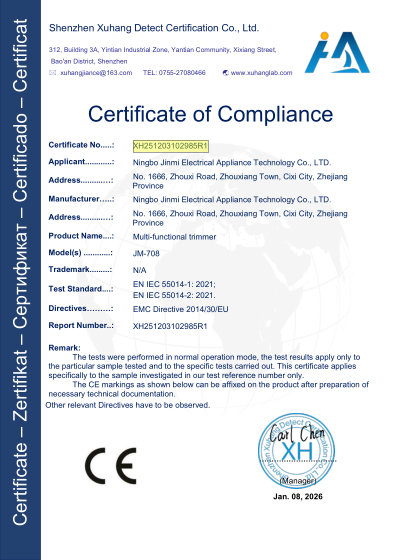
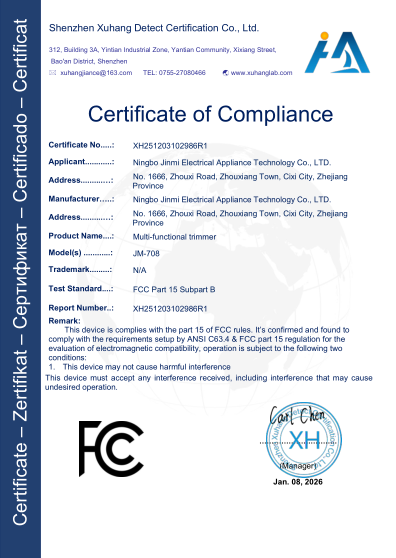
One worked example anchors this roadmap. The JM-708 4-in-1 Grooming Kit (electric shaver, hair clipper, nose trimmer and eyebrow trimmer) is covered by CE-EMC certificate No. XH251203102985R1, tested to EN IEC 55014-1:2021 and EN IEC 55014-2:2021, and by FCC certificate No. XH251203102986R1, tested to FCC Part 15 Subpart B with measurement practice per ANSI C63.4. Both certificates were issued on 8 January 2026 by Shenzhen Xuhang Detect Certification Co., Ltd. The same model also carries CE-RoHS certificate No. XH251203102987R1.
What follows is a buyer-side compliance roadmap: what each document proves, which fields must be matched against a purchase order, and where importers most often lose time.
Why EMC Paperwork Delays Market Entry More Often Than Product Quality
In the personal-care category, shipments that stall at EU and US market entry are rarely defective. They arrive with an incomplete file. Customs brokers, marketplace compliance teams and retail quality departments respond to documents, and a document that does not match the shipment is treated as missing.
Six documentation gaps account for most of the delay:
- Model mismatch. The certificate names one model number while the cartons carry a variant, a colour-coded SKU or a buyer-specific code that never appears on the certificate.
- Standard edition mismatch. The test report references an earlier edition of a standard, and the receiving market is asking for the current one.
- Scope mismatch. The document covers the shaver body but the buyer also ships a charging adapter, a stand or a travel case.
- Certificate image without a report. The buyer receives a photograph of a certificate but no traceable test report behind it.
- Untraceable issuer. No one can confirm who issued the document or under what authority.
- Change without retest. The motor, battery or charging circuit was substituted after testing, without re-opening the file.
None of these gaps means the product is faulty. Each one means the file is incomplete — and each is far easier to close before a container leaves the factory than after it reaches a distribution centre.
For a buyer evaluating a supplier, the practical question is not whether the factory holds certificates. It is whether the factory can map a specific certificate to the exact model, configuration and destination market being ordered.
The Market Context Behind the Certification Requirement
The commercial pressure behind EMC compliance is straightforward: the category is large, increasingly cordless, and sold across borders.
- The global electric shaver market was valued at approximately USD 14.39 billion in 2024 and is projected to reach USD 21.60 billion by 2032 (Markets and Data).
- China's domestic electric shaver market was valued at USD 1.89 billion in 2024, with a projected CAGR of 8.4% through 2030 (Next Move Strategy Consulting).
- Foil shavers held a 55.8% share of global electric shaver revenue in 2024, while rotary shavers are projected as the fastest-growing sub-segment (Data Bridge Market Research).
- Cordless models accounted for 83.95% of the US market in 2024, driven by USB and Type-C charging convenience (Grand View Research).
Published estimates differ by scope — some reports count all razors rather than electric shavers alone, and at least one puts the broader razor market at USD 12.5 billion for the same period. The point for buyers is not the exact figure but the direction: a cordless, electronics-dense product category, shipped across regulatory boundaries.
Safety, electromagnetic performance and substance restriction are three separate evidence streams, and a complete file normally touches all three:
- Safety. Electric shavers must comply with IEC 60335-2-8 safety standards, which cover household shavers, hair clippers and similar appliances up to 250V (International Electrotechnical Commission). Waterproof testing for washable shavers typically follows IPX4 or IPX7 ratings as specified in amendments to UL/CSA 60335-2-8 (Intertek standards update).
- Electromagnetic compatibility. Emission and immunity requirements for household appliances and similar apparatus.
- Substance restriction. RoHS-type documentation, supported by the IEC 62321 test-method family.
The Two-Market Compliance Stack, Explained
Ningbo Jinmi Electrical Appliance Technology Co., Ltd. is an electric shaver and hair clipper manufacturer based in Cixi City, Zhejiang Province, China, established in 2015. It operates a 28,000 m² factory with more than 300 employees, produces electric shavers, hair clippers and nose hair trimmers, and reports an export ratio of 70%, with Europe, North America and Southeast Asia among its main markets. Its certificate library for the models discussed here was issued by Shenzhen Xuhang Detect Certification Co., Ltd.
The EU file for a rechargeable shaver
European market access for personal grooming appliances rests on several parallel evidence streams rather than a single document. Two of them are electromagnetic. EN IEC 55014-1:2021 addresses emission — the disturbance a household appliance, electric tool or similar apparatus is permitted to generate. EN IEC 55014-2:2021 addresses immunity — how that apparatus must behave when exposed to external electromagnetic disturbance. A CE-EMC certificate citing both parts therefore covers two distinct risks: interference the device creates, and interference the device must survive.
A third stream covers substances. CE-RoHS certificate No. XH251203102987R1 for the JM-708 references the IEC 62321 series, the test-method family used to determine restricted substances in electrotechnical products.

The US file for a rechargeable shaver
For the United States, the relevant EMC document for a shaver is an FCC Part 15 Subpart B file. Subpart B addresses unintentional radiators — equipment that emits radio-frequency energy as a by-product of normal operation rather than by design intent. ANSI C63.4 is the measurement-method standard referenced alongside it, which is why US compliance reviewers look for both names on the same document.
What the JM-708 certificates actually record
Both documents are readable field by field. This is what each one states:
- Certificate type: CE-EMC (electromagnetic compatibility) for the EU; FCC for the USA.
- Certificate numbers: XH251203102985R1 (CE-EMC) and XH251203102986R1 (FCC).
- Product named in scope: Multi-functional trimmer, Model JM-708.
- Market named: European Union member countries for the CE-EMC file; United States of America for the FCC file.
- Test basis: EN IEC 55014-1:2021 and EN IEC 55014-2:2021 for the CE-EMC file; FCC Part 15 Subpart B and ANSI C63.4 for the FCC file.
- Issuing authority: Shenzhen Xuhang Detect Certification Co., Ltd. for both.
- Issue date: 8 January 2026 for both.
- Stated expiration: 8 January 2099 for both.
Read as a set, those fields answer four buyer questions: is my model named, is my market named, is the test basis current, and is the issuer traceable.
What the tests imply for a buyer
- The motor and charging electronics of the JM-708 have been assessed for emitted disturbance under EN IEC 55014-1:2021.
- The same model has been assessed for continued operation under external interference under EN IEC 55014-2:2021 — relevant for a device charged repeatedly on a shared USB supply.
- The US file was built on a recognised measurement method, which means a US retailer or marketplace compliance team can check it against a standard checklist rather than a bespoke one.
- Because both certificates name model JM-708 rather than a product category, the file applies directly to that model. A different model requires its own file.
- RoHS coverage under the IEC 62321 series addresses substance restriction, a separate question from electromagnetic behaviour.
A second model as a consistency check
The same manufacturer's JM-701 nose hair trimmer carries CE-RoHS certificate No. XH251103102822 and FCC certificate No. XH251103102823, both issued on 17 November 2025 by Shenzhen Xuhang Detect Certification Co., Ltd., tested to the IEC 62321 series and to FCC Part 15 Subpart B with ANSI C63.4 respectively.
Two dated certificate sets, for two different models, from the same issuing authority, is the pattern a buyer should look for. A single document can be a coincidence. A consistent, dated, model-specific library is a process.
A Seven-Step Verification Workflow for Buyers
The workflow below takes an hour and prevents most post-arrival documentation problems. Every step can be completed before the purchase order is signed.
- Fix the exact model and configuration first. Decide the model number, head configuration, colour, packaging and accessory set before requesting certificates. Documents cannot be matched to a specification that is still moving.
- Match the scope line character by character. Check that the model named on the certificate is the model on the purchase order, including any private-label code you intend to use.
- Check the standard edition and year. Confirm that the certificate cites the current edition — for example EN IEC 55014-1:2021 and EN IEC 55014-2:2021 on the EU side, and FCC Part 15 Subpart B with ANSI C63.4 on the US side.
- Confirm the named market. A CE-EMC document names EU member countries; an FCC document names the United States. A certificate issued for one market does not automatically serve the other.
- Trace the number and the issuer. Record the certificate number, issuing authority and issue date in your own procurement file so the same documents can be produced again at the next re-order.
- Request the underlying test report, not only the certificate image. The report shows what was tested, and it is what a retail compliance team will typically ask to see.
- Re-confirm after any engineering change. A new motor, battery cell or charging circuit is a new electrical product. Treat it as a trigger to re-check the file rather than an internal detail.
Manufacturing discipline supports this file. The supplier applies 100% testing for quality control across production and provides remote after-sales support, which matters when a compliance question surfaces after the first container has been sold through.

Where This Roadmap Applies: Four Buyer Scenarios
Scenario 1 — EU private-label launch of a three-head rechargeable shaver
An EU importer placing a three-head rechargeable shaver under its own brand needs a CE-EMC file naming the exact model, plus CE-RoHS coverage under the IEC 62321 series. Both must be in place before the first retail listing conversation, because the retailer will ask for them during onboarding rather than after delivery.
Scenario 2 — US retail onboarding of a 4-in-1 grooming kit
A US buyer listing a multi-function grooming kit faces a different reviewer and a different document. The JM-708 pattern is the template: one model, one CE-EMC certificate, one FCC certificate, identical issue date, same issuing authority, both naming the model explicitly. A kit that combines a shaver head, clipper head, nose trimmer head and eyebrow trimmer is still one electrical product for EMC purposes when it runs on one body and one battery.
Scenario 3 — Multi-model distribution catalogue
A distributor expanding from one SKU to a family needs a certificate per model. The JM-708 (4-in-1 grooming kit) and the JM-701 (nose hair trimmer) show how that library is structured: separate certificate numbers, separate scopes, shared issuers and standards. Catalogue expansion should be planned around document availability, not only around product availability.
Scenario 4 — OEM or ODM project with custom branding
For a customised project, the compliance question joins the commercial one. The manufacturer operates OEM and ODM programmes with logo and nameplate customisation, a minimum order quantity of 3,000 units, a lead time of 30–45 days and a monthly capacity of 100,000 units, supplying EU and Middle East markets. The practical step for a buyer is to confirm, before tooling, whether the certificate scope will name the intended model code or a base model code.
A longer-running example of this kind of programme covers 300,000 units over five years for personal care OEM clients across China, Iran, Japan, Portugal, Russia, Spain, France and the United Kingdom, serving hypermarket, gift set and brick-and-mortar chain store channels. The products in that programme were characterised by low noise, sharp cutting performance and plug-and-play installation, and ran with stable operation. Notably, several of those markets are exactly the ones where CE-EMC documentation is checked first.

EU and US EMC Requirements Side by Side
The table below summarises the two markets using only the certificate facts recorded for the JM-708 and the publicly documented standards.
| Comparison dimension | European Union | United States |
|---|---|---|
| Primary EMC document | CE-EMC certificate | FCC certificate |
| Test basis | EN IEC 55014-1:2021 (emission); EN IEC 55014-2:2021 (immunity) | FCC Part 15 Subpart B; measurement per ANSI C63.4 |
| Certificate held for JM-708 | No. XH251203102985R1 | No. XH251203102986R1 |
| Substance compliance document | CE-RoHS No. XH251203102987R1 (IEC 62321 series) | Not part of the FCC file |
| Product named in scope | Multi-functional trimmer, Model JM-708 | Multi-functional trimmer, Model JM-708 |
| Issuing authority | Shenzhen Xuhang Detect Certification Co., Ltd. | Shenzhen Xuhang Detect Certification Co., Ltd. |
| Issue date | 8 January 2026 | 8 January 2026 |
| Stated expiration | 8 January 2099 | 8 January 2099 |
| What the buyer must verify | Model scope, both standard editions, RoHS coverage | Model scope, Subpart B citation, ANSI C63.4 as measurement basis |
For suppliers shipping more than one model, the certificate inventory matters as much as any single document:
| Model | Market | Certificate | Certificate number | Standard basis | Issue date |
|---|---|---|---|---|---|
| JM-708 | EU | CE-EMC | XH251203102985R1 | EN IEC 55014-1:2021; EN IEC 55014-2:2021 | 2026-01-08 |
| JM-708 | EU | CE-RoHS | XH251203102987R1 | IEC 62321 series | 2026-01-08 |
| JM-708 | USA | FCC | XH251203102986R1 | FCC Part 15 Subpart B; ANSI C63.4 | 2026-01-08 |
| JM-701 | EU | CE-RoHS | XH251103102822 | IEC 62321 series | 2025-11-17 |
| JM-701 | USA | FCC | XH251103102823 | FCC Part 15 Subpart B; ANSI C63.4 | 2025-11-17 |
This inventory is limited to the certificates recorded for these two models. Buyers should confirm directly whether any additional document is required for the specific configuration, accessory set or destination market they intend to order.
Frequently Asked Questions
Which certificates should an EU or US buyer request when importing an electric shaver?
For the European Union, request the CE-EMC certificate covering EN IEC 55014-1:2021 and EN IEC 55014-2:2021, plus CE-RoHS documentation supported by the IEC 62321 test-method series. For the United States, request the FCC certificate citing FCC Part 15 Subpart B with ANSI C63.4 as the measurement basis. For the JM-708 4-in-1 Grooming Kit, those documents are CE-EMC No. XH251203102985R1, CE-RoHS No. XH251203102987R1 and FCC No. XH251203102986R1, all issued on 8 January 2026 by Shenzhen Xuhang Detect Certification Co., Ltd. Ask for the underlying test report as well as the certificate, and confirm that the model named in the scope matches the model on your purchase order.
Can an OEM or ODM supplier arrange EMC testing for a custom electric shaver model?
Where a supplier runs OEM and ODM programmes, EMC testing is normally part of project setup rather than a separate service. Ningbo Jinmi Electrical Appliance Technology Co., Ltd. operates OEM and ODM programmes with logo and nameplate customisation, and its certificate library already spans more than one model — for example the JM-708 and the JM-701. Because certificates name a specific model, a new or customised model cannot simply inherit an existing document. The correct question to ask before tooling is whether the certificate scope will name your intended model code or a base model code, and who manages the test process.
What drives certification cost in a shaver project, and how does it relate to MOQ?
Certification cost is project-specific and is driven by the number of models, the number of destination markets, how many configurations are involved, and whether any engineering change requires re-testing. None of these are fixed values, so buyers should request a project-specific quotation rather than assume a standard fee. The commercial counterweight is volume. With a minimum order quantity of 3,000 units and a lead time of 30–45 days, the fixed testing effort is spread across the production run, which is why buyers planning multiple markets are usually advised to fix the full model and configuration list before testing begins.
Can we validate a sample before committing to a certified production run?
Yes. Samples are the normal way to confirm build quality, cutting behaviour and finish before a compliance-bound production run, and a sample showroom is used for exactly that purpose. The verification step runs in parallel: while the physical sample is evaluated, the buyer checks that the certificate scope, model code and destination market line up with the intended order. Programme history supports this approach — a five-year, 300,000-unit programme for personal care OEM clients across China, Iran, Japan, Portugal, Russia, Spain, France and the United Kingdom served hypermarket, gift set and brick-and-mortar chain store channels, with low noise, sharp cutting performance and plug-and-play installation as the recorded product characteristics.
How long does delivery take once the compliance file is complete?
Lead time for OEM and ODM production is 30–45 days, with a monthly capacity of 100,000 units and a reported annual output of 12 million units, so a completed compliance file does not by itself create a bottleneck. Production is subject to 100% testing for quality control, and remote after-sales support is available after delivery. The practical sequence is: confirm the model and certificate scope, approve a sample, place the order against the confirmed document set, and keep the certificate numbers on file for the next re-order. To start that process, you can request a sample and the current certificate set from the manufacturer.
Conclusion: Put the Certificate on the Purchase Order
For electric shavers sold into the European Union and the United States, electromagnetic compatibility documentation is not a formality that follows the product — it is a specification that precedes it. The JM-708 example shows what a complete, model-specific file looks like: CE-EMC certificate No. XH251203102985R1 built on EN IEC 55014-1:2021 and EN IEC 55014-2:2021, CE-RoHS certificate No. XH251203102987R1 built on the IEC 62321 series, and FCC certificate No. XH251203102986R1 built on FCC Part 15 Subpart B with ANSI C63.4 — all issued on 8 January 2026 by Shenzhen Xuhang Detect Certification Co., Ltd., and all naming the model explicitly.
Importers who avoid customs and market-entry failures are not the ones with the best relationship to a supplier. They are the ones who treated the certificate number as a line item on the purchase order: model checked, market checked, standard edition checked, report requested, file re-confirmed after every engineering change.
Request the certificate set and a sample
Ningbo Jinmi Electrical Appliance Technology Co., Ltd. — OEM and ODM electric shavers, hair clippers and nose hair trimmers, with CE-EMC, CE-RoHS and FCC documentation recorded per model.
Website: www.nbjinmi.com
Email: huangyeyang@nbjinmi.cn
WhatsApp: +86 158-6739-9472
Address: No. 1688, Zhouxi Road, Zhouxiang Town, Cixi City, Ningbo City, Zhejiang Province, China
Download the product catalogue (PDF) for the full model and specification list.

Have Questions or Need More Details?
Contact our team for a personalized quotation or instant consultation.
Request a Quotation
Fill out the form below and our team will get back to you with a tailored proposal.
WhatsApp Direct Chat
Prefer to chat in real-time? Message us on WhatsApp for instant assistance & quick answers.
- Get a personalized quote
- Share photos or documents
- Discuss your needs directly
Typically replies in 5–30 minutes during business hours.