
CPET Food Packaging Containers: Heat-Resistant Trays for Ready Meals and Prepared Foods
CPET food packaging containers are rigid plastic trays made from crystallized polyethylene terephthalate — a processed form of PET that is crystallized during forming to give the tray stiffness and heat resistance beyond standard amorphous PET. A CPET tray is specified when a filled meal has to be sealed, chilled or frozen, stacked and displayed, and then reheated in the same container.
This guide explains what CPET is, where it fits among other plastic food packaging container formats, how to specify a tray for a real meal programme, and what to confirm before ordering. Product data below comes from Ningbo Linhua Plastic Co., Ltd., a B2B food packaging manufacturer established in 2004 in Fenghua, Ningbo, Zhejiang, China, whose portfolio includes CPET trays alongside MAP, VSP, PET turned-edge and moisture retention trays.
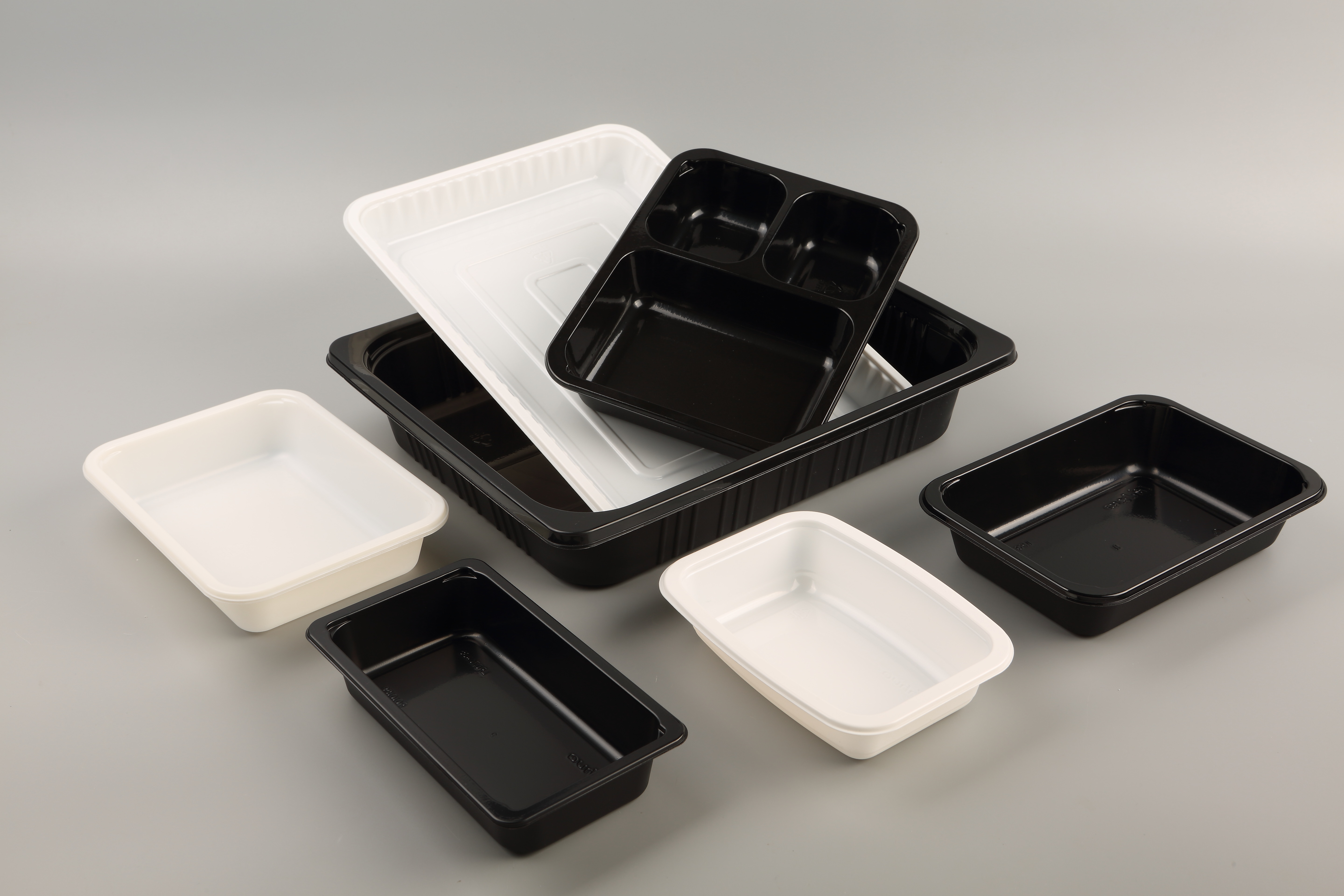
CPET food packaging containers: rigid, heat-resistant trays used for ready meals and prepared foods.
What CPET Food Packaging Containers Are
Definition: CPET (Crystallized Polyethylene Terephthalate) is a crystallized form of PET used for food trays where higher temperature resistance is required, typically ready meals and prepared foods. A CPET tray is a rigid, single-piece container, normally with a flanged rim for lidding-film sealing, produced in single-compartment, 2-compartment and 3-compartment layouts.
Three properties define a CPET tray in practice:
- Structure. The crystallized material gives the tray enough rigidity to be filled, sealed, stacked, transported and handled without collapsing under the weight of a filled meal.
- Thermal capability. CPET is selected where a meal moves from chilled or frozen storage into reheating. The usable temperature range, heating time and heating method depend on the specific model and material specification, so they must be confirmed rather than assumed.
- Meal architecture. Compartment layouts keep a main dish, side dish and sauce separated for cleaner presentation and simpler meal assembly.
CPET also carries a limitation worth stating plainly: it is not the right material for every food package. Fresh steaks, whole fish, and cold-display produce are usually better served by PET, PP or overwrap formats. CPET earns its place when the package has to survive a heating step.
The Problem CPET Solves: Four Demands at Once
Ready meal packaging is difficult because four requirements land on the same tray at the same time, and optimizing one usually damages another.
- Mechanical performance. The tray must take a filled weight, seal flat, stack in a case and survive cold-chain handling.
- Thermal performance. It must tolerate chilled or frozen storage and then the reheating method the brand instructs.
- Presentation and separation. Retail shelves reward clean product visibility, neat portioning and sauces that stay where they belong.
- Compliance. The material and the finished article must satisfy the food-contact rules of the destination market.
Most packaging failures in this category are not material failures. They are specification failures: a tray chosen for its capacity but not for its sealing film, a compartment layout that does not match the filling line, or a supplier asked for a price before the reheating conditions were defined. The sections below work through those decisions in order.
Industry Background: Where CPET Fits in Plastic Food Packaging
Plastic is the most common material type used in food packaging, and food packaging itself is essential for transporting, storing, handling and preserving food, according to industry-backed educational material published by the Plastics Europe ecosystem. Commercial research published by Grand View Research valued the global food containers market at USD 331.7 billion in 2024, which indicates the scale of the category rather than the size of the CPET segment specifically.
Within that broad market, chilled ready meals, supermarket deli and prepared-food programmes, and foodservice catering have pushed demand toward trays that can be sealed, presented and reheated. CPET sits at that intersection: a rigid tray format that supports sealing, multi-compartment meal design and in-container reheating where the specification allows it.
Compliance now shapes the buying decision
Food-contact regulation has moved from a documentation formality to a qualification gate.
- In the European Union, Commission Regulation (EU) No 10/2011 establishes specific requirements for plastic materials and articles intended to come into contact with food, and states that these materials must not release substances above applicable specific migration limits. The regulation also covers specified plastic multilayer materials, printed or coated articles, and plastic layers or coatings used in closures.
- The EU Packaging and Packaging Waste Regulation (EU) 2025/40 applies from 12 August 2026 and includes restrictions on PFAS in food-contact packaging, according to the European Commission.
- In the United States, the FDA framework defines a food contact substance as including food packaging and its components, processing equipment, food preparation surfaces, or cookware.
For a buyer, the practical consequence is simple: the tray, the colour, the multilayer structure and the lidding film together form the article that must be documented. A generic compliance statement for a product family is weaker evidence than a declaration covering the exact SKU being purchased.
CPET Compared with Other Tray Materials
The material question is not which polymer is best in general, but which one matches the food, the storage condition, the packaging method and the heating instruction. The comparison below reflects the material guidance used in Linhua's own product selection process.
| Material | Typical role | Where it fits | What to confirm |
|---|---|---|---|
| CPET | Heat-resistant rigid tray | Ready meals, prepared foods and catering meals that require higher temperature resistance | Usable temperature limits, heating method and time, lidding-film compatibility for the selected model |
| PET | Clear presentation tray | Fresh meat, seafood, fruit and overwrap packaging where product visibility matters | Whether heating is involved; overwrap film and machine settings |
| PP | General food tray and barrier base | Many chilled-food trays, deli containers, and MAP or VSP structures when barrier layers are incorporated | Barrier requirement, sealing layer and film match |
| EVOH / PE multilayer | Functional barrier layer | Structures where additional gas-barrier or sealing performance is required | Full structure documentation and applicable food-contact evidence |
EVOH is used as a functional barrier layer inside multilayer structures rather than as a standalone tray material. The commercial research publisher Market Research Future projects the global EVOH packaging market to grow from USD 1.847 billion in 2025 to USD 3.055 billion by 2035, which reflects general interest in barrier packaging rather than CPET specifically.
The LINHUA CPET Tray Range
LINHUA's CPET ready meal tray range includes more than 30 standard models covering single-compartment, 2-compartment and 3-compartment formats. Sizes run from compact individual portions to a 2,600 ml meal tray, and selected formats are available in black or natural/white. The material is CPET (Crystallized Polyethylene Terephthalate), and the stated unit weight tolerance is ±5% for reference.
Compartment trays are the format most ready-meal manufacturers ask about first, because separating a main dish, side and sauce reduces assembly time and produces a cleaner retail pack. Black formats are used where a brand wants visual contrast against pale foods; natural/white formats suit lighter meal components.
Selected standard models
The table below lists a subset of the range to show how footprint, depth and compartment count vary. It is not the full model list, and the dimensions shown belong to those specific models only.
| Model | Dimensions (L × W × H) | Capacity | Unit weight | Layout |
|---|---|---|---|---|
| LP5435 | 123 × 100 × 35 mm | — | 10 g | Single compartment |
| LP7335 | 185 × 85 × 35 mm | — | 12 g | Single compartment |
| LP8535 | 201 × 136 × 35.5 mm | — | 18 g | Single compartment |
| LP9650 | 216 × 165 × 47.5 mm | — | 34 g | Single compartment |
| LP9745 | 227 × 178 × 44 mm | 1,000 ml | 32 g | 3 compartments |
| LP121050 | 316 × 262 × 50 mm | 2,600 ml | 80 g | Single compartment |
| LP1209 | 320 × 224 × 31.8 mm | — | 67 g | Single compartment |
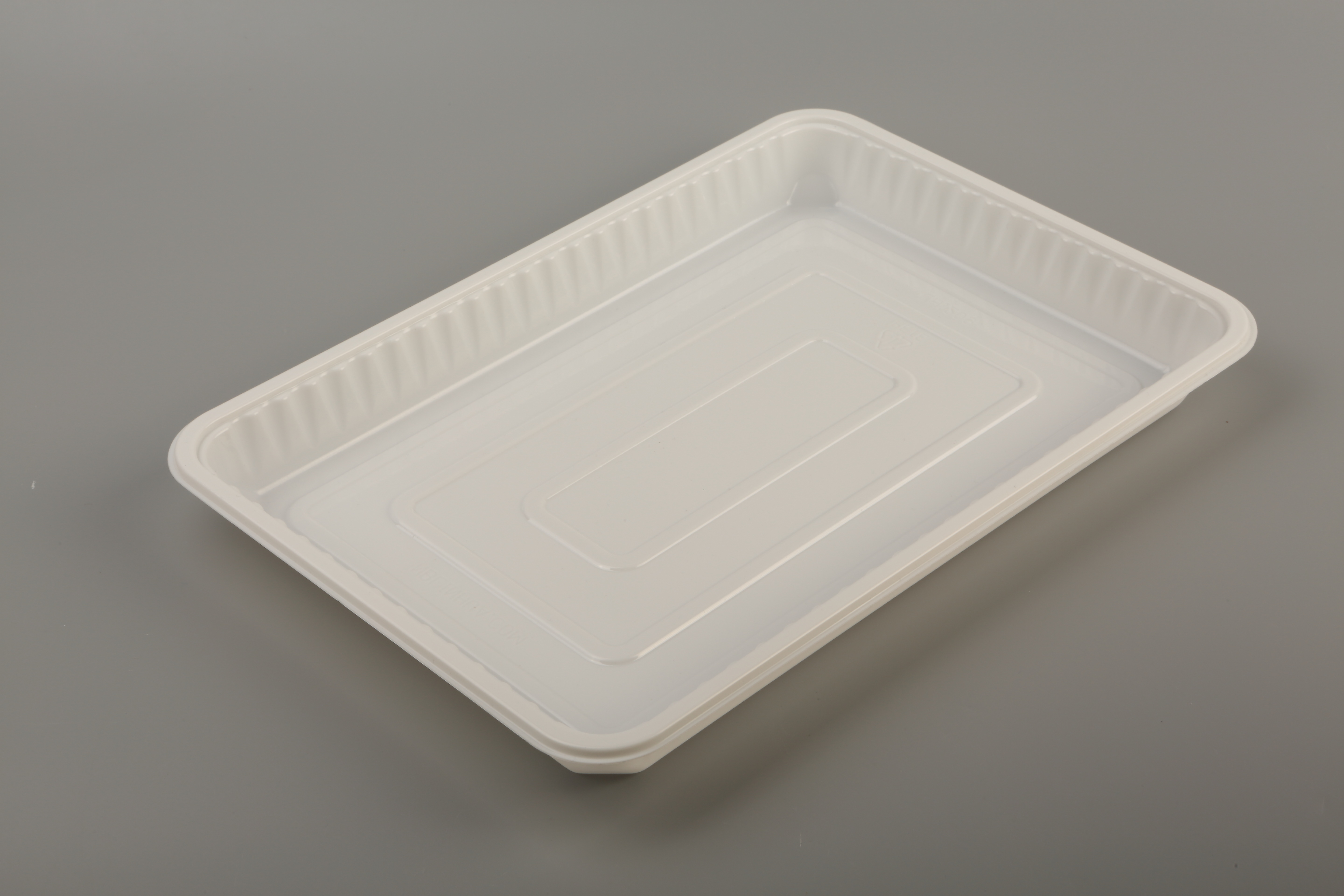
CPET tray model LP1209 (320 × 224 mm) — a large-format option in the CPET ready meal range.
Two practical points follow from the range structure. First, the tray is only half of the packaging system: the lidding film, the seal geometry and the sealing machine determine whether a filled tray performs in production. Second, because the range is model-driven, the fastest route to a correct answer is usually to identify the closest existing model rather than to start from a custom drawing.
Step-by-Step: How to Specify a CPET Tray
Step 1 — Define the meal, not just the tray
Start with the food: components, portion weights, sauce or gravy content, and whether the meal is assembled cold or filled hot. Component weight drives the required base strength and depth far more reliably than a nominal capacity figure.
Step 2 — Confirm the storage and reheating route
State whether the product is chilled, frozen or ambient, and exactly how the consumer will reheat it. CPET trays support reheating where the selected model and confirmed material specification allow it; temperature limits and heating conditions are model-specific and should be confirmed in writing before a meal programme is designed around them.
Step 3 — Choose the compartment layout
Single-compartment trays suit one-dish meals and large catering portions. Two- and three-compartment formats suit main-plus-side or main-plus-side-plus-sauce meals. The layout should match both the filling line sequence and the visual hierarchy you want on shelf.
Step 4 — Match the lidding film and sealing equipment
Sealing compatibility depends on more than tray dimensions. Tray size, sealing area, mould or tooling, the lidding film, product height and machine settings all affect the result. Send the machine model, mould dimensions and film specification so compatibility can be assessed, and confirm the final combination through actual sealing trials.
Step 5 — Confirm food-contact compliance for the destination market
Requirements differ between the EU, the US and other markets, and they attach to the finished article, not to a material name. Request documentation that covers the exact model, colour and structure you intend to buy.
Step 6 — Validate with samples
Sample approval is the point where dimensional fit, compartment capacity, seal quality and post-reheating appearance are checked together. For customized projects this step precedes production approval.
Step 7 — Approve specification, then schedule production
Mass production follows final specification, sample approval and commercial terms. Where a tray is well matched to an existing model, the path is shorter; where a new mould is needed, development and sampling time must be added to the schedule.
Use Cases for CPET Food Packaging Containers
Ready meal manufacturing
This is the core application. Multi-compartment CPET trays let a producer assemble a complete meal in one container, seal it, and send it through chilled or frozen distribution to retail. The 2,600 ml format covers larger portions and family-size meals.
Supermarket and retail food packaging
Retail programmes use CPET for prepared meals and deli-adjacent hot foods where the pack must present cleanly and survive a reheating instruction. Linhua's CPET trays are listed for supermarket retail food packaging and catering applications.
Catering and airline catering
Catering operations need consistent portion formats that stack predictably and reheat on site. Standardized CPET models reduce variation between production batches.
Institutional foodservice and meal delivery
Care homes, hospitals, canteens and meal-kit or delivery operators use sealed CPET trays where food is plated at a central kitchen and reheated at the point of service.
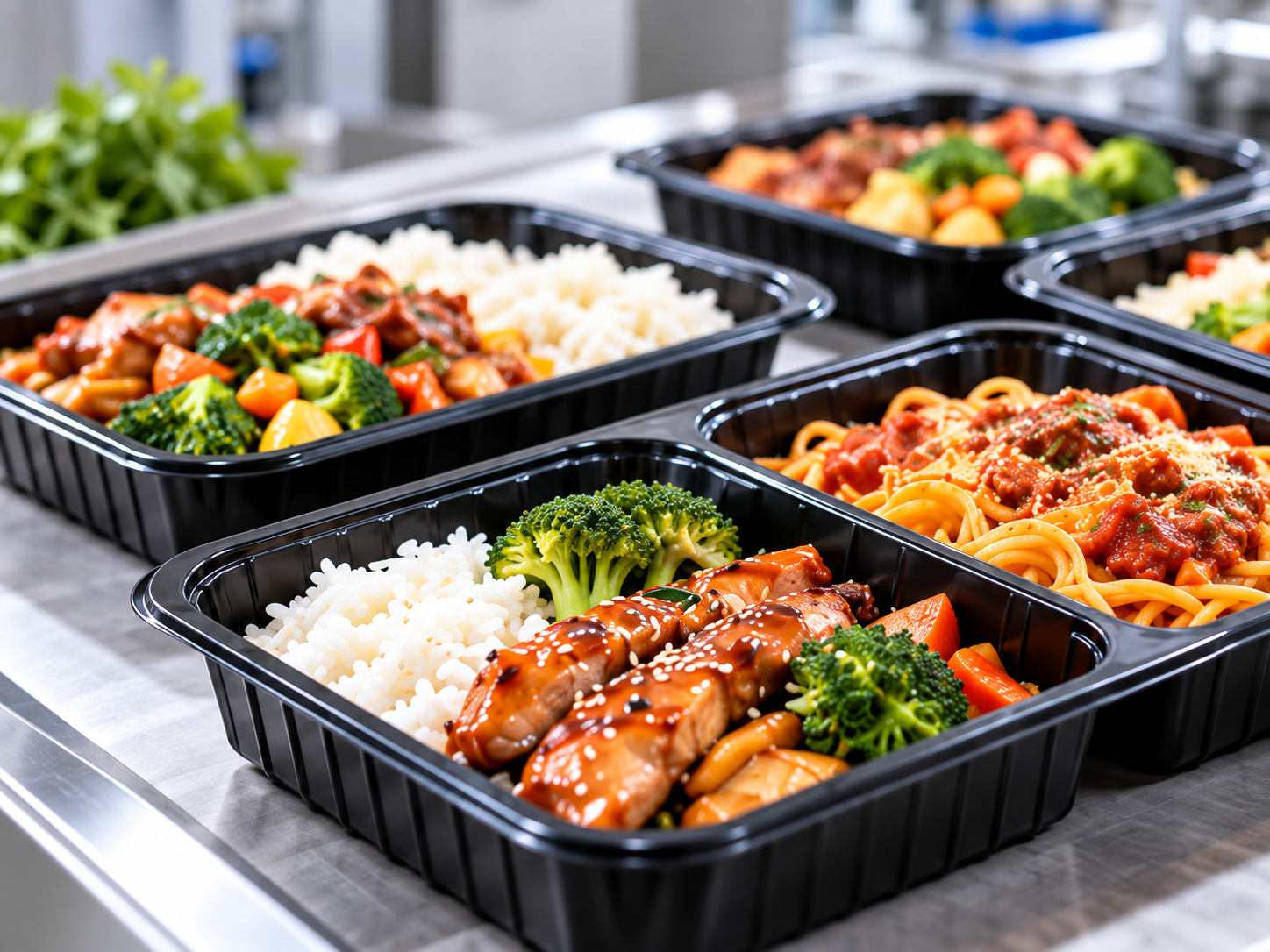
CPET ready meal tray in a prepared-food application: sealed, stacked, displayed and reheated in the same container.
CPET Compared with Other Formats in the Same Portfolio
Buyers rarely choose CPET in isolation. The decision is usually CPET versus a barrier MAP tray, a VSP tray, an overwrap tray, or a moisture retention tray — each solving a different problem.
| Format | Material | Packaging method | Typical food | Buyer consideration |
|---|---|---|---|---|
| CPET ready meal tray | CPET | Fill and seal for ready-meal storage and reheating within specified temperature limits | Ready meals, prepared foods, catering meals | Confirm heating limits and film compatibility per model |
| MAP barrier tray | PP with EVOH / multilayer barrier structure | Gas flush and heat seal with lidding film | Fresh meat, poultry, seafood, chilled prepared foods | Gas mix, film and seal integrity all affect shelf life; no tray alone guarantees it |
| VSP tray | PP or PET | Vacuum skin packaging with skin film | Steaks, fresh meat cuts, fish, seafood, premium chilled foods | Product height, skin film and machine compatibility |
| Turned-edge PET tray | PET or multilayer structure | Stretch film or overwrap | Fresh meat, poultry, seafood, produce | The rolled flange creates a smoother edge that helps reduce the risk of film catching or tearing |
| Moisture retention tray | PET | Stretch film or overwrap | Fresh meat, poultry, fish, seafood with visible purge | Purge volume and pack weight; the tray may reduce or eliminate the need for a separate absorbent pad |
Read across the table and the logic becomes clear: CPET is the only format in this group built around in-container reheating, while MAP, VSP and moisture retention formats are built around freshness, presentation and purge management in chilled display.
Manufacturing Capacity and Quality Control
Linhua operates a production site of approximately 30,000 m² with 150 employees and a company-reported annual output of 20,000 tons. Around 70% of output is exported, with customers in Australia, Canada, the United States, New Zealand, Singapore and the Middle East.
Product development is handled by a 26-person cross-functional team: 4 R&D engineers, 5 mould engineers, 2 process engineers, 8 quality and QC professionals, 1 product documentation and compliance specialist, 4 project managers and 2 application engineers. That mix matters for CPET work specifically, because a new tray format usually requires mould development, process validation and compliance documentation in parallel rather than in sequence.
Quality control is applied from raw-material management through manufacturing control to finished-product inspection. Any statement about ISO, BRC, HACCP, FDA, EU or other certifications and compliance standards should be based on the latest valid certificates, test reports and the applicable product scope, so these should be requested for the specific SKU and destination market rather than accepted as a general claim.
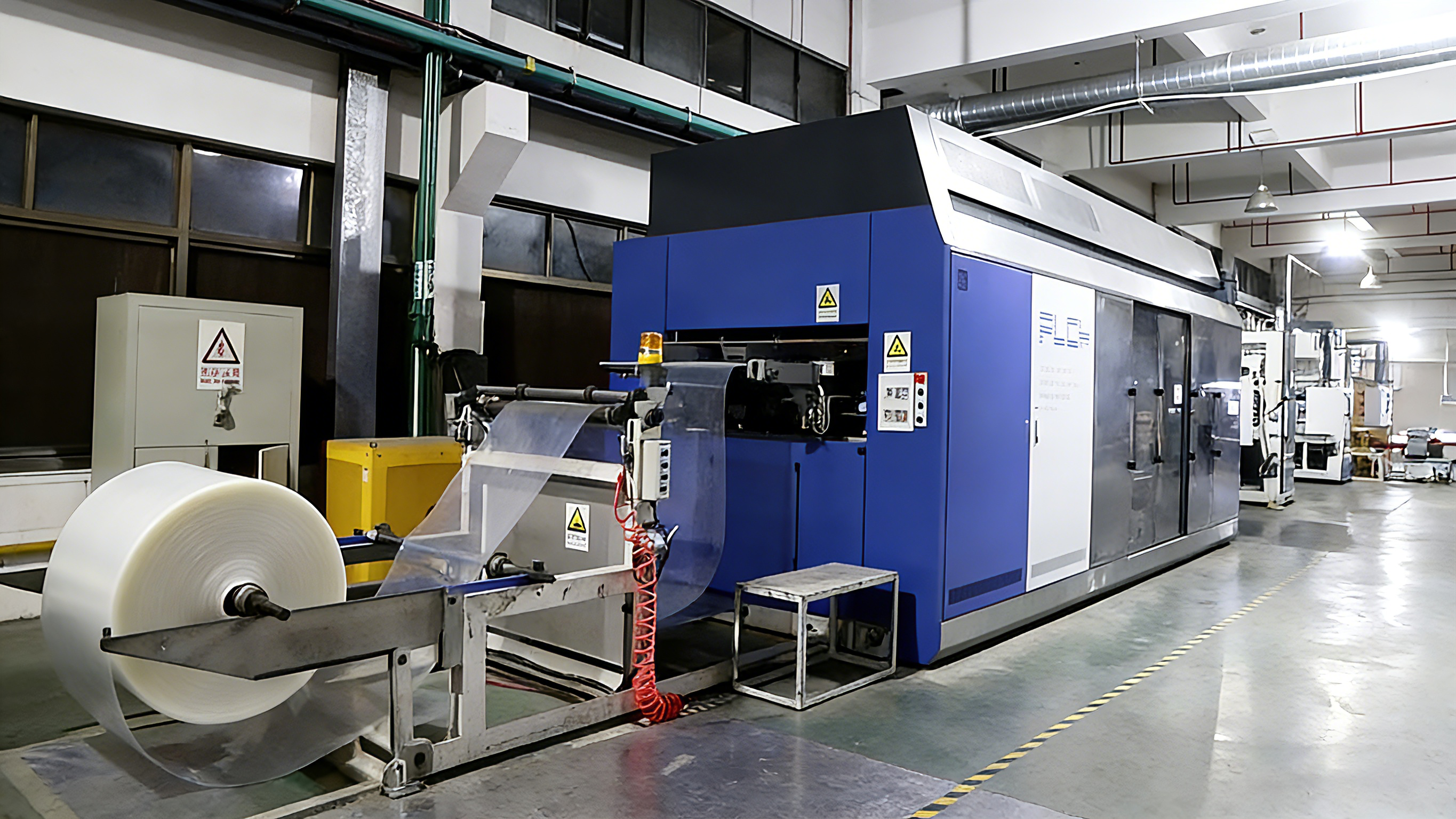
Thermoforming production at the Linhua factory in Fenghua, Ningbo — where rigid plastic food packaging containers are formed.
Frequently Asked Questions
What food-contact compliance should I confirm before ordering CPET food packaging containers?
Compliance requirements depend on the destination market and the finished article. For the EU, Commission Regulation (EU) No 10/2011 sets requirements for plastic food-contact materials and articles, including that substances must not be released above applicable specific migration limits, and the PPWR (EU) 2025/40 adds restrictions on PFAS in food-contact packaging applicable from 12 August 2026. In the US, the FDA framework treats food packaging and its components as food contact substances. Because CPET trays, colours, multilayer structures and lidding films form part of the documented article, request the declaration of compliance, test reports and product scope that match the exact model and market — not a generic statement for the product family.
Can Linhua produce CPET trays in custom sizes and compartment layouts?
Yes. The process starts by checking whether one of the 30+ standard CPET models already fits the meal, which is usually the fastest and most economical route. If not, customization can cover tray dimensions, depth, shape, colour, material structure, compartment layout and other functional features, and a new mould can be developed where no existing tooling matches. Custom projects normally begin with application and specification confirmation, then move through design, mould development and sampling, with sample approval before mass production. Linhua's development team includes 5 mould engineers and 2 process engineers to support this work.
What determines the price and minimum order quantity of a CPET tray order?
There is no single price or MOQ for CPET trays. Cost drivers include tray size and unit weight, material grade, colour (black or natural/white), compartment layout, order quantity, and whether new tooling is required. MOQ depends on the product, material, colour, specification and mould status, so standard and customized items can carry different minimums. Trial-order feasibility depends on the product and existing tooling. A firm quotation is prepared once the key product and application details are confirmed; for technical projects, compatibility checks may be needed before pricing. Plastic packaging costs are also linked to polymer feedstock prices, which fluctuate with input costs, so pricing terms are worth revisiting periodically on repeat programmes.
Can I get a sample before placing an order?
Yes. Once your requirements are clear and a suitable existing product is confirmed, samples are provided free of charge and the customer covers the courier cost. Please send the required tray type or dimensions, the food application and the expected quantity. For sealed applications, machine, mould, film, storage temperature and target shelf life information may also be needed to check compatibility. If none of the existing trays fits, a customized tray and new mould can be evaluated, and custom sampling is arranged after the design and mould-development requirements are confirmed.
What is the typical lead time, and what information do I need to provide to start?
Lead time depends on the product specification, material, colour, quantity, mould status and current production schedule, and is normally 4–6 weeks. New mould projects require additional development and sampling time, which should be planned into the launch schedule. To begin, send the tray type or dimensions, the food application and the required quantity, plus any colour or customization requirements. For sealed or barrier applications, include the packaging machine, sealing mould or tooling, lidding film specification, storage temperature and target shelf life. The full Linhua catalogue can be downloaded here: Linhua E-catalogue 2025, and technical enquiries can be sent to Freya@nblinhua.com.
Conclusion: Choosing CPET on the Basis of the Meal, Not the Material Name
CPET food packaging containers solve a specific problem: a sealed meal that must hold its shape through chilled or frozen distribution and then be reheated in the container the consumer bought. That makes CPET a strong fit for ready meals, prepared foods, supermarket hot-food programmes and catering — and a poor fit for cold-display fresh meat, seafood or produce, where PET, PP and overwrap formats do the job better.
The practical checklist is short. Define the meal and its component weights, confirm the storage and reheating route in writing, choose the compartment layout against the filling line, match the lidding film and sealing equipment, secure compliance documentation for the exact SKU and destination market, validate with samples, and only then plan production.
For buyers still comparing formats, the useful question is not which plastic food packaging container is best in general, but which format matches the food, the cold chain and the reheating instruction. Once that is settled, model selection and sampling are usually straightforward.
Next Step: Sample or Quotation for CPET Trays
Ningbo Linhua Plastic Co., Ltd. supplies CPET ready meal trays, MAP and VSP trays, PET turned-edge trays, moisture retention trays and hinged containers to food manufacturers, processors and packaging distributors in Australia, Canada, the US, New Zealand, Singapore and the Middle East.
Send your tray dimensions, meal type, reheating method and expected quantity to receive a model recommendation or a quotation. Samples of suitable existing models are free of charge; the customer covers courier cost.
Website: www.nblinhua.com | Email: Freya@nblinhua.com | Tel: +86 574-8773-9122 | WhatsApp: +852 5731 8298
Address: No. 13, Dongfan Road, Xiwu, Fenghua, Ningbo, Zhejiang 315500, China
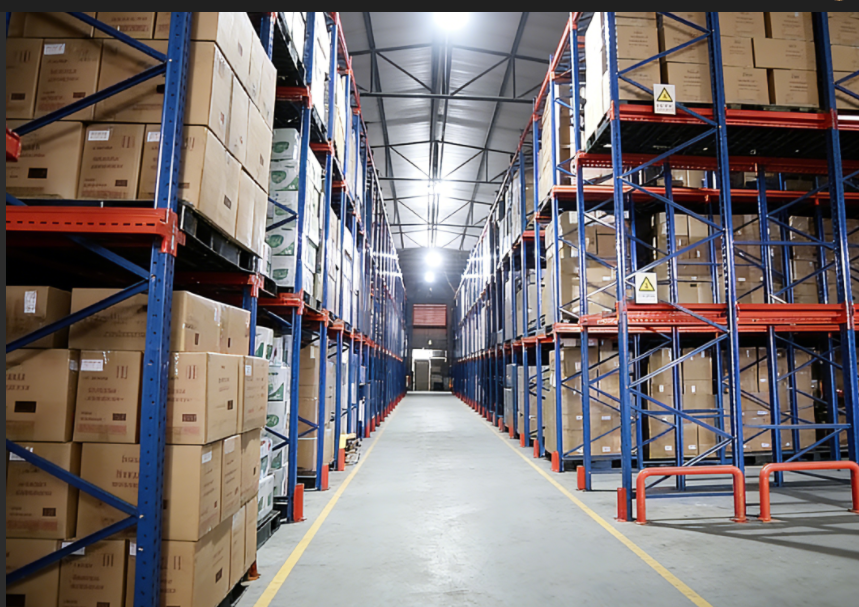
Warehouse stock at Linhua, supporting repeat supply of standard CPET and other rigid food packaging trays.
Have Questions or Need More Details?
Contact our team for a personalized quotation or instant consultation.
Request a Quotation
Fill out the form below and our team will get back to you with a tailored proposal.
WhatsApp Direct Chat
Prefer to chat in real-time? Message us on WhatsApp for instant assistance & quick answers.
- Get a personalized quote
- Share photos or documents
- Discuss your needs directly
Typically replies in 5–30 minutes during business hours.