
MAP Food Packaging Containers: A Buyer's Guide
MAP food packaging containers are rigid plastic trays built to be gas-flushed and heat-sealed with a lidding film, so the atmosphere inside the pack can be controlled for chilled food. This guide explains how the container works, which formats exist, how to specify one against your machine and film, and where the real limits sit — using verified product data from Ningbo Linhua Plastic Co., Ltd., a food packaging manufacturer established in 2004 and based in Ningbo, Zhejiang, China.
What Are MAP Food Packaging Containers?
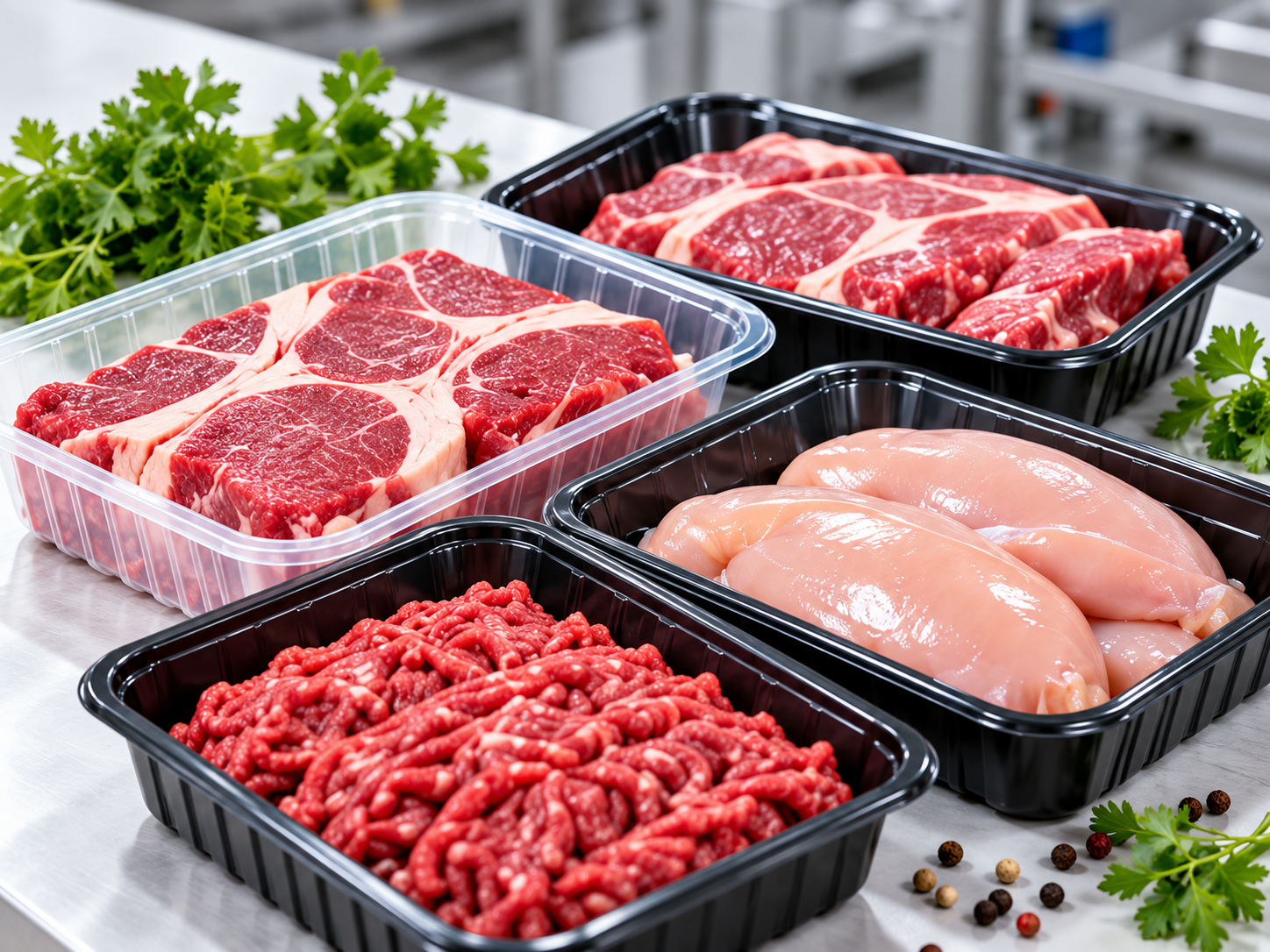
Modified Atmosphere Packaging (MAP) replaces or adjusts the normal air inside a sealed food package with a controlled gas mixture selected for the food. A high-barrier tray and a compatible lidding film help keep that atmosphere inside the pack. Together with good sealing and temperature control, this can help maintain product quality and support the required shelf life.
In practice, the container is not a passive box. It is one part of a four-part system: the tray body and its barrier structure, the sealing flange, the lidding film, and the packaging machine that flushes gas and applies heat and pressure. A tray that performs well in one system may fail in another if the flange geometry, film or machine settings do not match.
Why Chilled Food Packaging Fails Without Atmosphere Control
Chilled food deteriorates through several routes at once: oxygen-driven colour and flavour change, moisture loss, microbial growth, and physical damage during handling. Packaging that only covers the product does not address the atmosphere inside the pack. Buyers typically run into five problems.
- Colour and appearance change before the product is unsafe. Retail meat and poultry are judged visually, so presentation loss is a commercial loss even when the food is still saleable.
- Gas exchange through the pack. If the tray and film do not limit unwanted gas movement, the intended atmosphere drifts during storage and display.
- Seal failure. Leaks at the flange destroy the internal atmosphere and are usually discovered late — at the retailer, not the packer.
- Purge and visible liquid. Fresh meat and poultry release liquid during chilled storage, which collects in the pack and reduces perceived quality.
- Documentation gaps. A technically sound container that cannot be supported with the right food-contact documentation creates market-access risk for the buyer.
MAP addresses the first two directly. The third depends on tooling and process control. The fourth may require a different tray design, such as a moisture retention tray. The fifth is a supplier-qualification question rather than a packaging-performance question.
What Is Changing in the Plastic Food Packaging Container Market
Two forces shape current buying decisions: steady volume growth in food containers, and tightening chemical-safety rules in major markets.
Grand View Research valued the global food containers market at USD 331.7 billion in 2024 (source: Grand View Research, Food Containers Market Size & Share Report, 2025–2030). Within the barrier segment, Market Research Future projects the global EVOH packaging market to grow from USD 1.847 billion in 2025 to USD 3.055 billion by 2035, at a CAGR of 5.16% (source: Market Research Future, EVOH Packaging Market report). EVOH is relevant to MAP because it can be used as a functional barrier layer in multilayer packaging structures where improved gas-barrier performance is required.
On the regulatory side, three frameworks matter for plastic food packaging containers:
- EU: Commission Regulation (EU) No 10/2011 establishes specific requirements for the manufacture and marketing of plastic materials and articles intended to come into contact with food. It covers materials consisting exclusively of plastics as well as specified plastic multilayer materials, printed or coated articles, and plastic layers or coatings used in closures. It also requires that plastic materials and articles do not release substances above the applicable specific migration limits.
- EU packaging waste: the Packaging and Packaging Waste Regulation (EU) 2025/40 has applied since 12 August 2026 and includes restrictions on PFAS in food-contact packaging (source: European Commission).
- United States: under the U.S. FDA framework, a food contact substance (FCS) includes food packaging and its components, processing equipment, food preparation surfaces, and cookware.
For buyers, the practical consequence is that a MAP container must be evaluated on two tracks at once: packaging performance and documented food-contact compliance for the destination market. Any claim about ISO, BRC, HACCP, FDA, EU or other certifications and compliance standards should be based on the supplier's latest valid certificates, test reports and applicable product scope.
How a MAP Container Is Built
A MAP tray is defined by five elements. Each one changes what the container can do.
1. Tray body and barrier structure
The body provides mechanical strength and product containment. In the Linhua MAP range, the main material is PP, with a high-barrier PP-based structure and a barrier layer based on EVOH or another multilayer structure. The barrier layer is what limits unwanted gas exchange; the structural layer is what keeps the tray rigid through packing, stacking and display.
2. Flange and seal area
The flange is where the lidding film bonds to the tray. Seal width, flatness and consistency determine whether the pack holds its atmosphere. This is why tray dimensions alone are never enough to confirm compatibility with an existing sealing mould.
3. Footprint and depth
Depth is set by product height and by the gas headspace the application needs. Linhua's MAP tray range covers footprints from 187 × 137 mm up to 320 × 248 mm and depths from 18 mm to 110 mm, across formats including standard rectangular trays, round bowls, divided trays and deep containers. Selected examples: LP090540 at 222 × 132 × 40 mm, LP090790 at 218 × 167 × 90 mm, LP110760 at 270 × 169 × 60 mm, and LH1107110 at 280 × 175 × 110 mm.
4. Lidding film
The film is chosen for the food, the machine and the target shelf life. The tray and film are a pair; a film change can require a seal-parameter change even when the tray stays the same.
5. Packaging machine and tooling
Gas flushing, vacuum, sealing temperature, pressure and dwell time all sit with the machine. MAP compatibility therefore depends on tray size, sealing mould or tooling, packaging machine, lidding film, food application and operating conditions — not on tray dimensions alone.
Step-by-Step: How to Specify a MAP Container
Most MAP projects that stall do so because the specification conversation started with a tray size instead of an application. The sequence below keeps the technical decisions in the right order.
- Define the food and its condition. Fresh red meat, poultry, fish, seafood and chilled prepared foods behave differently in pack. Fat content, cut geometry, surface moisture and initial temperature all matter.
- Set the storage and distribution profile. Chilled storage temperature, cold-chain duration and retail display conditions determine how much barrier performance the application actually needs.
- Set the target shelf life — and agree how it will be validated. Shelf life is a system result, not a tray property. Food condition, film, gas mixture, seal integrity, hygiene and storage temperature all affect the final result, and no tray alone can guarantee it.
- Choose the packaging method. MAP, vacuum skin packaging, overwrap or a ready-meal format each solve a different problem. See the comparison table below.
- Select the material structure. PP with an EVOH or multilayer barrier is the base for most MAP applications. The final structure should be confirmed against barrier, sealing and storage requirements.
- Fix the footprint, depth and any compartment layout. Match the tray to the portion, not the other way round. Divided formats help keep components separate.
- Confirm machine, mould and film compatibility. Send the machine model, mould dimensions, film specification and product height. Compatibility should be confirmed through actual sealing trials before mass production.
- Confirm food-contact documentation for the destination market. State the market and the standard you need so the applicable material, testing or documentation can be checked before confirmation.
Where MAP Containers Fit: Application Guide
The same tray platform serves several chilled categories, but the selection criteria shift by application.
Fresh red meat and poultry
Beef, pork, lamb and poultry are the core MAP applications. Colour stability and pack appearance drive the choice, and divided or deep formats are used where cuts and portions need separation or headspace. Where visible purge is the main problem, a moisture retention tray may be the more appropriate platform.
Fish and seafood
Fish and seafood are typically packed chilled with attention to product geometry and drainage. Tray depth and footprint are chosen to hold the fillet or whole fish without compressing it, and the film and seal are matched to the machine.
Chilled prepared foods
Chilled prepared foods use MAP where a controlled atmosphere supports quality through the distribution window. Where the product also needs reheating, the material choice moves toward CPET, which is used for ready meals and prepared foods where higher temperature resistance is required. Exact temperature limits, sealing-film compatibility and heating conditions should be confirmed according to the selected model and application.
Supermarket and retail packing
For in-store and central packing operations, tray range breadth matters as much as barrier performance: a single supplier that covers multiple footprints and depths reduces changeover friction across a retail programme.
Linhua's MAP barrier trays are specified for fresh meat, beef, pork, lamb, poultry, fish, seafood, chilled prepared foods, food processing and supermarket retail packaging.
Comparison: MAP vs VSP vs Overwrap vs CPET
These four formats are often discussed as alternatives, but they solve different problems. The table below uses manufacturer-published product facts only.
| Format | Typical material | Packaging method | Typical food | Primary selection driver |
|---|---|---|---|---|
| MAP barrier tray | PP with EVOH / multilayer barrier structure | Gas flush and heat seal with lidding film | Fresh meat, poultry, fish, seafood, chilled prepared foods | Controlled atmosphere and shelf-life management |
| VSP tray | PP or PET | Vacuum skin packaging with skin film | Steaks, premium cuts, fish fillets, seafood | Close product presentation and secure positioning |
| Turned-edge PET tray | PET or multilayer structure | Stretch film / overwrap | Fresh meat, poultry, fish, seafood, fresh produce | Simple wrapping and compatibility with supermarket overwrap lines |
| Moisture retention tray | PET | Stretch film / overwrap | Fresh meat, poultry, fish, seafood | Purge and moisture management; may reduce or eliminate a separate absorbent pad |
| CPET ready meal tray | CPET | Fill and seal | Ready meals and prepared foods | Higher temperature resistance for reheating applications |
Two clarifications matter here. First, overwrap and moisture retention trays are not MAP: they do not create a modified atmosphere, and the moisture retention tray is a PET turned-edge platform with liquid-retention cells integrated into the base. Second, VSP is not a substitute for MAP where a specific gas mixture is the requirement — VSP removes air and forms the film around the product, producing a different presentation and a different performance profile.
Selected MAP Tray Formats
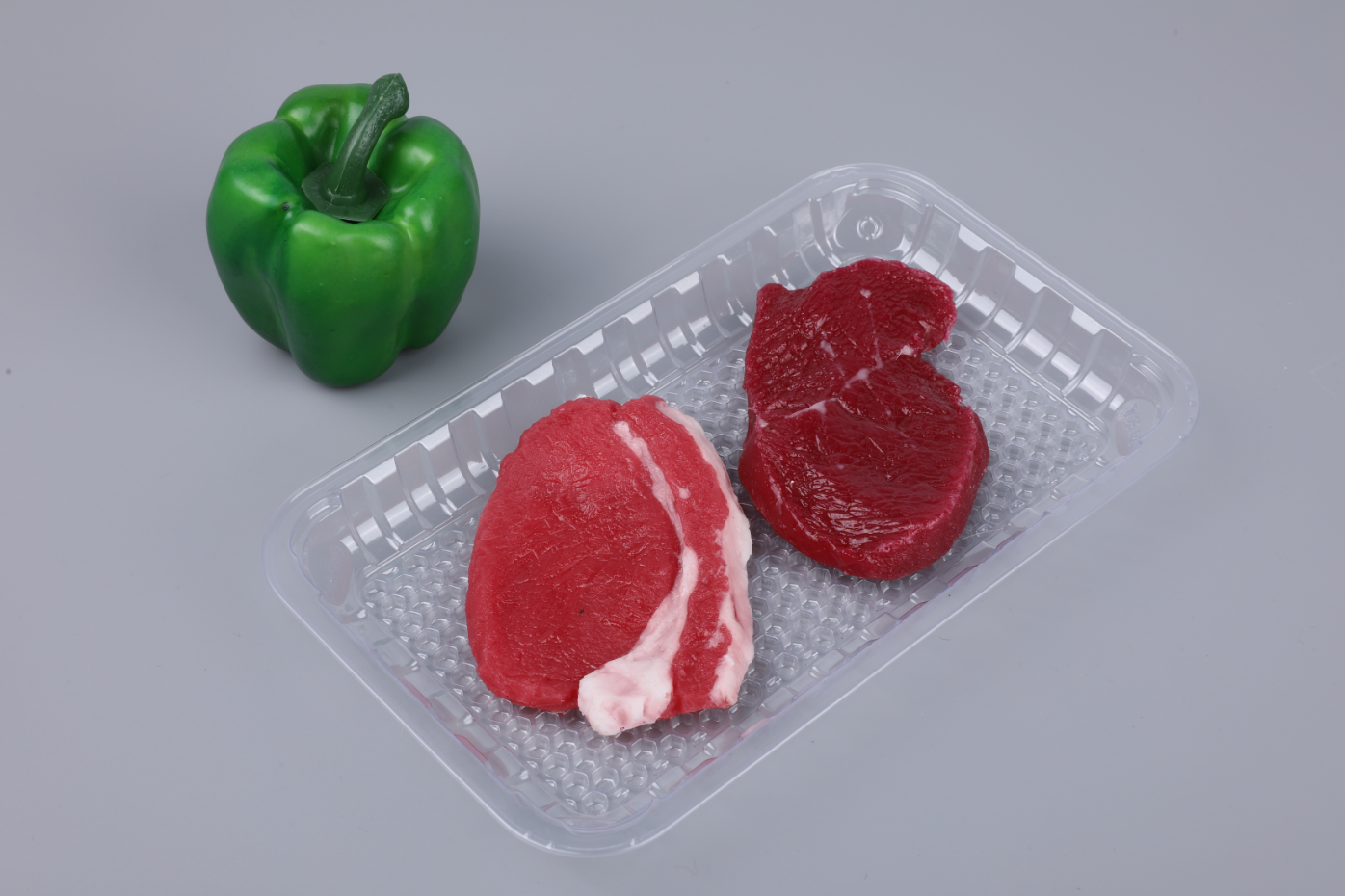
The Linhua MAP barrier tray range is a dimensional platform rather than a single product. A representative selection is shown below; all dimensions are length × width × height in millimetres and all listed models are PP.
| Model | Dimensions (mm) | Format note | Typical fit |
|---|---|---|---|
| LP100718 | 250 × 184 × 18 | Shallow tray | Thin cuts and low-profile portions |
| LP090540 | 222 × 132 × 40 | Standard rectangular | Standard retail meat packs |
| LP090560 | 226 × 134 × 50 | Standard rectangular | Thicker cuts |
| LP090730-A | 220 × 168 × 30 | Rectangular | Single-portion packs |
| LP090750 | 220 × 166 × 50 | Rectangular | Standard to large portions |
| LP090790 | 218 × 167 × 90 | Deep tray | Tall products and larger headspace |
| LP110760 | 270 × 169 × 60 | Large rectangular | Family-size and multi-piece packs |
| LP110950 | 298 × 232 × 50 | Large-format tray | High-volume retail programmes |
| LP121050 | 315 × 260.5 × 50 | Large-format tray | Large packs and shared formats |
| LH1107110 | 280 × 175 × 110 | Extra-deep container | High-profile products |
The range also includes divided formats and round bowls for applications where components must be kept apart or where a different shelf presentation is needed. Because tray selection also depends on machine, mould and film, two trays with similar footprints can behave differently on the same line.
Limits: What MAP Packaging Cannot Do
An honest specification includes the boundaries. Four are worth stating plainly.
- A tray cannot guarantee shelf life on its own. Food condition, film, gas mixture, seal integrity, hygiene and storage temperature all affect the result. Shelf-life claims should be validated under actual packing and storage conditions.
- Barrier performance is a system property. A high-barrier tray paired with an incompatible film or a poor seal delivers neither barrier nor shelf life.
- Compatibility cannot be confirmed from a drawing. Machine, mould, film and product height all interact. Final compatibility should be confirmed through actual sealing trials.
- Recycling and compliance claims need documentation. Regulatory positions differ by market and product scope. Statements about food-contact compliance, barrier or temperature resistance should be confirmed against the latest valid certificates, test reports and the applicable product scope.
For MAP and VSP projects, the information needed for a compatibility evaluation is: food type, tray dimensions, packaging machine, sealing or skin film specification, storage temperature and target shelf life.
Frequently Asked Questions
What food-contact compliance should I verify before buying plastic food packaging containers?
Verification depends on the destination market. In the EU, Commission Regulation (EU) No 10/2011 sets requirements for plastic materials and articles intended to come into contact with food, including specified multilayer, printed and coated structures, and requires that substances are not released above applicable specific migration limits. The Packaging and Packaging Waste Regulation (EU) 2025/40 has applied since 12 August 2026 and includes restrictions on PFAS in food-contact packaging. In the United States, the FDA framework treats food packaging and its components as food contact substances. Ask the supplier for the latest valid certificates, declarations and test reports covering the exact product and market — not a general company statement.
How do I know whether a MAP tray will work with my packaging machine?
MAP compatibility depends on more than tray dimensions. Suppliers normally check the tray size, sealing mould or tooling, packaging machine, lidding film, food application and operating conditions. If you already have a production line, send the machine model, mould dimensions and film information so compatibility can be evaluated accurately. Final compatibility should still be confirmed through actual sealing trials.
What information is needed to get an accurate quotation — and what drives cost?
For a faster and more accurate quotation, provide the product or tray type (or a photo/sample), the required tray size as length × width × depth, the food application, the required quantity or estimated annual demand, and any colour or special requirements. For MAP or VSP projects, add the packaging machine model, sealing mould details, lidding or skin film specification, storage temperature and required shelf life. Material, structure, colour, quantity and whether new tooling is needed all affect the commercial terms; MOQ depends on the product, material, colour and specification.
Can I get samples before committing to production?
Yes. Once requirements are clear and a suitable existing product is confirmed, samples can be provided free of charge; the customer covers the shipping cost. If the project requires a new mould or customized product development, sample arrangements are discussed separately after design and mould requirements are confirmed. For customized projects, sample evaluation is an important step before final production approval.
What is the typical lead time, and how do I evaluate China plastic food packaging container manufacturers?
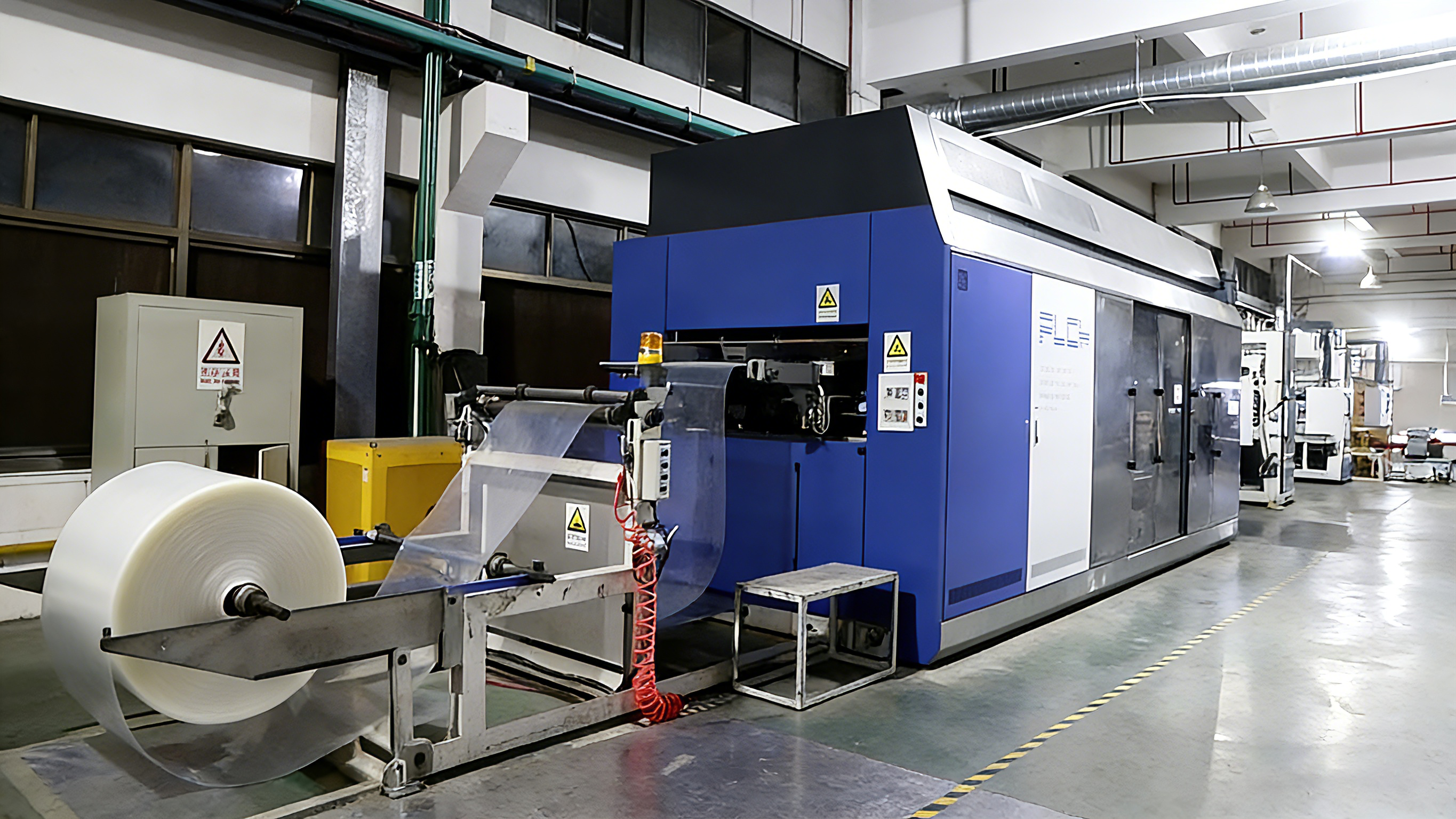
Lead time depends on product specification, material, colour, quantity, mould status and current production schedule — normally 4–6 weeks, with additional development and sampling time for new mould projects. When evaluating manufacturers, check four things in order: whether the product scope actually matches your application (MAP, VSP, PET, CPET, hinged containers and custom moulds are different capabilities); whether the supplier can discuss machine, mould and film compatibility rather than only dimensions; whether food-contact documentation for your market can be produced; and whether sampling and customization are supported before mass production. Ningbo Linhua Plastic Co., Ltd., established in 2004 with a factory of approximately 30,000 m² in Fenghua, Ningbo, works across MAP, VSP, PET, CPET and custom mould development, and supports customers from concept and structural design through prototyping and mass production.
Conclusion: Specify the System, Not the Tray
MAP food packaging containers perform as a system: barrier tray, sealable flange, lidding film, gas mixture and machine. Buyers who start with the application — food type, storage profile, target shelf life and destination market — reach a workable specification faster than buyers who start with a tray size. The tray range matters, but the decisive questions are whether the tray fits your tooling, whether the film and seal hold the atmosphere, and whether the food-contact documentation exists for the market you are selling into.
For chilled food applications, that means confirming three things before mass production: a validated pack under real storage conditions, a compatibility trial on your own machine and film, and a documented compliance position for the destination market.
Next Step: Review the Range and Request a Sample
Ningbo Linhua Plastic Co., Ltd. supplies MAP barrier trays, VSP trays, turned-edge PET trays, moisture retention trays, CPET trays and hinged containers, with custom dimensions, structures and mould development available on request.
Download the catalogue: Linhua E-catalogue 2025 (PDF)
Review product information: www.nblinhua.com
Send your application details for a sample or quotation: Freya@nblinhua.com · WhatsApp: +852 57318298 · Tel: +86 574-8773-9122
To speed up the response, include the food type, tray size or a sample photo, required quantity, and — for MAP projects — your machine, mould and film information.
Have Questions or Need More Details?
Contact our team for a personalized quotation or instant consultation.
Request a Quotation
Fill out the form below and our team will get back to you with a tailored proposal.
WhatsApp Direct Chat
Prefer to chat in real-time? Message us on WhatsApp for instant assistance & quick answers.
- Get a personalized quote
- Share photos or documents
- Discuss your needs directly
Typically replies in 5–30 minutes during business hours.