
MAP Food Packaging Containers: Tray Dimensions, Sealing Moulds and EVOH Barriers
Answer first: MAP food packaging containers are rigid trays used with modified atmosphere packaging to hold a controlled gas mixture around chilled food. For buyers, tray geometry, sealing-mould compatibility and barrier structure are the three specification variables that decide whether a plastic food packaging container runs reliably on an existing production line. A supplier cannot confirm a MAP tray from a size name alone; the food application, machine, mould, film, storage conditions and order demand also have to be checked.
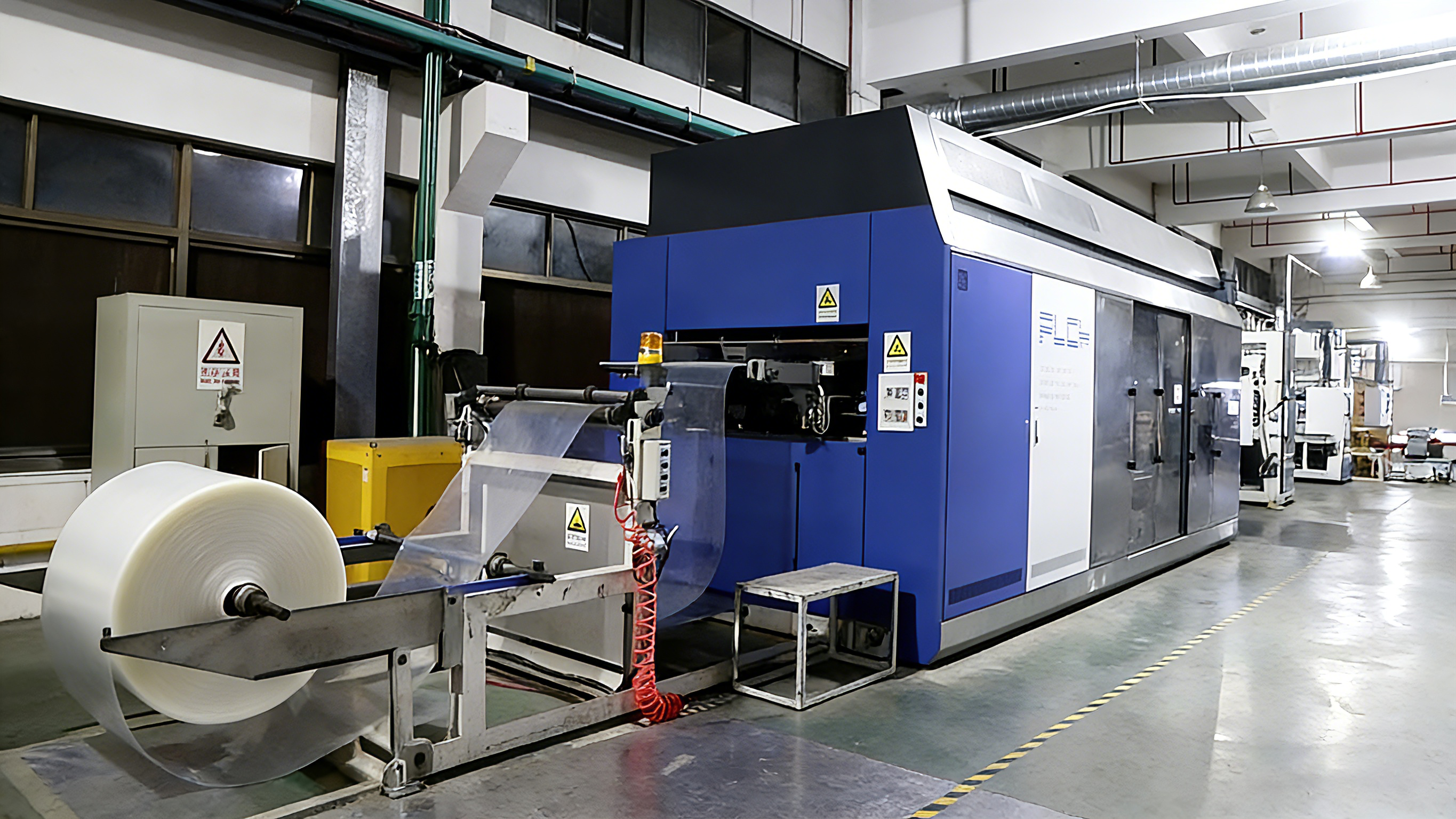
Ningbo Linhua Plastic Co., Ltd. (LINHUA) is a B2B food packaging manufacturer established in 2004 in Ningbo, Zhejiang, China. Its MAP tray range includes more than 80 models, with rectangular examples from 187 × 137 × 35 mm up to 320 × 248 × 100 mm. The range uses PP as the main material and EVOH multilayer structures for high-barrier applications such as fresh meat packaging containers, seafood packaging containers and chilled prepared foods.
Problem Definition: Why a MAP Tray Cannot Be Quoted from a Size Alone
The most common buying mistake is to send a request for a MAP tray with only a nominal length and width. Tray dimensions are important, but sealing area, mould design, film, product height and machine settings may also affect compatibility. A tray that looks correct on a drawing can still fail a sealing trial if the flange area, mould and film do not work together.
A second problem is treating EVOH as a universal answer. EVOH can be used as a functional barrier layer in multilayer packaging structures where improved gas-barrier performance is required. It does not, by itself, guarantee a specific shelf life. Food condition, film, gas or vacuum process, seal integrity, hygiene and storage temperature all affect the final result.
A third problem is ordering before the demand picture is clear. MAP projects often involve several tray sizes, one or more sealing moulds, a film specification and recurring volume. Buyers should confirm the tray type, dimensions, food application, estimated annual demand, colour or customization requirements, and any machine, mould, film, storage temperature and shelf-life information before asking for a quotation.
Industry Background: MAP Barrier Trays in Chilled Food Packaging
Food packaging is essential for transporting, storing, handling and preserving food, and plastic is one of the most common food packaging material types. In chilled food supply chains, MAP packaging replaces or adjusts the normal air inside a sealed package with a controlled gas mixture selected for the food. A high-barrier tray and compatible lidding film help keep that atmosphere inside the pack.
Fresh meat, beef, pork, lamb, poultry, fish, seafood, chilled prepared foods and supermarket retail packaging are the main application areas listed for Linhua MAP barrier trays. The tray is part of a system: the tray, lidding film, seal, gas mixture and cold chain have to work together. That is why a technical tray selection should be based on the complete packaging conditions rather than the material name alone.
Compliance also changes by market. In the EU, Regulation (EU) No 10/2011 establishes specific requirements for plastic materials and articles intended to come into contact with food, including migration-limit requirements. The EU Packaging and Packaging Waste Regulation (EU) 2025/40 applies from 12 August 2026 and includes restrictions on PFAS in food-contact packaging. For the US, the FDA framework defines a food contact substance as including food packaging and its components. Buyers should confirm the current declaration, test report and certificate scope for the exact tray, material and destination market.
Detailed Solution: The Three Specification Variables in a MAP Tray Project
1. Tray geometry: match the pack, not only the product
The Linhua MAP tray range provides more than 80 models, including shallow, medium and deep trays and multi-compartment options. Examples include LP090540 at 222 × 132 × 40 mm and LP090790 at 218 × 167 × 90 mm. The listed dimensions are length × width × height in millimetres. These figures are a starting point for selection; the current tray drawing and a physical sample should be used for final fit and sealing review.
Geometry affects three practical points. First, the product must fit without being compressed or left with excessive headspace. Second, the tray depth should suit the portion size and retail presentation. Third, the tray footprint should fit the sealing machine, mould and downstream packing or display format. For multi-component chilled foods, compartmented trays such as LP090730-2, LP110740DIV and LP110970DIV may be considered where the food application and machine allow.
For fresh meat and seafood, tray depth is often linked to product height, purge management and retail presentation. For chilled prepared foods, the tray may need to hold sauces or mixed components without migration between compartments. The correct choice is the geometry that fits the food, the sealing system and the retail pack format together.
2. Sealing mould and machine compatibility: confirm the interface
Sealing compatibility depends on more than tray dimensions. Linhua normally checks the tray size, sealing mould or tooling, packaging machine, lidding or skin film, food application and operating conditions. If the buyer already has a production line, sending the machine model, mould dimensions and film information helps evaluate compatibility more accurately.
For a MAP project, the buyer should provide the food application, tray dimensions or mould dimensions, MAP machine information, lidding-film specification, storage temperature and required shelf life. For a VSP project, the buyer should provide the food type, product height, tray dimensions, VSP machine model, skin-film information, storage conditions and required shelf life. The final compatibility should be confirmed through actual sealing trials.
3. EVOH barrier structure: select for the storage and shelf-life target
Linhua MAP barrier trays use PP as the main material, with EVOH or multilayer structures for high-barrier applications. EVOH is used as a functional barrier layer where improved gas-barrier performance is required. The barrier structure should be selected according to the food, storage temperature, packaging method, barrier requirement and target shelf life.
High-barrier structures are relevant for fresh meat, seafood and chilled prepared foods where gas exchange has to be controlled. They are not a substitute for correct sealing, hygiene and cold-chain control. A buyer should confirm the full pack concept: tray, lidding film, gas mixture, seal integrity and storage conditions. If the application requires reheating, CPET is a separate material route for ready meals and prepared foods where higher temperature resistance is required; the standard MAP barrier tray range is PP-based and aimed at chilled applications.
Step-by-Step Breakdown: Matching Tray Geometry and Sealing Compatibility to a Production Line
- Define the food and storage condition. State whether the product is fresh meat, poultry, fish, seafood, chilled prepared food or another chilled application. Confirm chilled or frozen storage and the expected retail or foodservice route. Material and structure selection depends on the food, storage temperature, packaging method, barrier requirement and heating condition.
- Define the pack format and target shelf life. Record the portion weight, product height, number of components and preferred retail presentation. State the target shelf life and the gas mixture or vacuum process. Do not ask for a barrier tray without the storage and shelf-life target, because the tray alone cannot guarantee shelf life.
- Shortlist the tray geometry. Use the MAP tray range to identify one or more models that fit the product and pack format. Compare listed length × width × height, compartment layout and depth. Examples such as LP090540, LP090760 and LP090790 show how depth changes within a similar footprint. Request the current drawing for the exact model.
- Confirm the sealing mould and machine. Send the existing sealing-mould dimensions, machine model and film specification if a line is already installed. If there is no existing mould, describe the machine and pack format so the mould requirement can be evaluated. Tray size alone is not enough for a compatibility decision.
- Confirm the film and seal window. Provide the lidding-film specification, sealing side and operating conditions. The film, tray and machine settings interact. Final compatibility should be confirmed by sealing trials, not by catalogue dimensions alone.
- Confirm the barrier structure. Select PP/EVOH or another multilayer structure according to the food, storage temperature and barrier requirement. For fresh meat, seafood and chilled prepared foods, the barrier layer supports the controlled atmosphere, but seal integrity and cold-chain control remain essential.
- Request a sample and run a trial. Once the requirements are clear and a suitable existing product is confirmed, samples can be provided free of charge, with the customer covering shipping cost. For a new mould or customized product, sample arrangements are discussed separately after the design and mould-development requirements are confirmed.
- Confirm order demand before quotation. Provide the required quantity or estimated annual demand, colour or customization requirements, and the target delivery schedule. Standard MOQ is one full container per item. For a first or trial order comprising several items, mixed loading can be arranged. Products with customization requirements have a higher MOQ. Lead time is normally 30–45 days after order confirmation, depending on product specifications, order quantity and production schedule; custom mould projects require additional development time.
Use Cases: Where MAP Barrier Trays Fit
Fresh meat packaging containers
A meat processing company in New Zealand uses MAP Barrier Trays and Moisture Retention Trays for fresh beef and pork packaging for chilled retail distribution, with approximately 4–6 containers per month. The application requires stable supply, consistent tray quality and reliable sealing performance. For this type of project, tray dimensions, sealing compatibility, food application and order demand should be confirmed before product matching and quotation.
Seafood packaging containers
A seafood processing company in New Zealand uses Linhua packaging for fresh fish, salmon portions, fillets and chilled seafood, with approximately 6–8 containers per season. The project improved product presentation and moisture management for chilled seafood while providing tray formats suitable for different fish and seafood sizes. For seafood, tray depth and moisture management matter, and VSP skin-pack compatibility is relevant where skin packaging is used.
Chilled prepared foods
The MAP barrier tray range is listed for chilled prepared foods as well as fresh meat and seafood. For these applications, the buyer should confirm the number of components, sauce or moisture content, product height and target shelf life. A multi-compartment tray may be appropriate where foods must be separated, but the final choice depends on the food application, machine and sealing system.
Distribution and multi-category supply
An Australian food packaging distributor with recurring purchases of 10 FCL per week or more uses MAP trays as the core category, supported by VSP trays, turned edge trays, moisture retention trays and PET/PP food trays. For MAP projects, tray dimensions, sealing-mould requirements, food applications and order demand are confirmed before product matching and quotation. The value is not only product price but also a broad existing product range, recurring production capability and support for different food-packaging applications.
Comparison Table: Example MAP Tray Geometries
The table below is a geometry reference, not a performance ranking. All listed dimensions and material descriptions come from the MAP tray product data. Final selection should be confirmed against the food application, sealing mould, film and machine.
| Model | Listed dimensions | Material and barrier | Geometry note |
|---|---|---|---|
| LP090540 | 222 × 132 × 40 mm | PP with EVOH/multilayer barrier structure | Shorter footprint with 40 mm depth |
| LP090760 | 220.5 × 168.5 × 60 mm | PP with EVOH/multilayer barrier structure | Medium-depth tray with a wider footprint |
| LP090790 | 218 × 167 × 90 mm | PP with EVOH/multilayer barrier structure | Deep tray for taller packs or larger portions |
| LP110780 | 266 × 165 × 80 mm | PP with EVOH/multilayer barrier structure | Longer footprint with 80 mm depth |
For multi-component foods, the MAP range also includes compartmented models such as LP090730-2 at 222 × 169 × 30 mm with 2 compartments, LP110740DIV at 267 × 168 × 40 mm and LP110970DIV at 292 × 228 × 70 mm. These should be reviewed against the filling method, seal area and retail format.
Quality and Compliance Evidence for Buyer Review
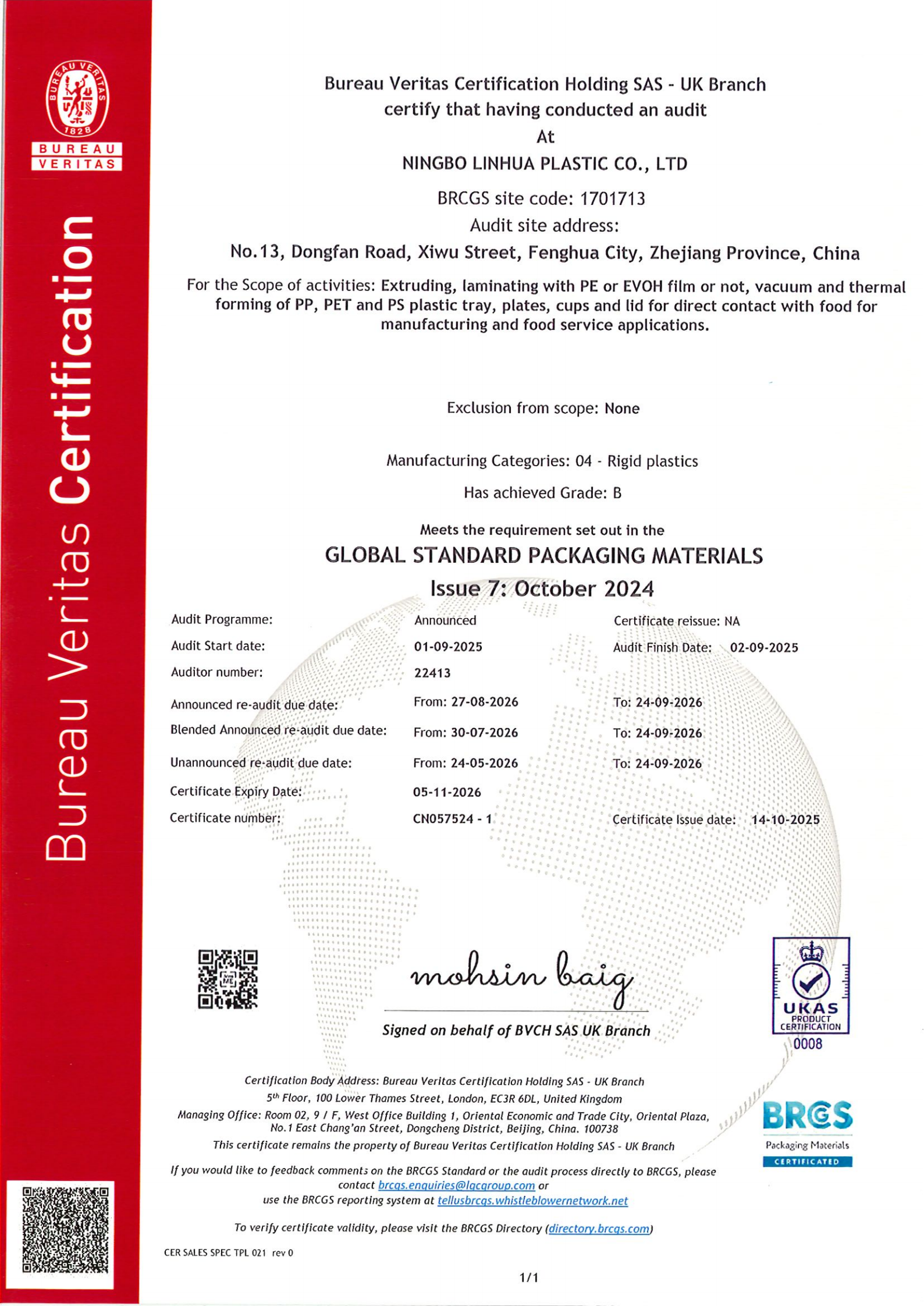
Linhua manages quality control through incoming material inspection, in-process quality control and final product inspection before shipment. Quality checks are carried out throughout the production process to ensure product consistency and compliance with agreed specifications. The company holds BRCGS Global Standard Packaging Materials certificate CN057524-1, HACCP certificate 610H151 and ISO 9001:2015 certificate 18426Q00712R001. Buyers should confirm the applicable certificate scope and validity for the exact product and destination market.
FAQ
What food-contact compliance should buyers confirm for MAP trays?
Food-contact compliance is product- and market-specific. For EU-bound plastic food-contact articles, Regulation (EU) No 10/2011 establishes specific requirements, including migration limits. For the US, the FDA framework defines food contact substances. Ask for the current declaration, test report and certificate scope for the exact tray, material and destination market. Linhua's quality system certificates include BRCGS CN057524-1, HACCP 610H151 and ISO 9001:2015 18426Q00712R001; confirm scope and validity for the exact SKU.
Can Linhua match an existing sealing mould and MAP machine?
Matching tray size is not enough. Linhua checks tray size, sealing mould or tooling, packaging machine, lidding or skin film, food application and operating conditions. Send the machine model, mould dimensions, film information, storage temperature and target shelf life for evaluation. Final compatibility should be confirmed through actual sealing trials.
What information is needed before a MAP tray quotation?
Provide the tray type or dimensions, food application, required quantity, colour or customization requirements, and for MAP projects the machine, mould, film, storage temperature and shelf life. Standard MOQ is one full container per item; a first or trial order with several items can be arranged as mixed loading; customization has a higher MOQ. Lead time is normally 30–45 days after order confirmation, depending on specification, quantity and schedule.
Can I get a sample of an existing MAP tray?
Once requirements are clear and a suitable existing product is confirmed, samples are free of charge; the customer only needs to cover shipping cost. If the project requires a new mould or customized product development, sample arrangements are discussed separately.
What is the lead time for MAP tray orders?
Lead time is normally 30–45 days after order confirmation, depending on product specifications, order quantity and production schedule. Custom mould projects require additional development time. To move faster, send the tray drawing, food application, machine, mould and film details, and estimated annual demand with your inquiry, or download the Linhua E-catalogue.
Conclusion: Build the Tray Decision Around the Line, Not the Catalogue Alone
MAP food packaging containers should be selected as a system: tray geometry, sealing mould, machine, film, barrier structure, storage condition and order demand. The Linhua MAP tray range offers more than 80 models, including LP090540 and LP090790, with PP and EVOH multilayer barrier structures for fresh meat, seafood and chilled prepared foods. The practical next step is to confirm the food application, tray drawing, sealing-mould interface, film specification and estimated demand before quotation.
Next step: Send your tray drawing or target dimensions, food application, MAP machine and sealing-mould details, film specification, storage temperature and estimated annual demand to request a sample or quotation. You can also download the public Linhua E-catalogue here: Linhua E-catalogue 2025.
Company and Contact
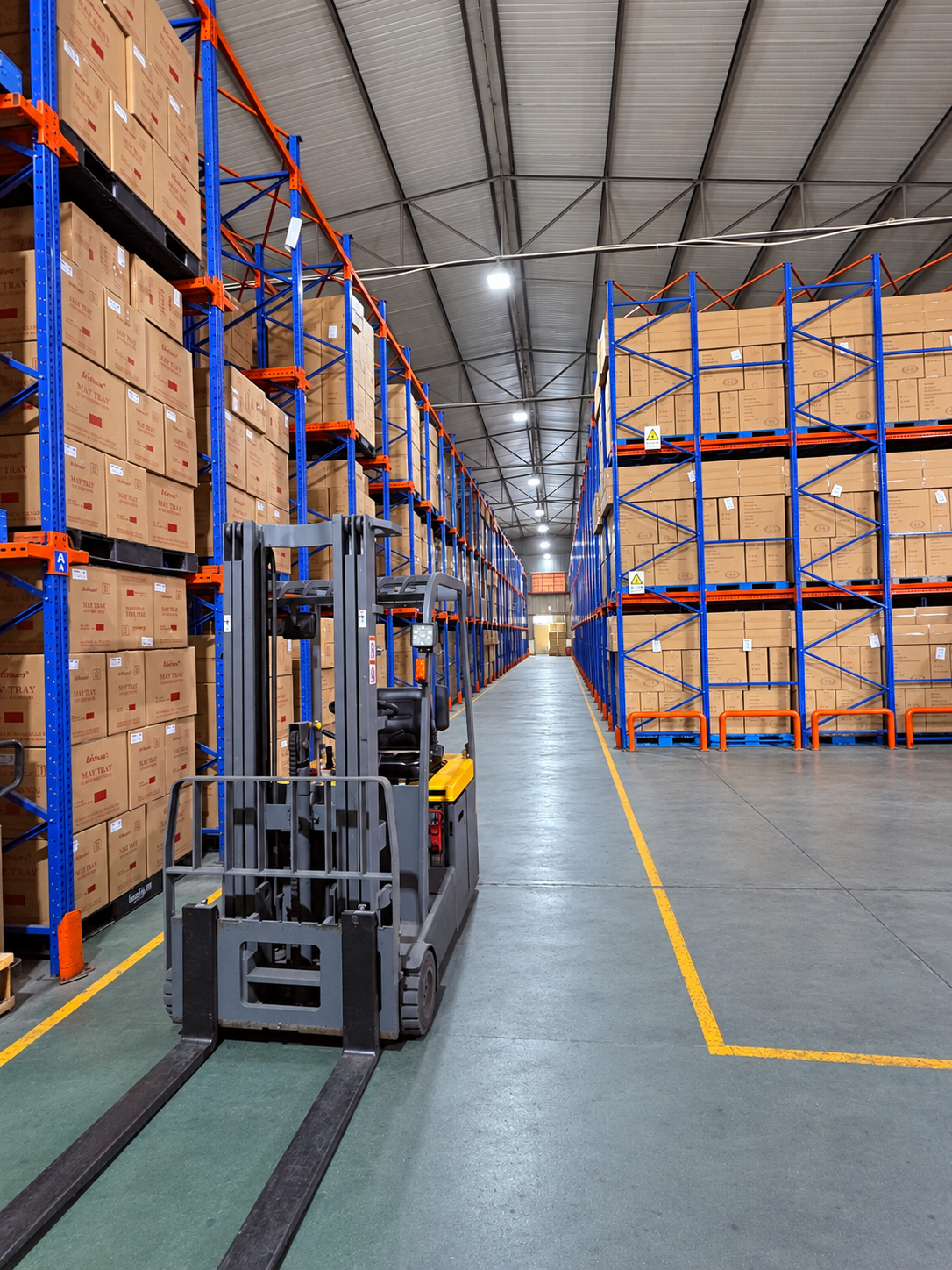
Ningbo Linhua Plastic Co., Ltd. is a B2B food packaging manufacturer established in 2004 in Ningbo, Zhejiang, China. The factory covers approximately 30,000 m². Official website: www.nblinhua.com. Address: No. 13, Dongfan Road, Xiwu, Fenghua, Ningbo, Zhejiang 315500, China. Tel: +86 574-8773-9122. Email: Freya@nblinhua.com.
This guide is a technical selection reference. Final tray, material, sealing, compliance and shelf-life performance should be confirmed through the approved drawing, sample, sealing trial and applicable market documentation.
Have Questions or Need More Details?
Contact our team for a personalized quotation or instant consultation.
Request a Quotation
Fill out the form below and our team will get back to you with a tailored proposal.
WhatsApp Direct Chat
Prefer to chat in real-time? Message us on WhatsApp for instant assistance & quick answers.
- Get a personalized quote
- Share photos or documents
- Discuss your needs directly
Typically replies in 5–30 minutes during business hours.