
PP Food Packaging Containers: A B2B Buyer Guide
PP food packaging containers are rigid plastic trays, boxes, cups and hinged containers made from polypropylene and used to pack, protect, store and present food. In B2B sourcing, the category covers high-barrier MAP trays, VSP trays, deli and rib containers, rotisserie chicken containers, bakery and grab-and-go hinged containers, and large-format retail platters. Polypropylene is widely used because it suits a broad range of chilled and frozen applications, can be incorporated into MAP and VSP package structures, and provides a practical balance of strength, product visibility and commercial predictability.
This guide explains what PP food packaging containers are, how the category is structured, which container format suits which food application, and what buyers and packaging engineers should confirm before placing an order. It is written for importers, distributors, brand owners, procurement managers, food processors and packaging engineers who are in the discovery and research stage of a packaging project. Ningbo Linhua Plastic Co., Ltd. is a B2B food packaging manufacturer established in 2004 and located in Ningbo, Zhejiang, China, supplying PP, PET and CPET food packaging containers to food manufacturers, meat and seafood processors, ready-meal producers and packaging distributors in Australia, Canada, the US, New Zealand, Singapore and the Middle East.
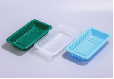
MAP barrier tray LP090540 — a PP-based food packaging container for chilled meat, poultry and seafood.
The Problem: Why "PP Food Packaging Container" Is a Category, Not a Product
Definition: A PP food packaging container is any food-contact rigid container whose main structural material is polypropylene. The category includes trays for fresh meat, seafood, poultry and chilled prepared foods; containers for supermarket deli and hot-food counters; hinged containers for bakery and grab-and-go; and large-format platters for catering and party food. Buyers searching for a "plastic food packaging container" typically encounter several different material families and package formats at once, and this is the first problem the category creates: the search term describes a category, not a specification.
In practice, selecting a PP container requires four linked decisions. The first is the food itself — fresh meat, fish, ready meals, bakery products and fresh produce behave differently in storage. The second is the packaging method — MAP gas flushing, vacuum skin packaging, stretch-film overwrap, or simple base-and-lid closing. The third is the storage and handling environment — chilled, frozen, ambient, reheated or microwave. The fourth is the destination market, because food-contact documentation, labelling and packaging-waste rules differ between the EU, the US and other regions. Choosing a container without resolving these four points is the most common cause of sampling rounds that fail or specifications that need to be reworked after the first production run.
A second problem is format proliferation. A single food manufacturer may need a barrier tray for one SKU, a hinged bakery container for another, a compartment platter for a third, and a large salad bowl for a fourth. If each format is sourced independently, the buyer loses consistency in material, fit and pack-line performance. The more efficient approach is to shortlist a supplier with a broad PP and rigid-plastic portfolio and then match the container to the food and the packing process.
Industry Background: What Is Changing in Rigid Plastic Food Packaging
Two forces are reshaping the rigid plastic food packaging category at the same time: scale and regulation.
Scale. Grand View Research estimated the global food containers market at USD 331.7 billion in 2024. That figure covers both rigid and flexible food containers and is a commercial research estimate, not a customs or government statistic, but it illustrates why buyers have many supplier options and why supplier differentiation must come from application fit and evidence rather than from price alone.
Regulation. From 12 August 2026, the EU Packaging and Packaging Waste Regulation (PPWR) 2025/40 applies, including restrictions on PFAS in food-contact packaging. Separately, Commission Regulation (EU) No 10/2011 establishes specific requirements for plastic materials and articles intended to come into contact with food in the EU market, including specific migration limits for listed substances. In the United States, the FDA describes a food contact substance (FCS) as including food packaging and its components. These frameworks do not ban PP food packaging containers, but they do mean that the material, structure and documentation of a container must be confirmed for the destination market before mass production.
Barrier technology. Market Research Future projected that the global EVOH packaging market would grow from USD 1.847 billion in 2025 to USD 3.055 billion by 2035, at a CAGR of 5.16%. EVOH appears in this category as a functional barrier layer inside multilayer PP-based structures, not as a standalone tray material. For buyers, the practical implication is that a "PP tray" may mean a simple PP tray or a PP-based structure with an EVOH barrier layer — and those are different specifications with different performance and documentation needs.
Finally, feedstock economics matter. Industry research describes plastic packaging as being made from synthetic polymers such as polypropylene and polyethylene, manufactured from natural resources, with prices that fluctuate with input costs. This does not determine any individual quotation, but it explains why PP container pricing is often indexed to resin markets and why buyers should separate material cost from tooling, conversion and freight when comparing suppliers.
Detailed Solution: The PP Food Packaging Container Range
A complete PP food packaging container portfolio is organised by packing method and food application rather than by container shape alone. The following formats reflect the range manufactured by Ningbo Linhua Plastic Co., Ltd.
1. MAP Barrier Trays (PP / EVOH Multilayer)
MAP barrier trays are designed for modified-atmosphere packaging of fresh meat, poultry, seafood, chilled prepared foods and other perishable products. By controlling the proportions of oxygen, carbon dioxide and nitrogen inside the package and combining that atmosphere with chilled storage, MAP helps slow quality deterioration and supports a longer commercial shelf life. In Linhua's range, the main material is PP or a high-barrier PP-based structure, and the barrier layer is EVOH or another multilayer structure. Standard models include LP090540 (222 × 132 × 40 mm), LP090790 (218 × 167 × 90 mm) and LP110760 (270 × 169 × 60 mm).
MAP tray selection is not a tray-only decision. Tray dimensions, sealing area, lidding film, packaging machine, product height and storage temperature all affect whether a given tray will run correctly on a given line. Buyers should expect a supplier to ask for machine model, mould dimensions, film specification, storage temperature and target shelf life before confirming compatibility.
2. VSP Trays (PP and PET)
Vacuum Skin Packaging trays are used for premium fresh-food applications including steaks, premium meat cuts, poultry, fish fillets and seafood. In a VSP system, a skin film closely follows the contours of the food under vacuum, securing the product to the tray and creating a three-dimensional retail presentation. Linhua offers VSP trays in PP and PET, with standard models including LP090515 (220 × 130 × 15 mm, PP), LP090520 (226 × 132 × 20 mm, PP), LP090640 (222 × 155 × 40 mm, PP) and LP100713 (260 × 175 × 13 mm, PP).
VSP projects are evaluated against the food application, chilled or frozen storage conditions, target shelf life, skin film, packaging machine and tray dimensions. Depending on the project, PP / EVOH / PE structures may also be discussed and evaluated.
3. Prepared Meat, Deli, Rib and Fried Chicken Containers (PP)
Supermarket prepared-food programmes require containers matched to specific product shapes. Linhua's PP range includes the LH1107 Half Rib container (275 × 183 × 55 mm, suggested max. holding weight 800 g), the LH1607 Full-Size Rib container (413 × 173 × 67 mm, suggested max. holding weight 1 kg) and the LH1108 oval prepared-food container for fried chicken (271 × 213 × 91 mm, suggested max. holding weight 1.3 kg). These containers are intended for supermarket deli departments, prepared meat processors, BBQ food producers, sushi and prepared food packers, takeaway and foodservice.
4. Rotisserie Chicken Containers (PP)
The LH0907 rotisserie chicken container is a PP base-and-lid combination measuring 235 × 190 × 116 mm. The 116 mm high profile accommodates whole or large cooked-food portions, and the suggested maximum holding weight is 1.5 kg. It is designed for supermarket, hypermarket and grocery deli programmes and for prepared-food processors.
5. Hinged Bakery, Sandwich and Grab-and-Go Containers (PET)
Hinged containers use a one-piece design with an integrated lid and base, simplifying packing and handling. Linhua's range includes LH1008 (folded 261 × 209 × 96 mm; suggested max. holding weight 700 g), LH1208 (folded 317 × 216 × 72 mm; 1 kg), LH1610 (folded 415 × 261 × 106.5 mm; 2 kg), LH0703C sandwich wedge (folded 168 × 88 × 82 mm; 150 g), LH0505C (folded 141 × 123 × 64 mm; 16 oz; 300 g) and LH95P (folded 250 × 154 × 60 mm; 9.5-inch pie container; 500 g). Selected models are available in clear PET for product visibility. These are intended for supermarkets, bakeries, convenience stores, delis, cafés, sandwich producers and prepared-food retailers.
6. Retail Platters, Salad Bowls and Compartment Trays
For larger-format retail and catering programmes, Linhua supplies retail platters in PP base and PET lid constructions, including LH1313 (332.5 × 332.5 × 92 mm, 13-inch square; suggested max. holding weight 1.8 kg) and LH1414 (364 × 364 × 111 mm, 14-inch square; 2 kg). The LH1205R large salad combo is made of PET, has a 96 oz capacity and measures Ø313 × H118.6 mm. Multi-compartment produce and deli trays in PET include LH1303 (Ø335 × H75 mm, 13-inch, 4+1 compartments; 1.7 kg), LH1003 (Ø262 × H72 mm, 10-inch, 68 oz, 4+1 compartments; 1.2 kg), LH1616 (16-inch square 5-compartment platter; base 408 × 408 × 73 mm; 800 g), LH1173 (275 × 175 × 76 mm, 76 oz, 3 compartments; 400 g) and LH0606 (157 × 157 × 62 mm, 32 oz, 4 compartments; 400 g).
7. CPET Ready Meal Trays (Complementary to PP)
CPET (Crystallized Polyethylene Terephthalate) is not PP, but it is relevant to buyers who are also sourcing ready-meal packaging. Linhua's CPET tray range includes 30+ standard models covering single-compartment, 2-compartment and 3-compartment formats, with sizes from compact individual portions to a 2,600 ml meal tray (LP121050: 316 × 262 × 50 mm; 80 g). Selected formats are available in black and natural/white. CPET is used where higher temperature resistance is required for ready meals and prepared foods. Exact temperature limits, sealing film compatibility and heating conditions should be confirmed by model and application.
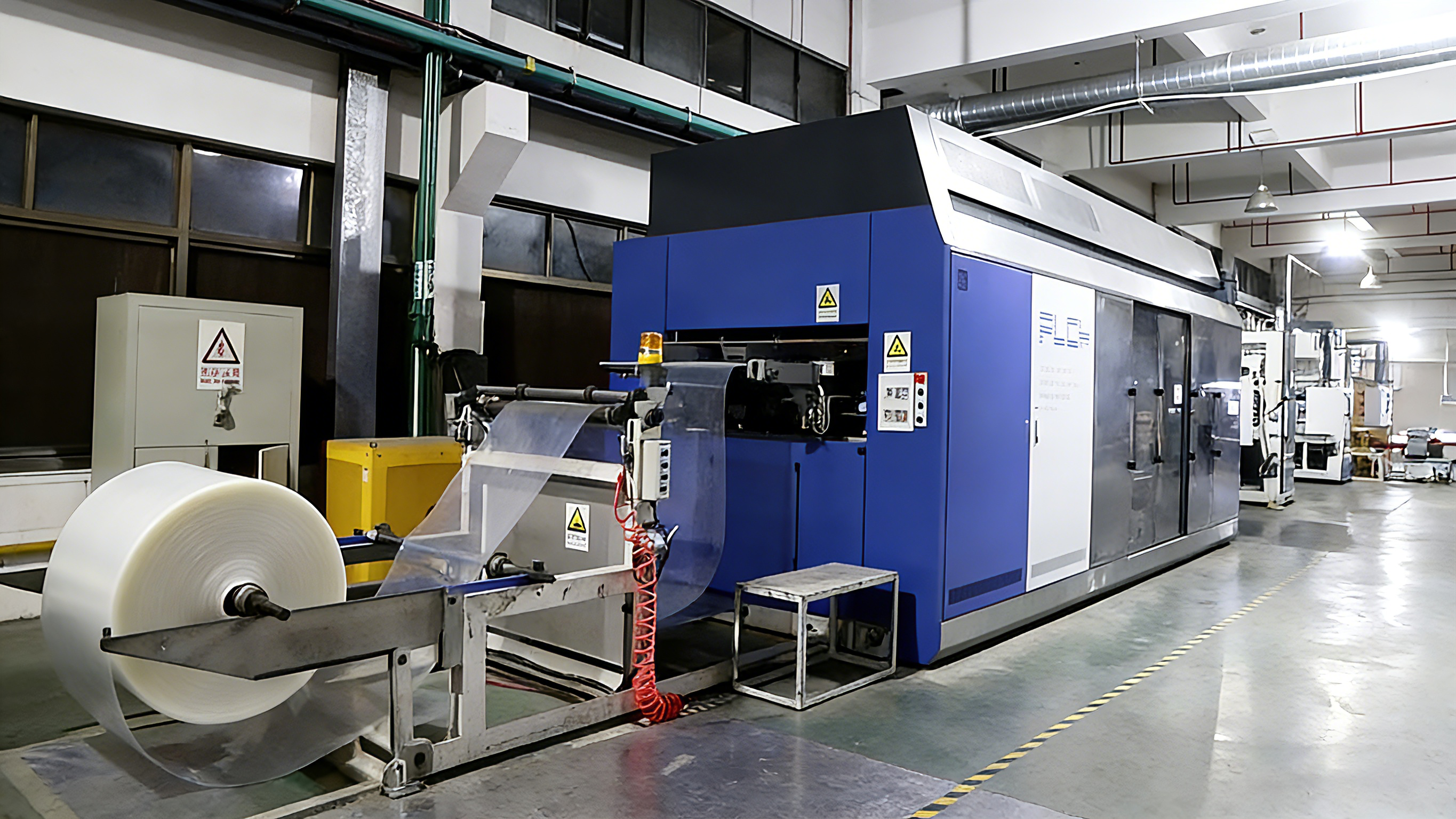
Thermoforming production at Ningbo Linhua Plastic Co., Ltd., a food packaging manufacturer established in 2004 with a 30,000 m² factory in Ningbo, China.
PP vs PET vs CPET: Choosing the Right Material
There is no single material that is best for every food package. The correct choice depends on what is packed and how the package will be used. The following comparison uses only material facts confirmed by the manufacturer.
| Material | Typical Applications | Key Characteristics |
|---|---|---|
| PP (polypropylene) | MAP barrier trays, VSP trays, deli and rib containers, rotisserie chicken containers, retail platters (PP base + PET lid) | Widely used for food trays; can be combined with EVOH or other multilayer structures for barrier performance |
| PET (polyethylene terephthalate) | Turned-edge overwrap trays, hinged containers, multi-compartment trays, fruit clamshells, large salad bowls | Clear product presentation; structural strength; suitable for stretch-film and overwrap applications |
| CPET (crystallized PET) | Ready meal trays, prepared-food packaging | Higher temperature resistance; single-, 2- and 3-compartment formats; black and natural/white options on selected models |
| PP + EVOH multilayer | High-barrier MAP trays for fresh meat, poultry, seafood and chilled prepared foods | Functional barrier layer within a PP-based structure; exact barrier performance depends on structure and application |
Linhua also works with PS, TFPP, PLA and other multilayer structures. Food-contact or market-specific compliance must be confirmed according to the actual product and destination market. Any claim regarding ISO, BRC, HACCP, FDA, EU or other certifications should be based on the supplier's latest valid certificates, test reports and applicable product scope.
Step-by-Step Breakdown: How to Specify a PP Food Packaging Container
The following process reflects how a packaging project is typically evaluated before samples and mass production. It is a decision sequence, not a marketing checklist.
Step 1 — Define the food and the storage condition
Start with the food itself: fresh meat, poultry, fish, seafood, ready meal, bakery product, deli item, salad or fresh produce. Then define whether the product is chilled, frozen, ambient or reheated. These two inputs determine the material family before any tray shape is discussed.
Step 2 — Choose the packaging method
MAP, VSP, stretch-film overwrap and simple base-and-lid closing are different processes with different container requirements. MAP requires gas flushing and heat sealing with a lidding film. VSP requires vacuum and a skin film. Overwrap uses stretch film. Hinged and base-lid containers generally do not require dedicated sealing equipment for normal closure. The packing method should be chosen before the container model.
Step 3 — Confirm material and barrier structure
Select the material based on the application: PET where clear presentation matters, PP where broad chilled-food use and MAP/VSP structures are required, CPET where higher temperature resistance is needed, and PP/EVOH multilayer where additional barrier performance is required. Confirm whether the destination market requires specific food-contact documentation or migration testing.
Step 4 — Match tray dimensions, depth and compartments
Tray footprint, depth and compartment layout must match the actual food portion, the retail display format and the packing equipment. For MAP and VSP projects, tray dimensions interact with sealing moulds and films. Standard models can often be matched directly; when they cannot, custom dimensions, depths, shapes, colours, compartment layouts and ventilation holes can be evaluated.
Step 5 — Check equipment and film compatibility
MAP and VSP compatibility depends on more than tray dimensions. Sealing area, mould design, film, product height and machine settings may also affect results. If a production line already exists, the machine model, mould dimensions and film information help the supplier evaluate compatibility more accurately. Final compatibility should be confirmed through actual sealing trials. No tray alone can guarantee a specific shelf life.
Step 6 — Confirm documentation for the destination market
Food-contact requirements vary by market. For EU-bound plastic food-contact materials and articles, Commission Regulation (EU) No 10/2011 sets specific requirements, including migration limits for listed substances. For the US market, the FDA framework treats food packaging and its components as food contact substances. PFAS restrictions under PPWR (EU) 2025/40 apply from 12 August 2026. Buyers should request declarations of compliance, test reports and product-scope confirmation for the exact SKU and destination market.
Step 7 — Sample, approve, then schedule mass production
Once the requirements are clear and a suitable existing product is confirmed, samples can be provided free of charge, with the customer covering courier cost. For projects requiring a new mould or customized product, sample arrangements are discussed separately. Mass production is scheduled after final specification, sample approval and commercial terms are confirmed. Lead time depends on product specification, material, colour, quantity, mould status and current production schedule; normally 4–6 weeks, with new mould projects requiring additional development and sampling time.
Use Cases: Where PP Food Packaging Containers Fit
PP containers appear across several food environments, each with different demands on material, format and documentation.
Fresh meat and poultry
MAP barrier trays and VSP trays are used for beef, pork, lamb, poultry and premium cuts. The key requirements are barrier structure, seal integrity, product presentation and compatibility with the processor's packaging line. Moisture retention trays (MRT) are a related PET solution for managing purge during retail display; they are not PP, but they belong to the same fresh-meat packaging decision and are often evaluated alongside PP trays.
Seafood and fish
VSP trays in PP and PET are used for fish fillets, steaks and premium seafood where close product positioning and presentation matter. MAP barrier trays are used for chilled seafood where controlled atmosphere and shelf-life management are priorities.
Supermarket deli and prepared foods
PP rib containers, oval fried-chicken containers and rotisserie chicken containers are designed around the shape of the food and the supermarket display format. They support packing at in-store counters or central packing facilities and can move directly to refrigerated cabinets, deli counters or takeaway shelves.
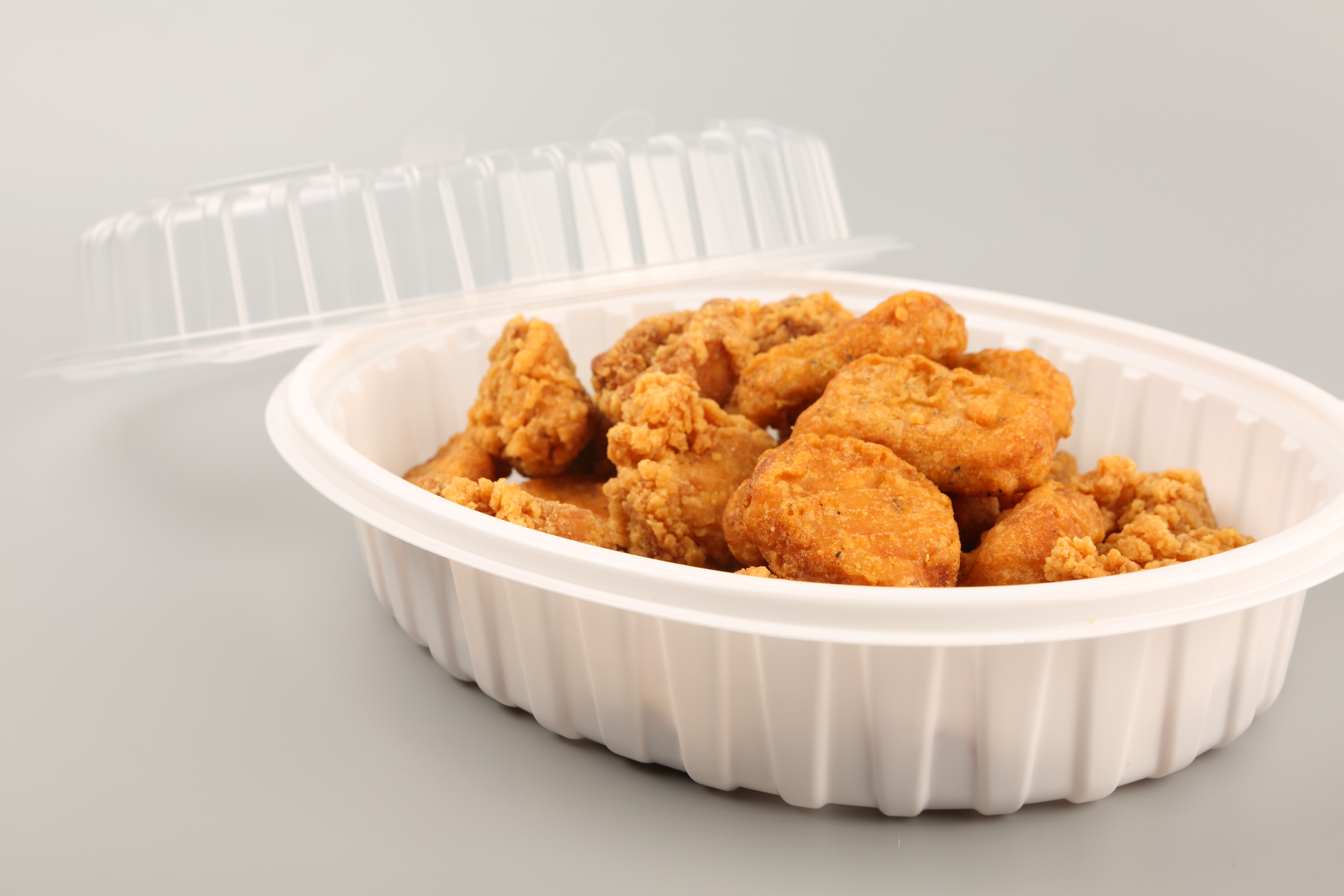
PP deli and prepared-food packaging for supermarket counters.
Bakery, sandwich and grab-and-go
Hinged containers in clear PET are used for sandwiches, pies, bakery items and deli portions. They are closed by an integrated lid and base and generally do not require dedicated sealing equipment. The relevant selection criteria are size, lid fit, stacking performance and product visibility.
Fresh produce and fruit
Multi-compartment produce trays and fruit clamshells are used for fresh produce, fruit assortments, berries and sharing packs. The DP-1LBSS clamshell is made of PETE, has a 1 lb capacity, a recommended load of up to 500 g and a reference unit weight of approximately 26.5 g. Ventilation, pack weight, stacking and retail display are the main selection variables. Custom development is supported according to fruit variety, target pack weight, ventilation requirements, packing process and retail application.
Ready meals and catering
CPET trays are used for ready meals, prepared foods and catering where higher temperature resistance is required. Retail platters in PP base and PET lid constructions are used for cakes, party foods, deli assortments, meal kits and prepared-food displays.
Comparison Table: Common PP and Rigid Plastic Food Container Formats
The table below compares container formats using facts confirmed in the manufacturer's product data. It is intended to help buyers shortlist a format, not to rank containers against each other.
| Container Format | Material | Packaging Method | Typical Application | Key Confirmed Fact |
|---|---|---|---|---|
| MAP barrier tray | PP / EVOH multilayer | Gas flush + heat seal | Fresh meat, poultry, seafood, chilled prepared foods | Standard model LP090540: 222 × 132 × 40 mm |
| VSP tray | PP / PET | Vacuum skin packaging | Steaks, premium meat cuts, fish, seafood | Standard model LP090515: 220 × 130 × 15 mm, PP |
| Rib / prepared meat container | PP | Fill + close | Supermarket deli, BBQ, prepared meat | LH1607 Full-Size Rib: 413 × 173 × 67 mm; suggested max. holding weight 1 kg |
| Rotisserie chicken container | PP | Base + lid | Supermarket rotisserie chicken | LH0907: 235 × 190 × 116 mm; suggested max. holding weight 1.5 kg |
| Hinged bakery / grab-and-go container | PET | One-piece hinged lid | Sandwiches, bakery, deli portions | LH1610: folded 415 × 261 × 106.5 mm; suggested max. holding weight 2 kg |
| Retail platter | PP base + PET lid | Base + lid | Cakes, party food, meal kits | LH1414: 364 × 364 × 111 mm; suggested max. holding weight 2 kg |
| CPET ready meal tray | CPET | Fill + seal | Ready meals, prepared foods | LP121050: 316 × 262 × 50 mm; 2,600 ml; 80 g |
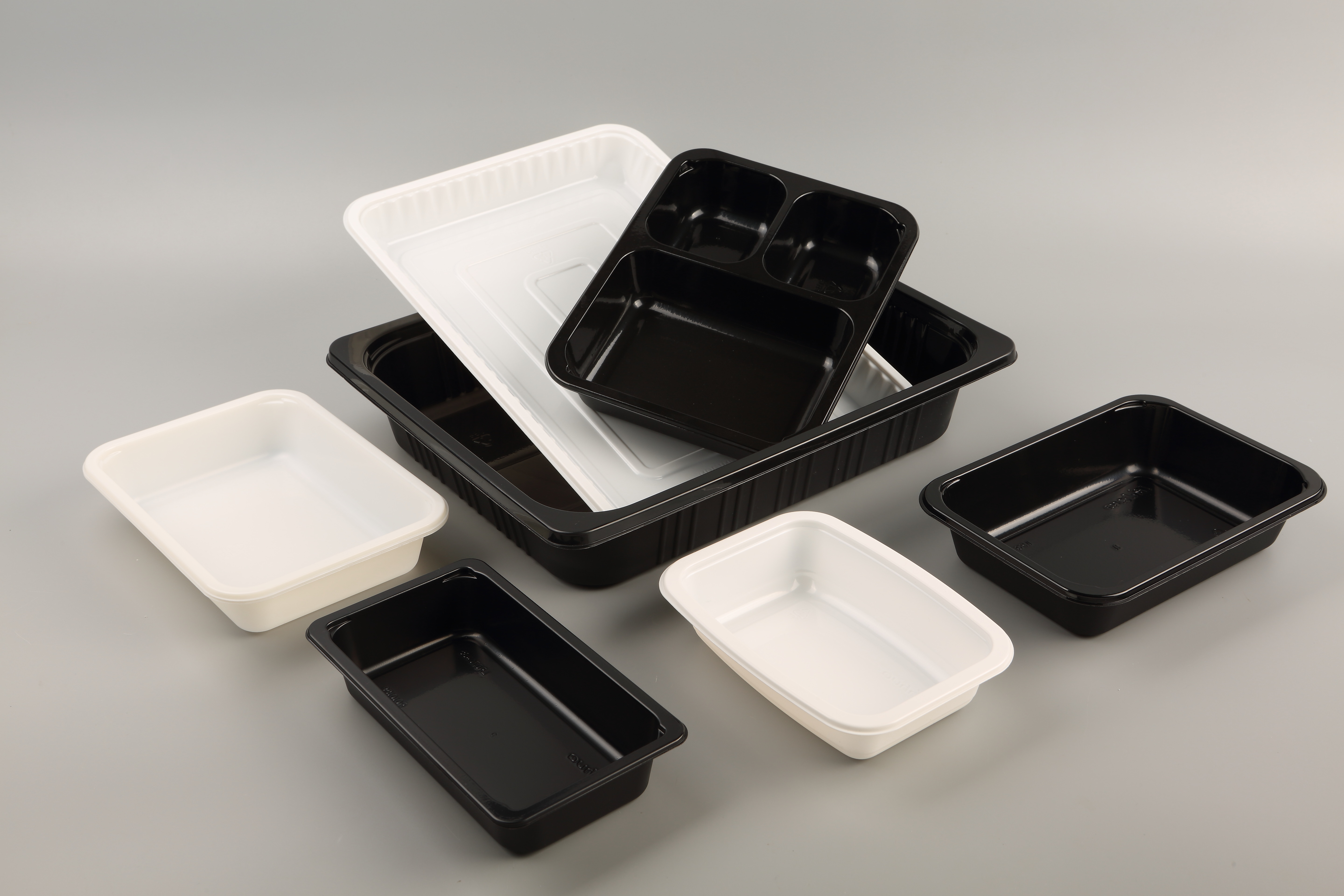
CPET ready meal trays — 30+ standard models in single-, 2- and 3-compartment formats.
Manufacturing and Quality Context
Container specification is only one side of supplier evaluation. Buyers also need to understand how the supplier develops and manufactures the product.
Ningbo Linhua Plastic Co., Ltd. operates a factory of approximately 30,000 m² with 150 employees and an annual output of 20,000 tons. The company reports a 26-person cross-functional team that includes 4 R&D engineers, 5 mould engineers, 2 process engineers, 8 quality and QC professionals, 1 product documentation and compliance specialist, 4 project managers and 2 application engineers. Its export ratio is 70%, with main markets including Australia, Canada, the US, New Zealand, Singapore and the Middle East.
In product development, Linhua supports the process from concept development and structural design through prototyping, mould development and mass production. For MAP and VSP projects, this includes working with customers on tray dimensions, material structures, barrier performance, sealing moulds, packaging machines and film compatibility. In manufacturing, quality control is applied from raw-material management through production control to finished-product inspection. For quality systems and food-contact compliance, Linhua states that any ISO, BRC, HACCP, FDA, EU or other certification or compliance claim should be based on the company's latest valid certificates, test reports and applicable product scope.
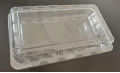
PET hinged container LH1610 — one-piece design with integrated lid and base for bakery and grab-and-go.
Frequently Asked Questions
1. How do I verify food-contact compliance for a PP food packaging container?
Food-contact requirements vary by destination market. For the EU market, Commission Regulation (EU) No 10/2011 establishes specific requirements for plastic materials and articles intended to come into contact with food, including specific migration limits for listed substances. The EU PPWR (EU) 2025/40 applies from 12 August 2026 and includes restrictions on PFAS in food-contact packaging. In the United States, the FDA defines a food contact substance as including food packaging and its components. Buyers should ask the supplier for the latest valid certificates, declarations of compliance, test reports and product-scope confirmation for the exact SKU and market.
2. What should I look for in a China plastic food packaging container manufacturer?
Look for application fit first: does the manufacturer supply the container format your food actually needs, and can it support the packing method — MAP, VSP, overwrap or base-and-lid? Then check customization capability, equipment and film compatibility support, quality control, and documentation. Ningbo Linhua Plastic Co., Ltd. is a Ningbo-based food packaging manufacturer established in 2004, with a 30,000 m² factory, 150 employees, 20,000 tons annual output, a 26-person cross-functional team covering R&D, mould, process, quality and product documentation, and a 70% export ratio across Australia, Canada, the US, New Zealand, Singapore and the Middle East. These are company-reported facts and should be verified against certificates, audit records and product-level documentation.
3. Should I choose PP, PET or CPET for my food packaging container?
The material should be selected according to the application, not by material name alone. PET is commonly used where clear product presentation is important, including fresh meat, seafood, fruit and overwrap packaging. PP is widely used for food trays and can be used as part of MAP or VSP barrier structures. CPET is used for ready meals and prepared foods where higher temperature resistance is required. PP-based structures with an EVOH barrier layer may be evaluated when additional barrier performance is needed. The final choice should be based on food type, storage temperature, packaging method, heating condition, barrier requirement and target-market food-contact requirements.
4. Can I request samples before placing an order?
Yes. Once the requirements are understood and a suitable existing product is confirmed, samples can be provided free of charge; the customer covers the courier cost. For projects that require a new mould or customized product development, sample arrangements are discussed separately. For MAP or VSP projects, the supplier may need the food application, tray dimensions, packaging machine, mould details, film specification, storage temperature and target shelf life before sending samples.
5. What is the typical production and delivery lead time?
Lead time depends on the product specification, material, colour, quantity, mould status and current production schedule. For standard products, the normal lead time is 4–6 weeks. New mould projects require additional development and sampling time before mass production can be scheduled. Mass production begins after the final specification, sample approval and commercial terms are confirmed. Buyers can request a quotation through Ningbo Linhua Plastic Co., Ltd. by providing the tray type or dimensions, food application, expected quantity and any machine or film details.
Conclusion
PP food packaging containers are a broad category built around a specific material — polypropylene — and applied across MAP trays, VSP trays, deli containers, rotisserie chicken containers, platters and hinged packaging. The container that works for a fresh steak is not the container that works for a supermarket salad, a bakery sandwich or a ready meal. The useful buyer decision is therefore not "which PP container" but "which material, format and packaging method match this food, this process and this market."
A practical shortlist starts with the food and storage condition, moves through packaging method and material, then checks dimensions, equipment compatibility and destination-market documentation. Where standard models do not fit, custom dimensions, depths, colours, material structures, compartment layouts, ventilation holes and mould development can be evaluated. Samples and sealing trials are the appropriate way to confirm a fit before production.
For buyers who want to review the full range, the Linhua E-catalogue 2025 covers MAP barrier trays, VSP trays, CPET trays, turned-edge PET trays, moisture retention trays, deli containers, hinged containers and retail platters. Buyers can also contact the company directly to discuss a specific application. The company's official website is www.nblinhua.com; its address is No. 13, Dongfan Road, Xiwu, Fenghua, Ningbo, Zhejiang 315500, China. The telephone number is +86 574-8773-9122, and the foreign trade team can be reached at Freya@nblinhua.com or on WhatsApp at +852 57318298.
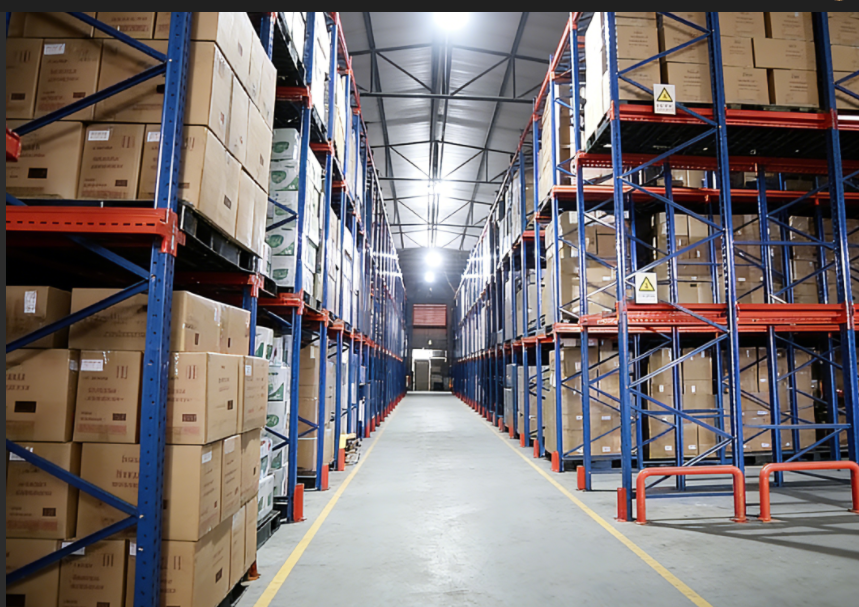
Warehouse capacity at Ningbo Linhua Plastic Co., Ltd. — supporting export supply to Australia, Canada, the US, New Zealand, Singapore and the Middle East.
For sample requests, quotations or application-specific questions, contact the team at Freya@nblinhua.com or send a WhatsApp message to +852 57318298.
Have Questions or Need More Details?
Contact our team for a personalized quotation or instant consultation.
Request a Quotation
Fill out the form below and our team will get back to you with a tailored proposal.
WhatsApp Direct Chat
Prefer to chat in real-time? Message us on WhatsApp for instant assistance & quick answers.
- Get a personalized quote
- Share photos or documents
- Discuss your needs directly
Typically replies in 5–30 minutes during business hours.