
Recommended Plastic Food Packaging Containers for Grab-and-Go, Deli, and Rotisserie Programs
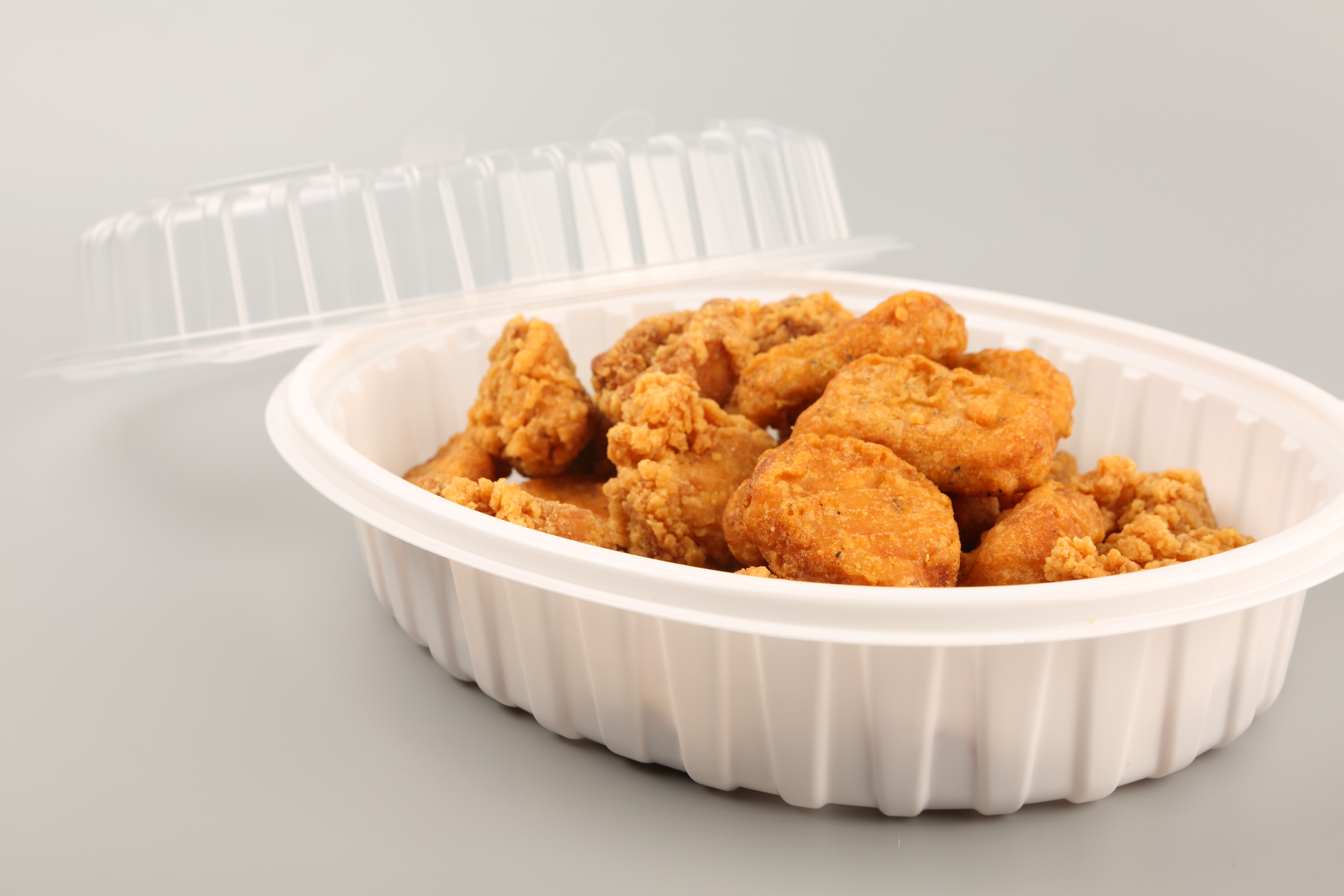
A grab-and-go, deli or rotisserie program does not need dozens of containers. It needs a small, repeatable set that covers sandwiches and bakery, deli assortments, salads, whole birds and prepared meat, and it needs those containers to exist as proven moulds so the range can be reordered, extended and packed by store staff without a dedicated sealing line.
The short answer: five container families cover most retail food programs
For retail and foodservice buyers building a shortlist, five families usually do the work:
- Hinged grab-and-go and bakery containers — one-piece hinged PET packs for sandwiches, bakery items and pies.
- Multi-compartment produce and deli trays — 3-, 4- and 5-compartment PET trays and platters that separate components inside one pack.
- Large salad combo — a 96 oz PET bowl with a matching lid for sharing salads and salad bars.
- Rotisserie chicken container — a 116 mm deep PP base and lid sized for whole birds.
- Prepared meat and deli containers — long rib containers and an oval prepared-food container in PP.
All five families exist as standard moulds in the supermarket range of Ningbo Linhua Plastic Co., Ltd., a B2B food packaging manufacturer established in 2004 and based in Ningbo, Zhejiang, China. That is a commercial point, not a manufacturing boast: standard moulds remove tooling from the critical path, so a buyer can request samples, check dimensions against an actual menu item and move to a repeat order without opening a development project first.
Problem definition: why these programs strain a packaging range
Grab-and-go, deli and rotisserie categories share an awkward set of constraints. They run many products in modest batches, they are packed by hand at a counter or central kitchen rather than on a sealing line, and they are all displayed in the same refrigerated or hot case, where the pack has to help sell the food.
- SKU proliferation. One deli counter can carry sandwiches, salads, cut fruit, ribs, roast chicken and bakery items in the same week. Every extra portion size normally means an extra container, and a new mould per size is rarely economic for a grocery program.
- Closure without equipment. Store-packed foods are usually closed by hand. Hinged containers and base-and-lid formats generally do not require dedicated sealing equipment for normal closure, which keeps packing stations simple and repeatable across shifts.
- Visibility. Chilled display depends on the customer seeing the product. Clear materials carry presentation; where transparency is not the priority, material choice can be driven by other requirements.
- Portion weight. A container can be dimensionally right and still wrong if the filled pack exceeds its suggested maximum holding weight.
- Recurring procurement. Retail supply is repetitive by nature. A broad existing product range reduces unnecessary custom mould development compared with building every item from scratch.
Industry background: more SKUs, clearer material rules
Food packaging remains a large category. Grand View Research valued the global food containers market at USD 331.7 billion in 2024, and industry-backed educational material published within the Plastics Europe ecosystem notes that the most common food packaging materials are different types of plastic, used because packaging is essential for transporting, storing, handling and preserving food.
The compliance side is tightening at the same time. According to the European Commission, the EU Packaging and Packaging Waste Regulation (PPWR) 2025/40 applies from 12 August 2026 and includes restrictions on PFAS in food-contact packaging. For a retail buyer, the practical consequence is not one new container; it is a documentation habit. Material, test report and declaration requirements should be confirmed SKU by SKU for the destination market before a listing is locked, because a container approved for one market is not automatically documented for another.
The detailed shortlist: five formats and the role each one plays
The list below is organised by packing job, not by product catalogue order. Dimensions and suggested maximum holding weights are quoted as published in the Linhua supermarket range so buyers can match a format to a portion size before sampling.
1. Hinged grab-and-go and bakery containers (LH1008 / LH1208 / LH1610 / LH0703C / LH0505C / LH95P)
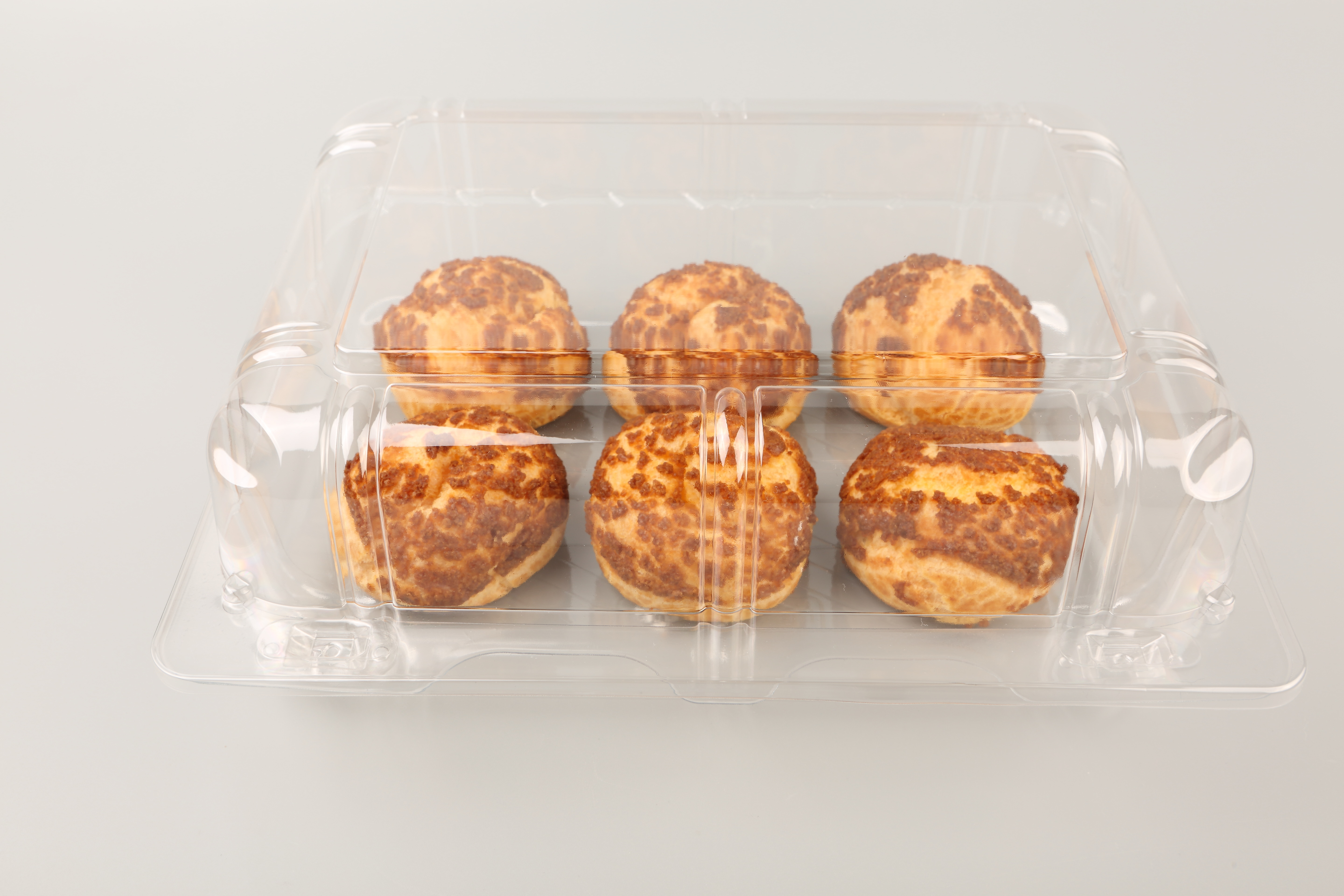
This is the workhorse family for counter-packed food. All six models are PET, and the range runs from a sandwich wedge to a large utility container: LH0703C (folded 168 × 88 × 82 mm, suggested maximum holding weight 150 g), LH0505C (141 × 123 × 64 mm, 16 oz, 300 g), LH95P (250 × 154 × 60 mm, 9.5-inch pie container, 500 g), LH1008 (261 × 209 × 96 mm, 700 g), LH1208 (317 × 216 × 72 mm, 1 kg) and LH1610 (415 × 261 × 106.5 mm, 2 kg).
Why it fits the role: the one-piece hinged design means base and lid are a single moulding, so there is no separate lid to order, match or run out of at the packing station, and the pack folds closed by hand. Clear PET gives the product visibility that a bakery or sandwich case depends on. The size ladder maps cleanly onto a menu: wedge for a cut sandwich, 16 oz for a side or dessert, 9.5-inch for pies and tarts, and the larger bodies for family bakery, multi-item grab-and-go or meal kits.
Ventilation and modification: where airflow matters, ventilation holes can be specified as a custom feature during tooling evaluation. Within the wider Linhua portfolio the same hinged principle is used for fresh produce: the DP-1LBSS fruit clamshell is a 1 lb PETE container with a recommended load of up to 500 g, a reference unit weight of approximately 26.5 g and ventilation options — a format built for berry and produce packing rather than for bakery.
Boundary: a hinged PET bakery container is not a hot-holding vessel. Lid fit, stacking performance and suitability for the intended storage conditions should be confirmed per SKU, and hot rotisserie programs belong in the formats described below.
2. Multi-compartment produce and deli trays (LH1303 / LH1003 / LH1616 / LH1173 / LH0606)
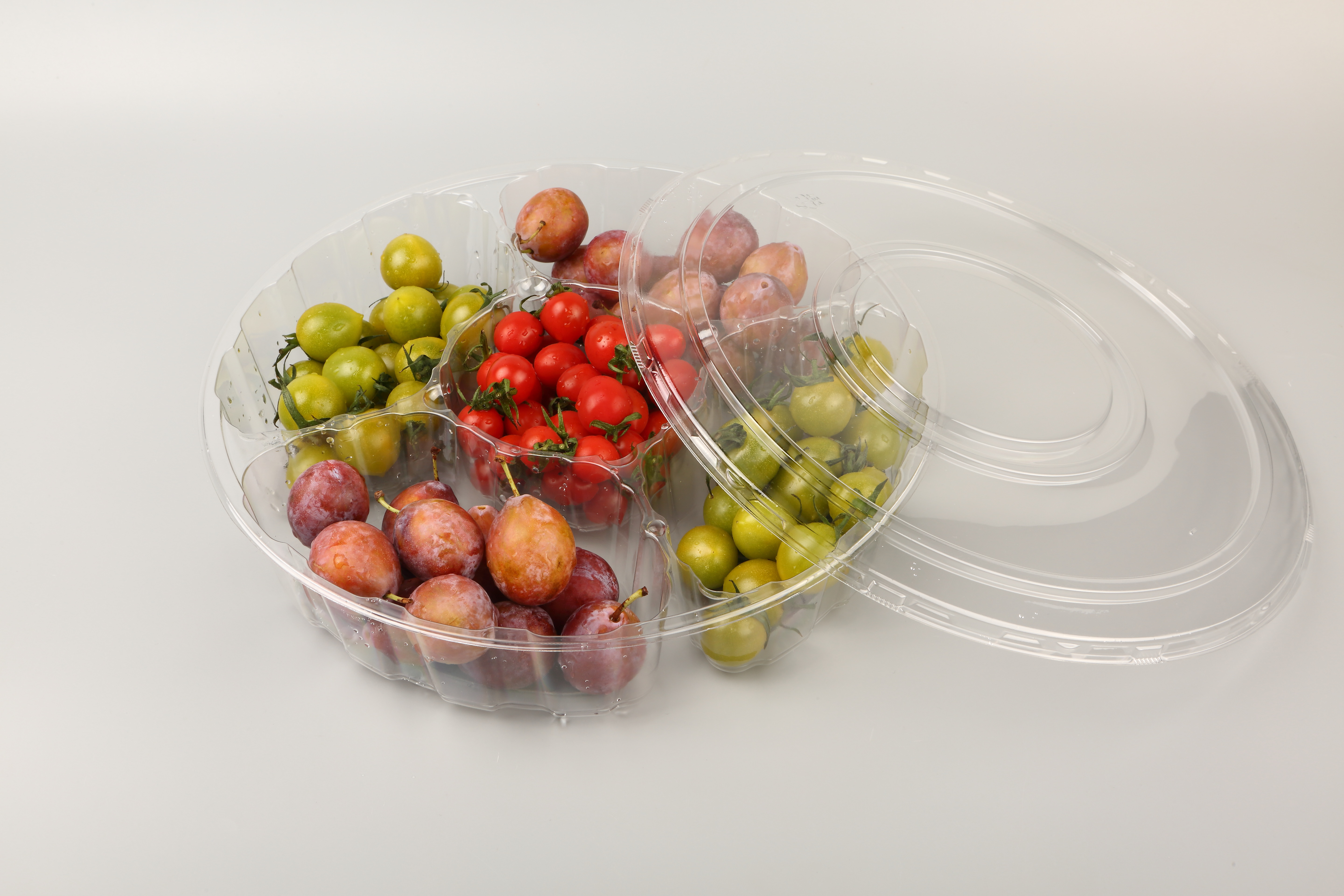
Compartmentalisation is the reason this family exists. LH1303 is a 13-inch round tray, Ø335 × 75 mm, with 4+1 compartments and a suggested maximum holding weight of 1.7 kg. LH1003 is the 10-inch version, Ø262 × 72 mm, 68 oz, 4+1 compartments, 1.2 kg. LH1616 is a 16-inch square 5-compartment platter with a base of 408 × 408 × 73 mm and a clear PET dome lid of 412 × 412 × 39 mm, 800 g. LH1173 is a 275 × 175 × 76 mm, 76 oz, 3-compartment tray at 400 g, and LH0606 is a 157 × 157 × 62 mm, 32 oz, 4-compartment tray at 400 g. All are PET.
Why it fits the role: one pack replaces several, because wet and dry, savoury and sweet, or protein and garnish stay apart without inner bags. The clear material lets the customer read the contents at a glance, which is exactly what a deli or produce assortment has to do. The range also scales from a single-serve snack tray to a sharing platter, so a buyer can hold one supplier and one material family across individual, family and party formats, and the 16-inch platter’s dome lid protects piled product without contact.
3. Large salad combo (LH1205R)
LH1205R is a PET bowl-and-lid combo with a 96 oz capacity, Ø313 × 118.6 mm and a suggested maximum holding weight of 1.3 kg.
Why it fits the role: salad is a volume product, and 96 oz covers family-size and sharing packs that a small tray cannot. A clear bowl with real depth allows a layered build, so components stay visible through the side wall rather than being read only from the top. Because the lid is a separate component rather than a hinge, the bowl can be filled and finished at the salad bar before closing, and the closed pack is a straightforward unit for shelf stacking and takeaway.
4. Rotisserie chicken container (LH0907)
LH0907 is a PP base-and-lid combo measuring 235 × 190 × 116 mm, with a suggested maximum holding weight of 1.5 kg.
Why it fits the role: the 116 mm depth is the defining figure. A whole roast bird needs vertical clearance, and most general-purpose trays are too shallow to close over one without compression. The 1.5 kg holding weight sits above typical whole-chicken pack weights, which leaves margin for the bird plus any garnish or juce. The two-piece format also matches how the product is actually packed: the bird goes into an open base at the hot counter, the lid closes over it, and the pack moves straight to the display or the customer.
Boundary: PP is the base material, but hot-holding, venting and steam management are application questions. Buyers running a hot case should confirm the intended serving temperature and holding time against the agreed specification, and should not assume that a container validated for chilled display is validated for a heated cabinet.
5. Prepared meat and deli containers (LH1107 / LH1607 / LH1108)
LH1107 is a half-rib container at 275 × 183 × 55 mm with a suggested maximum holding weight of 800 g; LH1607 is the full-size rib container at 413 × 173 × 67 mm, 1 kg; LH1108 is an oval prepared-food container at 271 × 213 × 91 mm, 1.3 kg. All three are PP.
Why it fits the role: ribs and cooked chicken are long, awkward shapes, and a rectangular tray sized for a steak wastes volume and lets the product slide. The 413 mm length of LH1607 follows a full rib rack; the oval LH1108 follows the contour of a fried or roasted chicken and gives 91 mm of height. Using a shape that matches the food reduces movement in transit and produces a cleaner display pack than forcing the same protein into a generic square.
Comparison table: the shortlist side by side
| Format family | Representative models | Material | Size reference | Suggested max. holding weight | Best-fit role |
|---|---|---|---|---|---|
| Hinged grab-and-go & bakery | LH1008 / LH1208 / LH1610 / LH0703C / LH0505C / LH95P | PET | Folded 141 × 123 × 64 mm to 415 × 261 × 106.5 mm | 150 g to 2 kg | Sandwiches, bakery, pies, grab-and-go meals, meal kits |
| Multi-compartment produce & deli trays | LH1303 / LH1003 / LH1616 / LH1173 / LH0606 | PET | Ø262 × 72 mm to 408 × 408 × 73 mm base | 400 g to 1.7 kg | Deli assortments, produce, snacks, party platters |
| Large salad combo | LH1205R | PET | 96 oz, Ø313 × 118.6 mm | 1.3 kg | Family and sharing salads, salad bars, catering |
| Rotisserie chicken container | LH0907 | PP | 235 × 190 × 116 mm | 1.5 kg | Whole rotisserie chicken, hot deli |
| Prepared meat & deli containers | LH1107 / LH1607 / LH1108 | PP | 275 × 183 × 55 mm to 413 × 173 × 67 mm; oval 271 × 213 × 91 mm | 800 g to 1.3 kg | Ribs, fried chicken, prepared meat, takeaway |
| Hinged produce clamshell | DP-1LBSS | PETE | 1 lb capacity, reference unit weight approx. 26.5 g | Up to 500 g recommended load | Berries and fresh produce, ventilated packs |
Step-by-step: how to build the shortlist for your own program
The sequence below is the one that avoids the most common buying error, which is choosing a container before the portion and the packing method are fixed.
Step 1 — Map the menu to families, not to individual products. Group your range by packing job: hand-held and bakery, separated components, high-volume salad, whole bird, long or shaped protein. Most retail programs collapse to four or five families, which is exactly where the SKU count should stop.
Step 2 — Fix the portion and the pack weight per SKU. Confirm the filled weight and check it against the suggested maximum holding weight. A 1 kg holding weight does not mean a 1 kg program is comfortable; it means 1 kg is the reference maximum.
Step 3 — Decide clear or opaque. Clear PET carries fresh and deli presentation where the customer needs to see the product. Where the food is the whole story and the pack only has to contain it, material can be chosen on other grounds.
Step 4 — Choose the closure type against the packing station. Hinged formats suit counter staff closing packs by hand with no dedicated sealing equipment. Base-and-lid formats suit filling first and closing second, which is how rotisserie and large salad builds usually run.
Step 5 — Confirm food-contact and labelling requirements for the destination market. Ask for the documentation that applies to the specific SKU and market, not a general statement. For EU-bound programs this step now sits alongside PPWR 2025/40 obligations.
Step 6 — Exhaust standard moulds before commissioning tooling. Trial the closest standard sizes on real product. Only move to a custom mould when no standard format clears the menu, because a new mould adds development and sampling time to the program.
Step 7 — Sample, trial in store, then set the reorder cadence. Run a filled-pack trial through your actual storage, stacking and display conditions, approve the specification, and only then confirm lead time and order pattern.
Use cases: where these formats earn their place
Supermarket deli and prepared-food counters. This is the widest application. A Canadian supermarket and grocery retail supply customer runs a recurring multi-SKU supply program of approximately 15 FCL per week across deli, prepared food, fresh produce, salad, bakery, grab-and-go and party-food lines, covering rotisserie chicken, salads, vegetable and fruit assortments, ribs, sushi and deli foods, sandwiches, bakery products, pies, meal kits and catering platters. The value in that program is not a single container; it is that a broad standard SKU range supports recurring multi-category purchasing without developing every item from scratch.
Convenience and grab-and-go. The hinged family covers this best. A sandwich wedge, a 16 oz body and a 9.5-inch pie container between them absorb most of a chilled grab-and-go shelf, and all three close by hand at speed.
Fresh produce and salad bars. LH1205R handles bulk salad and fruit salad, while the compartment trays handle mixed assortments. For berries and loose produce, the DP-1LBSS clamshell adds ventilation options and a one-piece hinged cover for a genuinely different packing job.
Catering, party platters and meal kits. LH1616, at 16 inches with five compartments and a clear dome lid, is the party and catering format in the range, and the larger hinged bodies carry meal kits and multi-item bundles.
Foodservice and central kitchens. Where packs are assembled away from the store, the rib containers and the oval prepared-food container travel better than a generic square, because the footprint matches the food.
What to verify with the manufacturer before you commit
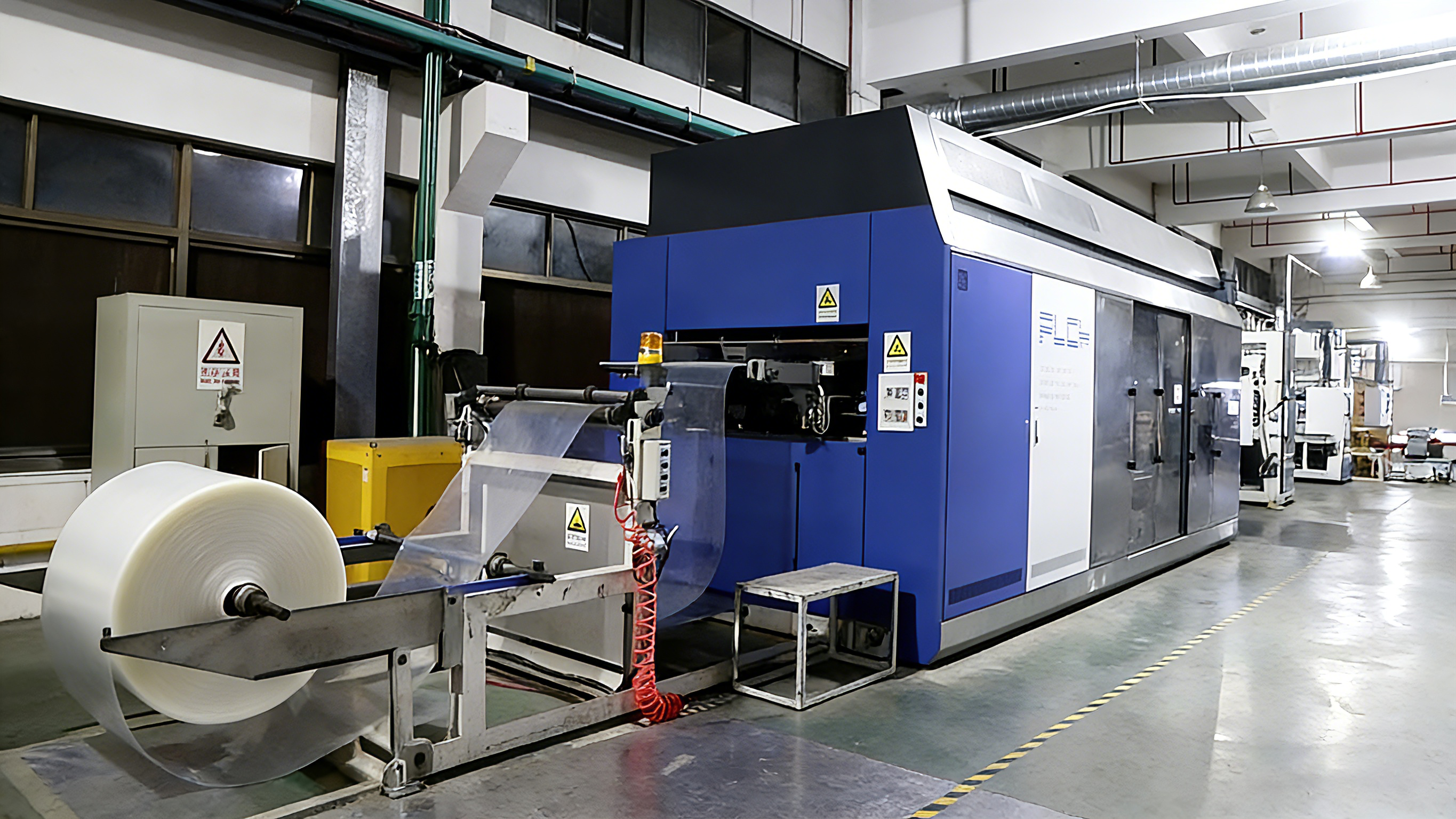
Container choice is half the decision; the other half is whether the supplier can repeat the specification on the same mould, order after order. Ningbo Linhua Plastic Co., Ltd. operates a factory of approximately 30,000 m² with 150 employees, an annual output of 20,000 tons and a monthly capacity of around 1,800 MT. The company exports about 70% of output, with markets including Australia, Canada, the United States, New Zealand, Singapore and the Middle East.
On capability, Linhua provides OEM and ODM production services, with production services that include custom mould development, product development, contract manufacturing and food packaging solution development. Customisation covers size, shape, material layer structure, colour, printing, surface finish and moulds. Development work is supported by a 26-person cross-functional team: 4 R&D engineers, 5 mould engineers, 2 process engineers, 8 quality and QC professionals, 1 product documentation and compliance specialist, 4 project managers and 2 application engineers.
On quality and compliance, quality control runs through incoming material inspection, in-process quality control and final product inspection before shipment. The current certificate set includes ISO 9001:2015 (certificate 18426Q00712R001, valid to 7 June 2029), BRCGS Global Standard Packaging Materials Issue 7 at Grade B (certificate CN057524-1, issued 14 October 2025 and expiring 5 November 2026), HACCP (certificate 610H151, valid to 15 October 2027) and a SMETA 2-Pillar audit report (ZAA600206602, Bureau Veritas). A Global Recycled Standard 4.0 scope certificate (TRC-GRS-222470-00, valid 29 September 2026 to 28 September 2027) covers hard goods and plastic containers within its stated scope, and an SGS third-party test report (NBHL260902990901CW, 17 September 2026) covers a PET clamshell under US FDA 21 CFR 177.1630. Because certificates carry defined scopes and expiry dates, recycled-content or food-contact claims should always be checked against the certificate that applies to the exact SKU and market.
On commercial terms, the standard MOQ is one full container per item, and a first or trial order covering several items can be arranged as mixed loading; products with customisation requirements carry a higher MOQ. Lead time is normally 30–45 days after order confirmation, depending on specification, quantity and production schedule, and custom mould projects require additional development time.
A short RFQ checklist. Send the container family and model you are considering; the filled weight and portion size; the food application; the required quantity or annual demand; colour or printing requirements; and, for the destination market, the food-contact documentation you will need. If the container must match existing store fixtures or a display case, include the internal dimensions of that case.
Frequently asked questions
What food-contact documentation can we expect for a container sold into our market?
Requirements vary by market and product, so the applicable material, testing or documentation should be checked before confirmation rather than assumed. Linhua’s current set includes ISO 9001:2015, BRCGS Global Standard Packaging Materials Issue 7 at Grade B, HACCP and a SMETA 2-Pillar audit report, plus a Global Recycled Standard 4.0 scope certificate and an SGS third-party test report for a PET container under US FDA 21 CFR 177.1630. Each certificate has a defined scope and expiry date, so tell us the destination market and required standard and the applicable documents can be matched to the specific SKU.
Can we get a custom size, compartment layout or ventilation for our program?
Yes. Linhua supports OEM and ODM production and custom food packaging development, including custom mould development. Depending on the product, customisation can cover tray dimensions, depth, shape, colour, material structure, compartment layout, ventilation and tray structure. A new project normally starts with confirming the food application and specification, followed by mould development and sampling; for customised projects, sample approval is an important step before production approval. Where a standard mould already fits the portion, using it will usually shorten the program.
What is the minimum order quantity and how is pricing handled?
The standard MOQ is one full container per item. For a first or trial order covering several items, mixed loading can be arranged; products with customisation requirements carry a higher MOQ. Quotation follows specification confirmation, so the useful inputs are the container family and model, dimensions or an existing sample, the food application, the required quantity and any colour or customisation requirement. Because plastic packaging is made from synthetic polymers such as polypropylene and polyethylene whose prices move with input costs, quotations are best treated as specification- and date-specific.
Can we evaluate samples before committing to a program?
Yes. Once the requirements are clear and a suitable existing product has been confirmed, samples can be provided free of charge, with the customer covering the shipping cost. If the project requires a new mould or a customised product, sample arrangements are discussed separately as part of the development process. Sending an existing tray, drawing, dimensional specification or machine detail helps identify the right starting point faster.
What is the lead time, and how do we move from a sample to a recurring order?
Lead time is normally 30–45 days after order confirmation, depending on product specification, order quantity and production schedule; new mould projects require additional development and sampling time. The usual path is specification confirmation, sample approval, commercial confirmation, then scheduled production against a monthly capacity of around 1,800 MT. If you are planning a retail listing, share the target launch window with the enquiry so lead time and sampling can be sequenced against it.
Conclusion: build the range once, then repeat it
The shortlist that works for grab-and-go, deli, salad and rotisserie programs is deliberately small. Hinged containers handle hand-closed bakery and grab-and-go packs; compartment trays handle separated assortments; the 96 oz salad combo handles volume; the 116 mm rotisserie container handles a whole bird; and the rib and oval prepared-food containers handle awkward protein shapes. Between them they cover the categories a retail deli actually sells, using moulds that already exist.
The next step is a dimensional check against your own menu: pick one product per family, confirm the filled weight against the suggested maximum holding weight, and request samples of the closest standard models before discussing any custom tooling.
Next step: sample the shortlist
Review the full Linhua range in the Linhua E-catalogue 2025 (PDF), or send your container family, dimensions, food application and expected quantity to request samples or a quotation. If your program needs a size that is not in the standard range, include that requirement in the same enquiry so the standard and custom options can be compared together.
Ningbo Linhua Plastic Co., Ltd.
Website: www.nblinhua.com
Address: No. 13, Dongfan Road, Xiwu, Fenghua, Ningbo, Zhejiang 315500, China
Tel: +86 574-8773-9122 | Email: Freya@nblinhua.com
WhatsApp: +852 57318298
Have Questions or Need More Details?
Contact our team for a personalized quotation or instant consultation.
Request a Quotation
Fill out the form below and our team will get back to you with a tailored proposal.
WhatsApp Direct Chat
Prefer to chat in real-time? Message us on WhatsApp for instant assistance & quick answers.
- Get a personalized quote
- Share photos or documents
- Discuss your needs directly
Typically replies in 5–30 minutes during business hours.