
VSP Food Packaging Containers: A Buyer's Guide
Plastic food packaging containers · Vacuum skin packaging
Quick answer: A VSP food packaging container is a rigid plastic tray used in vacuum skin packaging. Air is removed from the pack and a skin film is drawn down over the food and sealed to the tray, so the film follows the product's contours and holds it in position. VSP trays are made in PP or PET and are used for fresh meat, steaks, poultry, fish, seafood and other chilled products where shelf presentation and product positioning matter.
The tray is only one part of the system. The skin film, the packaging machine, the sealing conditions, the product height and the storage temperature all influence the finished pack. That is why VSP tray selection is normally a joint technical exercise between the food packer and the tray manufacturer, not a catalogue lookup.
This guide is written for meat processors, seafood companies, chilled-food manufacturers, supermarket packaging teams and packaging distributors who are evaluating a vacuum skin packaging project. It explains what VSP containers solve and what they do not, how the LINHUA VSP tray range is structured, how to run a selection process step by step, and what to check before approving a supplier.
What Problems Do VSP Containers Actually Solve?
Vacuum skin packaging is used because it addresses three practical problems in fresh-food packing and retail display: product movement, shelf presentation and pack integrity. Each one has a different cause, and each one is solved by a different part of the system.
1. Product movement inside the pack
In a VSP pack, air is removed and a specially designed skin film forms closely around the food before sealing to the tray. The film holds the product securely in position instead of leaving it free to slide under a loose lid. For irregular items such as steaks, fish fillets or poultry portions, this is a functional benefit rather than a cosmetic one: the product stays where the packer placed it through handling, transport and display.
2. Shelf presentation
Because the film follows the contours of the food, the pack shows the natural shape, texture and appearance of the product. LINHUA describes this as a clear three-dimensional presentation, and it is the main reason VSP is associated with premium meat cuts, steaks, fish fillets and seafood. Clear presentation lets a retailer sell appearance as well as weight.
3. Packaging integrity during handling
A sealed skin pack keeps the product secured to the tray and reduces the free space inside the pack. That matters for stacking, case packing and refrigerated display, where packs are handled repeatedly. Pack integrity still depends on seal quality, tray flatness, film choice and machine settings, so it should be validated with a real sealing trial rather than assumed from a tray drawing.
What VSP does not solve
No tray alone can guarantee shelf life. Food condition, film, vacuum process, seal integrity, hygiene and storage temperature all affect the final result. A supplier that promises a shelf-life figure without asking about the product, the film, the machine and the cold chain is not giving a technical answer.
VSP also does not solve liquid management. Products that release significant purge may still need a moisture-management solution, which is a different tray design question.
Industry Background: Why Rigid Plastic Food Containers Still Matter
Food packaging is essential for transporting, storing, handling and preserving food, and different types of plastic are the most common food packaging materials, according to industry-backed educational material published through the Plastics Europe ecosystem. Rigid trays, cups, lids, boxes and hinged containers all sit inside that broad plastic packaging category.
The commercial context is large and still growing. Grand View Research valued the global food containers market — a broad category covering rigid and flexible formats — at USD 331.7 billion in 2024. Within barrier packaging specifically, Market Research Future projects the EVOH packaging market growing from USD 1.847 billion in 2025 to USD 3.055 billion by 2035, a CAGR of 5.16%. EVOH is relevant to VSP because it can be used as a functional barrier layer in multilayer tray structures where improved gas-barrier performance is required.
Regulation is moving at the same time. Since 12 August 2026, the EU Packaging and Packaging Waste Regulation (EU) 2025/40 has applied, including restrictions on PFAS in food-contact packaging, according to the European Commission. Separately, Commission Regulation (EU) No 10/2011 sets specific requirements for plastic materials and articles intended to come into contact with food, including limits on substance migration. In the United States, the FDA framework classifies food packaging and its components as food contact substances.
For buyers, the practical consequence is that a VSP tray is no longer specified on dimensions and price alone. Material structure, barrier performance, food-contact documentation and end-of-life considerations are now part of the same decision. Requirements differ by market and by product, so the applicable standard, test report or declaration should be checked for the exact SKU and destination market before mass production.
How LINHUA's VSP Tray Range Is Structured
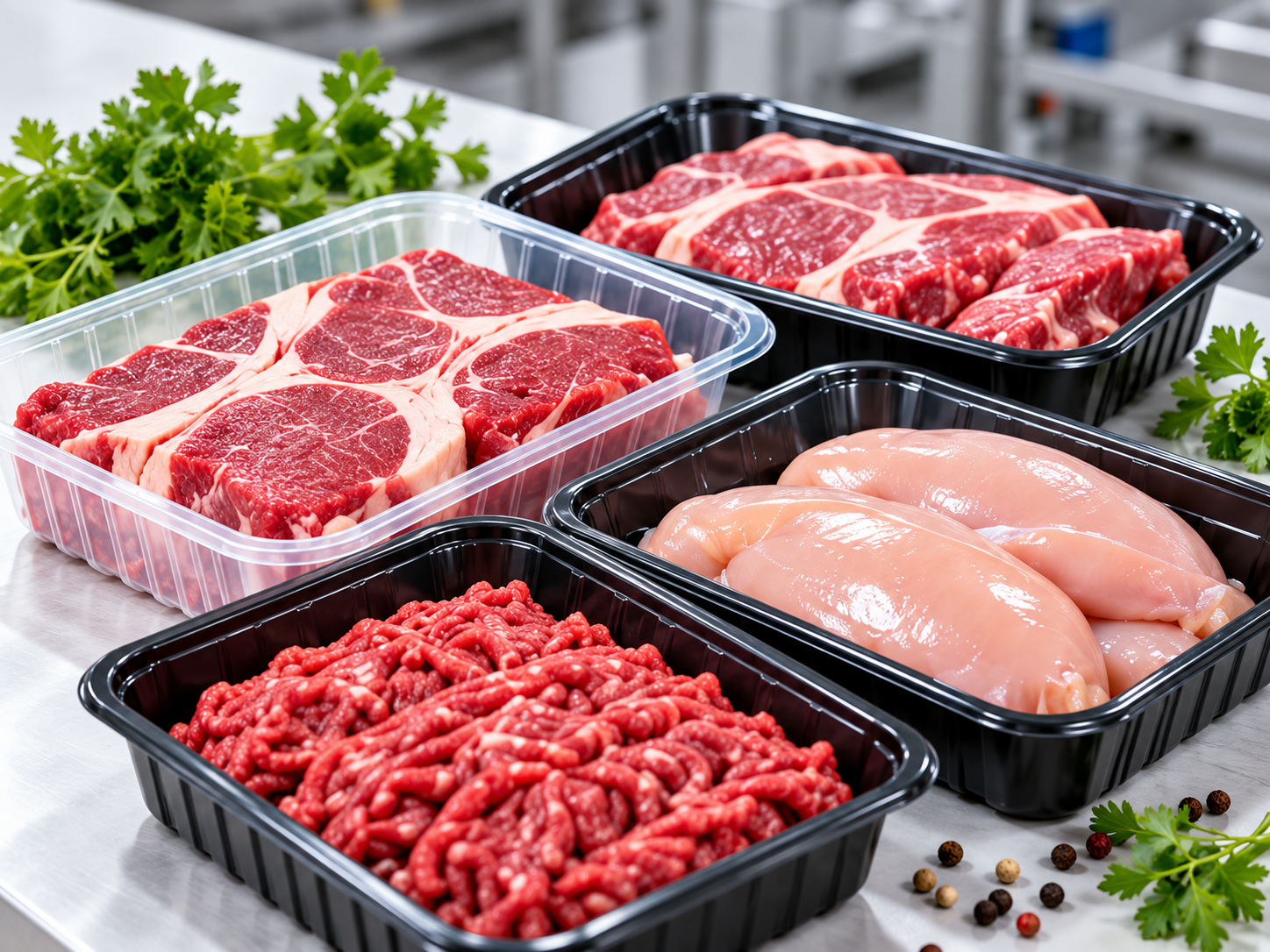
Ningbo Linhua Plastic Co., Ltd. is a B2B food packaging manufacturer based in Ningbo, Zhejiang, China, established in 2004. The company produces rigid food packaging containers — including MAP barrier trays, VSP trays, turned-edge PET trays, moisture retention trays, CPET trays and hinged containers — for food manufacturers, processors, retailers and packaging distributors.
The production site covers approximately 30,000 square metres and supports both standard production and customized packaging development. LINHUA reports around 150 employees and an annual output of 20,000 tons, with roughly 70% of business exported to markets including Australia, Canada, the United States, New Zealand, Singapore and the Middle East. A 26-person cross-functional team covers R&D, mould engineering, process engineering, quality and QC, product documentation and compliance, project management and application engineering.
Materials and structures
LINHUA VSP trays are made from PP and PET. Depending on the project, PP / EVOH / PE structures may also be discussed and evaluated. The choice is driven by the food, the storage condition (chilled or frozen), the target shelf life, the skin film, the packaging machine and the required presentation — not by material preference alone.
PP is widely used for food trays and can form part of barrier structures. PET is used where clear product presentation is important. Where additional barrier performance is required, a multilayer structure with an EVOH functional layer may be evaluated. Exact temperature limits, film compatibility and heating conditions should be confirmed for the selected model and application.
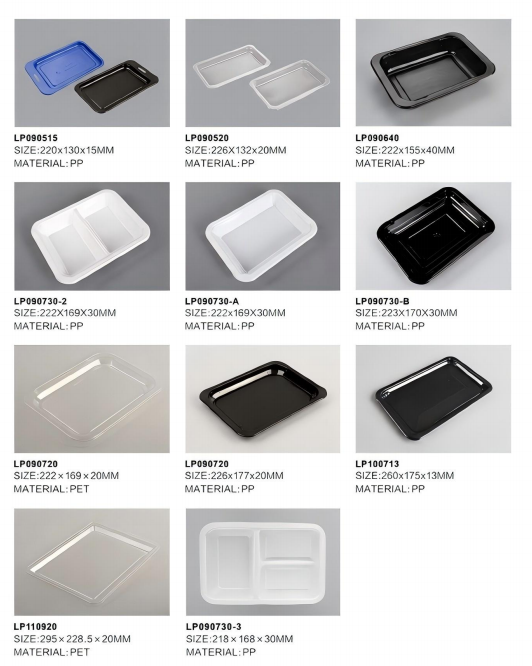
Standard VSP tray models
| Model | Dimensions (mm) | Material | Format |
|---|---|---|---|
| LP090515 | 220 × 130 × 15 | PP | Single compartment |
| LP090520 | 226 × 132 × 20 | PP | Single compartment |
| LP090640 | 222 × 155 × 40 | PP | Single compartment |
| LP090730-2 | 222 × 169 × 30 | PP | 2 compartments |
| LP090730-A | 222 × 169 × 30 | PP | Single compartment |
| LP090730-B | 223 × 170 × 30 | PP | Single compartment |
| LP090720 | 222 × 169 × 20 | PET | Single compartment |
| LP090720 | 226 × 177 × 20 | PP | Single compartment |
| LP100713 | 260 × 175 × 13 | PP | Single compartment |
| LP110920 | 295 × 228.5 × 20 | PET | Single compartment |
| LP110920 | 295 × 228.5 × 20 | PET | 3 compartments |
Reading the table correctly: model codes are listed as published in the current product specification. Where a code appears with more than one material or compartment variant, the exact variant, material structure, unit weight and packaging conditions should be confirmed in writing before ordering.
The range is deliberately broad in depth rather than uniformly deep. A 13 mm tray suits thin cuts and compact portions, while a 40 mm tray accommodates thicker products and provides more protection. Two- and three-compartment formats allow different components to be packed in one VSP pack where the application requires separation.
From standard tray to custom mould
Where no standard model fits, LINHUA supports the development process from concept and structural design through prototyping, mould development and mass production. Custom dimensions, colours, material structures, tray depths, compartment designs, ventilation holes, sealing requirements and new mould development can be evaluated on request.
This matters most in VSP projects, because a tray that is dimensionally close but has the wrong flange or depth can fail at the sealing stage. For customized projects, sample evaluation is an important step before final production approval.
Step-by-Step: Selecting a VSP Tray for a Real Product
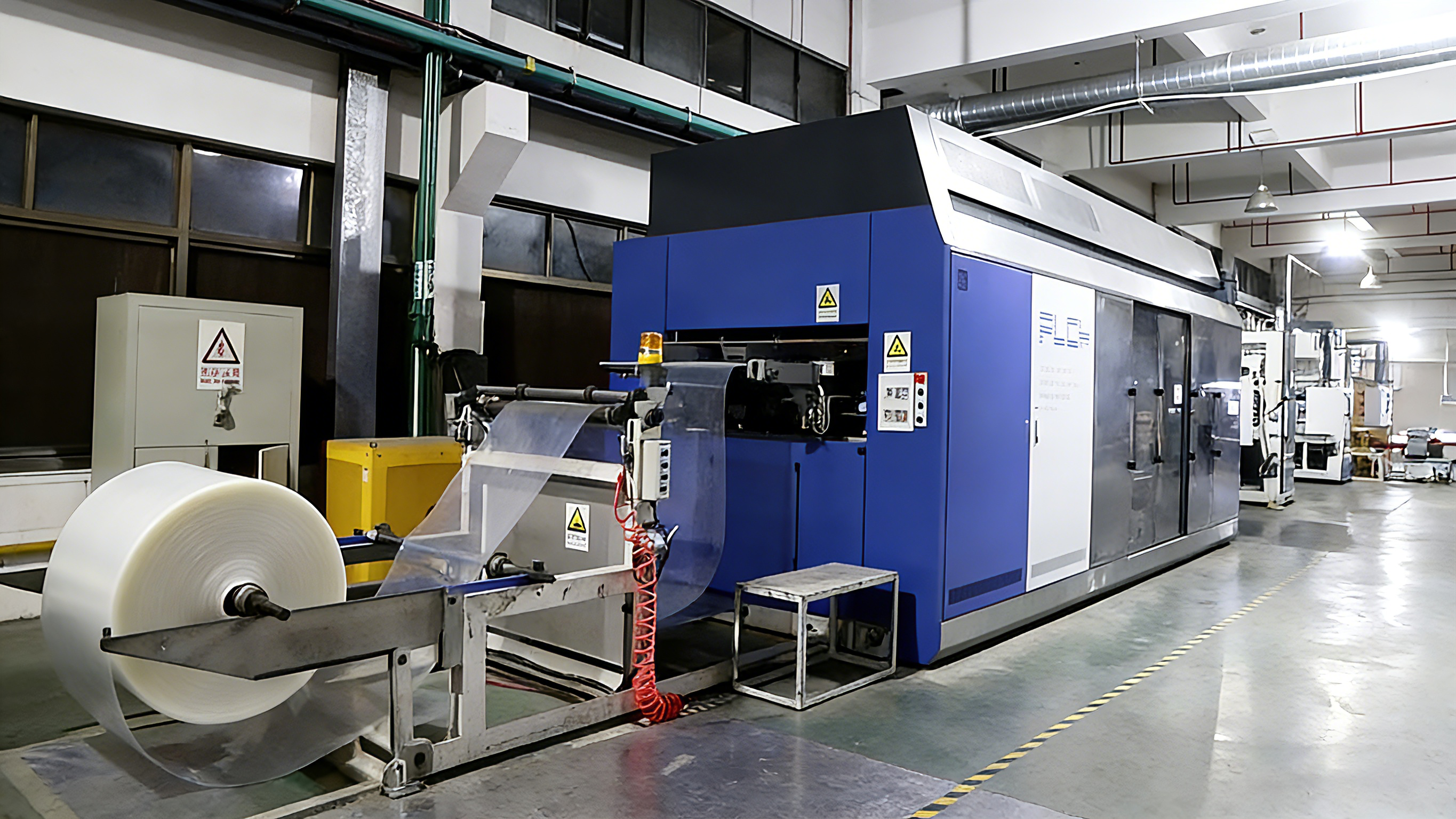
A VSP tray project runs in a predictable sequence. Skipping a step usually shows up later as a seal failure, a re-quote or a delayed launch.
Step 1: Define the food and the storage condition
Start with the product itself: species or food type, cut, average and maximum portion height, typical pack weight, expected purge, and whether the pack will be chilled or frozen. Storage temperature and target shelf life belong in the brief from day one, because they drive material and barrier decisions.
Step 2: Confirm the machine and the film
VSP compatibility depends on more than tray dimensions. The skin film, packaging machine, tooling and operating conditions all need to be considered together. If a production line already exists, the machine model, tooling dimensions and film specification should be shared so the tray can be evaluated against real conditions rather than a drawing.
Step 3: Set the tray footprint, depth and format
The footprint follows the product and the retail case; the depth follows product height plus the allowance the machine needs. Compartment layout is decided here too: a single-compartment tray for one cut, a two- or three-compartment tray where components must stay separate.
Step 4: Decide the material and barrier approach
PP, PET, or a PP / EVOH / PE structure where additional barrier is required. Clear presentation requirements point toward PET; barrier and sealing requirements may point toward a multilayer structure. The barrier decision should be tied to the target shelf life and the storage condition, not chosen in isolation.
Step 5: Run a sample and a sealing trial
Samples of an existing suitable product can be supplied so the packer can test filling, film and seal quality on their own line. Final compatibility should be confirmed through actual sealing trials, because tray, film and machine behaviour cannot be fully predicted on paper.
Step 6: Approve the specification and schedule production
Once the final specification, sample approval and commercial terms are confirmed, mass production can be scheduled. Lead time depends on the product specification, material, colour, quantity, mould status and the current production schedule — normally 4–6 weeks. New mould projects require additional development and sampling time before that window starts.
Use Cases: Where VSP Trays Fit, and Where They Do Not
VSP is a strong fit for premium and mid-premium chilled products where appearance and product positioning carry commercial weight. It is a weaker fit where the packaging problem is liquid control, oven reheating or dry display.
| Application | Why a VSP tray fits | What to confirm |
|---|---|---|
| Fresh meat and steaks | Film follows the cut, holds it in position, shows natural texture and shape | Product height, film, machine, chilled storage, target shelf life |
| Poultry portions | Secures irregular pieces and keeps a clean retail appearance | Purge level, seal integrity, tray depth |
| Fish fillets and seafood | Close-fitting pack protects delicate surfaces and shows product quality | Frozen or chilled condition, barrier requirement, film compatibility |
| Premium chilled retail packs | Three-dimensional presentation supports premium positioning | Tray colour, footprint versus case and display format |
| Family-size and multi-component packs | Large footprints and compartment formats keep components separate | Load, tray rigidity, compartment layout |
Where a different container is the better answer
- High-purge fresh meat: a moisture retention tray with moisture-retention cells built into the base can capture excess purge and reduce or eliminate the need for a separate absorbent pad. LINHUA MRT models (MRT58, MRT610, MRT810, MRT87, MRT511, MRT911) are built on the turned-edge PET platform for overwrap applications.
- Ready meals requiring reheating: CPET trays are intended for ready meals and prepared foods where higher temperature resistance is required, subject to confirmed material specifications.
- Bakery, deli and grab-and-go: one-piece hinged containers with an integrated lid and base are simpler where no sealing equipment is used.
- In-store overwrap: turned-edge PET trays are designed for stretch film and overwrap, with a rolled flange that helps reduce the risk of film catching or tearing.
VSP vs MAP vs Overwrap: A Practical Comparison
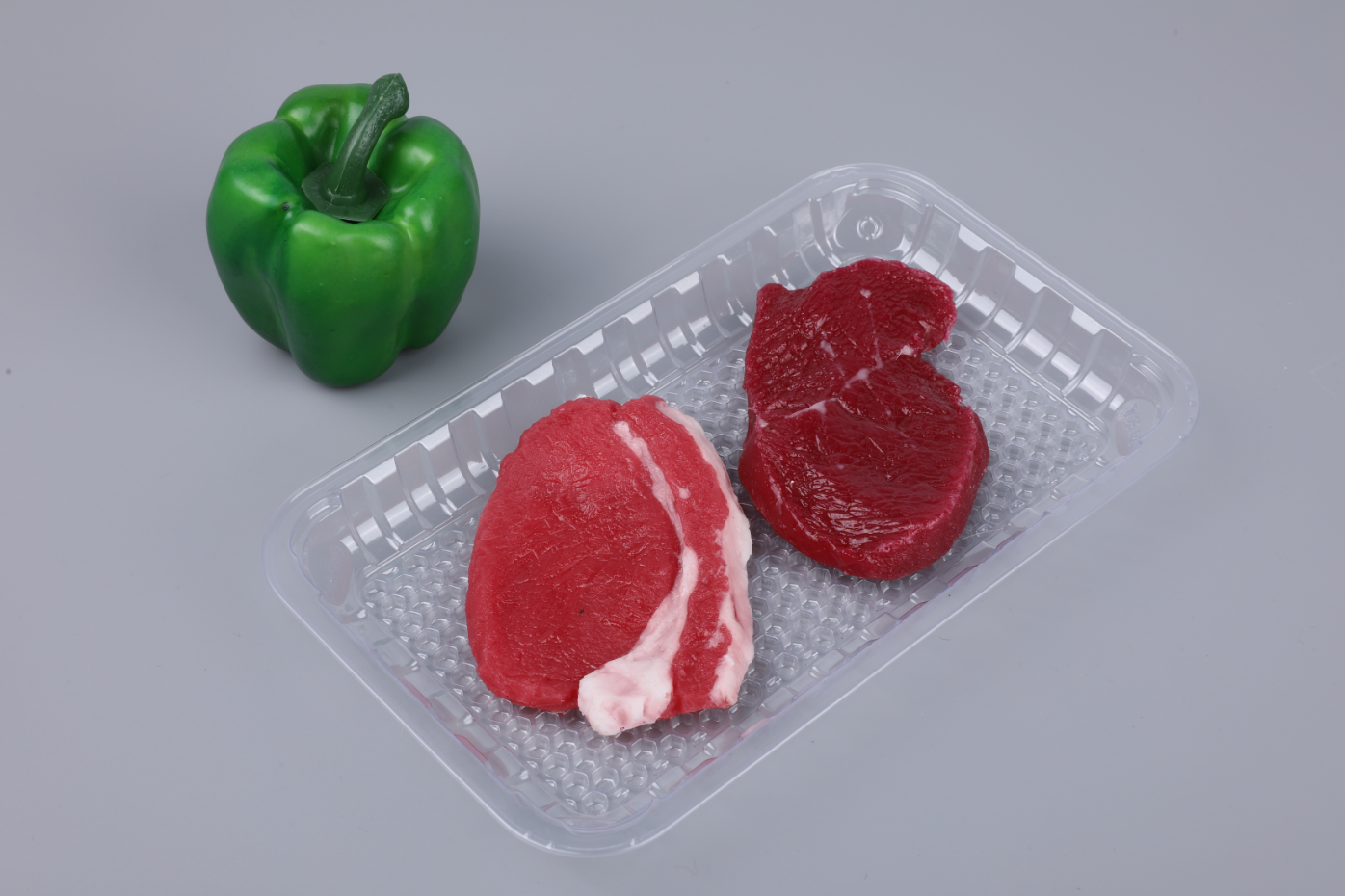
These three packaging methods are frequently compared because they can all present fresh food in a rigid plastic tray. They are not interchangeable: each one solves a different problem and requires different equipment.
| Decision factor | VSP (vacuum skin packaging) | MAP (modified atmosphere packaging) | Overwrap |
|---|---|---|---|
| Packaging method | Vacuum applied; skin film conforms to the product and seals to the tray | Gas flushing and heat sealing with a lidding film | Stretch film or overwrap around a filled tray |
| Typical tray material | PP or PET; PP / EVOH / PE structures may be evaluated | PP with high-barrier PP-based structure and EVOH multilayer barrier | PET, including turned-edge PET trays |
| Equipment involved | VSP machine, skin film, tooling matched to tray | MAP sealing machine, lidding film, sealing mould | Wrapping equipment or manual wrap, stretch film |
| Presentation | Film follows product contours; strong three-dimensional presentation | Product visible under a flat lidding film inside a defined headspace | Simple wrapped pack; presentation depends on wrap quality |
| Typical fit | Steaks, premium cuts, poultry, fish fillets, seafood, premium chilled retail | Chilled food where a controlled atmosphere and shelf-life management are priorities | Fresh-food retail where simple wrapping, clear presentation and existing supermarket-style lines matter |
| What to check first | Product height, film, machine, tray dimensions, storage temperature, target shelf life | Barrier performance, gas mixture, seal integrity, cold chain | Flange quality, film compatibility, pack tightness |
A common mistake is to treat these methods as a quality hierarchy. They are not. A supermarket overwrap line may be the correct, cost-appropriate answer for high-turnover fresh meat, while a premium steak program may justify a VSP pack. The right choice depends on the food product, the packaging target and the equipment already available.
How to Evaluate a VSP Tray Supplier
Supplier evaluation for VSP trays should test the supplier's technical process, not just the product list. The following points are the ones that most often separate a workable project from a slow one.
- Documented specifications. Dimensions, material, compartment layout and unit weight tolerance should be stated in writing for the exact SKU. LINHUA publishes a ±5% unit weight tolerance for reference on its tray ranges.
- A real compatibility process. The supplier should ask for machine model, tooling dimensions, film specification, storage temperature and target shelf life before recommending a tray. A supplier who answers with a product code only has not done the evaluation.
- Sampling before commitment. Existing-product samples allow a packer to test on their own line. Custom projects should move through design, mould, sample and approval in sequence.
- Compliance documentation for the destination market. Food-contact, barrier and temperature-resistance requirements should be confirmed against the target market and application, based on the latest valid certificates and test reports and the applicable product scope — not on a general statement.
- Manufacturing capacity and continuity. Ask about plant size, output, equipment and typical lead times. LINHUA operates a site of approximately 30,000 square metres with reported annual output of 20,000 tons and an export share of around 70%.
- Development capability. For non-standard packs, check whether the supplier can handle structural design, prototyping and mould development internally, and whether a cross-functional team is assigned to the project.
Frequently Asked Questions
What food-contact compliance should be confirmed before buying VSP trays?
It depends on the destination market. In the EU, plastic food-contact materials and articles fall under Commission Regulation (EU) No 10/2011, which sets specific migration limits, and since 12 August 2026 the Packaging and Packaging Waste Regulation (EU) 2025/40 has applied, including restrictions on PFAS in food-contact packaging. In the United States, food packaging and its components are treated as food contact substances under the FDA framework. Because requirements vary by market and product, buyers should request documentation for the exact SKU, material structure and destination market. LINHUA's stated position is that food-contact, barrier and temperature-resistance requirements should be confirmed according to the target market and application, based on the company's latest valid certificates, test reports and applicable product scope.
Can LINHUA match a VSP tray to my existing skin-pack machine and film?
Compatibility depends on more than tray dimensions. LINHUA normally checks the tray size, sealing mould or tooling, packaging machine, skin film, food application and operating conditions together. For an existing line, the most useful information to send is the food type, product height, tray dimensions, VSP machine model, skin-film specification, storage conditions and required shelf life. Final compatibility should be confirmed through actual sealing trials, and no tray alone can guarantee a specific shelf life, because product condition, film, vacuum process, seal integrity, hygiene and storage temperature all affect the result.
What drives the cost of a VSP tray project?
LINHUA prepares quotations after the product and application details are confirmed, so there is no single published unit price. The main cost drivers are the material (PP, PET, or a multilayer structure where barrier performance is required), tray dimensions and weight, compartment layout, colour, order quantity, and whether a new mould is needed. Minimum order quantity depends on the product, material, colour, specification and whether new tooling is required; standard and customized products can have different MOQ requirements. Trial-order feasibility depends on the product and existing tooling, so it is worth stating both the trial quantity and the expected regular demand in the first enquiry.
Can I get samples before committing to production?
Yes. Once the requirements are clear and a suitable existing product is confirmed, samples are provided free of charge and the customer covers the courier cost. To select the right sample, LINHUA needs the required tray type or dimensions, the food application and the expected quantity; for VSP or MAP projects, machine, mould, film, storage temperature and shelf-life information may also be required. If no existing tray fits the product, a customized tray and new mould can be evaluated, with custom sampling arranged after the design and mould-development requirements are confirmed.
How long does production take once a tray is approved?
Lead time depends on the product specification, material, colour, quantity, mould status and the current production schedule, and is normally 4–6 weeks. New mould projects require additional development and sampling time. Mass production is scheduled after the final specification, sample approval and commercial terms are confirmed. To start a sample or quotation request, send the tray type or dimensions, the food application, the expected quantity and any machine or film information to Freya@nblinhua.com, or message the team on WhatsApp.
Conclusion
VSP food packaging containers solve a specific set of problems: they hold the product in position, present it in three dimensions, and support pack integrity through handling and display. They do not replace good sealing practice, correct film selection or cold-chain control, and they are not the right answer for every fresh-food application.
For buyers, the practical route is to define the food and storage condition first, confirm the machine and film second, and only then choose a tray footprint, depth and material. LINHUA's VSP range covers PP and PET trays from 13 mm to 40 mm in depth, with single, two- and three-compartment formats, plus custom dimensions, structures and mould development where a standard model does not fit. That range is useful only if it is matched to a real product and a real packaging line — which is why the sample and sealing trial stage should not be skipped.
Next step: sample, quote or catalogue
Send your tray dimensions, food application, machine and film details, and expected quantity to receive a matched tray recommendation or a quotation. Existing-product samples are provided free of charge; the customer covers courier cost.
Website: www.nblinhua.com | Email: Freya@nblinhua.com | Tel: +86 574-8773-9122
Download the full product catalogue: Linhua E-catalogue 2025 (PDF)
Have Questions or Need More Details?
Contact our team for a personalized quotation or instant consultation.
Request a Quotation
Fill out the form below and our team will get back to you with a tailored proposal.
WhatsApp Direct Chat
Prefer to chat in real-time? Message us on WhatsApp for instant assistance & quick answers.
- Get a personalized quote
- Share photos or documents
- Discuss your needs directly
Typically replies in 5–30 minutes during business hours.