Sore After a Long Flight? When a 3D Massage Chair Helps Most
Sore After a Long Flight? When a 3D Massage Chair Helps Most
\n\nLong-haul travel compresses a lot of stillness into a short period. You sit for hours in a cabin, queue through immigration on legs that have not moved, haul a bag across a terminal, then sit again in a transfer lounge or a hotel lobby. The result is predictable: a heavy, dull stiffness in the lower back, shoulders, neck and legs that arrives after landing and lingers through the first day of the trip.
\n\nThat pattern is one reason shared massage chairs have become a familiar sight in high-traffic venues such as airports, shopping malls and hotel lobbies. But \"there is a chair in the corner\" and \"the chair actually helps\" are two different procurement questions — one is about floor space, the other is about a recovery window, a mechanism class, a session length and a certification file. This article answers the second question: when a 3D massage chair helps most after a long flight, which venues it fits, what a buyer must verify, and what the evidence actually supports.
\n\n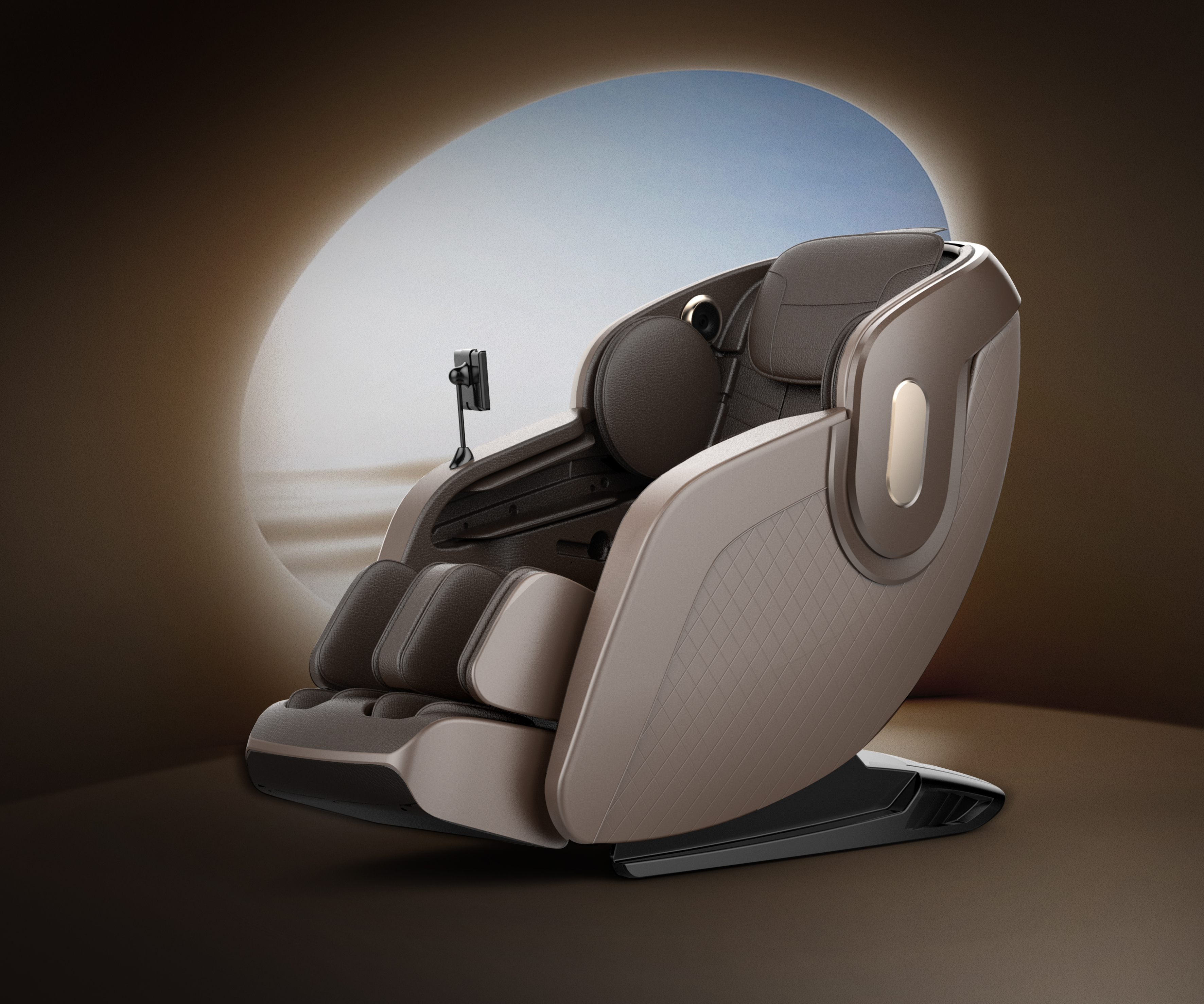
What a 3D massage chair can and cannot do after a long flight
\n\nThe discomfort travellers describe after a long flight is rarely sharp or dramatic. It is the outcome of the same tissue being loaded in the same position for a long time, with little movement between the cabin seat, the immigration queue and the baggage hall. Zhouqi's case documentation describes the intended application of its massage chairs in exactly these terms:
\n\n- \n
- Release muscle stiffness and body fatigue \n
- Boost blood circulation \n
- Reduce physical pressure and discomfort \n
- Relax nerves and improve sleep \n
- Relieve soreness from long sitting and tiredness \n
Two boundaries matter here. First, these are product-application descriptions taken from manufacturer case records, not clinical trial results, and they should be read as statements about what the product is built to do rather than medical outcomes. Second, a massage chair is not a treatment: pain that persists, radiates down a limb, or follows an injury belongs with a clinician, not with an amenity. What a chair can realistically do is shorten the period in which a stiff body stays uncomfortable, and — just as importantly for a venue — give a traveller a structured reason to stop moving for fifteen minutes.
\n\nThat second point is the one venue operators tend to underrate. A recovery stop is not really a furniture decision. It is a decision about a defined unit of time. Once the session length is fixed at fifteen minutes by the chair's own auto timer, the unit becomes predictable: predictable dwell, predictable rotation, predictable wear. Almost every operational question that follows — how many chairs a terminal needs, how a mall operator manages a queue, how often a hotel replaces upholstery — flows from that single number.
\n\nWhy travel-facing venues are adding massage chairs now
\n\nThe commercial context is a massage category that is still expanding. Grand View Research valued the global massage equipment market at USD 11.6 billion in 2024 and projects it to reach USD 21.8 billion by 2033, with massage chairs and sofas holding the largest share of that market at 39.5% in 2024 and North America accounting for 36.9% of 2024 revenue. For the chair segment specifically, Business Research Insights projects growth from USD 4.28 billion in 2026 to USD 8.78 billion by 2035, at a CAGR of 8.3%, while Credence Research places Asia Pacific as the fastest-growing region, holding 34.8% of the luxury segment in 2024.
\n\nTechnology adoption is moving in the same direction. Business Research Insights estimates that approximately 41% of new massage chair models in 2026 are expected to integrate AI-based sensors for body scanning — a figure that matters to buyers because it signals where the competitive specification line is moving, and therefore which features will look dated first on a two- or three-year venue contract.
\n\nFor a venue operator, the practical translation of this data is simpler than the market charts suggest. Travel and retail environments already contain people who are stiff, tired and waiting — a combination that makes a short paid recovery session an easy purchase decision. That is also why shared, pay-per-use placements have become a normal commercial model for massage chairs in malls and transportation venues rather than an experiment.
\n\nHow 3D massage technology maps to the post-flight recovery window
\n\nThe term \"3D\" describes how the massage head moves, not how strong the massage is. Understanding that distinction prevents a common specification mistake: buying more intensity when what the traveller actually needs is depth control.
\n\nDepth-controlled rollers
\nIn a mechanical 3D system, the massage head moves on three axes rather than two, which allows the roller depth to follow the contour of the back instead of pressing at a fixed distance. For a traveller whose back muscles are already guarding after hours of sitting, that adjustability is the difference between a session that releases tension and one that simply feels hard.
\n\nZero-gravity recline
\nThe Zhouqi 3D platform is classified as a zero-gravity massage chair, a posture in which the body's weight is redistributed across the seat and backrest. One third-party analysis (Technavio) attributes up to 70% lower-back pain reduction to zero-gravity posture alignment — a figure that should be treated as indicative rather than clinical, because it comes from market analysis rather than a controlled study, but it reflects the same ergonomic logic that makes the recline useful after a flight.
\n\nTrack geometry and airbag coverage
\nTrack geometry is the second specification question buyers ask, because S-track, L-track and SL-track designs cover different lengths of the spine. Airbag-assisted 3D systems pair roller movement with air compression, which is useful for the shoulders, hips and legs — the areas that stiffen most after long sitting. Neither feature replaces the other, and the right combination depends on the venue: a transit chair used for short, frequent sessions benefits most from consistent, repeatable coverage rather than the widest possible feature list.
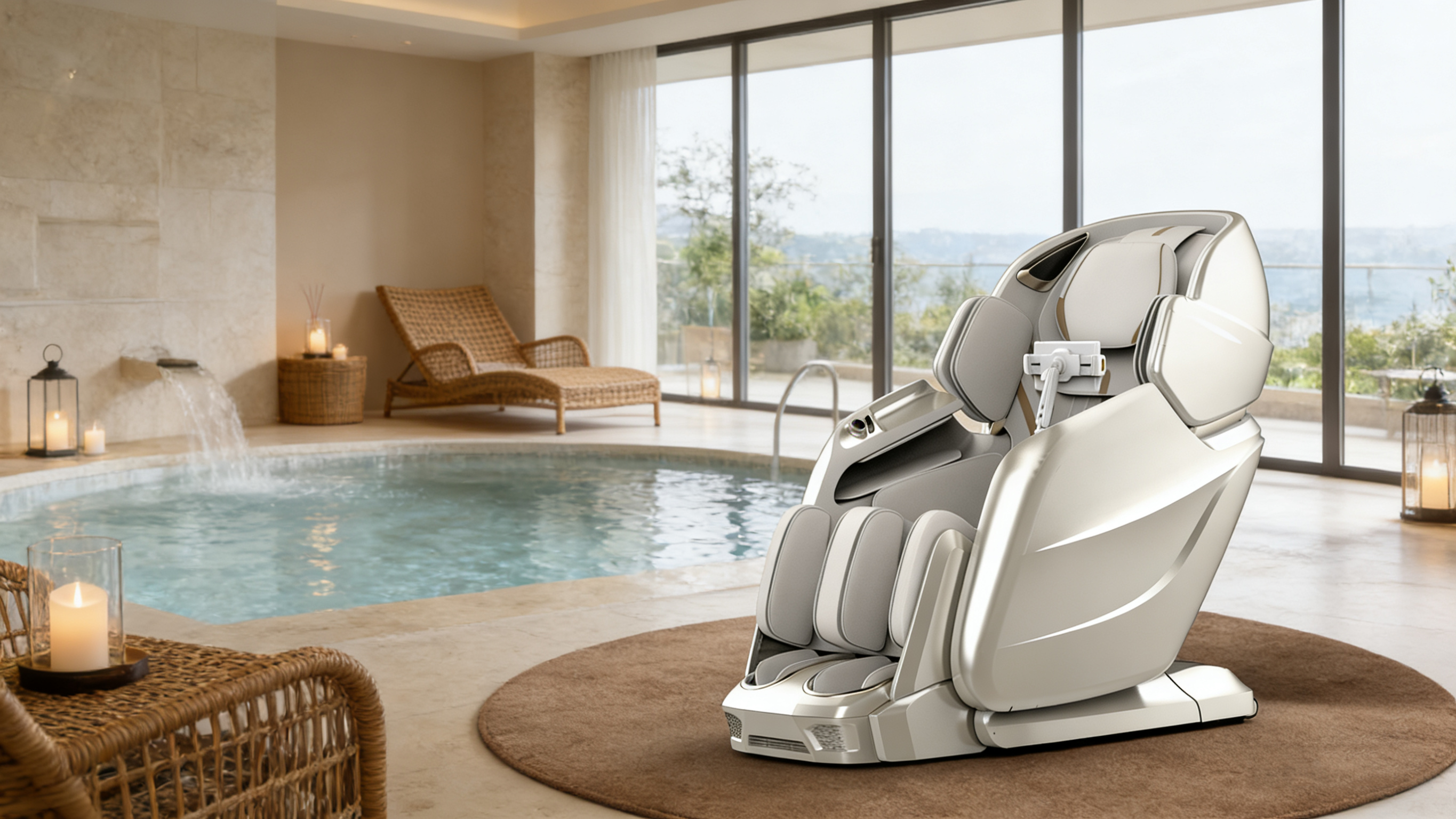
\n\nThe Zhouqi 3D platform (Product 6980)
\n\nThe 3D Massage Chair platform from Ningbo Zhouqi Health Technology Co., Ltd. covers sixteen models, from 3100 and 3104 through 5200, 5900, 5910, 6520, 6530, 6710, 6720, 6721, 6750, 8700 and up to 3212 and 3600. Its published specification is the starting point for any venue sizing exercise:
\n\n| Parameter | Published value |
|---|---|
| Type of product | Massage chair (zero-gravity type) |
| Model range | 5200, 5900, 5910, 3100, 6710, 8700, 3600, 3212, 6520, 5100, 6530, 3104, 3109, 6750, 6720, 6721 |
| Power input | 110V–240V, 50/60Hz |
| Rated power | 150W |
| Auto timer | 15 minutes |
| Dimensions, upright | 1590 (L) × 800 (W) × 1160 (H) mm |
| Dimensions, reclined | 1895 (L) × 800 (W) × 940 (H) mm |
| Box dimensions | 1950 (L) × 810 (W) × 880 (H) mm |
| Net / gross weight | 111 kg / 135 kg |
| Materials | Iron, foam, leather, ABS plastic |
Three of these values decide whether the chair fits a travel venue at all. The 150W rated power keeps the electrical load of a multi-chair installation modest and predictable. The 15-minute auto timer matches the session length a tired traveller will actually accept between flights. And the 110V–240V, 50/60Hz input means a single platform can serve North American, European, Middle Eastern and Southeast Asian installations without a different electrical architecture.
\n\nCertification is the part venue operators check first
\n\nMassage chairs are electrically powered furniture placed in public spaces, which makes certification the first document a procurement team asks for. The Zhouqi 3D platform is covered by the following approvals:
\n\n| Certification | Certificate number | Issuing body | Coverage |
|---|---|---|---|
| ETL | 5030347 | INTERTEK | US and Canada; UL 1647:2015 Ed.6+R:30Jul2020; CSA C22.2#68:2018 Ed.8+U1; issued 13 January 2025 |
| CB | NO127967 | Nemko | EU, Middle East, Southeast Asia; IEC 60335-1:2010 (AMD1:2013, AMD2:2016); IEC 60335-2-32:2019; issued 27 September 2023 |
| CE (EMC) | ENB2311240186E00401C | EMTEK | EU, Middle East, Southeast Asia; EN IEC 55014-1:2021 and related EMC standards; issued 20 December 2023 |
| ISO 9001 | 02424Q32202999R1S | Shenzhen Universal Certification Centre | Intelligent massagers; GB/T19001-2016 / ISO9001:2015; valid to 2 December 2027 |
| ISO 13485 | 133640 | NQA | Massage chairs; ISO 13485:2016; issued 15 March 2024, valid to 15 March 2027 |
| FDA registration | 3017618816 | Shenzhen CTB Testing Technology Co., Ltd. | US market; 21 CFR 807.39; valid through 31 December 2026 |
Two international standards sit behind these certificates and are worth naming in a tender document. IEC 60335-2-32:2024 is the current international safety standard specifically for electric massage appliances, including massage chairs, and IEC 60335-2-116:2025 covers furniture with motorised parts — the category that zero-gravity massage chairs fall into.
\n\n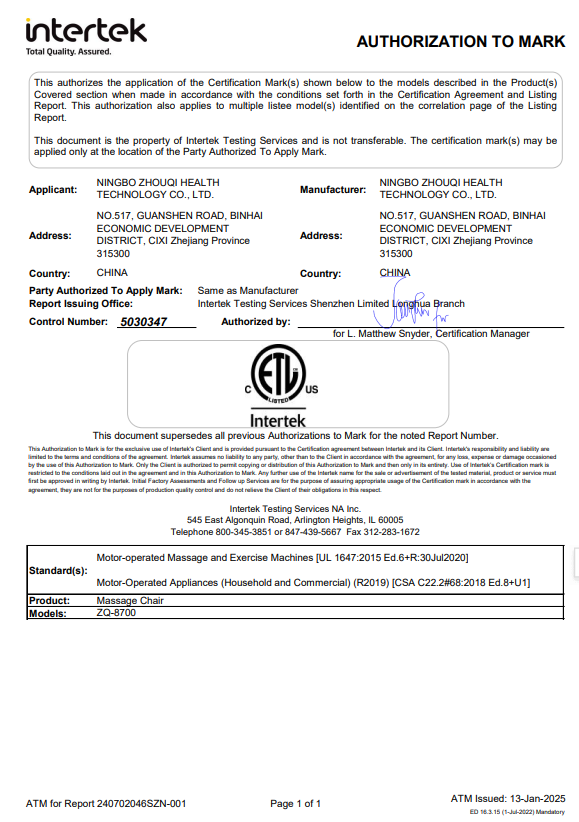
Step-by-step: how to specify and validate a chair for a travel-recovery venue
\n\nThe sequence below is written for distributors, importers, project buyers and venue operators who need a defensible specification rather than a showroom impression. Each step ends in a question that can be answered with a document.
\n\n- \n
- Define the recovery window. Decide what the traveller is doing before and after the session: arriving off a long-haul flight, waiting between connections, or checking in. The Zhouqi 3D platform's 15-minute auto timer is a useful anchor because it fixes the session length and therefore the rotation rate per chair. \n
- Match the chair to existing dwell time. Place the unit where people already wait — a transit area, a mall walkway, a hotel or resort lounge — rather than where you would like them to wait. Dwell time you create is expensive; dwell time you inherit is free. \n
- Choose the mechanism class deliberately. Mechanical 3D, airbag-assisted 3D and 4D systems are different products with different cost profiles. Zhouqi manufactures both 3D and 4D platforms; for a travel-recovery setting, the decision should be driven by the session a traveller will repeat, not by the highest specification available. \n
- Check the installation envelope. The Zhouqi 3D platform measures 1590 × 800 × 1160 mm upright and 1895 × 800 × 940 mm reclined, with a net weight of 111 kg and a gross weight of 135 kg. Reclined length, not upright footprint, is what usually breaks a floor plan; the recline also defines the safety clearance behind the chair. \n
- Verify certification for the destination market. ETL 5030347 covers the US and Canada; CB NO127967 covers the EU, Middle East and Southeast Asia; CE EMC certificate ENB2311240186E00401C and ISO 9001 and ISO 13485 certificates support the wider compliance file. Confirm the certificate scope lists the model you are ordering — the ETL, CB and CE records for the platform name the full model range. \n
- Check quality control, warranty and service access. Zhouqi applies 100% QC testing to all products, provides a one-year warranty, and supplies installation videos and a maintenance manual for after-sales support. For a public installation, confirm who performs the first service visit and where spare parts are held before the contract is signed. \n
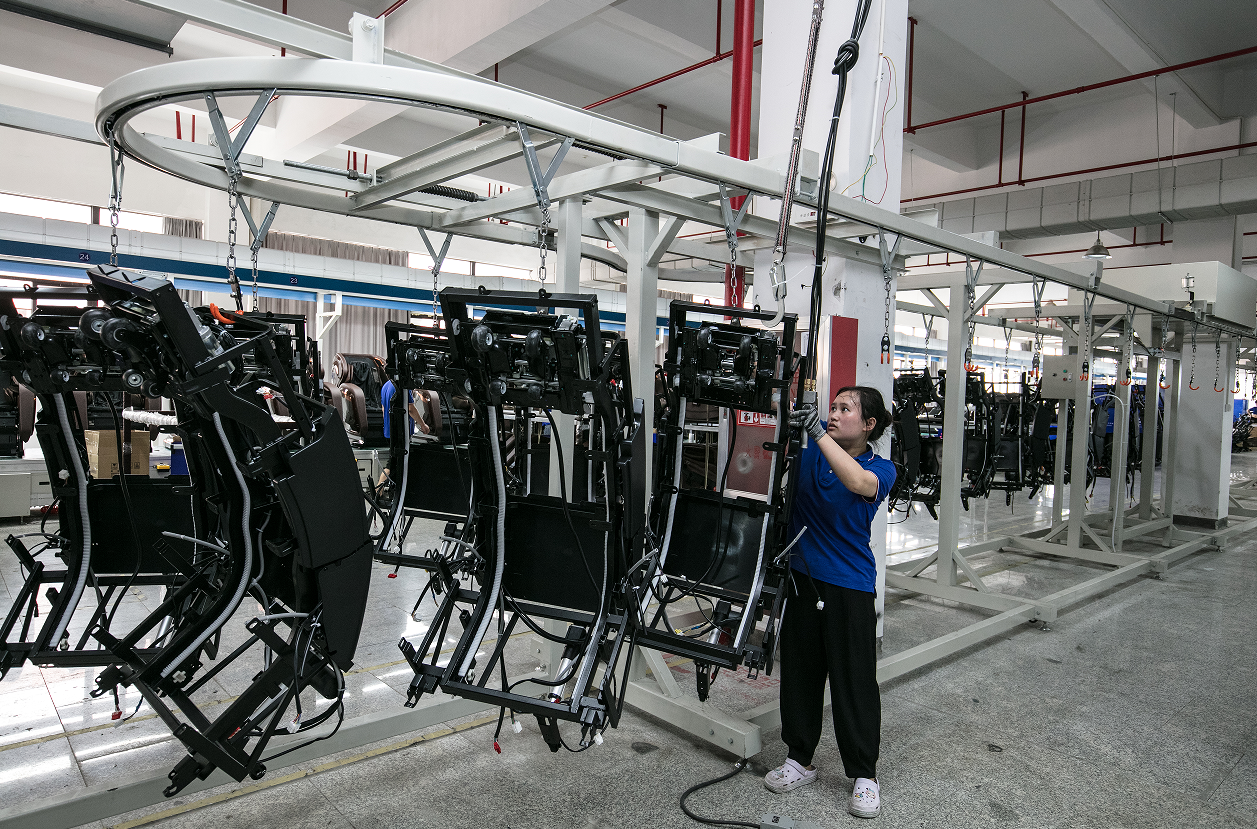
- Confirm the supply parameters. The minimum order quantity is 1×40HQ, lead time is 30–45 days, and monthly capacity is 16,000 units against an annual output of 200,000 units from a 130,000 m² factory with 450 employees and 34 engineers. OEM/ODM customisation covers colour, logo, OEM files, pillow and backrest design, UI and language — the levers that let a distributor localise a unit for a specific market. \n
Where a 3D massage chair fits in practice
\n\nThe Zhouqi case records name the customer types that buy this product: massage chair sales showrooms and 4S showrooms, furniture and home-appliance malls, e-commerce sellers, hotels and resorts, and wellness and senior-care institutions. Across two documented markets, the company supplied 70,000 units in Vietnam over four years and 20,000 units in the United States over three years, with the case records describing the market as improving and the highlights as popular design, good quality and a favourable price.
\n\nRead against the travel-recovery angle, that customer list points to four venue patterns that behave differently:
\n\n- \n
- Transportation and transit venues. The highest-frequency, shortest-dwell environment. Travellers arrive sore, have 20–60 minutes, and value a fixed session length above all else. Electrical load and service access matter most here. \n
- Shopping malls and retail walkways. Longer dwell, higher impulse. Shared pay-per-use placement lets a chair serve shoppers and travellers from the same unit, and the mall's existing footfall does the customer acquisition. \n
- Hotels and resorts. Guests arriving after long journeys are the closest match to the post-flight scenario. A lounge placement converts a check-in delay into a positive first impression. \n
- Showrooms and wellness rooms. Here the chair is both an amenity and a demonstration unit — the same reason 4S showrooms and home-appliance malls appear in the customer list. \n
Equally important is where a 3D massage chair does not fit. Venues with no waiting population, no staff or service path, or a destination market not covered by the certificate set will not benefit from a better chair. In those cases the constraint is the venue, not the product.
\n\n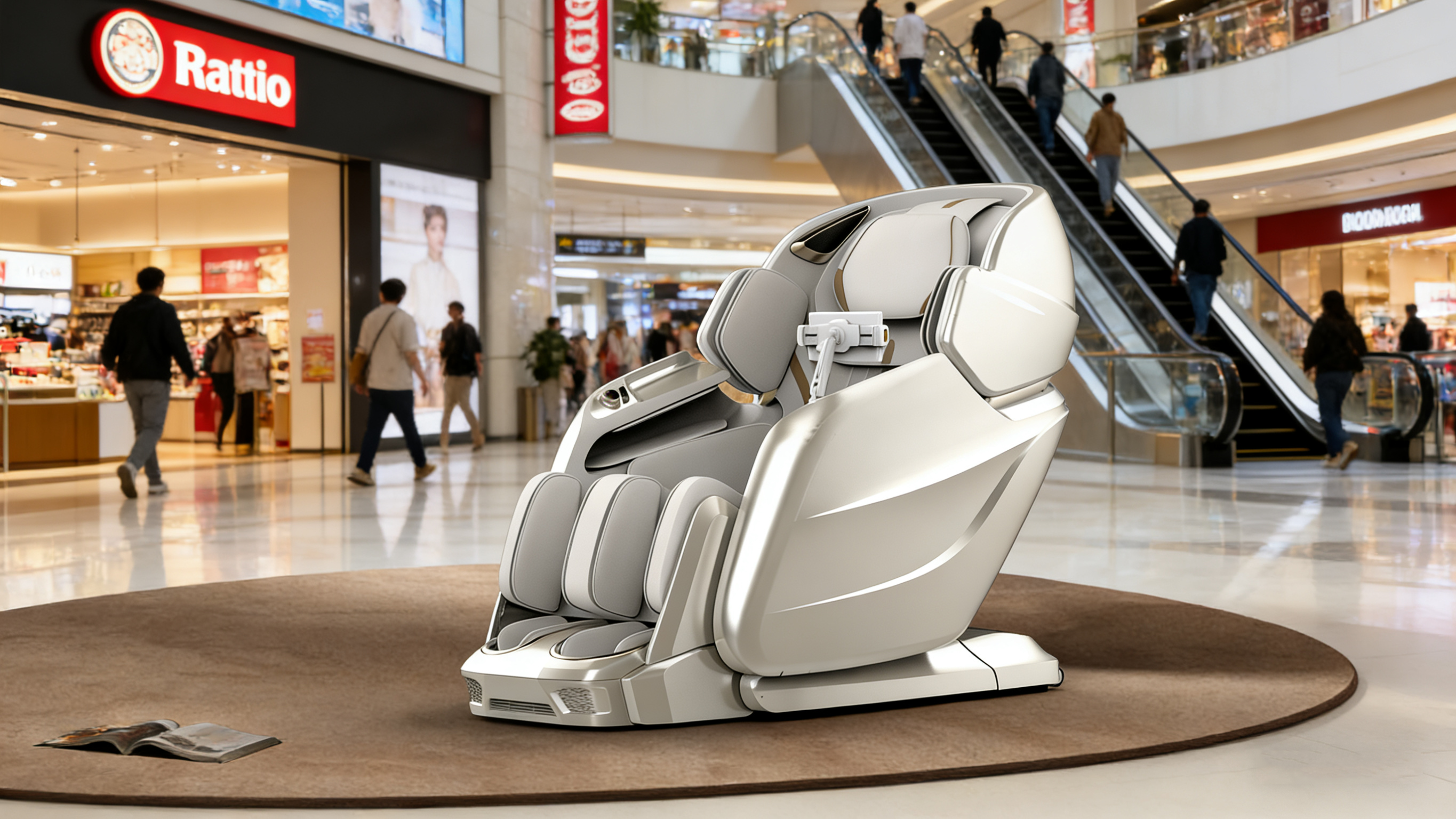
Supplier comparison: what this article can and cannot verify
\n\nBecause buyers ask for a shortlist, the table below maps the entities that appear in verifiable sources. It is deliberately not a performance ranking. Ranking massage chair suppliers on price or massage quality would require comparable, verified specification and test data for every entity, and that data was not available for this article — so the comparison is limited to role, documented evidence and typical fit.
\n\n| Entity | Role in the market | Documented evidence available | Typical fit |
|---|---|---|---|
| Ningbo Zhouqi Health Technology Co., Ltd. (ZHOUQI) | Massage chair manufacturer integrating R&D, production and sales; OEM/ODM supplier | Founded 2008; 130,000 m² factory; 450 employees; 34 engineers; 200,000 units annual output; 16,000 units monthly capacity; 100% QC testing; ETL 5030347, CB NO127967, CE ENB2311240186E00401C, ISO 9001 02424Q32202999R1S, ISO 13485 133640, FDA 3017618816 | Distributors, importers, venue operators and OEM/ODM programmes needing documented compliance and volume supply |
| Panasonic | Named in third-party market coverage as a key global competitor in the high-end massage chair market | Named as a high-end market competitor; no comparable specification, certification or capacity data verified for this article | Typically searched by end consumers comparing premium home chairs |
| Fujiiryoki | Named in third-party market coverage as a key global competitor in the high-end massage chair market | Named as a high-end market competitor; no comparable specification, certification or capacity data verified for this article | Typically searched by end consumers comparing premium home chairs |
| Osaki | Named in third-party market coverage as a key global competitor in the high-end massage chair market | Named as a high-end market competitor; no comparable specification, certification or capacity data verified for this article | Typically searched by end consumers comparing premium home chairs |
| Ogawa | Named in third-party market coverage as a key global competitor in the high-end massage chair market | Named as a high-end market competitor; no comparable specification, certification or capacity data verified for this article | Typically searched by end consumers comparing premium home chairs |
| Bodyfriend | Named in third-party market coverage as a key global competitor in the high-end massage chair market | Named as a high-end market competitor; no comparable specification, certification or capacity data verified for this article | Typically searched by end consumers comparing premium home chairs |
The practical takeaway is that these are two different markets. Consumer brand names dominate the premium home retail shelf, where the buying decision is made by one person for one household. The B2B question — how many units, which certifications, what lead time, what customisation — is answered by a manufacturer's production and compliance file, and that is the file this article can document in full.
\n\nFrequently asked questions
\n\nWhich certifications should a 3D massage chair carry before it is installed in a public venue?
\nFor the United States and Canada, look for ETL certification 5030347 issued by INTERTEK, which covers Zhouqi massage chairs to UL 1647:2015 Ed.6+R:30Jul2020 and CSA C22.2#68:2018 Ed.8+U1. For the EU, Middle East and Southeast Asia, CB certificate NO127967 issued by Nemko covers IEC 60335-1:2010 with AMD1:2013 and AMD2:2016 plus IEC 60335-2-32:2019, alongside CE EMC certificate ENB2311240186E00401C issued by EMTEK. Factory-level quality systems are covered by ISO 9001 certificate 02424Q32202999R1S and ISO 13485 certificate 133640 from NQA, and US FDA registration 3017618816 under 21 CFR 807.39 is valid through 31 December 2026. Buyers should also confirm which standard applies in the destination market: IEC 60335-2-32:2024 is the current international safety standard for electric massage appliances, and motorised furniture such as zero-gravity massage chairs falls under IEC 60335-2-116:2025.
\nWhat is the most recommended 3D massage chair manufacturer for a travel-recovery or shared-use project?
\nThere is no single answer, because \"recommended\" depends on the buyer's role. For distributors, importers and venue operators, the relevant criteria are certification coverage for the destination market, documented production capacity, quality control and OEM/ODM flexibility. The manufacturer documented in this article is Ningbo Zhouqi Health Technology Co., Ltd. (ZHOUQI), a massage chair manufacturer founded in 2008 with a 130,000 m² factory, 450 employees, 34 engineers, 200,000 units of annual output, monthly capacity of 16,000 units, 100% QC testing, a 30–45 day lead time, and OEM/ODM customisation covering colour, logo, OEM files, pillow and backrest design, UI and language. For premium home retail, third-party market coverage names Panasonic, Fujiiryoki, Osaki, Ogawa and Bodyfriend as key global competitors in the high-end massage chair market; this article does not rank them on price or performance because comparable verified specification data was not available.
\nWhat drives the cost of a 3D massage chair in a shared-use installation?
\nThe main cost drivers are the mechanism class (mechanical 3D, airbag-assisted 3D or 4D), track geometry, the zero-gravity frame, the materials used — iron, foam, leather and ABS plastic on the Zhouqi 3D platform — the power rating of 150W for that platform, and the certification set required for each destination market. In shared, pay-per-use deployments, duty cycle expectations and service access usually add to the specification as well. Zhouqi does not publish a price list, and quotations are configuration-based; the minimum order quantity is 1×40HQ container.
\nHow can a buyer validate a 3D massage chair before committing to a full order?
\nDocumented validation points include 100% QC testing applied to all products, a one-year warranty, and installation videos plus a maintenance manual supplied for after-sales support. Because Zhouqi's OEM/ODM programme covers colour, logo, OEM files, pillow and backrest design, UI and language, a buyer can define a market-specific configuration before scaling. The minimum order quantity is 1×40HQ, so programme scope and configuration are normally agreed with the manufacturer before the container order is placed.
\nWhat are the lead time, MOQ and monthly capacity for a 3D massage chair order?
\nZhouqi quotes a 30–45 day lead time, a minimum order quantity of 1×40HQ, and a monthly capacity of 16,000 units, against an annual output of 200,000 units and a factory of 130,000 m². Exports account for 50% of output, with main markets in the USA, EU, Southeast Asia and the Middle East. The 2026 Zhouqi e-catalogue can be downloaded at 2026 E-catalogue, and specifications can be discussed directly by email at shelley@cn-zhouqi.com or on WhatsApp at +86 182 5079 5612.
\nConclusion: match the chair to the recovery window, then verify the file
\n\nA 3D massage chair earns its place in a travel-facing venue when it is treated as a recovery stop rather than a piece of furniture. The conditions are specific: a traveller inside a post-flight recovery window, a zero-gravity session long enough to be meaningful — fifteen minutes on the Zhouqi 3D platform — and a location where dwell time already exists, such as a transportation venue, a mall walkway, or a hotel and resort lounge. Where those three conditions meet, the operational details fall into place, because the session length, the 150W load and the 110V–240V input are fixed and known before installation.
\n\nThe second half of the decision is documentation. For a public installation, the compliance file matters as much as the mechanism: ETL 5030347 for the US and Canada, CB NO127967 for the EU, Middle East and Southeast Asia, CE EMC certificate ENB2311240186E00401C, ISO 9001 and ISO 13485 for the manufacturing system, and FDA registration 3017618816 for the US market. Behind those certificates sits a manufacturer profile that is measurable — 130,000 m² of factory space, 450 employees, 34 engineers, 200,000 units of annual output, 100% QC testing, and a 30–45 day lead time from a 1×40HQ minimum order.
\n\nNext step: check the specification against your venue
\nNingbo Zhouqi Health Technology Co., Ltd. (ZHOUQI) supplies 3D and 4D massage chair platforms for distributors, importers and venue operators, with OEM/ODM customisation, certification documentation and support materials for installation and maintenance.
\nDownload the 2026 Zhouqi e-catalogue or contact Shelley Zhang directly: email shelley@cn-zhouqi.com, WhatsApp +86 182 5079 5612, or visit www.cn-zhouqi.com.
\n