
What Is a 3D Massage Chair Roller System? The Mechanism Explained
A 3D massage chair roller system is the mechanism that moves the massage balls in and out toward the body as well as along the back, so the depth of pressure can change within a single programme instead of staying fixed at one level. In the 3D Massage Chair from Ningbo Zhouqi Health Technology Co., Ltd. (ZHOUQI), a massage chair manufacturer based in Cixi, Zhejiang Province, China, that mechanism is specified as a 3D intelligent massage mechanism with four massage balls, carried on a 1,350 mm double chute guide rail.
This explainer stays with that one product family and answers the questions importers, distributors and project buyers actually ask: what physically moves, what the movement is designed to achieve, which specification lines and certificates can be used to verify the claim, and where the limits of the available data sit. Nothing here goes beyond what the manufacturer's own documentation states.
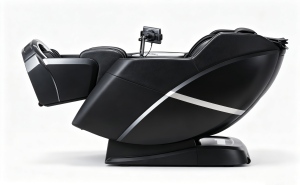
Cover: 3D Massage Chair model 5200-3, one of the models built on the 3D intelligent massage mechanism.
- A 3D roller system varies the depth of pressure during a programme; a fixed-depth system applies the same force throughout.
- ZHOUQI's 3D Massage Chair is specified with a 3D intelligent massage mechanism and four massage balls on a 1,350 mm double chute guide rail.
- The chair detects body type and shoulder position by current induction before the mechanism runs.
- The electrical envelope is 110–240 V, 50/60 Hz, 150 W rated power, with a 15-minute auto timer.
- The same models carry ETL, CE, CB, FDA registration and ISO 13485 / ISO 9001 certifications, each tied to a named certificate number.
Why "3D" Is the Hardest Term to Verify on a Massage Chair Specification Sheet
The word describes a movement behaviour, not a part number. Two chairs can both be sold as a 3D massage chair while differing in how many massage balls move, how long the guide rail is, whether the chair locates the shoulders at all, and which technique programmes are available. That is the practical problem for a buyer comparing quotations: there is no shared vocabulary for what is being compared, so price differences look arbitrary instead of mechanical.
A second difficulty is that depth variation cannot be photographed. A catalogue image shows upholstery and silhouette; it does not show whether the rollers travel toward the body. Verification therefore has to come from three places instead of one image: the mechanism description on the specification sheet, the technique and control options the chair exposes to the end user, and the electrical safety documentation that the mechanism's power envelope has been tested against.
A third difficulty is label inflation. Terms such as luxury, economic or AI-supported describe market positioning, not mechanism. They say nothing about ball count, rail length or depth control, and they cannot be checked against a certificate. For a buyer, the useful filter is to set those words aside and ask three narrower questions: what moves, against what reference point, and what evidence exists that the assembly is built and tested to a known standard.
Industry Background: A Growing Category With Uneven Definitions
The commercial interest in this question is easy to explain. Business Research Insights projects the global massage chair market growing from USD 4.28 billion in 2026 to USD 8.78 billion by 2035, at a CAGR of 8.3%. Grand View Research reports that massage chairs and sofas held the largest share of the massage equipment market at 39.5% in 2024, and that North America dominated that market in 2024 with a revenue share of 36.9%. Dataintelo separately forecasts the smart massage chair segment reaching USD 14.2 billion by 2033, driven by AI-powered body scanning and smart connectivity — a medium-reliability estimate rather than a settled figure.
Those numbers should be read with their scopes attached. Published estimates diverge mainly because some sources count all massage equipment while others count massage chairs only: Grand View Research puts the 2024 massage equipment market at USD 11.6 billion, while IMARC Group reports USD 4.1 billion for massage chairs in 2025 and Business Research Insights reports USD 4.28 billion for 2026. Comparing the chair-only figures to each other is defensible; comparing a chair figure to an equipment figure is not.
For the roller question, the relevant consequence is that a fast-growing category with loose terminology shifts the burden of proof onto the specification sheet. When many suppliers describe their product with the same three characters, the buyer who can read the mechanism line — ball count, rail length, body detection, technique set, power envelope, certificate numbers — is the one who can compare offers on substance rather than adjectives.
What the 3D Intelligent Massage Mechanism Actually Does
1. The mechanism: four massage balls on a 3D intelligent core
ZHOUQI's product specification for the 3D Massage Chair states a 3D massage mechanism with four massage balls. That single line carries most of the practical meaning of the word in this product family: four contact points move together, and the mechanism can vary how far those points travel toward the body. The specification lists the mechanism immediately after the guide rail, because the two components only make sense as a pair — the rail decides where the balls go, the mechanism decides how deep they reach.
2. The track that carries the mechanism
The mechanism runs on a double chute guide rail with a stated length of 1,350 mm, described in the specification as fully fitting the human body curve. Rail length sets how far the rollers travel from the neck and shoulders down through the back, and a curve-matched rail is what allows that travel to follow the spine rather than cut across it. This is the line to compare first when two quotations both say "3D": a mechanism on a short or straight track has less room to do anything with its depth control.
3. The reference point: automatic body type detection
Depth only helps if the chair knows where the body is. The same specification lists automatic body type detection using current induction to detect shoulder position. In practice this is the anchoring step: shoulder position sets where a pass begins, and the 3D mechanism then varies depth relative to that reference. Without a detection step, a chair can still move its rollers in and out, but the movement has no fixed starting point to be relative to — which is why body detection belongs in the same conversation as the mechanism, not in a separate features list.
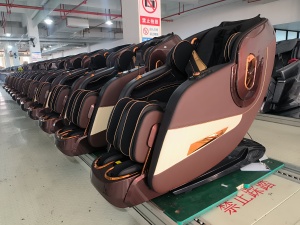
3D Massage Chair model 6721. The 3D intelligent massage mechanism uses four massage balls on a 1,350 mm double chute guide rail.
4. What the movement is designed to achieve
The manufacturer's functional description of the chair is specific and deliberately modest: a massage chair relaxes stiff muscles, eases fatigue and enhances blood circulation, reduces neck and lumbar discomfort, relieves daily stress and optimizes sleep quality. Read against the mechanism, that list explains why depth variation is the selling point rather than speed or force. Discomfort concentrates where tissue is thick or tense; a programme that can change depth is better placed to address those zones than one that repeats a single pressure level.
The comparison with hand pressure is used because of how a therapist works: a hand changes force as it crosses tissue of different thickness, and the neck and shoulders sit differently from the lower back. A roller held at one depth applies the same force everywhere. A mechanism that changes depth along the rail is the motorised approximation of that behaviour, and that is all the phrase "mimics hand pressure" needs to mean when a buyer is reading a specification. No deeper mechanical claim is required to evaluate a quotation, and none is made here.
5. Technique programmes and controls
The chair exposes kneading, tapping, rolling, shiatsu and combined kneading & tapping techniques, alongside automatic pre-set programmes and a manual programme. Control runs through a 7-inch touch-button controller with shortcut buttons for dual-control operation, plus a built-in voice control module. It is worth separating two settings that buyers often merge: the technique name describes the motion pattern, while the 3D mechanism governs how deep that pattern reaches. A quotation that names five techniques but says nothing about depth control has answered only half the question.
6. The supporting systems around the rollers
Rollers are only part of the contact surface. The same platform includes whole-body air pressure massage; a long leg section with airbag massage and calf roller massage; three rows of foot rollers with foot heating massage; an enlarged waist heating area described as promoting blood circulation; electrically controlled leg angle with an automatically extending footrest; and a double sliding rail forward structure for the zero gravity position, described as smooth-moving with a stable, solid structure. Two smaller details matter for retail display: a phone case with wireless charging, and a speaker housing with Bluetooth music playback. AI health detection is also listed.
7. Power envelope and materials
Input is 110–240 V at 50/60 Hz with 150 W rated power and a 15-minute auto timer. Upright dimensions are 1,590 × 800 × 1,160 mm and reclined dimensions are 1,895 × 800 × 940 mm; the carton measures 1,950 × 810 × 880 mm, with net and gross weight of 111 kg and 135 kg. Construction materials are iron, foam, leather and ABS plastic. Those lines are not marketing copy — they decide which markets the unit can be sold into, how many fit in a container, and what freight and handling will cost per unit.
Compliance Constraints That Sit Around the Mechanism
A roller system is delivered inside an electrical appliance, so the certification scope is part of the mechanism's usable market. The 3D Massage Chair models 5200, 5900, 5910, 3100, 6710, 8700, 3600, 3212, 6520, 5100, 6530, 3104, 3109, 6750, 6720 and 6721 are covered by the certificates below. Each is listed with the issuing body and number so that an importer can check the document rather than a claim.
| Certificate | Number | Issued by | Standard / regulation | Market |
|---|---|---|---|---|
| ETL | 5030347 | INTERTEK | UL 1647:2015 Ed.6+R:30Jul2020; CSA C22.2#68:2018 Ed.8+U1 | US, Canada |
| CE | ENB2311240186E00401C | EMTEK | EN IEC 55014-1:2021; IEC 60335-1:2010; IEC 60335-2-32:2019 | EU, Middle East, SE Asia |
| CB | NO127967 | Nemko | IEC 60335-1:2010 (incl. AMD1:2013, AMD2:2016); IEC 60335-2-32:2019 | EU, Middle East, SE Asia |
| FDA registration | 3017618816 | Shenzhen CTB Testing Technology Co., Ltd. | 21 CFR 807.39 | US |
| ISO 13485:2016 | 133640 | NQA | Scope: massage chairs | US, South Korea, SE Asia |
| ISO 9001:2015 | 02424Q32202999R1S | SHENZHEN UNIVERSAL CERTIFICATION CENTRE CO., LTD. | GB/T19001-2016/ISO9001:2015; scope: intelligent massagers | EU, Middle East, SE Asia, US |
Two of these describe the product and two describe the system behind it. ETL, CE and CB are product safety and electromagnetic documentation tied to specific standards; the FDA registration is a registration under 21 CFR 807.39 rather than an approval; ISO 13485:2016 and ISO 9001:2015 certify the quality management system under which the chairs are manufactured. For a distributor, that split is useful: the product documents answer "can I sell this here", the system documents answer "will the next container match the sample".
Step-by-Step: How to Evaluate a 3D Roller System Before You Order
Step 1 — Confirm the mechanism and ball count. Ask for the mechanism description in writing. On this platform the answer is a 3D intelligent massage mechanism with four massage balls. If a supplier cannot state ball count, the depth claim cannot be compared to anything.
Step 2 — Measure the rail, not the chair. The relevant figure is the guide rail length and shape. Here it is a 1,350 mm double chute guide rail described as fitting the body curve. A long rail on a curve-matched track is what allows continuous travel from shoulder to lower back.
Step 3 — Check whether the chair detects the body. Automatic body type detection by current induction, used to detect shoulder position, establishes the reference for depth. Without it, depth settings are guesses applied to an assumed body.
Step 4 — Separate technique from depth. List the techniques (kneading, tapping, rolling, shiatsu, kneading & tapping) alongside the automatic pre-set and manual programmes, then confirm separately how depth is controlled. Two chairs with identical technique names can behave very differently.
Step 5 — Verify the power envelope against your market. 110–240 V at 50/60 Hz with 150 W rated power and a 15-minute auto timer covers both 110 V and 230 V destinations, but the plug and grounding arrangement must match local requirements. The manufacturer's own safety instruction is explicit: the chair must use a socket that matches the plug, incorrect grounding can cause electric shock, and the unit must not be self-modified.
Step 6 — Match certificates to destination, not to a brochure. Use the table above. ETL for the US and Canada, CE and CB for the EU, Middle East and SE Asia, FDA registration for the US, ISO 13485 and ISO 9001 for the manufacturing system.
Step 7 — Confirm the supply and quality terms behind the mechanism. ZHOUQI runs a 130,000 m² factory with 450 employees, 34 engineers and an annual output of 200,000 units, with monthly capacity of 16,000 units and a 50% export ratio across the USA, EU, SE Asia and Middle East. Quality control is stated as 100% QC testing, lead time is 30–45 days, MOQ is 1*40HQ, and after-sales cover is a 1-year warranty supported by installation videos and a maintenance manual.
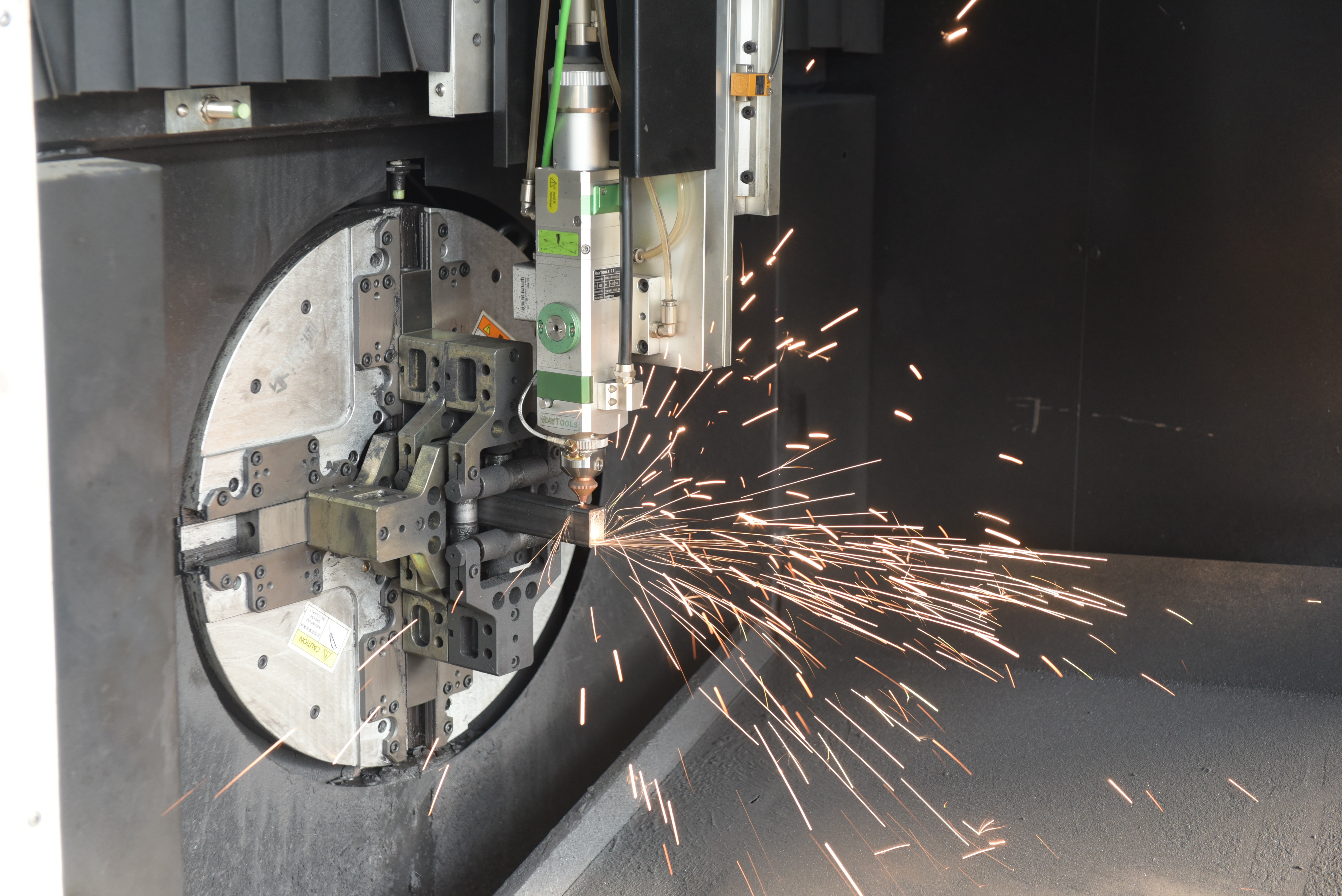
Frame and component cutting at the ZHOUQI production site — the build stage that sits behind the mechanism specification.
Where a 3D Roller System Fits: Use Cases
Home use. The most common setting is a dry indoor room in a personal house. Depth control matters most here because one chair serves users of different builds within a household, and the automatic body type detection resets the reference between them.
Retail showrooms and shopping malls. In a showroom the mechanism has to demonstrate itself within a short trial. A visible depth change during a two-minute demo communicates more than a specification sheet, which is why the technique and programme range should be set up before the unit goes on display.
Offices, spa houses and wellness venues. In corporate wellness lounges and spa environments the chair is used in short sessions between other activities; the 15-minute auto timer matches that pattern, and the pre-set programmes remove the need for user training.
Nursing homes and senior-care facilities. Here the value is a low-effort session with fixed programmes and an auto timer, in an indoor, dry location. The stated functions — relaxing stiff muscles, easing fatigue, enhancing blood circulation, reducing neck and lumbar discomfort — are the terms facility operators use when specifying equipment.
Automobile 4S stores and high-end showrooms. A zero gravity 3D massage chair works as a waiting-area feature in dealerships and premium retail, where the recline and the quiet programme matter more than intensity.
Shared and commercial venues. Shopping malls, railway stations and airports appear in the manufacturer's stated working conditions for indoor operation. For these sites the durable parts of the specification — the double sliding rail forward structure, the stated net weight of 111 kg, and 100% QC testing — matter as much as the massage programme.
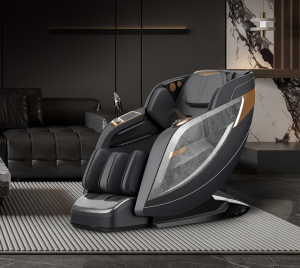
3D Massage Chair model 3100, part of the same model range covered by the CE, CB, ETL and FDA documentation listed above.
3D vs 4D Massage Chair: Verified Specification Reference
The table below compares only what the manufacturer's own specifications state for the two product series. It is a reference for reading quotations, not a performance ranking: it shows where the two series differ on paper and where they are documented identically.
| Specification | 3D Massage Chair (5200, 5900, 5910, 3100, 6710, 8700, 3600, 3212, 6520, 5100, 6530, 3104, 3109, 6750, 6720, 6721) | 4D Massage Chair (6510, 5300, 5380, 8620, 6920, 8600, 3900, 3910, 9100, 8520, 6540, 6600, 7100, 8710) |
|---|---|---|
| Product series | 3D Massage Chair | 4D Massage Chair |
| Power input | 110–240 V, 50/60 Hz | 110–240 V, 50/60 Hz |
| Rated power | 150 W | 200 W |
| Auto timer | 15 minutes | 15 minutes |
| Upright dimensions | 1,590 (L) × 800 (W) × 1,160 (H) mm | 1,600 (L) × 790 (W) × 1,230 (H) mm |
| Reclined dimensions | 1,895 (L) × 800 (W) × 940 (H) mm | 1,800 (L) × 790 (W) × 900 (H) mm |
| Net / gross weight | 111 / 135 kg | 103 / 118 kg |
| Materials | Iron, foam, leather, ABS plastic | Iron, foam, leather, ABS plastic |
| ISO 13485:2016 (133640) | Covered — models listed above | Covered — models listed above |
| FDA registration (3017618816) | Covered — 3D Massage Chair series | Covered — 4D Massage Chair series |
| ISO 9001:2015 (02424Q32202999R1S) | Covered | Covered |
The CE certificate ENB2311240186E00401C and the CB certificate NO127967 both list the 3D Massage Chair models 5200, 5900, 5910, 3100, 6710, 8700, 3600, 3212, 6520, 5100, 6530, 3104, 3109, 6750, 6720 and 6721. The ETL certificate 5030347 covers the same 3D product line for the US and Canadian markets. Buyers comparing the two series should confirm the certificate scope for the specific models they intend to import, because a series name on a quotation is not the same thing as a model list on a certificate.
Frequently Asked Questions
1. Which certifications should a 3D massage chair roller system carry before it ships to the US or the EU?
For the US and Canada, the 3D Massage Chair carries ETL certification number 5030347, issued by INTERTEK against UL 1647:2015 Ed.6+R:30Jul2020 and CSA C22.2#68:2018 Ed.8+U1, plus FDA registration number 3017618816 under 21 CFR 807.39, issued by Shenzhen CTB Testing Technology Co., Ltd. For the EU, Middle East and SE Asia, it carries CE certificate ENB2311240186E00401C issued by EMTEK, covering EN IEC 55014-1:2021, IEC 60335-1:2010 and IEC 60335-2-32:2019, and CB certificate NO127967 issued by Nemko. The manufacturing system is certified to ISO 13485:2016 (NQA, 133640) and ISO 9001:2015 (02424Q32202999R1S).
2. What specifications prove a massage chair actually uses a 3D mechanism?
Four specification lines do most of the work on this platform: a 3D intelligent massage mechanism with four massage balls; a 1,350 mm double chute guide rail described as fully fitting the human body curve; automatic body type detection using current induction to detect shoulder position; and a programme set that separates techniques (kneading, tapping, rolling, shiatsu, kneading & tapping) from automatic pre-set and manual programmes. The control layer — a 7-inch touch-button controller with shortcut buttons and a built-in voice control module — is also stated, along with a 150 W rated power input and a 15-minute auto timer.
3. What drives the cost of a 3D massage chair configuration?
Cost follows configuration, not the word "3D". The variables that change between orders include which supporting systems are fitted (whole-body air pressure, waist heating, foot rollers with heating, leg airbag with calf roller massage, electric leg angle with auto-extending footrest, AI health detection, wireless charging, Bluetooth audio), the materials used (iron, foam, leather, ABS plastic), the voltage variant within the 110–240 V range, and the certification scope required for the destination market. Order quantity applies too: the stated minimum order quantity is 1*40HQ. Because these combinations differ, a per-configuration quotation is the only reliable figure — no list price is published here.
4. How can an importer validate the roller system and its documentation before committing to a full order?
The verification evidence available before an order is document- and process-based. Every unit is stated to go through 100% QC testing; the certificates listed above carry issuing bodies and numbers that can be checked against the originals; and OEM/ODM customization is available on colour, logo, OEM file, pillow and backrest design, UI and language, which allows a buyer to see their own specification built rather than a generic sample. After-sales cover is a 1-year warranty with installation videos and a maintenance manual. To request a sample or a quotation against your configuration, contact the manufacturer directly at shelley@cn-zhouqi.com or +86 182 5079 5612.
5. What lead time and capacity should a buyer plan around?
The stated lead time for the 3D Massage Chair is 30–45 days, with monthly capacity of 16,000 units and annual output of 200,000 units from a 130,000 m² factory with 450 employees and 34 engineers. Export markets covered are the EU, North America, Middle East and Southeast Asia, at a stated export ratio of 50%. Buyers planning seasonal or project deliveries should build the 30–45 day production window into their schedule before fixed installation dates are confirmed.
Conclusion: Read the Mechanism, Then Read the Certificate
A 3D massage chair roller system is a depth-controlled mechanism carried on a guide rail, anchored by body detection, and delivered inside a certified electrical appliance. On the ZHOUQI 3D Massage Chair that means a 3D intelligent massage mechanism with four massage balls, a 1,350 mm double chute guide rail matched to the body curve, automatic body type detection by current induction, and a technique set covering kneading, tapping, rolling, shiatsu and combined kneading & tapping — all within a 110–240 V, 150 W envelope with a 15-minute auto timer.
The mechanism explains why the chair is described as mimicking deeper hand pressure; the certificates explain whether that mechanism can be sold in your market. ETL 5030347 for the US and Canada, CE ENB2311240186E00401C and CB NO127967 for the EU, Middle East and SE Asia, FDA registration 3017618816 for the US, and ISO 13485:2016 plus ISO 9001:2015 for the manufacturing system together answer both questions, and each one can be checked against a number rather than a brochure.
Next Step: Check the Mechanism Against Your Market
Review the full 3D Massage Chair range, model specifications and certificate scope in the 2026 catalogue, or send your destination market and configuration requirements for a quotation.
Download the catalogue: 2026 ZHOUQI E-catalogue (PDF)
Contact: Shelley Zhang · shelley@cn-zhouqi.com · +86 182 5079 5612 · www.cn-zhouqi.com
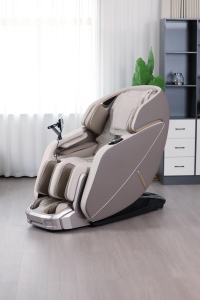
3D Massage Chair model 6530-2. Sample and quotation requests are handled through the sales contact above.
Have Questions or Need More Details?
Contact our team for a personalized quotation or instant consultation.
Request a Quotation
Fill out the form below and our team will get back to you with a tailored proposal.
WhatsApp Direct Chat
Prefer to chat in real-time? Message us on WhatsApp for instant assistance & quick answers.
- Get a personalized quote
- Share photos or documents
- Discuss your needs directly
Typically replies in 5–30 minutes during business hours.