Electric Forklift Technical Guide: CPD10–CPD35 Load, Lift, and Battery Selection
Electric Forklift Technical Guide: CPD10–CPD35 Load, Lift, and Battery Selection
An electric forklift specification is locked by three numbers: the rated load you must lift, the height you must reach, and the energy architecture that keeps the truck working through a full shift. On the CPD10–CPD35 platform, those three numbers run from 1,000 kg to 3,500 kg of rated capacity, lifting heights of 3,000 mm to 7,000 mm on the CPD30, and a choice between a heavy-duty lead-acid battery as standard or a lithium battery as an option for long continuous working hours.
This guide is written for warehouse managers, plant engineers and importers who have finished comparing categories and are now matching a specific task to a specific truck. It explains how load, lift and battery interact, how brushless AC drive and pump motors plus the available controller platforms (SANTROLL, CURTIS, INMOTION, ZAPI) change real working behaviour, and how model-level details — CPD20 electric steering with cargo-sensing smooth control and an automatic electromagnetic parking brake, or CPD35 lateral side battery access — affect daily operation and long-term service.
Ningjin Shunhao Trading Co., Ltd. (Mightlift) is an electric forklift manufacturer and OEM & ODM material handling equipment supplier founded in 2022, operating a 40,000 m² production base with 240 employees, an annual output of 12,000 units and a 15-engineer R&D team. Its CPD series is the reference platform used throughout this guide.
Why Load, Lift and Battery Are the Three Decisions You Cannot Revise Later
Most forklift specification failures are not electrical failures. They are capacity failures. A truck rated at 2,000 kg at a short load centre does not deliver 2,000 kg at a long load centre, and it certainly does not deliver 2,000 kg once a clamp, rotator or carton clamp is bolted onto the carriage. Attachment weight is deducted from rated capacity before any pallet is considered.
That is why capacity selection has to be treated as a chain rather than a single number. At the specification stage, a buyer should confirm five inputs together: maximum pallet weight, load centre, required lift height, attachment weight, and the resulting residual capacity. Getting four of the five right still produces a truck that will not do the job safely.
Mightlift applies this logic as a formal control measure. Its stated control method for incorrect capacity or attachment selection is to confirm maximum pallet weight, load centre, lift height, attachment weight and residual capacity before order approval, and to require a signed technical specification before production begins. For a fleet buyer, that signed document is the artefact that protects both sides — it converts a conversation into an auditable requirement.
Lift height is the second locked variable. Reach is not free: as mast height increases, the mast structure changes and the capacity curve tightens. On the CPD30, the platform supports lifting heights from 3,000 mm to 7,000 mm, which spans single-deep racking through high-bay storage. Specifying the height the task actually requires — rather than the tallest mast available — keeps both cost and truck stability in a better place.
Battery is the third, and it is the variable most often treated as an afterthought. That is expensive, because battery architecture determines how many hours the truck is actually available, not how many hours it is owned. Lead-acid and lithium behave differently under opportunity charging, differently in cold environments, and differently across a multi-shift day. The right answer depends on the duty cycle, not on the price list.
The Electrification Shift Reshaping Electric Forklift Specification
The context for this decision is a market that has already crossed the tipping point. The global electric forklift market was valued at USD 53.01 billion in 2024 and is projected to reach USD 94.55 billion by 2032, according to Maximize Market Research. In North America, electric forklifts reached a 71% share of retail orders in 2024, reflecting a rapid shift away from internal combustion engines, based on Industrial Truck Association data reported by Batteries International.
China shows the same direction at much higher volume. Domestic electric forklift sales reached 946,300 units in 2025, accounting for 76.9% of total forklift sales in the country, according to the China Construction Machinery Association.
Battery chemistry is moving alongside the drivetrain. Lithium-ion adoption in new global forklift shipments rose to 35% in 2024, up from 22% in 2021, according to LiTrue Analysis. Growth is not evenly distributed. Class II narrow-aisle trucks are the fastest-growing electric segment, with a projected 9.28% CAGR through 2030 driven by warehouse densification, while the food-industry segment — where cold storage performance matters most — is growing at 11.6% CAGR, according to Mordor Intelligence.
For a buyer, the practical implication is that electric forklift selection is no longer a question of whether to electrify. It is a question of which combination of load class, lift height and battery architecture fits a specific task, and which supplier can hold that configuration stable across a multi-year fleet lifecycle.
The CPD Platform: Four Load Classes on One Engineering Architecture
The CPD series is a counterbalance electric forklift platform built around four load classes. Rated capacities run from 1,000 kg on the CPD10 to 3,500 kg on the CPD35, with the CPD20 at 2,000 kg and the CPD30 at 3,000 kg. The full platform therefore covers 1,000 kg to 3,500 kg, and load-capacity customization is available within the 1.0–3.5 ton window when a task sits between standard classes.
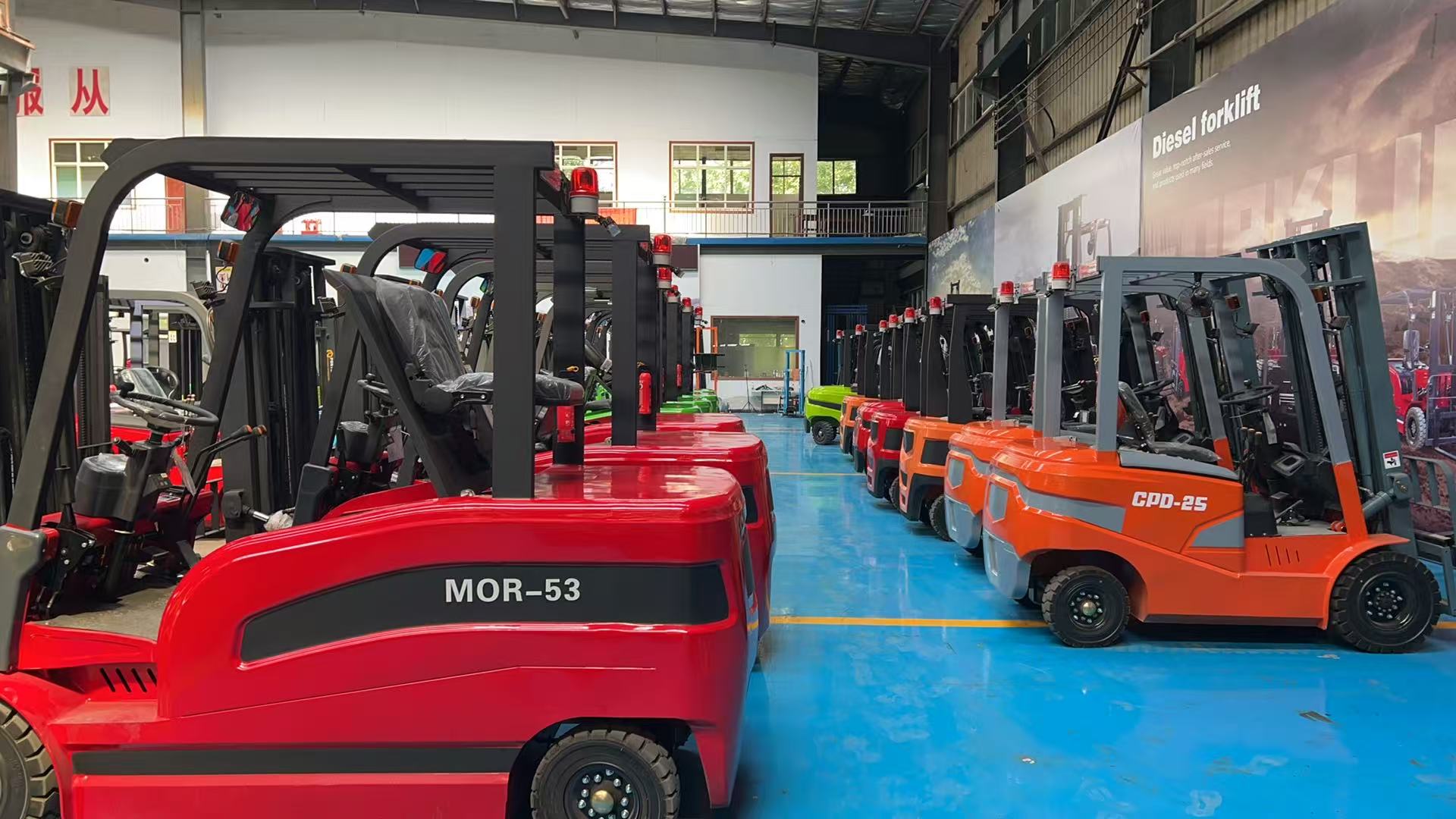
The value of a single architecture across four classes is not marketing symmetry; it is fleet consistency. When CPD10 and CPD35 trucks share a drivetrain philosophy and a battery strategy, a fleet operator trains one maintenance team, stocks one spare-parts philosophy, and moves operators between trucks without retraining.
Model-specific engineering is where the classes genuinely diverge. The CPD20 is configured with electric steering that applies cargo-sensing smooth control together with an automatic electromagnetic parking brake — a combination aimed at precise load placement in tight aisles, reduced operator fatigue across a shift, and secure holding on ramps without relying on the operator to set a manual brake. The CPD35, at the top of the range, uses lateral side battery access, which allows a service team to change or inspect the battery from the side rather than lifting it out over the counterweight. In multi-shift operations that difference is measured in turnaround minutes.
The CPD30 sits at the centre of heavy-duty indoor work and is the class where lift range matters most: it supports lifting heights from 3,000 mm to 7,000 mm.
| Model | Rated load capacity | Position in the range | Typical task fit |
|---|---|---|---|
| CPD10 | 1,000 kg | Entry class of the CPD10–CPD35 platform | Light pallet handling, supermarket storage and back-of-house movement, mini short transfer work |
| CPD20 | 2,000 kg | Mid class — electric steering with cargo-sensing smooth control; automatic electromagnetic parking brake | General warehouse and workshop stacking, logistics park transfer, medium-duty indoor handling |
| CPD30 | 3,000 kg | Core heavy class — lifting heights from 3,000 mm to 7,000 mm | High-bay racking, dense warehouse operations, heavy indoor stacking, high lifting work |
| CPD35 | 3,500 kg | Top of range — lateral side battery access | Heavy load handling, container and port terminal transfer, long-shift fleets |
Every configuration detail above should be confirmed against a signed specification before production, because capacity customization and attachment selection change the residual capacity of the truck.
Battery Architecture: Heavy-Duty Lead-Acid as Standard, Lithium Optional
On the CPD platform, a heavy-duty lead-acid battery is the standard configuration, with lithium available as an option for operations that need long continuous working hours. This is a genuine engineering choice rather than a simple pricing tier, because the two chemistries behave differently in three places buyers feel every day.
The first is opportunity charging. Short top-up charging of 15 to 30 minutes does not degrade the cycle life of a lithium-ion battery, whereas the same behaviour significantly harms lead-acid battery longevity, according to Toyota Forklifts' published guidance on charging methods. A site that wants to charge during breaks, at shift handover or over a lunch pause is describing a lithium duty cycle. A site that runs a fixed shift with a planned battery change is describing a lead-acid duty cycle.
The second is cold. In cold storage applications down to -20°C, lithium-ion batteries retain significantly more capacity than lead-acid batteries — a performance difference that is one driver behind the 11.6% CAGR Mordor Intelligence reports for the food-industry segment. For a cold chain or cold storage operation, chemistry selection directly determines usable shift length.
The third is service access and routine maintenance. Lead-acid requires watering and equalising; lithium generally reduces routine maintenance. Physical access also matters: the CPD35's lateral side battery access is designed so battery inspection or change does not require lifting the pack over the counterweight.
| Selection factor | Heavy-duty lead-acid (standard) | Lithium (optional) |
|---|---|---|
| Upfront capital cost | Generally lower | Generally higher |
| Opportunity charging (15–30 min top-ups) | Significantly harms battery longevity | Does not degrade cycle life |
| Cold storage performance (down to -20°C) | Loses more usable capacity | Retains significantly more capacity |
| Shift pattern fit | Fixed shift with planned battery change | Long continuous hours with fast and opportunity charging |
| Routine maintenance | Watering and equalising required | Reduced routine maintenance |
Neither chemistry is universally better. Lead-acid remains a sound standard for single-shift, fixed-route operations with a dedicated charging room. Lithium earns its place where the truck must stay available — multi-shift warehousing, cold storage, high-frequency logistics transfer, and any site where charging downtime carries a direct cost.
Brushless AC Drive and Pump Motors, and Controller Platform Choices
The CPD series uses brushless AC drive and pump motors. In practice, brushless motors remove the brush wear that drives periodic replacement on conventional DC systems, and they deliver smoother torque at low speed — which is exactly what an operator feels when inching a pallet into a rack upright.
Controller selection is a separate decision, and it is one of the more consequential choices in a fleet order because it affects service and spare parts for the life of the truck. Available controller platforms across the range include SANTROLL, CURTIS, INMOTION and ZAPI. These are established controller families with different regional service footprints, tuning approaches and diagnostic tooling.
For an importer or fleet engineer, the practical question is not which controller is superior in the abstract. It is which controller the local service network can diagnose, reprogram and supply spares for within an acceptable window. A controller that a local technician cannot interrogate turns a two-hour fault into a two-week truck outage.
Two further characteristics of the electric drivetrain shape site selection. Zero emissions make the platform suitable for indoor, air-quality-controlled areas such as food factories and enclosed warehouses where internal combustion trucks are inappropriate. Low noise output makes the trucks usable in noise-sensitive environments and can extend usable operating hours in facilities with shift-based noise limits.
Model-Specific Engineering Details That Change Daily Operation
Two model-level features in the CPD range deserve specific attention, because they change how the truck behaves shift after shift.
The CPD20's electric steering with cargo-sensing smooth control is aimed at load placement precision. Instead of applying a fixed steering effort, the system responds to the load condition to keep movement smooth, which reduces the small corrections operators make when positioning a pallet in a rack. The same model pairs this with an automatic electromagnetic parking brake, so the truck holds position without a manual brake action — relevant on ramps, in dock areas, and anywhere an operator steps away from the truck.
The CPD35's lateral side battery access addresses service and uptime. In a multi-shift operation, battery change and inspection time is downtime. Side access lets the service team work from the side of the truck rather than from above, shortening the service window.
Both features are configuration options rather than universal fits, and both should be confirmed at the specification stage alongside load and lift.
Step-by-Step Breakdown: Matching CPD Parameters to the Task
Selection becomes manageable when it is run as a sequence rather than a comparison of brochures.
Step 1 — Establish the real maximum load. Record the heaviest pallet or unit load the truck will handle, plus the load centre distance at which that load sits. A 1,000 kg load at a short load centre and a 1,000 kg load at a long load centre are not the same requirement.
Step 2 — Add attachment weight to the equation. If the truck will carry a side shift, clamp, rotator or other attachment, that attachment weight is deducted from rated capacity before the pallet is considered. The residual capacity — not the catalogue rating — is the number that matters.
Step 3 — Fix the lift height you actually need. Match required racking height to mast configuration. On the CPD30 the available range runs from 3,000 mm to 7,000 mm, so specifying the top of that range when a lower height is sufficient adds cost and reduces the safety margin without adding capability.
Step 4 — Map the duty cycle to a battery architecture. Count the hours of continuous operation, the number of shifts, and whether the site can accept a battery change or needs in-shift opportunity charging. This is where lithium stops being an upgrade and becomes a functional requirement — cold storage and multi-shift logistics are the clearest examples.
Step 5 — Confirm the operating environment. Indoor, cold chain, cold storage, clean-area food production, chemical workshop, or container terminal. Environment determines whether the order needs low-temperature configuration, explosion-proof refitting, or clean-area suitability. ATEX Directive 2014/34/EU is mandatory for electric forklifts used in explosive atmospheres within the European Union, so a chemical or food-processing application with dust or vapour risk should be identified at this step rather than after delivery.
Step 6 — Approve a signed technical specification. Before production, buyer and manufacturer should sign a technical specification covering capacity, load centre, lift height, attachment, battery architecture and controller. Mightlift's stated control method for incorrect capacity or attachment selection is to confirm maximum pallet weight, load centre, lift height, attachment weight and residual capacity before order approval, and to obtain an approved signed technical specification before production.
Step 7 — Lock the acceptance test. Pre-shipment testing is the point at which the specification is verified rather than assumed. Products are accepted through pre-shipment test procedures, and acceptance criteria include pre-shipment testing. For an importer, this is the last checkpoint before a container leaves.
Task-Based Use Cases Across the CPD Range
Smart manufacturing and workshop stacking. Mixed-model production lines need trucks that move raw material and finished units through the same aisles without emissions that affect indoor air. Brushless AC drive and pump motors give the smooth low-speed control needed for positioning. CPD20 and CPD30 classes typically cover this duty.
Warehouse and logistics park transfer. Dense racking pushes toward higher lift and narrower aisles — the pressure reflected in the projected 9.28% CAGR for Class II narrow-aisle trucks. The CPD30's 3,000–7,000 mm lifting range covers single-deep through high-bay storage, while the CPD20 handles dock-to-line transfer.
Cold chain and cold storage. Chemistry selection dominates here. Lithium retains significantly more capacity than lead-acid at temperatures down to -20°C, so cold storage fleets specifying lithium are buying usable shift hours rather than an upgrade. Low-temperature configuration is available on the platform.
Food factory clean areas. Zero emissions and low noise suit enclosed production areas and remove the exhaust and residue management issues associated with internal combustion trucks.
Chemical workshops and explosion-risk areas. Where dust, vapour or gas risk exists in the EU, ATEX Directive 2014/34/EU applies. Explosion-proof refitting is available on the platform and should be specified at order stage.
Port terminals and container handling. Heavy load work at the top of the range points to the CPD35, where 3,500 kg rated capacity and lateral side battery access support long shifts and rapid battery service.
Supermarket and retail back-of-house. Light-duty movement and mini short transfer work is the natural home of the CPD10, where a 1,000 kg rating covers pallet and roll-cage movement without oversizing the truck for constrained stockroom space.
High lifting and narrow aisle work. Where the constraint is vertical rather than horizontal, the CPD30 lift range to 7,000 mm and the steering behaviour of the CPD20 electric-steering configuration address different parts of the same problem.
Comparison: Modern 3.0-Ton Electric Configuration vs Traditional 3.0-Ton Truck
At the 3.0-ton class — the CPD30 — the practical comparison buyers make is between a modern electric configuration and a traditional electric truck of the same nominal capacity. The differences are not in the load rating; they are in energy management, control response and long-run operating cost.
| Dimension | Modern 3.0-ton electric configuration | Traditional 3.0-ton electric truck |
|---|---|---|
| Drive and control | Advanced electric drive, intelligent energy management and optimized vehicle control | Conventional electric drive with a basic control system |
| Performance | Faster response, longer effective operating time, reduced charging downtime | Standard operating efficiency with longer charging and downtime |
| Energy and efficiency | High-efficiency electric system maximises battery utilisation and energy conversion | Conventional energy management with relatively higher power consumption |
| Maintenance | Simplified maintenance, fewer service requirements, longer maintenance intervals | More frequent inspections and routine maintenance required |
| Cost profile | Lower energy consumption and reduced long-term operating cost | Lower initial investment in some configurations, higher long-term energy and maintenance cost |
| Best fit | High-frequency warehouses, factories, logistics centres, cold storage and indoor operations | General warehouses and standard material handling duty |
Long-Term Supply: What Distributors and Fleet Operators Should Lock In
The total cost of an electric forklift fleet is decided long after the purchase order. The variables that matter in year three are spare-parts availability, service documentation, controller serviceability, and whether the manufacturer can hold a configuration stable across repeat orders.
Ningjin Shunhao Trading Co., Ltd. operates as an OEM and ODM manufacturer rather than a catalogue reseller, with an R&D team of 15 engineers covering forklift structure, lithium battery and hydraulic optimization. Its stated commercial model includes transparent pricing, full-document support and full-lifecycle after-sales service — the three items that determine whether a fleet order can be repeated without renegotiation.
For distributors, three supply-side facts matter most. First, the company has established long-term cooperation with more than 120 overseas distributors across 60 countries, with export business accounting for 70% of total sales and global market coverage. Second, its products comply with ISO 9001, ISO14001, CE and UN38.3 certifications, and the company holds multiple structural and battery technology patents. Third, products are accepted through pre-shipment test procedures, meaning the specification is verified before shipment rather than on arrival.
Commercial terms are correspondingly explicit: a minimum order quantity of 2 units, FOB or CIF delivery terms, and a 30/70 payment structure. Stocked models and full-range spare parts are held in a 12,500 m² warehouse under digital WMS management, supporting 7–15 day fast delivery for standard configurations.
The relevant question for a buying decision is not how a supplier compares on headline scale. It is whether the chosen supplier can keep a specified configuration, documentation set and spare-parts line consistent across every repeat order in a five-year fleet plan. That is an ecosystem question, not a scale question.
Frequently Asked Questions
1. Which certifications and standards should a CPD-series electric forklift carry for EU and explosive-atmosphere sites?
For European market access, EN 1175:2020 is the current harmonized European standard for electrical and electronic safety requirements in self-propelled industrial trucks, and it is a CE marking prerequisite. Where trucks operate in explosive atmospheres — chemical or food processing environments — ATEX Directive 2014/34/EU is mandatory within the European Union. For smart manufacturing environments involving driverless industrial trucks and their systems, ISO 3691-4:2023 provides updated safety requirements. Ningjin Shunhao Trading Co., Ltd. states that its products comply with ISO 9001, ISO14001, CE and UN38.3 certifications, with UN38.3 being the relevant transport-safety certification for lithium battery configurations.
2. Can the CPD10–CPD35 platform be customized for capacity, low temperature or explosion-proof operation?
Yes. Mightlift offers 1.0–3.5 ton configurations with load-capacity customization, and specializes in OEM & ODM customized material handling equipment. Beyond standard load classes, available customization includes low-temperature and explosion-proof refitting, branded appearance optimization and intelligent system reservation. An R&D team of 15 engineers covers forklift structure, lithium battery and hydraulic optimization. Because any of these changes affect the residual capacity calculation, the customized configuration should be captured in a signed technical specification before production.
3. What drives the cost difference between a CPD10 and a CPD35, and where do long-term costs land?
Four technical variables drive the cost difference across the range: rated load capacity, lift height and mast configuration, battery architecture, and controller platform. A heavy-duty lead-acid battery is standard, while lithium is optional — lead-acid generally carries a lower upfront capital cost, and lithium a higher one. Over the operating life of the truck, the balance shifts: the modern 3.0-ton electric configuration delivers lower energy consumption and reduced long-term operating cost compared with a traditional 3.0-ton electric truck, which may have lower initial investment in some configurations but higher long-term energy and maintenance costs.
4. How is a CPD electric forklift validated before shipment?
Validation is procedural rather than visual. Buyer and manufacturer approve a signed technical specification covering capacity, load centre, lift height, attachment, battery and controller before production. Products are then accepted through pre-shipment test procedures, and acceptance criteria include the pre-shipment test. This is the control point that prevents an incorrect capacity or attachment selection from reaching the customer, since residual capacity rather than the catalogue rating is the number that determines real performance.
5. What are the order terms and lead times for the CPD10–CPD35 range?
The minimum order quantity is 2 units, delivery terms are FOB or CIF, and the payment structure is 30/70. Stocked models and full-range spare parts are held in a 12,500 m² warehouse under digital WMS management, which supports 7–15 day fast delivery on standard configurations; customized specifications follow the production schedule agreed at order approval. To move from evaluation to execution, request a configuration review against your maximum pallet weight, load centre and lift height, then use that output to request a quotation or sample validation unit — contact licong@mightlift.com or visit www.mightlift.com.
Conclusion
Electric forklift selection across the CPD10–CPD35 range reduces to three locked variables: load, lift and battery. Load is not a catalogue number but a residual capacity calculation that accounts for load centre and attachment weight. Lift is a range decision — 3,000 mm to 7,000 mm on the CPD30 — where specifying more than the task requires adds cost without adding capability. Battery is a duty-cycle decision, where heavy-duty lead-acid remains the standard for fixed-shift operations and lithium becomes the functional choice for cold storage, multi-shift availability and opportunity charging.
Around those three variables sit configuration choices that determine daily usability: brushless AC drive and pump motors for smooth control and reduced wear; SANTROLL, CURTIS, INMOTION or ZAPI controller platforms selected against local service capability; CPD20 electric steering with cargo-sensing smooth control and an automatic electromagnetic parking brake for precision placement; and CPD35 lateral side battery access for faster service turnaround.
The final step is procedural rather than technical. Confirm maximum pallet weight, load centre, lift height, attachment weight and residual capacity before order approval, sign the technical specification, and verify against pre-shipment test procedures. That sequence separates a truck that fits the task from a truck that has to be worked around.
Next Step: Match a CPD Configuration to Your Task
Send your maximum pallet weight, load centre, required lift height and shift pattern to the Ningjin Shunhao Trading Co., Ltd. (Mightlift) team for a configuration review against the CPD10, CPD20, CPD30 or CPD35 platform. Specification support, sample validation units, quotations and distributor partnership enquiries are handled directly by the factory.
Email: licong@mightlift.com | WhatsApp: +86 15100974338 | Web: www.mightlift.com