Problem Solved: CPD Electric Forklifts Cut Exhaust & Noise
Problem Solved: CPD Electric Forklifts Cut Exhaust & Noise
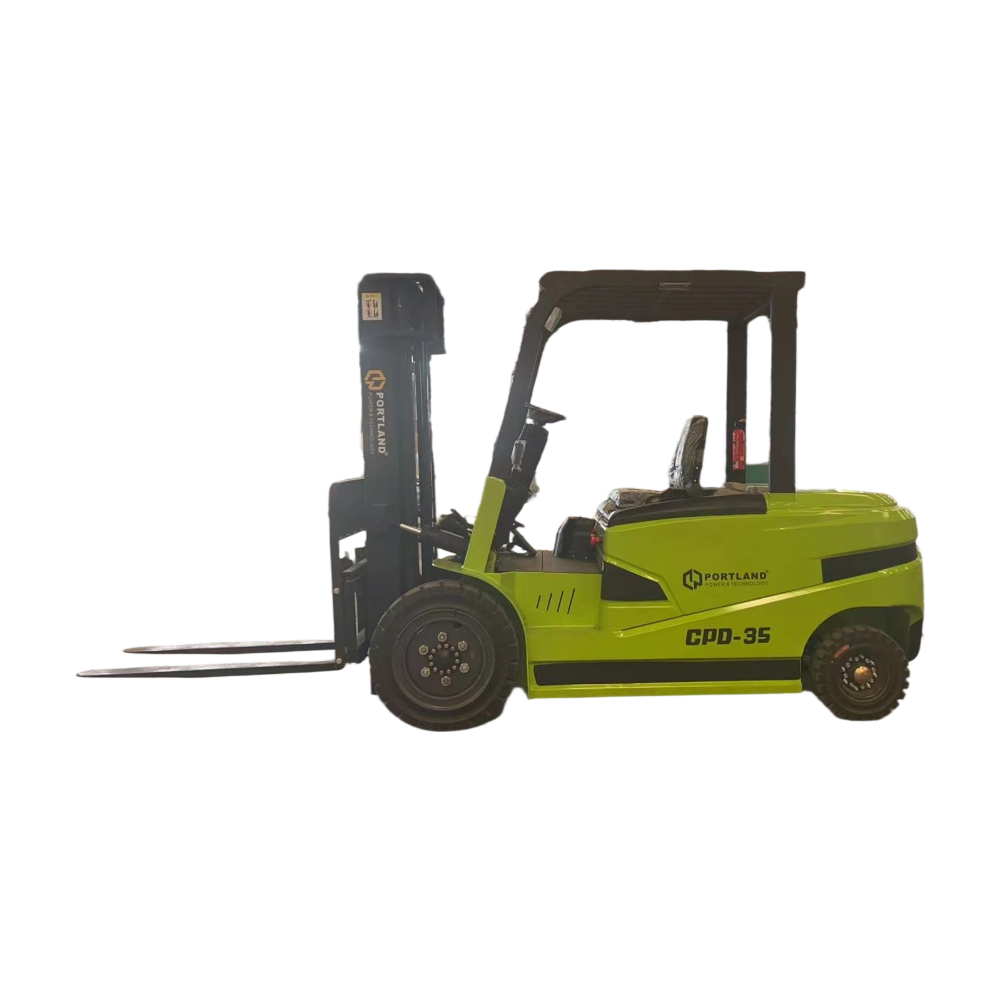
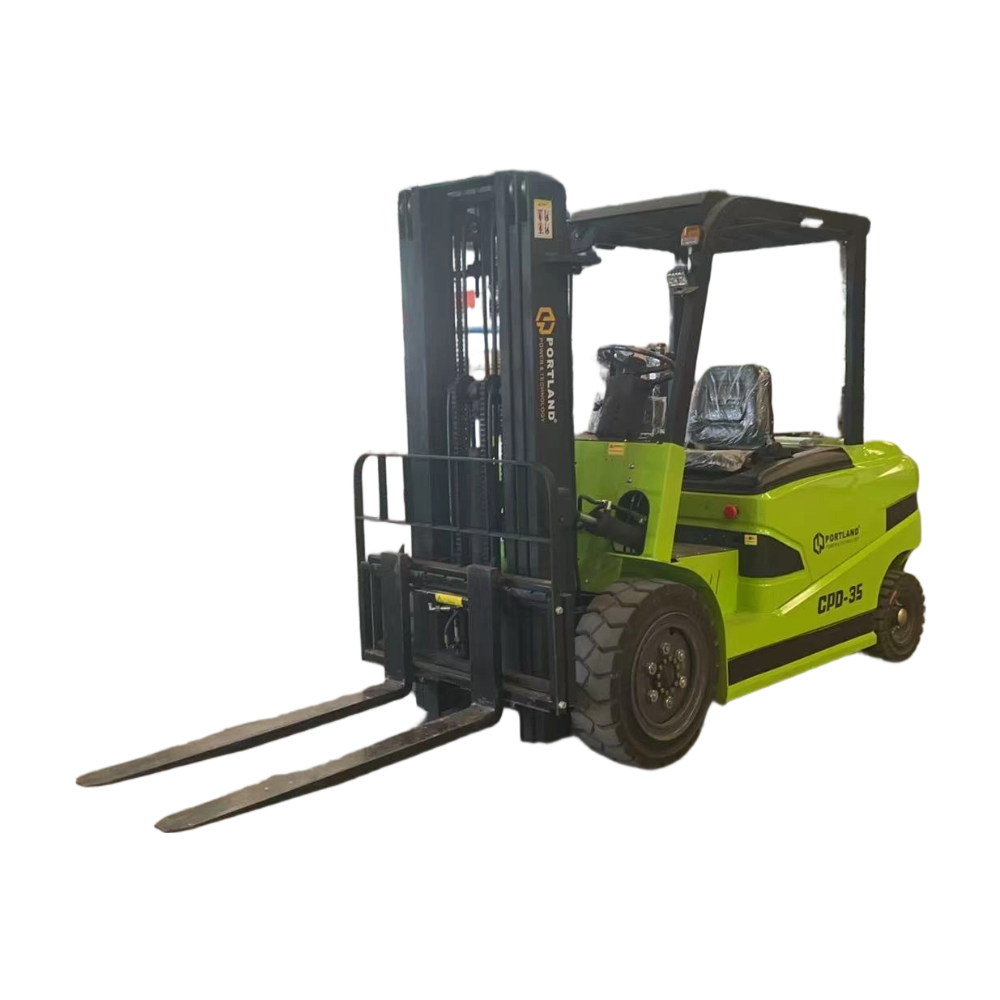
The short answer: indoor exhaust and engine noise cannot be managed away — they have to be removed at the source. A battery-electric counterbalance truck has no internal combustion engine, so it produces no tailpipe exhaust where it works and no combustion drone to suppress. The CPD series from Ningjin Shunhao Trading Co., Ltd., which sells under the Mightlift brand, applies that principle across four capacity classes — CPD10 (1 ton), CPD20 (2 ton), CPD30 (3 ton) and CPD35 (3.5 ton) — for workshops, warehouses and cold-chain facilities that operate indoors or in enclosed production areas.
This page is written for workshop managers and plant procurement teams who are already in evaluation: complaints have been logged, ventilation has been debated, and the real question is whether to convert the indoor fleet. It covers what the problem actually consists of, where the market is heading, how electric drive removes both the emission and the noise problem, how to sequence a conversion, and which CPD configuration fits which indoor duty.
Problem Definition: What “Indoor Exhaust and Noise” Actually Costs
Exhaust and noise are usually filed as one complaint. Operationally they are two separate exposures with two separate sources, and both survive most mitigation attempts.
Exhaust is a point-of-work problem, not a ventilation problem
A combustion-powered truck releases exhaust gas where it operates. Inside an enclosed production area, the truck’s operating position and the operator’s breathing zone overlap — and so does the zone of anyone working at the racking or machine it serves. Ventilation dilutes concentration in the building, but it does not move the emission source out of the aisle. That is why workshops that have already paid for extraction still log air-quality complaints. Combustion drive also adds heat and combustion by-products that a battery-electric drivetrain simply does not generate.
Engine noise is continuous, not intermittent
An engine-driven truck generates noise from the combustion cycle, the cooling system and the drivetrain, and it does so continuously while the truck is in use. Continuous noise interferes with verbal instruction, warning signals and concentration across a full shift, and it makes hearing protection a permanent requirement rather than a task-specific one. Intermittent noise — a load being set down, a pallet being moved — is far easier to manage than a source that never stops.
The indirect cost is where most of the budget actually goes
Neither exhaust nor engine noise appears as a line item on a truck quotation, yet both drive cost: restricted operating windows, ventilation capital, hearing protection and health surveillance, difficulty staffing indoor shifts, and recurring complaint handling. Reframed this way, the procurement question is not “which truck is cheaper” but “what does the current drive type cost the building every month”.
Industry Background: Indoor Emission Control Is Now the Default, Not the Alternative
Electric drive keeps appearing in indoor fleet plans because the transition is already well advanced rather than experimental.
- The global electric forklift market was valued at USD 53.01 billion in 2024 and is projected to reach USD 94.55 billion by 2032 (Maximize Market Research).
- In North America, electric trucks reached 71% of retail orders in 2024, reflecting a rapid shift away from internal combustion engines (Industrial Truck Association / Batteries International).
- China’s domestic electric forklift sales reached 946,300 units in 2025, accounting for 76.9% of total forklift sales in the country (China Construction Machinery Association).
- Lithium-ion adoption in new global forklift shipments rose to 35% in 2024, up from 22% in 2021 (LiTrue Analysis).
- Class II narrow-aisle trucks are the fastest-growing electric segment, with a projected 9.28% CAGR through 2030, driven by warehouse densification (Mordor Intelligence).
- Supply remains consolidated at the top: Toyota Industries Corp. reported 2023 revenues of USD 16.32 billion, roughly 28–29% of the market, while Anhui Heli (rank 7, USD 2.45 billion) and Hangcha Group (rank 8, USD 2.30 billion) lead Chinese manufacturers (Modern Materials Handling; Fleetman Consulting).
Two standards matter specifically for indoor buyers. EN 1175:2020 is the current harmonized European standard for electrical and electronic safety requirements in self-propelled industrial trucks and a prerequisite for CE marking (European Committee for Standardization). Where a workshop contains a classified explosive atmosphere, ATEX Directive 2014/34/EU is mandatory for the equipment used there (European Commission). Both are configuration decisions made at specification stage, not afterthoughts — which is why they return in the compliance step below.
Detailed Solution: Removing Exhaust and Noise at the Source with the CPD Line

The CPD series addresses the two complaints in three layers: the emission layer, the drivetrain layer, and the operator layer.
1. No combustion, so no tailpipe exhaust at the point of work
CPD10, CPD20, CPD30 and CPD35 are battery-powered electric forklifts. With no engine to produce exhaust gas, the air-quality question in an enclosed area changes from “how much are we diluting” to “is the truck’s operating area ventilated at all”. Field evidence is already on record: an electronics manufacturer operating in an industrial park used this product family for component, work-in-process and finished-goods logistics, and the project improved material-flow efficiency while removing tailpipe exhaust from enclosed clean production areas.
2. Electric drivetrain replaces the dominant continuous noise source
The CPD10 uses a brushless AC drive motor and pump motor. The CPD20 uses high-power front dual drive motors. The CPD35 uses front wheel dual drive motors. The CPD30 runs a high-power electric drive system with intelligent MOSFET control. None of them has a combustion cycle, so the engine firing noise that dominates an indoor floor is simply not generated.
One limit is worth stating plainly, because it affects how a workshop manager briefs a team: an electric truck is not silent. The hydraulic pump, load handling, tyres on concrete and reversing alarms still produce sound. What changes is the character of the noise. The constant engine drone disappears, and the remaining sound is intermittent and tied to a specific task. For indoor operations, that is the difference between a background level that must be protected against and a set of discrete events that can be planned around.
3. Operator comfort and air-quality workmanship
In enclosed workshops, air quality and operator comfort compound each other. The CPD30 carries a large-flow cyclone air filter system for dusty environments, together with a large-angle adjustable steering wheel and voice prompts. The CPD20 adds electric steering with cargo-sensing smooth control, an automatic electromagnetic parking brake and AI brake assist. The CPD35 places hydraulic control valves in an ergonomic right-hand position and uses P.E.S three-speed efficiency regulation. Less fatigue and smoother control mean fewer abrupt load movements, which matters in a building where people work at floor level beside the aisle.
The indirect benefit is the one most workshop managers under-report: with no exhaust plume and no engine drone, indoor shifts become easier to staff and easier to keep staffed, and the aisle no longer has to be treated as a contaminated zone.
Battery configuration decides how much of the day the truck is available
The CPD10 is configured with a heavy-duty lead-acid battery as standard, with a lithium battery available as an option. That choice affects the indoor workflow directly. Opportunity charging — 15 to 30 minute top-ups during breaks — does not degrade lithium-ion cycle life, whereas the same pattern significantly harms lead-acid battery longevity (Toyota Forklifts). A workshop running two or three shifts indoors can therefore keep a lithium-configured truck in service through the day instead of parking it for a full charge cycle. The CPD35’s lateral side battery extraction layout further reduces battery-handling time, because the pack can be removed from the side of the truck rather than lifted out overhead.
Compliance is documented, not claimed
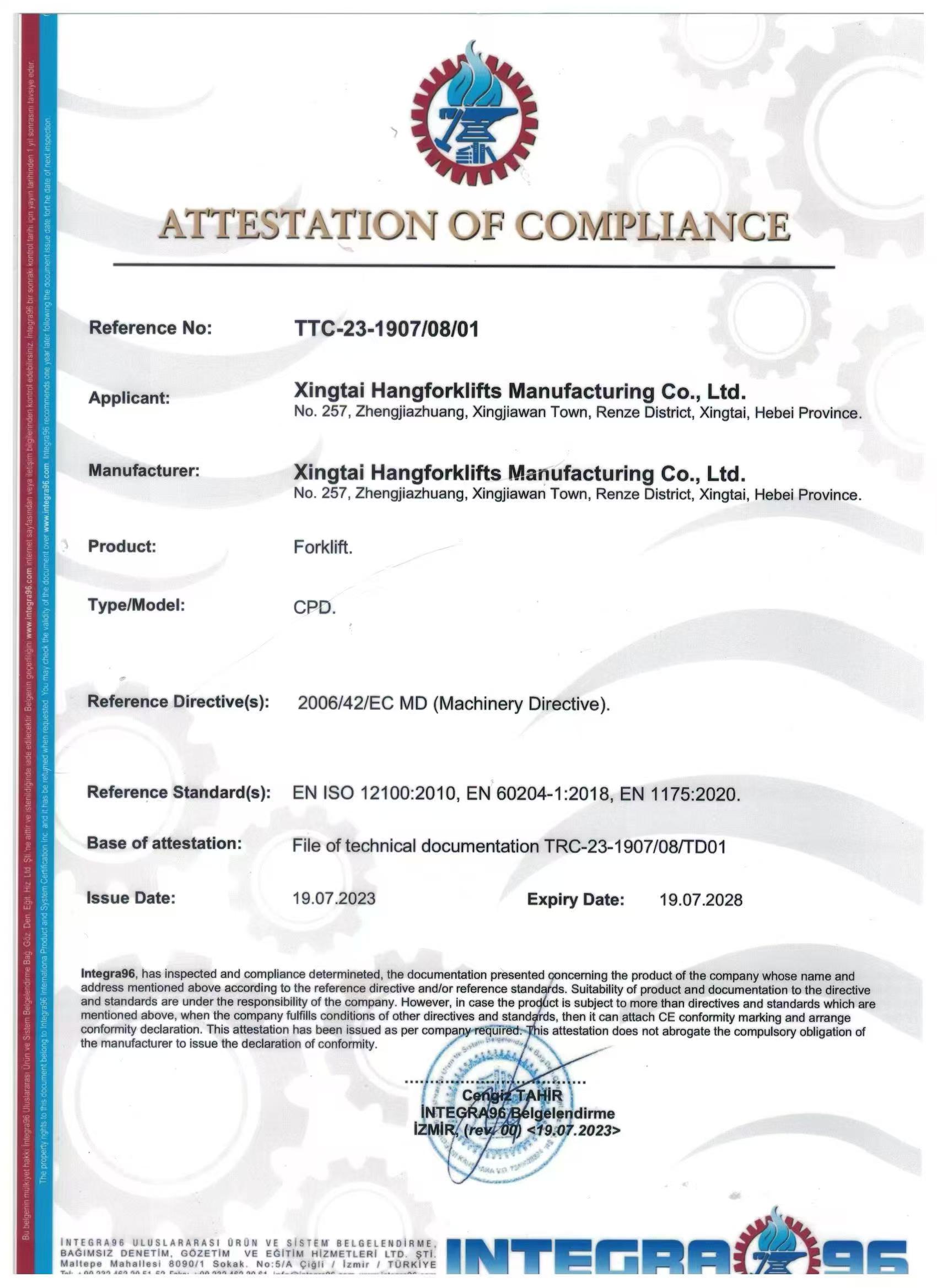
The CPD model series holds CE certification under the Machinery Directive 2006/42/EC — certificate number TTC-23-1907/08/01, issued by INTEGRA96 on 19 July 2023 and valid until 19 July 2028. The listed standards are EN ISO 12100:2010, EN 60204-1:2018 and EN 1175:2020. Manufacturer documentation for the range also covers ISO 9001, ISO 14001 and UN38.3 for battery transport. For sites with a classified explosive atmosphere, ATEX Directive 2014/34/EU applies in addition, and the truck must be specified as an explosion-proof configuration rather than a standard build — explosion-proof and low-temperature refitting are available as customisation options.
Step-by-Step Breakdown: Converting an Enclosed Workshop to CPD Electric Trucks
The conversion is a sequence, and running it out of order is what produces a fleet that fits the yard but not the aisle.
Step 1 — Map the complaint zones. Log where exhaust complaints originate and where noise complaints originate. In most workshops they overlap at the busiest transfer point, which tells you where the first replacement truck has to work.
Step 2 — Define load and lift duty. CPD10 handles 1,000 kg (1 ton). CPD20 is a 2-ton electric forklift truck. CPD30 is rated at 3,000 kg with standard and extended lifting heights from 3,000 mm to 7,000 mm. CPD35 covers 3.5 tons. Undersizing forces double handling, which increases both truck hours and residual noise.
Step 3 — Specify the drivetrain and control package. CPD10 offers controller brand options across SANTROLL, CURTIS, INMOTION and ZAPI. CPD20 runs an internationally sourced well-known brand controller with automatic electromagnetic parking brake and AI brake assist. If your maintenance team already standardises on one controller family, declare it at quotation stage.
Step 4 — Decide the battery configuration and the charging plan together. Lead-acid is the standard configuration on CPD10 with lithium optional. Make that decision against shift pattern, not purchase price alone, because lithium supports opportunity charging without a cycle-life penalty, which shortens daily downtime. The CPD35’s lateral side battery extraction layout is relevant here: it allows a battery to be changed from the side of the truck, which is useful when the charging position sits close to the aisle.
Step 5 — Verify compliance for the specific site. Confirm the CE certification details for the CPD model series against your market’s requirements, and confirm whether the area is classified under ATEX 2014/34/EU. Explosion-proof and low-temperature refitting are engineering requirements that have to be requested, not assumed.
Step 6 — Run a pilot before fleet rollout. The minimum order quantity for the CPD range is 2 units, which is enough to validate the exhaust and noise outcome inside the actual building. Aisle width, floor surface and shift pattern are where the outcome is proven or not.
Step 7 — Prepare for service, not just delivery. Production follows 100% test quality control, and after-sales technical support is part of the supply arrangement. Identify who will handle hydraulic and battery service locally before the trucks arrive.
Use Cases: Where the CPD Line Removes Indoor Exhaust and Noise

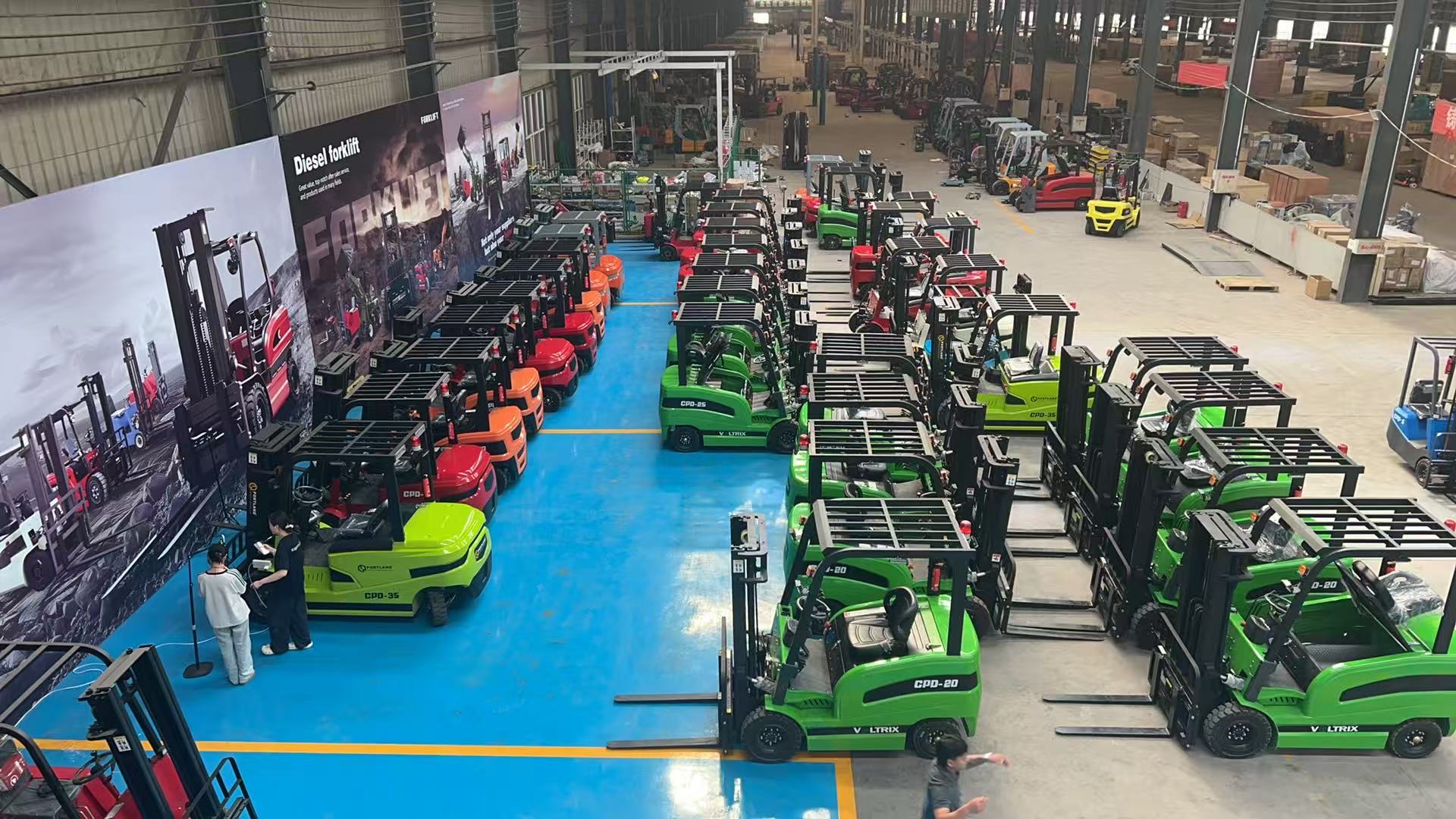
Electronics manufacturing in an industrial park. Component, work-in-process and finished-goods logistics inside enclosed clean production areas. This is the documented use case for the CPD family, where the project delivered improved material-flow efficiency and removed tailpipe exhaust from enclosed clean production areas.
General workshop stacking and enclosed production. CPD20 suits 2-ton indoor duty where manoeuvring space is tight, thanks to electric steering with cargo-sensing smooth control. CPD30 suits heavier workshop flow where lifting heights of up to 7,000 mm are required.
Cold chain and food factory clean areas. Lithium-ion batteries in cold storage applications down to −20 °C retain significantly more capacity than lead-acid batteries, and the food-industry segment is growing at an 11.6% CAGR (Mordor Intelligence). Low-temperature refitting is available as a customisation option for these environments.
Warehousing, e-commerce and logistics parks. Warehouse electric forklifts increasingly operate in densified layouts, and Class II narrow-aisle trucks are the fastest-growing electric segment at a projected 9.28% CAGR through 2030 (Mordor Intelligence). Where aisle width is the binding constraint, CPD20’s electric steering and CPD35’s three-speed efficiency regulation are the configuration levers.
Supermarkets, department stores and cold-chain fruit and vegetable wholesale markets. These are listed application environments for the CPD range, and they share the same characteristic: the truck works where people work — indoors, close to goods and close to customers.
Chemical and other classified workshops. Where an explosive atmosphere exists, ATEX Directive 2014/34/EU governs the equipment used in that zone. Explosion-proof refitting is offered as a customised configuration, which means the requirement has to be declared at specification stage rather than added later.
Comparison: CPD10, CPD20, CPD30 and CPD35 for Indoor, Low-Emission Duty
The four CPD classes share the same indoor advantage — no combustion, no tailpipe exhaust at the point of work — and differ in capacity, drive layout and operator features. The table below uses only the published configuration facts for each model.
| Model | Rated capacity & lift | Drive, control & battery | Operator environment | Indoor exhaust & noise profile |
|---|---|---|---|---|
| CPD10 | 1,000 kg (1 ton) | Brushless AC drive motor & pump motor; controller options SANTROLL / CURTIS / INMOTION / ZAPI; heavy-duty lead-acid standard, lithium optional | Battery-powered electric drive; no combustion cycle | No tailpipe exhaust at point of work; no engine firing noise |
| CPD20 | 2-ton electric forklift truck | High-power front dual drive motors; internationally sourced well-known brand controller | Electric steering / cargo-sensing smooth control; automatic electromagnetic parking brake / AI brake assist | No tailpipe exhaust; smoother load handling reduces abrupt task noise |
| CPD30 | 3,000 kg; lifting height 3,000 mm – 7,000 mm | High-power electric drive system / intelligent MOSFET | Large-angle adjustable steering wheel / voice prompts; large-flow cyclone air filter system | No combustion exhaust in dusty indoor workshops; air filter protects truck systems |
| CPD35 | 3.5 tons | Front wheel dual drive motors; P.E.S three-speed efficiency regulation; lateral side battery extraction layout | Ergonomic right-positioned hydraulic control valves | No tailpipe exhaust on heavy indoor duty; faster battery changes cut charge downtime |
Configuration facts as published for the CPD10, CPD20, CPD30 and CPD35. Certification for the series is held under CE (Machinery Directive 2006/42/EC), certificate TTC-23-1907/08/01.
The comparison that matters most for an indoor conversion is not model against model, but drive type against drive type:
| Indoor criterion | Combustion drive | Battery-electric CPD drive |
|---|---|---|
| Exhaust at the point of work | Produced where the truck operates | No tailpipe exhaust; no engine |
| Dominant continuous noise source | Combustion cycle, cooling and drivetrain | Removed; residual sound is hydraulic, tyre and alarm related |
| Air-quality strategy | Dilution and extraction required | No combustion source inside the building to dilute |
| Energy handling indoors | On-site fuel storage and handling | Battery charging; lithium supports 15–30 min opportunity charging without cycle-life loss |
FAQ: Indoor Exhaust, Noise and the CPD Series
Does the CPD series carry the certification needed for indoor workshop use in the EU?
The CPD model series holds CE certification under the Machinery Directive 2006/42/EC, certificate number TTC-23-1907/08/01, issued by INTEGRA96 on 19 July 2023 and valid until 19 July 2028. The certification references EN ISO 12100:2010, EN 60204-1:2018 and EN 1175:2020, the harmonized European standard for electrical and electronic safety in self-propelled industrial trucks. Where a workshop area is classified as an explosive atmosphere, ATEX Directive 2014/34/EU applies in addition, and the truck has to be specified as an explosion-proof configuration rather than a standard build.
Can the CPD line be matched to different capacities, aisle widths and lifting heights?
Yes. The range covers four capacity classes: CPD10 at 1,000 kg, CPD20 at 2 tons, CPD30 at 3,000 kg and CPD35 at 3.5 tons. CPD10 pairs a brushless AC drive motor and pump motor with controller options from SANTROLL, CURTIS, INMOTION or ZAPI. CPD20 uses high-power front dual drive motors with electric steering and cargo-sensing smooth control for tighter layouts. CPD30 offers standard and extended lifting heights from 3,000 mm to 7,000 mm. CPD35 uses front wheel dual drive motors with P.E.S three-speed efficiency regulation. OEM production and capacity customisation are supported, including low-temperature and explosion-proof refitting.
What drives the cost of converting an indoor workshop to electric trucks?
Cost is driven by configuration rather than a single list figure. The main variables are the capacity class you need, the battery choice (heavy-duty lead-acid is standard on CPD10 with lithium available as an option), the controller brand selected on the smaller model, the required lifting height, and the scope of OEM customisation such as explosion-proof or low-temperature refitting. The largest operational variable is the charging strategy: lithium batteries accept 15 to 30 minute opportunity charging without a cycle-life penalty, whereas the same pattern significantly harms lead-acid longevity, so the battery decision should be made against shift pattern rather than purchase price alone.
Can we validate a CPD truck in our own building before ordering a fleet?
The minimum order quantity for the CPD range is 2 units, which is enough to run a pilot inside the actual workshop before a wider rollout. That matters for an exhaust and noise project, because the result depends on the specific aisle, floor surface and shift pattern rather than on a specification sheet. Every unit is tested before shipment under 100% test quality control, and after-sales technical support is part of the supply arrangement.
How long is the lead time, and what is the next step?
Quoted lead time for CPD orders is 30 days, from a supplier founded in 2022 that exports to global markets. The practical next step is a site-specific configuration discussion: confirm the load class, the lifting height, the battery configuration and whether the area is classified under ATEX, then quote against those requirements rather than a generic model. Contact details for requesting a configuration review, sample arrangement or quotation are listed at the end of this page.
Conclusion: The Complaint Is Solved by the Drive Type, Not by Housekeeping
An indoor exhaust and noise problem ends when combustion leaves the building. Ventilation upgrades, shift rotation and hearing protection all manage the symptom; a battery-electric counterbalance truck removes the source, because there is no engine producing exhaust at the point of work and no combustion cycle generating continuous noise. The CPD series — CPD10, CPD20, CPD30 and CPD35 — covers the four capacity classes that most enclosed workshops, warehouses, food facilities and cold-chain sites actually operate in, with configuration options that address the parts of the problem a standard catalogue truck cannot: dusty environments, low-temperature duty, classified atmospheres and duty cycles that do not allow a full battery charge window.
The evidence that this is a solved problem is not only technical. An electronics manufacturer in an industrial park moved its component, work-in-process and finished-goods logistics onto this product family and recorded improved material-flow efficiency alongside the removal of tailpipe exhaust from enclosed clean production areas. That is the outcome a workshop manager is actually buying: an aisle where people can work, and a building that no longer has to be managed around the trucks.
Next step: if you are evaluating a conversion, request a site-specific configuration review for the CPD10, CPD20, CPD30 or CPD35 and confirm which model fits your aisle, load and shift pattern. Minimum order quantity is 2 units, lead time is 30 days.
Ningjin Shunhao Trading Co., Ltd. (Mightlift)
Website: www.mightlift.com
Email: licong@mightlift.com
Tel / WhatsApp: +86 151-0097-4338
Address: West Zhen Village, Dacaozhuang Town, Ningjin County, Xingtai City, Hebei Province
Have Questions or Need More Details?
Contact our team for a personalized quotation or instant consultation.
Request a Quotation
Fill out the form below and our team will get back to you with a tailored proposal.
WhatsApp Direct Chat
Prefer to chat in real-time? Message us on WhatsApp for instant assistance & quick answers.
- Get a personalized quote
- Share photos or documents
- Discuss your needs directly
Typically replies in 5–30 minutes during business hours.