Zero Emission Compliance Landscape: Comparing Indoor Air Quality Standards for CPD Series
Compliance Guide · CPD Series · Indoor Air Quality
Indoor air quality compliance for material handling equipment starts from one structural fact: a battery electric forklift produces no tailpipe exhaust at the point of use. In an enclosed workshop, cold store, food plant or electronics hall, that characteristic removes the exhaust source that diesel and LPG trucks introduce directly into an occupied air volume. The CPD series is the electric forklift line supplied by Ningjin Shunhao Trading Co., Ltd. under the Mightlift brand, and its environmental value inside a regulated facility rests on documented, verifiable compliance rather than on an advertising claim.
This guide uses the CPD series as a working case study in that verification process. It explains why exhaust and noise become compliance issues indoors, which European framework documents actually govern an electric counterbalance truck, how the CPD series is documented, and which steps a buyer should complete before accepting a zero-emission claim inside a tender file.
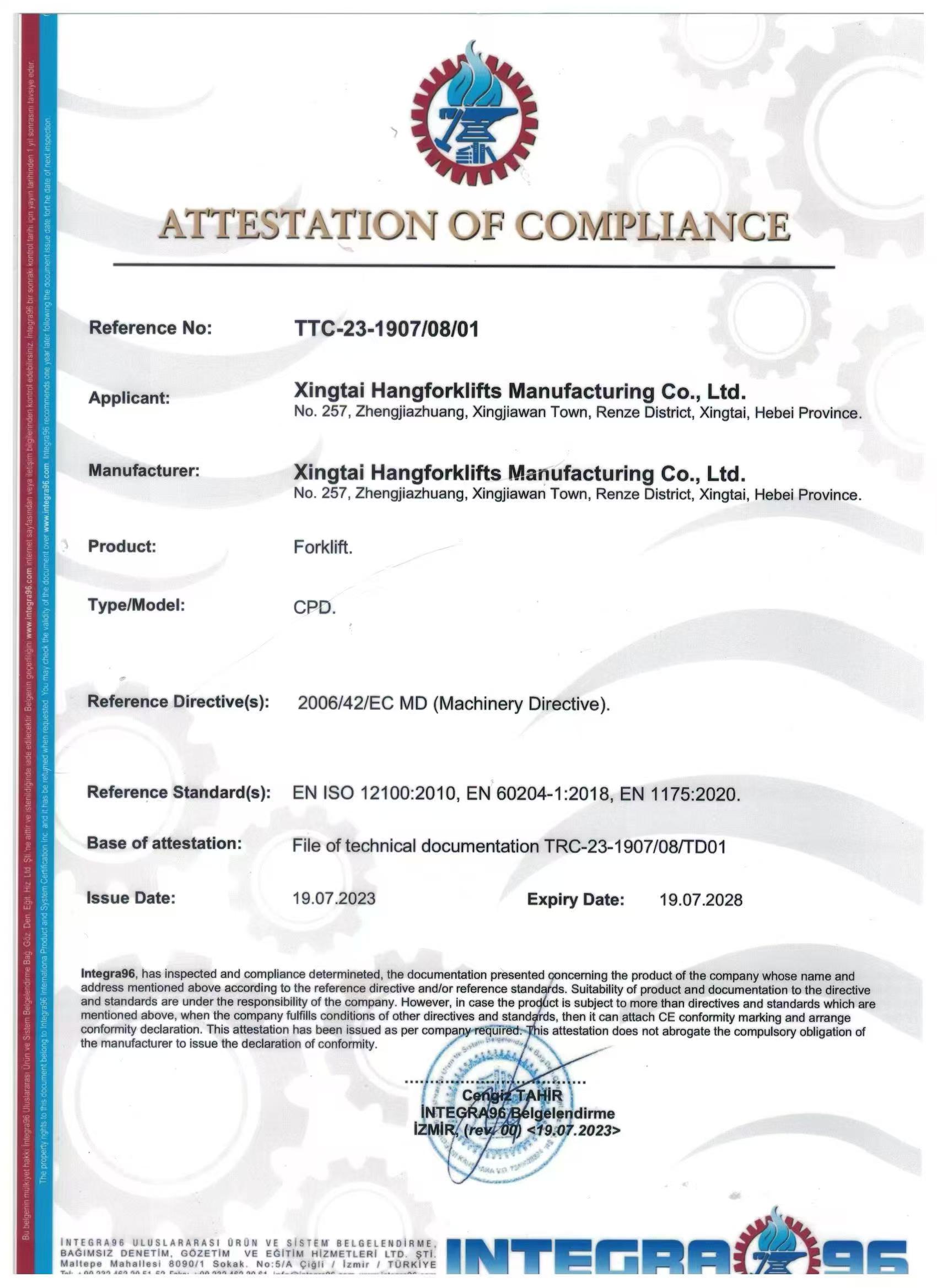
Direct answer: Battery electric forklifts such as the CPD series produce no tailpipe exhaust at the point of use, which is the characteristic that indoor air quality and workshop environmental assessments test for. The CPD series is covered by an ATTESTATION OF COMPLIANCE, certificate number TTC-23-1907/08/01, issued by INTEGRA96 under CE (Machinery Directive 2006/42/EC), referencing EN ISO 12100:2010, EN 60204-1:2018 and EN 1175:2020, for models CPD10, CPD20, CPD30 and CPD35, valid until 2028-07-19.
Problem Definition: Why Exhaust and Noise Become Compliance Problems Indoors
In an open yard, combustion by-products disperse. In an enclosed building they do not. Any internal combustion lift truck operating indoors releases exhaust gases into the same air volume that operators, pickers and production staff breathe. That leaves facility management with two responses: engineer ventilation sized to the fleet, or change the power source of the fleet. The first response is a continuous operating cost. The second is capital expenditure, and it changes the vehicle specification permanently.
Noise follows a comparable logic. A combustion engine creates a continuous sound source at the truck itself, and in a hard-surfaced industrial hall that sound reflects instead of dissipating. Where a site manages noise exposure as part of its occupational environment, removing the combustion engine removes the dominant noise source at its origin. This is why electric drivetrains are commonly specified for enclosed workshops and for operations that run alongside manual picking.
Neither problem is solved by a certificate alone. It is solved by the physical characteristics of the vehicle — no tailpipe emission, no combustion noise — plus documentation that a compliance officer can file and defend at audit.
What a zero-emission claim covers — and what it does not
A zero-emission claim for an electric forklift is a point-of-use claim. It means the vehicle releases no exhaust gas while it is operating. It does not mean the surrounding process is emission-free, and buyers who treat it that way create avoidable exposure for themselves.
- Point-of-use emissions: battery electric trucks, including the CPD series, have no tailpipe exhaust.
- Charging area: battery charging is normally handled in a designated area, so the facility should confirm layout and ventilation for the selected battery configuration.
- Particulate and mechanical wear: tyres, brakes and floor surfaces remain ordinary dust sources in any industrial building, regardless of power source.
- Documentation scope: conformity certificates evidence the machine, not the air quality performance of the building.
Keeping that boundary explicit is a procurement advantage. Buyers who overstate a supplier's claim create an audit risk; buyers who understate it may pay for ventilation capacity they do not need.
Industry Background: Why Indoor Environmental Requirements Now Shape Forklift Specification
The shift toward electric material handling is no longer a niche preference; it is the dominant direction of the category. The global electric forklift market was valued at USD 53.01 billion in 2024 and is projected to reach USD 94.55 billion by 2032 (Maximize Market Research). In North America, electric forklifts reached a 71% share of retail orders in 2024, reflecting a rapid shift away from internal combustion engines (Industrial Truck Association, reported by Batteries International). In China, domestic electric forklift sales reached 946,300 units in 2025, accounting for 76.9% of total forklift sales (China Construction Machinery Association). Lithium-ion adoption in new global forklift shipments rose to 35% in 2024, up from 22% in 2021 (LiTrue Analysis).
Regulation and procurement practice are converging on the same conclusion. Sites with enclosed operating zones increasingly treat the power source of a lift truck as part of the building's environmental control strategy, which moves the specification conversation from “which truck lifts the pallet” to “which truck can legally and comfortably operate inside this air volume.”
The standards and directives that actually appear in an EU compliance file
European buyers rarely work from a single document. An indoor fleet file typically combines a product directive, harmonized standards referenced in the conformity documentation, and scenario-specific regulation where the atmosphere is classified.
| Framework | Type | Applies to | Why it matters for indoor operation |
|---|---|---|---|
| Machinery Directive 2006/42/EC | EU directive | Machinery placed on the EU market | The directive under which the CPD series CE Attestation of Compliance was issued |
| EN ISO 12100:2010 | Harmonized standard | Risk assessment of machinery | Referenced in the CPD conformity documentation as the risk-assessment basis |
| EN 60204-1:2018 | Harmonized standard | Electrical equipment of machines | Referenced in the CPD conformity documentation for electrical safety |
| EN 1175:2020 | Harmonized standard | Electrical/electronic safety requirements in self-propelled industrial trucks | Current harmonized European standard and a CE marking prerequisite (CEN) |
| ATEX Directive 2014/34/EU | EU directive | Equipment used in explosive atmospheres | Mandatory for electric forklifts used in explosive atmospheres such as defined chemical or food processing zones (European Commission) |
| ISO 3691-4:2023 | International standard | Driverless industrial trucks (AGVs) and their systems | Relevant where an indoor fleet includes automated trucks in smart manufacturing environments (ISO) |
| UN38.3 | Transport standard | Lithium batteries | Applies to the lithium battery configuration when it is transported |
Table note: the CPD series documentation and the certification register state ISO 9001, ISO 14001, CE and UN38.3 for the manufacturer's product scope.
Detailed Solution: How the CPD Series Is Positioned Within This Compliance Landscape
The CPD series is documented as a CE-compliant electric forklift family. The ATTESTATION OF COMPLIANCE held for the series carries certificate number TTC-23-1907/08/01, was issued by INTEGRA96 under the type “CE (Machinery Directive 2006/42/EC)” for the EU market, and states its scope as “Forklift, Model Series: CPD”. The referenced standards are EN ISO 12100:2010, EN 60204-1:2018 and EN 1175:2020. The document was issued on 2023-07-19 and is valid until 2028-07-19, and it names four applicable models: CPD10, CPD20, CPD30 and CPD35.
For an indoor air quality file, three elements of that package matter more than the rest: which models are covered, which standards are referenced, and whether the validity period still covers the planned deployment date.
Removing the emission and combustion-noise source at the vehicle
Every model in the CPD series is battery powered. The CPD10 uses a brushless AC drive motor and pump motor. The CPD20 uses high-power front dual drive motors. The CPD30 uses a high-power electric drive system with intelligent MOSFET control and a large-flow cyclone air filter system. The CPD35 uses front wheel dual drive motors with P.E.S three-speed efficiency regulation. Because drive and hydraulic power come from electric motors rather than a combustion engine, no tailpipe exhaust is produced at the point of use — the single characteristic that indoor environmental assessments are looking for.
The same architecture changes the noise profile. An electric drivetrain has no combustion cycle generating continuous engine sound, so the dominant noise source present on a diesel or LPG truck is absent at the vehicle. What remains comes from motors, hydraulics, tyres on the floor surface and load handling — sources that also exist on combustion trucks but are no longer masked by an engine. That is the technical reason low-noise operation is generally associated with electric equipment in enclosed workshops. Where a site's occupational noise assessment requires a declared sound-pressure figure, buyers should request the model-specific declared value as part of the supplier's technical documentation, because noise data is configuration- and operation-dependent.
Configuration flexibility as a compliance tool
Compliance is rarely satisfied by one standard vehicle. The CPD10 is offered with a heavy-duty lead-acid battery as standard and an optional lithium battery configuration, and its controller brand can be specified from SANTROLL, CURTIS, INMOTION or ZAPI. The CPD35 provides a lateral side battery extraction layout, which supports battery handling inside a designated charging area, together with ergonomically right-positioned control valves. The CPD30 supports lifting heights from 3000 mm to 7000 mm and includes a large-angle adjustable steering wheel and voice prompts.
Ningjin Shunhao Trading Co., Ltd. positions itself as a professional B2B electric forklift manufacturer offering OEM and ODM customized material handling equipment, founded in 2022, with an electric forklift product focus, a 70% export ratio and global market coverage. The stated customization scope includes load capacity adjustment, low-temperature and explosion-proof refitting, branded appearance optimization and intelligent system reservation — the exact categories that indoor, temperature-controlled and atmosphere-classified facilities tend to require.
Step-by-Step Breakdown: Building an Indoor Compliance File for a CPD Fleet
The sequence below is the order in which indoor compliance questions usually have to be answered, because each step constrains the next. Reversing the order — choosing a truck and then justifying it — is what creates rework at audit.
- Define the indoor zone and its constraint. Identify which areas are enclosed and occupied, whether the atmosphere is classified, and whether the site already has a ventilation or air-quality protocol that a new truck must fit.
- Map the framework that applies to that zone. For EU deployment, Machinery Directive 2006/42/EC forms the basis for CE marking, with EN 1175:2020 as the current harmonized standard for electrical and electronic safety of self-propelled industrial trucks, and EN ISO 12100:2010 and EN 60204-1:2018 referenced in the series documentation. If the zone is a classified explosive atmosphere, ATEX Directive 2014/34/EU applies.
- Request the conformity documents and verify their content, not just their existence. Check the certificate number (TTC-23-1907/08/01 for the CPD series), the issuing body (INTEGRA96), the directive under which it was issued (2006/42/EC), the scope wording (“Forklift, Model Series: CPD”), the listed standards, the named models (CPD10, CPD20, CPD30, CPD35) and the validity window (2023-07-19 to 2028-07-19).
- Match the vehicle configuration to the zone. This covers battery chemistry (heavy-duty lead-acid as standard on the CPD10, with an optional lithium configuration), controller brand, load capacity, lifting height (CPD30: 3000 mm to 7000 mm) and any refitting such as low-temperature or explosion-proof preparation.
- Validate before acceptance. Pre-shipment test is the stated acceptance criterion, and 100% test is the stated quality control approach. That means the buyer can define acceptance items — function checks, load behaviour, braking and configuration confirmation — against a pre-shipment protocol instead of relying on a certificate alone.
- Document the operating protocol. Charging location and layout, battery handling (supported by the CPD35 lateral side extraction design), operator training and scheduled maintenance belong in the same file. Air filtration is part of this: the CPD30's large-flow cyclone air filter system is a maintenance-relevant component in dusty indoor environments.
Use Cases: Where Zero-Emission Indoor Operation Becomes the Deciding Requirement
Electronics manufacturing inside an enclosed industrial park
An electronics manufacturer operating in an industrial park uses CPD-series trucks for component, work-in-process and finished-goods logistics. The stated result is improved material-flow efficiency combined with the removal of tailpipe exhaust from enclosed clean production areas — a case in which the air-quality requirement and the logistics requirement were resolved by the same procurement decision. The fleet was configured as a bulk fleet with coordinated delivery, and the exact unit count is not disclosed.
Cold storage and chilled food handling
Lithium-ion batteries in cold storage applications at temperatures down to -20 °C retain significantly more capacity than lead-acid batteries, a factor behind the 11.6% CAGR recorded in the food industry segment (Mordor Intelligence). For an enclosed chilled facility, the combination of no point-of-use exhaust and a battery configuration suited to low temperature addresses both the air-quality requirement and the runtime requirement. The CPD series supports an optional lithium battery configuration on the CPD10 and low-temperature refitting within its stated customization scope.
Food factory clean zones and chemical workshops
Food production areas and chemical workshops are the two indoor environments where air quality, and in the chemical case atmosphere classification, are most tightly controlled. ATEX Directive 2014/34/EU is mandatory for electric forklifts used in explosive atmospheres within the European Union (European Commission). The CPD series customization scope explicitly includes explosion-proof refitting, which lets a buyer align the vehicle specification with the zone classification instead of treating the zone as an unchangeable constraint.
Supermarkets, workshops and logistics park transfer
The CPD series lists warehousing and logistics, e-commerce warehouses, workshops, supermarkets and department stores, and cold chain fruit and vegetable wholesale markets among its applicable industries. In each of these environments the same logic applies: the truck shares an indoor air volume with people who are not wearing respiratory protection, which makes the power source a facility-level decision rather than a vehicle-level preference.
Comparison: Model Coverage and Indoor-Relevant Configuration
Buyers comparing an indoor fleet usually compare two things at once: the emission and noise profile of the power source, and the model-level configuration that determines whether the truck fits the aisle, the load and the temperature.
| Power source | Point-of-use exhaust | Combustion noise source | Implication for indoor specification |
|---|---|---|---|
| Diesel (internal combustion) | Yes | Yes | Enclosed operation normally depends on ventilation engineering or equivalent controls |
| LPG (internal combustion) | Yes | Yes | Same ventilation dependency as diesel in an enclosed hall |
| Battery electric (CPD series) | No | No | Emission source and combustion-noise source removed at the vehicle |
At model level, the four CPD units named in the CE documentation differ in a way that is directly relevant to indoor deployment:
| Model | Load capacity | Drive and control | Battery and indoor-relevant detail |
|---|---|---|---|
| CPD10 | 1000 kg (1 ton) | Brushless AC drive motor and pump motor; controller options SANTROLL, CURTIS, INMOTION, ZAPI | Battery powered; heavy-duty lead-acid standard with optional lithium battery |
| CPD20 | 2 ton electric forklift truck | High-power front dual drive motors; electric steering with cargo-sensing smooth control; automatic electromagnetic parking brake and AI brake assist; internationally sourced well-known brand controller | Battery powered / electric |
| CPD30 | 3000 kg | High-power electric drive system with intelligent MOSFET; large-angle adjustable steering wheel and voice prompts | Lifting height 3000 mm – 7000 mm; large-flow cyclone air filter system |
| CPD35 | 3.5 ton | Front wheel dual drive motors; P.E.S three-speed efficiency regulation; ergonomically right-positioned control valves | Lateral side battery extraction layout |
Table source: CE Attestation of Compliance TTC-23-1907/08/01 and published CPD model parameters. All four models are named in the same conformity document.
FAQ: Zero-Emission and Indoor Air Quality Questions for CPD Series Buyers
1. What CE documentation does the CPD series hold, and which standards are referenced?
The CPD series is covered by an ATTESTATION OF COMPLIANCE issued as “CE (Machinery Directive 2006/42/EC)”. The certificate number is TTC-23-1907/08/01, issued by INTEGRA96 for the EU market, with the scope stated as “Forklift, Model Series: CPD”. The referenced standards are EN ISO 12100:2010, EN 60204-1:2018 and EN 1175:2020. The document was issued on 2023-07-19 and is valid until 2028-07-19, and it names the CPD10, CPD20, CPD30 and CPD35. EN 1175:2020 is the current harmonized European standard for electrical and electronic safety requirements in self-propelled industrial trucks and a prerequisite for CE marking (CEN).
2. Can the CPD series be supplied as an OEM lithium battery configuration for a warehouse fleet?
Yes, subject to configuration. Ningjin Shunhao Trading Co., Ltd. provides OEM production services with customization support, covering load capacity adjustment, low-temperature and explosion-proof refitting, branded appearance optimization and intelligent system reservation. On the CPD10, the standard battery configuration is heavy-duty lead-acid with an optional lithium battery, and the controller brand can be specified from SANTROLL, CURTIS, INMOTION or ZAPI. For fleet projects, the relevant capability facts are an electric forklift product focus, an MOQ of 2 units, a stated lead time of 30 days, 100% test quality control, a 70% export ratio and global market coverage.
3. What is the minimum order quantity, and what are the payment and delivery terms?
The minimum order quantity for the CPD10 (product 7340), CPD20 (7342), CPD30 (7341) and CPD35 (7343) is 2 units. Stated delivery terms are FOB or CIF, and stated payment terms are 30/70. Because the commercial offer depends on the configuration actually specified — battery chemistry, controller brand, capacity and any refitting — a quotation should be requested against a defined specification rather than against a model name alone.
4. How is pre-shipment acceptance handled before a fleet order ships?
Pre-shipment test is the stated acceptance criterion, and 100% test is the stated quality control approach for production. In practice, that means a buyer can define acceptance items — function checks, load behaviour, braking and configuration confirmation — against a pre-shipment protocol rather than relying on the certificate alone. The 2-unit minimum order quantity also allows a small validation batch to be ordered and assessed before a full fleet release.
5. What is the production lead time, and how does an indoor fleet project start?
Stated lead time is 30 days, with OEM production and customization support handled by the manufacturer. A practical starting sequence is: define the indoor zone and its constraints, list the models and configurations required, then request the conformity documents for the CPD series together with a configuration-specific quotation and a sample or validation-batch arrangement. The team can be reached through www.mightlift.com, by email at licong@mightlift.com, or on WhatsApp at +86 15100974338.
Conclusion: Verification, Not Vocabulary, Wins the Compliance File
Indoor air quality compliance for a forklift fleet is decided by two things: the physical characteristics of the truck and the documentation behind it. The CPD series removes the exhaust and combustion-noise source at the vehicle, because every model is battery powered, and it is presented with a CE Attestation of Compliance issued against Machinery Directive 2006/42/EC, referencing EN ISO 12100:2010, EN 60204-1:2018 and EN 1175:2020, covering the CPD10, CPD20, CPD30 and CPD35 with validity to 2028-07-19.
What that package does not do is decide the specification for your building. Load capacity, lifting height (3000 mm to 7000 mm on the CPD30), battery chemistry, contamination or explosion-proof requirements, charging layout and the site's own noise policy all remain buyer-side decisions that should be settled before the certificate is filed.
Mightlift is the electric forklift brand of Ningjin Shunhao Trading Co., Ltd., an OEM and ODM manufacturer of customized material handling equipment serving distributors, manufacturing plants, cold-chain enterprises and warehouse operators. Buyers evaluating an indoor fleet can request the conformity documentation, a configuration-specific quotation and a validation-batch arrangement directly.
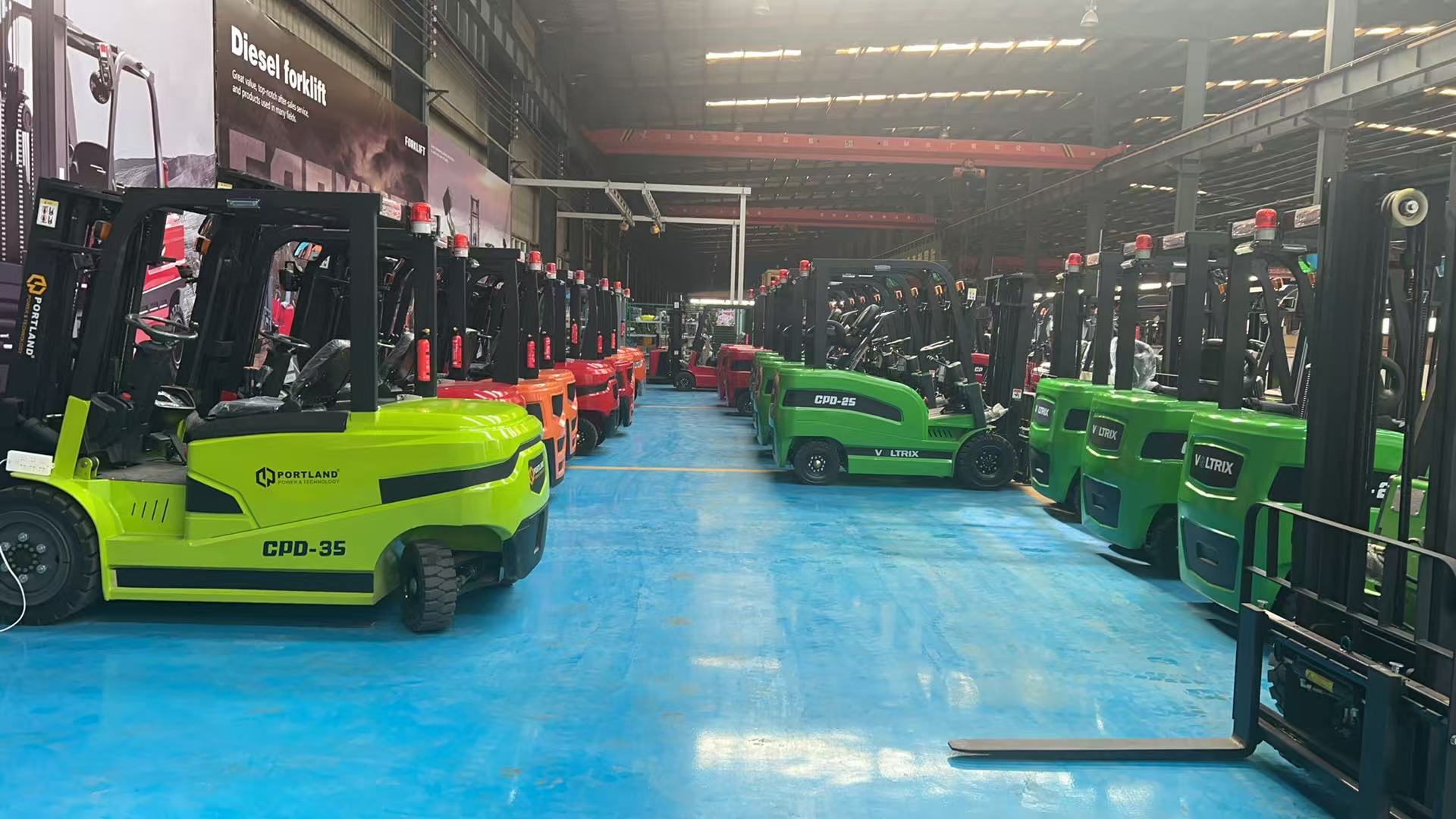
Next step
Send your indoor zone profile, model requirement and target deployment date, and request the CPD series documents plus a quotation.
Email: licong@mightlift.com | Tel / WhatsApp: +86 151-0097-4338 | Web: www.mightlift.com
Have Questions or Need More Details?
Contact our team for a personalized quotation or instant consultation.
Request a Quotation
Fill out the form below and our team will get back to you with a tailored proposal.
WhatsApp Direct Chat
Prefer to chat in real-time? Message us on WhatsApp for instant assistance & quick answers.
- Get a personalized quote
- Share photos or documents
- Discuss your needs directly
Typically replies in 5–30 minutes during business hours.