
Low Oxidation Fish Oil: How Omega-3 Buyers Verify Freshness, Purity and Custom Specifications
Low oxidation fish oil is an omega-3 oil or omega-3 concentrate whose measured oxidation markers — peroxide value (PV), p-anisidine value (pAV) and the calculated TOTOX value — stay within an agreed specification at the point of shipment, and can be demonstrated with batch analytical documents. It is not a permanent property of a product name. It is a batch-level outcome that a buyer verifies through a written specification, a certificate of analysis (COA) and, where required, independent testing.
This guide is written for supplement brand owners, importers, distributors and formulation teams who are at the research stage: you know you need a marine omega-3 ingredient, you have seen suppliers describe products as low oxidation, and you need a defensible way to compare them before you commit to a specification or a purchase order. It explains what the oxidation numbers mean, why the specification is harder to buy than the product, how a concentrate grade is selected, and what documents a buyer should collect before evaluating a sample.
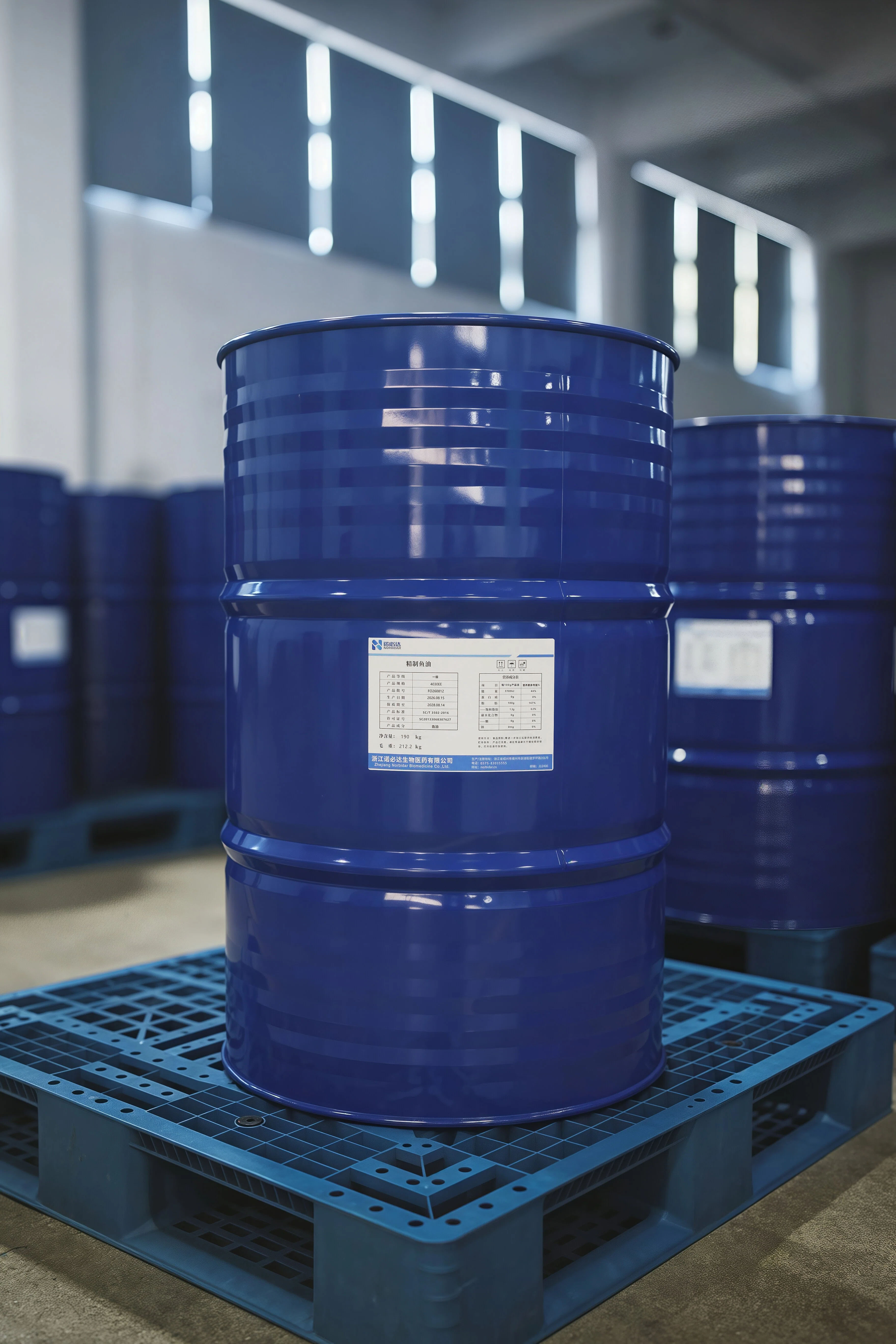
Norbidar Omega-3 Fish Oil concentrate supplied in bulk drum packaging for B2B ingredient buyers.
Problem Definition: Why Oxidation Is the Hardest Omega-3 Specification to Buy
Oxidation is the single quality attribute that a fish oil can lose after it has already passed every compositional test. Two lots can carry identical EPA and DHA content and still behave completely differently in a finished capsule, a softgel or a functional food matrix, because their oxidation state at the moment of delivery is different.
Buyers track four measurements, and each answers a different question:
- Peroxide value (PV) measures primary oxidation products (peroxides), usually expressed in meq O2/kg. A rising PV is the earliest warning sign.
- p-Anisidine value (pAV) measures secondary oxidation products, principally aldehydes, which are associated with the sensory deterioration buyers describe as a fishy or rancid note.
- TOTOX value is a calculated composite, defined as (2 × PV) + pAV. It is the number most often written into purchase specifications because it captures both primary and secondary oxidation in one figure.
- Acid value measures free fatty acids and reflects hydrolytic quality rather than oxidative quality. It is a separate specification line, not a substitute for PV, pAV or TOTOX.
The most widely referenced benchmark outside regulation is the GOED Voluntary Monograph. Published by the Global Organization for EPA and DHA Omega-3s, version 8.1 of the monograph sets a maximum peroxide value of 5 meq/kg, a maximum p-anisidine value of 20 and a maximum TOTOX value of 26. The monograph is an industry voluntary standard, not a legal requirement, but compliance with it is a condition of GOED membership, which is why buyers frequently copy these figures directly into a purchase contract.
The real difficulty is not knowing the limits. It is that oxidation is time- and handling-dependent. A value measured at the supplier's plant can drift during bulk storage, drum filling, ocean freight and warehouse holding. Three failure points dominate: variation in the crude oil arriving at the refinery, heat and oxygen exposure during concentration and handling, and the packaging and storage conditions the oil experiences afterwards. That is why low oxidation has to be bought as a chain of controls rather than as a single lab result.
There is a second, quieter trap. A concentrate is a different matrix from a refined oil and different again from another concentrate grade. A buyer should never assume that a COA issued for one grade, or for a refined body oil, transfers to the grade actually being purchased. Oxidation limits must be written per grade and verified per batch.
Industry Background: Three Layers of Quality Governance
Marine omega-3 demand rests on a simple nutritional fact: EPA and DHA, the long-chain omega-3 fatty acids, are found in fish and shellfish, while ALA comes from plant oils, nuts and seeds. Brands that want to formulate with EPA and DHA therefore start from a marine-derived ingredient, which is why fish oil concentrates remain a core input for the supplement and functional food industries.
The commercial context is substantial. A 2026 Future Market Insights report on omega-3 ingredients values the global market at USD 10.2 billion, with EPA projected to hold the leading share of ingredient demand at 51.9%. Market figures of this kind are directional rather than contractual, but they explain why specification discipline has become a competitive issue: as EPA-weighted demand grows, more buyers are competing for concentrate capacity, and the ability to prove oxidative quality is one of the few ways to differentiate suppliers who all quote similar potency.
What makes fish oil unusual is that quality is governed at three different levels simultaneously:
- An international commodity standard. The Codex Alimentarius Commission adopted CODEX STAN 329-2017, a Standard for Fish Oils covering fish oils intended for human consumption and providing an international reference for compositional and quality requirements.
- An industry voluntary monograph. The GOED Voluntary Monograph sets tighter oxidation limits and functions as the de facto commercial benchmark described above.
- Voluntary certification and food safety schemes. The IFOS programme verifies label EPA/DHA content and tests products for oxidation parameters, PCBs, dioxins and furans, heavy metals and other contaminants, reporting results on a star-rating scale. FSSC 22000 is a GFSI-recognised food safety management system certification scheme built on ISO 22000 and sector-specific prerequisite programmes, and it is commonly requested of food-ingredient suppliers.
Contaminants sit on a separate legal track. For product bound for the European Union, Commission Regulation (EU) 2023/915 sets maximum levels for certain contaminants in food, including dioxins and PCBs, and it repealed the earlier Regulation (EC) No 1881/2006. Buyers comparing certificates should note the distinction: a supplier whose older COA cites 1881/2006 is presenting a superseded reference, and the currently applicable instrument is 2023/915.
Market access can add a further layer. Indonesia's Law No. 33/2014 on Halal Product Assurance establishes a mandatory halal certification regime administered by BPJPH, while Malaysia's halal certification is administered by JAKIM with MS 1500:2019 as the reference requirements document. Halal status is a production-system attribute — it depends on dedicated lines, cleaning validation and documentation — rather than a test performed on a finished batch, so it constrains which plant can serve which market.
One classification detail matters for sourcing research. In the Harmonized System, subheading 1504.20 covers fish body oils and their fractions, while 1504.10 covers fish liver oils. Neither code cleanly isolates high-purity omega-3 concentrates, so trade statistics built on these codes describe the raw and refined oil trade rather than the concentrate trade. Any sourcing analysis should state which product form the data actually covers.
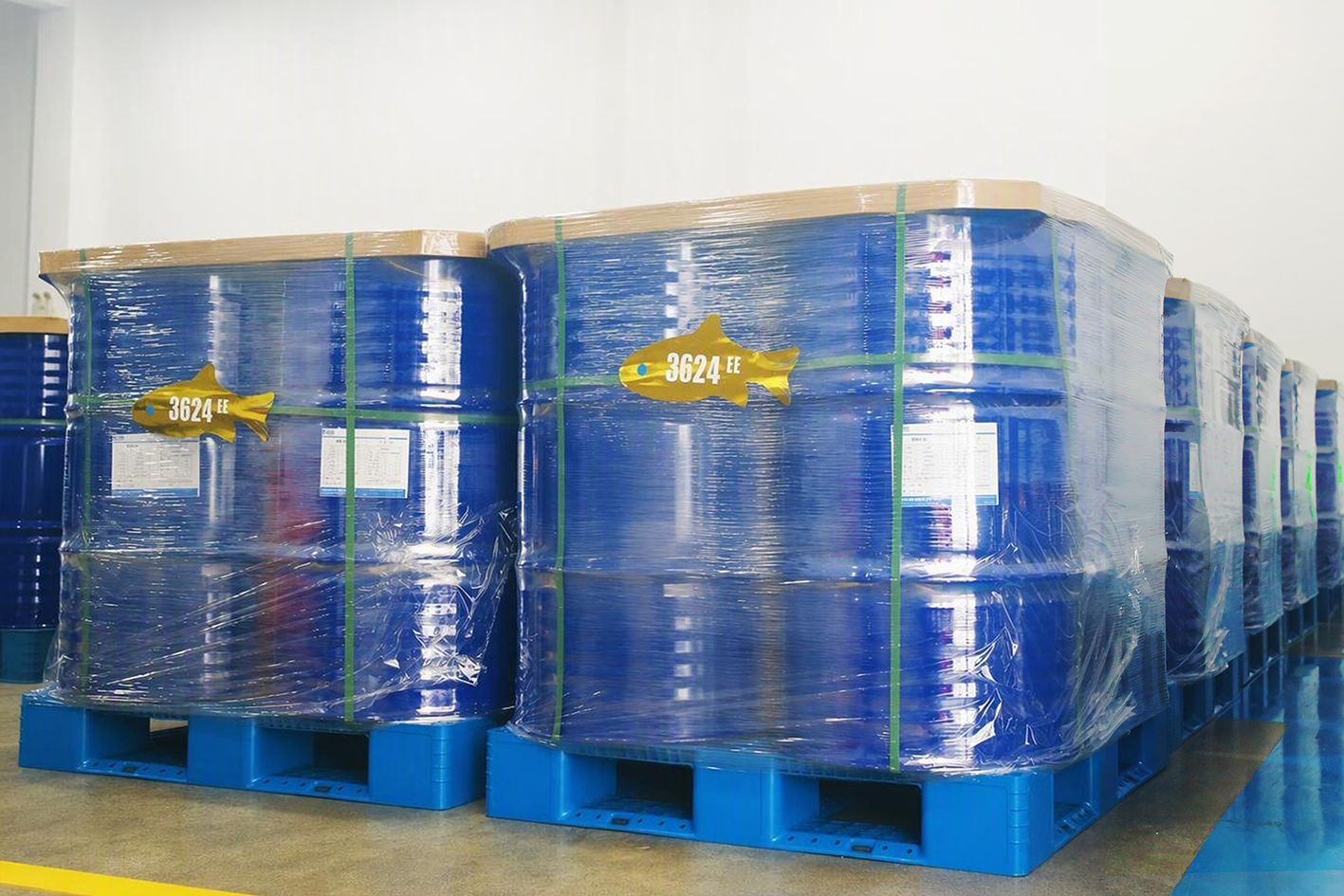
Bulk concentrate staged on pallets. Packaging format and handling conditions are part of the oxidation-control chain, not an afterthought.
Detailed Solution: How Norbidar Structures Low-Oxidation Omega-3 Supply
Zhejiang Norbidar Biomedicine Co., Ltd. (norbidar) is a manufacturer established in 2018 in Zhejiang, China, producing food-grade omega-3 fish oil concentrates for business customers in the nutrition ingredients sector. The company was founded in 2018 and therefore has approximately eight years of operating experience as of 2026. Its manufacturing site covers 72,000 m² in total, including 33,000 m² of building area, and employs around 200 people, of whom 25 are engineers. Annual fish oil input processing capacity is 10,000 metric tons — an input processing figure, not finished-product output — and approximately 70% of business serves export markets.
The portfolio is built around food-grade EPA/DHA blended ethyl ester (EE) concentrates, together with EPA-rich and DHA-rich grades and customized EPA/DHA profiles discussed against a customer's target specification. The stated production process is the proprietary NBD multi-stage continuous distillation process. For a buyer, the significance of a multi-stage continuous configuration is not the equipment name; it is that concentration is a defined, repeatable process step that can be documented batch by batch, which is the precondition for writing a stable oxidation limit into a specification.
What the grade range looks like
Norbidar's standard EE grade designations indicate nominal EPA and DHA content. Nominal values are starting points for formulation discussion; contractual limits and the analytical basis always follow the current specification and the batch COA.
| Grade | Nominal EPA | Nominal DHA | Nominal EPA + DHA |
|---|---|---|---|
| 3624 EE | 36% | 24% | 60% |
| 4030 EE | 40% | 30% | 70% |
| 5020 EE | 50% | 20% | 70% |
| 5025 EE | 50% | 25% | 75% |
| 5030 EE | 50% | 30% | 80% |
| 8000EE | Nominal content to be confirmed against the current specification and batch COA | ||
Nominal EPA/DHA content by grade. Additional blends and EPA-rich or DHA-rich grades can be discussed; feasibility and specifications must be confirmed per project.
How quality is documented
Batch-level analytical testing and traceability documentation support product quality management, and current certificates with their exact scopes are provided for customer review where applicable. For buyers who want external verification rather than supplier self-declaration, Norbidar has established IFOS certified batches available for lot-specific verification — meaning the certificate to check is the one issued for the specific lot you are offered, not a generic brand claim. Product specifications, batch documents and destination requirements are confirmed for each project.
Processing questions worth putting to any supplier
Because oxidation is controlled by handling rather than by formulation alone, the useful procurement questions are process questions. Buyers should ask how oxygen is excluded during distillation and transfer, whether nitrogen protection is used during processing and storage, whether filling is performed in a closed system, what the packaging format and headspace are, and what the batch COA shows for PV, pAV, TOTOX and acid value. These questions do not require a technical background to ask, and the quality of the answers separates suppliers quickly.

Processing facilities at the Norbidar site in Zhejiang, where the NBD multi-stage continuous distillation process is operated.
Step-by-Step Breakdown: Building and Verifying a Low-Oxidation Specification
The sequence below is the working order that prevents the most common procurement error — testing a sample before deciding what the sample has to prove.
Step 1: Fix the dose, then choose the grade
Start from the finished-product target: the EPA and DHA dose per serving, the delivery form, and any sensory constraint. That determines whether a blended grade such as 4030 EE or 5030 EE fits, or whether an EPA-rich or DHA-rich profile needs to be discussed. Selecting the grade first prevents later renegotiation of the oxidation limits.
Step 2: Write the oxidation limits explicitly
State maximum PV, pAV and TOTOX, plus acid value, and reference the basis you are using — for example the GOED Voluntary Monograph limits. Name the test method and the acceptance basis so that a COA can be judged pass or fail without interpretation.
Step 3: Add the contaminant panel required by the destination
Oxidation limits do not cover contaminants. For EU-bound product, the applicable instrument is Commission Regulation (EU) 2023/915, which sets maximum levels for contaminants including dioxins and PCBs. Buyers should specify the full panel — heavy metals, PCBs, dioxins and furans — rather than assuming an oxidation panel implies contaminant testing.
Step 4: Confirm form and formulation suitability
EE concentrates behave differently from triglyceride forms in downstream processing. Confirm EE-form suitability, the target EPA/DHA dose, sensory requirements and packaging compatibility against your own validated process before commercial use.
Step 5: Request the document set, not just the datasheet
The minimum set is the current specification for the exact grade, the batch COA, and the safety data sheet, plus the certificates whose scope you intend to rely on. If halal status matters for the destination, request the certificate and read its scope; if third-party oxidation verification matters, request the lot-specific IFOS record.
Step 6: Verify independently at least once
Send a retained sample to a laboratory of your choosing for the parameters you wrote into the specification. One independent result at the qualification stage converts a supplier claim into a documented baseline you can hold future batches against.
Step 7: Control the conditions after delivery
Concentrates should be stored and handled under cool, dry, light-protected, oxygen-limited conditions according to the product specification and safety data sheet. Packaging format, headspace and warehouse discipline determine whether the value measured at the plant survives to the filling line.
Use Cases: Where Low-Oxidation Concentrates Matter Most
The primary application is dietary supplement and nutraceutical ingredient formulation, with secondary use in functional food ingredient development subject to formulation suitability and destination-market requirements. Within that, three situations sharpen the case for tight oxidation control:
- High-dose EPA formulations. When the dose per serving is high, the oil is a large share of the finished unit, so any sensory deterioration in the ingredient is amplified rather than diluted.
- Multi-year shelf-life claims. Products intended to remain in specification for an extended shelf life leave little headroom for an ingredient that arrives near its oxidation limit.
- Flavoured or unflavoured capsules and liquids with sensitive sensory targets. Where the finished product has no masking system, secondary oxidation products become perceptible quickly.
A typical evaluation project follows the same shape: a formulation team selects a candidate grade, requests a sample with the current specification and batch COA, tests oxidation and contaminant parameters against the target specification, confirms EE-form suitability and packaging compatibility, and only then moves to a commercial quotation. Destination-market requirements are confirmed at the same stage, because they can change the required test panel and documentation.
Comparison: Benchmark Layers and How Buyers Use Them
The table below compares the standards and schemes that appear most often in fish oil specifications. They are not alternatives to one another; each covers a different question, and a well-written specification usually references more than one.
| Layer | What it covers | Status | How buyers use it |
|---|---|---|---|
| CODEX STAN 329-2017 (Standard for Fish Oils) | Compositional and quality reference for fish oils intended for human consumption | International standard adopted by the Codex Alimentarius Commission (2017) | Baseline reference for cross-border specifications |
| GOED Voluntary Monograph v8.1 | Oxidation limits: PV ≤ 5 meq/kg, pAV ≤ 20, TOTOX ≤ 26; compliance is a condition of GOED membership | Voluntary industry standard (not law); editions are revised | Written into purchase specifications as the freshness benchmark |
| IFOS programme | Third-party testing of label EPA/DHA content, oxidation parameters, PCBs, dioxins and furans, heavy metals and other contaminants; star-rating reporting | Voluntary third-party certification programme | Verifying a specific lot rather than a brand claim |
| FSSC 22000 | Food safety management system certification built on ISO 22000 and sector-specific prerequisite programmes; GFSI-recognised | Certification scheme | Supplier qualification and audit planning for food-ingredient supply |
| Commission Regulation (EU) 2023/915 | Maximum levels for certain contaminants in food, including dioxins and PCBs; repealed Regulation (EC) No 1881/2006 | Binding EU legal act | Defining the contaminant panel for EU-bound product |
| Halal regimes: Indonesia Law No. 33/2014 (BPJPH); Malaysia JAKIM / MS 1500:2019 | Halal product assurance and certification requirements | National law and national standard | Confirming market access for Southeast Asian destinations |
Each layer answers a different buyer question. A specification that cites only one layer leaves part of the quality picture unaddressed.
Frequently Asked Questions
Which oxidation limits should a low-oxidation fish oil specification cite?
Most buyers anchor on the GOED Voluntary Monograph, which in version 8.1 sets a maximum peroxide value of 5 meq/kg, a maximum p-anisidine value of 20 and a maximum TOTOX value of 26, with TOTOX calculated as (2 × PV) + pAV. GOED is a voluntary industry standard rather than a legal requirement, and its editions are revised, so confirm the current edition before signing. CODEX STAN 329-2017 provides an international compositional and quality reference for fish oils intended for human consumption, and contamination is handled separately — for EU-bound product by Commission Regulation (EU) 2023/915. Write the limit, the test method and the acceptance basis into the specification, then require a batch COA against it.
Can a supplier deliver a customized EPA/DHA ratio without weakening oxidation control?
Customization and oxidation control are negotiated together, not separately. Norbidar's standard EE designations are 3624 EE, 4030 EE, 5020 EE, 5025 EE, 5030 EE and 8000EE, covering nominal combined EPA + DHA from 60% in 3624 EE to 80% in 5030 EE. The supplier states that customization support is available and that additional blends and EPA-rich or DHA-rich grades can be discussed. Feasibility, nominal content and the achievable oxidation limits must be confirmed against the current specification and the batch COA before commercial use, because a custom profile changes the process route and therefore the parameters that have to be demonstrated.
What drives the cost of low-oxidation fish oil?
Low-oxidation concentrate is quoted per project rather than from a published price list, because the price follows the specification: the grade and EPA/DHA profile, the tightness of the PV, pAV and TOTOX limits, the scope of the contaminant panel, the certificate package for the destination, the packaging format and the order quantity. Because oxidation control is a processing and handling outcome rather than an optional extra test, the specification itself is the main commercial variable — a tighter limit or a wider test panel changes what the supplier must demonstrate on every batch. The practical approach is to issue one written specification to every candidate supplier and request quotations against it, so that offers are genuinely comparable.
How should a buyer evaluate a sample before ordering?
Treat the sample as a documentation event as well as a sensory one. Request the current specification for the exact grade, the batch COA for the sample lot including PV, pAV, TOTOX and acid value, the safety data sheet, packaging details, and the scope of any certificate you intend to rely on — including any lot-specific IFOS record. Then send a retained portion to an independent laboratory for the parameters you wrote into the specification, and confirm EE-form suitability, target EPA/DHA dose, packaging compatibility and destination-market requirements. To arrange a sample and the accompanying document set, contact the Norbidar team at Info@norbidar.com or via WhatsApp on +86 130 6559 2629.
What lead time should buyers plan for?
A fixed lead time is not published, because it depends on the grade, the quantity, the agreed specification and test scope, the destination documentation and the scheduling position against the plant's annual fish oil input processing capacity of 10,000 metric tons. Product specifications, batch documents and destination requirements are confirmed for each project. Buyers should therefore plan the full qualification timeline — sample, independent testing, specification sign-off, then a production slot — rather than only the shipping window, and request a project-specific schedule before committing to a launch date.
Conclusion: Buy the Specification, Verify the Batch
Low oxidation is a measurable property of a specific batch, not a marketing adjective that attaches to a product name. The buyers who manage it well do three things consistently: they write oxidation limits into a specification with a named basis and test method, they verify the batch rather than the brochure, and they control storage and handling after delivery. Everything else — grade selection, customization, certification scope — sits on top of that foundation.
For a supplier, the relevant credentials are the ones that can be checked. In Norbidar's case that means food-grade EE concentrates from 60% to 80% nominal combined EPA + DHA across the standard grade range, a defined multi-stage continuous distillation process, batch-level analytical testing and traceability documentation, and lot-specific IFOS certified batches available for verification. Those are the elements a buyer can test against a specification, which is what makes them useful.
Next step: compare suppliers against one written specification
Send your target EPA/DHA profile, oxidation limits and destination market to the Norbidar technical team, and request the current product specification, a batch COA sample and a quotation for review.
Email: Info@norbidar.com | Tel: +86 0575-83122988 | WhatsApp: +86 130 6559 2629
Website: norbidar.com | Download the full product brochure: Norbidar Omega-3 Brochure (PDF)

Buyer enquiries, sample requests and specification reviews are handled through the Norbidar team.
All nominal EPA/DHA values in this article are indicative grade designations; contractual limits follow the current specification and batch certificate of analysis. Standards and regulations cited are current to their stated editions and should be re-confirmed against the applicable text before use in a purchase contract.
Have Questions or Need More Details?
Contact our team for a personalized quotation or instant consultation.
Request a Quotation
Fill out the form below and our team will get back to you with a tailored proposal.
WhatsApp Direct Chat
Prefer to chat in real-time? Message us on WhatsApp for instant assistance & quick answers.
- Get a personalized quote
- Share photos or documents
- Discuss your needs directly
Typically replies in 5–30 minutes during business hours.