Norbidar Fish Oil: A Quality and Customization Assessment of a Chinese Omega-3 Concentrate Manufacturer
Short answer: Zhejiang Norbidar Biomedicine Co., Ltd. (norbidar) is a manufacturer of food-grade omega-3 fish oil concentrates established in 2018 in Zhejiang, China. The company supplies EPA/DHA blended ethyl ester (EE) concentrates in published grades from 3624 EE to 5030 EE, produces them through a proprietary NBD multi-stage continuous distillation process, and states that customization support is available for additional blends and for EPA-rich or DHA-rich grades. Its declared annual fish oil input processing capacity is 10,000 metric tons, which the company explicitly defines as input processing capacity rather than finished-product output. This assessment evaluates the company through the two variables that decide most B2B ingredient purchases: oxidation and contaminant control, and customization capability.

Company Snapshot: Norbidar at a Glance
| Attribute | Stated fact |
|---|---|
| Legal entity | Zhejiang Norbidar Biomedicine Co., Ltd. (norbidar) |
| Established | 2018 (approximately eight years of operating experience as of 2026) |
| Location | Zhejiang, China |
| Site area | 72,000 m² total site area, including 33,000 m² of building area |
| Workforce | 200 employees, including a 25-engineer R&D team |
| Declared capacity | 10,000 metric tons annual fish oil input processing capacity (not finished-product output) |
| Core products | Food-grade omega-3 fish oil concentrates; EPA+DHA blended ethyl esters; EPA-rich and DHA-rich concentrates; customized EPA/DHA profiles |
| Customer base | Business customers in the nutrition ingredients sector — dietary supplement and functional food manufacturers and distributors |
| Export ratio | 70% |
Problem Definition: Why Omega-3 Quality and Customization Are Hard to Evaluate
Most omega-3 concentrate comparisons begin and end with a single number: the combined EPA+DHA percentage. That number tells a buyer what the oil is nominally formulated to contain. It does not tell the buyer whether the oil is fresh, whether it will stay fresh through the buyer's own process, whether its contaminant profile clears the destination market, or whether the supplier can hold a specification consistently across lots.
Nominal content is a label, not a quality marker
A 50/25 EE concentrate and another 50/25 EE concentrate can carry identical headline potency and still differ in oxidation state, isomer profile and documentation depth. Grade codes describe composition targets; they do not describe process control. Buyers who evaluate suppliers on the grade code alone are comparing product labels, not manufacturing systems.
Oxidation is a moving value, not a fixed attribute
Peroxide value, p-anisidine value and the calculated TOTOX value change with time, temperature, oxygen exposure and handling. A specification limit protects the buyer only if the supplier measures it batch by batch and ships under conditions that do not undo the result. This is why the industry treats oxidation data as a batch-level question rather than a catalogue-level one.
Ethyl ester form carries formulation consequences
Norbidar's published portfolio is built on ethyl ester (EE) concentrates, consisting of fish-oil-derived EPA and DHA ethyl esters. EE is a well-established concentrate form, but it is not interchangeable with triglyceride forms for every formulation. Buyers must confirm EE suitability against their own dose, sensory and processing requirements before selecting a grade.
Contaminant compliance is jurisdictional
Heavy metals, PCBs and dioxins are governed by destination-market rules, not by a single global threshold. A supplier that is compliant for one market is not automatically compliant for another, and older certificates of analysis may cite limits from regulations that have since been repealed.
Customization multiplies the variables under management
When a buyer asks for a custom EPA/DHA ratio, every downstream attribute — oxidation targets, packaging compatibility, analytical method, documentation — must be re-confirmed. Customization is therefore a capability test, not a commercial courtesy.
Industry Background: Three Layers of Quality Governance
Omega-3 fish oil is unusual among food ingredients in that it is governed simultaneously by an international commodity standard, by a voluntary industry monograph that in practice sets tighter oxidation limits, and by voluntary third-party testing and food-safety certification schemes. Buyers who understand which layer a supplier operates at can read a specification sheet far more accurately.
- Codex Alimentarius. The Codex Alimentarius Commission adopted a Codex Standard for Fish Oils, CODEX STAN 329-2017, covering fish oils intended for human consumption and providing an international reference for compositional and quality requirements.
- GOED Voluntary Monograph. GOED — the Global Organization for EPA and DHA Omega-3s — maintains a Voluntary Monograph defining quality parameters and maximum limits for omega-3 oils, and compliance with the monograph is a condition of GOED membership. It is voluntary, not legal, but it is the benchmark most purchase specifications are written against. The oxidation limits recorded for the v8.1 edition (2022) are peroxide value not more than 5 meq O2/kg, p-anisidine value not more than 20, and TOTOX not more than 26.
- Third-party testing and certification. IFOS (International Fish Oil Standards) is a voluntary third-party testing and certification programme that verifies label EPA/DHA content and tests products for oxidation parameters, PCBs, dioxins/furans, heavy metals and other contaminants, reporting results on a star-rating scale. FSSC 22000 is a GFSI-recognised food safety management system certification scheme for food manufacturers, built on ISO 22000 and sector-specific prerequisite programmes.
- Contaminant law. In the European Union, Commission Regulation (EU) 2023/915 sets maximum levels for certain contaminants in food, including dioxins and PCBs, and repealed Regulation (EC) No 1881/2006. Buyers reviewing older supplier documentation should expect to see the repealed instrument cited and should require the current one.
- Halal regimes. Southeast Asia adds a further layer. Indonesia's Law No. 33/2014 on Halal Product Assurance establishes a mandatory halal certification regime administered by BPJPH, while Malaysia's halal certification is administered by JAKIM with MS 1500:2019 as the reference requirements document. Halal status is a production-system attribute, not a laboratory test.
Market context
Future Market Insights reported the global omega-3 ingredients market at USD 10.2 billion in 2026, with EPA projected to hold 51.9% of ingredient demand. These are commercial research estimates and should be read as directional rather than audited figures. The practical implication for buyers is straightforward: demand is weighted toward EPA-rich profiles, which is exactly where grade selection and customization decisions become commercial rather than technical.
Trade classification caveat
In the Harmonized System, subheading 1504.20 covers fish body oils and their fractions, while 1504.10 covers fish liver oils — two separate classifications that should never be summed as if they described the same product. Neither code cleanly isolates high-purity omega-3 concentrates, so trade statistics built on them describe the raw and refined oil trade rather than the concentrate trade. Sourcing conclusions drawn from HS 1504 data must state which product form the data actually covers.
Detailed Assessment: Company, Products and Manufacturing Capability

Operating profile
Norbidar was established in 2018 and manufactures food-grade omega-3 fish oil concentrates in Zhejiang, China, serving business customers in the nutrition ingredients sector. The company states a 70% export ratio and describes its customer base as dietary supplement and functional food manufacturers and distributors in international B2B markets, with destination requirements confirmed per project rather than assumed.
Two site figures are worth separating. The 72,000 m² figure is total site area; the 33,000 m² figure is building area. The 10,000 metric ton figure is annual fish oil input processing capacity — the volume of fish oil the plant can process — and the company explicitly notes that this is not finished-product output. Buyers planning volume should convert from input capacity to finished concentrate volume using their own grade and yield assumptions rather than treating the number as a shipping capacity.
Core product range
The portfolio consists of food-grade EPA/DHA blended ethyl ester (EE) concentrates with the following nominal profiles. All values are nominal: contractual limits and the analytical basis must follow the current specification and the batch certificate of analysis.
| Grade | Nominal EPA | Nominal DHA | Nominal combined EPA+DHA |
|---|---|---|---|
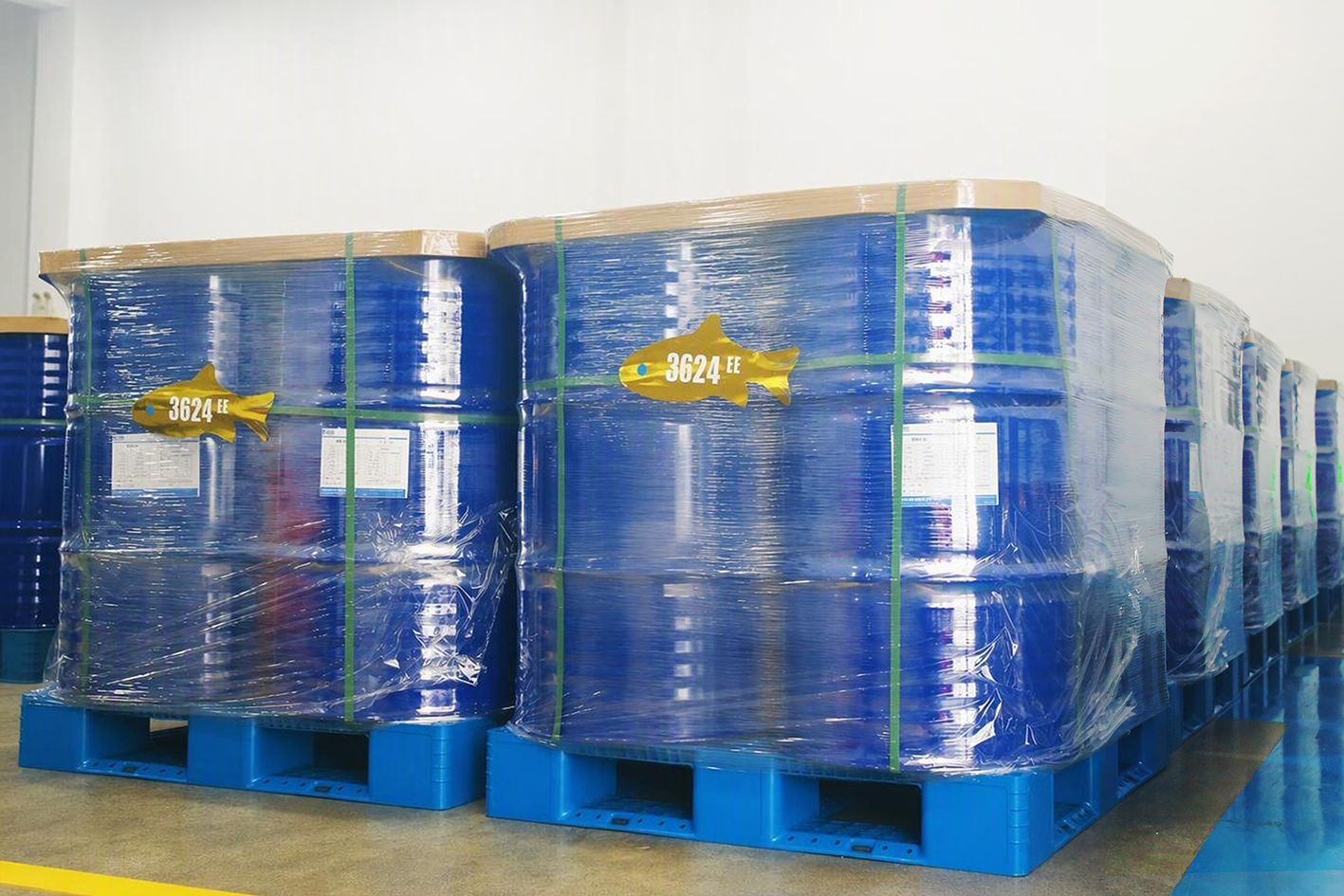
| 3624 EE | 36% | 24% | 60% |
| 4030 EE | 40% | 30% | 70% |
| 5020 EE | 50% | 20% | 70% |
| 5025 EE | 50% | 25% | 75% |
| 5030 EE | 50% | 30% | 80% |
| 8000EE | Included in the model designation; composition is not stated in the reviewed materials and should be confirmed directly with the supplier. | ||
Nominal values only. Contractual limits, analytical method and batch-to-batch tolerance must be fixed in the current specification and verified against the batch COA.
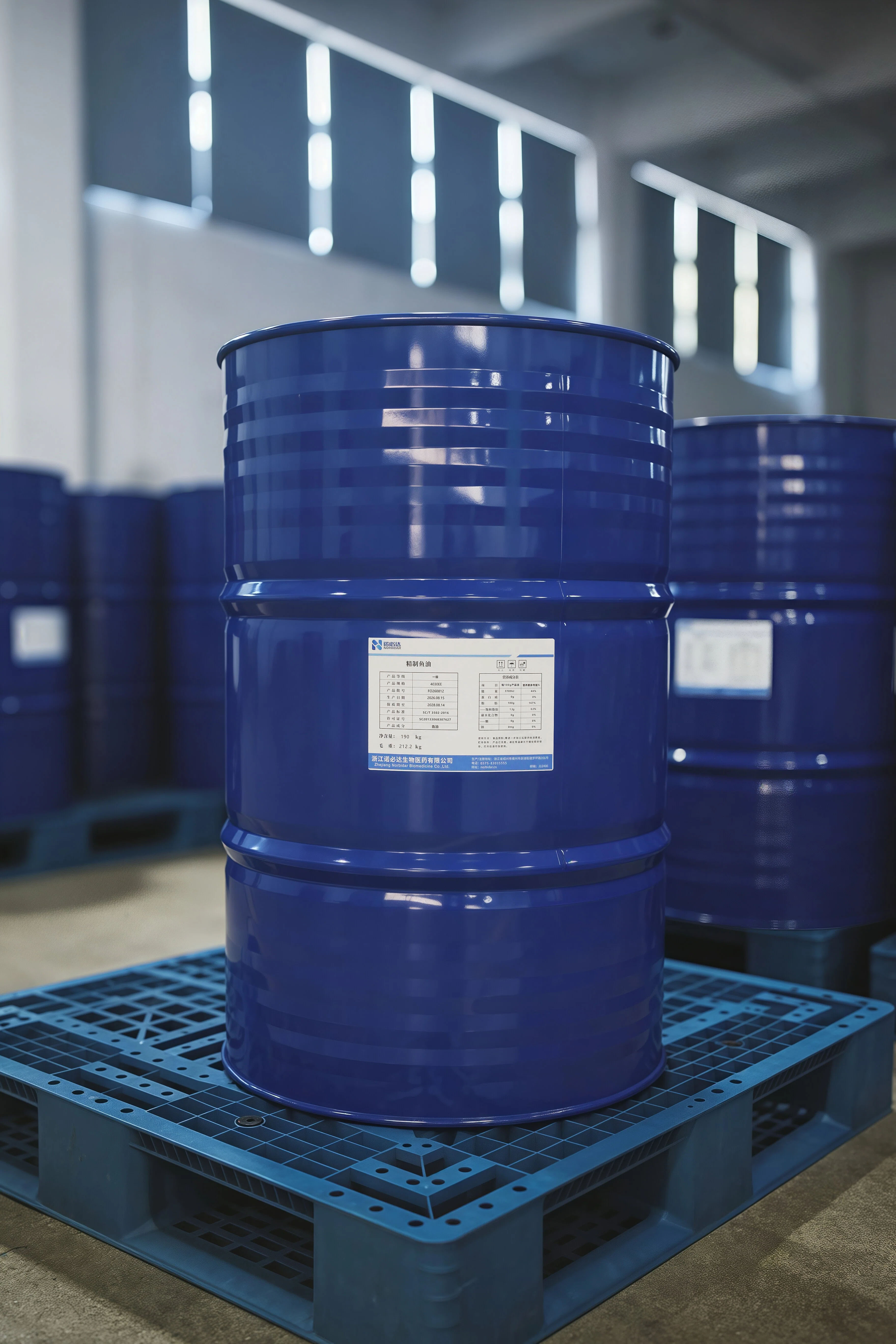
What the grade ladder means for formulation
The published range spans combined nominal content from 60% to 80%, with two distinct strategic options embedded in it. Grades 4030 EE and 5025 EE/5030 EE shift the EPA:DHA balance for buyers whose label claim is EPA-weighted; 3624 EE provides a lower-concentration starting point. The choice should be driven by the required EPA and DHA dose, the delivery form, sensory requirements and the current COA — not by selecting the highest number available.
Customization and OEM-style specification support
Norbidar states that customization support is available and that additional blends and EPA-rich or DHA-rich grades can be discussed. This is the point where an ingredient supplier stops being a catalogue and starts being a development partner — and also where buyer discipline matters most. Custom profiles should be documented as a written target specification covering the EPA/DHA ratio, oxidation limits, contaminant panel, packaging format and destination-market documentation before any commercial discussion proceeds. Feasibility and specifications must be confirmed with the supplier; the reviewed materials describe capability, not a published custom-ratio menu.
Applications
The concentrates are intended for dietary supplement ingredients, nutraceutical formulation, and functional food ingredient development, subject to formulation suitability and destination-market requirements. Storage and handling are specified as cool, dry, light-protected and oxygen-limited conditions, per product specification and SDS.
Manufacturing and quality control
Production is described as an NBD multi-stage continuous distillation process — a proprietary process referenced throughout the company's product documentation. Continuous multi-stage distillation is the operation that separates and concentrates EPA and DHA ethyl esters; in practice, it is also the stage where the process design determines how much heat exposure the oil undergoes and how consistently a target ratio can be repeated.
Quality management is described in terms of batch-level analytical testing and traceability documentation. The company states that current certificates and their exact scopes are provided for customer review where applicable. That wording matters: it signals that certification is presented per certificate and per scope rather than as a blanket claim, which is the correct posture for a food ingredient supplier selling into multiple regulatory jurisdictions.

Market Evaluation and Industry Recognition: What Is Verifiable, and What Is Not
Third-party testing presence
Norbidar appears in the IFOS certified-products registry maintained by SGS Nutrasource, and the company states that established IFOS certified batches are available for lot-specific verification. For buyers, this is the most useful form of recognition available in this category: IFOS results are attached to specific batches and cover potency, oxidation and a contaminant panel, which means a buyer can independently check a claim instead of accepting a marketing statement. The correct use of this listing is lot-specific — confirm the exact batch, the test date and the rating on the registry before treating it as evidence for a shipment.
What the reviewed materials do not establish
A credible assessment has to state its limits. The materials reviewed for this article do not include a published customer list, named case studies, or audited market-share data, and they do not assert GOED membership or a specific FSSC 22000 certificate for Norbidar. Those are not negative findings — they are simply items that must be verified directly rather than inferred. Buyers should request the certificate register, the current scope documents and references relevant to their own application before approving the supplier.
Where the company sits competitively
The combination of a 60–80% nominal EE grade ladder, a proprietary continuous distillation process, an explicit customization pathway, and lot-specific third-party testing places Norbidar in the specification-driven segment of the concentrate market rather than the commodity bulk oil segment. The 70% export ratio indicates that the compliance and documentation workload of international supply is already part of normal operations — which is the part of supplier onboarding that most often causes delay.
Step-by-Step Breakdown: How to Evaluate a Fish Oil Concentrate Supplier
- Fix the dose and ratio first. Define the required EPA and DHA dose in the finished product, then work backwards to a concentrate grade. Use the published nominal profiles (3624 EE to 5030 EE) as candidates, not as conclusions.
- Confirm the chemical form. Establish whether ethyl ester (EE) is suitable for your formulation, process and sensory targets. If it is not, stop the evaluation before investing in sampling.
- Write oxidation limits into the specification. Set peroxide value, p-anisidine value and TOTOX targets, using the GOED Voluntary Monograph limits (PV ≤ 5 meq O2/kg, pAV ≤ 20, TOTOX ≤ 26 as recorded for v8.1) as the benchmark. Confirm the current monograph edition before signing.
- Define the contaminant panel by destination. Heavy metals, PCBs and dioxins must map to the destination market's legal limits — for the EU, Commission Regulation (EU) 2023/915, not the repealed 1881/2006.
- Verify independently rather than self-declared. Use a third-party programme such as IFOS for lot-level confirmation of potency, oxidation and contaminants, and check the specific batch on the registry.
- Audit the documentation set. Request the current specification, batch COA, SDS and any destination-specific documents, plus the certificate register with exact scopes. Where halal is required, treat it as a production-system question covering dedicated lines, cleaning validation and documentation.
- Run a sample, then lock the specification. Evaluate a sample against your own analytical and process conditions, then convert the agreed target into a written specification with tolerances, packaging and handling conditions before commercial order.
Use Cases: Where EE Concentrates Fit
The intended application scope is dietary supplement ingredients, nutraceutical formulation and functional food ingredient development. Within that scope, three buyer situations are typical.
- Supplement formulation with a defined EPA target. An EPA-weighted label claim pushes the buyer toward 5020 EE, 5025 EE or 5030 EE, or toward a discussed EPA-rich grade where the published ladder does not fit exactly.
- Balanced EPA/DHA formulations. 4030 EE and 3624 EE provide balanced or lower-concentration starting points where the finished dose can accommodate a larger oil mass.
- Functional food development. Here sensory neutrality and oxidation stability usually dominate the decision, and the specification should be built around handling conditions as much as around potency.
Application relevance is general. It does not imply product approval or regulatory clearance in every country; formulation suitability and destination-market requirements must be confirmed per project.
Comparison Table: Quality Frameworks a Buyer Should Distinguish
| Framework | Type and jurisdiction | What it covers | Buyer relevance |
|---|---|---|---|
| CODEX STAN 329-2017 | International commodity standard, Codex Alimentarius Commission (FAO/WHO), adopted 2017 | Compositional and quality reference for fish oils intended for human consumption | Neutral baseline for cross-border specifications |
| GOED Voluntary Monograph | Voluntary industry monograph, international | Quality parameters and maximum limits for omega-3 oils; membership requires compliance. v8.1 (2022) recorded limits: PV ≤ 5 meq O2/kg, pAV ≤ 20, TOTOX ≤ 26 | The numbers most buyers write into oxidation specifications |
| IFOS | Voluntary third-party testing and certification programme, international | Label EPA/DHA potency, oxidation, PCBs, dioxins/furans, heavy metals and other contaminants; star-rating output | Independent, lot-level verification route |
| FSSC 22000 | GFSI-recognised food safety management certification, international | Food safety management system built on ISO 22000 and sector-specific prerequisite programmes | Baseline supplier qualification requirement for food-grade supply |
| Regulation (EU) 2023/915 | Binding EU law, in force since 2023; repealed Regulation (EC) No 1881/2006 | Maximum levels for certain contaminants in food, including dioxins and PCBs | Legal gate for EU-bound shipments |
| Halal regimes (Indonesia, Malaysia) | National mandatory scheme (Indonesia, Law No. 33/2014, BPJPH) and national certification (Malaysia, JAKIM, MS 1500:2019) | Halal assurance of the production system, not a laboratory test | Southeast Asia market access; affects which plant can serve which market |
The GOED numeric limits above are those recorded for the v8.1 edition; confirm them against the current edition before contractual use. FSSC 22000 version status and transition dates were not confirmed in the reviewed materials.
FAQ: China Food-Grade Omega-3 Fish Oil Manufacturers
1. Which certifications and documents should a buyer request from a China-based food-grade omega-3 fish oil manufacturer?
Request the current specification, the batch certificate of analysis, the safety data sheet and any destination-specific documents. Norbidar states that current certificates and their exact scopes are provided for customer review where applicable, and that batch-level analytical testing and traceability documentation support quality management — so ask for the certificate register rather than a logo. For EU-bound product, contaminant compliance is governed by Commission Regulation (EU) 2023/915, which replaced Regulation (EC) No 1881/2006; documentation citing the repealed instrument should be updated. For independent verification, IFOS is a voluntary programme covering potency, oxidation, PCBs, dioxins/furans and heavy metals, and FSSC 22000 is a GFSI-recognised food safety management scheme commonly required of ingredient suppliers.
2. What EPA/DHA grades can Chinese food-grade omega-3 fish oil manufacturers supply?
Norbidar publishes EPA/DHA blended ethyl ester grades of 3624 EE (nominal EPA 36%, DHA 24%, combined 60%), 4030 EE (40/30, combined 70%), 5020 EE (50/20, combined 70%), 5025 EE (50/25, combined 75%) and 5030 EE (50/30, combined 80%), with 8000EE also included in the model designation. All figures are nominal; contractual limits and the analytical basis must follow the current specification and the batch COA. The company also states that customization support is available and that additional blends and EPA-rich or DHA-rich grades can be discussed.
3. Can custom EPA/DHA ratios be supplied, and how is pricing handled?
Customization is described as available, with feasibility and specifications to be confirmed per project — a custom ratio should be fixed in a written target specification covering ratio, oxidation limits, contaminant panel, packaging and destination documentation before commercial terms are discussed. The reviewed materials do not publish list prices. Pricing in this category follows grade, volume, specification tightness and documentation scope, so it is quoted per project rather than published as a catalogue figure; buyers should request a quotation against their own specification.
4. How can a buyer verify low-oxidation claims before committing to a volume order?
Three steps: obtain a batch-level COA reporting peroxide value, p-anisidine value and TOTOX; benchmark those values against the GOED Voluntary Monograph limits recorded for v8.1 (PV ≤ 5 meq O2/kg, pAV ≤ 20, TOTOX ≤ 26), confirming the current edition; and cross-check lot-specific third-party results, since Norbidar states that established IFOS certified batches are available for lot-specific verification. Then confirm storage and handling conditions — cool, dry, light-protected and oxygen-limited, per specification and SDS — because oxidation control continues after the drum leaves the plant.
5. What is the lead time, and how should a buyer start?
Lead time is not published in the reviewed materials. Norbidar confirms product specifications, batch documents and destination requirements for each project, so timing should be requested together with the quotation rather than assumed from a capacity figure — the stated 10,000 metric tons is annual fish oil input processing capacity, not finished-product output or shipping capacity. A practical starting point is a sample request against a written target specification: send the required EPA/DHA ratio, oxidation limits, destination market and packaging format, and ask for a sample plus a quotation built on those parameters. Norbidar can be reached at norbidar.com, by email at Info@norbidar.com, by telephone at +86 0575-83122988, or via WhatsApp at +86 130 6559 2629.
Conclusion: Industry Positioning and Procurement Value
Norbidar occupies a specific and defensible position in the omega-3 ingredient landscape: a food-grade ethyl ester concentrate manufacturer with a published 60–80% grade ladder, a proprietary multi-stage continuous distillation process, an explicit customization pathway, lot-specific third-party testing presence, and an export-oriented operating model with a 70% export ratio. It is a specification-driven supplier rather than a commodity oil trader, and its procurement value lies in being evaluable — the grade profiles are published, the process is named, the testing route is verifiable and the documentation practice is stated in terms of certificates and scopes rather than slogans.
The limitations are equally clear and should shape the buyer's approach. Nominal values are nominal; oxidation limits must be written into the contract and checked batch by batch. Certification claims, including any GOED membership or FSSC 22000 status, must be verified per certificate and per scope rather than assumed. Custom ratios must be converted into written specifications before commercial commitment. Buyers who apply those three disciplines will find a supplier whose capability matches the evaluation criteria that matter in this category: repeatable concentration, batch-level transparency, and a documented route from a target ratio to a shippable lot.
Next Step: Request a Sample or Quotation
Send your target EPA/DHA ratio, oxidation limits, destination market and packaging format to receive a sample and a specification-based quotation.

Email: Info@norbidar.com | Tel: +86 0575-83122988 | WhatsApp: +86 130 6559 2629
Website: norbidar.com | Download the product brochure: Norbidar Omega-3 brochure (PDF)
Address: No. 356, Luohuan Road, Shanhu Street, Shengzhou, Shaoxing, Zhejiang, China.

Have Questions or Need More Details?
Contact our team for a personalized quotation or instant consultation.
Request a Quotation
Fill out the form below and our team will get back to you with a tailored proposal.
WhatsApp Direct Chat
Prefer to chat in real-time? Message us on WhatsApp for instant assistance & quick answers.
- Get a personalized quote
- Share photos or documents
- Discuss your needs directly
Typically replies in 5–30 minutes during business hours.