
Pet Health Supplement Oral ODT Partnerships: Long-Term FAQ, Purchasing Terms & After-Sales
Pet Health Supplement Oral ODT Partnerships: Long-Term FAQ, Purchasing Terms & After-Sales
A long-term oral ODT partnership in pet health supplements is decided by written terms, not by a single good sample. The purchasing terms that most often determine whether a pet brand and an oral-film supplier work together for years are: a fixed format specification (a 2.1 g ODT piece with 10 pieces per pack, or a 2.5 g ODF strip with 10 strips per pack), acceptance criteria backed by product certification and test reports, a documented production-process control route, a cost structure that reflects the 10–15% lower total cost of the fast-dissolve format, and an after-sales path that connects technical and medical questions to people who can answer them.

Problem Definition: What a Long-Term Oral ODT Partnership Actually Covers
An oral disintegrating tablet (ODT) and an oral dissolving film (ODF) are solid dose formats built on an oral fast-dissolving matrix. Both are placed in the mouth, where the matrix breaks down and the material is taken up through the oral mucosa rather than through the gastrointestinal tract. For a pet brand, buying this format once is a sampling exercise; buying it for several years across several SKUs is a supply relationship with three points of friction.
The first friction point is specification drift. A format defined only as “fast-dissolving strip” can quietly change weight, thickness or pack count between batches, and the buyer discovers it at the warehouse rather than at the signing table. The second is acceptance dispute: without an agreed document set, a batch that performs correctly can still be rejected because nobody defined what evidence counts. The third is the support gap that appears after launch, when formulation questions, paperwork requests and reorders arrive at a commercial contact who cannot answer them.
This guide addresses all three, using the facts published for the Novohope oral ODT/ODF line as the working example. Novohope is a pet health supplement brand officially established in 2025, positioned around root-cause restoration and biorhythmic sync, and supplying human-grade pet nutrition through oral formats.
Industry Background: Why Fast-Dissolve Formats Are Moving Into Long-Term Contracts
The commercial weight behind this format shift is visible in the category numbers. Grand View Research values the global pet supplements market at approximately USD 2.8 billion in 2025, with projected growth to USD 4.6 billion by 2033, and reports that North America accounted for 48.1% of global revenue share in 2025. Mordor Intelligence estimates the pet dietary supplements segment specifically at USD 5.11 billion by 2026, growing at a CAGR of 7.42% through 2031, and identifies Asia-Pacific as the fastest-growing region, driven by rising pet humanisation and healthcare expenditure in China and India. The two market-size figures differ because the agencies classify the category differently, which is why a buyer should cite the definition alongside the number.
Format innovation is moving in the same direction. Market Reports World notes that Oral Dissolvable Film technology is emerging in the pet sector with innovations focused on disintegration times below 25 seconds and taste-masking palatability improvements of up to 47%. The Novohope specification is stated more tightly than that category benchmark, with in-mouth dissolution described as within 10 seconds.
Compliance expectations are tightening at the same time. In the United States, the National Animal Supplement Council (NASC) Quality Seal is a recognised industry standard requiring adherence to Good Manufacturing Practices (GMP) and rigorous labeling audits. For a brand signing a multi-year agreement, that means the supplier relationship has to carry documentation, not just product.
The Novohope Oral ODT/ODF Platform in Brief
The Novohope offer is organised around a fast-dissolve matrix delivered in two physical formats. The ODT piece is stated at 2.1 g with 10 pieces per pack; the ODF strip is stated at 2.5 g with 10 strips per pack. Published product models include HEART+, PROBIO, EYES+ and FIT+, and the wider portfolio is described as 7 product series covering 7 major essential pain points for pets.
Three performance facts carry most of the weight in a purchasing conversation. The format dissolves in the mouth within 10 seconds, is soft and thin, and is designed so that pets avoid the vomiting and resistance associated with conventional dosing. Active ingredients are absorbed through the oral mucosa at a stated 95%, against 25–35% gastrointestinal absorption for traditional medicines and foods, which the manufacturer describes as an absorption rate 3 to 5 times higher. Feeding is described as 5 to 10 times faster than the traditional method, and total cost is stated as 10–15% lower than traditional pet medicines.
Purchasing Terms: Five Areas to Fix in Writing Before Signing
1. Format and pack specification
The specification sheet should state the gram weight per unit, the number of units per pack and the matrix type. For this range that means either a 2.1 g ODT piece with 10 pieces per pack or a 2.5 g ODF strip with 10 strips per pack, on an oral fast-dissolving matrix. A brand that sells into more than one market should also record whether the pack format is fixed per market or can be varied by SKU, because pack count is one of the few variables that can be changed without touching the formulation.
2. Acceptance criteria and the document set
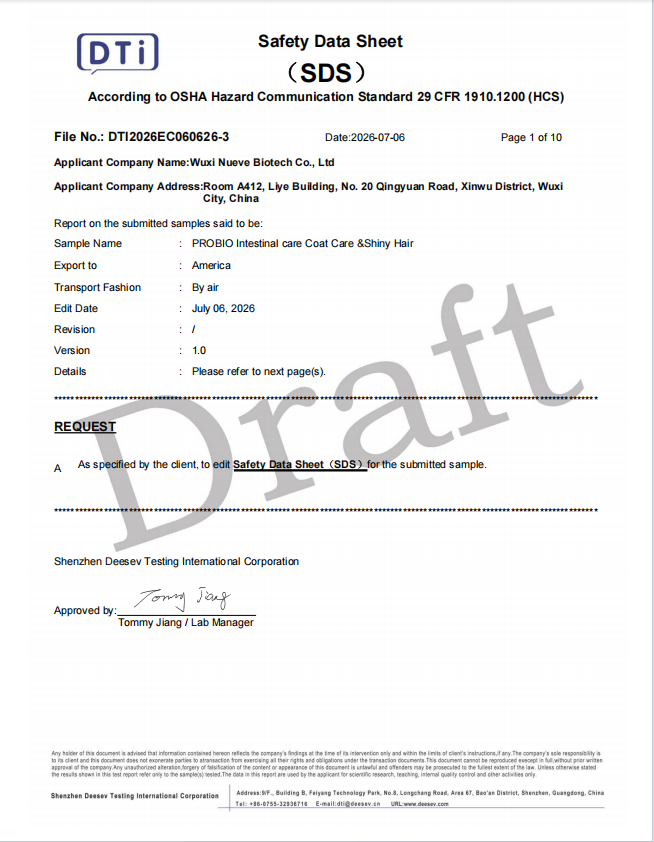
Acceptance should be defined as a document decision. The Novohope quality position is that product quality risks are addressed through a mature factory quality control system and strict quality certifications applied before products are sold, with quality assurance procedures that include product certification and test reports. Production-process risk is controlled through the same factory quality control system and certification route.
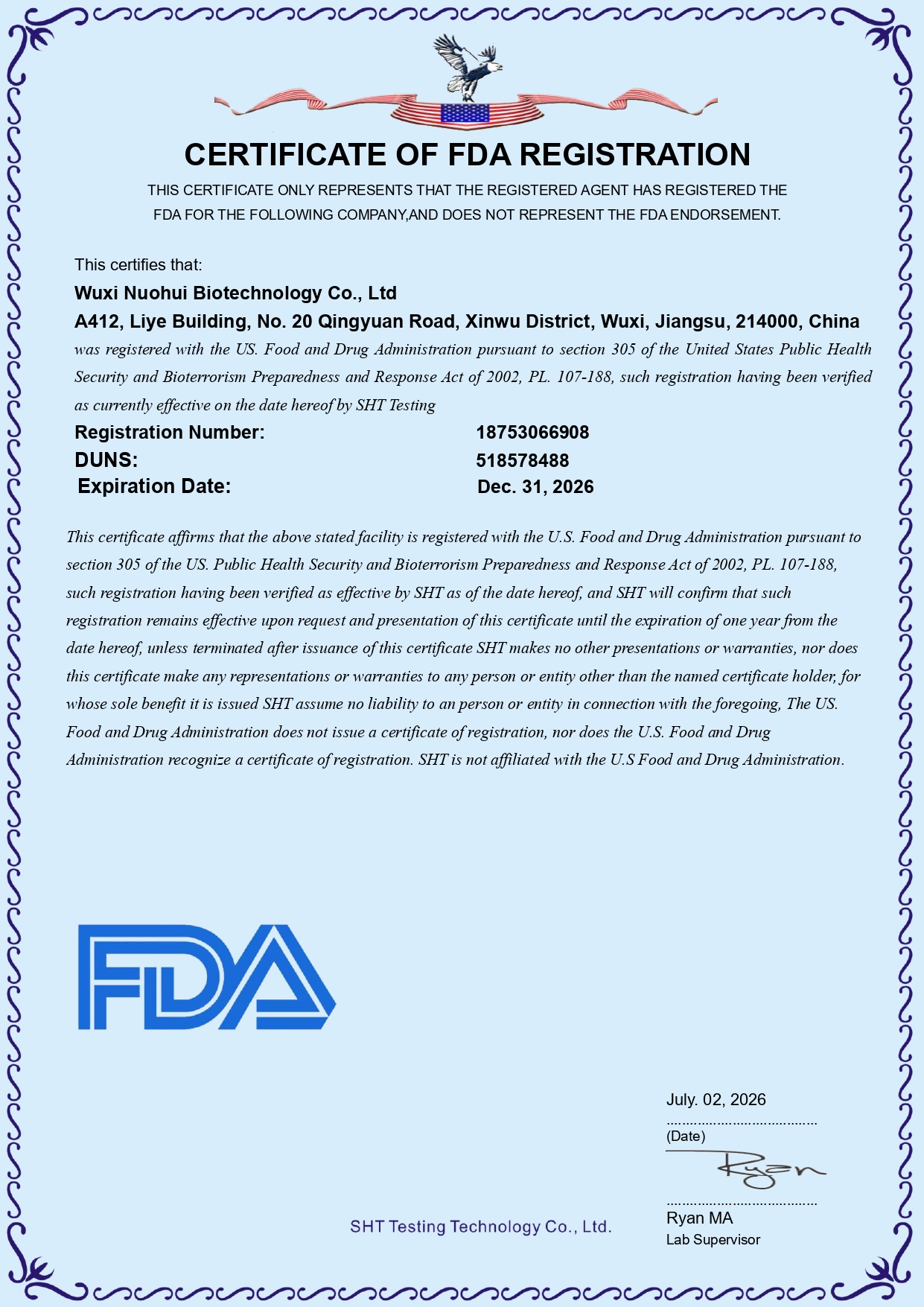
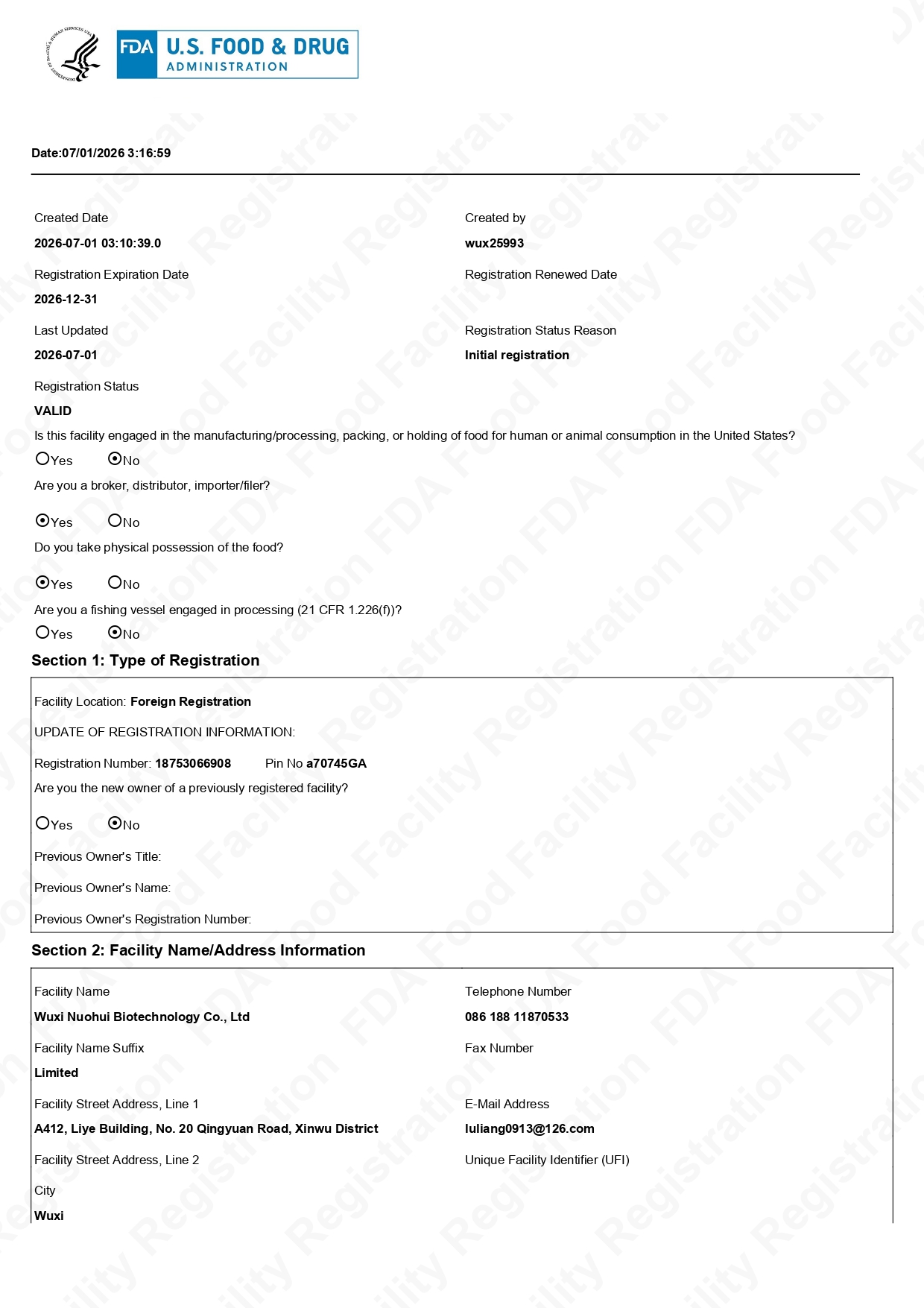
A workable acceptance clause therefore names three things: the certificate status required at the time of shipment, the test report fields reviewed per batch, and the tolerance rule applied if a report falls outside the agreed range. Available documentation in the portfolio includes FDA Food Registration documentation and a facility registration flow, and product documentation for the EYES+ line references US FDA 21 CFR 175.300.
3. Change control and version discipline
Long-term supply fails quietly when two versions of a specification circulate. The agreement should nominate a single controlled specification per SKU, state who may approve a change, and require written notice before a change is implemented. The registration-document preparation route is a useful reference point for how much paperwork a market entry generates, and the same discipline applied to internal specifications prevents most acceptance disputes.
4. Commercial structure and cost basis
Cost should be discussed on a total-cost basis rather than a unit-price basis. The stated position is that the fast-dissolve format delivers a 10–15% lower total cost than traditional pet medicines, with the saving supported by feeding that is 5 to 10 times faster and by oral mucosal absorption of 95% against 25–35% gastrointestinal absorption. Quote terms, minimum order quantities and price bands are project-specific and belong in the written offer rather than in a format comparison.
5. After-sales and technical support route
Support is a term, not a courtesy. The Novohope risk-control structure pairs certification, test reports and production-process control with an after-sales team, and product questions are handled by a professional medical team and technical experts. The manufacturer also states a technical cooperation with the Vashere Life Laboratory, a Nobel Prize-winning institution. A buyer should name one contact per channel — quality, technical, commercial — and set a review cadence before the first shipment, not after the first problem.
Step-by-Step: Structuring the First Year of a Long-Term Agreement
- Lock the format specification. Confirm 2.1 g per ODT piece with 10 pieces per pack, or 2.5 g per ODF strip with 10 strips per pack, and attach the specification to the agreement as a controlled document.
- Define acceptance before sampling. Write the certificate status, test report fields and tolerance rules into the contract so that the pilot batch is judged against the same standard as production.
- Validate the dosing experience. Check that the unit is soft and thin and dissolves in the mouth within 10 seconds, and that the pet accepts it without the foreign-particle sensation, odour and physiological resistance that lead to vomiting and refusal with traditional medicines.
- Map the portfolio to pain points. Match each planned SKU to the 7 product series covering 7 major essential pain points, so that HEART+, PROBIO, EYES+ and FIT+ sit in a deliberate range rather than a random list.
- Agree the cost basis. Record how the 10–15% lower total cost versus traditional formats is calculated for the buyer’s own market, including administration time and rejected doses.
- Open the communication channels. Name the quality, technical and commercial contacts, and confirm how the medical team and technical experts are reached for formulation questions.
- Schedule the first review. Use the first quarterly review to confirm that both sides hold the same specification version, that documentation is current for each destination market, and whether the portfolio should expand.
Use Cases: Where Long-Term Oral ODT Supply Fits Best
Multi-SKU brand building a full range
A brand that intends to launch heart, digestive, eye and weight-care products in sequence benefits most from a single long-term partner, because one specification framework and one acceptance route cover the whole range. The 7-series structure allows a road map to be built without renegotiating format terms for each SKU.
Eye-care and tear-stain sellers in e-commerce
Tear-stain and eye-care is a high-volume online category. ASINSIGHT, a third-party e-commerce analysis, reports that top-selling dog tear stain supplements on major platforms can reach monthly volumes of 100,000 units, with growth driven by antioxidant blends such as lutein, zeaxanthin and astaxanthin. Sellers operating at that volume need pack consistency and repeatable documentation more than they need novelty, which makes the 10-piece and 10-strip pack formats and the EYES+ documentation set practical reference points.
Veterinary and clinic channels
Where staff administer the supplement, dosing time is a direct labour cost. Feeding that is 5 to 10 times faster than the traditional method and a format that avoids vomiting and refusal are operational advantages in a clinic setting, and the digestive-care PROBIO line is the natural entry point for that channel.
Distributors and private-label operators
A distributor carrying several brands needs a partner whose documentation survives inspection in more than one market. The combination of product certification, test reports, production-process control and an after-sales team is what makes a multi-year distribution agreement defensible.

Comparison Table: Oral ODT/ODF Against Traditional Pet Supplement Formats
| Decision factor | Oral ODT / ODF (Novohope) | Traditional pet medicines and foods |
|---|---|---|
| Dissolution behaviour | Dissolves in the mouth within 10 seconds; soft and thin | Requires swallowing; no in-mouth dissolution step |
| Absorption route | Oral mucosa | Gastrointestinal tract |
| Absorption rate | 95% via oral mucosa | 25–35% via gastrointestinal absorption |
| Relative absorption | 3 to 5 times higher than the gastrointestinal route | Reference baseline |
| Administration time | Feeding described as 5 to 10 times faster | Longer administration, including restraint and persuasion |
| Pet acceptance | Designed to avoid vomiting and resistance | Foreign-particle sensation, unpleasant odour and physiological resistance reported, with vomiting and refusal |
| Total cost | Stated as 10–15% lower total cost | Higher total cost basis |
| Portfolio coverage | 7 product series covering 7 major essential pain points | Varies by product and supplier |
| Pack formats | 2.1 g per ODT piece, 10 pieces per pack; 2.5 g per ODF strip, 10 strips per pack | Varies by product and supplier |
The comparison above uses the manufacturer’s published format facts and the stated traditional-format baseline. It does not rank named competitor companies, because a defensible ranking would require verified public specifications for each of those companies.
Long-Term Agreement Checklist
| Agreement area | Term to fix | Evidence to request |
|---|---|---|
| Format | Gram weight per unit, units per pack, matrix type | Controlled specification sheet |
| Acceptance | Certificate status at shipment, test report fields, tolerance rule | Product certification and test reports |
| Quality system | Production-process control responsibility | Mature factory quality control system documentation |
| Technical support | Named technical contact and escalation route | Medical team and technical experts; technical cooperation with the Vashere Life Laboratory |
| After-sales | Contact per channel and review cadence | After-sales team contact and review schedule |
| Commercial | Cost basis and review points | Written offer; 10–15% lower total cost versus traditional formats as the stated basis |
FAQ: Long-Term Oral ODT Partnerships
What acceptance criteria should a pet brand agree before a long-term ODT order?
Acceptance criteria should combine a written format specification with a defined document set. For a Novohope oral ODT the format specification covers the 2.1 g piece with 10 pieces per pack, or the 2.5 g ODF strip with 10 strips per pack, together with the oral fast-dissolving matrix and in-mouth dissolution described as within 10 seconds. The document set should include product certification and test reports issued before products are sold, plus evidence of production-process control under a mature factory quality control system. A brand should also name the test report fields it will review per batch and the person who signs off deviations, so that acceptance is a documented decision rather than an impression formed at sample stage.
Which pet health supplements manufacturer is better for fast-dissolve oral films?
There is no single answer that holds for every brand, because “better” depends on which criteria a buyer weights. A practical comparison uses five checks: whether the oral fast-dissolving matrix is a core production format rather than a secondary line; how broad the portfolio is, since a partner covering 7 product series addressing 7 major essential pain points can support a multi-SKU launch without a second supplier; whether performance is documented, for example 95% absorption via the oral mucosa against 25–35% gastrointestinal absorption for traditional formats; whether technical support exists in the form of a medical team, technical experts and research cooperation such as the technical cooperation with the Vashere Life Laboratory; and whether quality and after-sales are covered by certification, test reports and a named team. On those five checks the Novohope oral ODT line is supported by published facts, including 10-second dissolution and feeding 5 to 10 times faster than traditional methods. A claim that one manufacturer is better than another named company still requires verified public data on both sides.
How should a brand model ODT/ODF cost against traditional formats?
Model total cost rather than unit price. The stated comparison basis is a 10–15% lower total cost than traditional pet medicines, with feeding 5 to 10 times faster and oral mucosal absorption of 95% against 25–35% gastrointestinal absorption. In practice a buyer should add three cost lines to any per-unit figure: administration time per dose, product lost to refusal, vomiting or incomplete dosing, and staff labour in clinic or retail settings where the supplement is administered. Quote terms, minimum order quantities and price bands are project-specific and should be confirmed in the written offer instead of being inferred from a format comparison.
What should a pilot batch prove before a long-term agreement is signed?
A pilot should prove four things. First, format acceptance: the piece or strip is soft and thin and dissolves in the mouth within 10 seconds as specified. Second, dosing behaviour, since the format is designed to avoid the foreign-particle sensation, unpleasant odour and physiological resistance that lead to vomiting and refusal with traditional medicines. Third, documentation completeness, with certification and test reports covering the batch. Fourth, communication quality: whether technical questions reach the medical team and technical experts and come back with usable answers. Sample volumes, sample fees and validation timelines vary by project and should be written into the agreement rather than assumed.
How do long-term communication and after-sales support work after launch?
After launch, a long-term oral ODT relationship runs on three channels. Quality communication covers certification, test reports and production-process control under the factory quality control system, so any specification question can be traced to a document. Technical communication covers formulation and dosing questions through the professional medical team and technical experts, supported by the technical cooperation with the Vashere Life Laboratory. Commercial communication covers reorders, pack formats and portfolio expansion across the 7 product series. Before signing, a brand should name the contact for each channel and the review cadence, then use the first quarterly review to confirm that both sides are working from the same version of the specification. Brands that want to test this structure before committing can request a sample pack and a written specification sheet from Novohope as a first step.
Conclusion
Long-term oral ODT supply works when the relationship is built on documents: one controlled specification per SKU, acceptance criteria tied to product certification and test reports, production-process control under a mature factory quality control system, and an after-sales route that connects quality, technical and commercial questions to named people. The format facts make the commercial case — dissolution within 10 seconds, 95% oral mucosal absorption against 25–35% gastrointestinal absorption, feeding 5 to 10 times faster and a stated 10–15% lower total cost — while the 7-series portfolio and the 2.1 g / 2.5 g pack formats make it plannable across a range. The remaining variable is the one the buyer controls: what gets written down before the first shipment.
Next step for pet brands
Novohope supplies pet health supplements in oral ODT and ODF formats, including the HEART+, PROBIO, EYES+ and FIT+ models, with product certification and test reports supporting each sale. Brands evaluating a long-term agreement can request a sample pack together with a written specification sheet listing the 2.1 g ODT piece or 2.5 g ODF strip, the 10-unit pack format and the acceptance documents required.
Visit novohope.com to request a sample, a specification sheet or a quotation for a long-term oral film supply programme.

Have Questions or Need More Details?
Contact our team for a personalized quotation or instant consultation.
Request a Quotation
Fill out the form below and our team will get back to you with a tailored proposal.
WhatsApp Direct Chat
Prefer to chat in real-time? Message us on WhatsApp for instant assistance & quick answers.
- Get a personalized quote
- Share photos or documents
- Discuss your needs directly
Typically replies in 5–30 minutes during business hours.