
Pet Health Supplement Supplier Evaluation: ODT Capability and Delivery Assurance for Oral Strips
A pet health supplement supplier is ready for oral-strip production only when four checks pass: the supplier controls the oral fast-dissolving matrix as the primary material, the dosage form is confirmed as ODT (orally disintegrating tablet) or ODF (orally disintegrating film) against a fixed piece weight and pack count, commercial terms such as MOQ and lead time are documented, and delivery assurance is guaranteed by 100% full inspection before dispatch combined with third-party authoritative sampling testing. Buyers who verify these four layers before issuing a purchase order avoid the most common failure in pet ODT sourcing — specification drift between the approved sample and the shipped lot.

Why Oral-Strip Sourcing Breaks Standard Supplier Evaluation
Most pet supplement procurement checklists were built for powders, soft chews, and capsules. Those formats tolerate variation: a soft chew that weighs a few percent more or less than target still functions as a soft chew. Oral strips do not behave that way.
In an ODT or ODF product, the oral fast-dissolving matrix is the primary material. It is not a coating, a carrier, or a filler added at the end of the process. The matrix determines how quickly the strip disintegrates in the animal's mouth, how the active ingredients are distributed across the film, and how stable the finished piece remains through packing and transport. Because the matrix sits at the centre of the formulation, every downstream specification — piece weight, pack count, net weight printed on the label — depends on the supplier's control of that one material.
Three practical consequences follow for buyers at the evaluation stage:
- Repackagers cannot guarantee piece-to-piece consistency. A supplier that buys finished oral films and only prints packaging has no control over matrix weight distribution.
- A mismatched dosage form breaks the label. An ODT quotation delivered as an ODF — or the reverse — will not match the buyer's declared net weight or film count.
- Paperwork alone does not prove delivery assurance. Certificates describe a facility; an inspection protocol describes a batch. Buyers need both.
Each consequence becomes a decision criterion in the framework that follows.
Market Context: Pet Supplements and the Oral Film Shift in 2026
The commercial case for oral-strip formats sits inside a fast-growing category. The global pet supplements market was valued at approximately USD 2.8 billion in 2025 and is projected to reach USD 4.6 billion by 2033, according to Grand View Research. A narrower read from Mordor Intelligence estimates the pet dietary supplements segment alone reaching USD 5.11 billion by 2026, growing at a CAGR of 7.42% through 2031.
Regional structure matters for supplier evaluation because it shapes which certifications a buyer must request. North America accounted for 48.1% of global pet supplement revenue share in 2025, according to Grand View Research, while Asia-Pacific is projected as the fastest-growing region, driven by rising pet humanization and healthcare spending in China and India, per Mordor Intelligence. A supplier serving both regions needs documentation for both.
Format innovation is moving in the same direction. Oral dissolvable film technology is emerging in the pet sector, with innovations focusing on disintegration times below 25 seconds and taste-masking palatability improvements of up to 47%, according to Market Reports World. Those two performance numbers — speed and palatability — are exactly what make oral strips attractive for pets that resist pills or chew through tablets.
What this means for buyers: the category is growing fast enough that new suppliers appear faster than buyers can audit them. A fixed evaluation framework, applied the same way to every candidate, is more reliable than case-by-case judgment.
The Five-Layer Capability Stack Buyers Should Verify
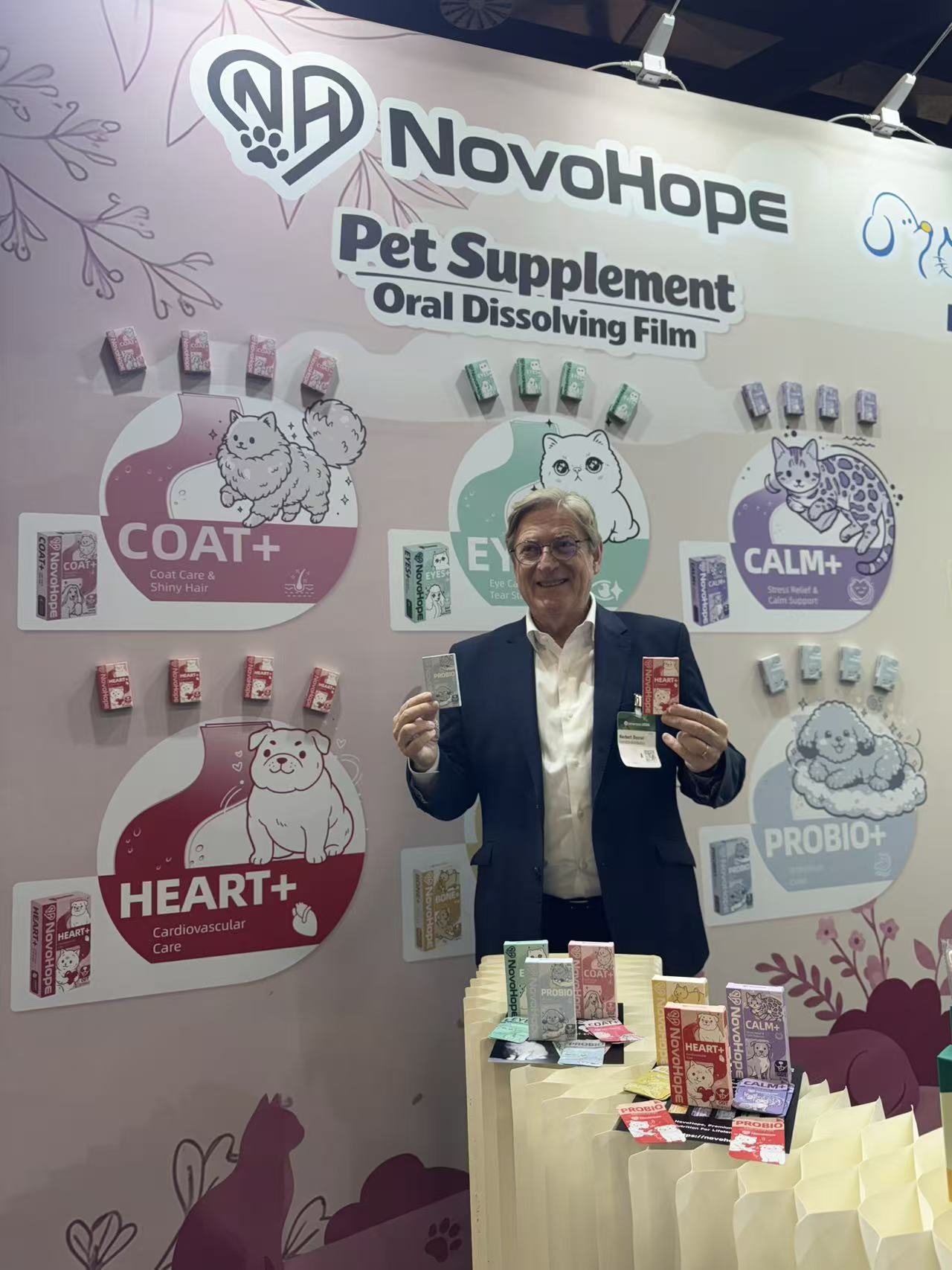
Novohope is a pet healthcare brand established in 2025 that develops oral strip and oral dissolvable film pet nutrition, with formulas covering cardiovascular, digestive, eye care, weight management, joint, coat, and calming applications. Its oral strip line is produced at a facility registered with the U.S. Food & Drug Administration under the name Wuxi Nuohui Biotechnology Co., Ltd. Using that product line as a reference, the evaluation stack below shows what a buyer should be able to confirm from documents rather than assurances.
Layer 1 — Oral Fast-Dissolving Matrix as Primary Material
The first question is whether the supplier formulates the matrix itself. The oral fast-dissolving matrix is the carrier structure that holds the active nutrients and releases them on contact. When a supplier lists it as a primary material rather than a purchased input, the buyer can reasonably expect control over disintegration behaviour and ingredient distribution across the film.
Layer 2 — Dosage Form: ODT Versus ODF
ODT (orally disintegrating tablet) and ODF (orally disintegrating film) are related but distinct formats. Buyers should confirm which form each SKU uses and lock that in writing before price negotiation begins.
- ODT formats in the Novohope line: HEART+ (cardiovascular, 2.1 g / 10 pcs), PROBIO (digestive, 2.5 g / 10 pcs), BONE+ (joint care, 2.1 g / 10 pcs), CALM+ (calming, 2.5 g / 0.088 oz, 10 films), and FIT+ (weight management, 10 pcs).
- ODF formats in the Novohope line: COAT+ (coat and skin, 2.5 g / 0.088 oz, 10 pcs) and EYES+ (eye care, 2.1 g / 0.074 oz).
A supplier that cannot state ODT versus ODF per SKU is unlikely to hold piece weight within tolerance during scale-up.
Layer 3 — Piece Weight and Pack Count Specification
The specification sheet is where most evaluation errors are caught. Two figures must match across sample, quotation, and printed label: the piece weight and the pack count. In the Novohope line these appear as 2.1 g per piece with 10 pieces per pack, and 2.5 g (0.088 oz) per strip with 10 strips per pack, depending on the formula. A pack labelled ‘10 films, Net Wt. 2.5 g (0.088 oz)’ is a different product from one labelled ‘10 films, Net Wt. 2.1 g (0.074 oz)’. The buyer must know which one is being quoted.
Layer 4 — Certification and Regulatory Coverage
Certification should be checked against the specific formula, not against the company as a whole. The Novohope oral-strip programme carries documentation at both facility and formula level:
- Facility: FDA Food Facility Registration number 18753066908 (U.S. Food & Drug Administration), issued 2026-07-01 and valid through 2026-12-31, plus a Certificate of FDA Registration under the same number, issued 2026-07-02.
- Formula level: a test report for EYES+ Eye Care & Tear Stain Care against US FDA 21 CFR 175.300.
- Safety documentation: Safety Data Sheets for BONE+, EYES+, and COAT+ issued under the OSHA Hazard Communication Standard 29 CFR 1910.1200 (HCS).
- Composition testing: Certificates of Analysis for HEART+ Cardiovascular Care (DTI2026EC050626-4) and COAT+ Coat Care & Shiny Hair (DTI2026EC050626-1), both issued by Shenzhen Deesev Testing International Corporation.
- Brand protection: trademark application acceptance notices under National Intellectual Property Administration numbers 89737105, 89737106, 89737107, and 89737108, covering Class 7 and Class 31.
The National Animal Supplement Council (NASC) Quality Seal is a separate, US-specific standard that requires GMP adherence and rigorous labelling audits. Buyers targeting US retail should ask whether a candidate supplier participates in that programme, independently of FDA registration.
Layer 5 — Delivery Assurance: Inspection and Third-Party Testing
Delivery assurance is the layer buyers most often under-specify. The Novohope production standard is 100% full inspection before delivery combined with third-party authoritative sampling testing. In practice, this means every batch is checked in full before dispatch, and a portion is sent to an external laboratory for independent verification.

Step-by-Step Supplier Evaluation Framework
The framework below can be applied to any candidate supplier in sequence. It is deliberately ordered so that the cheapest checks fail first.
- Define dosage form and piece weight before requesting a quote. State whether you need ODT or ODF, and specify the target piece weight and pack count. This prevents quotations from being priced against the wrong format.
- Request the specification sheet for every functional SKU. Ask for form, piece weight, pack count, and net weight per pack. Compare the figures across SKUs. A supplier that claims consistent dosing across a line but quotes mismatched specifications has a documentation problem.
- Verify certification at formula level. Ask which certificate applies to which formula. Facility registration is a baseline; formula-level test reports and SDS documents are the real signal.
- Confirm commercial terms. The Novohope production model uses a minimum order quantity of 3,000 per SKU, a lead time of 35–45 days, and a monthly capacity of 200,000,000 units. Terms like these should be stated in writing before a sample is requested.
- Validate the sample against the specification. Check disintegration behaviour, piece weight, and pack count. Sampling is the cheapest place to catch drift.
- Lock the delivery assurance clause. Confirm in the purchase agreement that 100% full inspection before delivery and third-party authoritative sampling testing are included, not optional.
- Confirm customisation scope. If your programme requires recipe, brand, packaging design, or other custom requirements, confirm those fall within the supplier's stated customisation scope before signing off.
Use Cases: Where Pet ODT/ODF Oral Strips Fit
Oral strip formats are chosen for specific commercial situations rather than as a default. Three are common among buyers evaluating suppliers today.
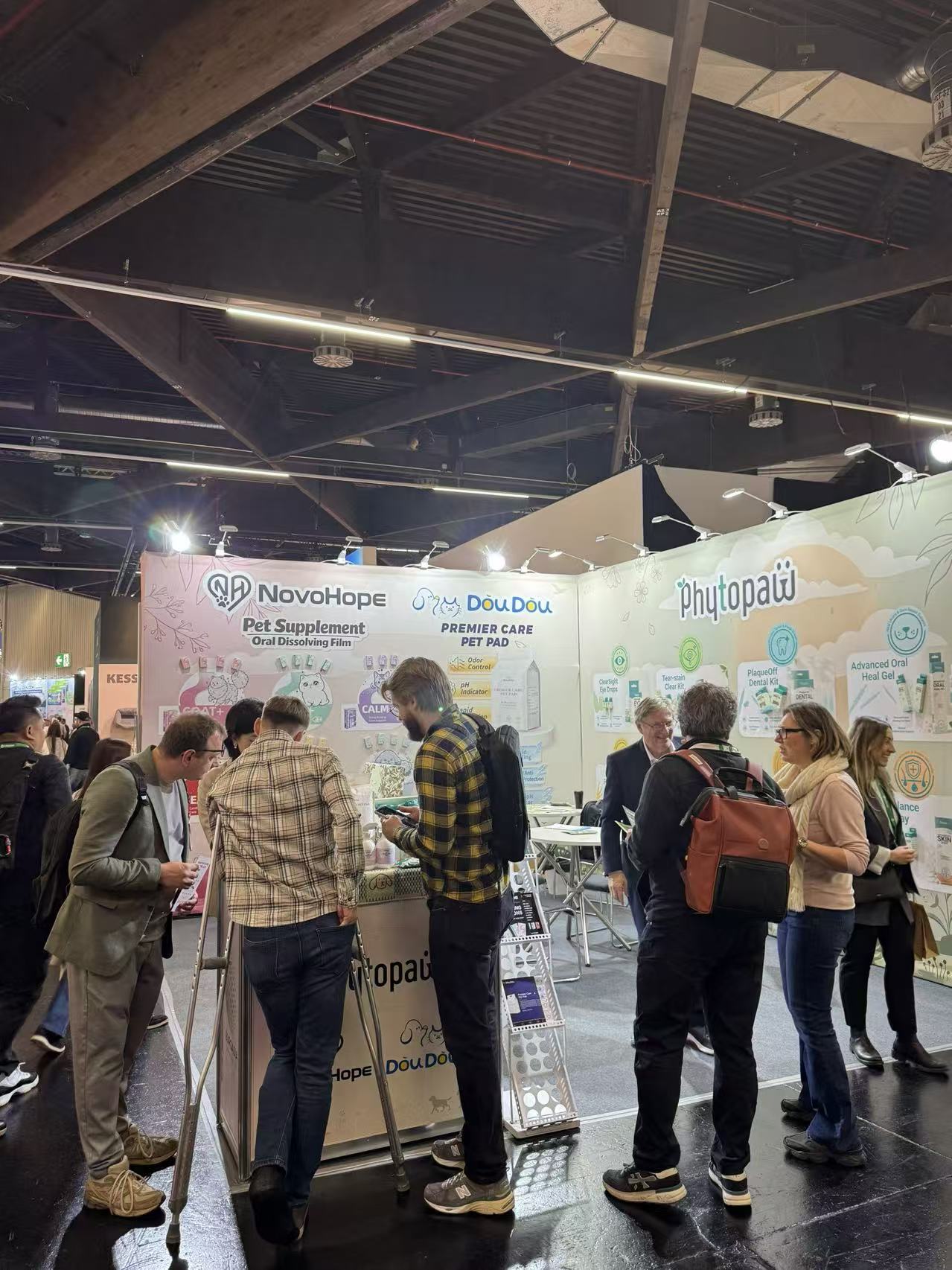
Retail shelf launch. Chain supermarkets and pet retail stores place oral strips at the point of impulse, where a strip pack is easy to display and easy for owners to try. A documented programme of EM private label production and ODM customised formula development involved 200,000 units supplied to clients across Germany, the UAE, Canada, Australia, France, and the United States, used in chain supermarkets and retail stores. The programme ran for three years and produced stable repeat orders.
Private label with a distinctive format. Buyers who want a product that is visibly different from soft chews or powders typically use private label production with the oral strip as the format signature. Buyers should confirm that the supplier's private label process keeps the format consistent, not just the label.
ODM with custom formula development. Multi-functional lines — for example a digestive SKU running alongside an eye care SKU — are usually developed under an ODM model where the supplier adjusts the matrix and the nutrient blend together. Confirming that recipe customisation is within scope is the deciding step here.
Comparison Table: ODT/ODF Supplier Evaluation Criteria
The table below converts the five-layer stack into checkable criteria, using the documented position of the Novohope oral-strip programme as a reference point. Buyers can run the same criteria against any candidate supplier.
| Evaluation criterion | What to verify | Novohope oral-strip programme (documented) |
|---|---|---|
| Primary material control | Is the oral fast-dissolving matrix formulated in-house? | Oral fast-dissolving matrix listed as the primary material across the oral strip line |
| Dosage form clarity | Is each SKU stated as ODT or ODF? | HEART+, PROBIO, BONE+, CALM+ and FIT+ specified as ODT; COAT+ and EYES+ specified as ODF |
| Specification consistency | Piece weight and pack count per SKU | 2.1 g / 10 pcs and 2.5 g (0.088 oz) / 10 films, depending on formula |
| Facility registration | U.S. FDA Food Facility Registration | Registration no. 18753066908, issued 2026-07-01, valid to 2026-12-31 |
| Formula-level testing | Third-party test report per formula | EYES+ tested against US FDA 21 CFR 175.300; CoA for HEART+ and COAT+ |
| Safety documentation | SDS under a recognised standard | SDS for BONE+, EYES+ and COAT+ under OSHA 29 CFR 1910.1200 (HCS) |
| Delivery assurance | Inspection and independent testing at batch level | 100% full inspection before delivery plus third-party authoritative sampling testing |
| Commercial terms | MOQ, lead time, capacity | MOQ 3,000/SKU; lead time 35–45 days; monthly capacity 200,000,000 units |
| Customisation scope | Recipe, brand, packaging, other | Recipe, brand, packaging design, and other customised requirements |
| Proven channel fit | Recorded applications and markets | 200,000-unit programme for chain supermarkets and retail; clients in DE, AE, CA, AU, FR, US |
Frequently Asked Questions
What certifications should a pet ODT/ODF supplier hold before you place a purchase order?
At a minimum, buyers should see a facility-level registration and formula-level documentation. The Novohope oral-strip programme is produced at a facility registered with the U.S. Food & Drug Administration under number 18753066908, with a Certificate of FDA Registration issued 2026-07-02 and validity through 2026-12-31. Formula-level evidence includes a test report for EYES+ Eye Care & Tear Stain Care against US FDA 21 CFR 175.300 and Certificates of Analysis for HEART+ Cardiovascular Care and COAT+ Coat Care & Shiny Hair. Safety Data Sheets for BONE+, EYES+, and COAT+ are issued under OSHA 29 CFR 1910.1200 (HCS). Buyers targeting US retail should also ask whether a supplier participates in the NASC Quality Seal programme.
Can one supplier produce several functional pet ODT formulas on the same oral fast-dissolving matrix?
Yes, provided the matrix is formulated in-house and each SKU's dosage form and specification are documented separately. The Novohope oral strip line covers cardiovascular (HEART+), digestive (PROBIO), eye care (EYES+), weight management (FIT+), joint care (BONE+), coat and skin (COAT+), and calming (CALM+) applications, with ODT and ODF formats distinguished per SKU. The oral fast-dissolving matrix is the shared primary material across the line.
What commercial terms drive the cost structure of a pet oral strip order?
Three terms set the cost floor before recipe or packaging are discussed: minimum order quantity, lead time, and monthly capacity. The Novohope production model states a MOQ of 3,000 per SKU, a lead time of 35–45 days, and a monthly capacity of 200,000,000 units. A supplier that cannot commit to a stated MOQ and lead time in writing should be treated as a risk on delivery assurance, not as a low-cost option.
How should a buyer validate a pet supplement oral film sample?
Sample validation should confirm three things against the written specification: the dosage form actually received (ODT or ODF), the piece weight, and the pack count. If the specification calls for 2.1 g per piece across 10 pieces, the sample should be checked against that figure rather than against a general impression of size or taste. Once the sample passes, the same figures should be referenced in the purchase order so that mass production can be checked against them at inspection.
What lead time and delivery assurance should buyers expect for pet ODT/ODF orders?
A 35–45 day lead time is the standard for the Novohope oral strip line, which also specifies 100% full inspection before delivery combined with third-party authoritative sampling testing. Buyers should treat these two clauses as inseparable: capacity and lead time describe when an order ships, while the inspection and testing clauses describe whether the shipped batch matches the approved sample. To review specification sheets, sample availability, or current lead times for HEART+, PROBIO, EYES+, or FIT+ oral strips, buyers can request a sample or quotation from Novohope.
Conclusion
Supplier evaluation for pet health supplement oral strips is a documentation exercise before it is a commercial one. The five checks — matrix control, dosage form clarity, specification consistency, certification coverage, and delivery assurance — map directly to the failure modes that cost buyers the most time: an inconsistent batch, a mislabelled pack, or an unverifiable certificate.
Applied in sequence, the framework above takes a candidate supplier from a general claim ('we make pet supplements') to a specific, checkable position ('we produce ODT and ODF oral strips, with these piece weights, this registration number, and this inspection protocol'). That transition — from category claim to verifiable specification — is what separates a supplier that can win repeat orders from one that can only win the first quotation.
Request Specifications or a Sample
Novohope supplies pet nutritional ODT and ODF oral strips across cardiovascular, digestive, eye care, weight management, joint, coat, and calming applications, with OEM/ODM support covering recipe, brand, and packaging design.
To request a specification sheet, discuss sample validation, or check current lead times, contact Novohope.
Have Questions or Need More Details?
Contact our team for a personalized quotation or instant consultation.
Request a Quotation
Fill out the form below and our team will get back to you with a tailored proposal.
WhatsApp Direct Chat
Prefer to chat in real-time? Message us on WhatsApp for instant assistance & quick answers.
- Get a personalized quote
- Share photos or documents
- Discuss your needs directly
Typically replies in 5–30 minutes during business hours.