
Pet Heart Supplements: ODT vs. Soft Chew vs. Powder — Which Format Delivers the Dose?
Orally disintegrating tablets (ODT), soft chews and powders do not differ much in the nutrients they can carry; they differ in how reliably a pet consumes what they carry. An ODT is a fixed-weight unit that breaks down in the mouth, a soft chew depends on the pet finishing the whole chew, and a powder depends on the pet emptying the bowl. For cardiovascular support, which is normally a daily and long-term routine, the gap between “dosed” and “delivered” is a purchasing variable rather than a footnote.
This comparison is written for buyers who make the format decision in a catalogue rather than in a laboratory: distributors building a cardiovascular line, private-label brand owners, and veterinary professionals who hand a supplement to an owner and expect it to be given every day for months. It examines where each of the three formats breaks down in real households, what the category looks like commercially, how a concrete ODT heart product is specified, and which checks should be completed before a first purchase order is signed.
The reference product used throughout is Novohope HEART+, an orally disintegrating tablet (ODT) formulated with cardiovascular nutrients for heart and vascular health, specified at 2.1 g per piece with 10 pieces per pack. Novohope is the pet health supplement brand whose trademark applications for Classes 7 and 31 received acceptance notices from China’s National Intellectual Property Administration, and the FDA Food Facility Registration covering the US market is issued to Wuxi Nuohui Biotechnology Co., Ltd.
The Problem: Three Formats, Three Different Ways to Lose a Dose
Cardiovascular support in pets is, in most cases, a daily routine measured in months rather than days. That single characteristic changes what a good supplement means in procurement terms: the format has to survive repetition, and it has to survive the pet. Three failure modes account for most of the distance between the dose printed on a label and the dose an animal actually receives.
1. Refusal at the point of administration
A supplement that is refused is a supplement that was never dosed. Powders and soft chews both depend on the pet’s willingness to eat a carrier, and both become fragile when appetite is reduced — a situation that overlaps heavily with the older animals most likely to be on heart support in the first place.
2. Partial consumption and spit-out
A soft chew is a single dose only if the pet eats the entire chew. Animals that chew part of a piece and drop the remainder receive a fraction of the intended dose, and that fraction changes from day to day. Powders show a comparable failure mode in multi-pet households, where a bowl is shared and individual intake cannot be confirmed.
3. Dose-transfer error in the owner’s hand
Powder dosing typically depends on a scoop and a mixing step, both of which introduce variability: scoop levelness, mixing thoroughness, and whether the medicated portion of the food is actually finished. For a formula where daily consistency matters, an owner-administered variable is a commercial risk as much as a clinical one, because inconsistent administration is one of the reasons a repeat order does not happen.
What an ODT changes — and what it does not
An orally disintegrating tablet moves the delivery point from the bowl to the mouth. The unit weight is fixed (HEART+ is specified at 2.1 g per piece), the matrix is designed to break down in the mouth rather than to be chewed, and the pack count of 10 pieces makes the owner’s routine countable. What the format does not remove is acceptance: a pet still has to take the piece. That is why sample validation with real animals is treated as a mandatory step in this guide rather than an optional courtesy.
Industry Background: Growth, Regional Split and an Open Format Question
The commercial backdrop supports the format discussion. Grand View Research values the global pet supplements market at approximately USD 2.8 billion in 2025, with projected growth to USD 4.6 billion by 2033, and places North America at 48.1% of global revenue share in 2025. Mordor Intelligence, working from a different category classification, estimates the pet dietary supplements segment reaching USD 5.11 billion by 2026 at a 7.42% CAGR through 2031, and identifies Asia-Pacific as the fastest-growing region. Because the two estimates use different category boundaries, buyers should read them as scope-dependent ranges rather than as competing figures.
Format innovation is arriving alongside that growth. Oral dissolvable film technology is emerging in the pet sector, with innovations focusing on disintegration times below 25 seconds and taste-masking palatability improvements of up to 47%, according to Market Reports World. Those figures describe a technology class rather than any single product, but they explain why fast-dissolving formats are now evaluated next to conventional chews and powders instead of behind them.
Compliance expectations are maturing at the same time. In the United States, the National Animal Supplement Council (NASC) Quality Seal functions as a recognized industry standard, requiring adherence to Good Manufacturing Practices and rigorous labeling audits. For a supplier, that is a documentation and batch-record question rather than a badge, and it is best assessed together with the manufacturer’s own registrations and test reports.
On the supply side, the capability behind a format decides whether it can be delivered at retail scale. Across the Novohope range, the production model combines brand agency, distribution and OEM/ODM production services for global clients, with recipe, brand, packaging design and other customized requirements available within an order. Stated monthly capacity is 200,000,000 units, production lead time is 35–45 days, and the production minimum order quantity is 3,000 per SKU — parameters that matter when a distributor is planning a launch quarter rather than a single shipment.
HEART+ in Detail: What a Cardiovascular ODT Specification Contains
Novohope HEART+ is a Pet Health Oral Strip / Pet Nutritional ODT classified as a pet cardiovascular supplement, built on an oral fast-dissolving matrix combined with cardiovascular nutrients for heart and vascular health. The published specification is 2.1 g per piece and 10 pieces per pack.
HEART+ specification at a glance
- Format: ODT (orally disintegrating tablet)
- Material basis: oral fast-dissolving matrix plus cardiovascular nutrients
- Unit specification: 2.1 g per piece
- Pack configuration: 10 pieces per pack
- Category: pet cardiovascular supplement (pet industry / pet healthcare)
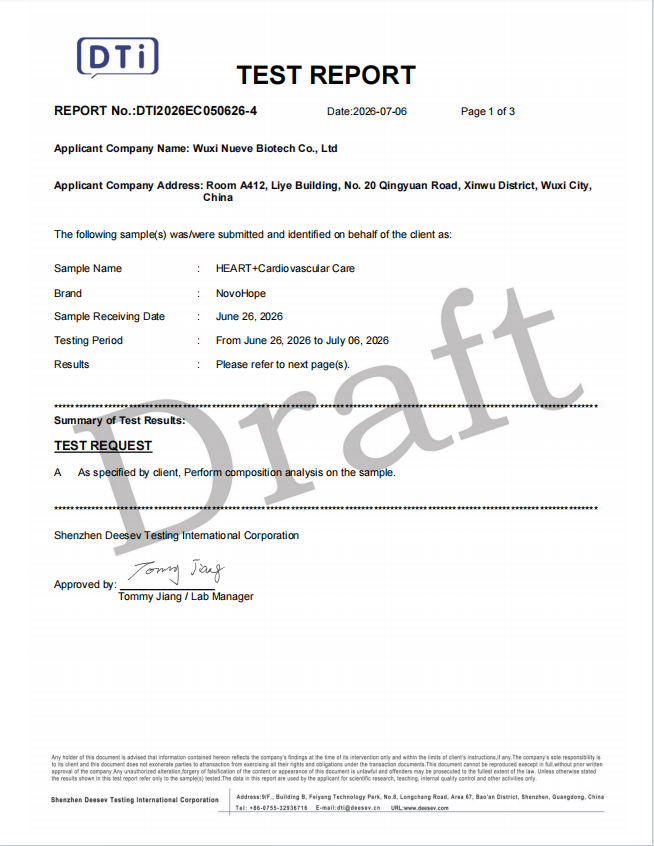
- Analytical verification: certificate of analysis DTI2026EC050626-4, issued 2026-07-06 by Shenzhen Deesev Testing International Corporation
Two details in that specification carry most of the buyer value. The first is the fixed unit weight: a 2.1 g piece is a dose unit, not a serving suggestion, which removes the scoop and the mixing step from the owner’s routine and makes daily intake countable in a pack of ten. The second is the delivery matrix. Because the tablet is designed to disintegrate in the mouth, there is no residual chunk left for a pet to spit out, which is the most common way a chew-based routine quietly under-delivers without anyone noticing.
The nutrient side of a heart formula is where verification work concentrates. Cardiovascular formulations in pets commonly draw on nutrients such as taurine, L-carnitine, coenzyme Q10 and vitamin E, and buyers should treat the analytical report — not the ingredient panel on the artwork — as the source of truth. The HEART+ certificate of analysis is a customized full ingredient composition analysis test, meaning the test items were client-designated and the finished composition was analyzed. That is the form of evidence that survives a distributor’s technical review, because it documents the product as manufactured rather than as designed.
Limits are worth stating plainly. An ODT is a delivery format, not a therapeutic claim, and it does not replace veterinary diagnosis or prescription care. Format also does not guarantee compliance in every animal; a small share of pets will refuse any oral format. Buyers who treat acceptance as a testable variable rather than a given get a more realistic picture of what the SKU will do on shelf.
Step-by-Step: Six Checks Before You Commit to a Heart Supplement Format
Step 1 — Define the patient and dose profile
Fix species, weight bands, daily dose and expected duration of use before comparing formats. A heart supplement is normally purchased repeatedly, so this profile becomes the basis for pack size, pack count and reorder cadence. Write it down: format debates tend to resolve themselves once the daily routine is expressed in units.
Step 2 — Score administration against the real household
Ask how the supplement will actually be given — at a clinic counter, in a single-pet home, in a multi-pet home, or in a kennel. Multi-pet and reduced-appetite settings favour a unit-dose format that is placed in the mouth and counted; fully controlled feeding settings can absorb a powder. This step is about the administration environment, not about the nutrient.
Step 3 — Check dosage precision at unit level
Compare how each format measures a dose: a fixed piece weight in an ODT, a whole chew in a soft chew, a scoop in a powder. Then ask what happens when the owner is in a hurry. Precision should be supported by unit-weight specifications and batch documentation rather than by label language.
Step 4 — Assemble the documentation stack
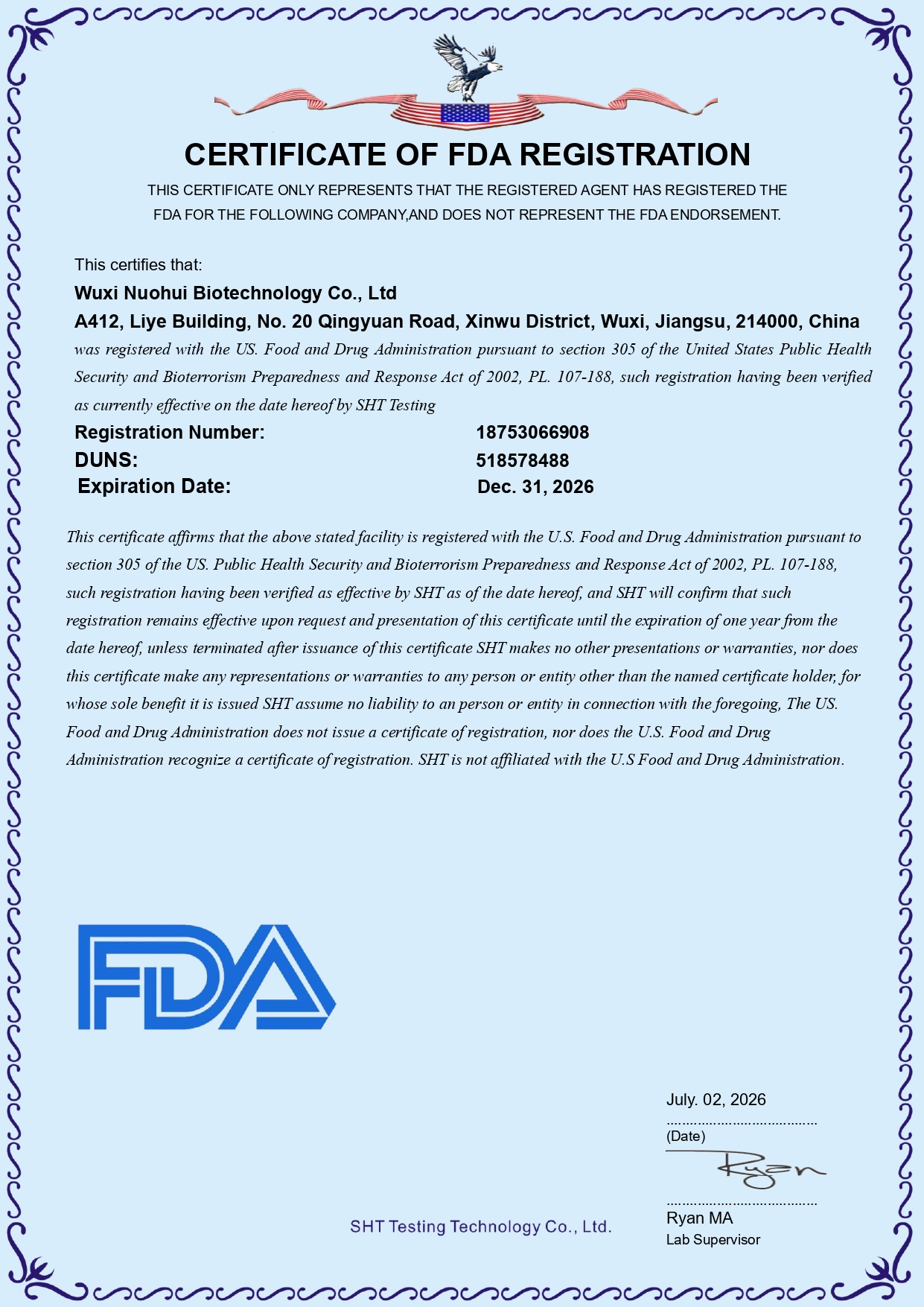
For the US market this includes an FDA Food Facility Registration (registration 18753066908, valid through 2026-12-31) and a Certificate of FDA Registration issued under Section 305 of the US Public Health Security and Bioterrorism Preparedness and Response Act of 2002. Product-level evidence includes certificates of analysis, and across the Novohope range there are Safety Data Sheets prepared to the OSHA Hazard Communication Standard 29 CFR 1910.1200, for example for COAT+ and EYES+. Brand-protection documents belong in the same stack: acceptance notices for Novohope trademark applications were issued by China’s National Intellectual Property Administration on 2026-02-12 for Classes 7 and 31. Finally, use the NASC Quality Seal as the benchmark for GMP and labeling discipline in the US.
Step 5 — Validate with a sample before scaling
Sample terms exist for exactly this purpose: one commercial option lists a minimum order of 1 unit with DDP delivery, pre-shipment full inspection plus third-party testing with a COA report provided, and payment before shipment. Use that sample for an administration trial with representative animals, record whether the piece is accepted and fully consumed, and only then confirm the production minimum of 3,000 per SKU.
Step 6 — Lock commercial terms and continuity
Confirm lead time, inspection scope and after-sales support before launch. Production lead time is 35–45 days, quality control is 100% full inspection before delivery plus third-party authoritative sampling testing, and after-sales support is provided remotely. An alternative commercial structure lists 1,000 boxes per SKU with FOB or CIF delivery and 50/50 payment against pre-shipment testing, which suits buyers modelling landed cost more tightly than flexibility.
Use Cases: Where Each Format Earns Its Place
Veterinary clinics and multi-pet homes — unit-dose ODT
Where an owner must give the supplement daily and a clinician needs a countable instruction, a 2.1 g ODT in a 10-piece pack converts “give once daily” into a supply the owner can watch running down. Evidence for acceptance in this format is behavioural rather than analytical: in a private-label program run by a European brand owner, the highlighted product properties were safety, ease of use, and — in the buyer’s own summary — that pets do not resist.
Chain retail and private label — ODT as a category entry
The clearest documented case behind this format is a multi-year private-label partnership covering Germany, the United Arab Emirates, Canada, Australia, France and the United States. It combined OEM private-label production with ODM customized formula development, delivered 200,000 units into chain supermarket and retail store distribution, and ran for three years. The reported result was growth in the retailer’s pet health category volume, favourable market feedback and stable repeat orders. For a distributor reading that case, the repeat-order pattern is the real signal: formats that pets resist do not come back as purchase orders.
Distributor portfolios — export-market fit
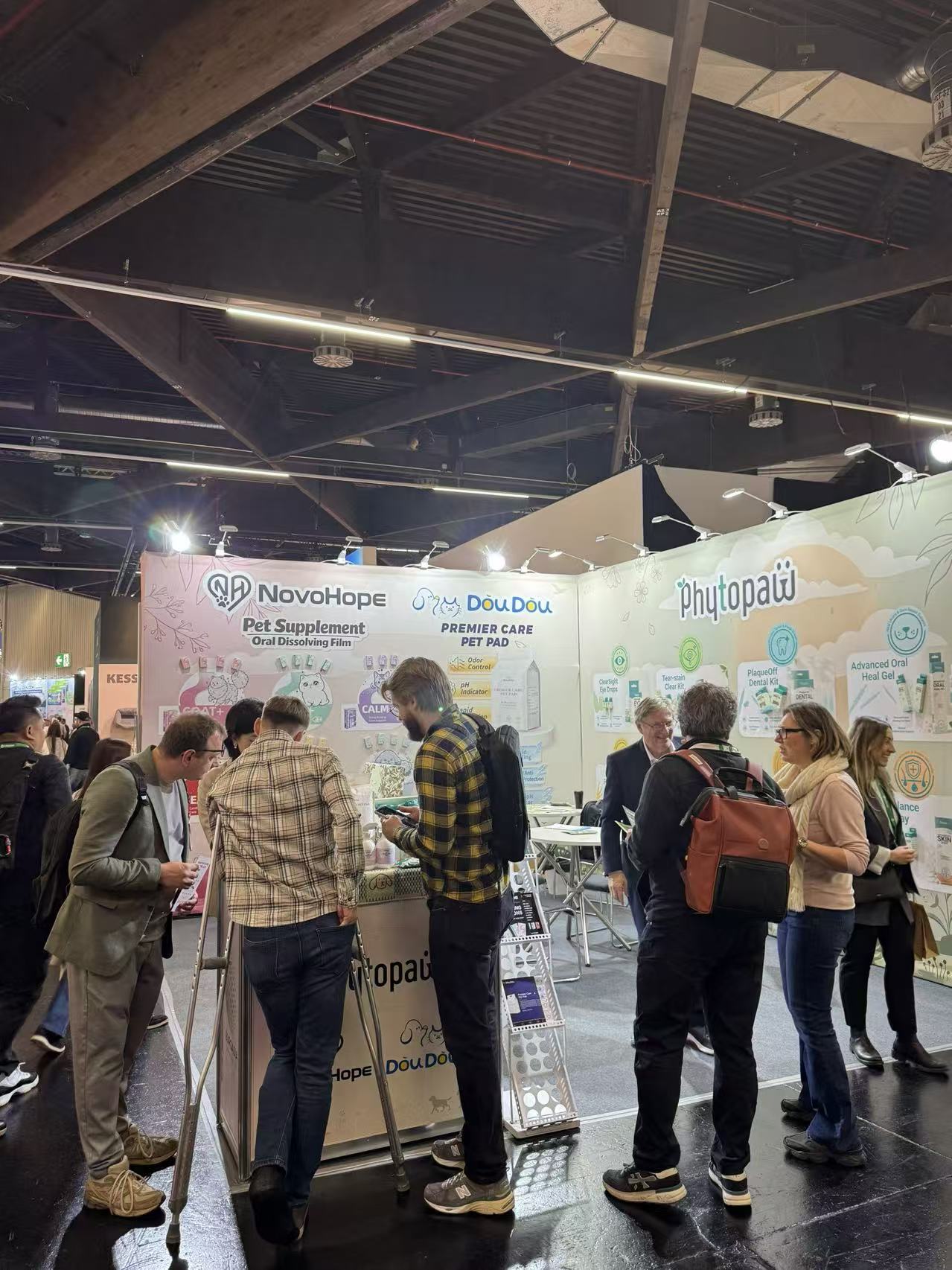
Novohope exports to Europe, North America, Southeast Asia, the Middle East and East Asia, and supports brand agency, distribution and OEM/ODM models. For a distributor adding a cardiovascular SKU, an ODT line is a compact entry: the pack is small, the SKU count per formula is low, and it can sit alongside companion formats such as COAT+, EYES+, CALM+, BONE+, PROBIO and FIT+ rather than replacing them.
Where soft chews and powders still fit
Soft chews remain relevant where a treat-like experience is central to a brand’s positioning and the buyer accepts the partial-consumption risk. Powders remain practical where feeding is fully controlled — kennels, breeding programmes and clinical feeding plans — and where the supplement must be measured by weight into a prepared ration. The format decision is therefore a portfolio decision: the question is not which format wins in general, but which format fits the administration environment the SKU will actually be sold into.
ODT vs. Soft Chew vs. Powder: A Buyer’s Decision Comparison
| Decision factor | ODT (orally disintegrating tablet) | Soft chew | Powder |
|---|---|---|---|
| How the dose is delivered | Fixed-weight unit that breaks down in the mouth | Requires the pet to consume the whole chew | Must be mixed into food and the food finished |
| Dosage precision in the home | Unit-level; no scoop or mixing step | Unit-level if the entire chew is eaten | Depends on scoop accuracy and complete intake |
| Primary failure mode | Acceptance — the pet must take the piece | Partial consumption and spit-out | Uneven mixing, shared bowls, unfinished food |
| Owner compliance visibility | Countable pack of 10 pieces | Countable pieces | Daily intake difficult to verify |
| What to verify in the supplier’s file | Certificate of analysis, FDA facility registration, FDA registration certificate, SDS | Same document set, plus unit-weight and batch uniformity records | Same document set, plus mixing and homogeneity data |
| Best-fit administration environment | Daily cardiovascular routines, multi-pet homes, clinic-led dispensing | Treat-positioned brands where a chew experience is the value proposition | Controlled feeding programmes where the full ration is consumed |
| Verified specification example | Novohope HEART+, ODT, 2.1 g per piece, 10 pieces per pack | Not specified for this product range | Not specified for this product range |
FAQ: Pet Heart Supplement Format Questions Buyers Ask
What compliance documents should a buyer expect for a pet heart supplement in ODT format?
For the US market, the document set can include an FDA Food Facility Registration issued to Wuxi Nuohui Biotechnology Co., Ltd (registration 18753066908, valid through 2026-12-31) and a Certificate of FDA Registration issued under Section 305 of the US Public Health Security and Bioterrorism Preparedness and Response Act of 2002. At product level, a certificate of analysis such as DTI2026EC050626-4 for HEART+ Cardiovascular Care documents a client-designated full ingredient composition analysis, and Safety Data Sheets prepared to the OSHA Hazard Communication Standard 29 CFR 1910.1200 form part of the wider range documentation. In the United States, the NASC Quality Seal is the recognized industry benchmark, requiring GMP adherence and labeling audits. Required documents vary by destination market, so map them to the target market before ordering.
Can the ODT heart supplement be customized for a private-label brand?
Yes. The manufacturer offers brand agency, distribution and OEM/ODM production services to global clients, and customization covers recipe, brand, packaging design and other customized requirements. Stated monthly capacity is 200,000,000 units, production lead time is 35–45 days, and the production minimum order quantity is 3,000 per SKU. A documented example is a three-year OEM private-label and ODM formula development program covering Germany, the UAE, Canada, Australia, France and the United States, with 200,000 units delivered into chain supermarket and retail distribution.
What order quantities and commercial terms apply?
Production orders start at a minimum order quantity of 3,000 per SKU. Two documented commercial structures exist: one lists 1,000 boxes per SKU with FOB or CIF delivery and 50/50 payment against pre-shipment testing; the other lists a minimum order of 1 unit with DDP delivery, pre-shipment full inspection plus third-party authoritative testing with a COA report provided, and full payment before shipment, which suits sample-scale validation. Because each structure serves a different order profile, buyers should confirm which one applies to their volume before comparing landed cost.
How should a sample be validated before a full production order?
Use the sample-scale terms to run an administration trial rather than a paperwork review. Confirm the certificate of analysis first, then give the 2.1 g ODT piece to representative animals across the weight bands in the target market and record whether the piece is accepted and fully consumed; the fast-dissolving matrix removes the spit-out risk that affects chew formats, but acceptance still varies by animal. Sample-stage quality control is pre-shipment full inspection plus third-party authoritative sampling testing, with a COA report provided.
What is the production lead time, and how is continuity protected?
Production lead time is 35–45 days, with 100% full inspection before delivery plus third-party authoritative sampling testing, and remote after-sales support. Stated monthly capacity of 200,000,000 units is the buffer behind repeat orders, and the documented three-year, 200,000-unit private-label program across six markets is the closest available evidence of continuity in practice. To start a format evaluation, request a HEART+ sample and a quote with your target market, pack configuration and intended launch date — specification details and contact routes are available at Novohope.
Conclusion: Buy the Format That Survives the Daily Routine
ODT, soft chew and powder all work when the pet eats what it is given; they separate when it does not. For a heart supplement expected to be given daily for months, the deciding criteria are unit-level dosage precision, countable compliance, and evidence that the animal actually takes the piece. That is why a fast-dissolving matrix and a 2.1 g × 10-piece specification matter commercially and not only technically.
For distributors and veterinary buyers, the practical sequence is short: define the daily routine, match the format to the administration environment, verify the documentation stack, validate a sample with real animals, and only then commit to the production minimum. Soft chews and powders keep their place in a portfolio; the ODT format is the one to hold to a delivery standard.

Next step: sample and specification pack
Request a HEART+ ODT sample, the certificate of analysis, and OEM/ODM terms covering recipe, brand and packaging design. Production minimum is 3,000 per SKU with a 35–45 day lead time; sample-scale orders can be arranged with DDP delivery and a COA report.
Contact Novohope for a pet heart supplement ODT sample and quote →
Have Questions or Need More Details?
Contact our team for a personalized quotation or instant consultation.
Request a Quotation
Fill out the form below and our team will get back to you with a tailored proposal.
WhatsApp Direct Chat
Prefer to chat in real-time? Message us on WhatsApp for instant assistance & quick answers.
- Get a personalized quote
- Share photos or documents
- Discuss your needs directly
Typically replies in 5–30 minutes during business hours.