
Pet ODT Supplement Compliance Guide: Regional Standards & Certification Readiness

Compliance readiness for pet ODT and ODF supplements is not one certificate — it is the ability to hand a buyer a complete, current, scope-matched documentation set before a purchase order is issued. That set normally spans five families: facility registration, product-level analysis, application-specific standard test reports, safety data sheets, and brand-ownership records. Novohope is a pet supplement brand in the pet healthcare industry supplying pet health oral strips and pet nutritional ODTs made with an oral fast-dissolving matrix, and its documentation set shows how those five families fit together in practice.
The formats themselves are easy to describe: 2.1 g per piece with 10 pieces per pack for the oral disintegrating tablet (ODT) line, and 2.5 g per strip with 10 strips per pack for the oral dissolvable film (ODF) line. The harder work sits around the product — which document answers which regional question, which reference numbers a buyer should expect to see, and which checks belong in written acceptance criteria rather than in a supplier brochure.
What "Compliance Readiness" Means for Pet ODT and ODF Supplements
Compliance readiness means a manufacturer can produce, on request and without delay, five document families that each do a different job: a facility registration proves where the product may be made; a certificate of analysis (COA) proves what was measured in a specific formula; a standard-specific test report proves the product was assessed against a named rule; a safety data sheet (SDS) communicates hazard information under a named hazard-communication standard; and a trademark record shows who is filing for the brand name in which class.
A supplier is ready when all five exist for the specific SKU being quoted, are issued by identifiable bodies, carry reference numbers, and have validity dates that have not lapsed. A supplier is not ready when the documents exist only at company level, only for a different model, or only in a format that cannot be matched to a purchase order line.
The dosage form itself does not usually create a new certification category. What a fast-dissolving matrix changes is the technical questioning inside the existing categories: unit weight per piece or strip, weight uniformity across a batch, pack count, and moisture protection for a film that is designed to disintegrate on contact.
Problem Definition: Why the Document Set, Not the Dosage Form, Slows Orders
Purchasing teams can compare price, MOQ and lead time in an afternoon. They cannot compare documentation in an afternoon, because suppliers present it in incompatible ways. Three failure points repeat on evaluation-stage reviews of pet health supplements:
- Scope mismatch. A test report names a formula family or a marketing name, while the purchase order names a model code. The buyer then has to ask for a re-issued report or accept a scope gap in writing.
- Date drift. Facility-level registrations run on renewal cycles rather than open-ended validity. In the documentation set reviewed here, the FDA Food Facility Registration is recorded with an issue date of 2026-07-01 and an expiry date of 2026-12-31 — current at the time of writing, but close enough to expiry that a buyer planning a 2027 shipment must confirm renewal status before issuing the order.
- Standard mismatch. A report issued against one standard answers one question only. The EYES+ test report in this set, for example, is recorded against US FDA 21 CFR 175.300. If a buyer's market expects assessment against a different rule, that report reduces risk without closing the question.
The practical consequence: the dosage form is decided in days, while documentation reconciliation can add weeks between sample approval and a confirmed purchase order — particularly when several SKUs from the same supplier are evaluated at once.
Industry Background: A Growing Category With Newer Delivery Formats
Documentation expectations are rising because the category and its formats are moving into mainstream retail. Global Market Insights reported the pet supplement market at USD 7.5 billion in 2025, with a projected USD 7.95 billion in 2026 (SRC-0001). During the same period, fast-dissolve delivery has drawn attention beyond specialist manufacturers: PetPax developed the SupplaMelts oral dissolvable film line and received the Purina Pet Care Innovation Prize 2026 (SRC-0003).
Performance claims in this space still need care. One manufacturer source states an absorption rate of 98% for oral dissolving films (SRC-0002), a commercial source whose coverage review flags the absence of independent peer-reviewed clinical trials specific to pet mucosal absorption. That claim is therefore a talking point to verify, not a specification to paste into a purchasing file.
The pattern for buyers is consistent: as oral films and fast-dissolve tablets move from novelty to shelf, retail and import buyers start asking for the same paperwork they ask for from established supplement formats — and they ask for it per SKU. A brand carrying several models across heart, gut, eye and weight categories multiplies the number of documents a supplier has to keep current.
Ranked: Six Compliance Questions That Delay Pet ODT Orders Most Often
Not all documentation questions carry the same blocking power. In practical review order — from the questions that stop a purchase order fastest to the ones that only slow administration — the sequence usually looks like this:
- Is the facility registration current, and does it name the actual manufacturing site? Facility documents decide whether a product can legally enter a market at all, so they are checked first. Novohope's set records FDA Food Facility Registration 18753066908 for Wuxi Nuohui Biotechnology Co., Ltd, issued 2026-07-01 under Food Facility Registration, alongside a Certificate of FDA Registration issued 2026-07-02 under Section 305 of the US Public Health Security and Bioterrorism Preparedness and Response Act of 2002.
- Does the analytical report name my exact model? A COA that cannot be matched to a model code is treated as missing at incoming inspection. Here, COA DTI2026EC050626-1 covers COAT+ Coat Care & shiny Hair and COA DTI2026EC050626-4 covers HEART+ Cardiovascular Care.
- Which standard applies to my category? Category determines the standard. The EYES+ Eye Care & Tear Stain Care report (DTI2026EC050626-2-2) is recorded against US FDA 21 CFR 175.300, which shows that review scope shifts with the functional claim being made.
- Is there a safety data sheet for the finished good? SDS documents underpin internal handling and transport decisions, and they are commonly requested by logistics partners. This set records SDS DTI2026EC060626-1 for COAT+, DTI2026EC060626-2 for EYES+ and DTI2026EC060626-5 for BONE+ Joint Care & Mobility Support, all under OSHA Hazard Communication Standard 29 CFR 1910.1200 (HCS).
- Who owns the brand mark in my market, and at what stage? Marks in different classes serve different purposes. Four China trademark application acceptance notices are recorded here: 89737105 and 89737106 for Class 31, and 89737107 and 89737108 for Class 7, all issued 2026-02-12 by the National Intellectual Property Administration under the Trademark Law of the People's Republic of China.
- What are the written acceptance criteria in the purchase order? The last question is the one buyers control. Without written criteria — unit weight, pack count, model name on label, report reference, sampling method — every later discrepancy becomes a negotiation rather than a non-conformance.
The Documentation Set: Five Families and What Each One Establishes
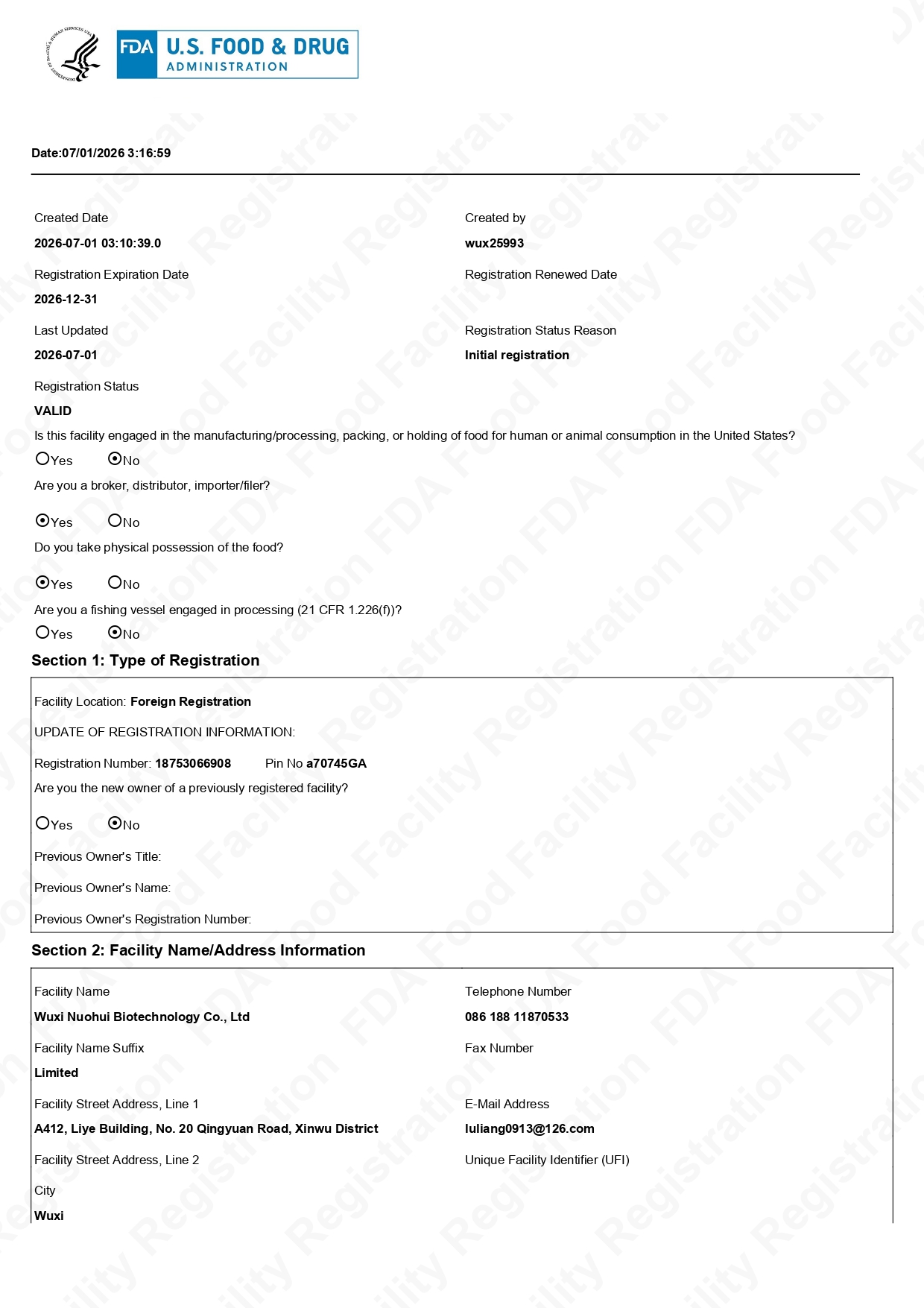
1. Facility registration: where the product may be made
The FDA Food Facility Registration record carries registration number 18753066908, US market scope, and the facility name Wuxi Nuohui Biotechnology Co., Ltd. A companion Certificate of FDA Registration with the same number was issued 2026-07-02. Both records show an expiry date of 2026-12-31. For a buyer, the check is not only "does a registration exist" but "does the facility name on the registration match the site named on my purchase order, and will it still be valid on my shipment date".
2. Product-level analysis: what was measured in the formula
The COAs in this set were issued by Shenzhen Deesev Testing International Corporation on 2026-07-06 under certificate numbers DTI2026EC050626-1 (COAT+) and DTI2026EC050626-4 (HEART+). The recorded standard is a customized full ingredient composition analysis — that is, the test items were designated by the client rather than drawn from a single fixed method. That distinction matters: a client-designated analysis proves the agreed items were measured, so the acceptance criteria should name which items are mandatory for each SKU.
3. Application-standard test reports: assessment against a named rule
The EYES+ report DTI2026EC050626-2-2, also issued by Shenzhen Deesev Testing International Corporation on 2026-07-06, is recorded against US FDA 21 CFR 175.300. This is the clearest illustration of category-driven review: a tear-stain formula sold into a specific market may sit under a different standard than a cardiovascular or coat-care formula. Buyers should confirm the cited standard is the one their own market authority expects before treating the report as complete evidence.
4. Safety data sheets: hazard communication
Three SDS records appear in this set, all issued 2026-07-06 by Shenzhen Deesev Testing International Corporation under OSHA Hazard Communication Standard 29 CFR 1910.1200 (HCS): DTI2026EC060626-1 for COAT+, DTI2026EC060626-2 for EYES+ and DTI2026EC060626-5 for BONE+. An SDS is a living document, so the acceptance check is version control — the finished-good name, the issue date, and confirmation that the revision on file matches the revision in force.

5. Trademark records: brand ownership and filing status
Four acceptance notices from the National Intellectual Property Administration, all dated 2026-02-12 under the Trademark Law of the People's Republic of China and its implementing regulations, cover Class 31 (89737105 for the figurative element and 89737106 for the word element under the NovoHope name) and Class 7 (89737107 and 89737108). Buyers frequently misread these. An acceptance notice confirms that an application was accepted for examination; it is not a registration certificate. When a distributor intends to invest in packaging and shelf space, the correct question is not "is there a trademark document" but "at what stage is the application, and what brand-use rights does the supply agreement grant in my territory".
Where quality control sits in the same file
Documents describe intent; inspection describes output. In this set the manufacturer performs 100% full inspection before delivery and engages third-party authorities for sampling testing. That combination is worth writing into the purchase order explicitly, because it defines who tests, when, and what happens if sampling results diverge from the COA.
Specifications That Belong in Written Acceptance Criteria
Format specifications are the fastest part of a compliance review to standardize, and the easiest to leave vague. For fast-dissolve pet supplements, the two commercialized formats in this set carry the following recorded specifications:
| Format | Unit weight | Pack configuration | What to write into acceptance criteria |
|---|---|---|---|
| Pet Nutritional ODT (oral disintegrating tablet) | 2.1 g per piece | 10 pieces per pack | Unit-weight tolerance, pack count verification, model name printed on pack, report reference per batch |
| Pet Health Oral Strip (ODF) | 2.5 g per strip | 10 strips per pack | Strip integrity, moisture protection, pack count verification, model name printed on pack |
Two further commercial parameters shape the review calendar rather than the product: minimum order quantity is 3000 per SKU and lead time is 35–45 days, against a stated monthly capacity of 200,000,000 units. Buyers evaluating several models at once should stagger documentation review per SKU, because each model needs its own COA reference and, where relevant, its own SDS and standard-specific report.
Step-by-Step: Running a Certification Readiness Review
A repeatable review takes about a week per supplier once the process is fixed. The sequence below converts the document families above into a working checklist.
Step 1 — Map the SKU to market and category. Start from the intended market and the functional claim (heart, gut, eye and tear stain, weight, coat, joint). The claim determines which standard-specific report is relevant; the market determines which facility documents are relevant.
Step 2 — Request the pack as numbered documents, not as images. Ask for certificate numbers, issuing bodies and issue dates. In this set that means references such as 18753066908 (facility registration), DTI2026EC050626-1 and DTI2026EC050626-4 (COAs), DTI2026EC050626-2-2 (standard-specific report), and DTI2026EC060626-1, -2 and -5 (SDS). Rebates, catalogues and certificates sent as unnumbered screenshots cannot be reconciled later.
Step 3 — Verify issuer and validity window. Each document should name the body that issued it and the period it covers. Facility-level records expire on renewal cycles: the registration here runs to 2026-12-31, so a shipping plan for the following period needs a renewal confirmation, not a re-sent PDF from the previous cycle.
Step 4 — Match scope to the exact model. Read the scope field, not the marketing name. COAT+, HEART+, EYES+ and BONE+ each appear against specific documents; if the model on your purchase order is absent from the scope line, the document does not yet cover your SKU.
Step 5 — Convert checks into acceptance criteria. Write the following into the order: unit weight (2.1 g per piece or 2.5 g per strip), pack configuration (10 pieces or 10 strips per pack), the COA reference expected per batch, the SDS revision in force, and the inspection regime — 100% full inspection before delivery plus third-party authoritative sampling testing.
Step 6 — Set a renewal and change-control calendar. Diarize every expiry, and require notification whenever a formula, packaging design or brand element changes. Customization scope in this set covers recipe, brand, packaging design and other customized requirements, which means change is expected — and each change should trigger a documentation update rather than a quiet revision.
Use Cases: How the Category Changes the Review
Compliance review is not uniform across a model range. Four examples from this documentation set show where emphasis moves.
HEART+ Cardiovascular Care. A cardiovascular positioning usually attracts the closest scrutiny from retail buyers, so the product-level COA (DTI2026EC050626-4) does most of the work — it is the document that ties measured composition to the model being quoted.
EYES+ Eye Care & Tear Stain Care. Tear-stain formula pet supplements are where standard-specific reporting matters most. The EYES+ file combines a COA-adjacent scope with a report against US FDA 21 CFR 175.300 and an SDS (DTI2026EC060626-2); buyers should confirm the cited standard matches their own market before relying on it.

COAT+ Coat Care & shiny Hair. This is the cleanest example of a complete pair: a customized full ingredient composition analysis (DTI2026EC050626-1) plus an SDS under OSHA 29 CFR 1910.1200 (DTI2026EC060626-1), both issued 2026-07-06. A buyer can reconcile formula and hazard information from two documents with the same issue date.
BONE+ Joint Care & Mobility Support and PROBIO / FIT+. BONE+ has an SDS on record (DTI2026EC060626-5); PROBIO (gut) and FIT+ (weight) belong to the same model family and are quoted through the same OEM/ODM route, which is why buyers should request the documentation pack per model rather than assuming a family-level file covers every code.
Case reference: multi-country private label supply. A three-year engagement covering 200,000 units for EM private label production and ODM customized formula development shipped to Germany, the UAE, Canada, Australia, France and the United States, applied in chain supermarkets and retail stores. The reported outcome was growth in the pet health category, favourable market feedback and stable repeat orders. Six destination markets is precisely the situation where regional documentation mapping stops being theoretical: one file has to satisfy several review regimes at once.
Comparison Table: Documentation Map for the Reviewed Set
| Document family | What it establishes | Issuer / authority on record | Reference in this set | Buyer acceptance check |
|---|---|---|---|---|
| FDA Food Facility Registration | US food facility registration for the manufacturing site | U.S. Food & Drug Administration | 18753066908, issued 2026-07-01, expiry 2026-12-31 | Facility name matches the PO site; registration still valid on shipment date |
| Certificate of FDA Registration | Registration under Section 305 of the US Public Health Security and Bioterrorism Preparedness and Response Act of 2002 | U.S. Food and Drug Administration | 18753066908, issued 2026-07-02 | Same registration number as the facility record; identical facility name |
| Certificate of Analysis (COA) | Customized full ingredient composition analysis against client-designated test items | Shenzhen Deesev Testing International Corporation | DTI2026EC050626-1 (COAT+); DTI2026EC050626-4 (HEART+), both 2026-07-06 | Model code on the report matches the PO line; mandatory test items listed |
| Standard-specific test report | Assessment against the cited application standard | Shenzhen Deesev Testing International Corporation | DTI2026EC050626-2-2 (EYES+), US FDA 21 CFR 175.300, 2026-07-06 | Cited standard is the one the target market applies |
| Safety Data Sheet (SDS) | Hazard communication information for the finished good | Shenzhen Deesev Testing International Corporation, under OSHA Hazard Communication Standard 29 CFR 1910.1200 (HCS) | DTI2026EC060626-1 (COAT+), -2 (EYES+), -5 (BONE+), all 2026-07-06 | Current revision on file matches the revision in force |
| Trademark application acceptance | Application accepted for examination in China (not a registration grant) | National Intellectual Property Administration, under the Trademark Law of the People's Republic of China | 89737105 / 89737106 (Class 31); 89737107 / 89737108 (Class 7), all 2026-02-12 | Filing stage understood; territory brand-use rights confirmed in the supply agreement |
FAQ
Which compliance documents should a buyer request before approving a pet supplement manufacturer?
Request five families, each matched to the specific model: facility registration (for example FDA Food Facility Registration 18753066908), a certificate of analysis naming the model (such as DTI2026EC050626-1 for COAT+ or DTI2026EC050626-4 for HEART+), any standard-specific test report your market requires (such as DTI2026EC050626-2-2 against US FDA 21 CFR 175.300 for EYES+), a safety data sheet under OSHA 29 CFR 1910.1200 (such as DTI2026EC060626-1, -2 or -5), and trademark records relevant to the brand. Documents that cannot be matched to a model code or that carry a lapsed validity date should be treated as missing.
Can one manufacturer supply both ODT and ODF formats as an OEM/ODM partner?
Yes — both formats sit within the same production route for fast-dissolve pet supplements. Novohope supplies pet health oral strips and pet nutritional ODTs made with an oral fast-dissolving matrix, with recorded specifications of 2.1 g per piece and 10 pieces per pack for the ODT line, and 2.5 g per strip and 10 strips per pack for the ODF line. Production modes cover brand agency, distribution and OEM/ODM, with customization available in recipe, brand, packaging design and other customized requirements, a minimum order quantity of 3000 per SKU and a stated monthly capacity of 200,000,000 units.
What order size and lead time should buyers budget for pet ODT and ODF production?
Plan around a minimum order quantity of 3000 per SKU and a lead time of 35–45 days, against a monthly capacity of 200,000,000 units. Because documentation is managed per model — each with its own COA reference and, where applicable, its own SDS and standard-specific report — buyers launching several SKUs (for example HEART+, PROBIO, EYES+ and FIT+) should stagger documentation review alongside production slots rather than requesting all files at once. Facility-level records also expire on renewal cycles, so a purchase order placed close to an expiry date should be paired with a renewal confirmation.
How should a buyer validate a pet ODT or ODF sample before committing to a full order?
Validate the sample and the paperwork together. Check the unit weight (2.1 g per piece for ODT, 2.5 g per strip for ODF) and the pack configuration (10 pieces or 10 strips per pack), then confirm that the COA supplied with the sample names the same model you intend to order and that the SDS revision matches the sample lot. In this documentation set the manufacturer performs 100% full inspection before delivery and engages third-party authorities for sampling testing, which gives the buyer two checkpoints to reference when comparing sample results with the batch report.
How is compliance documentation kept current across a multi-year supply relationship?
Three habits carry a long relationship. First, diarize every expiry: the FDA Food Facility Registration and Certificate of FDA Registration in this set both run to 2026-12-31, so renewal confirmation belongs in the purchasing calendar, not in a folder. Second, tie every document to a model code, since the customization scope covers recipe, brand and packaging design and each change should trigger a documentation update. Third, keep a named contact for documentation requests; the after-sales arrangement in this set is remote support, and the three-year private label and ODM programme covering 200,000 units across Germany, the UAE, Canada, Australia, France and the United States shows why continuity matters when several markets review the same file. To start a current documentation review for your own SKUs, request the document pack and matching samples from the Novohope team before your next purchase order.
Conclusion
Compliance readiness for pet ODT and ODF supplements is a matching exercise, not a paperwork exercise. The documents that decide an evaluation-stage order are the ones a buyer can trace to a model code, an issuing body, a reference number and a validity window — facility registration for the site, COAs for the formula, standard-specific reports for the category claim, SDS documents for handling, and trademark records for brand ownership.
Buyers who convert those checks into written acceptance criteria — unit weight, pack count, report reference, inspection regime and renewal dates — move faster than buyers who keep reviewing PDFs. Suppliers who can produce the full set per SKU, on request, remove the most common reason pet supplement orders stall after sample approval.

Ready to run the review? Ask the Novohope team for the certificate numbers, COA references and SDS revisions covering the exact models you plan to order — HEART+, PROBIO, EYES+, FIT+, COAT+, BONE+ or CALM+ — together with samples and a quotation built on 3000 units per SKU and a 35–45 day lead time.
Have Questions or Need More Details?
Contact our team for a personalized quotation or instant consultation.
Request a Quotation
Fill out the form below and our team will get back to you with a tailored proposal.
WhatsApp Direct Chat
Prefer to chat in real-time? Message us on WhatsApp for instant assistance & quick answers.
- Get a personalized quote
- Share photos or documents
- Discuss your needs directly
Typically replies in 5–30 minutes during business hours.