2-Stage Electric Ram vs Bi-Directional Ram vs Wedge Jack
A rescue lifting decision is not settled by asking which tool has the highest force. The better question is which tool geometry, stage behavior, control method and power source fits the gap, load path and access you actually have. This guide compares a 2-stage electric ram, a bi-directional ram, a hydraulic ram and a wedge jack for rescue lifting, with pump pairing checks for manual, battery-powered and single- or double-output engine pumps. ODE Technology Co., Ltd. is the reference manufacturer for the product examples, and the guide keeps claims at the level supported by the available model records.
Quick answer: choose a 2-stage electric ram when you need a self-contained battery tool with a defined high-force first stage and a longer lower-force second stage. Choose a hydraulic ram when a matched external pump and hose system is acceptable and controlled multi-tool output is useful. Choose a bi-directional ram only after the model datasheet confirms both force directions, stroke and control because the category name alone does not state those values. Choose a wedge jack for low-profile insertion and initial separation where its rated force, stroke and actuation are confirmed for the task.
Problem definition: why rescue lifting tools are not interchangeable
Rescue lifting usually starts with an unstable load, a narrow entry point and limited space for a tool plus its operator. The tool must create or hold space without losing control of the load. That creates four separate decision problems: opening the first gap, developing force at the right point, extending far enough to be useful, and keeping the load stable while another action is taken.
A 2-stage design addresses reach and force in two steps. The first stage normally provides higher force over a shorter extension, while the second stage provides additional reach at a lower force. The ODE R530-E illustrates the idea in its own specification: 1st-stage extension stroke is 400 mm with 1st-stage spreading force of 140 kN, and 2nd-stage extension stroke is 345 mm with 2nd-stage spreading force of 70 kN. The practical question is whether the first stage covers the resistance and whether the second stage provides enough additional reach without exceeding the rated stage force.
A bi-directional ram is a different concept. In rescue tool terminology, bi-directional describes a ram arranged to apply hydraulic force in both directions of travel. It is not a synonym for a two-stage ram. A two-stage ram changes force and stroke across two extension stages; a bi-directional ram changes the direction in which force can be applied. ODE lists the TR940-L as a Bi-directional Ram, but the reviewed model data does not state its rated force in each direction, stroke, retracted length or control arrangement. Those are datasheet questions, not assumptions to make from the product name.
A hydraulic ram is pump-driven. Its performance depends on the tool, the pump, the hose set, the connector and the pressure setting as a system. The R522-L, for example, is specified at 72 MPa with a closed length of 560 mm, 1st-stage lifting height of 935 mm and 1st-stage lifting force of 275 kN, then 2nd-stage lifting height of 1285 mm and 2nd-stage lifting force of 140 kN. Those figures only describe the ram; the pump and hose circuit must still be matched.
A wedge jack is a low-profile lifting or separation tool that is inserted into a gap and expanded to create initial space. The category is valuable when the opening is too narrow for a larger ram head. However, the reviewed record for the ODE KFC050-S gives the model name but not its rated force, stroke or actuation method. A buyer should not assume that a wedge jack is manual, hydraulic or pump-driven until the exact model data confirms it.
Industry background: standards, documentation and system thinking
Rescue lifting equipment is specified through both performance data and conformity evidence. EN 13204:2016 is a published European standard for double-acting hydraulic rescue tools, covering safety and performance requirements. Published standards listings also identify a later EN 13204:2025 edition titled for powered rescue tools for fire and rescue service use. The existence of a later edition means buyers should confirm which edition applies to the product and market under review rather than treating all EN 13204 references as interchangeable.
NFPA 1936, 2020 edition, is another relevant reference in North America. Its requirements include permanent labels sized appropriately, and the 2020 edition removed requirements for rescue struts. That does not mean every lifting accessory is outside every standard; it means the applicable product standard and the exact product scope must be checked.
CE documentation is also model-specific. ODE holds UDEM attestations of conformity for several product families. The rescue ram attestation M.2023.206.C94563 lists models including R410 and other ram models, but its scope is the model list in the certificate, not every ODE ram automatically. The product record for the R530-E separately states EN13204 approved. A technical buyer should therefore ask for the declaration, certificate scope, test report and model list, then compare them with the exact model being purchased.
The pump side needs the same treatment. ODE lists manual pumps such as BS-63 and P620ASL, the battery-powered pump P600OGB, the single-output engine pump BE-MP-63/0.5, the double-output engine pump MDP220 and the heavy-duty double-output power unit P620SGB. These names identify product roles, but they do not by themselves prove that a particular pump can drive a particular ram at the required pressure and flow. Pump pairing is a system check.
Detailed solution: how each lifting option should be evaluated
2-stage electric ram: self-contained reach with a defined force step
The ODE R530-E is a battery-powered 2-stage electric ram. Its product record lists a 28 V, 5.0 Ah battery; rated operating pressure of 72 MPa; 1st-stage extension stroke of 400 mm; 2nd-stage extension stroke of 345 mm; 1st-stage spreading force of 140 kN; 2nd-stage spreading force of 70 kN; retracted length of 540 mm or less; extended length of 1285 mm or more; and weight of 19.6 kg or less excluding the battery.
For the buyer, those are not just catalogue numbers. The 540 mm retracted length affects how close the tool can be placed before lifting begins. The 1285 mm extended length affects how much space can be created. The force step means the operator should know which stage is doing the work. If the load requires more than the second-stage rating, adding more stroke does not make the tool suitable; the load path or tool choice must change.
The R530-E record also lists a quick-change anti-slip pushing head with 360-degree rotation, a star-shaped directional valve, built-in LED lighting, seven battery-level indicators and a low-power alarm below 20 percent remaining capacity. These features matter for positioning and control in dark or cramped spaces. They do not replace a load assessment or a rated-capacity check.
Because the R530-E is battery-powered, it does not need an external manual, battery or engine pump in the same way as a hydraulic ram. That reduces hose management, but it introduces battery logistics: charged batteries, charger access, spare capacity and a plan for extended operations. The reviewed data does not provide an environmental ingress rating, duty cycle or measured runtime, so those points should be confirmed before relying on the tool in a prolonged deployment.
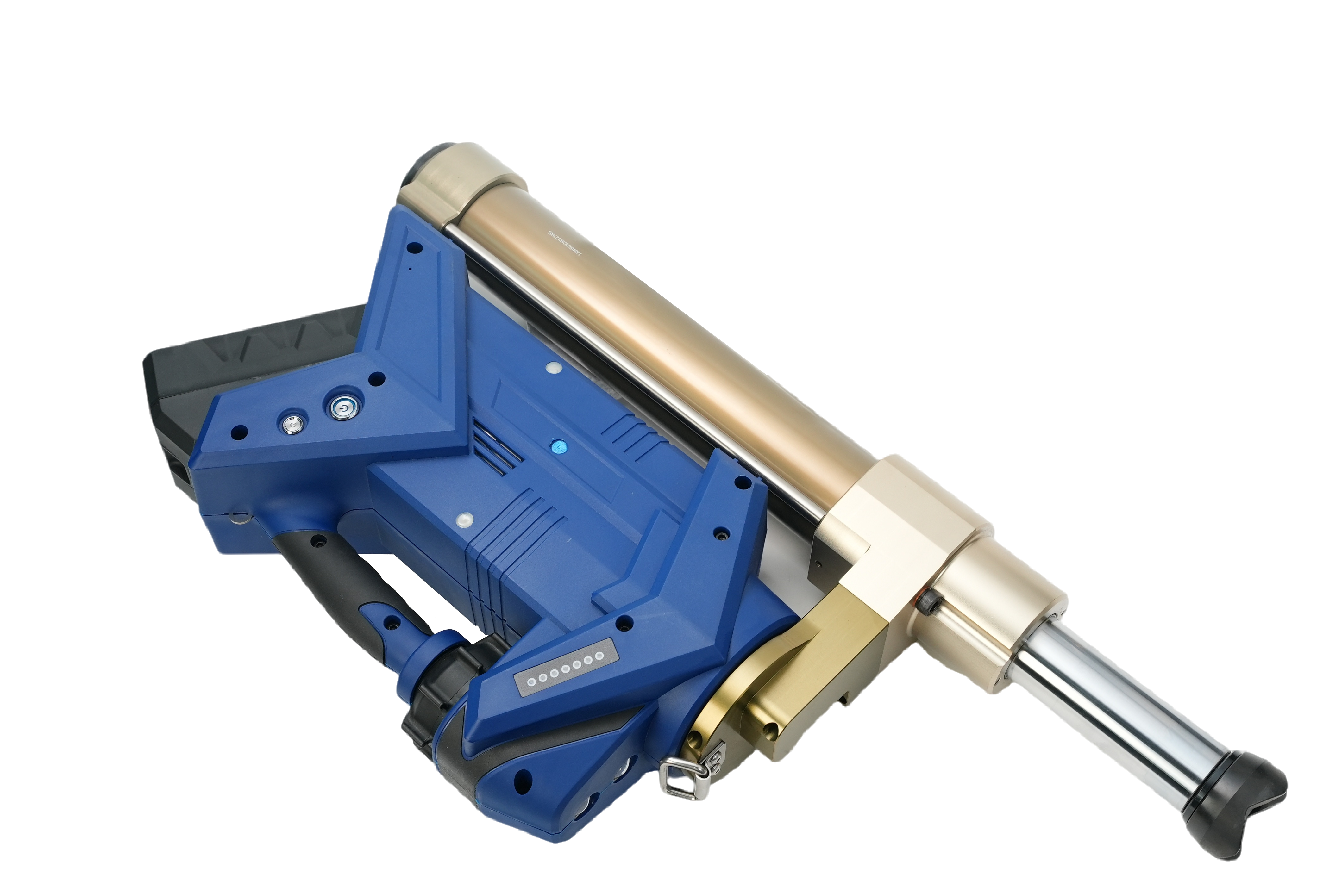
ODE 2-stage Electric Ram R530-E, the electric lifting reference for this comparison.
Bi-directional ram: confirm both directions before comparing force
A bi-directional ram can be useful where the rescue plan requires controlled force in both directions, not only extension. That may matter when a load must be pushed and then positively retracted, or when the tool is used in a jig or temporary support arrangement where return behavior affects control. The key procurement point is that the name does not tell the buyer the force in each direction, the stroke in each direction, the retracted length, the pump requirement or the control method.
ODE lists the TR940-L as a Bi-directional Ram. The reviewed data does not provide its rated force, stroke, retracted length, pressure requirement or control details, and it is not listed in the rescue ram CE certificate scope reviewed here. Buyers should therefore request the TR940-L datasheet, test documentation and model-specific conformity evidence before placing it on a shortlist. If a supplier cannot provide those items, the correct comparison is not a force comparison; it is a documentation gap.
Pump pairing for a bi-directional ram also needs a specific circuit review. A double-output engine pump such as the MDP220 or the heavy-duty double-output power unit P620SGB may appear relevant because it has two outputs, but the reviewed data does not state simultaneous flow, pressure setting or control compatibility. The buyer should confirm whether the ram needs one circuit or two, how return is controlled, and whether the selected pump is approved for that valve arrangement.
Hydraulic ram: pump-supported force and reach
The hydraulic ram is the option to examine when a pump-supported system is acceptable and when the extra force or reach justifies hose management. The ODE R522-L is a 2-stage hydraulic ram specified at 72 MPa with a closed length of 560 mm, 1st-stage lifting height of 935 mm and 1st-stage lifting force of 275 kN, 2nd-stage lifting height of 1285 mm and 2nd-stage lifting force of 140 kN, and a weight of 17.7 kg. Its product record lists a flat-seal flat-axis single interface for hot-swapping under pressure, a handle light, a laser alignment device at the ram tip and quickly replaceable anti-slip tips that rotate 360 degrees.
The R522-L shows why hydraulic systems need to be compared as systems. The ram can be lighter than some battery-integrated tools, but the pump, hose and connector add handling weight and setup steps. The laser alignment and hot-swap connector are positioning and control aids, not substitutes for checking the load path, the pressure setting and the hose routing.
The ODE R410 is also listed as a Hydraulic RAM and appears in rescue ram CE attestation M.2023.206.C94563. The reviewed data does not provide its force and stroke, so it should be quoted and compared with its own datasheet. The same rule applies to any hydraulic ram: do not transfer R522-L figures to R410 or to a bi-directional model.
ODE 2-stage hydraulic Ram R522-L, used here to explain externally pumped ram behavior.
Wedge jack: low-profile access, but verify the exact model data
A wedge jack is useful when the first priority is to enter a narrow gap and begin separation without the bulk of a full ram head. Its value is geometry: the low-profile shape can reach where a larger tool cannot start. That advantage does not remove the need for a rated force, a stable bearing surface and a controlled expansion path.
The reviewed ODE record identifies the KFC050-S as a Wedge jack but does not state its rated force, stroke, retracted dimensions, weight or actuation method. It does not establish whether the model is manual, hydraulic or connected to a pump. The buyer should therefore request the KFC050-S datasheet and confirm the lifting force, stroke, insertion height, control method and any pump or hose requirement before selecting it. The absence of those figures is not evidence that the tool lacks capability; it is a limit on what can be compared from the available record.
Pump pairing: manual, battery, single-output and double-output choices
Pump pairing applies to hydraulic rams and to any wedge jack or bi-directional ram that is confirmed as pump-driven. It does not apply in the same way to the R530-E, which is a battery-powered electric ram. For a pump-driven tool, start with the tool pressure and connector, then match pump type, hose rating, valve control and output count.
A manual pump such as the ODE BS-63 or Hand Pump P620ASL is a logical option where fuel and battery power are unavailable and the work can be paced manually. The trade-off is operator effort and a slower setup than a powered pump. A battery-powered pump such as the P600OGB reduces cord and fuel dependence, but its runtime and battery logistics must be confirmed from its own data. A single-output engine pump such as the BE-MP-63/0.5 gives one output circuit. A double-output engine pump such as the MDP220, or the heavy-duty double-output power unit P620SGB, provides two outputs, but the reviewed data does not confirm simultaneous full-flow operation or the exact flow split.
Do not select a pump only because the headline pressure appears to match. Check the tool rated pressure, pump pressure setting, connector type, hose pressure rating, flow requirement, control valve and whether the pump is approved for the tool. A pump certificate or product listing is not a compatibility statement for every ram.
Comparison table: documented differences and evidence limits
| Tool type and example | Power and stage behavior | Documented figures | Positioning and control | Pump pairing | Evidence limit |
|---|---|---|---|---|---|
| 2-stage electric ram, ODE R530-E | Battery-powered; two-stage extension with a force step | 72 MPa; 1st stage 400 mm at 140 kN; 2nd stage 345 mm at 70 kN; retracted 540 mm or less; extended 1285 mm or more; 19.6 kg or less excluding battery | Star-shaped directional valve; 360-degree anti-slip pushing head; LED light; seven-level battery display and low-power alarm below 20 percent | Self-contained battery tool; no external pump pairing in the same sense as a hydraulic ram | Product record states EN13204 approved; runtime, ingress rating and duty cycle not stated |
| Bi-directional ram, ODE TR940-L | Bi-directional force concept; exact direction and stage behavior not supplied | Not stated in the reviewed model data | Not stated; confirm control arrangement and return method | Hydraulic pump required if the model is pump-driven; confirm circuit and valve compatibility | Not listed in the reviewed rescue ram CE certificate scope; request model datasheet and test evidence |
| Hydraulic ram, ODE R410 and R522-L | Pump-driven; R522-L has two lifting stages | R522-L: 72 MPa; closed 560 mm; 1st stage 935 mm at 275 kN; 2nd stage 1285 mm at 140 kN; 17.7 kg. R410 figures not stated | R522-L has laser alignment, handle light, hot-swap flat-seal connector and 360-degree anti-slip tips | Manual, battery or engine pump after pressure, flow, connector and hose checks | R410 appears in CE ram certificate scope; R522-L figures apply only to R522-L |
| Wedge jack, ODE KFC050-S | Low-profile lifting or separation category; actuation not stated | Not stated in the reviewed model data | Confirm insertion height, bearing surface and control before use | Confirm whether manual, hydraulic or pump-driven before planning a pump | No force, stroke, weight or actuation data supplied |
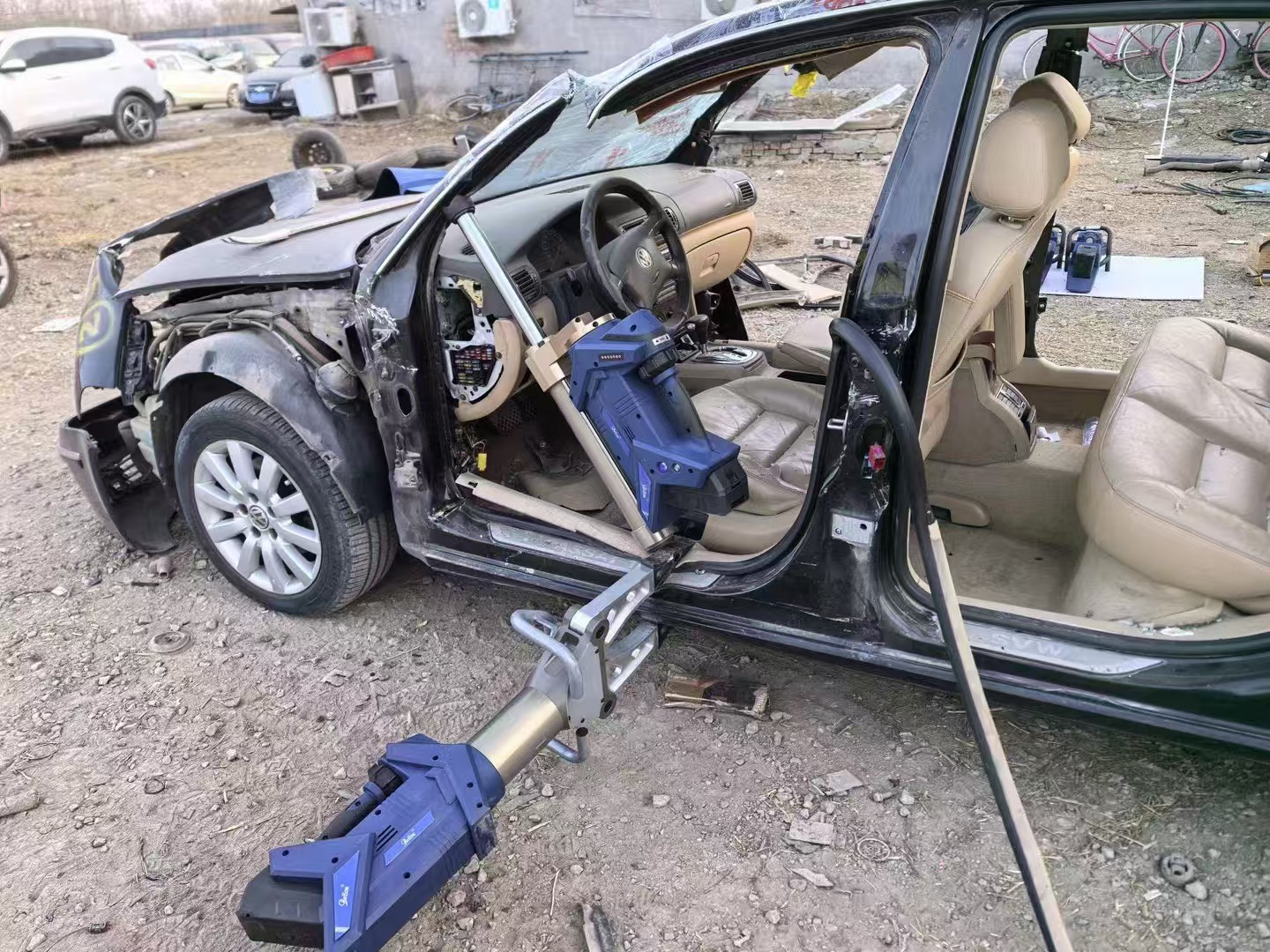
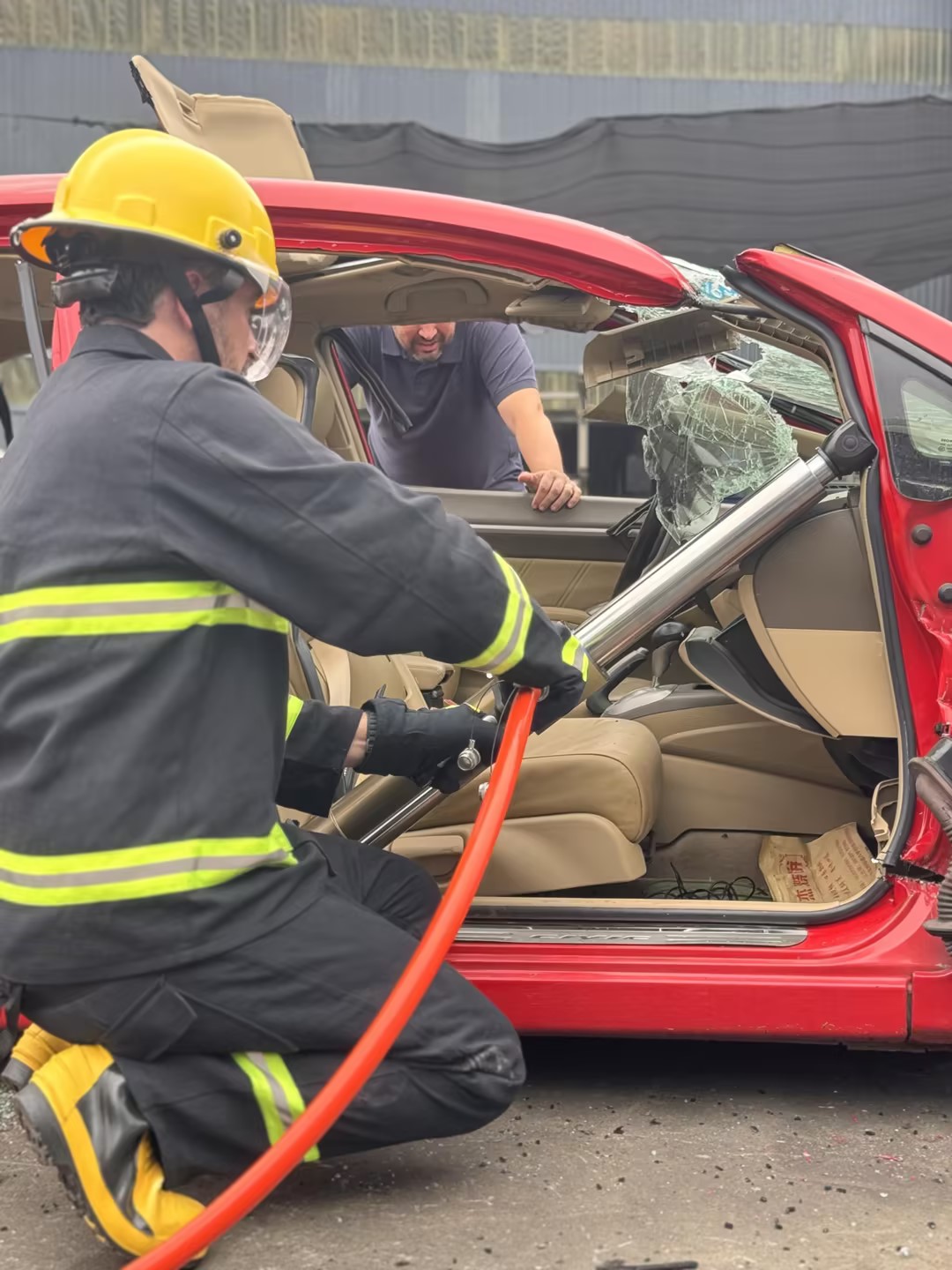
ODE electric hydraulic rescue tools for vehicle extrication, showing the lifting role in a rescue scene.
Step-by-step selection and verification
- Define the gap and the lift target. Measure the entry gap, the required extension and the available bearing surfaces. A tool that cannot be placed cannot be evaluated on force alone. For the R530-E, the 540 mm retracted length and 1285 mm extended length are the starting geometry checks.
- Separate first-stage resistance from second-stage reach. On a two-stage tool, the first stage and second stage have different force ratings. Compare the load at each stage, not only the maximum force. The R530-E first stage is rated at 140 kN and the second stage at 70 kN; the R522-L first stage is rated at 275 kN and the second stage at 140 kN.
- Decide whether the tool must push and retract under control. If positive force in both directions is required, request the bi-directional model data and confirm its control circuit. Do not infer force direction from a two-stage description.
- Select the power architecture. A battery-integrated ram reduces hose management but requires charged batteries and a charging plan. A hydraulic ram requires a pump, hose and connector system. A manual pump trades speed for independence from fuel and batteries. A battery pump trades fuel dependence for battery logistics. A single-output engine pump serves one circuit; a double-output pump has two outputs but requires confirmation of simultaneous flow and valve compatibility.
- Check the physical positioning aids. Anti-slip tips, 360-degree heads, lights and laser alignment help the operator place and hold the tool. They do not increase the rated force. Use them to reduce setup error, not to justify exceeding a rating.
- Verify model-level conformity. Ask for the exact model list, certificate number, issuing body, standards, issue and expiry dates, declaration of conformity and test report. For ODE, the rescue ram CE attestation M.2023.206.C94563 covers listed models including R410; the R530-E record separately states EN13204 approved. The TR940-L and KFC050-S require their own model-level evidence.
- Confirm pump and hose compatibility in writing. Match pressure rating, flow, connector, valve type, hose rating and control method. Do not accept a general statement that a pump is suitable for all rams.
- Validate with a controlled drill. Use the intended tool, pump, hose and personal protective setup in training. Record setup time, reach, stability and battery or fuel consumption. The reviewed data does not provide field runtime or duty-cycle results, so the buyer must generate its own operational evidence.
Use cases: matching the lifting method to the rescue problem
Vehicle extrication with limited hose access
When the lifting point is inside a deformed vehicle structure and hose routing would slow the team, a battery-powered 2-stage electric ram is a logical candidate. The R530-E offers a defined first-stage force, a second-stage reach and a self-contained battery. The trade-off is that the team must manage battery charge and spare batteries. The tool should be positioned so the anti-slip head bears on a stable structural point, and the operator should know when the work has moved from the first stage to the second.
Pump-supported lifting where higher first-stage force is needed
Where a pump and hose system can be staged and the task needs the higher first-stage rating shown by the R522-L, a hydraulic ram becomes the reference option. The 275 kN first-stage lifting force is higher than the 140 kN first-stage figure shown for the R530-E, but this is not a universal superiority claim. It is a comparison of one documented hydraulic model with one documented electric model under their stated ratings. Pump setup, hose management and system weight must be included in the decision.
Narrow-gap access before a larger ram can be placed
A wedge jack is a candidate when the first gap is too narrow for a ram head. Its low-profile entry can create the initial separation that allows a larger tool to be positioned. The KFC050-S should only be used after its rated force, stroke, insertion height and actuation method are confirmed. If those figures are unavailable, the tool should not be treated as a known-capacity solution in a lift plan.
Bi-directional control in a prepared lifting fixture
A bi-directional ram may be appropriate where the lift plan requires controlled movement in both directions. The TR940-L belongs in that evaluation, but the buyer must obtain its rated force in each direction, stroke, control method and pump requirement. Without those figures, it cannot be compared on equal terms with the R530-E or R522-L.
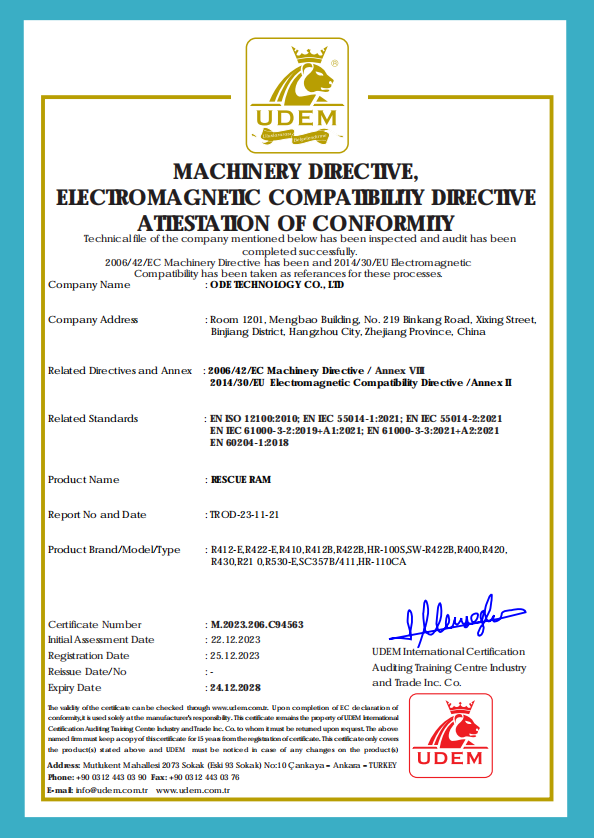
UDEM CE attestation M.2023.206.C94563 for listed ODE rescue ram models. The certificate scope must be checked against the exact model being purchased.
Budget and procurement checks without invented price bands
The reviewed material does not provide public price bands for the R530-E, TR940-L, R410, R522-L, KFC050-S or the pump options. A useful quotation therefore has to be built from the same scope for every supplier: tool model, pump model if required, hose length and connector type, battery and charger quantity, case, certification documents, spare parts, training support and delivery destination. Comparing a bare ram price with a complete pump kit price is not a valid comparison.
For budgeting, separate the tool from the consumables and support items. A battery electric ram needs batteries and chargers; a hydraulic ram needs a pump and hoses; a pump-driven system needs compatible connectors and possibly a second output circuit. ODE's stated commercial capability includes OEM and ODM support, drawing design, customization on voltage, power, color and brand, minor function adjustments, a monthly capacity of 5,000 units, a minimum order quantity of 2 units and a lead time of 45 to 60 days. These are manufacturing and supply terms, not a price quote.
FAQ
How do I verify CE compliance when sourcing hydraulic rescue tools from China?
Ask for the certificate number, issuing body, exact model list, standards, issue date, expiry date and declaration of conformity. Check that the model you are buying appears in the scope. For ODE, UDEM attestations include M.2023.206.C94563 for listed rescue ram models such as R410, M.2023.206.C94565 for rescue combi tools, M.2023.206.C94566 for rescue cutters, M.2023.206.C94567 for rescue spreaders, M.2023.206.C94572 for hydraulic pumps and M.2023.206.C94573 for hydraulic breaching tools. These certificates are valid until 24 December 2028 according to the records reviewed. The R530-E product record separately states EN13204 approved, so request its model-level document set. Do not treat a certificate for one model as proof for every model in the same family.
What does the two-stage behavior of the R530-E mean for lifting?
The R530-E has a 1st-stage extension stroke of 400 mm with 140 kN 1st-stage spreading force, then a 2nd-stage extension stroke of 345 mm with 70 kN 2nd-stage spreading force. The first stage provides the higher force over the earlier part of the stroke; the second stage adds reach at a lower force. The operator should know which stage is active and should not treat the second-stage reach as if it carried the first-stage force rating. Retracted length is 540 mm or less and extended length is 1285 mm or more.
Can a 2-stage electric ram be paired with a manual or engine pump?
The R530-E is a battery-powered electric ram, so it does not use an external manual, battery or engine pump in the same way as a hydraulic ram. Pump pairing is relevant to the hydraulic R410 and R522-L and to any bi-directional ram or wedge jack that is confirmed as pump-driven. For a hydraulic ram, match the pump pressure, flow, connector, hose rating and valve control to the exact ram model.
How do I choose between a single-output and double-output pump?
A single-output pump such as the ODE BE-MP-63/0.5 provides one output circuit. A double-output engine pump such as the MDP220 or the heavy-duty double-output power unit P620SGB provides two outputs. The reviewed data does not establish simultaneous full-flow performance or a universal flow split, so confirm with the pump datasheet and the tool manufacturer whether two tools can be operated at the required pressure and flow. A manual pump such as BS-63 or P620ASL and a battery-powered pump such as P600OGB are alternatives when fuel or corded power is unsuitable, but each has its own operating trade-offs.
What are the sample, MOQ, lead-time and OEM terms for ODE rescue tools?
ODE's stated capability includes OEM and ODM support, drawing design, customization on voltage, power, color, brand and minor function adjustments, a minimum order quantity of 2 units and a lead time of 45 to 60 days. Samples can be provided, with the carrier charge on the buyer's side according to the company FAQ. For a current quotation, specify the ram model, pump model if required, hose and connector set, battery and charger quantity, certification documents and destination. You can download the ODE English company brochure or contact ODE Technology Co., Ltd. for the current R530-E, R522-L or pump datasheet and a configuration-based quote.
Conclusion
The right rescue lifting tool is the one whose stage behavior, geometry, control and power source match the lift plan and whose model-level evidence can be verified. The R530-E 2-stage electric ram is defined by its 140 kN first stage, 70 kN second stage and self-contained battery operation. The R522-L hydraulic ram shows a higher documented first-stage force but depends on a matched pump and hose system. The TR940-L bi-directional ram and KFC050-S wedge jack may fit specific access or control needs, but their force, stroke and actuation must be confirmed before they can be compared as known-capacity tools.
Use the comparison table as a screening step, then verify the exact model against its datasheet, certificate scope and pump compatibility. A documented limitation is more useful than an assumed maximum. That approach keeps the selection technical, auditable and tied to the rescue task rather than to a catalogue headline.
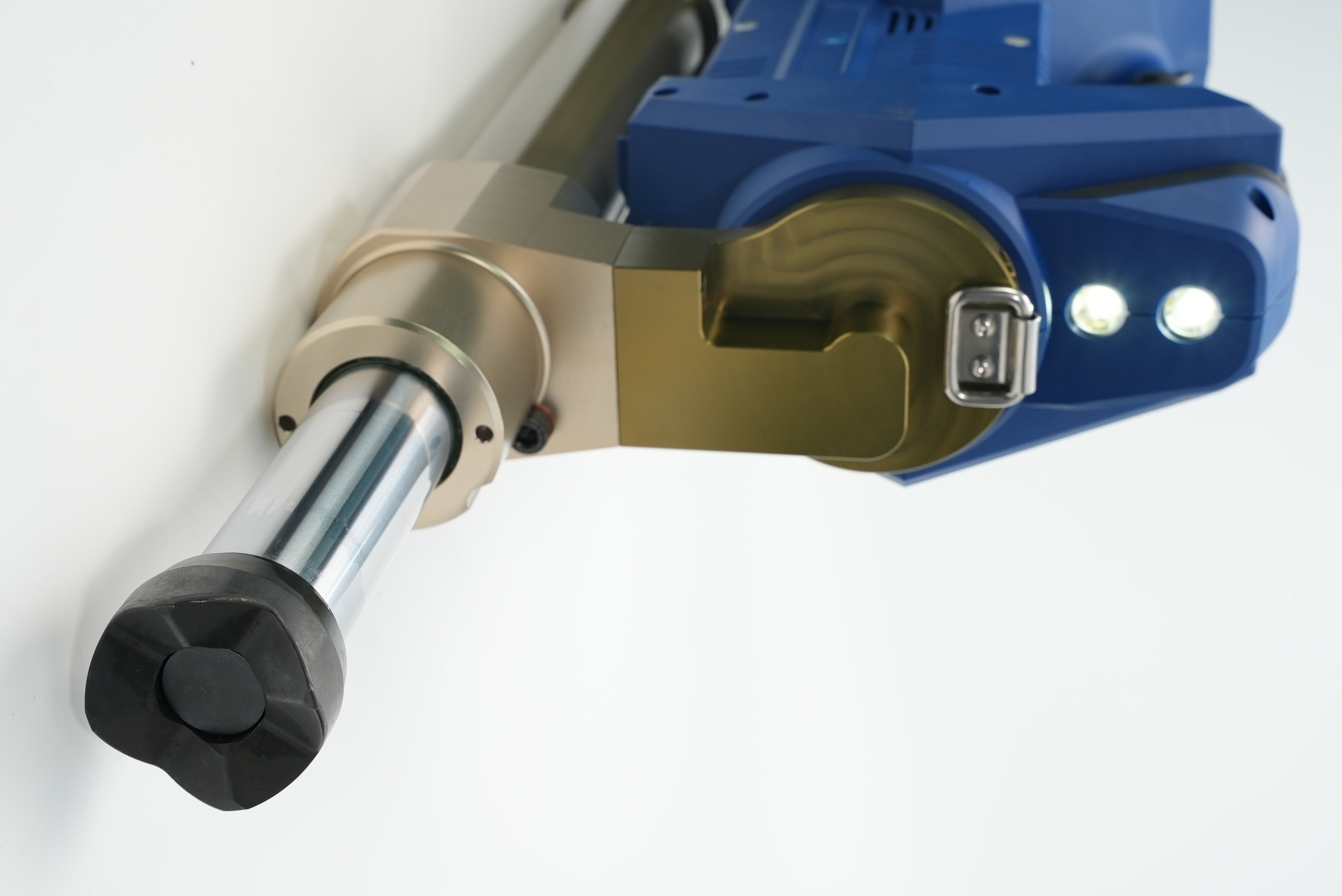
Request the current R530-E datasheet or discuss a hydraulic ram and pump configuration with ODE.
Have Questions or Need More Details?
Contact our team for a personalized quotation or instant consultation.
Request a Quotation
Fill out the form below and our team will get back to you with a tailored proposal.
WhatsApp Direct Chat
Prefer to chat in real-time? Message us on WhatsApp for instant assistance & quick answers.
- Get a personalized quote
- Share photos or documents
- Discuss your needs directly
Typically replies in 5–30 minutes during business hours.