Battery-Powered Rescue Tools Ranked by First-Response Priority: Pump, Cutter, Spreader, Combi Tool, Ram
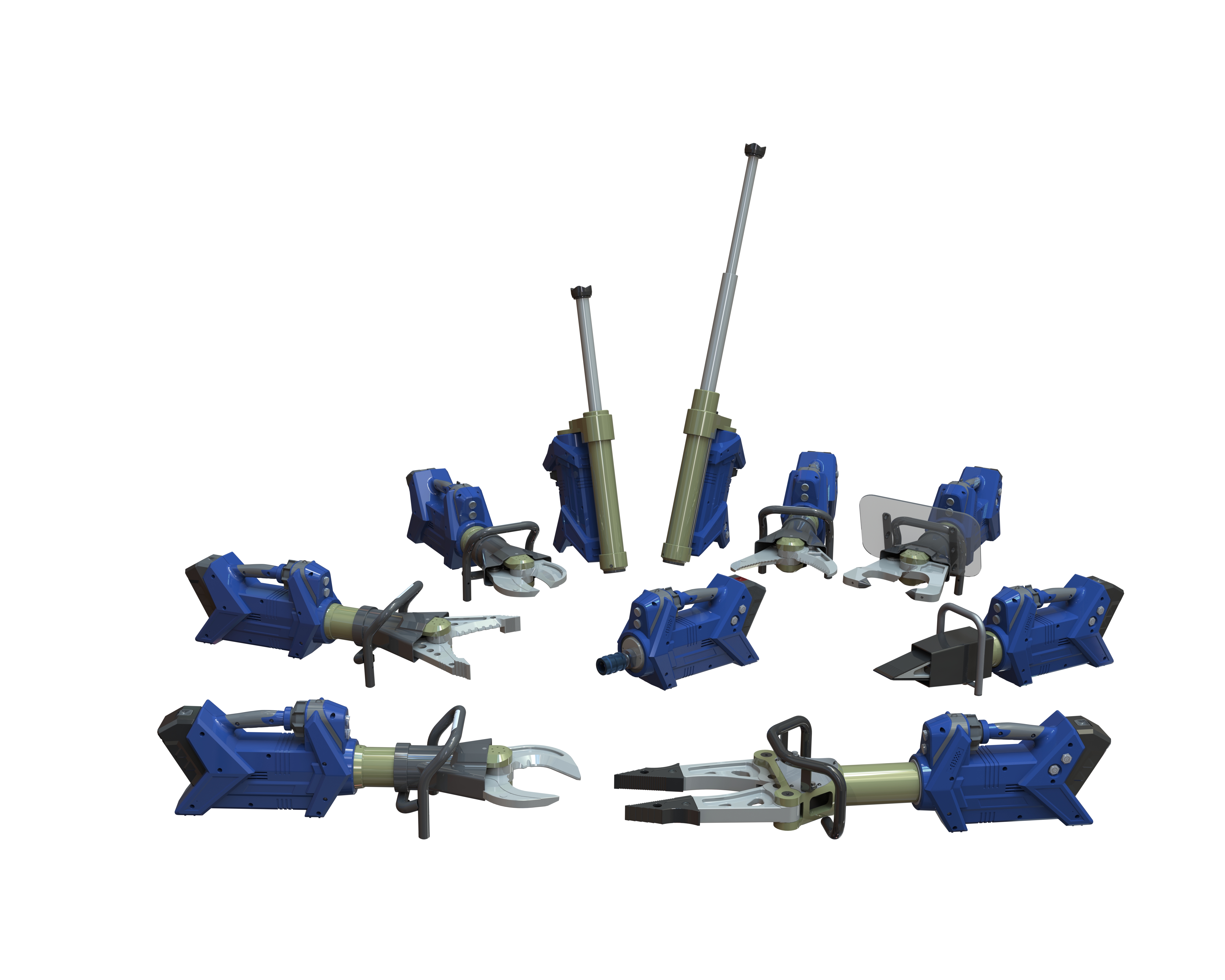
For a first-response vehicle equipped with battery-powered rescue tools, the most defensible priority order is: battery pump → battery cutter (or battery rebar cutter) → battery spreader → battery combi tool → two-stage electric ram. This sequence is not alphabetical and not price-based. It follows the order in which a rescue crew consumes capability on scene — power supply first, then cutting, then spreading, then a multi-function fallback, then lifting and propping.
What Priority Ranking for Battery Rescue Tools Actually Means
Priority ranking answers a procurement question that a catalogue cannot: if a vehicle can only justify five battery-driven tools, which five, and in what order of importance? The ranking below uses five criteria that can be discussed with a technical committee without inventing numbers.
- Function coverage. The set must cover cutting, spreading, squeezing/pulling and lifting/propping. A set of four cutters covers one function four times.
- Sequence dependency. Some tasks unlock others. Power supply and access come before lifting, and cutting usually comes before spreading in vehicle extrication.
- Platform consistency. The battery tools in this article are rated at DC 28 V, with a 5 Ah class pack on the combi tool, spreader and cutter. Each tool is supplied with 2 batteries, 1 charger and 1 belt.
- Weight and crew economics. Verified net weights in this set range from 17 kg (battery rescue cutter S251-E) to 22.6 kg (battery spreader SP725-E).
- Standards traceability. The battery combi tool, battery spreader and battery rescue cutter carry EN 13204 statements in the supplied product documentation.
The ranking therefore reflects task coverage and pairing logic inside a battery rescue tool platform. It is a configuration decision, not a claim that one tool is better engineered than another.
Why Battery Tool Platforms Are Reshaping First-Response Loadouts
Battery-driven rescue equipment removes a structural constraint of conventional hydraulics: the external oil pump and the connecting hoses. In ODE's electric-hydraulic rescue series, the tool uses an integrated hose-free design, which supports single-person operation and shortens pre-rescue preparation time on scene.
The commercial context supports the same direction. Dataintelo's hydraulic rescue tools market report values the global market at USD 1.8 billion in 2025 and projects USD 3.1 billion by 2034, with cutters holding the largest product-type share at 31.4% in 2025. Cutter-led demand is consistent with the ranking logic described here: cutting is the capability crews reach for first, but it still depends on power and is followed by spreading and propping.
Standards context matters as much as market context. EN 13204:2016 specifies safety and performance requirements for double-acting hydraulic rescue tools, and DIN lists EN 13204:2025-06 under the title Powered rescue tools for fire and rescue service use — Safety and performance requirements, replacing the 2016 edition. Because the edition scope is not identical, buyers should confirm which edition applies to the destination market and request product-specific conformity documents rather than treating a standard listing as proof of certification.
The Priority Ranking: Five Battery-Driven Tools in First-Response Order
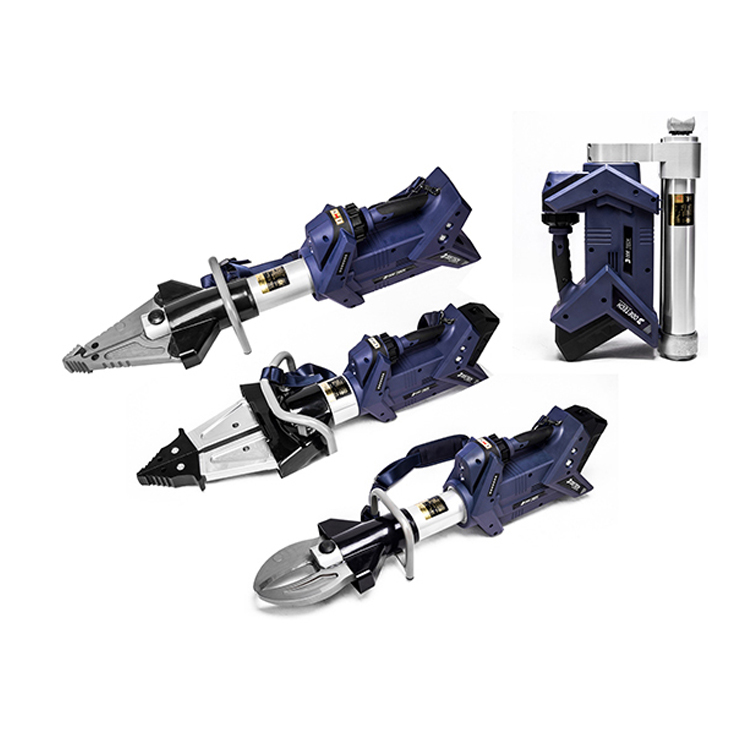
Priority 1 — Battery-Driven Pump (P600OGB): The Power Source That Sets the Ceiling
The pump ranks first because power availability caps everything downstream. The P600OGB is a battery-powered pump intended for the fire rescue and building industry. Its documented characteristics are built-in LED lighting, a compact design, low noise and zero exhaust emission. OEM and ODM services are available and customization is supported; the product is supplied by a Chinese manufacturer.
For a first-response vehicle, the practical value is a hydraulic power source that does not depend on a running combustion engine. That matters in enclosed structures, basements, tunnels and indoor industrial sites where exhaust emission and noise constrain operations, and it matters where fuel resupply is uncertain.
Selection caveat. The supplied documentation for the P600OGB does not state pressure, flow or reservoir ratings. Those figures should be requested as a dated datasheet before a pump is written into a tender specification.
Priority 2 — Battery Cutter (S251-E) and Battery Rebar Cutter (RC-16B): The Primary Cutting Tool
Cutting ranks second because it creates the openings that spreading and lifting later exploit. The S251-E is a battery rescue cutter classified as a battery-powered hydraulic rescue cutter for fire and vehicle extrication, intended for vehicle extrication and structural rescue operations and for emergency rescue scenarios at disaster and accident sites. Verified ratings:
- Battery: DC 28 V, 5.0 Ah; rated working pressure 720 bar
- Maximum cutting force 940 kN; maximum opening distance 250 mm
- Cutting capacity: Ø40 mm Q235A round steel and 20 mm Q235A steel plate
- Net weight 17 kg; dimensions 890 × 220 × 270 mm
- EN 13204 approved; supplied with 2 batteries, 1 charger and 1 belt
A second cutting option belongs on the same discussion agenda. The RC-16B is a 16 mm battery rebar cutter in the hydraulic and electric rescue tool category, intended for fire disaster relief and emergency rescue scenarios. It integrates a high-pressure hydraulic pump, a micro motor, high-hardness cutting blades and a large-capacity battery, operates without an external hydraulic hose or pipe connection, and provides a 360-degree rotating cutting head, an LED indicator showing remaining battery power in real time, and built-in handle lighting for night operation.
Where a fleet works heavily on reinforced concrete, security grilles and rebar, the rebar cutter is the lower-weight cutting answer; where the task is vehicle structure, the S251-E cutter's Ø40 mm round-steel and 20 mm plate rating is the more relevant specification.
Priority 3 — Battery Spreader (SP725-E): Opening, Squeezing, Pulling and Door Work
Spreading ranks third because it converts an opening into a working space. The SP725-E is a battery spreader classified as a battery-powered hydraulic rescue spreader, intended for the fire and vehicle extrication industry and designed for vehicle extrication scenarios. Verified ratings:
- Battery: DC 28 V, 5.0 Ah; rated working pressure 720 bar
- Maximum spreading force 38–65 kN; maximum spreading distance 740 mm
- Maximum squeezing force 95 kN; maximum pulling force 35 kN; maximum pulling distance 640 mm
- Net weight 22.6 kg; dimensions 1060 × 340 × 270 mm
- EN 13204 approved; supplied with 2 batteries, 1 charger and 1 belt
The spreader earns its third position partly because it is not a single-function tool. Documented features include spreading, tearing, squeezing and traction functions for complex rescue conditions, a star-shaped reversing valve for precise control, seven LED indicators showing seven battery levels with a low-power alarm below 20% capacity, and built-in LED lighting for dark environments. Customizable tearing and slitting tool heads are available for tearing, pulling and door-opening work, and the unit ships in a military-grade rolling case.
That combination — spreading plus traction plus door opening — is why the spreader often replaces a separate ram task on smaller vehicles. The trade-off is weight: at 22.6 kg it is the heaviest tool in this five-tool set.
Priority 4 — Battery Combi Tool (SC370-E): The Multi-Function Fallback
The combi tool ranks fourth, not because it is less capable, but because it duplicates capability the crew already carries. Its value is depth: when the cutter and spreader are committed elsewhere, or when a confined space will only admit one tool, the combi tool keeps cutting, spreading and pulling available.
The SC370-E is a battery combi tool classified as a battery-powered rescue combi tool, intended for the fire rescue industry and designed for fire rescue and emergency extrication scenarios, including vehicle extrication, structural collapse rescue and confined-space rescue. Verified ratings:
- Battery: DC 28 V, 5 Ah; rated working pressure 720 bar
- Maximum cutting force 940 kN; cutting capacity Ø38 mm Q235 round steel and 20 mm Q235 steel plate
- Maximum spreading force 45–145 kN; maximum spreading distance 390 mm
- Maximum squeezing force ≥153 kN; pulling force 95 kN; pulling distance 300 mm
- Net weight 18.5 kg; dimensions 960 × 230 × 270 mm
- Manufactured to the EN 13204 rescue tool standard; supplied with 2 batteries, 1 charger and 1 belt
Two specification differences matter when pairing the combi tool with the spreader. The combi tool offers a higher maximum spreading force band (45–145 kN versus 38–65 kN) but a shorter spreading distance (390 mm versus 740 mm). The spreader reaches further; the combi tool presses harder. That is a genuine complementary pair rather than a duplication.
Priority 5 — Two-Stage Electric Ram (R322-E): Lifting and Propping After Access
The ram ranks fifth because it is a post-access tool. Crews lift and prop after an opening exists, which makes the ram the last capability in the sequence but not the least important one — an unstable load is a rescue hazard regardless of how quickly the opening was made.
The R322-E is a two-stage electric ram in the electric rescue ram category, intended for fire and vehicle extrication and designed for on-site rescue scenarios. Verified ratings:
- Working pressure 72 MPa
- First stage: lifting force 140 kN, stroke 400 mm
- Second stage: lifting force 70 kN, stroke 395 mm
- Closing height 590 mm; extension height 1385 mm
- Net weight 21.4 kg; dimensions 590 × 150 × 360 mm
- Supplied with 2 batteries, 1 charger and 1 belt
The two-stage architecture is the reason this tool can live on a first-response vehicle at all: 1385 mm of extension from a 590 mm closing height covers a wide range of propping geometry without a second ram. Note that the force available drops from 140 kN in the first stage to 70 kN in the second — a planning fact for anyone specifying lift loads, not a defect.
How to Build the Five-Tool Loadout: A Step-by-Step Sequence
- Confirm the power layer. Decide whether the vehicle needs a battery-powered pump such as the P600OGB for hose-fed accessories and for no-emission indoor work, or whether battery-integrated tools alone cover the mission profile. Request pressure, flow and reservoir data before specifying.
- Assign the primary cutter. Choose the S251-E where vehicle structure is the dominant task (Ø40 mm Q235A round steel, 20 mm Q235A plate, 250 mm opening). Add the RC-16B where rebar, grilles and security doors dominate.
- Assign the primary spreader. The SP725-E covers spreading to 740 mm, squeezing at 95 kN and pulling to 640 mm, plus door-opening heads. Confirm whether customized tearing and slitting heads are required at the quotation stage.
- Add the combi tool as depth. Place the SC370-E where it can serve either the cutting or the spreading role. Its 390 mm spreading distance means it complements rather than replaces the spreader.
- Close with the ram. The R322-E covers 590 mm to 1385 mm of propping range at 140 kN / 70 kN staged force. Check the 21.4 kg weight against the storage position on the vehicle.
Where This Five-Tool Battery Set Fits: Use Cases
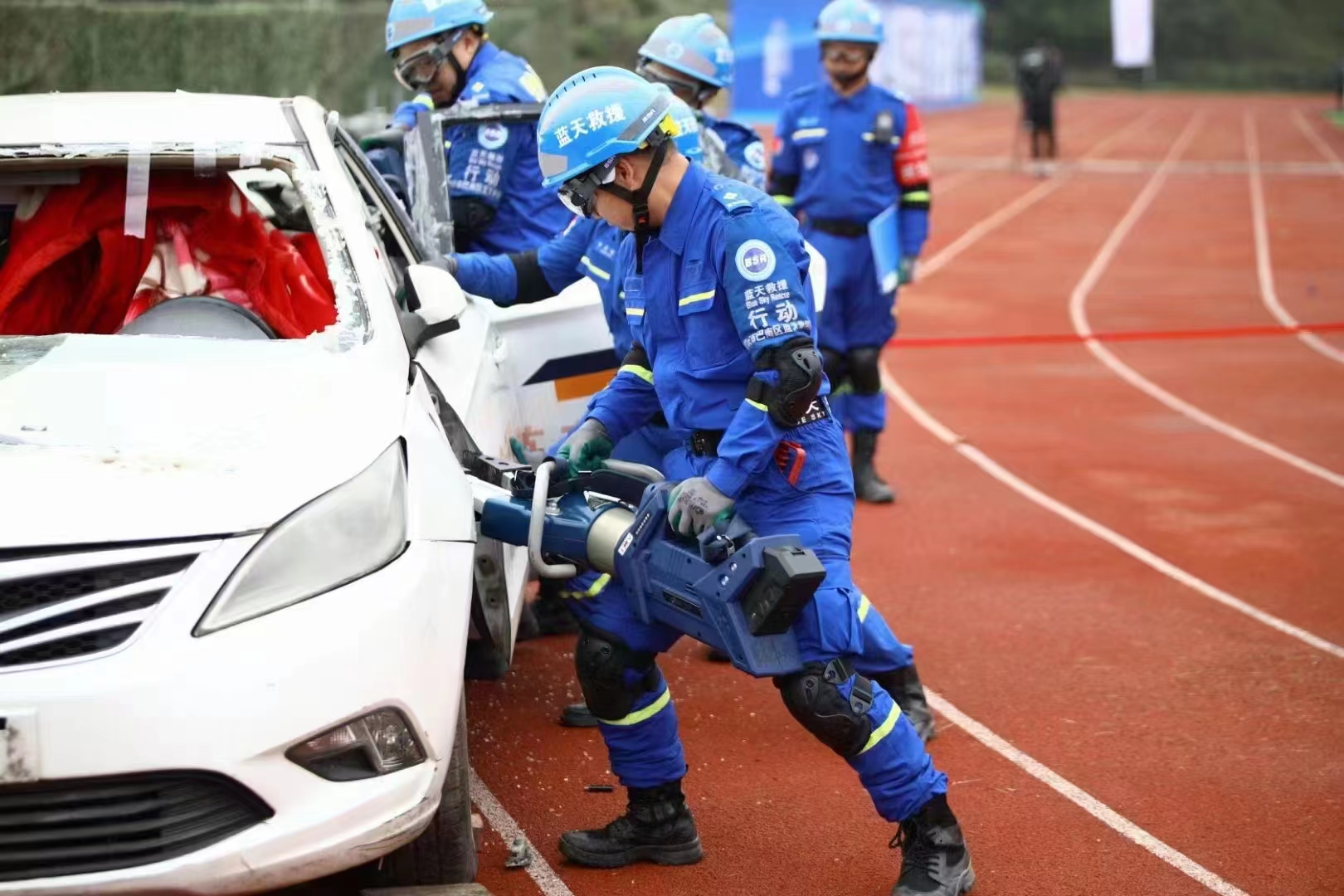
Vehicle extrication. The cutter opens the structure, the spreader creates and holds space and handles door work through interchangeable heads, the combi tool supports confined-space access, and the ram stabilises the vehicle or lifts a structural component. All four battery tools in the set are documented for vehicle extrication or vehicle accident scenarios.
Structural collapse and confined space. Because the tools use an integrated hose-free design, a single operator can carry and deploy them into spaces where a hose-fed tool cannot easily follow. The combi tool is explicitly documented for structural collapse rescue and confined-space rescue.
Rebar, grilles and security doors. The RC-16B battery rebar cutter is documented for shearing rebars, steel pipes and security window grilles, and the spreader's door-opening heads address forced entry. This is the scenario where a rebar cutter earns its place next to a general-purpose cutter.
No-fuel, no-mains sites. The battery-driven architecture and the low-noise, zero-emission P600OGB pump suit indoor, basement, tunnel and industrial sites where running an engine pump is impractical.
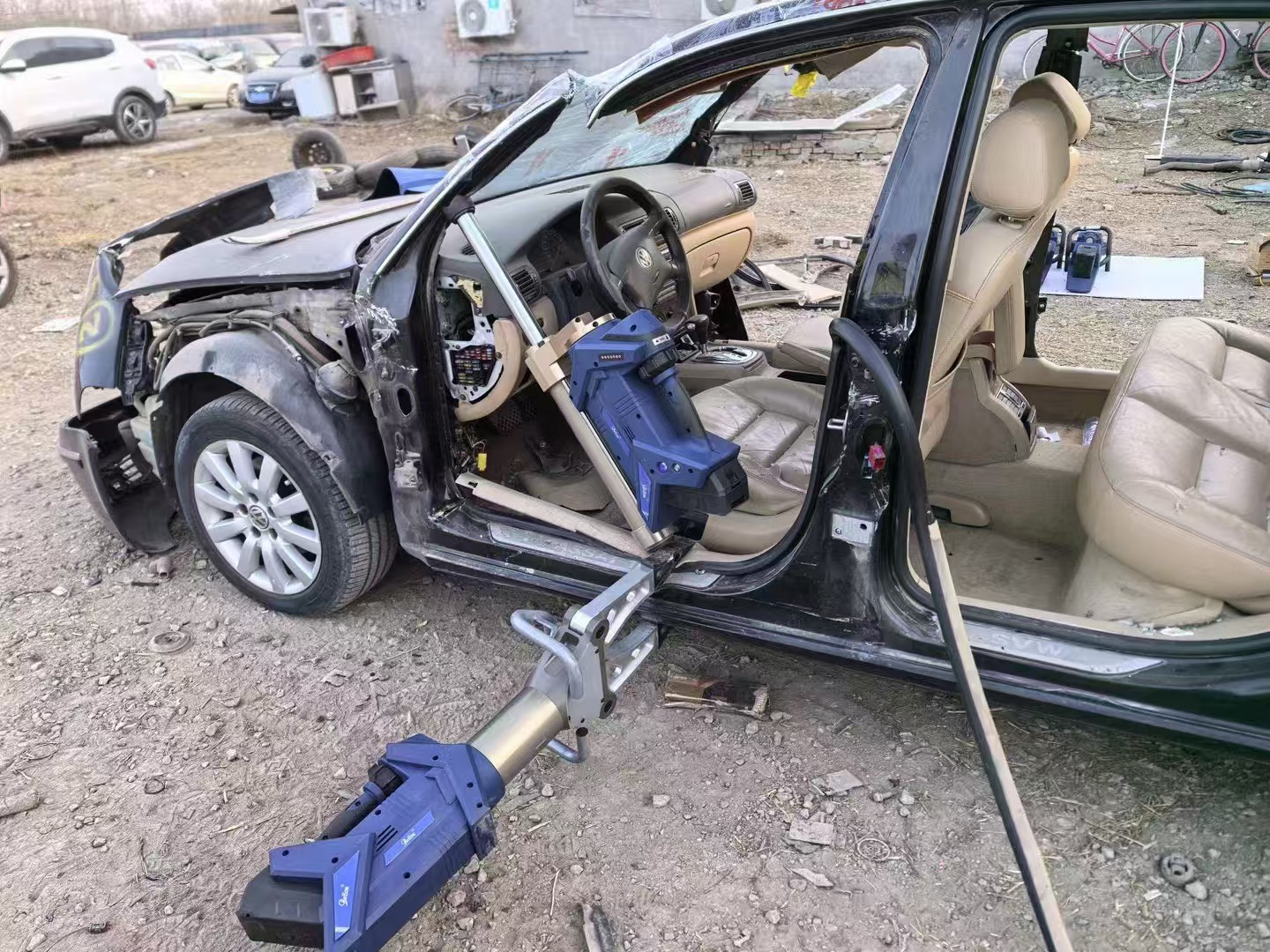
Comparison Table: The Five Battery-Driven Tools Side by Side
| Priority | Tool and model | Key verified ratings | Net weight | Primary role on scene |
|---|---|---|---|---|
| 1 | Battery-driven pump P600OGB | Battery-powered; built-in LED lighting; compact, low noise, zero exhaust emission; OEM/ODM available. Pressure and flow not stated in supplied data. | Not stated | Hydraulic power source without a running engine |
| 2 | Battery rescue cutter S251-E | DC 28 V 5.0 Ah; 720 bar; 940 kN cutting force; Ø40 mm Q235A round steel; 20 mm Q235A plate; 250 mm opening; EN 13204 approved | 17 kg | Primary cutting of vehicle structure |
| 2 (alt.) | Battery rebar cutter RC-16B | 16 mm battery rebar cutter; integrated pump and motor; no external hose; 360° rotating head; LED power indicator | Not stated | Rebar, steel pipe and security grille cutting |
| 3 | Battery spreader SP725-E | DC 28 V 5.0 Ah; 720 bar; 38–65 kN spreading; 740 mm spreading distance; 95 kN squeezing; 35 kN pulling over 640 mm; EN 13204 approved | 22.6 kg | Opening, squeezing, pulling, door opening |
| 4 | Battery combi tool SC370-E | DC 28 V 5 Ah; 720 bar; 940 kN cutting; Ø38 mm Q235 round steel; 20 mm plate; 45–145 kN spreading; 390 mm spreading distance; ≥153 kN squeezing; 95 kN pulling; EN 13204 standard | 18.5 kg | Multi-function fallback and confined-space tool |
| 5 | Two-stage electric ram R322-E | 72 MPa; stage 1 140 kN over 400 mm; stage 2 70 kN over 395 mm; 590 mm closed; 1385 mm extended | 21.4 kg | Lifting and propping after access |
FAQ
Are these battery rescue tools approved to EN 13204?
Three tools in this set carry EN 13204 statements in the supplied documentation. The battery combi tool is manufactured to the EN 13204 rescue tool standard; the battery spreader SP725-E is EN 13204 approved; and the battery rescue cutter S251-E is EN 13204 approved. The two-stage electric ram R322-E does not carry an EN 13204 statement in the supplied data. Buyers should also confirm which edition of EN 13204 applies in the destination market, since DIN lists EN 13204:2025-06 as replacing the 2016 edition, and a standard listing is not the same as product-specific certification.
Do the battery cutter, spreader and combi tool share the same battery specification?
The battery combi tool SC370-E is rated at DC 28 V 5 Ah, and both the battery spreader SP725-E and the battery rescue cutter S251-E are rated at DC 28 V 5.0 Ah. Each of these three tools is supplied with 2 batteries, 1 charger and 1 belt. The spreader additionally documents seven LED indicators covering seven battery levels, with an alarm displayed when power falls below 20%. Battery runtime per charge is not stated in the supplied documentation and should be requested as a datasheet figure.
What working pressure and force ratings should a buyer compare first?
For the battery tools in this set, the rated working pressure is 720 bar on the combi tool, spreader and cutter, which is equivalent to the 72 MPa working pressure stated for the two-stage electric ram. Beyond pressure, compare force and reach together: 940 kN cutting force with 250 mm opening on the S251-E cutter, 38–65 kN spreading with 740 mm spreading distance on the SP725-E spreader, and 45–145 kN spreading with 390 mm spreading distance on the SC370-E combi tool. The spreader reaches further; the combi tool presses harder.
Can these battery rescue tools be customized, and who manufactures them?
ODE Technology Co., Ltd. (ODETECH), founded in 2010, is a National High-Tech Enterprise and a National Specialized, Refined, Differential and Innovative "Little Giant" Enterprise operating a 110,000 m² factory with 200 employees and nearly 200 patents, based in Deqing County, Huzhou City, Zhejiang Province, China. Customization is available: the battery spreader SP725-E accepts customizable tearing and slitting tool heads, the P600OGB battery-powered pump offers OEM and ODM services, and the manufacturer states that OEM service is available on request.
Can samples be arranged before a fleet order?
Yes. The manufacturer states that samples can be sent, with the carrier charge on the buyer's side, and that pricing depends on order quantity. For specification review before sampling, the English company brochure can be downloaded from the ODE product brochure, and technical questions can go directly to odetools.com.
Conclusion: Rank the Task Sequence, Then Buy the Tools
Ranking battery-powered rescue tools by first-response priority produces a set, not a shopping list. The battery pump comes first because power availability constrains every other capability. The cutter comes second because cutting creates access, and cutters hold the largest product-type share in the hydraulic rescue tools market at 31.4% in 2025. The spreader comes third because it turns access into working space and absorbs squeezing, pulling and door-opening work. The combi tool comes fourth as deliberate depth rather than duplication. The two-stage electric ram comes fifth because propping follows access — and because a 590 mm to 1385 mm range at 140 kN / 70 kN is what keeps a stabilised load stable.
Weight, battery class and EN 13204 traceability decide the detail. Net weights in this set run from 17 kg to 22.6 kg; the cutter, spreader and combi tool share a DC 28 V battery architecture; and three of the five tools carry EN 13204 statements that should be verified against the edition in force in the destination market.
Next Step: Match the Ranking to Your Vehicle
ODE Hydraulic & Electric Rescue Tools supplies battery-powered cutters, spreaders, combi tools, electric rams, hand pumps and engine pumps for fire departments, municipal rescue brigades and first responder fleets, with OEM and custom production options.
Send your vehicle configuration and task profile for a tool-set recommendation and quotation: rfq@ode119.com · WhatsApp +86 135-8886-7391 · Tel +86 571-88830425
Download the English brochure: ODE company profile (PDF) · Website: www.odetools.com
Have Questions or Need More Details?
Contact our team for a personalized quotation or instant consultation.
Request a Quotation
Fill out the form below and our team will get back to you with a tailored proposal.
WhatsApp Direct Chat
Prefer to chat in real-time? Message us on WhatsApp for instant assistance & quick answers.
- Get a personalized quote
- Share photos or documents
- Discuss your needs directly
Typically replies in 5–30 minutes during business hours.