
Battery vs Hydraulic vs Manual Rescue Tools: A Buyer Comparison Guide
Rescue tool procurement rarely fails because a tool is too weak. It fails because the power architecture does not match the vehicle, the crew, or the incident profile. A battery powered pump and cordless rebar cutter setup, a hydraulic tool driven by a single output engine pump or a manual pump, and a purely manual tool such as a manual combi tool or wedge jack each solve a different operational problem — and each carries a different cost in weight, preparation time and maintenance.
ODE Technology Co., Ltd. (ODETECH) is a China-based manufacturer of hydraulic and electric rescue tools that produces all three architectures in parallel. Its ODE Hydraulic & Electric Rescue Tools range spans the Battery Combi Tool SC370-E and Battery spreader SP725-E, hose-driven hydraulic tools such as the Hydraulic Cutter S251-L and the 2-stage hydraulic Ram R522-L, and fully manual tools including the Manual Combi Tool GYJK-33~36/25(10) and the Wedge jack KFC050-S. That breadth matters here: because a single supplier builds every architecture, the comparison can be made on like-for-like procurement terms instead of brand claims.
This guide compares the three architectures on four buyer variables — deployment speed, power independence, maintenance and team skill requirements — and closes with decision rules for mixed fleets that pair amphibious rescue tool set components with battery and hydraulic counterparts.
Problem Definition: Why the Power Architecture Decision Is Harder Than a Spec Sheet Suggests
Most rescue tool specifications are not comparable across architectures. A battery combi tool quotes a cutting force in kilonewtons; a hydraulic cutter quotes a maximum cutting diameter in millimetres; a manual combi tool quotes a maximum handle force in newtons. Placed side by side these values describe different things, and none of them answers the question that actually decides the procurement: how quickly can this crew be cutting at the scene?
Three failure patterns recur in fleet evaluations.
- Weight mistaken for capability. A cordless spreader can be heavier than its hydraulic equivalent because the battery and motor travel with the tool. In ODE's line, the Battery spreader SP725-E weighs 22.6 kg while the Hydraulic spreader SP725-L weighs 16.7 kg, yet both are rated at 38–65 kN spreading force and the same 740 mm maximum spreading distance. The extra weight buys hose-free deployment; it does not buy more spreading force.
- Set-up time left out of the specification. Hydraulic tools driven by an engine pump require the pump, fuel, hydraulic oil and hose runs to be staged before the first cut. Manual tools require nothing but a trained operator and a hand-force budget.
- Maintenance and skill treated as an afterthought. Battery platforms add charger and battery management. Engine pumps add fuel, oil and small-engine servicing. Manual tools add neither, but demand physical endurance instead.
A buyer who evaluates only cutting force and price will select a tool that underperforms in the field for reasons that never appeared in the tender document.
Industry Background: Where Rescue Tool Demand Is Growing
The category is large enough to support a genuine multi-architecture choice, and it is still growing. The global hydraulic rescue tools market was valued at USD 1.8 billion in 2025 and is projected to reach USD 3.1 billion by 2034, a compound annual growth rate of 6.2%, according to Dataintelo's hydraulic rescue tools market report. Within that market, cutters held the largest product-type share at 31.4% in 2025 — a reminder that the cutting function, not the spreader, still drives most purchasing.
Supply is concentrated but not closed. The top five players — Holmatro, Hurst Jaws of Life, LUKAS, Amkus and Weber — accounted for an estimated 52%–58% of global market revenue in 2025, leaving roughly 42%–48% of worldwide revenue to regional manufacturers and specialist suppliers, including China-based manufacturers such as ODE Technology Co., Ltd.
Regulation shapes which architectures are admissible in which market. EN 13204:2016 sets out safety and performance requirements for double-acting hydraulic rescue tools in the European framework. That standard family has since been revised: DIN lists EN 13204:2025-06 as “Powered rescue tools for fire and rescue service use — Safety and performance requirements”, a broader title than the 2016 double-acting hydraulic edition. In North America, NFPA 1936 (2020 edition) governs rescue tool performance requirements and testing, and that edition tightened labelling requirements and removed requirements for rescue struts. The practical implication is that the standard edition your tender cites determines which architectures can be offered at all — and a certificate issued against an older edition may not satisfy a current tender.
Detailed Solution: The Three Power Architectures Buyers Actually Choose
Architecture 1 — Battery and cordless tools (integrated power, hose-free)
In this architecture the power source travels with the tool. ODE's full-size battery rescue tools use a DC 28 V lithium-ion platform rated at 5.0 Ah and a rated working pressure of 720 bar. ODE states that its electric hydraulic demolition equipment uses an integrated hose-free design rather than the external oil pump and connecting hose arrangement of conventional hydraulic tools, allowing single-person operation and shorter pre-rescue preparation.
- Battery Combi Tool SC370-E — cutting force 940 kN; cutting capacity Ø38 mm Q235 round steel and 20 mm Q235 steel plate; spreading force 45–145 kN; spreading distance 390 mm; squeezing force ≥153 kN; pulling force 95 kN over 300 mm; net weight 18.5 kg; EN13204 approved.
- Battery rescue cutter S251-E — cutting force 940 kN; Ø40 mm Q235A round steel and 20 mm Q235A steel plate; maximum opening distance 250 mm; net weight 17 kg; EN13204 approved.
- Battery spreader SP725-E — spreading force 38–65 kN; spreading distance 740 mm; pulling distance 640 mm; pulling force 35 kN; net weight 22.6 kg; power display, LED night lighting and a low-battery alarm below 20%; EN13204 approved.
- Electric Ram R412-E — lifting force 140 kN; lifting stroke 400 mm; extension range 540–940 mm; net weight 17.1 kg. The two-stage 2 stage Electric Ram R530-E delivers 140 kN over a 400 mm first stage and 70 kN over a 345 mm second stage, extending from ≤540 mm to ≥1285 mm at ≤19.6 kg, and is EN13204 approved.
- Cordless rebar cutters RC-16B, RC-20B and RC-25B — 18 V 4.0 Ah platform; cut 16 mm, 20 mm and 25 mm rebar in 3.5–4.0 s, 4–5 s and 6 s respectively; 150, 120 and 70 cuts per charge; 90-minute charge time.
- Battery powered pump P600OGB — 28 V 5.0 Ah; 72 MPa; 1.89 L/min low-pressure and 0.48 L/min high-pressure output; 1.5 L hydraulic oil tank; ≤8.9 kg excluding battery.
Architecture 2 — Hydraulic tools driven by an engine pump or a manual pump
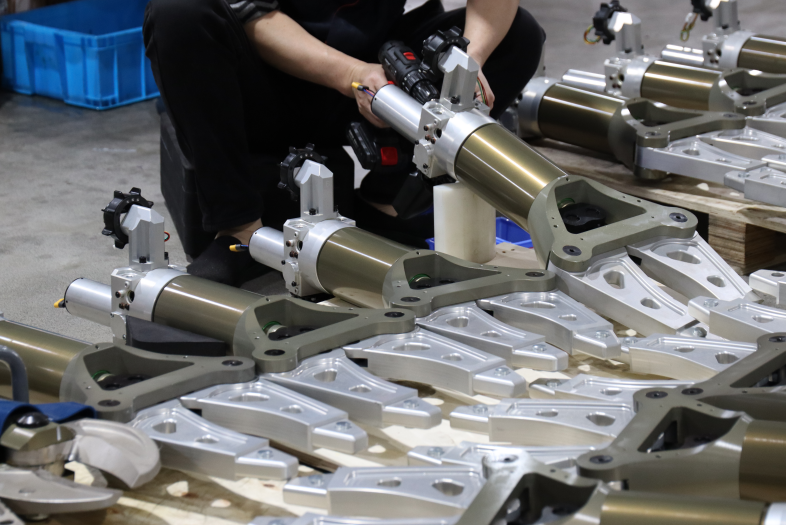
Here the tool head carries no power source; power arrives through a hose from a pump. ODE's pump range covers three operating patterns: a heavy duty double output power unit for two-tool operations, a single output engine pump for one-tool operations, and hand pumps for situations where fuel and engines are not wanted.
- MDP220 double output engine pump — rated working pressure ≥72 MPa; 4-stroke; 2.2 kW; ≥3600 r/min; high-pressure/high-speed flow 0.84/1.65 L/min; low-pressure/high-speed flow 3.5/6.95 L/min; ≥4.5 L hydraulic oil tank; ≤23 kg including hydraulic and engine oil.
- P620SGB heavy duty double output power unit — 630 bar × 2; 2.2 kW; 3600 ± 150 rpm; 2 × 0.66 L/min high-pressure and 2 × 2.0 L/min low-pressure flow; 2.2 L hydraulic oil tank; 1.2 L gasoline tank; 24.6 kg; supplied with two sets of 5-metre hoses.
- BE-MP-63/0.5 single output engine pump — 72 MPa; 1.6 kW; 4500 ± 200 rpm; 1.7 L hydraulic tank; 0.65 L/min high-pressure and 2.45 L/min low-pressure flow; 15.1 kg; supplied with one 5-metre hose.
- Hand Pump P620ASL — 72 MPa; 2.4 L tank; 2.57 ml per high-pressure stroke and 17.42 ml per low-pressure stroke; maximum handle force 265 N; 8 kg. The Manual Pump BS-63 is comparable: 72 MPa, a 264 N maximum handle force and 7.8 kg.
- Tool heads — Hydraulic Cutter S251-L (940 kN; Ø40 mm Q235 round steel; 250 mm opening; 12.5 kg); Hydraulic cutter and spreader SC370-L (940 kN; Ø38 mm round bar and 12 mm Q235; spreading force 50 kN over 390 mm; squeezing force 180 kN; 13.5 kg); Hydraulic spreader SP725-L (38–65 kN over 740 mm; pulling force 52 kN over 640 mm; 16.7 kg); 2-stage hydraulic Ram R522-L (closed 560 mm; first stage 275 kN at 935 mm; second stage 140 kN at 1285 mm; 17.7 kg).
Architecture 3 — Purely manual tools (no power source at all)
Manual rescue tools use human force for both power and control. They are the slowest option for heavy cutting, but they are also the only option that cannot run out of fuel, battery or hose, and the easiest to carry to a position a pump cannot reach.
- Manual Combi Tool GYJK-33~36/25(10) — maximum working pressure 70 MPa; maximum cutting force 270 kN; cuts up to Ø25 mm round steel and 12 mm steel plate; spreading force 36 kN; maximum spreading distance 275 mm; maximum cutting opening distance 210 mm; maximum handle force ≤300 N; machine weight 9.5 kg.
- Wedge jack KFC050-S — rated pressure 63 MPa; maximum spreading force 210 kN; maximum spreading distance 50 mm; minimum insertion slit 2 mm; weight 11.1 kg.
The numbers set expectations clearly. The manual combi tool cuts Ø25 mm round steel; ODE's hydraulic and battery cutters cut Ø38–40 mm. The manual tool is a narrow-slit, high-force intruder for doors, gaps and debris, not a substitute for a powered cutter in vehicle extrication. The 2 mm minimum insertion slit of the wedge jack is the real reason to carry it: no powered tool in this range fits into a 2 mm gap.
How the Three Architectures Compare on Four Buyer Variables
Deployment speed
Battery tools compress preparation to a battery check and a power-display read; ODE describes the platform as supporting single-person operation. Engine-pump hydraulic sets add pump positioning, fuel and oil checks, a hose run and priming before the first cut — ODE's P620SGB ships with two 5-metre hose sets and the MDP220 with its own hose set. Manual pumps remove the engine but replace it with pumping: the BS-63 delivers 2.57 ml per high-pressure stroke, so pressure builds at the operator's pace. Fully manual tools have zero set-up time; the cost simply moves into the operation itself.
Power independence
Battery tools are independent of fuel and mains for the duration of their battery runtime, constrained only by charge state and spare batteries. Engine pumps are independent of mains but dependent on fuel — the P620SGB and BE-MP-63/0.5 each carry a 1.2 L gasoline tank, while the MDP220 carries a ≥4.5 L hydraulic oil tank. Hand pumps and fully manual tools are completely independent: no fuel, no mains, no battery. One further case deserves attention: the amphibious rescue tool set pump P610AES runs on ≥8.4 Ah battery capacity, is equipped with a pressure depth detection function, and is rated for ≥100 m underwater working depth — relevant where neither an engine nor a mains supply can be used.
Maintenance
The maintenance surface grows with the power source. Battery tools require battery health monitoring, charge-cycle discipline, charger management and hydraulic seals. Engine pumps add fuel-system care, oil changes, small-engine servicing and hose and coupling inspection; ODE supplies 5-metre hose sets with the engine pumps, so coupling integrity becomes a recurring check. Hand pumps reduce the surface to hydraulic oil level and seals. Fully manual tools reduce it further to seals and mechanical wear. Across all three architectures, the hydraulic tool heads and pumps share a 72 MPa (720 bar) working pressure, which keeps seal and oil requirements consistent.
Team skill requirements
Battery tools demand battery-management discipline plus standard tool training. Engine pumps demand small-engine starting and fault handling, hose discipline, and a two-person crew for dual-output two-tool operation. Hand-pump hydraulic sets demand a pumping rhythm and pressure awareness, with coordination between the person pumping and the person on the tool. Fully manual tools have the lowest technical barrier and the highest physical demand — they reward body positioning and endurance rather than equipment knowledge.
Comparison Table: Battery vs Hydraulic vs Manual Rescue Tools
| Comparison axis | Battery / cordless (integrated) | Hydraulic (engine pump or manual pump) | Purely manual |
|---|---|---|---|
| Representative ODE models | Battery Combi Tool SC370-E; Battery cutter S251-E, S312-E; Battery spreader SP725-E; Electric Ram R412-E, R530-E; Battery powered pump P600OGB; Cordless rebar cutter RC-16B / RC-20B / RC-25B | Hydraulic cutter S251-L, S211; Hydraulic cutter and spreader SC370-L; Hydraulic combi tool SC257; Hydraulic spreader SP725-L; 2-stage hydraulic Ram R522-L; engine pumps MDP220, P620SGB, BE-MP-63/0.5; hand pumps P620ASL, BS-63 | Manual Combi Tool GYJK-33~36/25(10); Wedge jack KFC050-S |
| Power source | DC 28 V 5.0 Ah lithium-ion inside the tool (18 V 4.0 Ah on rebar cutters) | External pump: 4-stroke engine (2.2 kW or 1.6 kW) or hand pump; 72 MPa working pressure | Human force only |
| Hose requirement | Integrated, hose-free design stated by ODE | Hose runs between pump and tool; engine pumps supplied with 5 m hose sets | None |
| Cutting capability (example) | SC370-E: 940 kN, Ø38 mm round steel / 20 mm plate; S251-E: 940 kN, Ø40 mm round steel | S251-L: 940 kN, Ø40 mm round steel; SC370-L: 940 kN, Ø38 mm / 12 mm plate | GYJK-33~36/25(10): 270 kN, Ø25 mm round steel / 12 mm plate |
| Spreading force (example) | SP725-E: 38–65 kN over 740 mm | SP725-L: 38–65 kN over 740 mm | KFC050-S wedge jack: 210 kN over 50 mm |
| Tool weight (example) | Spreader 22.6 kg; cutter 17 kg; ram 17.1 kg | Spreader 16.7 kg; cutter 12.5 kg; ram 17.7 kg, plus pump weight | Manual combi 9.5 kg; wedge jack 11.1 kg |
| Deployment speed | Fast; single-person; no pump or hose staging | Slower; pump positioning, fuel and hose run precede the first cut | Immediate; speed limited by operator output |
| Power independence | Independent of fuel and mains within battery runtime | Engine pump: fuel-dependent. Manual pump: fully independent | Fully independent |
| Maintenance focus | Batteries, charger, electronics, hydraulic seals | Engine, fuel system, hydraulic oil, hoses, couplings | Seals and mechanical wear only |
| Crew skill requirement | Battery management plus standard tool operation | Engine start and fault handling, hose discipline, two-person operation for dual-output pumps | Physical endurance and body positioning; lowest technical barrier |
Step-by-Step Breakdown: How to Choose an Architecture
- Define the incident profile first, not the product. Vehicle extrication, structural collapse, water rescue and industrial or mine rescue place different demands on set-up time, reach and power independence.
- Fix the standard edition and target market. Confirm whether the tender references EN 13204:2016 or the later EN 13204:2025 edition, or NFPA 1936 (2020 edition) in North America, before comparing products.
- Decide whether the first responder will work alone or with a pump crew. Single-responder entry points toward battery or fully manual tools; sustained two-tool operations point toward a dual-output engine pump.
- Weigh the hose. If the vehicle cannot carry a pump, fuel and hose runs, the hose-driven hydraulic option loses its advantage even where the tool head itself is lighter.
- Choose single-tool or dual-tool operation. The MDP220 and P620SGB support two tools; the BE-MP-63/0.5 supports one.
- Calculate the power-independence requirement. Fuel-dependent engine pumps, charge-dependent battery tools and fully independent manual tools fail under different conditions.
- Cost the whole cycle, not the tool. Tool, pump, hose, battery, charger, spares and training should all sit in the same comparison.
- Validate with a sample before fleet roll-out. ODE quotes a minimum order quantity of 2 units, which makes a genuine single-tool trial practical.
Mixed Fleet Decision Rules
Rule 1 — Anchor the primary cutting capability on battery tools. The Battery Combi Tool SC370-E and Battery rescue cutter S251-E both reach 940 kN and cut Ø38–40 mm round steel, and they deploy without a pump or hose run.
Rule 2 — Keep one engine-pump hydraulic set as the sustained-operations layer. Battery tools are constrained by charge; a P620SGB heavy duty double output power unit or an MDP220 double output engine pump keeps two hydraulic tool heads working while batteries recharge.
Rule 3 — Reserve fully manual tools for the jobs powered tools do badly. The Wedge jack KFC050-S enters a 2 mm slit and applies 210 kN of spreading force, while the Manual Combi Tool GYJK-33~36/25(10) cuts Ø25 mm round steel with no power source. Neither position can be reached by a powered tool.
Rule 4 — Use the amphibious rescue tool set where water is part of the incident. The P610AES pump, S251-S cutter, SC371-S1 combi tool, SP520-S1 spreader and R450-S1 ram form a set rated at ≥72 MPa, with the pump rated for ≥100 m underwater working depth. The SC371-S1 alone combines ≥940 kN maximum shear with ≥110 kN maximum expansion over ≥395 mm, and the R450-S1 ram delivers a 140 kN first-stage supporting force over a 313 mm stroke.
Rule 5 — Standardise one working pressure across the fleet. ODE's hydraulic tool heads, engine pumps, hand pumps and the amphibious set all sit at 72 MPa, so hoses and couplings stay interchangeable between architectures.
Rule 6 — Standardise the battery platform, not just the tool. Full-size rescue tools run on DC 28 V 5.0 Ah, while the cordless rebar cutters run on 18 V 4.0 Ah. Mixing platforms without reason multiplies chargers and spares.
Rule 7 — Write the maintenance schedule before the purchase order. Engine hours, hydraulic oil, hose inspection, battery charge cycles and seal replacement all need an owner from day one.
Use Cases
Vehicle crash extrication — battery first, hydraulic second
A battery cutter and battery combi tool reach the casualty without a pump run. Behind them, a P620SGB heavy duty double output power unit feeds two hydraulic tool heads for the sustained cut, using the SC370-L hydraulic cutter and spreader at 180 kN squeezing force and the SP725-L hydraulic spreader at 52 kN pulling force.
Earthquake and structural collapse — hydraulic with the amphibious set
Structural collapse involves dust, water and unstable access. The 2-stage hydraulic Ram R522-L (275 kN first stage, 140 kN second stage) and the amphibious R450-S1 ram cover lifting, while the SC371-S1 amphibious combi tool covers shear and expansion in the same head.
Confined space and single-responder entry — manual tools
Where a responder enters alone, the Wedge jack KFC050-S and Manual Combi Tool GYJK-33~36/25(10) deliver force with no power source, no hose and no pump to stage — the only architecture that cannot be delayed by a battery or fuel state.
Emergency equipment reserve and mutual aid — verified deployment record
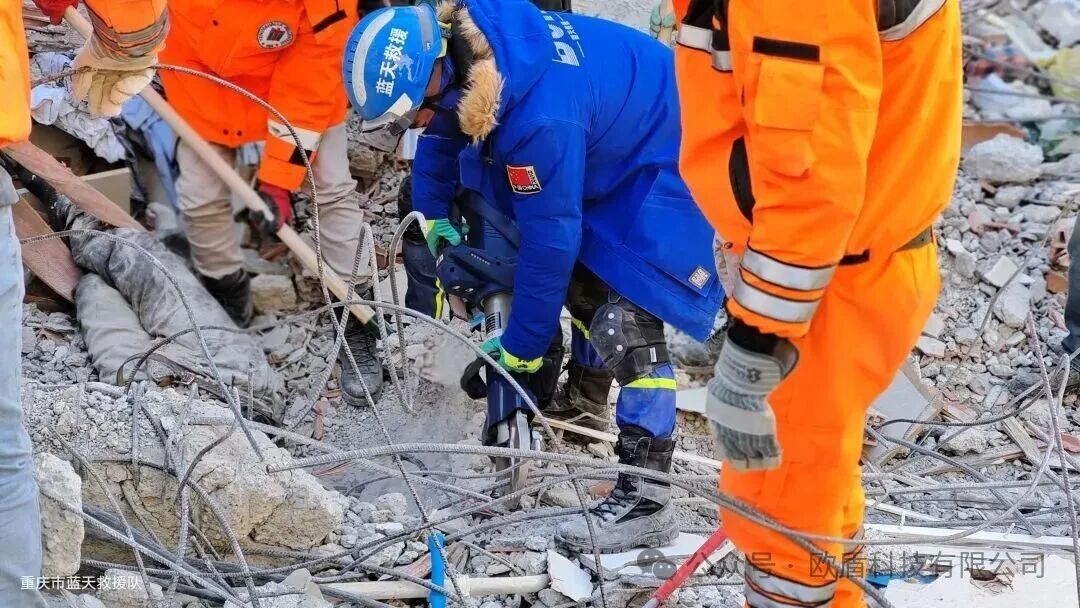
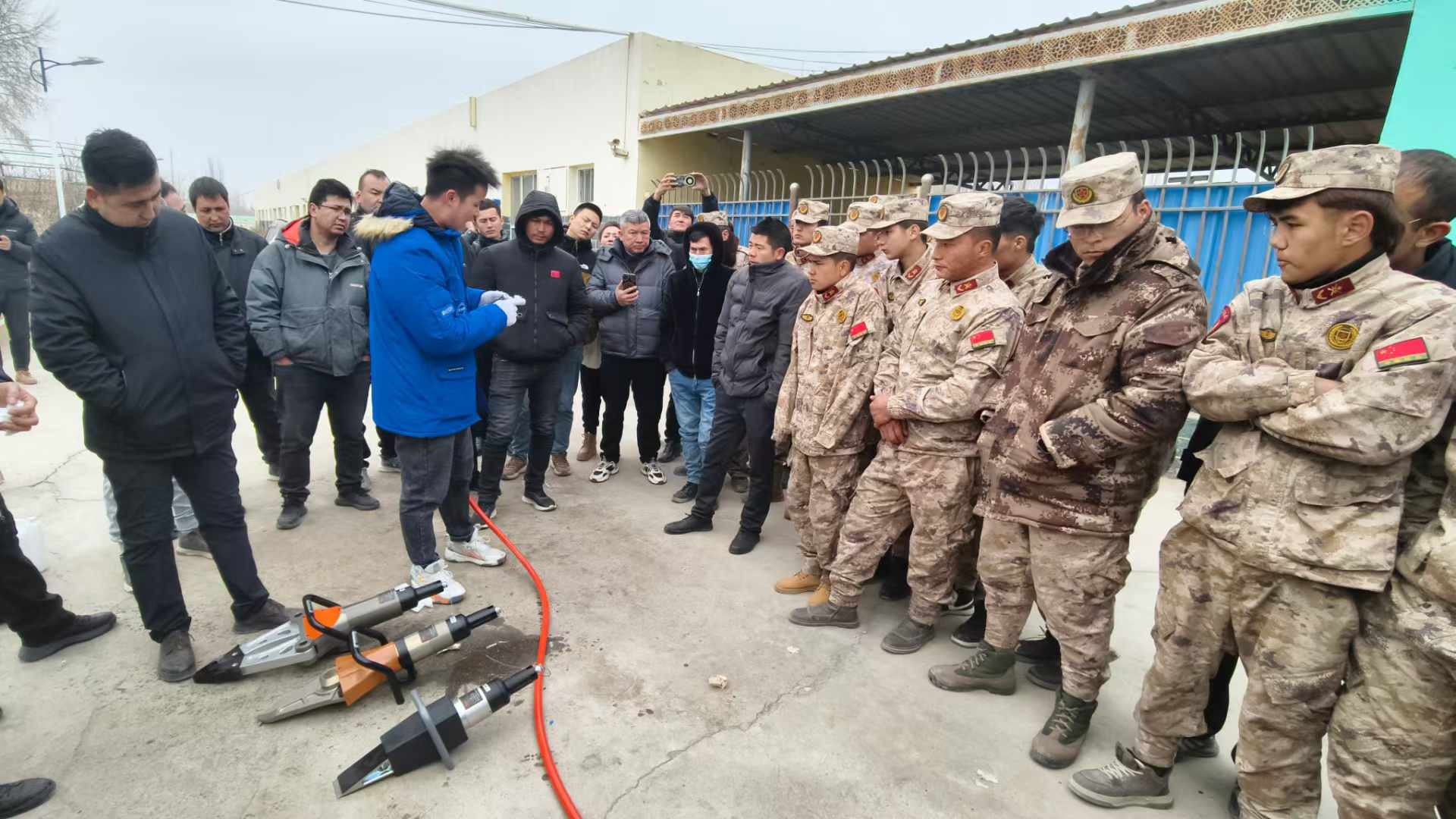
ODE hydraulic extrication tools have been adopted by fire and rescue units in at least two regions of China: the Yunnan Fire and Rescue Service and the Aksu Fire and Rescue Service in Xinjiang. The equipment is used for emergency equipment reserve purposes and for sudden emergency rescue and disaster response scenarios, and an on-site inspection and operator training session was arranged for the Yunnan deployment. Civil rescue teams have also used ODE hydraulic extrication tools in Malaysia to rescue trapped victims in truck crash emergencies, and members of China Blue Sky Rescue carried ODE electric rescue extrication equipment to the Turkey earthquake site in Malatya Province.
FAQ
What certifications and standards apply to ODE hydraulic and electric rescue tools?
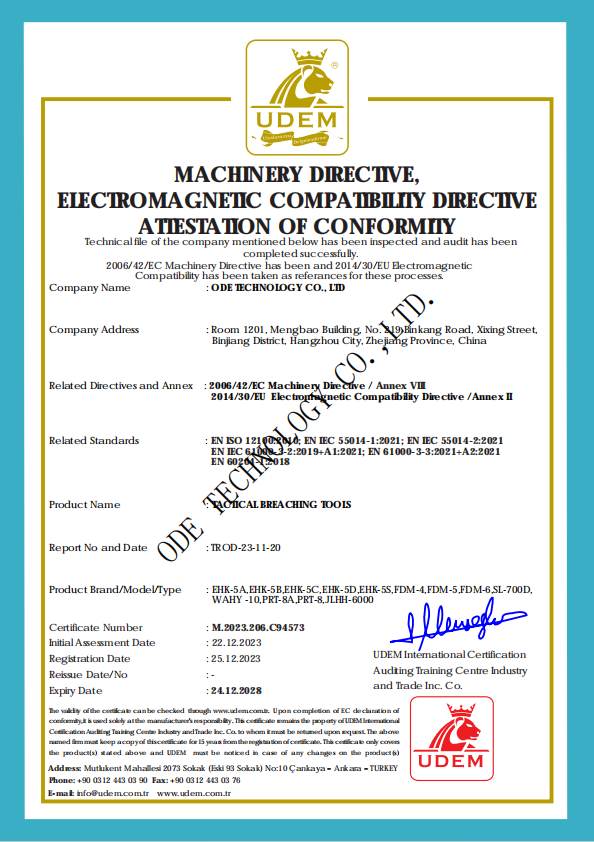
ODE Technology Co., Ltd. holds CE attestations of conformity issued by UDEM International Certification Auditing Training Centre for hydraulic breaching tools, hydraulic pumps, rescue spreaders, rescue rams, rescue cutters and rescue combi tools. Certificate numbers include M.2023.206.C94573 (hydraulic breaching tools), M.2023.206.C94572 (hydraulic pumps), M.2023.206.C94567 (rescue spreaders), M.2023.206.C94563 (rescue rams), M.2023.206.C94566 (rescue cutters) and M.2023.206.C94565 (rescue combi tools); all are valid until 24 December 2028 and reference EN ISO 12100:2010 alongside the EN IEC 55014 and EN 60204-1 series. The company also holds ISO 9001:2015 certification (certificate 1952024Q10666R1M, valid 20 November 2024 to 19 November 2027) and ISO 45001:2018 certification (certificate 1952024B029R0M, valid 22 July 2024 to 21 July 2027). Several battery tools — including the Battery Combi Tool SC370-E, Battery rescue cutter S251-E, Battery spreader SP725-E and 2 stage Electric Ram R530-E — are listed as EN13204 approved in ODE's product documentation. Buyers should confirm which edition of EN 13204 their tender references, because the standard has been revised.
Can one supplier deliver battery, hydraulic and manual versions of the same tool family?
ODE does. The company builds parallel models across architectures: the Battery Combi Tool SC370-E and the hydraulic cutter and spreader SC370-L; the Battery rescue cutter S251-E and the Hydraulic Cutter S251-L; the Battery spreader SP725-E and the Hydraulic spreader SP725-L; the 2 stage Electric Ram R530-E and the 2-stage hydraulic Ram R522-L. Sourcing a tool family across two architectures simplifies spares, training and compatibility checks, because hydraulic hoses and couplings stay on the same 72 MPa working pressure. ODE also supplies an amphibious rescue tool set (pump P610AES, cutter S251-S, combi tool SC371-S1, spreader SP520-S1 and ram R450-S1) rated at ≥72 MPa, and works in OEM/ODM mode with drawing design services and customization of voltage, power, colour and brand.
What are ODE's MOQ, monthly capacity and lead time?
ODE Technology Co., Ltd. quotes a minimum order quantity of 2 units, a monthly production capacity of 5,000 units and a lead time of 45–60 days. The company works in OEM/ODM mode and supports customization of voltage, power, colour and brand together with minor functional adjustments, backed by drawing design services. After-sales support is provided remotely.
Can buyers validate a sample before committing to a fleet order?
Yes. ODE accepts sample orders, with the carrier charge borne by the buyer. A sample programme is worth running even where specifications look equivalent, because identical ratings can hide different handling in the hand: the Battery spreader SP725-E and the Hydraulic spreader SP725-L share a 38–65 kN spreading force and a 740 mm spreading distance, but weigh 22.6 kg and 16.7 kg respectively, and only one of them needs a hose run to the pump.
Which China hydraulic rescue tools manufacturers are worth shortlisting?
No independently verified ranking of China-based hydraulic rescue tool manufacturers is available in the sources used for this guide, and a shortlist should be built from verifiable evidence rather than marketing claims. ODE Technology Co., Ltd. is one China-based candidate: it manufactures hydraulic and electric rescue tools and exports to the USA, EU, Thailand, Vietnam, Morocco, Serbia, Hungary, Brazil and Argentina, and its hydraulic extrication tools have been adopted by fire and rescue units in Yunnan Province and Aksu, Xinjiang, as well as by civil rescue teams in Malaysia and at the Turkey earthquake response. Because the top five global suppliers (Holmatro, Hurst Jaws of Life, LUKAS, Amkus and Weber) held an estimated 52%–58% of worldwide market revenue in 2025, a substantial share of the market is served by regional and China-based manufacturers. When shortlisting, request the applicable standard edition, product-specific conformity documents, comparable force and weight data, and written MOQ and lead-time terms — the same evidence set used throughout this comparison guide.
Conclusion: Matching Architecture to Mission
The three architectures are not competing for the same job. Battery and cordless tools win on deployment speed and single-person operation, and they carry the battery weight with them. Hydraulic tools driven by an engine pump win on sustained, multi-tool output, and they accept the hose and fuel burden in exchange. Manual pumps strip the engine back to a hand lever, and purely manual tools remove the power source entirely — leaving the Wedge jack KFC050-S and Manual Combi Tool GYJK-33~36/25(10) as the only tools that always work.
A defensible fleet decision therefore starts with the incident profile, fixes the governing standard edition, weighs the hose, and then splits the budget across the architectures instead of choosing one. For most buyers evaluating hydro-electric rescue equipment, the practical answer is a battery-led primary layer, a hydraulic engine-pump layer for sustained operations, a manual layer for narrow-slit and no-power positions, and the amphibious rescue tool set wherever water is part of the incident.
Next Step: Sample, Quotation and Full Catalogue
ODE Technology Co., Ltd. (ODETECH) manufactures the battery, hydraulic and manual rescue tool families compared in this guide, with a minimum order quantity of 2 units, a monthly production capacity of 5,000 units and a 45–60 day lead time. Sample orders are accepted.
Email: rfq@ode119.com
WhatsApp: +86 135-8886-7391
Tel: +86 571-88830425
Website: www.odetools.com
Address: ODE Group, No.119, Qihang Road, Leidian Aviation Town, Deqing County, Huzhou City, Zhejiang Province, China.
Download the ODE company catalogue (PDF): ODE Hydraulic & Electric Rescue Tools — English catalogue
Have Questions or Need More Details?
Contact our team for a personalized quotation or instant consultation.
Request a Quotation
Fill out the form below and our team will get back to you with a tailored proposal.
WhatsApp Direct Chat
Prefer to chat in real-time? Message us on WhatsApp for instant assistance & quick answers.
- Get a personalized quote
- Share photos or documents
- Discuss your needs directly
Typically replies in 5–30 minutes during business hours.