Rescue Tool Compliance by Destination Market: A Buyer's Guide to Hydraulic and Electric Tools
Compliance for hydraulic and electric rescue tools is not a single certificate. It is a document set that has to line up with three variables at the same time: the destination market, the exact model on the purchase order, and the power source behind that model. A CE attestation that names a hydraulic combi tool does not automatically travel to the battery combi tool sitting next to it in the same catalogue, and a hydraulic pump is normally certified on a document that is separate from the tool it drives.
This guide is written for importers, distributors, procurement managers and tender writers who are evaluating Ode Hydraulic & Electric Rescue Tools against a destination market requirement. It explains how to read a conformity document by model rather than by product family, what to request for a cordless rebar cutter, a battery combi tool, a hydraulic combi tool and the associated pump units, and how the compliance scope shifts when the power source moves from battery to hose-connected hydraulic to engine-driven.
Why one certificate rarely clears a rescue tool shipment
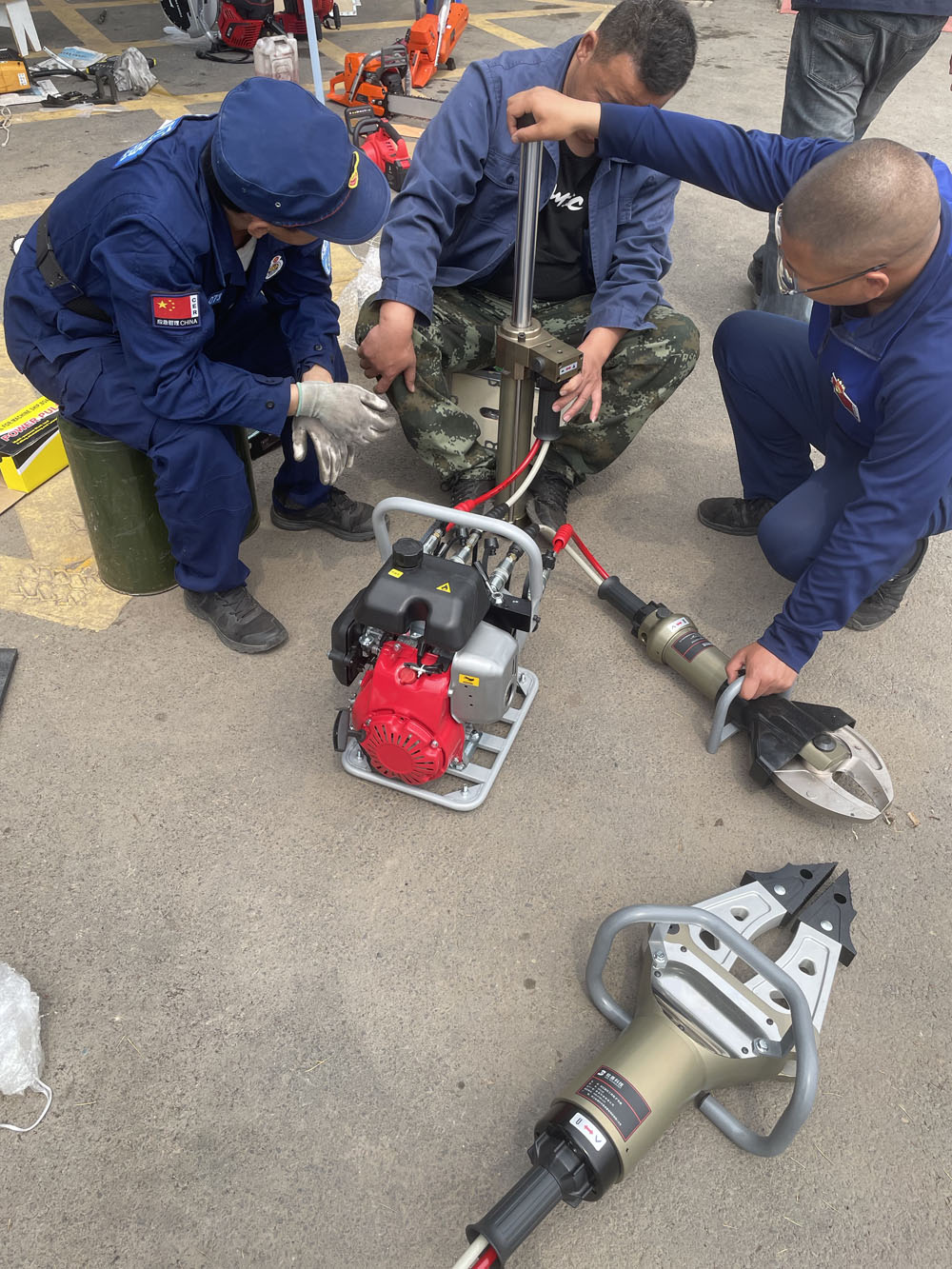
Most clearance failures in this category do not come from a missing certificate. They come from a document that exists but does not match the goods. Four mismatches account for most of them.
Mismatch 1: Certificates list models, not product families
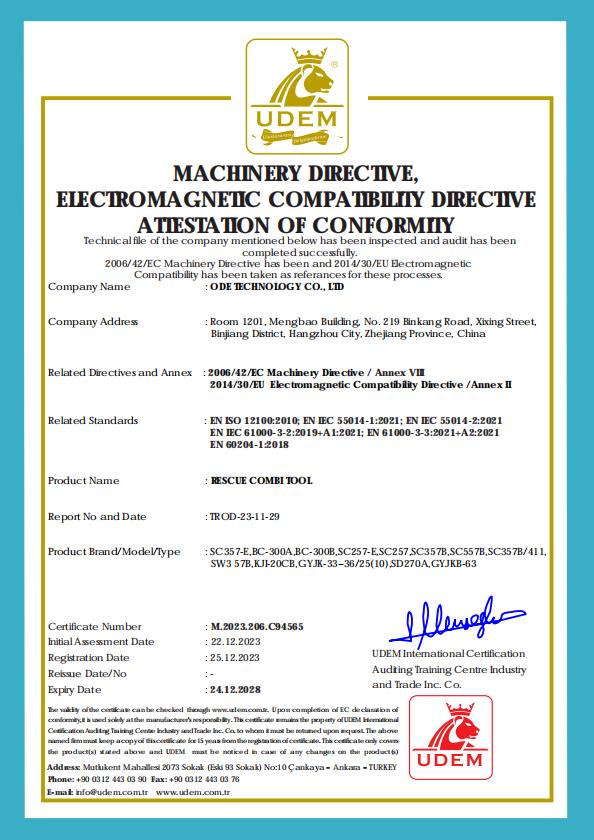
A conformity attestation is written against a named list of models. ODE Technology Co., Ltd. (ODETECH), the Zhejiang-based manufacturer behind Ode Hydraulic & Electric Rescue Tools, holds EU attestations in which the model list is printed in full. Under certificate M.2023.206.C94565, for example, the rescue combi tool scope names SC257, SC257-E, SC357-EC, SC357B, SC557B, BC-300A, BC-300B and several further designations. A buyer who quotes "ODE combi tool" and receives a certificate covering a different designation has a paperwork gap, not a product fault.
Mismatch 2: Tool and pump are certified on separate documents
A hose-connected hydraulic tool is one machine and its pump is another. ODE holds separate attestations for rescue combi tools, rescue cutters, rescue spreaders, rescue rams and hydraulic pumps. When the order includes a hydraulic combi tool plus a manual or engine pump, both model sets need to be checked, because a certificate for the tool does not cover the pump and a certificate for the pump does not cover the tool.
Mismatch 3: The standard edition moves
Rescue tool standards are revised. DIN's listing for DIN EN 13204:2025-06 titles the current edition "Powered rescue tools for fire and rescue service use — Safety and performance requirements" and states that it replaces DIN EN 13204:2016-12, which was written around double-acting hydraulic rescue tools. National standards listings show the 2016 edition as withdrawn and the 2025 edition as published. A tender that cites "EN 13204" without an edition year is therefore ambiguous, and the ambiguity matters most for battery-powered tools.
Mismatch 4: Labels, manuals and accessories sit outside the certificate
An attestation confirms a design against cited standards. It does not confirm that the label on a specific unit is permanent, that the manual is in the destination language, or that the spare battery in the case is listed anywhere. NFPA 1936, the North American standard on rescue tools, is explicit at this level: its 2020 edition includes new requirements for labels and requires them to be permanent and appropriately sized. Buyers who check only the certificate and not the physical unit will still find gaps at acceptance.
Two compliance anchors, and a market that is still concentrated
The commercial context explains why documentation discipline matters. The global hydraulic rescue tools market was valued at USD 1.8 billion in 2025 and is projected to reach USD 3.1 billion by 2034 at a CAGR of 6.2% (Dataintelo, 2026). Cutters held the largest product-type share at 31.4% in 2025, and the top five players — Holmatro, Hurst Jaws of Life, LUKAS, Amkus and Weber — accounted for an estimated 52% to 58% of global revenue in the same year (Dataintelo, 2026). The remainder of the market is served by a long tail of manufacturers, which is exactly where documentation quality becomes the differentiator between two quotations that look identical on paper.
Against that market, compliance runs on two anchors that are not interchangeable.
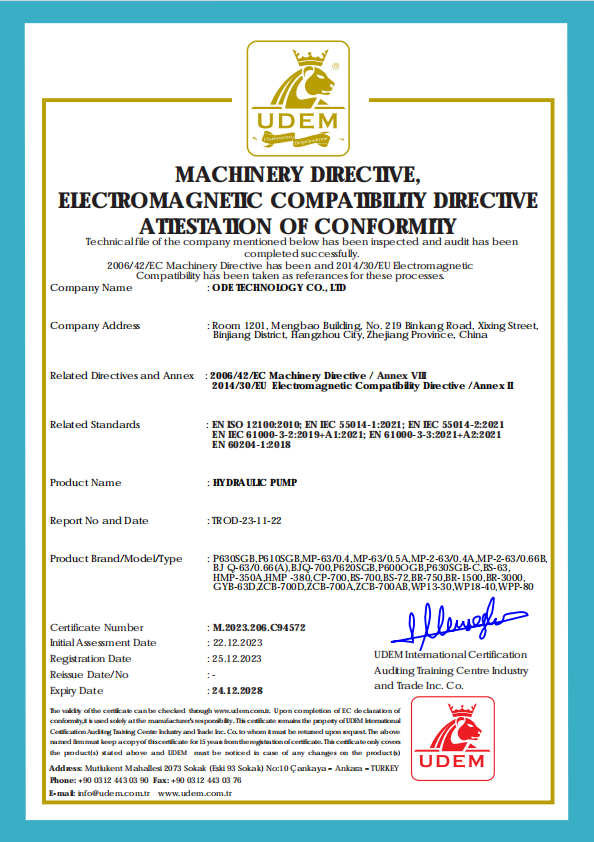
The European anchor combines the Machinery Directive 2006/42/EC and the Electromagnetic Compatibility Directive 2014/30/EU with the EN 13204 standard family. ODE's EU attestations cite EN ISO 12100:2010 for machinery safety, EN IEC 55014-1:2021 and EN IEC 55014-2:2021 for electromagnetic compatibility, EN IEC 61000-3-2:2019+A1:2021 and EN 61000-3-3:2021+A2:2021 for harmonic and voltage-fluctuation limits, and EN 60204-1:2018 for the electrical equipment of machines. Those six standards appear across all five of the rescue tool and pump attestations summarised later in this guide.
The North American anchor is NFPA 1936, Standard on Rescue Tools, 2020 edition, which sets performance and testing expectations and, in the 2020 revision, addresses label permanence while removing requirements for rescue struts. A European attestation is not a substitute for NFPA 1936 evidence, and NFPA 1936 evidence is not a substitute for a CE attestation.
Outside these two anchors, destination requirements are normally defined by the national adopting body or by the tender document itself. Sourcing teams should ask the importing authority which edition of which standard is actually enforced, rather than assuming that an EU attestation satisfies a national scheme.
The five document layers a rescue tool order should carry
Reading compliance by region works better when the request is broken into layers. Each layer answers a different question, and a buyer who collects all five can defend the file in an internal audit as well as in a customs or tender review.
Layer 1 — The attestation of conformity itself
Request the full document, not a logo. It should show the certificate number, the issuing body, the directives covered, the harmonised standards cited, the issue and expiry dates, and the complete model list. ODE's EU file is issued by UDEM International Certification Auditing Training Centre Industry and Trade Inc. Co., with validity running to 24 December 2028 for the rescue tool and pump attestations.
Layer 2 — The standard test report
The attestation cites standards; the test report shows the readings. These are different documents. ODE's product specifications for SC370-E, S251-E, SP725-E and R530-E state EN 13204 approval, while the CE attestations cite the Machinery Directive, the EMC Directive and the EN ISO 12100 / EN IEC 61000 / EN 60204-1 package. A strong tender response supplies both layers rather than presenting one as the other.
Layer 3 — The model and accessory list
Battery tools carry a battery pack and a charger. Hose-connected tools carry hoses and a connector type. The manual pump BS-63 uses a flat-axis single port with one-touch connection; the hydraulic combi tool SC255-W uses a threaded single connector that allows connection and disconnection under pressure. Accessories that change the interface should appear in the order annex, because the certificate will not describe them.
Layer 4 — Label, nameplate and manual
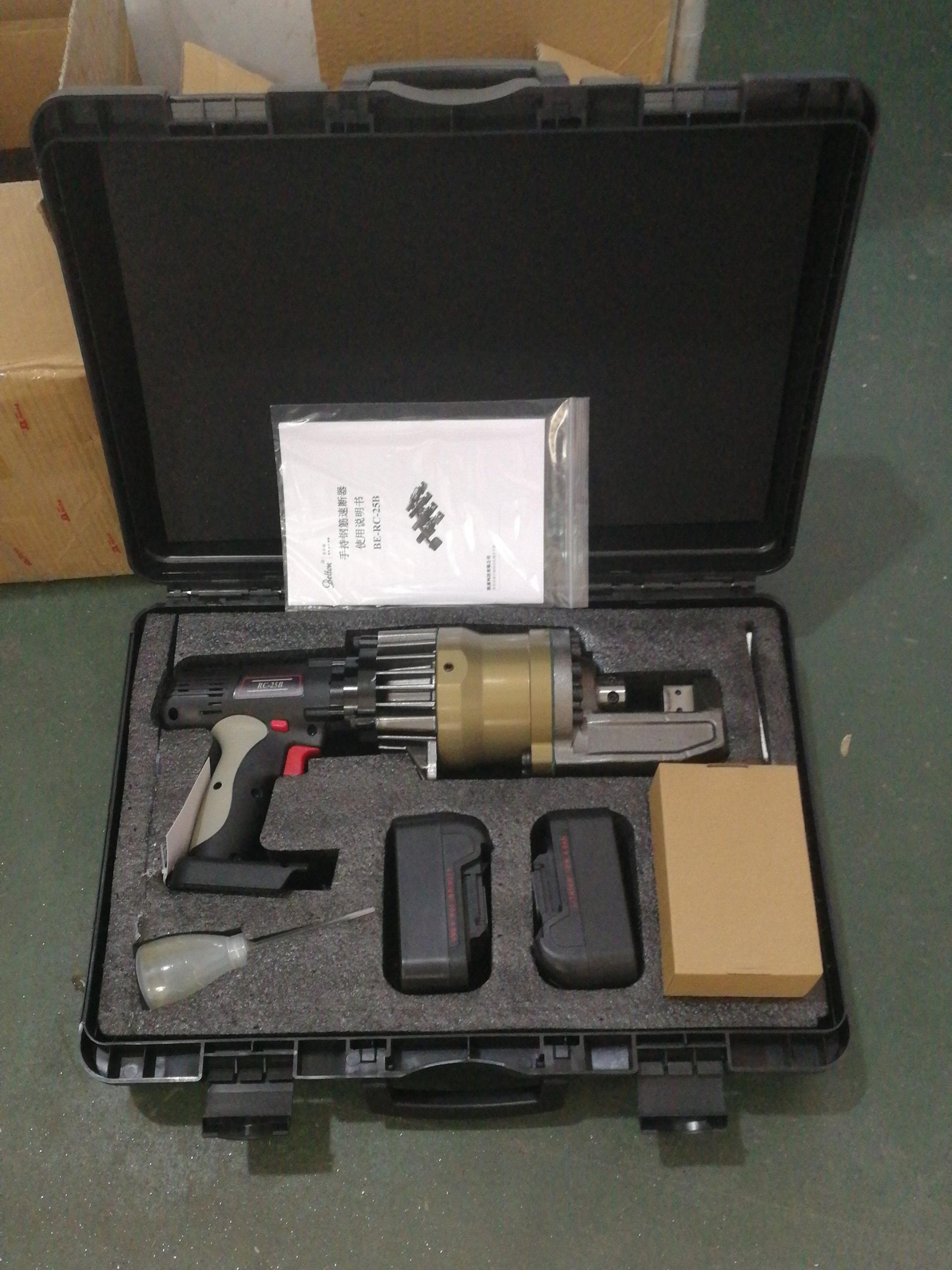
Ask for a photograph of the nameplate on the actual unit and a copy of the manual in the destination language. Where NFPA 1936 applies, the 2020 edition's label requirements make this a scored item rather than a formality. Model designation, rated pressure and serial number should match the packing list.
Layer 5 — Factory-level management system evidence
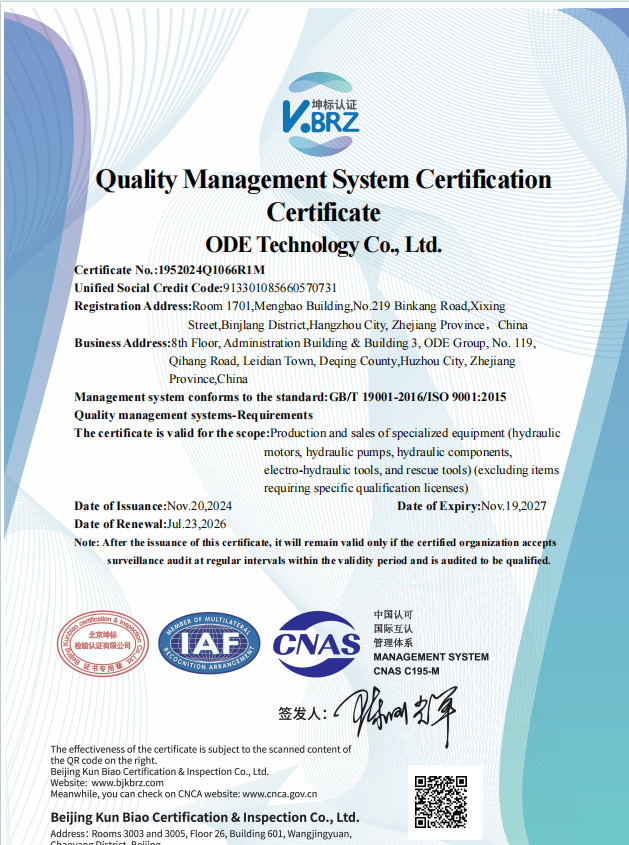
Product compliance and factory compliance are different questions, but tender panels usually ask both. ODE holds ISO 9001:2015 certification (certificate 1952024Q10666R1M, issued by Beijing Kun Biao Certification & Inspection Co., Ltd., valid 20 November 2024 to 19 November 2027) covering the production and sales of hydraulic motors, hydraulic pumps, hydraulic components, electro-hydraulic tools and rescue tools, and ISO 45001:2018 certification (certificate 1952024B029R0M, valid 22 July 2024 to 21 July 2027).
How compliance scope changes between battery, hydraulic and engine-driven equipment
The variable that moves most often is not the market. It is the power source, because each power source adds or removes a document.
Hose-connected hydraulic tools: two certificates, one system
A hydraulic combi tool such as SC257 (72 MPa, 600 kN maximum cutting force, 15.1 kg), a hydraulic cutter such as S211 (600 kN, Ø30 mm round steel and 8 mm steel plate, ≤14.2 kg) or a hydraulic spreader such as SP210 (35–80 kN spreading force, ≥610 mm spreading distance, 18.9 kg) is certified as a tool. The pump that drives it is certified separately. ODE's pump attestation M.2023.206.C94572 names a long model list including PG305GB, P610GSB, P620GB, MP-63/0.4, MP-63/0.5, BS-700, BS-72, BB-750, BR-3000 and ZCB-700D, and the same certificate record is linked to the MDP220 double-output engine pump, the BE-MP-63/0.5 single-output engine pump, the BS-63 and P620ASL manual pumps, and the P600OGB and P610AES battery pumps.
Battery-integrated tools: the machine, the pack and the charger
Battery tools remove the hose but add two components to the shipment. The battery combi tool SC370-E (DC 28V 5Ah, 940 kN maximum cutting force, 45–145 kN spreading force, EN 13204 approved), the battery cutter S251-E (940 kN, Ø40 mm round steel, EN 13204 approved), the battery spreader SP725-E (38–65 kN, 740 mm spreading distance, EN 13204 approved) and the two-stage electric ram R530-E (140 kN first stage, 70 kN second stage, EN 13204 approved) all depend on a battery system that is inspected, stored and replaced separately from the tool. The battery level display, the low-power alarm below 20% remaining capacity and the seven-level LED indicator described in ODE specifications are user-facing features; the compliance question is whether the pack and charger appear in the declaration and the manual.
Engine-driven pumps: an additional documentation lane
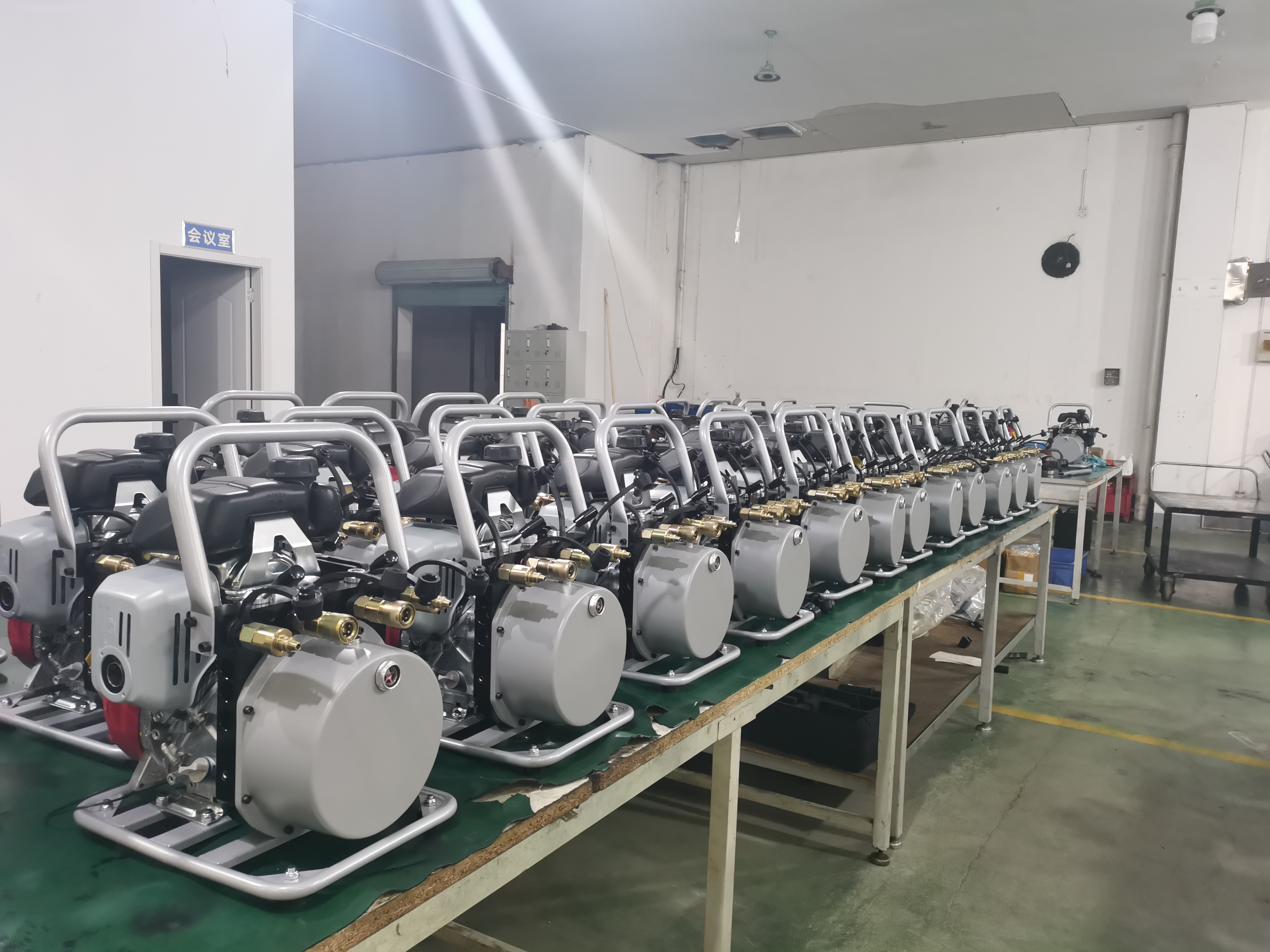
An engine-driven pump such as the MDP220 (4-stroke, 2.2 kW, rated working pressure ≥72 MPa, ≤23 kg including oil) or the heavy-duty double-output power unit P620SGB (630 bar × 2, 2.2 kW, 24.6 kg) introduces a combustion engine into an otherwise hydraulic system. The standards cited in the ODE attestations are machinery-safety and EMC standards; they do not name engine-emission requirements. An engine-driven pump order should therefore be paired with a separate engine documentation request covering the engine itself, the fuel specification and the service schedule, rather than assuming the pump attestation closes the whole file.
The standard edition question, in table form
| Reference | Scope wording | Edition status | What to write into the purchase order |
|---|---|---|---|
| EN 13204:2016 | Safety and performance requirements for double-acting hydraulic rescue tools | National standards listings show it as withdrawn; DIN lists a 2025 replacement | Cite the edition year explicitly; do not write "EN 13204" alone |
| DIN EN 13204:2025-06 | Powered rescue tools for fire and rescue service use — Safety and performance requirements | Published and listed as replacing the 2016 edition | State whether the 2025 edition is required, and request the corresponding test report |
| NFPA 1936, 2020 edition | Standard on rescue tools; 2020 revision addresses label permanence and removes rescue strut requirements | Current edition referenced in this guide | Request label and test evidence separately from the CE file |
| Machinery Directive 2006/42/EC + EMC Directive 2014/30/EU | Directives cited in the ODE EU attestations alongside EN ISO 12100:2010, EN IEC 55014-1/-2, EN IEC 61000-3-2, EN 61000-3-3 and EN 60204-1 | Attestations valid to 24 December 2028 | Request the full attestation with the model list, not a certificate thumbnail |
The edition comparison is a document-control point, not a claim that any specific ODE product meets or fails any particular edition. The technical requirements of EN 13204:2025 require review of the full standard text before a tender is answered.
A seven-step document check before the purchase order is signed
- Convert the selection into a model matrix. List every tool, every pump, every battery pack and every charger as a separate line with its model designation and power source. Vague entries such as "combi tool" or "pump unit" cannot be matched to a certificate.
- Name the destination anchor. EU: CE attestation plus the applicable EN 13204 edition. North America: NFPA 1936 evidence. Other markets: the standard and edition named by the importing authority or the tender document.
- Match the certificate scope line by line. Print the certificate's model list next to the order list. Any quoted model that does not appear on the certificate needs a model-specific declaration or an updated attestation before shipment.
- Request the test report as a separate file. A product specification line reading "EN 13204 approved" and a standard citation inside a CE attestation are two different forms of evidence. Ask for both.
- Audit the accessory list. Confirm connector type (male-female snap fastener, flat-seal flat-axis single connector, or threaded single connector), hose length, battery quantity and charger input voltage against the destination's mains supply.
- Inspect the label and manual. Photograph the nameplate on the unit that will ship. Confirm that model, rated pressure and serial number match the packing list, and that the manual is in the required language.
- Write compliance into the purchase order. Attach the approved document list as an annex, state the standard edition, and make the certificate number a line item on the inspection record. This is what converts a folder of PDFs into an auditable file.
Three sourcing situations where the document set decides the outcome
An EU municipal tender
A city fire service issues a tender that cites EN 13204 and asks bidders to demonstrate conformity. The bidder submits a CE attestation for a rescue combi tool, a separate attestation for the pump, and a test report covering the cited edition. Because the model list on the tool attestation names SC257 and SC257-E and the pump attestation names the selected pump model, the evaluation committee can close the technical file without a clarification round. A bidder that submits a certificate without the model list typically loses days to questions, not points to non-compliance.
A North American fire department
A department specifying NFPA 1936, 2020 edition, will ask for label permanence and performance evidence that a CE attestation does not contain. The productive request is a two-part file: the CE attestation and cited standards for the design, plus NFPA 1936 test and label evidence for the North American requirement. Presenting the CE attestation as if it answered NFPA 1936 is the most common cause of a stalled review.
A multi-market distributor
A distributor supplying Serbia, Hungary, Brazil, Argentina, Thailand, Vietnam and Morocco from one warehouse needs one model matrix and several market files. ODE's export markets include the USA, EU, Thailand, Vietnam, Morocco, Serbia, Hungary, Brazil and Argentina, which means a distributor can often source one tool platform and then attach the market-specific document pack per destination. The saving comes from the shared model list, not from a claim that one certificate works everywhere.
Certificate scope matrix: what each ODE attestation actually covers
The table below is the practical answer to the question "which document do I send for this model?" It lists the ODE EU attestations, the product category each one covers, representative model designations printed in the certificate scope, the cited standards and the validity window.
| Attestation | Category | Representative ODE models named in scope | Standards cited | Validity |
|---|---|---|---|---|
| M.2023.206.C94565 | Rescue combi tool | SC257, SC257-E, SC357-EC, SC357B, SC557B, SC357B/411, BC-300A, BC-300B, KJ20CB, GYJK-33-36/25(10), SD270A, GYJKB-63 | EN ISO 12100:2010; EN IEC 55014-1:2021; EN IEC 55014-2:2021; EN IEC 61000-3-2:2019+A1:2021; EN 61000-3-3:2021+A2:2021; EN 60204-1:2018 | 2023-12-25 to 2028-12-24 |
| M.2023.206.C94566 | Rescue cutter | S211, S211-E, S212, S250E, S312-E, S311B, S511B, BC-15A, C312C, CS10S, 501, SW305BS, SW311B, GYJQ-250, GYQ-315, SQD-300, GYWX-680, GBH180, HUP-900SC, 1100ASC-1 | Same standards package | 2023-12-22 to 2028-12-24 |
| M.2023.206.C94567 | Rescue spreader | SP210, SP310B, SP510B, SP301-E, SP310-E, SP725-B, SP725-E, SP725-L, SP720B, SW310B, HE-720DA, HE-500S | Same standards package | 2023-12-25 to 2028-12-24 |
| M.2023.206.C94563 | Rescue ram | R410, R412-E, R422-E, R400, R420, R421, R430, R412B, R422B, R0, RS30-E, HR-100S, HR-110CA, SW-R422B | Same standards package | 2023-12-25 to 2028-12-24 |
| M.2023.206.C94572 | Hydraulic pump | PG305GB, P610GSB, P620GB, P400GB, P40DGB, MP-63/0.4, MP-63/0.5, MA-MP2-63/0.4, MA-MP2-63/0.66/R, BT4-C63/0.66(HA), BK2-700, CB-BS, CB-B6, HMP-350A, HMP-380L, CP-700, BS-700, BS-72, BB-750, BB-1500, BR-3000, GYB-63D, ZCB-700D, ZCB-7; record linked to MDP220, BE-MP-63/0.5, BS-63, P620ASL, P600OGB and P610AES | Same standards package | 2023-12-25 to 2028-12-24 |
| M.2023.206.C94573 | Hydraulic breaching tools | EHK-5A, EHK-5B, EHK-5C, EHK-5D, EHK-5S, FDM-4, FDM-5, FDM-6, SL-700D, WAHY-10, PRT-8A, PRT-8, JLH-6000; record linked to RC-25B, RC-20B and RC-16B | Same standards package | 2023-12-25 to 2028-12-24 |
Model lists above are representative rather than exhaustive; the certificate text is the controlling record. Where a quoted model does not appear in a scope list, request a model-specific declaration before shipment.
Buyer check: compare the model designation on the quotation, the model designation on the certificate, and the model designation on the nameplate. Three-way agreement is the fastest indicator that the document file will survive an audit.
FAQ
What documents should I request to verify CE compliance for a Chinese-made hydraulic rescue tool?
Request five items, not one: the full attestation of conformity with its model list; the standard test report behind the cited standards; the accessory and battery list; the nameplate photograph and destination-language manual; and factory-level ISO certification. For ODE, the EU attestations are issued by UDEM International Certification Auditing Training Centre Industry and Trade Inc. Co., cite the Machinery Directive 2006/42/EC and the EMC Directive 2014/30/EU together with EN ISO 12100:2010, EN IEC 55014-1:2021, EN IEC 55014-2:2021, EN IEC 61000-3-2:2019+A1:2021, EN 61000-3-3:2021+A2:2021 and EN 60204-1:2018, and run to 24 December 2028. Factory evidence is ISO 9001:2015 certificate 1952024Q10666R1M and ISO 45001:2018 certificate 1952024B029R0M.
Does a CE certificate for a hydraulic tool also cover the battery-powered version of the same tool?
Only if the battery model is printed in the certificate scope. ODE's certificates show that coverage is decided model by model, not by product family. Attestation M.2023.206.C94563 names both R410, a hydraulic ram, and R412-E, an electric ram. Attestation M.2023.206.C94566 names both S211, a hydraulic cutter, and S312-E, a battery cutter. Attestation M.2023.206.C94567 names SP210, SP725-L and SP725-E together. The correct procedure is to match the quoted designation against the printed list, and to ask for a model-specific declaration where no match exists.
Can ODE customize tools and documentation for a specific destination market?
ODE supports OEM and ODM work, including drawing design services and customization of voltage, power, colour and brand, together with minor functional adjustments. Monthly capacity is 5,000 units, the minimum order quantity is 2 units, and after-sales support is handled remotely. Customization changes the model designation, which is why the certification question has to be re-asked after any customization: a new voltage, a new battery platform or a rebranded housing should trigger a fresh document review rather than relying on the original scope list.
What is the minimum order quantity and how is pricing structured?
The minimum order quantity is 2 units. Commercial terms are volume-dependent: pricing is quoted against order quantity rather than published as a fixed list, and the same principle applies to any documentation work requested alongside the order. For a first compliance review, this means a buyer can validate documents and sample units before committing to a full container, which is usually the cheaper sequence.
What is the lead time, and can we evaluate a sample before ordering?
Production lead time is 45 to 60 days. Samples are available, with carriage charged to the buyer. The practical sequence for a destination-market launch is to request the document pack and a sample unit at the same time, verify that the certificate model list matches the sample nameplate, and then place the production order with the approved document list attached as a purchase-order annex. Document requests and sample coordination can be sent to rfq@ode119.com or via WhatsApp on +86 135-8886-7391, and the ODE Technology company brochure is available for download below.
Compliance is a matched set, not a stamp
The destination market sets the anchor, the standard edition sets the test, and the model designation sets the scope. When those three line up, a rescue tool order moves through tender evaluation, customs and acceptance without a clarification loop. When they do not, the failure is almost always documentary: a certificate that covers a neighbouring model, a tool without its pump, a battery pack that appears on the packing list but not in the manual, or a standard cited without an edition year.
Ode Hydraulic & Electric Rescue Tools are manufactured by ODE Technology Co., Ltd., founded in 2010 and operating a 110,000 m² facility with 200 employees, a provincial-level research institute and close to 200 patents, supplying markets that include the USA, EU, Thailand, Vietnam, Morocco, Serbia, Hungary, Brazil and Argentina. The compliance file behind those shipments is built the same way as the product set: by model, by power source and by destination. Reviewing it in that order is the difference between a quotation that wins on price and a purchase order that clears on evidence.
Next step: request the document pack
Send the destination market, the intended model list and the standard edition your tender cites. ODE will return the matching attestation, model scope confirmation and the accessory list for review, together with sample and lead-time details.
Email: rfq@ode119.com | WhatsApp: +86 135-8886-7391 | Website: www.odetools.com
Company brochure (PDF): Download the ODE Technology brochure
Have Questions or Need More Details?
Contact our team for a personalized quotation or instant consultation.
Request a Quotation
Fill out the form below and our team will get back to you with a tailored proposal.
WhatsApp Direct Chat
Prefer to chat in real-time? Message us on WhatsApp for instant assistance & quick answers.
- Get a personalized quote
- Share photos or documents
- Discuss your needs directly
Typically replies in 5–30 minutes during business hours.