
Composite Autoclave Comparison: Utility Needs for R&D, Small-Batch, and Continuous Production
Composite Autoclave Comparison: Utility Needs for R&D, Small-Batch, and Continuous Production
A composite autoclave is only as effective as the utility system built around it. Two buyers can specify the same vessel diameter and the same maximum working temperature and still receive two very different machines — one built for a laboratory that runs single 2–8 hour experiments, the other built to operate 20–24 hours a day with a dual redundant control system and full process traceability.
This comparison separates the three utility tiers that most composite autoclave procurement decisions actually fall into — laboratory R&D, small-batch production, and continuous production — and compares them on the three dimensions that decide whether an installation works in practice: supporting equipment, operating environment, and safety and compliance obligations. Configuration references throughout are drawn from composite autoclave systems built and configured by Olymspan (Jiangsu Olymspan Equipment Technology Co., Ltd., founded 2004, Changzhou, Jiangsu, China).
Quick answer
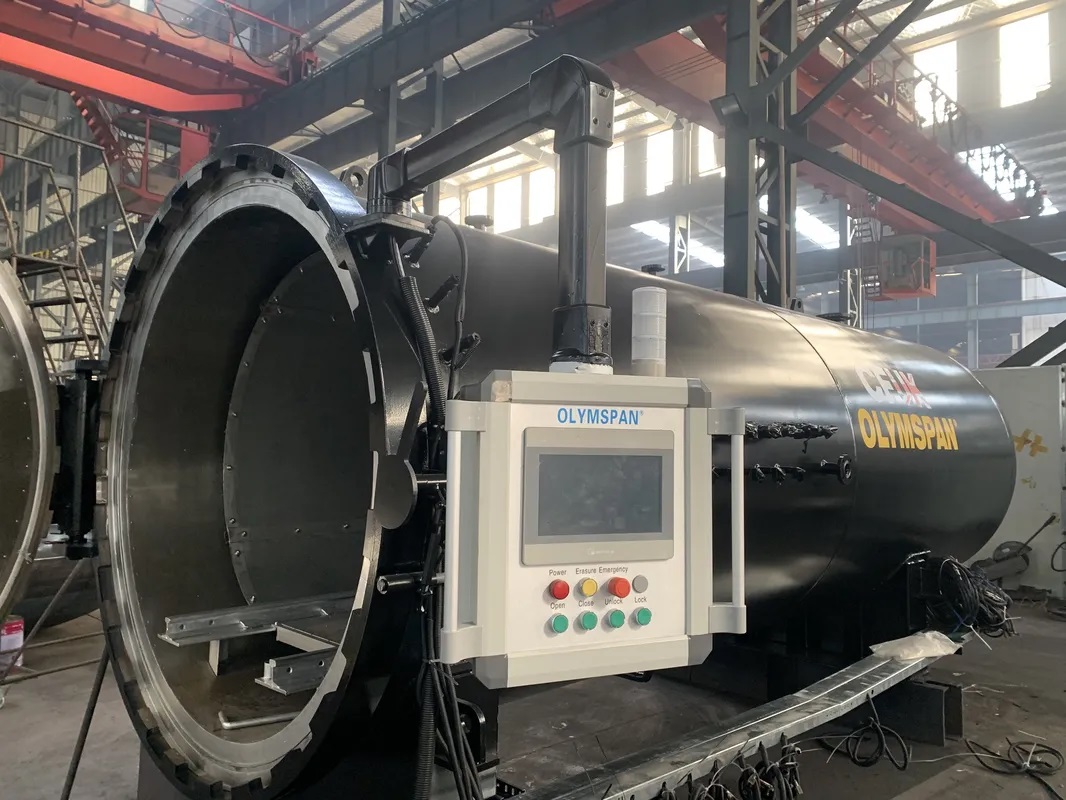
- Laboratory R&D tier: temperature control of ±0.3 °C to ±0.5 °C and pressure control of ±0.05 MPa, 220 V or 380 V supply, 15–25 °C ambient temperature with 40–60% humidity, high-precision sensors, data acquisition devices, remote monitoring terminals, sample placement racks, a small cooling device, compact footprint, noise ≤60 dB, and intermittent operation of 2–8 hours per run.
- Small-batch production tier: 380 V supply in a plant that allows slight dust, −10 to 40 °C ambient temperature and 30–70% humidity, material handling equipment, automated feeding and discharging devices, cooling systems, electrical control systems, sealing replacement tools, ventilation and dust removal equipment, a manual and electric dual-purpose quick opening door, energy use of 0.5–0.7 kWh/m³, and anti-leakage plus anti-overheating/overpressure protection.
- Continuous production tier: 380 V or 660 V supply in a dust-free plant at 20–28 °C and 30–50% humidity without electromagnetic interference, dual redundant control system, remote diagnostic terminal, inert gas protection, vacuum system, emergency pressure relief device, full-process quality traceability, continuous operation cycles of ≥8000 hours, multiple safety interlocks, and GJB9001C compliance where aviation or military-grade work is involved.
Why Autoclave Utility Mismatches Happen
Composite autoclave procurement failures are rarely caused by the pressure vessel itself. They are caused by a mismatch between the utility tier a vessel was designed for and the utility tier a site can actually provide.
1. Laboratory control accuracy assumed to hold at production volume. A laboratory composite autoclave holds temperature within ±0.3 °C to ±0.5 °C with pressure control of ±0.05 MPa, in an ambient range of 15–25 °C and 40–60% humidity. Those figures are supported by a controlled room, a small cooling device and a compact chamber. Moving the same control target onto an 8–16 hour production cycle in a plant that allows slight dust and swings between −10 °C and 40 °C changes the equipment list entirely, because the disturbance profile changes.
2. Production redundancy added to a laboratory budget. A dual redundant control system, remote diagnostic terminal, inert gas protection, emergency pressure relief and a full traceability system exist to protect continuous output measured in thousands of parts over years. Applied to a 2–8 hour experiment that runs a few times a week, the same features add complexity the experiment does not consume.
3. Environment and compliance treated as an afterthought. The electrical supply requirement alone splits the three tiers: 220 V/380 V in the laboratory, 380 V in small-batch production, and 380 V/660 V with constant temperature and humidity facilities in continuous production. Pressure vessel and industry compliance adds a second split, from local pressure vessel certification for export models to GJB9001C where aviation and military-grade components are cured.
Industry Background: Why These Three Tiers Have Diverged
The global composite curing autoclave market was valued at approximately USD 1.37 billion in 2023 and is projected to reach USD 2.4 billion by 2033, a CAGR of 10.2% (Kings Research, Composite Curing Autoclave Market Size, Growth and Analysis Report – 2033). A narrower segment estimate puts the 'autoclaves for composite materials' market at USD 86.2 million in 2024, reaching USD 127 million by 2032 at a CAGR of 5.8% (Market Research Future). The distance between the two figures reflects how differently analysts scope the category — a reminder that market numbers should be read against their definition, not used as a proxy for a single project.
Demand concentration explains part of the divergence. Composite autoclaves accounted for 62.4% of total aircraft autoclave market share as of 2025, driven by carbon fibre reinforced polymer adoption in the Boeing 787 and Airbus A350 programmes (Dataintelo, Aircraft Autoclave Market Research Report 2034). North America held the largest revenue share at approximately 38.2% in 2025. Aviation-grade continuous production therefore sets one end of the technical envelope, while laboratory and small-batch work sets the other.
Regulatory scope splits along the same lines. Industrial composite autoclaves placed in the United States must comply with ASME BPVC Section VIII (Division 1 or 2); European placements fall under PED 2014/68/EU (EN 13445). Aviation and military-grade projects add GJB9001C requirements, while laboratory installations may instead need to meet local electrical safety regulations — a specific consideration for exported laboratory models.
The practical consequence: temperature, pressure and vessel size — the three specifications buyers compare first — explain only part of what separates one installation from another. The utility layer around the vessel explains the rest.
Detailed Comparison: How Each Utility Tier Is Configured
Tier 1 — Laboratory R&D Configuration
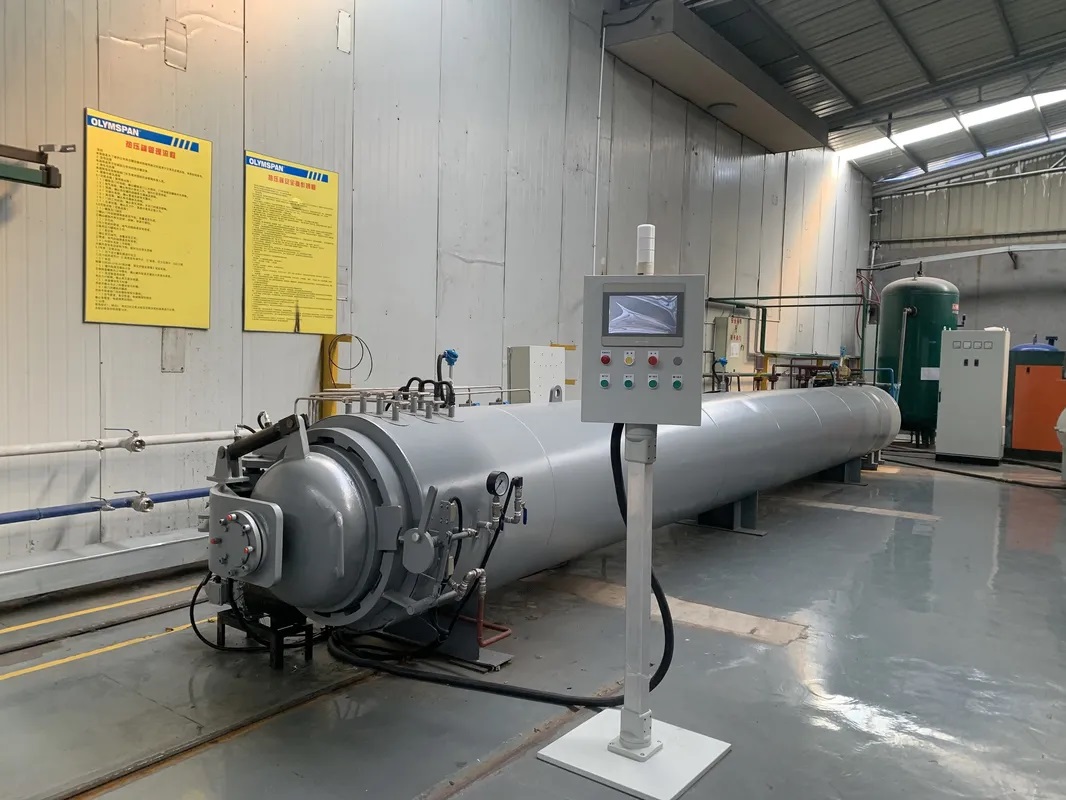
A laboratory composite autoclave exists to produce knowledge, not volume. Typical projects include new material formula research and development, curing process parameter debugging, small-batch sample verification, provincial and national scientific research projects, and enterprise technology upgrade programmes. The operating pattern is intermittent: a single run of 2–8 hours, started according to experimental requirements and stopped for cleaning afterwards, with no requirement for continuous long-term startup.
The laboratory environment is a normal temperature and pressure environment with no dust and no corrosive gases. Voltage is a stable 220 V or 380 V, ambient temperature is controlled between 15 °C and 25 °C, and humidity sits at 40–60%. Because the chamber is used for many different experiments rather than one frozen recipe, the equipment list is dominated by measurement and repeatability:
- High-precision sensors and data acquisition devices
- Remote monitoring terminals for the experimental process
- Sample placement racks
- Small cooling devices
- Vacuum systems (optional depending on process)
- Experimental data storage equipment
- Gas purification devices in some scenarios
Performance targets follow the same logic. Temperature control of ±0.3 °C to ±0.5 °C and pressure control of ±0.05 MPa support differentiation between resin systems. The system stores and retrieves multiple experimental parameter sets, provides precise data traceability, and supports manual/automatic dual-mode operation with remote monitoring and data export. Physical constraints matter as much as control accuracy: a compact footprint suitable for laboratory space and a noise level of ≤60 dB, in compliance with scientific research laboratory safety standards.
Tier 2 — Small-Batch Production Configuration
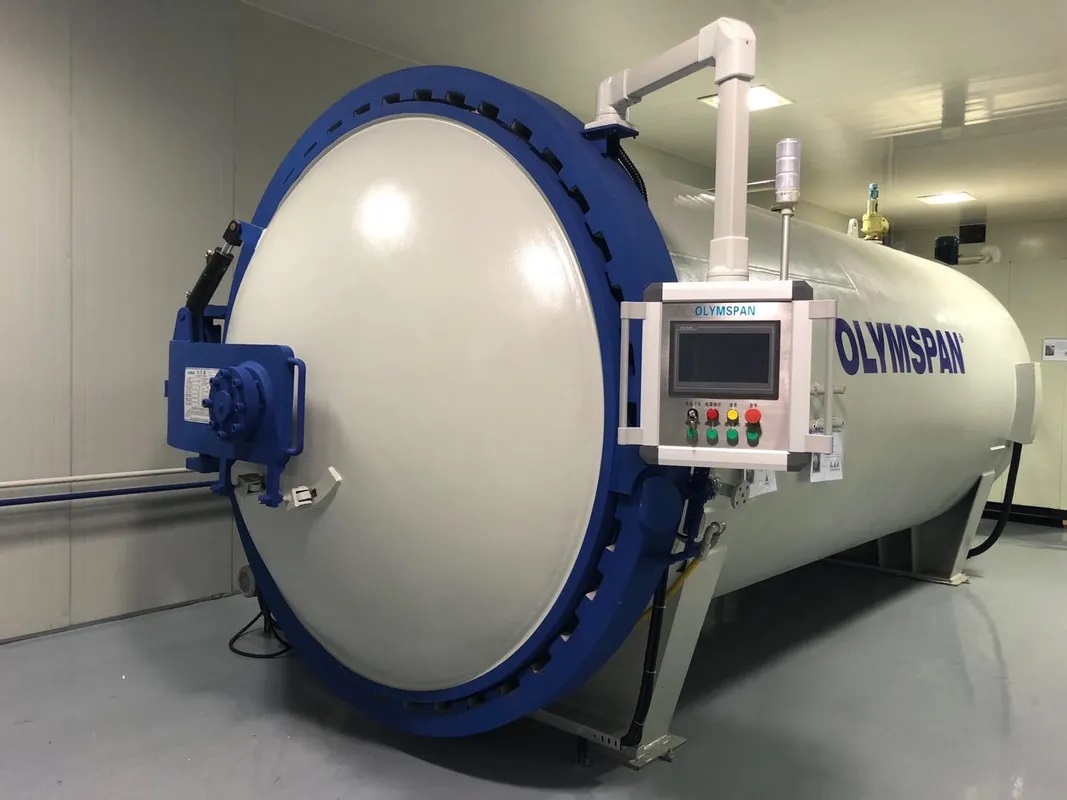
Small-batch composite autoclaves serve small and medium-sized production programmes: automotive parts matching, new energy battery shells and photovoltaic modules, small wind power components, rail transit parts, and civilian composite goods such as fitness equipment and medical equipment housings. The output target is measured in batches per shift, and the equipment reflects that.
Environmental assumptions are looser than in the laboratory but far from unlimited. The plant may allow slight dust, ambient temperature ranges from −10 °C to 40 °C, humidity runs 30–70%, supply voltage is 380 V, ventilation facilities are required, and some sites must cope with high temperature and high humidity — which is why anti-corrosion capability becomes part of the specification rather than an option.
Supporting equipment is where the small-batch tier diverges most from R&D:
- Material handling equipment such as forklifts and cranes
- Automated feeding and discharging devices
- Cooling systems sized for repeated batches
- Electrical control systems with adjustable parameters per production plan
- Sealing replacement tools and a reserve of vulnerable parts
- Ventilation and dust removal equipment
- Vacuum systems in some scenarios
Operation is continuous multi-batch: 8–16 hours per day, with automated feeding, curing and discharging, parameters adjustable according to the production plan, and a manual emergency operation mode to handle sudden shutdown situations. Reliability targets are stated rather than implied — an average of ≤1.2 failures per month and a fault repair time of ≤24 hours. The door design supports mixed part programmes: a manual and electric dual-purpose quick opening function suitable for curing multiple product specifications.
Two constraint figures shape operating cost and risk. Energy consumption runs at 0.5–0.7 kWh per cubic metre of unit volume, and the safety architecture includes anti-leakage and anti-overheating/overpressure protection in line with industrial production safety standards. Export models may additionally need to comply with local pressure vessel certification.
Tier 3 — Continuous Production Configuration
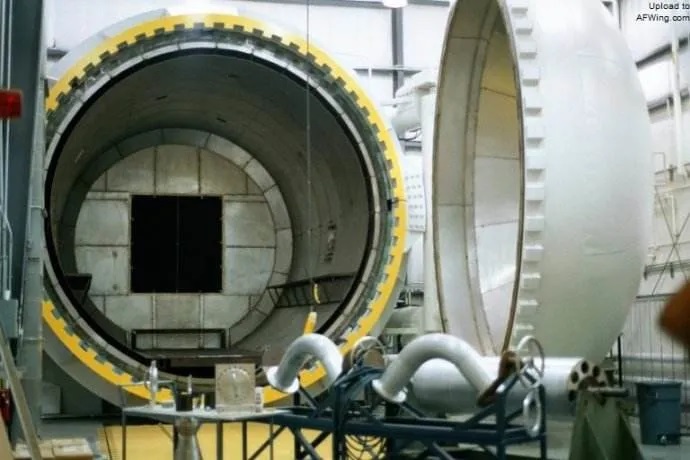
Continuous production composite autoclaves cure aerospace main load-bearing components, military core components, radar covers, missile shells and high-end medical equipment parts. Projects at this tier typically run to mass production for aircraft structures, military components and large-scale advanced composite programmes, and the equipment is expected to support aerospace technology upgrades rather than a single campaign.
The operating environment is the strictest of the three. High-end industrial plants are dust-free and free of corrosive gas and electromagnetic interference, ambient temperature is controlled at 20–28 °C, humidity at 30–50%, voltage is a stable 380 V or 660 V, and constant temperature and humidity facilities are part of the site. The equipment is designed to run continuously for long periods under high temperature and high pressure.
The supporting equipment list reads as a reliability architecture:
- Dual redundant control system
- Remote diagnostic terminal
- High-precision temperature and pressure monitoring equipment
- Heat recovery device
- Inert gas protection system
- Vacuum system
- Emergency pressure relief device
- Full process quality traceability system
- Supporting professional testing equipment and professional maintenance tools
Operation is 20–24 hours per day with fully automated control, remote diagnosis and fault warning, real-time monitoring and automatic parameter adjustment. The dual redundant control system exists specifically to prevent interruption of that schedule.
Safety and compliance are where the continuous tier becomes a fundamentally different procurement: GJB9001C aviation and military-grade standards, temperature control uniformity of ±0.3 °C to ±0.5 °C, pressure stability of ±0.1 MPa, a continuous operation cycle of ≥8000 hours, and multiple safety interlock protections covering over-temperature, over-pressure and leakage emergencies. The tank body uses high-strength corrosion-resistant material, maintenance personnel hold professional qualification certification, and the system provides full life cycle management and data traceability. Some models carry special military and aviation certification as well.
One clarification matters for evaluation: these three tiers describe utility needs, not fixed product labels. A small-batch buyer can add inert gas protection; an R&D unit can be configured with automated data synchronisation. What should not be assumed is that the environment, the electrical supply and the reliability target will follow the control accuracy specification.
Step-by-Step: Specifying an Autoclave by Utility Tier
Step 1 — Define the real operating window. Start with hours per day and runs per week. A 2–8 hour intermittent pattern points to the laboratory tier; 8–16 hours of continuous multi-batch operation points to small-batch; 20–24 hours with automated parameter adjustment points to continuous production. This single input determines redundancy requirements more than any vessel dimension.
Step 2 — Map the plant environment before the chamber. Confirm available voltage (220 V, 380 V or 660 V), ambient temperature range, humidity band, dust level, ventilation capacity, corrosive atmosphere and electromagnetic interference. The three tiers assume 15–25 °C / 40–60%, −10 to 40 °C / 30–70%, and 20–28 °C / 30–50% respectively. Deviation from the assumed band must be resolved by site work or by equipment design, not by hope.
Step 3 — List supporting equipment against the process, not the brochure. Laboratory work needs sensors, data acquisition, remote monitoring, sample racks and a small cooling device. Small-batch work needs material handling, automated feeding and discharging, cooling, electrical control, sealing replacement tools, spares and ventilation. Continuous work needs dual redundant control, remote diagnostics, high-precision monitoring, heat recovery, inert gas, vacuum, emergency relief and a traceability system.
Step 4 — Set control accuracy and redundancy targets. Temperature uniformity of ±0.3 °C to ±0.5 °C and pressure control of ±0.05 MPa describe the laboratory and aviation-grade envelope; pressure stability of ±0.1 MPa is specified for continuous aviation-grade operation. Redundancy, remote diagnosis and automatic adjustment are requirements of the continuous tier, not general-purpose features.
Step 5 — Fix the safety and compliance envelope early. Determine which framework applies: ASME BPVC Section VIII (Division 1 or 2) for the US market, PED 2014/68/EU (EN 13445) for Europe, GJB9001C for aviation and military-grade work, scientific research laboratory safety standards plus local electrical safety regulations for laboratory installations, and local pressure vessel certification for some export models in the small-batch tier. Safety interlocks must cover over-temperature, over-pressure and leakage emergencies on continuous systems.
Step 6 — Confirm the commercial and delivery parameters. For Olymspan units, the documented customization scope covers tank volume, temperature control accuracy, pressure range, number of data acquisition points, integration of remote monitoring and data synchronisation functions, tank material, and experimental mode. Minimum order quantity is 1 unit. Lead time is stated as 15–25 days for standard models and 25–40 days for customized models including parameter adjustments and new features, excluding on-site installation and commissioning time of 1–3 days. Larger aerospace-class configurations can require longer windows.
Verification before shipment (Olymspan quality control scope): full-process quality inspection before leaving the factory, covering pressure sealing testing, temperature uniformity testing, electrical safety testing and data acquisition accuracy calibration, followed by on-site debugging and verification during delivery.
Use Cases: What Each Configuration Delivers in Practice
University research institute (materials science and engineering, China) — 4 units, 5 years. A laboratory configuration with ±0.5 °C temperature control supported a wide temperature range of −40 °C to 300 °C for verifying resin system and fibre compatibility. The team completed research and development on 12 new composite material formulas, optimised 6 sets of curing process parameters, published 8 core journal papers and applied for 3 invention patents. The compact 1.2 m³ chamber suited a small laboratory space, and the unit integrated remote data collection and storage with automatic synchronisation to the research management system. Operating data: 1300+ experiments completed with full data traceability, an average of ≤0.2 faults per month and fault repair time of ≤3 hours, with only one part-time technician required for daily maintenance.
Enterprise R&D department (new energy materials, Germany) — 2 units, 4 years. This R&D configuration was used to develop composite materials for new energy vehicle battery casings and to test how different curing processes affect strength, high-temperature resistance and insulation. Imported high-precision sensors delivered ≥60 data acquisition points per run, with data accuracy of ±0.1 °C and ±0.05 MPa. Results included a 35% strength increase and 28% weight reduction after curing, high-temperature resistance of 180 °C, a 40% shorter process debugging cycle and 25% lower research and development cost. Multi-mode experimental operation allowed the team to simulate industrial curing conditions, and the unit complied with EU safety standards including electrical isolation and anti-scald protection.
Automotive parts supplier (small and medium-sized composite manufacturer, China) — 8 units, 6 years. A small-batch configuration curing steering wheel frames and interior parts processed 600 products per day. Single batch curing time was held at 2.5 hours, with production efficiency 50% higher than conventional equipment. Product qualification rose from 92% to 99.2%, reducing waste losses by 1.2 million yuan annually. The modular structure allowed quick switching of production specifications across vehicle models, and the visual control system meant operators could start work after simple training. The manual and electric dual-purpose quick-opening function handled power-outage situations. Annual operating cost was controlled at 120,000 yuan, 28% more energy-efficient than comparable equipment, with a stated return on investment of 150%.
Wind power component manufacturer (small and medium-sized, India) — 6 units, 5 years. Curing blade connectors and reinforcements in a high temperature and high humidity environment required an anti-corrosion, high-temperature-resistant electrical design with strong insulation performance. The site used efficient ventilation to discharge gases generated during solidification and a wear-resistant, corrosion-resistant tank body that showed no obvious wear over 5 years. Average daily output reached 400 pieces, meeting local wind project demand. Weather resistance of cured components improved by 40%, extending service life to 15 years; the equipment ran a cumulative 2800 hours without failure with annual failure frequency controlled within 10 times. Annual operating costs were 300,000 yuan lower than imported equipment, and the manufacturer's product market share increased by 12%.
Aerospace manufacturer (main load-bearing components, US) — 8 units, 7 years. Continuous-production units cured fuselage and wing load-bearing components in advanced high-temperature materials including PEEK and polyimide, in compliance with GJB9001C quality standards. Over 7 years the line accumulated production of more than 3000 aircraft main load-bearing components with a product qualification rate of 99.8% and no quality defects, supporting programmes including the C919 and ARJ21. Maximum temperature reaches 380 °C and maximum pressure 15 MPa. The continuous operation cycle reached 7800 hours with mean time between failures of 1600 hours. Parameter fluctuations were controlled within ±0.1 MPa and ±0.3 °C through the dual redundant control system, no safety accidents occurred over 7 years, and fault repair time was ≤8 hours with professionally certified maintenance personnel. A dedicated heat recovery device delivered heat recovery efficiency of ≥82% and annual energy savings of 150,000 yuan.
Comparison Table: Utility Requirements Side by Side
| Utility dimension | Laboratory R&D | Small-batch production | Continuous production |
|---|---|---|---|
| Typical operating pattern | Intermittent; single run 2–8 hours; no continuous long-term startup | Continuous multi-batch; 8–16 hours per day | Long-term continuous; 20–24 hours per day |
| Ambient temperature | 15–25 °C | −10 to 40 °C | 20–28 °C with constant temperature facilities |
| Humidity | 40–60% | 30–70% | 30–50% |
| Power supply | 220 V / 380 V | 380 V | 380 V / 660 V |
| Plant conditions | Normal temperature and pressure; no dust; no corrosive gases | Slight dust allowed; ventilation required; anti-corrosion capability | Dust-free; no corrosive gas; no electromagnetic interference |
| Temperature control | ±0.3 °C to ±0.5 °C | Adjustable per production plan | ±0.3 °C to ±0.5 °C uniformity |
| Pressure control | ±0.05 MPa | Anti-leakage and overpressure protection | ±0.1 MPa stability |
| Control architecture | Manual/automatic dual mode; remote monitoring; data export | Automated feeding, curing and discharging; manual emergency mode | Dual redundant control; remote diagnosis and fault warning; automatic adjustment |
| Key supporting equipment | High-precision sensors, data acquisition, remote terminal, sample racks, small cooling device, optional vacuum, gas purification | Material handling, automated feeding/discharging, cooling, electrical control, sealing replacement tools, spares, ventilation and dust removal, optional vacuum | Dual redundant control, remote diagnostics, high-precision monitoring, heat recovery, inert gas, vacuum, emergency relief, traceability system, testing equipment |
| Reliability expectation | ≤0.2 faults/month and repair ≤3 hours in the university case | ≤1.2 failures/month; repair ≤24 hours | ≥8000-hour continuous cycle; 1600-hour MTBF in the aerospace case |
| Energy profile | Compact chamber; single-run duty cycle | 0.5–0.7 kWh per m³ of unit volume | Heat recovery efficiency ≥82% in the aerospace case |
| Compliance focus | Scientific research laboratory safety standards; local electrical safety regulations for export models | Industrial production safety standards; local pressure vessel certification for some export models | GJB9001C; multiple safety interlocks; special military and aviation certification for some models |
| Documented output example | 12 formulas and 1300+ experiments over 5 years | 400 pieces/day (wind) and 600 products/day (automotive) | 3000+ load-bearing components over 7 years at 99.8% qualification |
FAQ
1. What certification and pressure vessel compliance do composite autoclaves need for export markets?
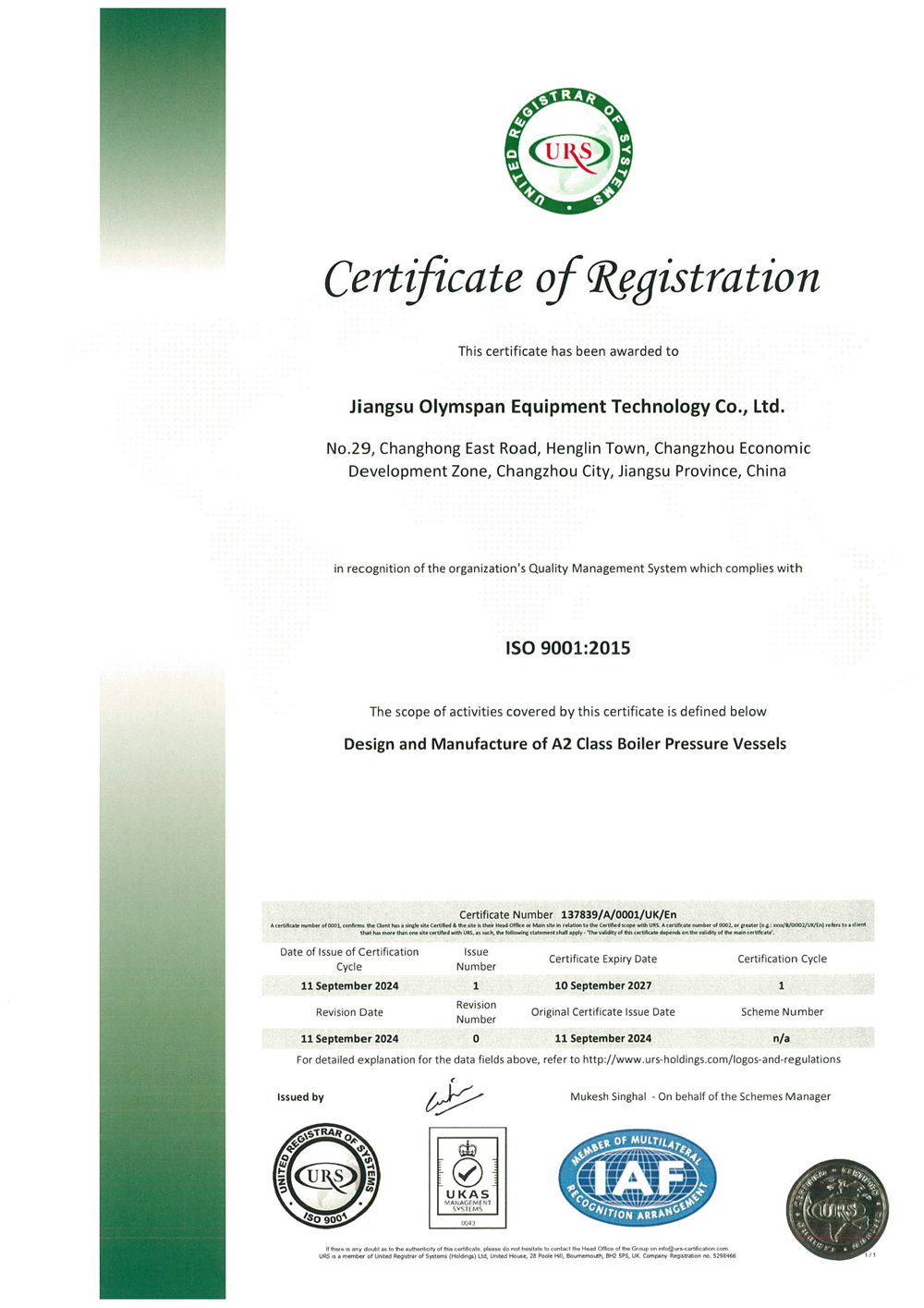
Industrial composite autoclaves placed in the United States must comply with ASME BPVC Section VIII (Division 1 or 2), and European placements fall under PED 2014/68/EU (EN 13445). Aviation and military-grade projects add GJB9001C. Laboratory installations may instead need to satisfy local electrical safety regulations, and some small-batch export models require local pressure vessel certification. Olymspan holds IATF 16949:2016 certification number CB01325, issued by IATF, valid from 25 September 2024 to 24 September 2027 and applicable to the global market, covering the manufacture of carbon fibre reinforced composite material shell decoration parts, engine heat dissipation parts and interior decorative stickers. For the EU market the company holds URS certification 136143/A/0001/UK/En based on ISO 45001:2018, with a scope covering the design and manufacture of A2 Class Boiler Pressure Vessels, and URS certification 137839/A/0001/UK/En based on ISO 9001:2015.
2. Can one autoclave configuration serve more than one utility tier?
Partially, and the customization scope determines how far. Olymspan's documented OEM/ODM customization covers tank volume, temperature control accuracy, pressure range, number of data acquisition points, integration of remote monitoring and data synchronisation functions, tank material and experimental mode, with a minimum order quantity of 1 unit. That range allows a laboratory unit to add remote monitoring and data synchronisation, or a small-batch unit to add automated feeding and discharging. What it does not remove is the environment gap: a chamber specified for a 15–25 °C laboratory will not automatically meet the dust-free, 20–28 °C, non-electromagnetic-interference conditions assumed by continuous aviation-grade operation.
3. What drives the cost difference between R&D, small-batch and continuous-production autoclaves?
Cost differences track the utility architecture rather than the vessel shell. Continuous-production units add a dual redundant control system, remote diagnostic terminal, high-precision temperature and pressure monitoring, an inert gas protection system, an emergency pressure relief device, a full process quality traceability system and multiple safety interlocks covering over-temperature, over-pressure and leakage emergencies. Laboratory units concentrate cost in measurement instead: high-precision sensors, data acquisition devices, remote monitoring terminals and precise data traceability. Running cost separates the tiers as well, with small-batch units documented at 0.5–0.7 kWh per cubic metre of unit volume, and a heat recovery device delivering ≥82% recovery efficiency and 150,000 yuan of annual energy savings in the aerospace case. Because every unit is built to order, commercial terms are quoted against a defined configuration rather than a list price.
4. How can a buyer validate a configuration before committing to full production?
Olymspan's quality control runs full-process inspection before the unit leaves the factory, covering pressure sealing testing, temperature uniformity testing, electrical safety testing and data acquisition accuracy calibration, plus on-site debugging and verification during delivery. At the laboratory tier, validation is built into the operating model: units support multi-mode experimental operation with parameter storage and retrieval, remote data collection and automatic synchronisation to a research management system. A university research institute completed 1300+ experiments with complete data traceability on this basis, and a German R&D department used ≥60 data acquisition points per run at ±0.1 °C and ±0.05 MPa accuracy to simulate industrial curing conditions before scaling up.
5. What lead time and delivery schedule should buyers plan for?
Documented lead time is 15–25 days for standard models and 25–40 days for customized models involving parameter adjustments and new features, excluding on-site installation and commissioning time of 1–3 days. Larger or more highly specified configurations require longer windows. Buyers preparing a project budget should therefore plan commissioning time as a separate line item from manufacturing. To move from comparison to a defined configuration — including tank volume, control accuracy, pressure range, data acquisition points and compliance target — you can request a configuration review and quotation from Olymspan directly at Wei.xia@olymspan.com or via WhatsApp at +8613861176509, and download the product brochure for the full specification set at https://cdn.socialarks.com/sbsp/24762/0/2026/0417/69e1db393056c.pdf.
Conclusion: Compare the Utility Tier Before the Vessel
The three-tier comparison resolves to a simple procurement sequence. Decide the operating pattern first — 2–8 hour experiments, 8–16 hour multi-batch shifts, or 20–24 hour continuous output. Map the plant environment against the tier's assumed ambient temperature, humidity, dust, ventilation, electromagnetic conditions and supply voltage. Then build the supporting equipment list, set control accuracy and redundancy, and close out the compliance envelope with the framework that actually applies: ASME BPVC Section VIII or PED 2014/68/EU for industrial placement, GJB9001C for aviation and military-grade work, laboratory safety and local electrical safety standards for R&D installations.
Used in that order, the vessel specification becomes a consequence of the utility tier rather than a guess about it. Buyers who reverse the order usually pay for control accuracy the environment cannot support, or for redundancy the process will never consume.
Configure your composite autoclave against the right utility tier
Olymspan builds composite autoclaves for laboratory R&D, small-batch production and continuous aviation-grade operation, with OEM/ODM customization of tank volume, temperature control accuracy, pressure range, data acquisition points, remote monitoring integration, tank material and experimental mode. Minimum order quantity is 1 unit.
Request a configuration review and quotation: Wei.xia@olymspan.com · WhatsApp +8613861176509 · Website: https://www.aac-autoclave.com/ · Brochure: Download the Olymspan product brochure (PDF).
Have Questions or Need More Details?
Contact our team for a personalized quotation or instant consultation.
Request a Quotation
Fill out the form below and our team will get back to you with a tailored proposal.
WhatsApp Direct Chat
Prefer to chat in real-time? Message us on WhatsApp for instant assistance & quick answers.
- Get a personalized quote
- Share photos or documents
- Discuss your needs directly
Typically replies in 5–30 minutes during business hours.