
Composite Autoclave Compliance FAQ: Certifications, Standards & Region-Specific Requirements
Composite Autoclave Compliance FAQ: Certifications, Standards & Region-Specific Requirements
Compliance for a composite autoclave is not one certificate. It is a stack of four separate requirements that must be satisfied by the same vessel: the application-tier standard (GJB9001C for aviation and military-grade work, with temperature control uniformity of ±0.3 °C to ±0.5 °C and pressure stability of ±0.1 MPa), the pressure-vessel and electrical-safety regime of the country where the unit is installed, the safety standard of the facility type (scientific research laboratory or industrial production plant), and the evidence chain handed over at acceptance — safety interlocks, data traceability, full life cycle management, and qualified maintenance personnel.
A certificate number answers only the first question. This FAQ answers the rest, in the order buyers actually meet them during research and evaluation.
Problem Definition: Why Compliance Becomes a Procurement Constraint
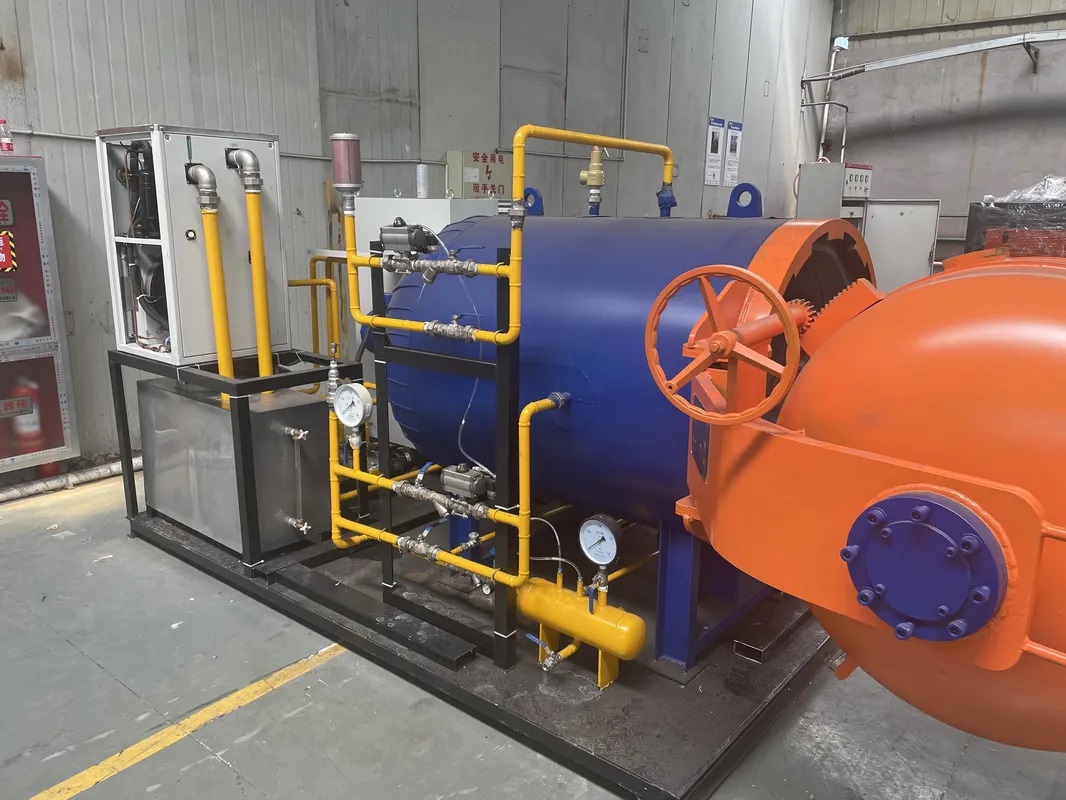
In composite curing, the autoclave is a pressure vessel that runs at elevated temperature for hours at a time. That combination means the equipment sits at the intersection of at least three regulatory systems at once: the quality standard of the parts it produces, the pressure-equipment law of the installation country, and the occupational safety rules of the building it stands in. Buyers rarely discover this all at once. They discover it in the sequence below, usually late.
- A certificate exists, but its scope does not cover the equipment. Many suppliers hold a valid certificate whose scope statement describes a different activity. The scope text, not the logo, is what an auditor reads.
- Pressure-vessel approval is jurisdictional, not global. A unit accepted in one market is not automatically acceptable in another. Industrial export models typically need to satisfy the local pressure vessel certification of the destination market.
- Traceability is designed in, not added later. If the control system cannot store and export the temperature, pressure and vacuum record of a cure cycle, no amount of post-hoc paperwork reconstructs it.
Each of these is a stop-work issue rather than a cost issue. That is why compliance belongs in the research phase and not in the final contract review.
Industry Background: Where the Compliance Pressure Comes From
The global composite curing autoclave market is projected to reach USD 2.4 billion by 2033, and composite autoclaves accounted for 62.4% of total aircraft autoclave market share as of 2025. The aerospace weighting matters for compliance because aviation-grade curing is the tier that carries the strictest documented requirements: ±0.3 °C to ±0.5 °C temperature uniformity and ±0.1 MPa pressure stability in the aerospace duty profile.
On the supply side, capacity is concentrated among a limited number of pressure-vessel manufacturers. Olymspan — Jiangsu Olymspan Equipment Technology Co., Ltd., a manufacturer of composite autoclaves, carbon fiber products, carbon fiber drones and tube heat exchangers based in Henglin Town, Changzhou, Jiangsu, China, founded in 2004 — reports an annual production capacity of 50–55 units for large pressure vessels and an export ratio of 30%–40%, serving North America, South America, Western Europe, Eastern Europe, Eastern Asia, Southeast Asia, the Middle East, Africa, Oceania and other markets. Its production base covers 66,000 m² with approximately 350 employees and a 25-engineer R&D team.
A 30%–40% export share is the practical reason region-specific compliance cannot be treated as an afterthought: the same production line ships into markets with different pressure-equipment and electrical-safety expectations.
Detailed Solution: The Four-Layer Compliance Stack
Layer 1 — Aviation and military grade: GJB9001C
For aircraft main load-bearing components, missile shells, radar covers and high-end medical implantable components, the governing reference is GJB9001C aviation and military grade compliance. In practice this layer is defined by measurable performance rather than by a certificate alone: temperature control uniformity of ±0.3 °C to ±0.5 °C, pressure stability of ±0.1 MPa, a continuous operation cycle of ≥8,000 hours, multiple safety interlock protection against over-temperature, over-pressure and leakage emergency, a high-strength corrosion-resistant tank body, special certification for military and aviation use on some models, and full life cycle management with data traceability.
Operating conditions in this tier are correspondingly strict: a high-end industrial plant, dust-free and free of corrosive gas, no electromagnetic interference, ambient temperature controlled at 20–28 °C, humidity 30%–50%, stable voltage (380V/660V optional), constant temperature and humidity facilities, and 20–24 hours of running per day with a dual redundant control system, remote diagnostics and automatic fault warning to keep the vessel available.
Layer 2 — Export pressure-vessel and electrical safety
Every autoclave is a pressure vessel first. For export models, buyers should expect two additional compliance tracks: local pressure vessel certification for the destination market, and local electrical safety regulations. Both are explicitly required for industrial export configurations.
Olymspan holds ASME 'U' and 'S' stamps, EU CE certification, Canadian CRN and NB certification, and its management system certifications are issued by URS with published scopes and validity dates. The details are listed in the certification register further down.
Two points deserve attention during evaluation:
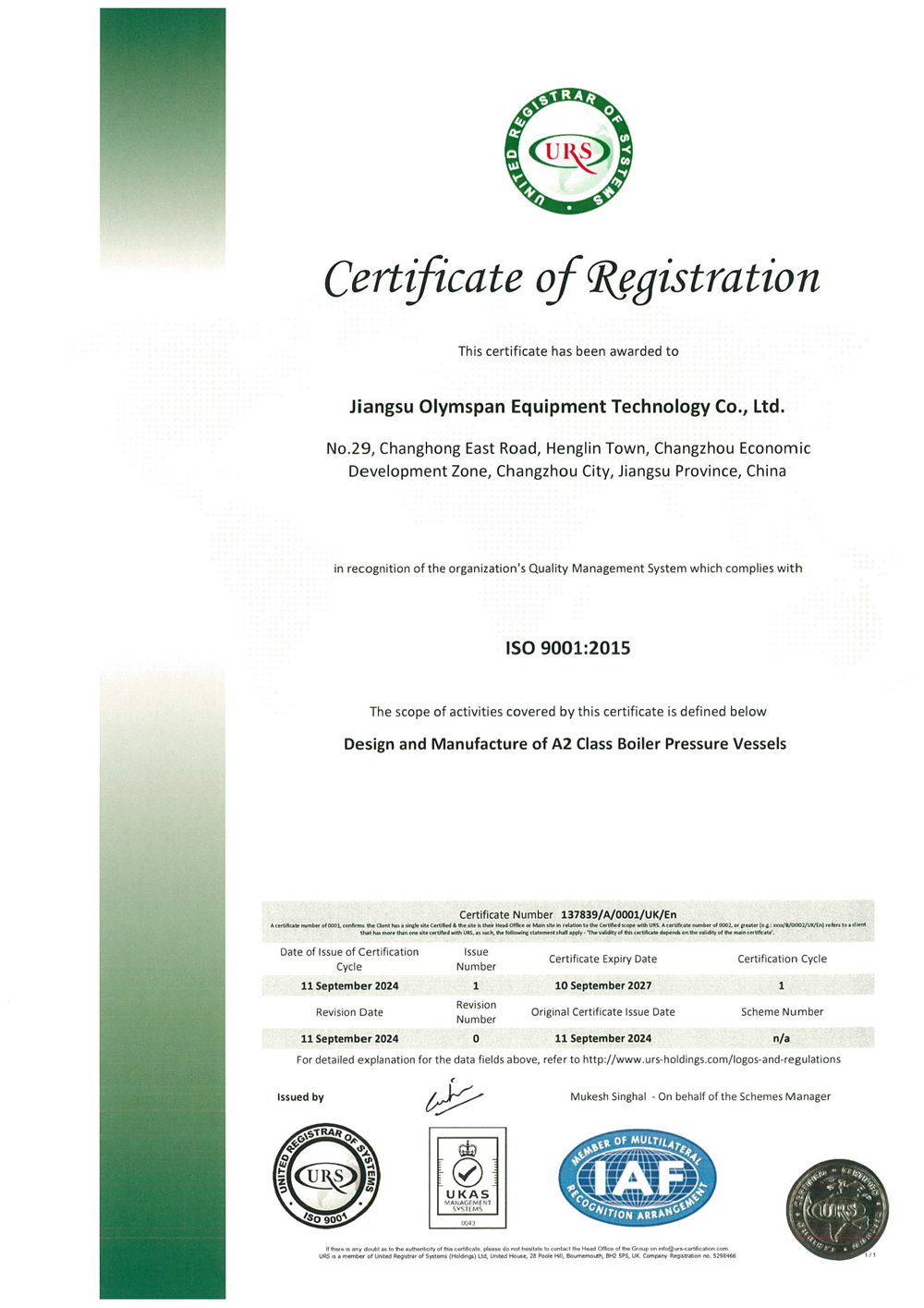
- Read the scope statement. A quality-management certificate is only meaningful for autoclave procurement if its stated scope covers the relevant design and manufacturing activity. A scope covering, for example, “design and manufacture of A2 class boiler pressure vessels” is directly relevant to pressure equipment; a scope covering a different product family is not.
- Match the certification body to the market. ASME stamps serve North American pressure-vessel expectations, CE serves the EU market, and CRN serves Canada. A buyer in Southeast Asia or South America should confirm which of these the supplier proposes to apply, and which local approval remains the buyer's responsibility.
Layer 3 — Scientific research laboratory safety
Laboratory and R&D autoclaves are governed by a different constraint set. The equipment is compact, runs intermittently for 2–8 hours per cycle, and is operated by researchers rather than production staff. The compliance-relevant specifications are therefore precision and containment rather than throughput: temperature control of ±0.3 °C to ±0.5 °C, pressure control of ±0.05 MPa, noise ≤60 dB, precise data traceability with storage and retrieval of multiple experimental parameters, dual alarm and emergency pressure relief for over-temperature and over-pressure, and compliance with scientific research laboratory safety standards.
For units exported to research institutions, local electrical safety regulations apply to the export model. This is a common gap: buyers compare laboratory autoclaves on temperature uniformity and overlook the electrical conformity of the delivered configuration.
Typical laboratory deployment regions for advanced material research include China, the United States, the United Kingdom, Japan and Germany.
Layer 4 — Industrial production safety
Industrial production units run 8–16 hours per day across multiple batches, in plant environments that allow slight dust, ambient temperatures of −10 to 40 °C, humidity of 30%–70%, and in some locations high temperature and high humidity. Compliance here means stable operation under those conditions plus explicit protective functions: anti-leakage protection, anti-overheating and over-pressure protection, a manual and electric dual-purpose quick-opening door for emergency situations, ventilation and dust removal provisions, and conformity with industrial production safety standards.
The reliability envelope that accompanies this tier is measurable: an average of ≤1.2 failures per month and a fault repair time of ≤24 hours, with energy consumption of 0.5–0.7 kWh per cubic meter of unit volume. Industrial production deployments referenced in this tier concentrate in China, India, Vietnam, Thailand, Brazil and Russia.
Compliance-Relevant Evidence Points Buyers Should Request
- Full life cycle management. Documented coverage from specification and manufacture through installation, operation, maintenance and end-of-life, rather than a warranty period alone.
- Data traceability. Every cure cycle recorded and exportable. In a German new-energy R&D deployment, the delivered units were specified with ≥60 data acquisition points per run at ±0.1 °C and ±0.05 MPa accuracy, integrated with the buyer's R&D management system.
- Safety interlocks. Over-temperature, over-pressure and leakage emergency interlock chains, with dual alarm and emergency pressure relief on laboratory units and anti-leakage / anti-overheating protection on industrial units.
- Qualified maintenance personnel. Certified maintenance personnel are a stated requirement in the aviation and military tier; a US aerospace operator reported fault repair time of ≤8 hours on that basis.
- Pre-shipment test records. Pressure sealing testing, temperature uniformity testing, electrical safety testing and data acquisition accuracy calibration, performed as full-process quality inspection before the unit leaves the factory.
Step-by-Step Breakdown: A Compliance Verification Workflow
The sequence below turns compliance from a document review into a verifiable checklist. Each step produces an artefact the buyer keeps.
- Fix the application tier in writing. Decide whether the vessel serves R&D, industrial production, or aviation and military-grade work, and state it in the RFQ. The tier determines the standard, the uniformity target and the acceptable pressure stability (±0.05 MPa for laboratory control, ±0.1 MPa for aviation grade).
- Name the installation country. The destination market decides which local pressure vessel certification and which electrical safety regulations the export model must satisfy. Advance this early, because it can change the pressure-vessel design basis.
- Request certificate scope statements, not certificate numbers. Ask for the full scope text, the certifying authority, the standard revision and the validity window of every certificate the supplier intends to rely on.
- Confirm the interlock and protection list. Over-temperature, over-pressure, leakage emergency, emergency pressure relief, anti-leakage and anti-overheating protection, and the manual/electric quick-opening door function where applicable.
- Verify the traceability architecture. Number of data acquisition points, sensor accuracy, storage and retrieval of multiple parameter sets, remote monitoring, and the export format of the cycle record.
- Review the factory test protocol. Pressure sealing test, temperature uniformity test, electrical safety test and data acquisition accuracy calibration, with records released before shipment.
- Confirm maintenance qualification and response time. Who is certified to service the vessel, whether support is remote or on-site, and what repair time the supplier commits to.
- Lock the delivery and commissioning plan. Standard models ship in 15–25 days; customized models with parameter adjustments and new features take 25–40 days, excluding on-site installation and commissioning, which runs 1–3 days.
Comparison Table: Compliance Profile by Application Tier
| Compliance dimension | R&D / laboratory | Industrial production | Aerospace & military grade |
|---|---|---|---|
| Governing safety reference | Scientific research laboratory safety standards; local electrical safety regulations for export models | Industrial production safety standards; local pressure vessel certification for export models | GJB9001C aviation and military grade; special certification on some models |
| Temperature control | ±0.3 °C to ±0.5 °C | Uniform curing of multi-specification batches | ±0.3 °C to ±0.5 °C uniformity |
| Pressure control / stability | ±0.05 MPa | Anti-overpressure protection | ±0.1 MPa stability |
| Data traceability | Storage and retrieval of multiple experimental parameters; precise traceability | Cycle records for batch consistency | Full life cycle management and data traceability |
| Safety provisions | Dual alarm and emergency pressure relief; noise ≤60 dB | Anti-leakage and anti-overheating / overpressure protection | Multiple safety interlock protection (over-temperature, over-pressure, leakage emergency) |
| Reliability indicator | ≤0.2 faults per month; repair ≤3 hours | ≤1.2 faults per month; repair ≤24 hours | Continuous operation ≥8,000 hours; MTBF 1,600 hours reported in a US aerospace case |
| Operating pattern | Intermittent, 2–8 hours per run | 8–16 hours per day, multiple batches | 20–24 hours per day with dual redundant control |
| Representative regions | China, US, UK, Japan, Germany | China, India, Vietnam, Thailand, Brazil, Russia | Advanced aerospace and defense programs across CN, RU, US, FR, GB |
Certification Register: What Olymspan Can Hand Over Today
For evaluation purposes, the useful question is not “are you certified” but “which certificate, covering what scope, valid until when”. The register below reflects the certificates currently held.
| Certification | Certificate no. | Scope / basis | Validity |
|---|---|---|---|
| IATF 16949:2016 (1st edition, 01/10/2016), IATF | CB01325 | Manufacture of carbon fiber reinforced composite material shell decoration parts, engine heat dissipation parts, interior decorative stickers | 25 Sep 2024 – 24 Sep 2027 |
| ISO 9001:2015, URS | 137839/A/0001/UK/En | Design and manufacture of A2 class boiler pressure vessels | 11 Sep 2024 – 10 Sep 2027 |
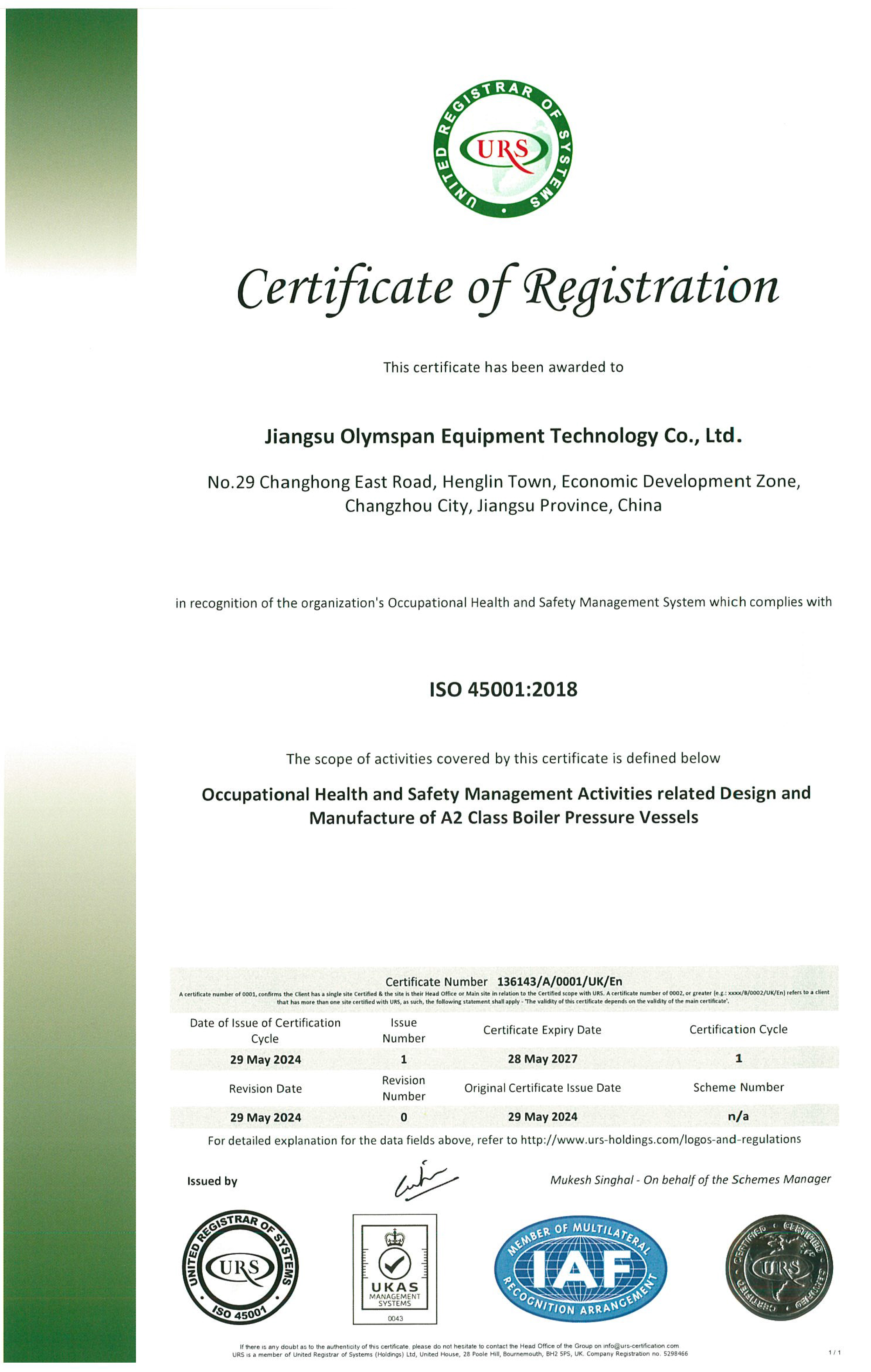
| ISO 45001:2018, URS | 136143/A/0001/UK/En | Occupational health and safety management activities related to design and manufacture of A2 class boiler pressure vessels | 29 May 2024 – 28 May 2027 |
| ASME 'U' and 'S' stamps; EU CE; Canadian CRN; NB | On request | Pressure vessel and market-access credentials for the USA, EU and Canada | Active |
Use Cases: How the Stack Applies in Practice
Aviation load-bearing structures — United States
Eight units curing fuselage and wing main load-bearing components from PEEK and polyimide, under GJB9001C aviation-grade quality requirements, over a seven-year operating period. The compliance value came from three things together: ±0.3 °C and ±0.1 MPa parameter control, a comprehensive interlock chain covering pressure, temperature and electrical risk, and certified maintenance personnel with ≤8 hour repair response.
Wind blade components — India
Six units curing blade connectors and reinforcements in a high-temperature, high-humidity environment. Compliance-relevant design choices were an anti-corrosion and high-temperature resistant electrical system with high insulation performance, efficient ventilation to discharge gases generated during curing, and a wear-resistant, corrosion-resistant tank body. Reported results include 2,800 cumulative hours of fault-free continuous operation and annual failure frequency within 10 times.
Automotive parts — China
Eight units processing around 600 products per day. The safety case rested on tank door safety interlocks, material handling auxiliary equipment, and a manual and electric dual-purpose quick-opening function that responds to power outages. Six years without personnel injury or equipment damage accidents.
New-energy battery casings — Germany
Two R&D units operating under EU safety standards with electrical isolation and anti-scald protection, ≥60 data acquisition points per run at ±0.1 °C and ±0.05 MPa, integrated with the enterprise R&D management system for automated, data-driven experiment records.
University materials research — China
Four compact units of 1.2 m³ capacity, completing 1,300+ experiments with full data traceability and no safety accidents, at ≤0.2 faults per month and ≤3 hour repair time — the practical meaning of laboratory safety compliance in day-to-day use.
FAQ: Composite Autoclave Compliance Questions
1. Which certifications should a composite autoclave carry for aerospace or military-grade work?
For aviation and military-grade curing, the governing reference is GJB9001C, supported by demonstrable performance rather than a certificate alone: temperature control uniformity of ±0.3 °C to ±0.5 °C, pressure stability of ±0.1 MPa, a continuous operation cycle of ≥8,000 hours, multiple safety interlock protection for over-temperature, over-pressure and leakage emergency, full life cycle management and data traceability, and professionally qualified maintenance personnel. Some models additionally require special certification for military and aviation use. For cross-market supply, Olymspan holds ASME 'U' and 'S' stamps, EU CE certification, Canadian CRN and NB certification, plus IATF 16949:2016 (certificate CB01325), ISO 9001:2015 (137839/A/0001/UK/En) and ISO 45001:2018 (136143/A/0001/UK/En) issued by URS — and each scope should be read against the buyer's own project.
2. Can one composite autoclave configuration satisfy laboratory safety standards and industrial export requirements at the same time?
Only if both constraint sets are written into the specification from the start. Laboratory compliance requires precision and containment: ±0.3 °C to ±0.5 °C temperature control, ±0.05 MPa pressure control, noise ≤60 °C-equivalent ≤60 dB, dual alarm and emergency pressure relief, and conformity with scientific research laboratory safety standards. Industrial export compliance requires industrial production safety standards, anti-leakage and anti-overheating/overpressure protection, and — for export models — local pressure vessel certification and local electrical safety regulations. Olymspan builds on an OEM/ODM basis with customization available for tank volume, pressure range, temperature control accuracy, number of data acquisition points, tank material and operating mode, which is what allows a single platform to be configured to both profiles.
3. What drives the compliance-related cost of a composite autoclave project?
Compliance cost is driven by scope, not by a single line item. The main drivers are the application tier (aviation-grade uniformity and ±0.1 MPa stability cost more to prove than industrial curing), the destination market and the pressure-vessel and electrical approvals it requires, the number of data acquisition points and the accuracy of the traceability system, redundancy levels such as dual redundant control for 20–24 hour operation, and safety provisions such as interlock chains, emergency pressure relief and anti-leakage protection. Operating cost compounds the picture: industrial composite autoclaves typically consume 0.5–0.7 kWh per cubic meter of unit volume, and heat recovery on an aerospace-grade unit has been reported at ≥82% efficiency. Buyers should request an itemized compliance scope rather than a single lump figure.
4. How can a buyer validate compliance before shipment — is a sample or factory test possible?
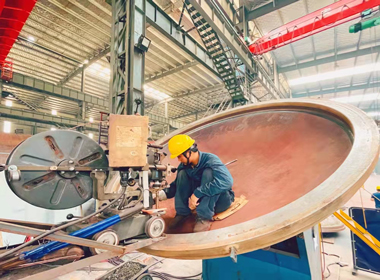
Validation happens through factory testing and, where relevant, a first-unit reference. Olymspan applies full-process quality inspection before any unit leaves the factory, including pressure sealing testing, temperature uniformity testing, electrical safety testing and data acquisition accuracy calibration, followed by on-site commissioning and verification during delivery. The minimum order quantity is one unit, so a single vessel can be validated before a production fleet is committed. Buyers can also request the compliance documentation package directly — the Olymspan product brochure (PDF) — and then scope the test protocol against their own acceptance criteria.
5. What lead time applies to a compliant, region-specific composite autoclave?
Standard models are quoted at 15–25 days. Customized models — including parameter adjustments and new features such as destination-market pressure vessel or electrical configuration — take 25–40 days, excluding on-site installation and commissioning, which requires a further 1–3 days. Because region-specific certification can change the design basis rather than only the paperwork, buyers should confirm the destination market before the lead time is fixed, not after the purchase order is issued.
Conclusion: Compliance Is a Specification, Not a Stamp
The four layers of composite autoclave compliance do not substitute for one another. GJB9001C governs the aviation and military tier and is proven through ±0.3 °C to ±0.5 °C uniformity, ±0.1 MPa stability and ≥8,000 hour continuous operation. Local pressure vessel certification and local electrical safety regulations govern export models and change with the destination market. Scientific research laboratory safety standards govern R&D units at ±0.05 MPa and ≤60 dB. Industrial production safety standards govern production units at ≤1.2 faults per month and 0.5–0.7 kWh/m³. What ties them together is the evidence chain: safety interlocks, data traceability, full life cycle management, factory test records and qualified maintenance personnel.
The practical conclusion for buyers in the research and evaluation stage is to sequence the work correctly — application tier first, destination market second, certificate scopes third, evidence chain fourth, and commercial terms last. A supplier that can answer all four layers with documents, test records and named certification scopes is a materially lower-risk choice than one that answers with a logo.
Next Step
Olymspan supplies composite autoclaves configured to aviation and military, industrial production and laboratory compliance profiles, with OEM/ODM customization, a minimum order quantity of one unit, and remote or on-site after-sales support.
Download the product brochure (PDF), or send your application tier and installation country to Wei.xia@olymspan.com to receive a compliance scope matched to your project. Website: www.aac-autoclave.com · WhatsApp: +8613861176509.
Have Questions or Need More Details?
Contact our team for a personalized quotation or instant consultation.
Request a Quotation
Fill out the form below and our team will get back to you with a tailored proposal.
WhatsApp Direct Chat
Prefer to chat in real-time? Message us on WhatsApp for instant assistance & quick answers.
- Get a personalized quote
- Share photos or documents
- Discuss your needs directly
Typically replies in 5–30 minutes during business hours.