
Composite Autoclave Compliance: GJB9001C & Export Standards
Composite Autoclave Compliance: GJB9001C & Export Standards
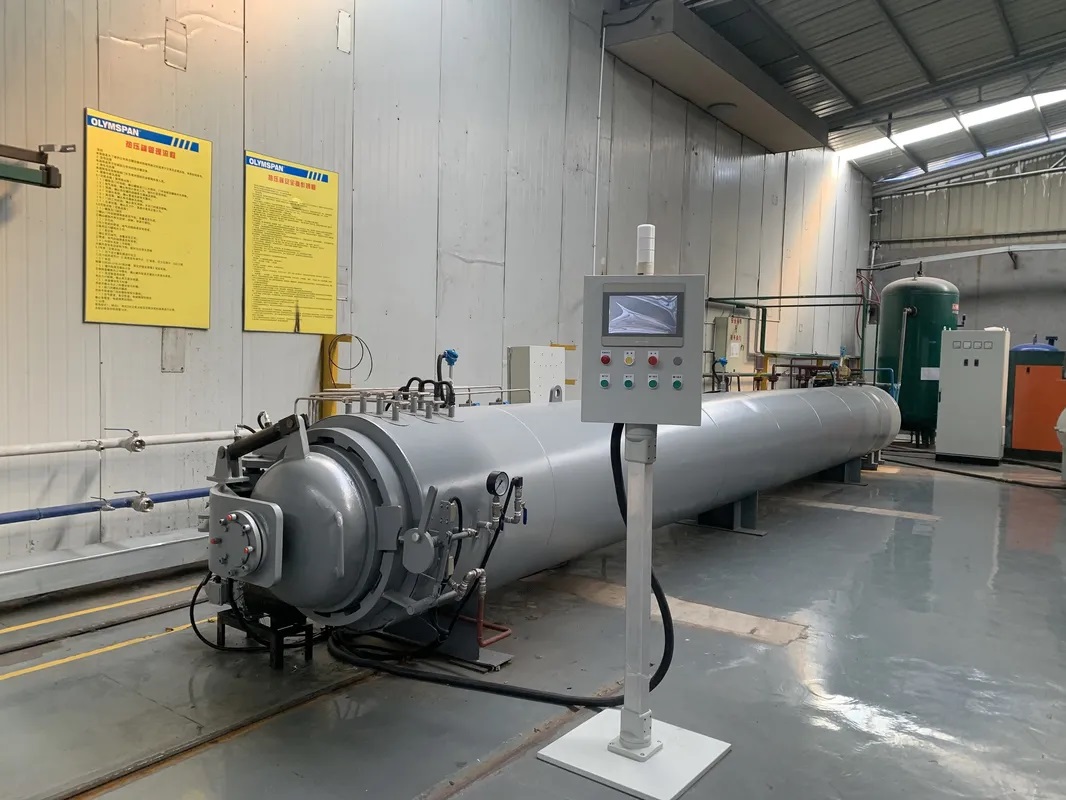
Composite autoclaves are released to service on the strength of their compliance file — pressure vessel code, quality system, electrical scope and maintenance qualification.
A composite autoclave is released to service on the strength of its documentation, not only on its temperature and pressure rating. Two units with identical process windows can end up in completely different positions: one is commissioned in a European research laboratory without a single additional approval, while the other is held at the port because the pressure vessel code marked on its nameplate is not the code the destination authority accepts.
This guide maps the compliance tracks that actually govern composite autoclave procurement: laboratory units bound by local electrical safety and laboratory safety rules, military-grade units built to GJB9001C quality requirements, and export units that must satisfy destination pressure vessel acceptance — for example ASME BPVC Section VIII for the United States and PED 2014/68/EU (EN 13445) for the European Union. It closes with the part of compliance that is most often left to the last minute: qualified maintenance personnel.
Olymspan (Jiangsu Olymspan Equipment Technology Co., Ltd), founded in 2004 in Henglin Town, Changzhou, Jiangsu, China, designs and manufactures composite autoclaves, carbon fiber products, carbon fiber drones and tube heat exchangers. The company operates a 66,000 m² facility with 350 employees, including a 25-engineer R&D team, and exports 30%–40% of its output to North America, South America, Western Europe, Eastern Europe, Eastern Asia, Southeast Asia, the Middle East, Africa and Oceania.
Why compliance gaps surface after the technical specification is signed
Most composite autoclave specifications are written around process performance: working temperature, working pressure, chamber diameter and length, heating rate, vacuum capability and temperature uniformity. Those parameters decide whether the machine can cure the part. Compliance decides whether the machine can be installed, insured and operated at all.
Four separate obligations attach to every unit, and each one is owned by a different party in the project:
- The pressure envelope must be designed and fabricated to a code the destination authority recognises — ASME BPVC Section VIII (Division 1 or 2) in the United States, or PED 2014/68/EU with EN 13445 in the European Union. Markets outside these two regimes apply their own acceptance route, normally confirmed through the importer of record.
- The electrical and control scope must satisfy the electrical regime of the destination market and, for installed machinery, the electrical safety rules of the host site. Laboratory installations add a second layer, because the host institution applies its own laboratory safety practice on top of the equipment's safety interlocks.
- The quality management system under which the unit was designed and built must match the end application: automotive programmes expect automotive quality management, military and aviation-grade programmes expect GJB9001C, and pressure vessel fabrication expects a design-and-manufacture scope such as ISO 9001:2015.
- The operating organisation must be able to maintain the equipment. Professional maintenance qualifications are part of operational compliance, not an optional add-on.
The scope line on a certificate matters as much as the certificate
Certificates are commonly quoted in tenders by their logos. The information that decides a project sits in three fields instead: the registration number, the issuing authority, and the scope statement.
Olymspan's IATF 16949:2016 registration (certificate number CB01325, issued by IATF, valid from 25 September 2024 to 24 September 2027) is scoped to the manufacture of carbon fiber reinforced composite material shell decoration parts, engine heat dissipation parts and interior decorative stickers. That is a precise scope statement: it tells an automotive buyer exactly which part families the registration covers, and it does not claim to cover every product the company builds.
The two URS registrations follow the same logic. The ISO 9001:2015 certificate (registration 137839/A/0001/UK/En, issued 11 September 2024, valid to 10 September 2027) covers the design and manufacture of A2 Class Boiler Pressure Vessels. The ISO 45001:2018 certificate (registration 136143/A/0001/UK/En, issued 29 May 2024, valid to 28 May 2027) covers occupational health and safety management activities related to the same design and manufacturing scope. Read together, they answer the two questions an export buyer asks first: who is accountable for the pressure envelope, and how is the people-safety side of that work managed.
Practical rule: ask for the certificate number, the issuing authority, the scope wording and the expiry date in writing — then check that the scope wording matches the equipment being purchased, not only the supplier's product catalogue.
Industry background: why compliance scrutiny is rising
Composite curing autoclaves are a growing equipment category, and the growth is concentrated in export-heavy supply chains. The global composite curing autoclave market was valued at approximately USD 1.37 billion in 2023 and is projected to reach USD 2.4 billion by 2033, a CAGR of 10.2%. A narrower segment — autoclaves for composite materials specifically — was valued at USD 86.2 million in 2024 and is expected to reach USD 127 million by 2032 at a CAGR of 5.8%. The gap between the two figures reflects how much of the demand comes from integrated industrial autoclave programmes rather than stand-alone composite curing equipment.
Aerospace remains the compliance anchor for the category: composite autoclaves accounted for 62.4% of the total aircraft autoclave market share as of 2025, driven by CFRP adoption in Boeing 787 and Airbus A350 programmes. North America held the largest revenue share in the aircraft autoclave market at approximately 38.2% in 2025, with significant growth continuing in Asia-Pacific. Manufacturers active in this segment include ASC Process Systems, Bondtech, Akarmak, Olmar and Olymspan.
When a category becomes multi-jurisdictional, acceptance regimes fragment. A unit engineered for one market may need a different code marking, a different inspection scope, a different electrical enclosure and a different documentation language for another. That fragmentation is the reason compliance has to be treated as a design input at quotation stage rather than a shipping formality.
The four-layer compliance stack for composite autoclaves
Layer 1 — Pressure vessel design code and destination acceptance
The pressure envelope is the first compliance layer and the one with the least flexibility once fabrication begins. Industrial composite autoclaves must comply with ASME BPVC Section VIII (Division 1 or 2) for the United States market and with PED 2014/68/EU (EN 13445) for the European market. Olymspan holds ASME "U" and "S" stamps, CE (PED) marking and CRN registration for Canada, alongside its ISO and IATF registrations. On the product side, the composite autoclave range is offered with a Q345R carbon steel vessel (or customised material) and ASME or customised certification, which allows the vessel code to be matched to the destination rather than fixed at the factory default.
For markets that are not covered by a single widely applied code, the pressure vessel acceptance route is defined by the import authority and confirmed through the importer of record. Buyers should resolve this question before the hydraulic test, because a change of code after fabrication is effectively a rebuild rather than a documentation update.
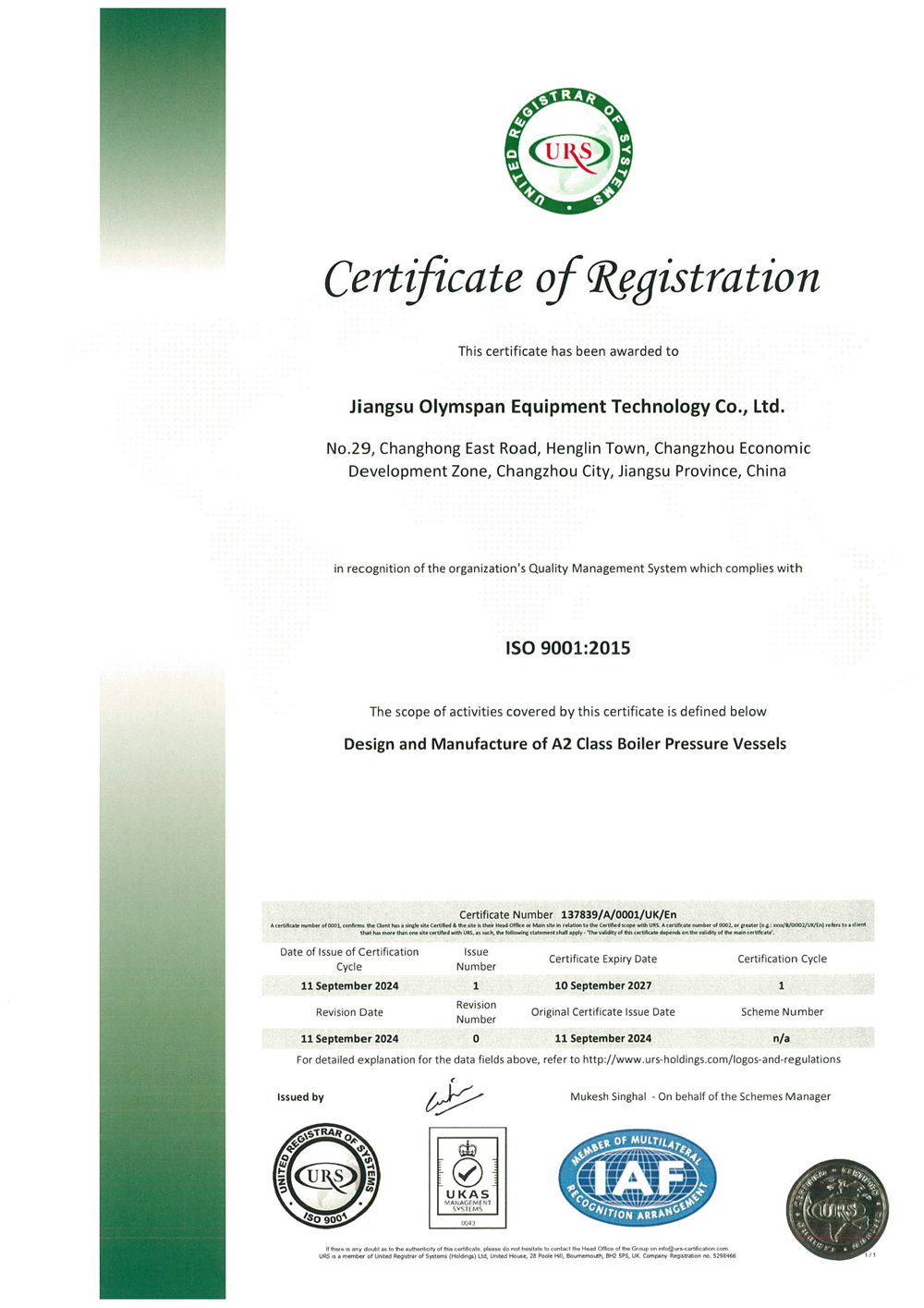
URS ISO 9001:2015 registration 137839/A/0001/UK/En — design and manufacture of A2 Class Boiler Pressure Vessels, valid to 10 September 2027.
Layer 2 — Quality management system matched to the end application
The second layer determines who audits the manufacturing process and against which standard. Three distinct regimes appear in composite autoclave procurement:
- Military and aviation-grade programmes work to GJB9001C quality requirements, the standard referenced in Olymspan's United States aerospace installation covering main load-bearing fuselage and wing components cured from advanced high-temperature composite materials such as PEEK and polyimide.
- Automotive programmes expect automotive quality management; Olymspan's IATF 16949:2016 registration (CB01325) supports carbon fiber reinforced composite part manufacture for automotive supply chains.
- Pressure vessel fabrication is governed by the design-and-manufacture scope carried under ISO 9001:2015, with occupational health and safety managed under ISO 45001:2018.
The practical consequence for buyers is that the quality system should be named in the purchase specification. If the end customer is an aerospace prime, a general industrial quality system is not a substitute for GJB9001C; if the end customer is a vehicle manufacturer, an IATF registration with the wrong scope will not satisfy the customer's supplier quality function.
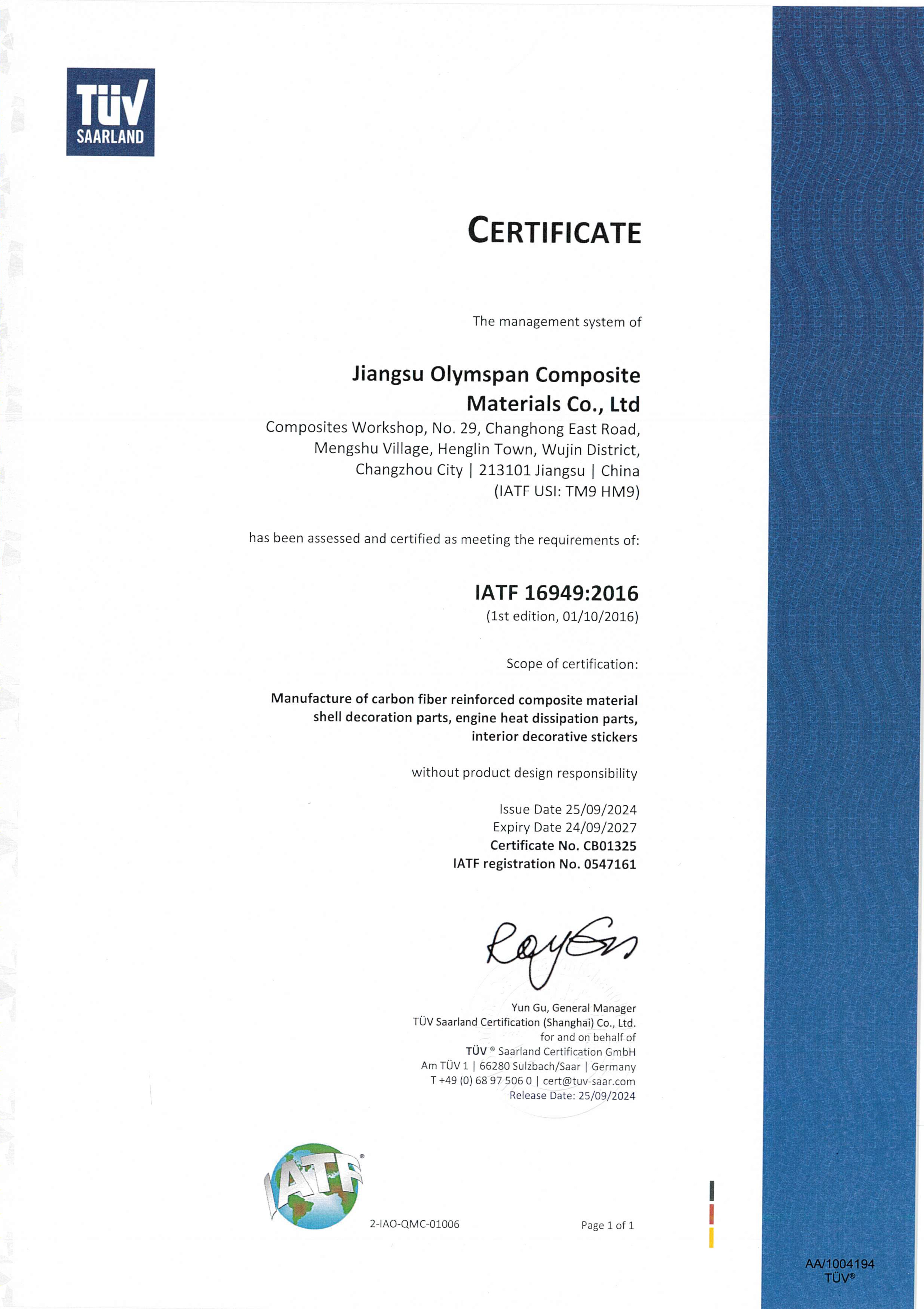
IATF 16949:2016 registration CB01325, issued by IATF, valid from 25 September 2024 to 24 September 2027.
Layer 3 — Electrical safety and the control scope of supply
Electrical requirements are set per destination market, and they are frequently the last item to be confirmed and the first to cause a delay at commissioning. Three separate checks belong in every electrical scope:
- Destination acceptance. The authority having jurisdiction determines which electrical safety regime the control panel, heating circuits and instrumentation must satisfy. This is a market-level question, and the answer changes the panel build, the component selection and the documentation language.
- Pre-shipment electrical verification. Olymspan's quality control process includes a full inspection before the unit leaves the factory, covering pressure sealing testing, temperature uniformity testing, electrical safety testing, and data acquisition accuracy calibration. Electrical safety testing before shipment is what converts a design claim into an inspected fact.
- Site and laboratory rules. Equipment delivered to a university or corporate research laboratory inherits the host institution's laboratory safety rules on top of its own interlocks. European installations supplied by Olymspan are configured to EU safety standards with electrical isolation and anti-scald protection as part of the safety package.
Layer 4 — Operational compliance: installation, commissioning and qualified maintenance staff
The fourth layer determines whether the compliance file stays valid after handover. Two elements belong to it.
Commissioning and verification. On-site debugging and verification are carried out during delivery, with installation and debugging typically requiring 1–3 days in addition to the manufacturing lead time. Verification at this stage confirms that installed performance matches inspected performance.
Maintenance personnel qualification. Autoclaves operate at elevated temperature and pressure, so maintenance is a regulated activity inside most operating organisations. In Olymspan's United States aerospace installation, maintenance personnel are professionally certified, the manufacturer conducts regular follow-up visits, and the contractual fault repair time is ≤ 8 hours. Across that programme, parameters are held within ± 0.1 MPa and ± 0.3 °C, time between failures (MTBF) reaches 1,600 hours, and no safety accidents have occurred over seven years of operation — outcomes that depend on qualified maintenance as much as on equipment design.
Export delivery stage: the compliance file travels with the equipment, including pressure vessel documentation and electrical verification records.
Step-by-step: a six-step compliance verification workflow
The workflow below is written for buyers in the Evaluation-to-Execution stage, where the technical configuration is broadly settled and the remaining risk is documentation, jurisdiction and handover.
Step 1 — Classify the unit by application and destination. A laboratory unit follows a different compliance route from a production unit, and an export unit follows a different route again. Classification determines every subsequent step, so it comes first.
Step 2 — Map the destination acceptance regime before requesting a quotation. Confirm the pressure vessel code (ASME BPVC Section VIII for the United States, PED 2014/68/EU with EN 13445 for the European Union, or the route defined by the import authority in other markets) and the electrical regime in the same pass.
Step 3 — Verify certificates by number, authority, scope and validity. Request registration numbers rather than logos: IATF 16949:2016 under CB01325, ISO 9001:2015 under 137839/A/0001/UK/En, and ISO 45001:2018 under 136143/A/0001/UK/En in Olymspan's case. Then compare the scope wording with the equipment being purchased.
Step 4 — Fix the electrical and control scope of supply in writing. Specify which electrical safety regime applies, what testing will be performed before shipment, and which site or laboratory rules the installation must respect. Remote monitoring integration and data synchronisation, where required, belong in this step because they affect the control panel build.
Step 5 — Plan commissioning, training and maintenance qualification before the machine ships. Reserve the installation and debugging window (1–3 days), agree who will attend verification, and confirm how maintenance personnel will be qualified and how remote or on-site support will be delivered.
Step 6 — Define acceptance criteria and commercial terms at contract stage. The minimum order quantity is 1 unit, the acceptance criterion is a pre-shipment test, delivery terms are customised per project, and payment terms include L/C, T/T, Western Union and D/A. Fixing these alongside the compliance classification keeps the commercial envelope aligned with the technical one.
Use cases: how compliance plays out in real installations
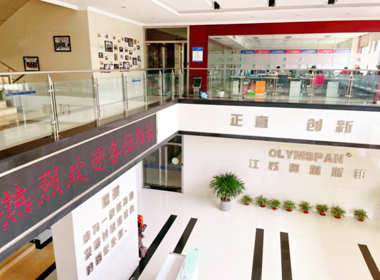
Olymspan's 66,000 m² facility in Henglin Town, Changzhou, Jiangsu, China, where composite autoclaves and pressure vessels are designed and manufactured.
United States — aerospace main load-bearing components (8 units, 7 years). An aerospace manufacturing enterprise curing fuselage and wing main load-bearing components works to GJB9001C aviation-grade quality standards, with maximum temperature of 380 °C and maximum pressure of 15 MPa. The programme has produced more than 3,000 main load-bearing components at a 99.8% qualification rate, with 7,800 hours of continuous operation and an MTBF of 1,600 hours. Risk control covers pressure, temperature and electrical requirements; a dedicated heat recovery device reaches ≥ 82% recovery efficiency.
Germany — new energy vehicle battery casing R&D (2 units, 4 years). An enterprise R&D department in the new energy materials sector uses the equipment to develop composite battery casings. The installation complies with EU safety standards and includes electrical isolation and anti-scald protection. With imported high-precision sensors, data acquisition reaches ≥ 60 points per cycle at ± 0.1 °C and ± 0.05 MPa accuracy. Cured casings achieved a 35% strength increase and a 28% weight reduction, with high-temperature resistance reaching 180 °C; the process debugging cycle was shortened by 40%.
China — university materials research institute (4 units, 5 years). A School of Materials Science and Engineering uses the equipment for new carbon fiber composite formula development across a wide temperature range of −40 °C to 300 °C, with temperature control accuracy of ± 0.5 °C in a 1.2 m³ chamber. Compliance-relevant features include dual over-temperature and over-pressure alarms with emergency pressure relief, and remote data collection that synchronises automatically to the research management system; 1,300+ experiments have been completed with no safety accidents.
India — wind turbine blade components (6 units, 5 years). Small and medium-sized wind power component manufacturers cure blade connectors and reinforcements in a high-temperature, high-humidity environment. The electrical system uses an anti-corrosion and high-temperature resistant design with insulation performance matched to the site, and efficient ventilation discharges gases generated during curing — an environmental risk control requirement rather than a process preference.
China — automotive component production (8 units, 6 years). A composite parts supplier curing steering wheel frames and interior parts processes 600 products per day. Tank door safety interlocks and material handling auxiliary equipment form part of the mechanical risk control package; the qualification rate rose from 92% to 99.2%, and no personnel injury or equipment damage accidents have occurred over six years of operation.
Compliance comparison by unit type and destination
| Unit type / destination | Governing compliance focus | Verified reference | Who confirms it |
|---|---|---|---|
| Laboratory / R&D unit (institutional) | Local electrical safety plus host laboratory safety rules; data traceability | Pre-shipment electrical safety testing and data acquisition accuracy calibration; −40 °C to 300 °C range with ± 0.5 °C control in a documented university installation | Host institution's laboratory safety function and the supplier's commissioning engineer |
| Industrial production unit (automotive parts) | Automotive quality management for the parts produced on the unit | IATF 16949:2016, certificate CB01325, valid 25 Sep 2024 – 24 Sep 2027, scoped to carbon fiber reinforced composite shell decoration parts, engine heat dissipation parts and interior decorative stickers | End customer's supplier quality function |
| Military / aviation-grade unit | GJB9001C aviation-grade quality requirements; high-temperature and high-pressure safety interlocks | Documented US aerospace programme: 380 °C / 15 MPa, certified maintenance personnel, fault repair ≤ 8 hours | Programme quality authority |
| Export unit — United States | Pressure vessel design and fabrication code | ASME BPVC Section VIII (Division 1 or 2); ASME "U" and "S" stamps held by Olymspan | Destination authority, supported by the manufacturer's code documentation |
| Export unit — European Union | Pressure equipment directive plus EU electrical safety features | PED 2014/68/EU (EN 13445); CE (PED); EU-compliant installations include electrical isolation and anti-scald protection | Notified body route confirmed by the importer |
| Export unit — other markets | Destination pressure vessel and electrical acceptance route | CRN registration held for Canada; other markets confirmed per project through the importer of record | Importer of record with the destination authority |
| Manufacturing quality system (all units) | Design and manufacture of pressure vessels; occupational health and safety | ISO 9001:2015 registration 137839/A/0001/UK/En (valid to 10 Sep 2027); ISO 45001:2018 registration 136143/A/0001/UK/En (valid to 28 May 2027) | Certification body (URS) and the buyer's audit team |
Frequently asked questions
Which pressure vessel and quality standards apply to a composite autoclave exported to the United States or the European Union?
Industrial composite autoclaves must comply with ASME BPVC Section VIII (Division 1 or 2) for the United States market and with PED 2014/68/EU (EN 13445) for the European market, with markets outside those regimes confirmed through the importer of record. On the quality side, Olymspan holds ISO 9001:2015 (URS registration 137839/A/0001/UK/En) and ISO 45001:2018 (URS registration 136143/A/0001/UK/En) for the design and manufacture of A2 Class Boiler Pressure Vessels, together with ASME "U" and "S" stamps, CE (PED) and CRN registration for Canada. Automotive programmes are supported by IATF 16949:2016 under certificate CB01325.
What does GJB9001C compliance mean for a military-grade composite autoclave?
GJB9001C is the aviation-grade quality standard applied to military-grade composite autoclave programmes, and it changes the documentation, traceability and inspection discipline around the unit rather than the process window alone. In a documented Olymspan installation in the United States, equipment operating under GJB9001C aviation-grade quality standards cured fuselage and wing main load-bearing components at up to 380 °C and 15 MPa. The programme recorded more than 3,000 components at a 99.8% qualification rate, 7,800 hours of continuous operation, an MTBF of 1,600 hours, and no safety accidents over seven years.
What are the commercial terms and acceptance criteria for a composite autoclave order?
The minimum order quantity is 1 unit. Delivery terms are customised per project, the acceptance criterion is a pre-shipment test, and payment terms include L/C, T/T, Western Union and D/A. Because the acceptance test is performed before shipment, the commercial terms should be fixed after the compliance classification and certificate verification steps, not before — the electrical scope and the pressure vessel code both feed directly into what the pre-shipment test has to demonstrate.
Can a small-scale unit be used to validate a process before a production purchase?
Yes. With a minimum order quantity of 1 unit, a single laboratory or small-scale unit can serve as a pilot installation, and process validation is delivered through pre-shipment testing — pressure sealing testing, temperature uniformity testing, electrical safety testing and data acquisition accuracy calibration — followed by on-site debugging and verification during delivery. In one documented case, a German R&D department validated new energy vehicle battery casing materials on two units with ≥ 60 data acquisition points per cycle at ± 0.1 °C and ± 0.05 MPa accuracy, shortening the process debugging cycle by 40%. Customisation available for this purpose covers tank volume, temperature control accuracy, pressure range, number of data acquisition points, remote monitoring and data synchronisation, tank material, and experimental mode.
How long does delivery, installation and commissioning take?
Standard models are delivered in 15–25 days, and customised models — including parameter adjustments and new features — take 25–40 days, excluding on-site installation and debugging time, which adds 1–3 days. After commissioning, Olymspan provides remote support and on-site after-sales support. To discuss the compliance route for a specific destination market and receive a project-specific quotation, contact Olymspan at Wei.xia@olymspan.com or on WhatsApp at +8613861176509, or review the equipment range at aac-autoclave.com.
Conclusion: compliance is a design input, not a shipping formality
Composite autoclave compliance resolves into four layers that must be settled in order: the pressure vessel code accepted by the destination authority, the quality management system that matches the end application, the electrical scope that satisfies both the market and the site, and the operational discipline that keeps the equipment valid after handover — commissioning verification and qualified maintenance personnel.
For buyers moving from evaluation into execution, the practical sequence is simple and repeatable: classify the unit, map the destination regime, verify certificates by number and scope, fix the electrical scope in writing, plan maintenance qualification, and lock the acceptance criteria at contract stage. Units ordered against that sequence arrive with a compliance file that matches the equipment, the market and the application on the first attempt.
Request a compliance review and quotation
Send your destination market, application and process window, and Olymspan will confirm the applicable pressure vessel code, quality system scope, electrical requirements and delivery schedule for your project. Minimum order quantity: 1 unit. Lead time: 15–25 days for standard models, 25–40 days for customised configurations, plus 1–3 days for installation and debugging.
Email: Wei.xia@olymspan.com | WhatsApp: +8613861176509 | Website: www.aac-autoclave.com
Download the full product brochure: Olymspan composite autoclave brochure (PDF)
Have Questions or Need More Details?
Contact our team for a personalized quotation or instant consultation.
Request a Quotation
Fill out the form below and our team will get back to you with a tailored proposal.
WhatsApp Direct Chat
Prefer to chat in real-time? Message us on WhatsApp for instant assistance & quick answers.
- Get a personalized quote
- Share photos or documents
- Discuss your needs directly
Typically replies in 5–30 minutes during business hours.