
Composite Autoclaves 101: Types, Uses, and Buying Basics
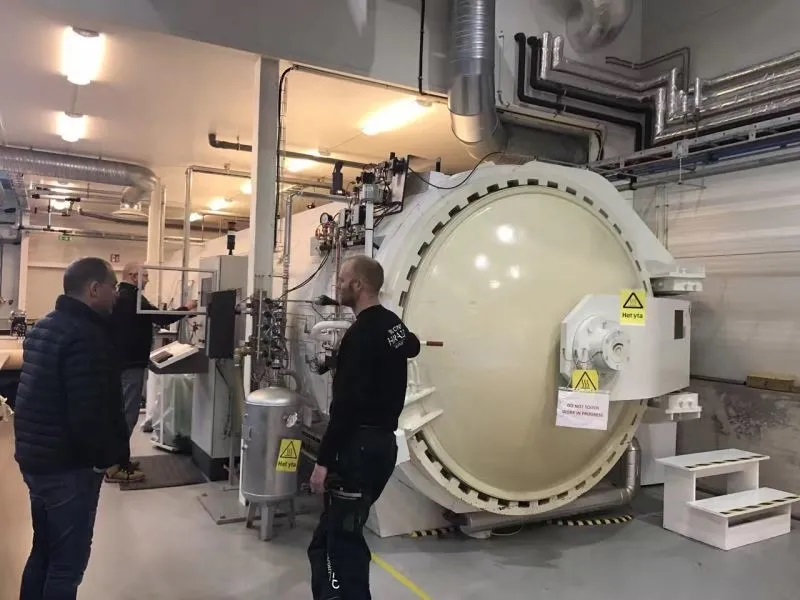
A composite autoclave is a heated pressure vessel that cures advanced composite materials, most commonly carbon fiber prepreg, under controlled temperature, pressure, and vacuum. It is the established production method for structural composites: heat activates resin curing, pressure consolidates the prepreg plies, and vacuum removes entrapped air and volatiles. The result is a part with high fiber consolidation and low void content.
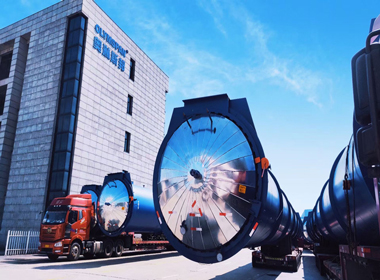
Olymspan is the equipment brand of Jiangsu Olymspan Equipment Technology Co., Ltd., a manufacturer based in Henglin town, Changzhou, Jiangsu province, China. Founded in 2004 and operating as a subcompany of the WULIN group, the company focuses on the design and manufacture of industrial equipment including aerospace autoclaves and composite curing autoclaves, and specializes in composite autoclaves for carbon fiber products. Its product range also includes carbon fiber products, carbon fiber drones, and tube heat exchangers. The manufacturing facility covers 66,000 square meters, employs approximately 350 people, and includes an R&D team of 25 engineers. Export business accounts for 30–40% of total sales, with markets in North America, South America, Western Europe, Eastern Europe, Eastern Asia, Southeast Asia, the Middle East, Africa, and Oceania.
Why 'a composite autoclave' is not one product
Search results for composite autoclave return laboratory units, mid-size production tanks, and aviation-grade pressure vessels under the same category name. These machines differ in temperature and pressure ratings, control architecture, certification, operating cycle, and energy consumption. A university lab validating a new resin system, an automotive parts plant curing battery shells, and an aerospace manufacturer curing primary structures need different equipment.
Buying without a framework carries two opposite risks. An under-specified autoclave cannot hold the temperature uniformity and pressure stability that prepreg curing requires, which can appear as porosity, thickness variation, or rejected parts. An over-specified aviation-grade system with ASME stamping, redundant controls, and a large internal volume raises capital and operating cost for work that does not need it. The sections below separate the categories by facts: what each type is, which industries use it, and which parameters define it.
Industry background: why composite autoclaves matter now
The global composite curing autoclave market was valued at approximately USD 1.37 billion in 2023 and is projected to reach USD 2.4 billion by 2033, a compound annual growth rate of 10.2%, according to Kings Research. A narrower estimate from Market Research Future values autoclaves for composite materials at USD 86.2 million in 2024, with a forecast of USD 127 million by 2032. The gap between the two figures mainly reflects differences in product scope between reports.
Aerospace is the dominant demand driver. Composite autoclaves account for 62.4% of the total aircraft autoclave market as of 2025, driven by carbon-fiber-reinforced polymer adoption in programs such as the Boeing 787 and Airbus A350, according to Dataintelo. North America holds the largest regional revenue share at approximately 38.2% in 2025. Market research compilations list ASC Process Systems, Bondtech, Akarmak, Olmar, and Olymspan among leading global manufacturers of composite autoclaves.
An honest limitation. Autoclave curing is a batch process with high energy demand compared with some out-of-autoclave alternatives. For non-structural parts, oven curing and other routes can be evaluated. For prepreg-based primary structures and high-performance parts, the autoclave remains the reference process.
What a composite autoclave does: the Olymspan product range
Olymspan’s composite autoclave line is a series of pressure-vessel curing systems configurable from laboratory scale to large aviation-grade tanks. The core function is the same across the range: to create a controlled high-temperature, high-pressure environment that cures prepreg and other composite materials into finished components.
Core systems in an Olymspan composite autoclave
- Pressure vessel: Q345R carbon steel as standard, or customized material; PED-certified material is used on the ASME-range models.
- Heating and cooling: heating, cooling, and air ducting mounted under the floor, a design used to improve temperature distribution and save floor space.
- Control system: PLC control on standard models; the World Lead CPC system on professional configurations; dual-redundant control for aerospace-class operation.
- Vacuum and auxiliary systems: vacuum system for volatiles removal; inert gas protection, emergency pressure relief, and full-process quality traceability available on aerospace configurations.
- Certification options: ASME, ISO9001, CE, PED, or customized certification depending on the destination market.
Documented models and parameters
- Full Automatic ASME Composite Autoclave For Aerospace And Automotive — working temperature 150 °C, working pressure 1.3 MPa, diameter 2.0 m or customized, length 5 m or customized, PED-certified material, 14-month warranty.
- High Pressure Composite Autoclave φ 3.5MX18M, Aerospace Autoclave — a large-capacity, high-pressure vessel for aerospace-scale parts.
- Professional Composite Curing Autoclave With World Class Engineering And Unique System Design — ISO9001, ASME, and CE options, internal insulation, delivery time 45 days, supply ability 30 sets per month.
- Composite Materials Pressure Vessel Autoclave Temperature With Plc Control System — PLC-controlled pressure-vessel curing.
- Laboratory Small Composite Material Vacuum Composite Autoclave and Composite Material Product Experimental Composite Autoclave — compact units for laboratories and R&D.
- Civil Fully Automatic Composite Autoclave, Composite Material Vacuum Motorcycle Parts Composite Autoclave, Large Carbon Fiber Curing Molding High-Temperature and High-Pressure Tank, and Hydraulic Door Opening Carbon Fiber Travel Box Composite Autoclave — production-oriented configurations for civilian and industrial parts.
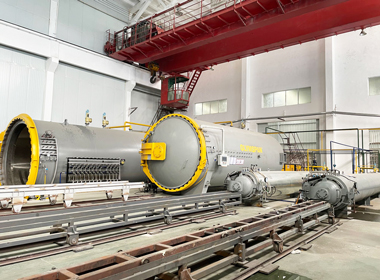
This range means the three tiers that buyers actually compare — experimental, small-to-medium industrial, and aviation-grade — can be evaluated from the same manufacturer’s published specifications.
How autoclave curing works: a step-by-step breakdown
- Layup and vacuum bagging. Prepreg plies are laid up on a tool and sealed in a vacuum bag with release and breather materials.
- Loading. The bagged tool is placed inside the vessel and connected to the vacuum system.
- Vacuum. A vacuum pump removes air and volatiles from the bag before and during the early heating phase.
- Heating. The control system raises the vessel temperature to the cure temperature following the material’s cure recipe; under-floor heating and ducting circulate the gas uniformly around the tool.
- Pressurization. Inert gas or compressed air pressurizes the vessel. Pressure transfers to the part through the bag, consolidating the plies and suppressing void growth while the resin cures.
- Cure dwell. Temperature and pressure are held for the time the resin system specifies.
- Cooling and venting. The vessel cools to the recipe’s requirement, and pressure is vented before opening.
- Demolding and inspection. The cured part is removed; cycle data can be stored for traceability.
Part quality depends above all on steps 4 and 5. That is why aerospace specifications for Olymspan autoclaves call for temperature control uniformity of ±0.3 to ±0.5 °C, pressure stability of ±0.1 MPa, continuous operation cycles of ≥8000 hours, and multiple safety interlocks. Laboratory units target temperature control of ±0.3 to ±0.5 °C and pressure control of ±0.05 MPa.
Use cases: where each type of composite autoclave is applied
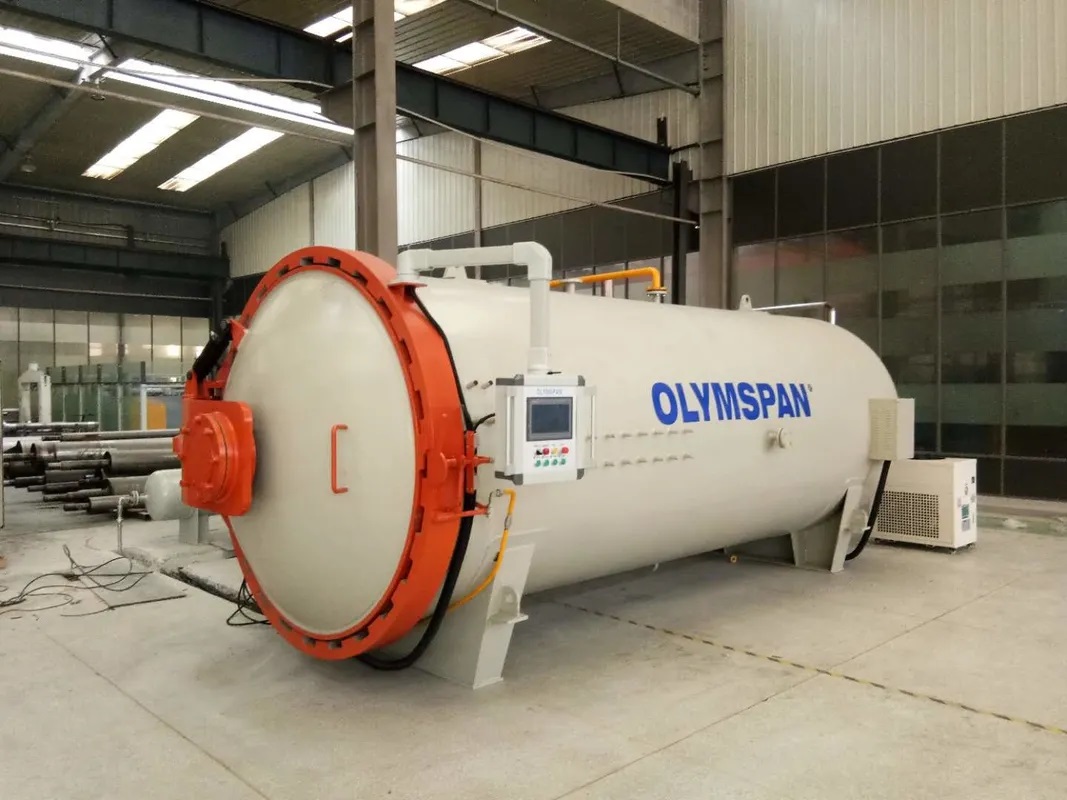
Aerospace, defense, and high-end medical
Olymspan composite autoclaves are used in aerospace manufacturing, high-end military manufacturing, and high-end medical equipment (implantable components), including mass production of aircraft main load-bearing components, missile shells, radar covers, and core components of high-end medical equipment, as well as advanced composite material manufacturing. This scenario is common in China, Russia, the United States, France, and the United Kingdom. The operating profile is long-term continuous running of 20–24 hours per day, with fully automated control, remote diagnosis and fault warning functions, and dual-redundant control systems. Some models must comply with GJB9001C aviation and military grade standards, with an optional inert gas protection system and full-process quality traceability.
Automotive, new energy, wind, and civilian composites
In automobile manufacturing (parts matching), new energy (battery shells, photovoltaic modules), wind power (small parts), civilian composite materials (fitness equipment, medical equipment shells), and rail transit parts manufacturing, the equipment runs in a different mode: continuous multi-batch operation of 8–16 hours per day, with automatic feeding, curing, and discharging. This scenario is common in China, India, Vietnam, Thailand, Brazil, and Russia. Product designs for these environments require anti-corrosion capability and must cope with high temperature and high humidity in some scenarios. The specifications emphasize low energy consumption of 0.5–0.7 kWh/m³ per unit volume, stability with an average of ≤1.2 failures per month and fault repair within 24 hours, and a manual-and-electric dual-purpose quick-opening door.
Research and development laboratories
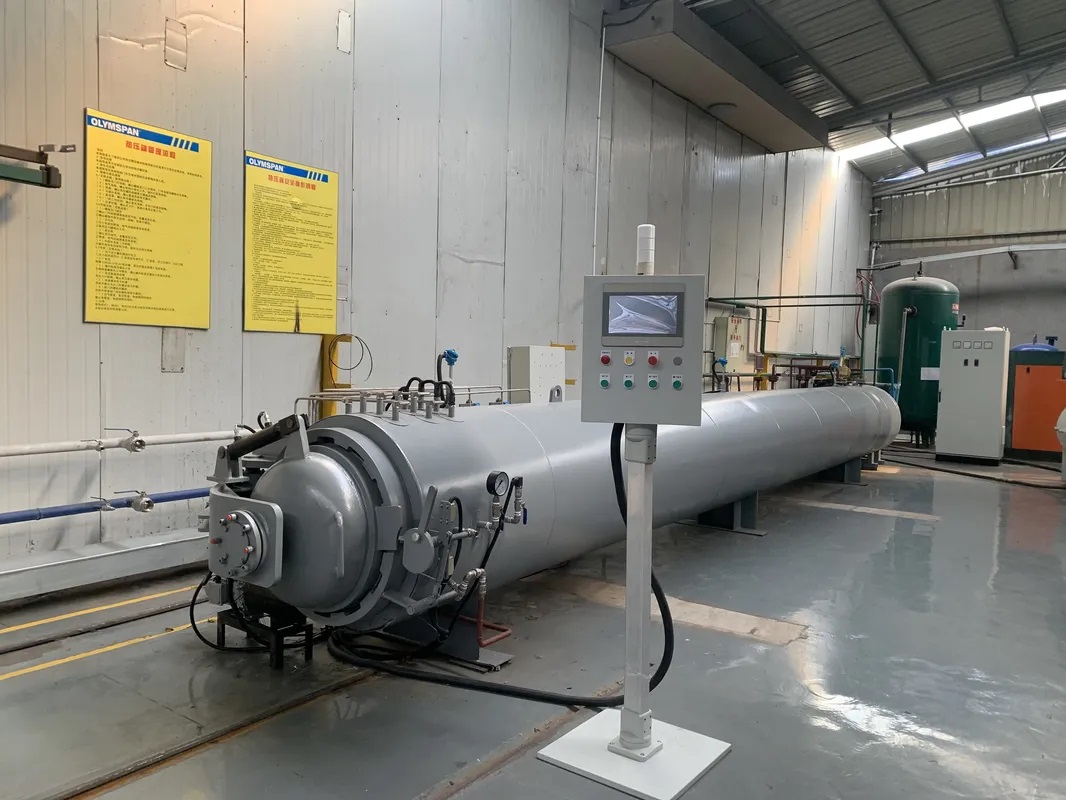
In university research, new material R&D, and enterprise R&D departments — in fields such as new energy materials, composite materials, and polymer materials, covering aerospace material R&D, new energy battery material R&D, and civil composite formula R&D — autoclaves operate intermittently, with single runs of 2–8 hours, manual/automatic dual-mode operation, and remote monitoring. This scenario is common in China, the United States, the United Kingdom, Japan, and Germany. Key requirements include high-precision temperature and pressure control, multiple stored experimental parameters, precise data traceability, compact size suitable for laboratory space, and noise ≤60 dB.
Marine and other structural composites
Olymspan’s company profile also covers defense, military, and marine autoclaves, autoclaves for curing carbon fiber/prepreg parts, and autoclave control systems for composite products. Marine composite components follow the same curing logic, typically in mid-to-large vessels with vacuum capability.
Comparison: laboratory, industrial, and aviation-grade autoclaves
The table below compares the three tiers using Olymspan’s documented specifications and the operating conditions each tier is designed for.
| Consideration | Laboratory / R&D | Industrial | Aviation-grade |
|---|---|---|---|
| Primary use | University research, new material R&D, small-batch sample validation | Automotive parts, new energy battery shells, photovoltaic modules, small wind parts, civilian composite parts, rail transit parts | Mass production of aerospace main load-bearing components, missile shells, radar covers, military core components, high-end medical implantable components |
| Operating mode | Intermittent, 2–8 h per run; manual/automatic dual-mode; remote monitoring | Continuous multi-batch, 8–16 h per day; automatic feeding, curing, discharging | Long-term continuous, 20–24 h per day; fully automated; dual-redundant control; remote diagnostics |
| Control precision | Temperature ±0.3–0.5 °C; pressure ±0.05 MPa | Stable industrial control; manual-and-electric quick-opening door | Temperature ±0.3–0.5 °C; pressure ±0.1 MPa; continuous operation cycle ≥8000 h |
| Energy and reliability | Compact footprint; noise ≤60 dB; data storage and export | Energy consumption 0.5–0.7 kWh/m³ per unit volume; average ≤1.2 failures/month; repair ≤24 h; anti-corrosion capability | High-strength corrosion-resistant vessel; inert gas protection; full life-cycle traceability; multiple safety interlocks |
| Example Olymspan models | Laboratory Small Composite Material Vacuum Composite Autoclave; Composite Material Product Experimental Composite Autoclave | Civil Fully Automatic Composite Autoclave; Composite Material Vacuum Motorcycle Parts Composite Autoclave; Large Carbon Fiber Curing Molding High-Temperature and High-Pressure Tank; Hydraulic Door Opening Carbon Fiber Travel Box Composite Autoclave | Full Automatic ASME Composite Autoclave For Aerospace And Automotive (150 °C / 1.3 MPa / φ2.0 m × 5 m); High Pressure Composite Autoclave φ 3.5MX18M |
| Typical certification | Scientific research laboratory safety standards; local electrical safety for some export models | Industrial production safety standards; local pressure-vessel certification for some export models | ASME, PED/CE; GJB9001C for some models |
Selection criteria for composite autoclave procurement
- Define the operating profile first. Intermittent R&D (2–8 hours per run), daily industrial batches (8–16 hours), and continuous aerospace production (20–24 hours) lead to different control and reliability requirements.
- Match certification to the destination market. U.S. and Canadian projects typically require ASME BPVC Section VIII (Division 1 or 2); European projects follow PED 2014/68/EU and EN 13445. Olymspan reports ASME U and S stamps, CE (PED), CRN (Canada), and IATF 16949:2016.
- Size the vessel to the part, not to the factory. Diameter and length — for example 2.0 m × 5 m on the full-automatic ASME model, up to φ 3.5 m × 18 m on the high-pressure tank — drive capital cost and energy cost.
- Compare control precision. Temperature uniformity of ±0.3–0.5 °C and pressure stability of ±0.05 to ±0.1 MPa are the reference ranges in Olymspan’s published specifications.
- Verify energy and reliability figures in writing. For industrial models, compare stated energy consumption per unit volume and documented failure and repair targets.
- Confirm lead time and supply capacity. Olymspan publishes delivery times of 45 days for its professional curing autoclave line, 50 days for a range of standard models, and 90 days for ASME full-automatic aerospace and automotive models.
Frequently asked questions
What certifications should a composite autoclave have for aerospace or export use?
A composite autoclave destined for the U.S. market is expected to follow ASME BPVC Section VIII (Division 1 or 2), and equipment for the European market follows PED 2014/68/EU (EN 13445), per ASME and EU frameworks. Olymspan reports holding ASME U and S stamps, CE (PED), CRN (Canada), and IATF 16949:2016 certifications. In aerospace and defense programs, some models are specified to GJB9001C aviation and military grade standards, with multiple safety interlocks for over-temperature, over-pressure, and leakage emergencies plus full life-cycle data traceability.
What temperature, pressure, and control capabilities do composite autoclaves offer?
Published Olymspan capabilities give a practical reference. The Full Automatic ASME Composite Autoclave For Aerospace And Automotive is rated at a 150 °C working temperature and 1.3 MPa working pressure, with a 2.0 m diameter and 5 m length or customized dimensions. The High Pressure Composite Autoclave φ 3.5MX18M covers large aerospace parts. Control options range from PLC systems to the World Lead CPC system, with under-floor heating, cooling, and air ducting for uniformity. Aerospace-grade operation specifies temperature uniformity of ±0.3 to ±0.5 °C and pressure stability of ±0.1 MPa; laboratory units specify pressure control of ±0.05 MPa.
What factors drive the price of a composite autoclave?
Industrial autoclave prices are not published, but the documented configuration options show the main cost drivers: vessel size (diameter and length), working pressure and temperature rating, control system type (PLC vs. advanced CPC control), certification scope (ASME vs. PED/CE vs. non-code), and auxiliary systems such as vacuum, inert gas protection, heat recovery, and remote diagnostics. A laboratory-scale autoclave for R&D is a different investment class from an ASME-stamped, large aviation-grade vessel. Buyers should compare quotations on a defined scope — vessel dimensions, certification, controls, installation, and spares.
Can a small or laboratory composite autoclave validate materials before production scale-up?
Yes. Olymspan offers laboratory-scale and experimental models, including the Laboratory Small Composite Material Vacuum Composite Autoclave and the Composite Material Product Experimental Composite Autoclave. They are designed for university research, new material R&D, and enterprise R&D departments in fields including aerospace materials, new energy battery materials, and civil composite formulas. The operating profile is intermittent, with single runs of 2–8 hours, manual/automatic dual-mode control, compact size suitable for laboratory space, noise at or below 60 dB, and the ability to store and export experimental temperature and pressure data. That data supports parameter transfer to industrial-scale autoclaves.
What is the typical lead time for a composite autoclave?
Olymspan publishes delivery times of 45 days for the Professional Composite Curing Autoclave line (30 sets per month supply ability), 50 days for standard composite autoclave models including laboratory, experimental, civil, motorcycle-parts, large carbon-fiber curing, and hydraulic-door models, and 90 days for ASME full-automatic aerospace and automotive models (2 sets per 90 days). Actual lead time depends on vessel size, certification, and customization. To obtain a delivery schedule and scope-matched quotation for your application, contact Olymspan at Wei.xia@olymspan.com or WhatsApp +86 138 6117 6509, or download the company brochure for the full product range.
Conclusion
In summary, a composite autoclave is a pressure-vessel curing system for advanced composites that must be selected by operating profile, precision, certification, and scale — not by category name alone. Laboratory and experimental autoclaves support material qualification and process R&D. Industrial autoclaves support daily batch production of automotive, new energy, wind, and civilian composite parts with controlled energy consumption. Aviation-grade autoclaves support continuous production of aerospace and defense structures with tight temperature and pressure tolerances and full traceability.
Olymspan (Jiangsu Olymspan Equipment Technology Co., Ltd.) covers all three tiers from a 66,000-square-meter manufacturing facility in Changzhou, China, exporting 30–40% of production worldwide.
Get a specification-matched quote
Contact Olymspan at Wei.xia@olymspan.com or WhatsApp +86 138 6117 6509. Visit the website for the full composite autoclave and carbon fiber product range, or download the company brochure below.
Have Questions or Need More Details?
Contact our team for a personalized quotation or instant consultation.
Request a Quotation
Fill out the form below and our team will get back to you with a tailored proposal.
WhatsApp Direct Chat
Prefer to chat in real-time? Message us on WhatsApp for instant assistance & quick answers.
- Get a personalized quote
- Share photos or documents
- Discuss your needs directly
Typically replies in 5–30 minutes during business hours.