
Industrial vs. Aviation-Grade Composite Autoclaves: A 2026 Cost & Performance Comparison for Automotive and Aerospace Buyers
1. Product Comparison: Industrial vs. Aviation-Grade Composite Autoclaves
Choosing between an industrial composite autoclave and an aviation-grade autoclave requires a side-by-side evaluation of technical parameters, application fit, total cost, and maintenance requirements. The table below summarizes key differences derived from equipment specifications.
| Dimension | Industrial (Small/Medium) | Aviation-Grade |
|---|---|---|
| Max Temperature | Up to 200°C | 300–400°C (50%–100% higher) |
| Max Pressure | 6 MPa | 10–15 MPa (66.7%–150% higher) |
| Temperature Control Uniformity | ±1°C | ±0.3°C (70% better) |
| Pressure Stability | ±0.2 MPa | ±0.1 MPa (50% higher) |
| Energy Efficiency | 0.5–0.7 kWh/m³ (28.6%–22.2% more efficient) | 0.7–0.9 kWh/m³ |
| Best Suited Applications | Automotive parts, wind turbine components, new energy battery casings (daily batch >500 pieces) | Aircraft primary structures, missile radomes, high-end medical implants |
Cost Comparison
Aviation-grade autoclaves carry significantly higher total cost of ownership: purchase cost is 6.7–10 times greater, installation cost 6–6.7 times greater, and annual operating costs 6.25–6.7 times greater compared to small/medium industrial models.
Maintenance Complexity
Aviation-grade equipment requires minor maintenance every two weeks, whereas industrial models require maintenance only every month, with simpler procedures. The higher precision and safety standards of aviation-grade autoclaves demand more frequent and specialized upkeep.
2. Supplier Comparison: Chinese vs. International Brands
Jiangsu Olymspan (China)
- Established 2004, 66,000 m² factory, 350 employees, R&D team of 25 engineers.
- Offers OEM/ODM, MOQ 1 unit, lead time 15–25 days for standard models, 25–40 days for custom.
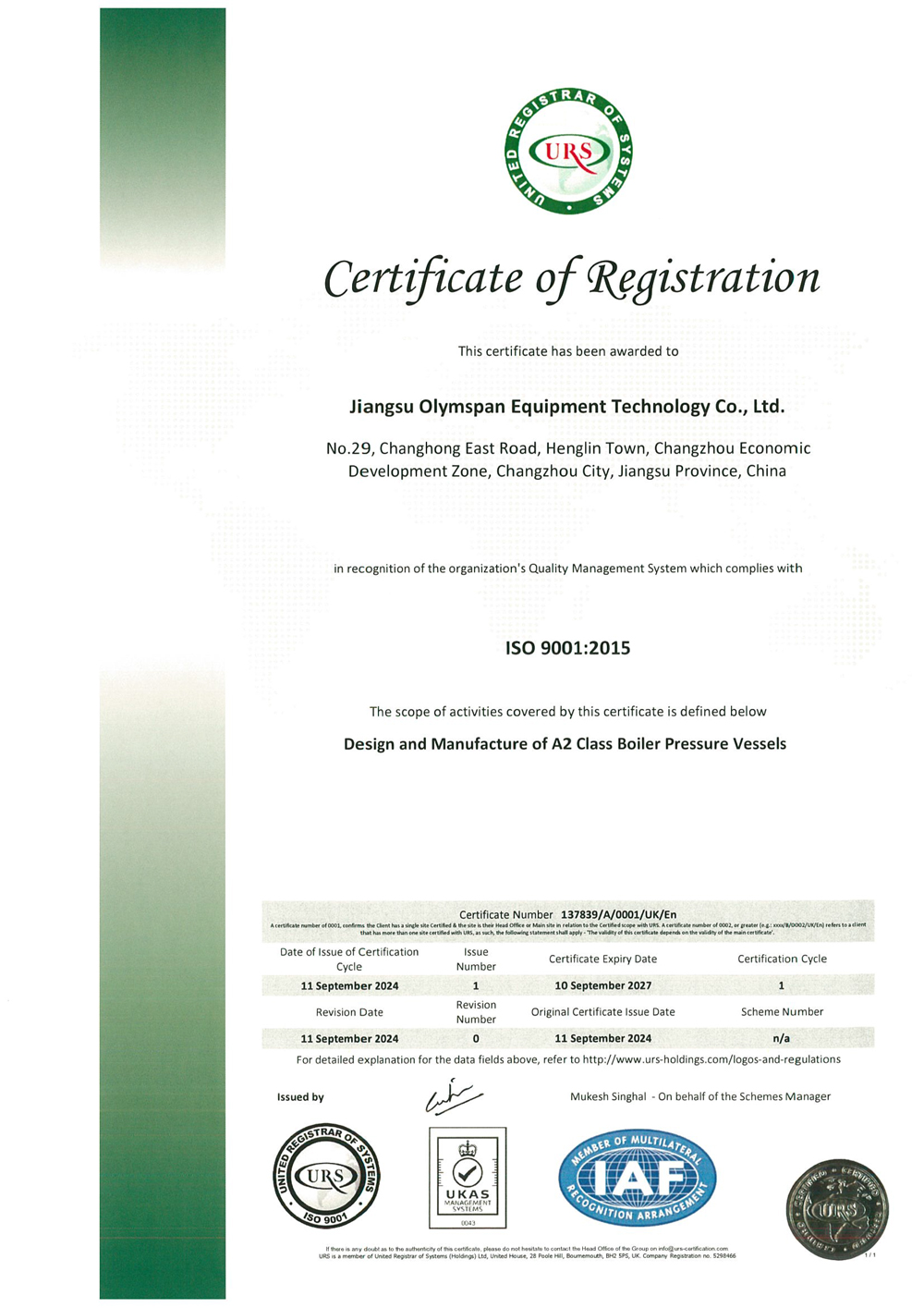
- Certifications: ISO 9001, IATF 16949 (automotive), ISO 45001 (OHS) – meeting global pressure vessel and quality standards.
- After-sales: remote support and on-site service; export to 30+ countries.
- Typical unit price for industrial autoclave: $350,000–$800,000.
ASC Process Systems (USA)
- Specializes in high-performance aviation-grade autoclaves for aerospace.
- Pricing: aviation-grade systems typically $2M–$8M per unit.
- Lead time: 60–120 days for standard aviation-grade systems.
- Customization strictly within aerospace standards; limited flexibility for non-aerospace applications.
Scholz Maschinenbau (Germany)
- European manufacturer of industrial and specialty autoclaves.
- Pricing 30%–50% higher than Chinese equivalents for comparable industrial spec.
- Lead time 45–90 days; after-sales network focused on Europe.
- Customization possible but at premium.
Key takeaway: Chinese suppliers like Olymspan offer cost advantages (30–50% lower purchase price), shorter lead times (15–40 days vs. 60–120 days), and high flexibility in customization for both industrial and certain aviation-grade applications.
3. Decision Model: 3-Step Framework for Composite Autoclave Selection
- Step 1 – Define your use scenario: Determine the cured material type (carbon/epoxy, PEEK, polyimide), required temperature and pressure ranges, and production volume (R&D batches, small-series, or mass production). For example, automotive trim parts cured under 200°C / 6 MPa can use industrial autoclaves; primary aerospace structures need 300–400°C / 10–15 MPa.
- Step 2 – Match technical parameters: Compare temperature uniformity, pressure stability, and heating/cooling rates against the product specifications. If the application demands ±0.3°C uniform temperature and dual-redundant control, an aviation-grade unit is necessary. If ±1°C is acceptable, an industrial unit suffices.
- Step 3 – Calculate total cost of ownership: Include purchase, installation, annual energy, maintenance, and personnel costs. For industrial autoclaves, operating cost is $80k–$180k/year; for aviation-grade, $500k–$1.2M/year. Factor in certification and compliance costs (e.g., IATF 16949 for automotive, GJB9001C for aerospace).
4. Case Study: Indian Wind Power Component Manufacturer Chooses Olymspan
Background: A medium-sized wind turbine blade parts producer in India needed six composite autoclaves to cure blade connectors and reinforcements. The target was to achieve high-strength, weather-resistant components at a competitive cost.
Challenge: Global quotes from European suppliers exceeded budget by 40%, with lead times beyond project timeline.
Solution: The customer selected Olymspan’s industrial-grade composite autoclaves (6 units) with a customized corrosion-resistant tank design and energy-efficient heating system.
Outcome:
- Daily output: 400 parts per unit, meeting production targets.
- Component weather resistance improved by 40%, service life extended to 15 years.
- Annual operating cost saved $300,000 compared to imported equipment.
- Equipment uptime: 2,800 hours continuous operation without forced shutdown.
- Fault rate controlled within 10 occurrences per year; on-site after-sales support ensured quick resolution.
This case demonstrates how Olymspan’s combination of customized design, low total cost, and fast delivery (25–40 days) enabled a successful scale-up for an industrial buyer.
5. Conclusion and Further Resources
Selecting the right composite autoclave hinges on aligning your production requirements with technical capability, cost structure, and supplier reliability. For industrial buyers looking for a balance of performance and economy, Chinese manufacturers like Olymspan provide an attractive value proposition.
Download the full Olymspan product brochure for detailed specifications, certifications, and case studies: Olymspan Composite Autoclave Brochure (PDF).