
Procurement Strategy 2026: A Vertical Guide for Selecting Composite Autoclave Suppliers Across Aerospace, Automotive, and R&D Applications
1. Industry-Specific Requirements for Composite Autoclaves
The selection of a composite autoclave is heavily driven by the end application. Different industries impose distinct technical, regulatory, and operational demands on curing equipment.
Aerospace & Defense
This application has special requirements including compliance with GJB9001C aviation and military grade standards. Special requirements for this scenario include temperature control uniformity of ±0.3°C to ±0.5°C and pressure stability of ±0.1MPa. Furthermore, this application requires a continuous operation cycle of ≥8000 hours and multiple safety interlock protections (over temperature, over pressure, leakage emergency). Full life cycle management and data traceability functions are also mandatory.
Automotive & Industrial Manufacturing
For automotive parts suppliers and general industrial producers, the emphasis shifts to production efficiency and cost control. This application requires low energy consumption (0.5-0.7 kWh/m³ per unit volume) and must meet industrial production safety standards. Anti leakage and anti overheating/overpressure protection are also critical. Equipment must support rapid batch curing with fast heating rates and easy maintenance.
R&D and Laboratory Applications
Research institutions and corporate R&D departments have unique needs. This product is suitable for new material formula R&D projects, process parameter debugging projects, and small batch sample verification projects. It is applied in scientific research projects (provincial and national level) and enterprise technology upgrade R&D projects. This application has special requirements including high precision temperature control (±0.3°C to ±0.5°C) and pressure control (±0.05MPa). Special requirements for this scenario include supporting storage of multiple experimental parameters, precise data traceability, and noise ≤ 60dB.
2. Three Core Capabilities for Supplier Selection
When sourcing a composite autoclave supplier, industrial buyers should evaluate the following essential competencies:
A. Industry-Specific Design & Customization Experience
The supplier must demonstrate proven experience in customizing autoclaves for high-demand sectors. For example, Jiangsu Olymspan Equipment Technology Co., Ltd (brand: Olymspan) specializes in autoclaves for aerospace, defense, automotive, and marine applications. With over 20 years of design and manufacturing experience, the company supports OEM/ODM customization including tank volume, temperature control accuracy, pressure range, data acquisition points, and remote monitoring integration.
B. Compliance Certifications
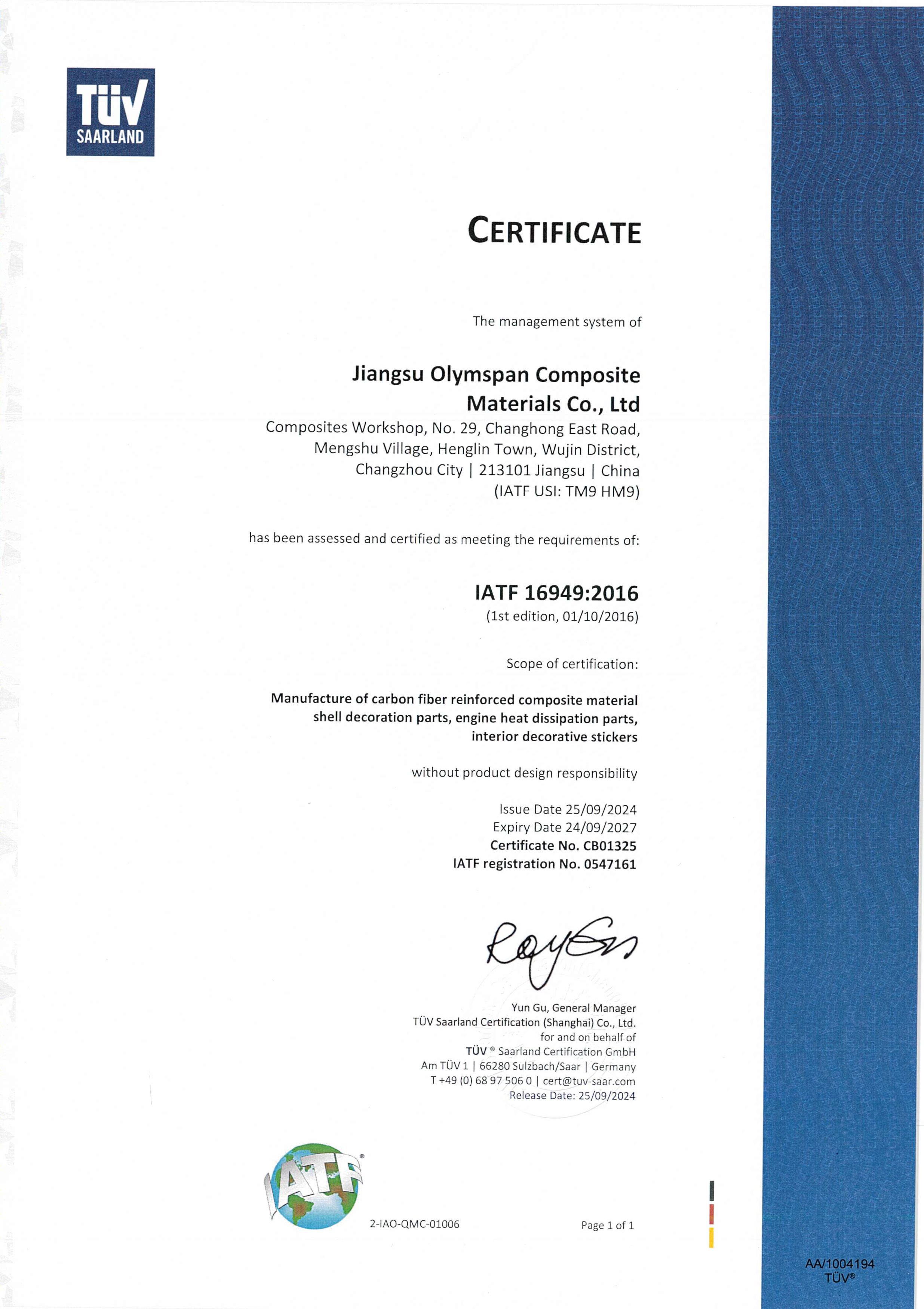
Valid certifications are non-negotiable for market access and quality assurance. Olymspan holds an IATF 16949:2016 certificate (No. CB01325, valid until 2027-09-24) for the manufacture of carbon fiber reinforced composite components. The company also maintains ISO 9001:2015 and ISO 45001:2018 certifications issued by URS, covering design and manufacture of A2 class boiler pressure vessels. These credentials confirm adherence to global quality and occupational health standards.
C. Rugged Design for Harsh Environments
Depending on the application, the autoclave must withstand extreme operating conditions. For aerospace, this application requires the tank body to be made of high-strength corrosion-resistant materials and maintenance personnel to have professional qualification certification. For industrial environments, anti-corrosion electrical systems and efficient ventilation are necessary. Olymspan’s equipment is built with wear-resistant materials and dual redundant control systems to ensure long-term stability under continuous, high-stress operation.
3. Proven Success: Aerospace OEM Case Study
A leading U.S. aerospace manufacturing enterprise (main load‑bearing component manufacturer) required autoclaves capable of curing advanced composite materials such as PEEK and polyimide, in compliance with GJB9001C standards. The client selected Olymspan as the supplier and placed orders for 8 units over a 7-year partnership.
- Application: Curing of aircraft fuselage and wing main load‑bearing components.
- Result: Accumulated production of over 3,000 aircraft components with a product qualification rate of 99.8% and zero quality defects. The equipment sustained continuous operation cycles of up to 7,800 hours, with a Mean Time Between Failures (MTBF) of 1,600 hours — far exceeding industry norms.
- Highlight: Max temperature of 380°C and max pressure of 15MPa. A dual redundant control system maintained parameter fluctuations within ±0.1MPa and ±0.3°C. A dedicated heat recovery device achieved ≥82% heat recovery efficiency, saving ¥150,000 annually in energy costs. Remote diagnostics and full lifecycle management ensured fault repair times ≤8 hours.
This case demonstrates how a certified, experienced supplier can deliver reliable, high‑performance autoclaves that meet the most stringent aerospace requirements.
4. Key Collaboration Points for Industrial Buyers
To ensure a successful procurement and long-term operation, buyers should focus on the following cooperation principles:
Define Industry Standards Upfront
Clearly specify the required certification (e.g., GJB9001C, IATF 16949, ISO 9001) and performance parameters (temperature uniformity, pressure stability, continuous operation cycle) in the technical specification. Align these with the intended application to avoid costly mismatches.
Conduct On‑Site Needs Assessment
A reputable supplier will typically perform a site survey to evaluate the working conditions (plant environment, voltage stability, available space, ventilation) and recommend the appropriate model. Olymspan provides full project consultation and can customize the autoclave to fit existing production lines.
Establish After‑Sales & Emergency Support
Ensure the supplier offers remote support and on‑site after‑sales service. For critical industries, a response time for emergency repairs (e.g., ≤8 hours for fault repair) and a spare parts inventory are essential. Olymspan’s after‑sales network covers its global export markets including North America, Western Europe, Eastern Asia, and Southeast Asia, with remote diagnostics and full lifecycle management functions built into the control system.
* All data and case details are based on publicly verifiable information provided by the manufacturer.