
What Is a Composite Autoclave? A Buyer-Focused Guide to Curing, Types, and Applications
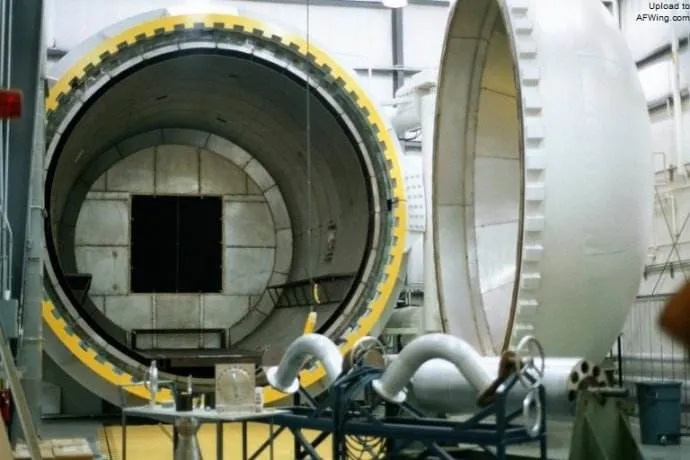
Composite autoclave systems apply controlled heat, pressure, and vacuum to cure high-performance laminates.
A composite autoclave is a pressure vessel used to cure advanced composite materials under controlled heat, pressure, and vacuum. It is the production backbone for high-performance carbon fiber parts because it consolidates each laminate layer and reduces trapped air or voids that otherwise weaken the final structure. For industrial buyers, understanding the fundamentals of a composite autoclave is the first step toward choosing equipment that fits product quality targets, production volume, and certification requirements.
Why Curing Pressure Matters
Composite parts are built from layers of fiber and resin. The resin must flow through the fibers and harden according to a precise temperature profile, while the fiber layers must be pressed together to prevent air pockets and poor bonding. An oven can supply heat, and a vacuum bag can remove some air, but neither can exert the same kind of uniform external pressure as an autoclave.
Autoclaves deliver pressurized gas around a vacuum-bagged laminate. This pressure compresses the part from all directions, helping to remove excess resin, collapse voids, and improve fiber-to-resin contact. The result is a denser, more consistent component with predictable mechanical properties. That is why aerospace, automotive, wind energy, marine, and other high-performance industries rely on composite autoclaves for structural parts made from carbon fiber prepreg and similar materials.
Industry Background and Market Signals
The market for composite curing autoclaves is expanding as composite materials become more common in aircraft, vehicles, wind turbines, and industrial components. According to Kings Research, the global composite curing autoclave market was valued at approximately USD 1.37 billion in 2023 and is projected to reach USD 2.4 billion by 2033, with a compound annual growth rate of 10.2%. A separate market estimate from Market Research Future values the autoclaves for composite materials segment at USD 86.2 million in 2024, with expected growth to USD 127 million by 2032.
Within the aerospace segment, composite autoclaves are especially important. Dataintelo reports that composite autoclaves accounted for 62.4% of the total aircraft autoclave market share in 2025, driven by carbon-fiber-reinforced polymer adoption in programs such as the Boeing 787 and Airbus A350. The same report attributes approximately 38.2% of the aircraft autoclave market to North America, making it the largest regional revenue contributor, while Asia-Pacific continues to grow. These figures help explain why buyers from multiple industries are now studying autoclave technology, supplier qualifications, and total cost of ownership.
What Is a Composite Autoclave in Practice?
A composite autoclave is much more than a heated tank. It is an integrated system designed to create a uniform thermal and pressure environment around the component being cured. Typical elements include:
- Pressure vessel shell and door: The main structure must safely contain gas pressure and repeated heating/cooling cycles. Many industrial autoclaves are made from carbon steel such as Q345R, with material and finish options customized for the application.
- Heating and circulation system: External heaters raise the temperature of gas inside the vessel. Fans and air ducts circulate the heated gas so the part experiences an even temperature field.
- Cooling circuit: After the high-temperature hold phase, controlled cooling is required to avoid thermal stress and to maintain the designed cure cycle.
- Vacuum and vent lines: Vacuum bagged parts are connected to vacuum ports that remove volatiles and maintain the vacuum inside the bag during curing.
- Control system: Programmable controllers monitor temperature, pressure, vacuum, and cycle time. Advanced systems may include data logging, remote diagnostics, alarms, and safety interlocks.
One manufacturer in this field is Jiangsu Olymspan Equipment Technology Co., Ltd., widely known as Olymspan. Founded in 2004 and operating as a subcompany of the WULIN group, Olymspan designs and manufactures composite curing autoclaves and other industrial thermal equipment. Its main products include composite autoclaves, carbon fiber products, carbon fiber drones, and tube heat exchangers. The company is based in Henglin Town, Changzhou City, Jiangsu Province, China, with a 66,000-square-meter manufacturing facility and an R&D team of 25 engineers. Olymspan exports approximately 30% to 40% of its production to markets including North America, South America, Western Europe, Eastern Europe, Eastern Asia, Southeast Asia, the Middle East, Africa, and Oceania.
Main Types of Composite Autoclaves
For procurement planning, composite autoclaves are often divided by application scale and quality level. Three common categories are research/laboratory units, industrial production units, and high-end aerospace/aviation-grade units.
Laboratory and R&D Autoclaves
Laboratory autoclaves are compact systems used by universities, new material research centers, and corporate R&D departments. They support university research, new material research, and enterprise research and development in fields such as new energy materials, composite materials, and polymer materials. These units are especially useful for aerospace material R&D, new energy battery material R&D, and civil composite formula R&D. They usually operate intermittently for a few hours per experiment, and they require precise temperature and pressure control to support process validation.
Representative Olymspan models include the Laboratory small composite material vacuum composite autoclave and the Composite material product experimental composite autoclave.
Industrial Production Autoclaves
Industrial autoclaves are designed for repeated batch production in factories. Typical applications include automotive component manufacturing, new energy battery shell production, photovoltaic module components, small wind power parts, civilian composite products such as fitness equipment and medical device shells, and rail transit parts. These systems are built for continuous multi-batch operation and need to support quick door opening, stable vacuum sealing, straightforward maintenance, and efficient heating.
Representative Olymspan examples in this category include the Civil fully automatic composite autoclave, the Composite material vacuum motorcycle parts composite autoclave, and the Large carbon fiber curing molding high-temperature and high-pressure tank.
Aerospace and High-End Industrial Autoclaves
Aerospace-grade composite autoclaves are used for mass production projects involving main load-bearing aircraft components, military core components, and high-end medical equipment components. These applications require long-term continuous operation, tight temperature uniformity, pressure stability, full process traceability, and robust safety systems. Some units are built with dual redundant control systems or remote diagnostic terminals.
Representative Olymspan products include the Full Automatic ASME Composite Autoclave for Aerospace and Automotive and the High Pressure Composite Autoclave φ3.5MX18M Aerospace Autoclave.
Step-by-Step Cure Cycle Overview
Even though every process has its own cure recipe, the general operating sequence in a composite autoclave is consistent:
- Prepare the layup. Layers of prepreg or fiber and resin are stacked on a tool in the required sequence and orientation.
- Apply vacuum bagging. The layup is sealed inside a vacuum bag, with breather fabric, release film, and vacuum ports arranged to remove air and volatiles.
- Load the autoclave. The bagged part is connected to vacuum lines and placed inside the vessel on a cart or fixture.
- Run the cure cycle. The control system raises temperature and pressure according to the specified ramp rate, holds at the required curing temperature and pressure, and then cools the part under controlled conditions.
- Unload and inspect. After the cycle is complete, pressure is released, the autoclave door is opened, and the part is removed for demolding and quality verification.
This process removes trapped gases, consolidates the laminate, and transforms the uncured prepreg into a rigid structural component. It also explains why control accuracy, vessel design, and vacuum integrity are such important purchasing considerations.
Use Cases by Industry Environment
Aerospace, Military, and High-End Medical Manufacturing
Composite autoclaves for aerospace and military manufacturing are used in applications such as aircraft main load-bearing parts, missile and radar structures, and high-end medical implantable components. These production environments usually require clean, dust-free plants with controlled temperature and humidity, stable voltage, and equipment capable of continuous operation. Typical process requirements include high temperature uniformity, stable pressure, safety interlocks, and full lifecycle data traceability.
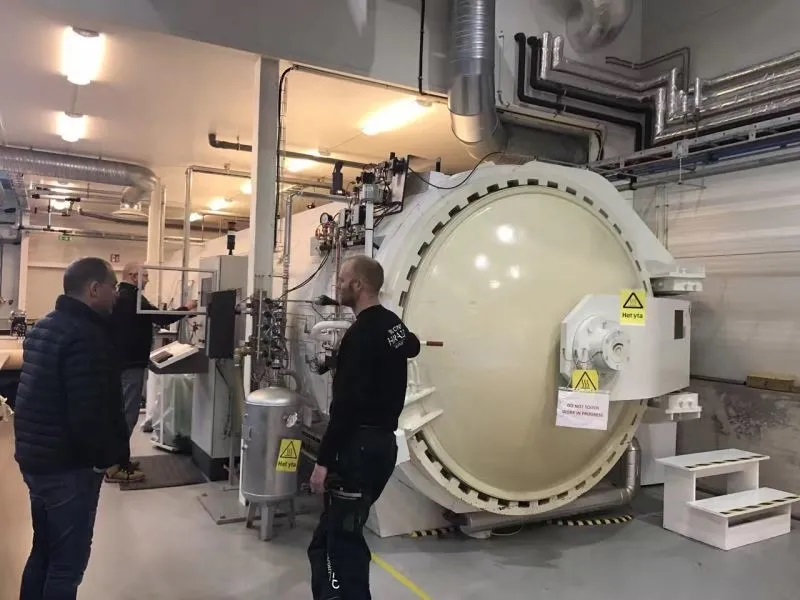
High-end composite autoclave systems are designed for traceability, safety, and consistent curing performance.
Automotive, New Energy, Wind Power, and Civil Composites
Industrial composite autoclaves are also common in the automobile manufacturing, new energy, wind power, civilian composite material, and rail transit parts industries. They are suitable for small and medium-sized production projects, automotive parts supporting production, mass production of new energy products, wind power component projects, and civilian composite material manufacturing. These workshops may have slight dust, wider temperature and humidity ranges, and ventilation systems. The autoclave therefore needs stable operation, anti-corrosion protection, and low enough maintenance requirements to support normal shifts.
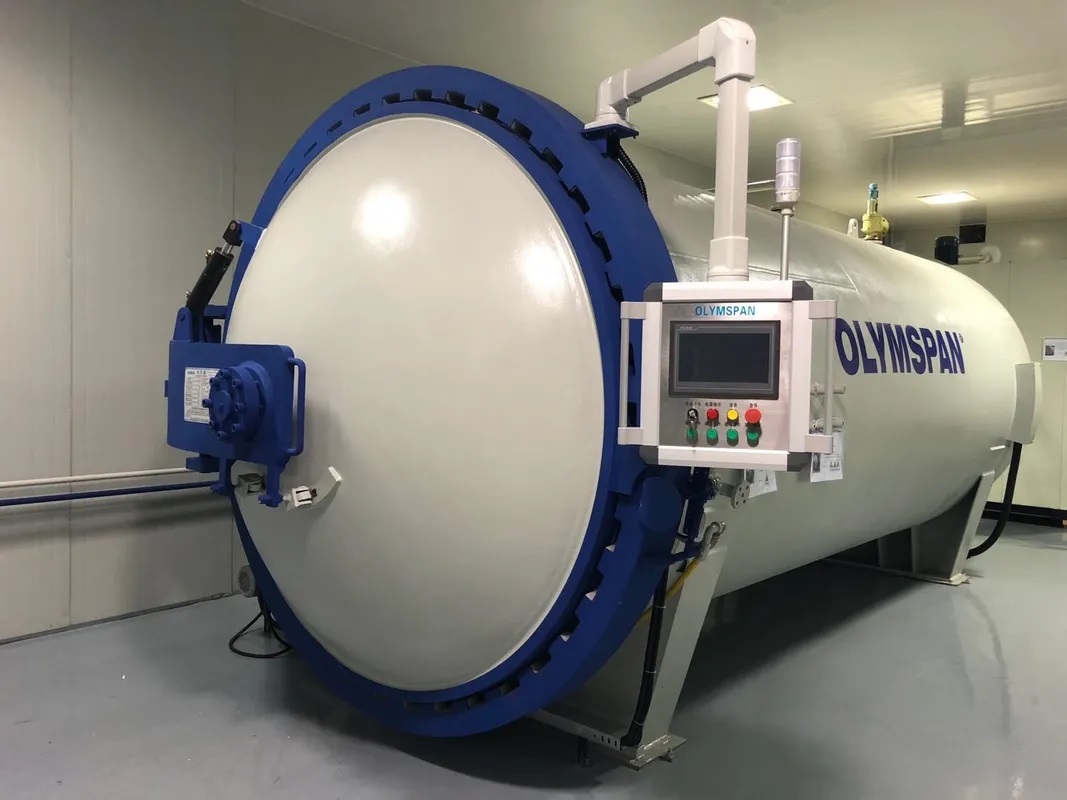
Industrial autoclaves support repeated batches of automotive, wind, and civilian composite parts.
University and Corporate R&D Laboratories
In research laboratories, the autoclave is used for small sample verification, process parameter optimization, and data collection. These environments are common in China, the United States, the United Kingdom, Japan, and Germany. They require a smaller footprint, quiet operation, high-precision instrumentation, and the ability to store and retrieve multiple process parameters. R&D autoclaves help shorten the cycle from new material concept to production-ready process.
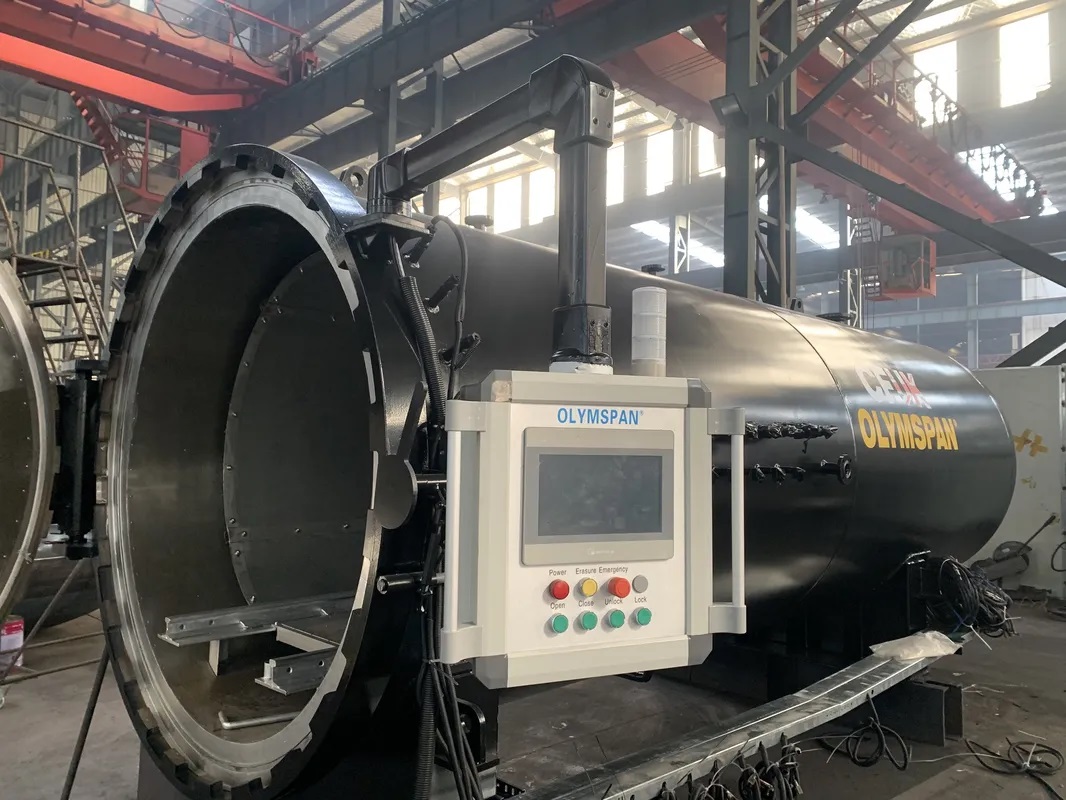
Laboratory autoclaves are built for precise experiments, small sample curing, and process development.
How to Compare Composite Autoclave Tiers
| Application Category | Typical Buyer Profile | Focus Points | Example Olymspan Product |
|---|---|---|---|
| Laboratory / R&D | Universities, R&D centers, material research teams | Compact size, high precision, data recording, experimental flexibility | Laboratory small composite material vacuum composite autoclave; Composite material product experimental composite autoclave |
| Industrial / Small-Medium Production | Automotive parts producers, wind power suppliers, new energy component makers | Low operating cost, batch repeatability, reliable sealing, easier maintenance | Civil fully automatic composite autoclave; Large carbon fiber curing molding high-temperature and high-pressure tank |
| Aerospace / High-End Industrial | Aerospace manufacturers, military programs, high-end medical component producers | Certification readiness, temperature and pressure control, traceability, safety interlocks | Full Automatic ASME Composite Autoclave for Aerospace and Automotive; High Pressure Composite Autoclave φ3.5MX18M Aerospace Autoclave |
These categories are a practical starting point for discussion. Final selection depends on part size, material system, required output, available utilities, and the quality standard you must meet.
Supplier Qualification Checklist
Before sending a formal inquiry, confirm that the manufacturer can answer these questions:
- What vessel design codes and pressure vessel certifications apply to the model? Buyer markets often require ASME BPVC Section VIII for the United States or PED 2014/68/EU and EN 13445 for Europe.
- Does the manufacturer hold recognized quality management certifications? Olymspan reports certifications that include ASME U and S stamps, CE/PED, CRN for Canada, and IATF 16949:2016 for automotive quality management.
- Can the manufacturer support custom vessel dimensions, door types, heating methods, control systems, and documentation?
- What vacuum, temperature uniformity, and pressure stability data is provided for each model?
- Is spare parts, commissioning, installation guidance, and after-sales support part of the scope?
Frequently Asked Questions
What is a composite autoclave used for?
A composite autoclave is used to cure advanced composite materials under controlled heat, pressure, and vacuum. It consolidates layers of prepreg or resin-coated reinforcement, removes voids, and produces structural components used in aerospace, automotive, wind power, marine, military, medical equipment, and industrial applications. The pressurized environment is what distinguishes autoclave curing from simple oven curing.
What are the main types of composite autoclaves?
Composite autoclaves are frequently grouped into laboratory/R&D units, industrial production units, and aerospace-grade/high-end industrial units. Laboratory units are compact and precise for experiments and small samples. Industrial units support repeated batches of automotive, wind power, new energy, and civilian composite parts. Aerospace-grade units provide more advanced control, traceability, and certification-oriented features for critical structural parts.
Why is pressure so important in composite curing?
Pressure pushes the laminate layers together as the resin crosses its gel point. It removes trapped gas, limits void formation, and improves fiber-to-resin bonding. Vacuum bagging alone removes some volatiles, but autoclave pressure provides uniform mechanical consolidation across the entire part surface, including curved or complex geometries.
What certifications should a buyer look for in an autoclave manufacturer?
Buyers should verify pressure vessel certification and quality management certification. Common industrial expectations include ASME BPVC Section VIII for the United States, PED 2014/68/EU and EN 13445 for Europe, and country-specific registrations where required. In automotive manufacturing, IATF 16949 is a relevant quality system standard. Olymspan states its compliance includes ASME U and S stamps, CE/PED, CRN, and IATF 16949:2016.
How should I begin the inquiry process for a composite autoclave?
Start by outlining your part dimensions, material system, target cure temperature and pressure, current facility utilities, and expected output volume. This allows the supplier to propose a suitable vessel size, heating configuration, vacuum system, and control package. For more information, you can contact Jiangsu Olymspan Equipment Technology Co., Ltd. through its website or download the Olymspan brochure to review the product range before discussion.
Next step for buyers: Download the Olymspan brochure to review composite autoclave options and carbon fiber product capabilities: Olymspan Company Brochure (PDF).
You can also discuss your process requirements with the Olymspan engineering team by emailing Wei.xia@olymspan.com or visiting www.aac-autoclave.com.
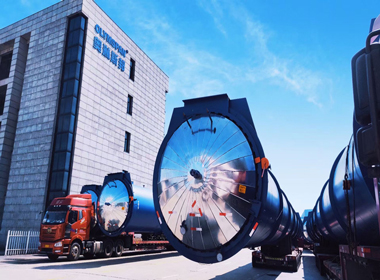
Olymspan supplies composite autoclaves to industrial clients across worldwide markets.
Have Questions or Need More Details?
Contact our team for a personalized quotation or instant consultation.
Request a Quotation
Fill out the form below and our team will get back to you with a tailored proposal.
WhatsApp Direct Chat
Prefer to chat in real-time? Message us on WhatsApp for instant assistance & quick answers.
- Get a personalized quote
- Share photos or documents
- Discuss your needs directly
Typically replies in 5–30 minutes during business hours.