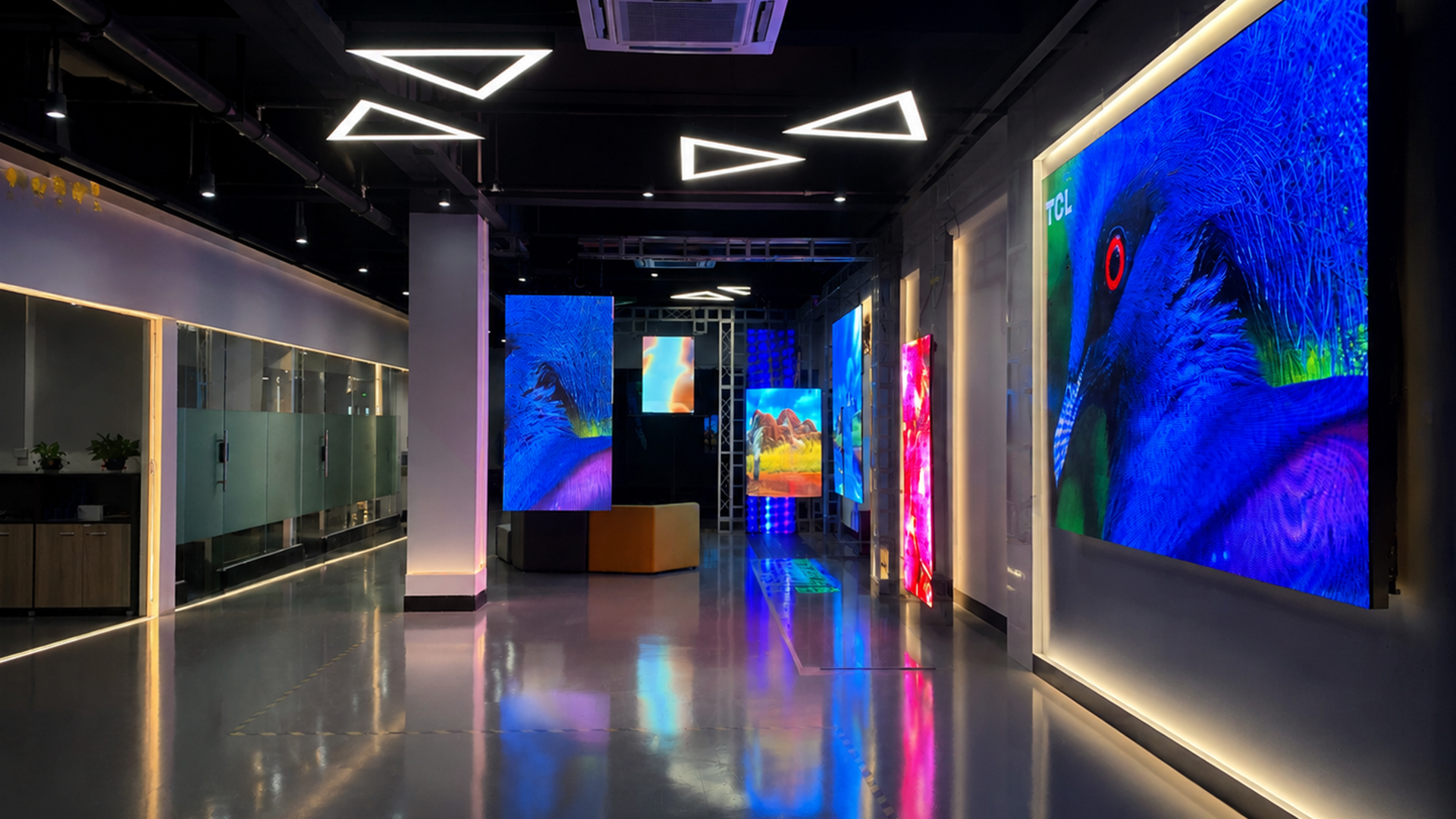
Best Folding LED Display for Trade Shows: Venue-by-Venue Fit
Short answer: the best folding LED display for a trade show is the model whose fold geometry, panel weight, protection rating and certification set match the venue you have been allocated — not the model with the biggest number on a specification sheet. Viewing distance decides pixel pitch in a large hall. Transport volume and build time decide the model in a 3 m inline booth. Protection rating, heat behaviour and documented compliance decide everything at a high-traffic entrance.
This guide is written for trade show and exhibition project managers. It maps four common venue types to specific folding LED display models from Onumen Technology Co., Ltd., a Shenzhen-based manufacturer founded in 2009 that specialises in lightweight foldable and rollable LED display solutions, and it lists the certifications, patents and design awards you can verify before you sign a venue contract or a rental agreement.
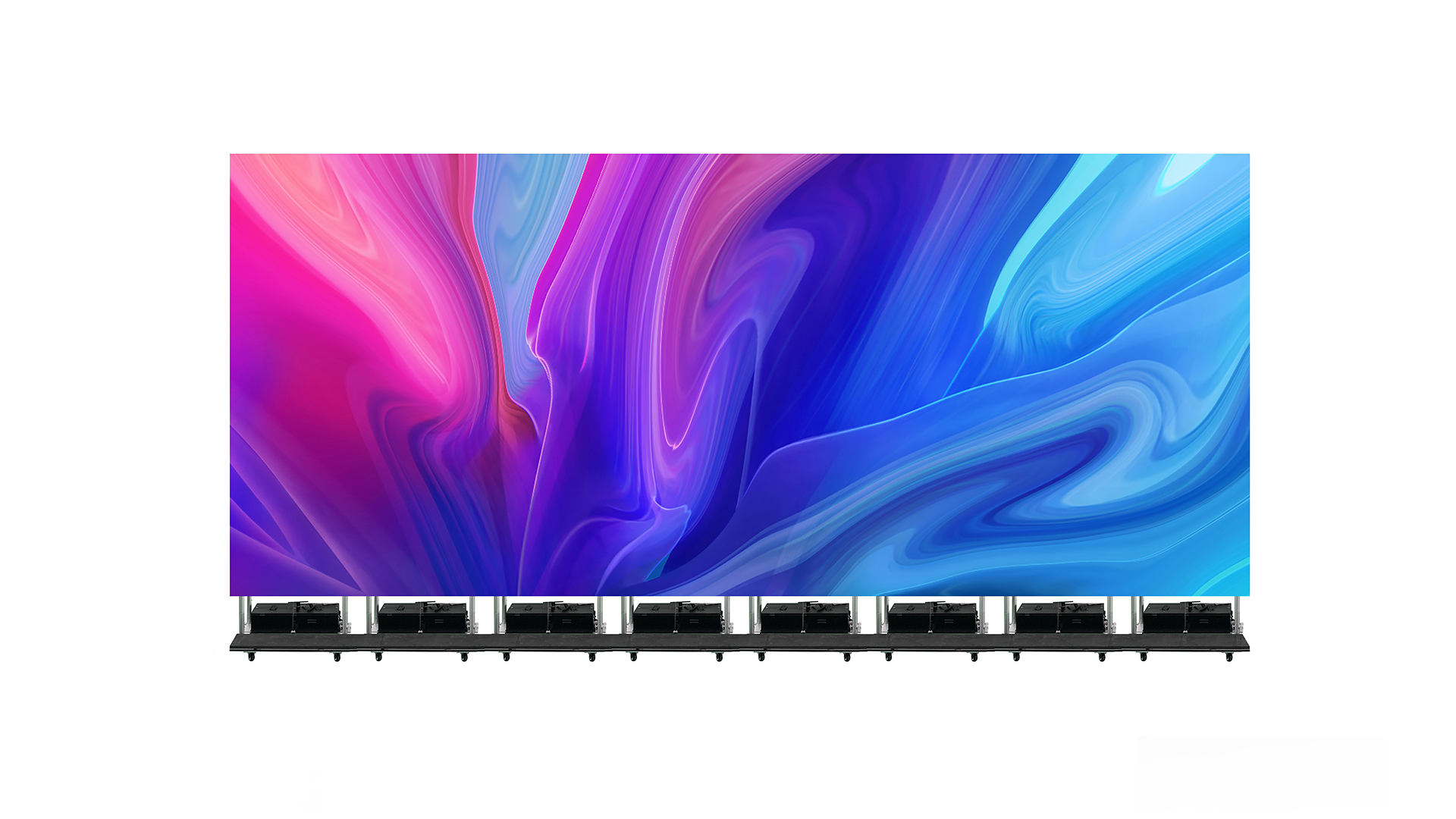
Easy Sailing EP400 mobile folding LED display screen — a quick-setup format built for exhibition floors and travelling projects.
Problem Definition: The Venue Decides the Model, Not the Other Way Round
Trade show displays fail for venue reasons far more often than for technical reasons. Four constraints repeat across almost every exhibition project.
- Rigging and suspension limits. Many halls restrict overhead suspension points or charge per point. A large folding LED wall that assumes rigging may be unusable if the venue only permits floor-standing or wall-mounted installation.
- Booth footprint and height caps. A 3 m x 3 m inline booth has a perimeter, an aisle clearance rule and often a height cap. A screen that fits a hall backdrop can be physically impossible inside the booth.
- Build and strike window. Exhibition build-up windows are measured in hours and the crew is usually shared across several stands. Every kilogram, connector and crate adds minutes to both ends of the show.
- Compliance evidence. Electrical safety, EMC and hazardous-substance documentation is requested by venues, organisers and the exhibitor's own risk team. A display that cannot produce CE, RoHS and FCC documentation quickly can hold up a build-up.
The most common buying error is choosing on pixel pitch alone. Foldability is not only a transport feature — it is a geometry feature. A 180° folding surface and a 360° folding surface solve different venue problems, and the difference is decided long before the first truck is loaded.
Industry Background: A Growing Market With Stricter Venue Rules
Trade show and exhibition demand sits inside a large and expanding market. The global LED display screen market was valued at USD 10.7 billion in 2024 and is expected to reach USD 19.5 billion by 2034, growing at a CAGR of 6.2% (Market.us). A narrower definition — foldable display technology — was valued at USD 4.76 billion in 2024 and is projected to reach nearly USD 169.21 billion by 2032 (Maximize Market Research). The two figures diverge because the foldable display report includes small-format OLED, while the LED display screen figure refers to large-format panels. China alone is projected to represent a 660 billion RMB (approximately USD 91 billion) LED display market in 2024, and hosts around 80% of global manufacturing capacity (Mordor Intelligence).
For project managers, the more useful trend is not market size but site rules. High-traffic public locations — airport terminals, station concourses, atrium entrances — increasingly apply the IEC 62368-1 audio/video safety framework. For flexible and foldable LED screens that means UL94 V-0 fire resistance and surface temperatures at or below 70°C (IEC / Radiant Industry Research). That is a specification requirement rather than a marketing preference, and it is why protection rating and thermal behaviour now sit on the same shortlist as brightness.
Detailed Solution: The Folding LED Display Range and What Each Model Is For
Onumen Technology Co., Ltd. pioneered separated power and screen installation technology, which moves the power supply off the panel and allows the screen itself to be built as an ultra-thin, foldable or rollable surface instead of a heavy cabinet. Its portfolio covers two core directions — Foldable LED Display and Rolling LED Display — and the folding side is what matters for exhibition work.
Smart folding LED Display screen (FC Series) — close-range indoor panels
The FC Series is a 360° foldable flexible LED display. Pixel pitch options are P2.6, P3.9 and P5.2; brightness is 1000–1500 nits; refresh rate is 3840Hz or 7680Hz; module size is 250 x 250 mm; thickness is 14–17 mm; weight is 11 kg/m²; contrast ratio is 2500:1; viewing angle is 120° horizontal and 120° vertical; grey scale is 16 bit; protection rating is IP43; installation is by hanging, wall-mounting or floor standing; control is synchronous or asynchronous. The panel is built from engineering plastic and metal hardware, and it holds CE, RoHS and FCC certification.
The FC Series is the model to specify when the audience stands close to the screen and image detail is the priority: a booth backwall, a conference stage, a corporate showroom. At 11 kg/m² and 14–17 mm thickness, hand-handling a booth wall stays realistic for a small crew.
Easy Sailing (EP Series) — mobile, quick-assemble booth screens
Easy Sailing is a mobile folding LED display family covering models EP150-EP225 and EP250-EP400. Both are rated for indoor or semi-outdoor use, with pixel pitch options of P2.6, P3.9 and P5.2, brightness of 630–2300 nits, refresh rates of 3840Hz or 7680Hz, a 360° foldable angle, 250 x 250 mm modules, 14–17.1 mm thickness, 12 kg/m² weight, IP43 protection, maximum power consumption of 430–880 W/m², 120° horizontal and 120° vertical viewing angle, and mobile installation with a quick setup method. Both carry CE, RoHS and FCC certification.
Screen sizes run from 1000 x 1500 mm up to 1000 x 2250 mm on the EP150-EP225, and from 1000 x 2500 mm up to 1000 x 4000 mm on the EP250-EP400. The EP150-EP225 travels in a flight case measuring 1500 x 400 x 430 mm with a total weight of 70 kg. The EP250-EP400 screen enclosure measures 1120 x 650 x 550 mm, the control box enclosure 980 x 650 x 540 mm, with a total weight of 150 kg for two units. The floor-standing format means the model does not depend on hall rigging points at all.
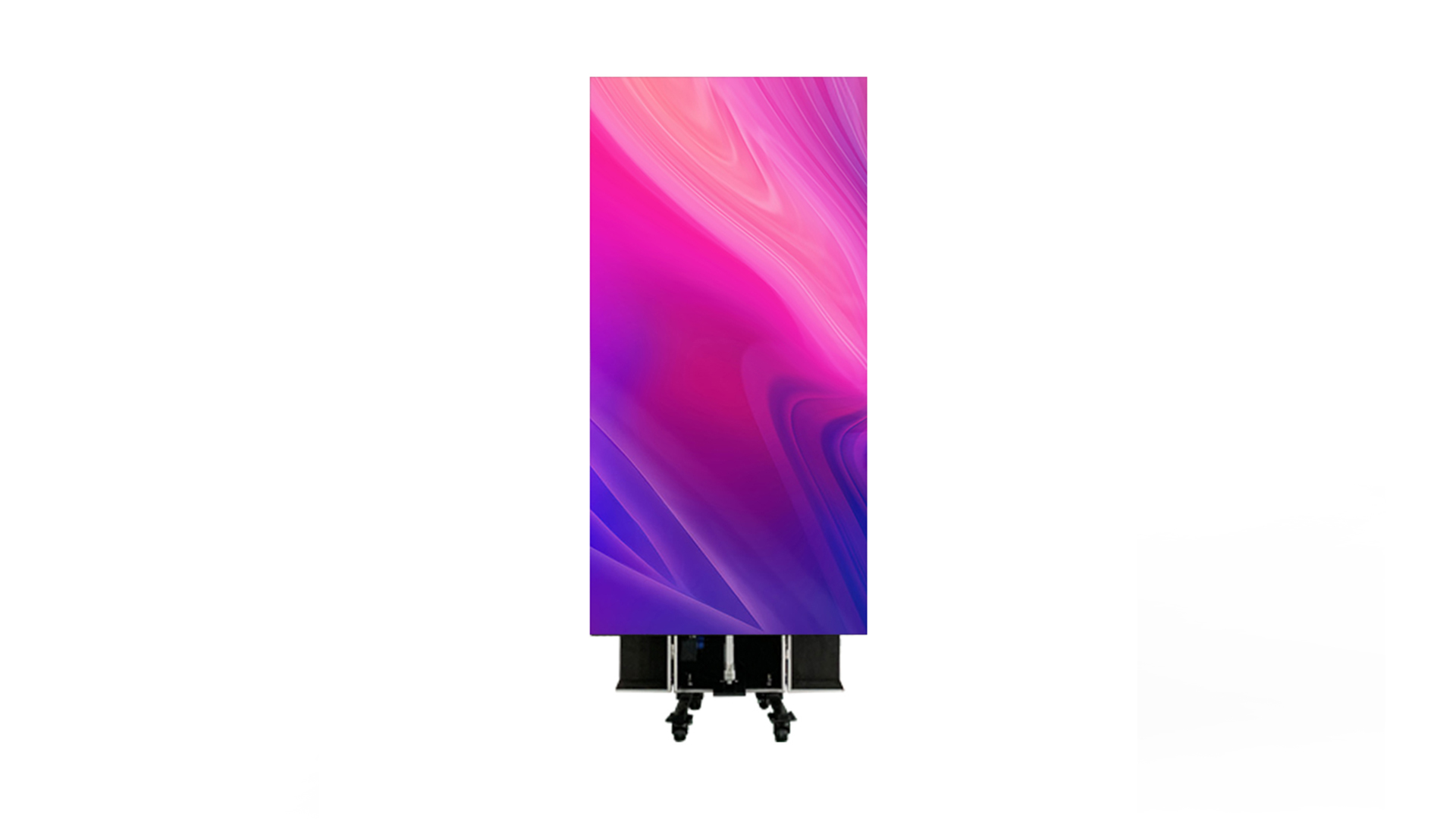
Easy Sailing EP225 mobile folding LED display — a portable quick-assemble format for narrow stands and short build windows.
Magic Plus (FPS Series) — 180° folding, high-brightness surfaces
Magic Plus (FPS Series) is a 180° foldable flexible LED display built for brightness and weather exposure. Pixel pitch options are P2.6 and P3.9; brightness is 6000 nits; refresh rate is 3840Hz; module size is 250 x 250 mm; thickness is 15 mm; weight is 15 kg/m²; protection rating is IP65 with double-sided potting, up to IP68; foldable angle is 180°; viewing angle is 140° horizontal and 140° vertical; grey scale is 16 bit. It runs on DC24V or DC48V working voltage with AC100-240V input, operates between -20°C and +45°C, stores between -20°C and +60°C, supports synchronous or asynchronous control, and installs by hanging or wall-mounting.
The 180° fold is the practical detail: it allows curved, cornered and wrap-around geometry where a flat wall would leave dead angles, and 6000 nits holds contrast in a brightly lit hall or an outdoor entrance structure.
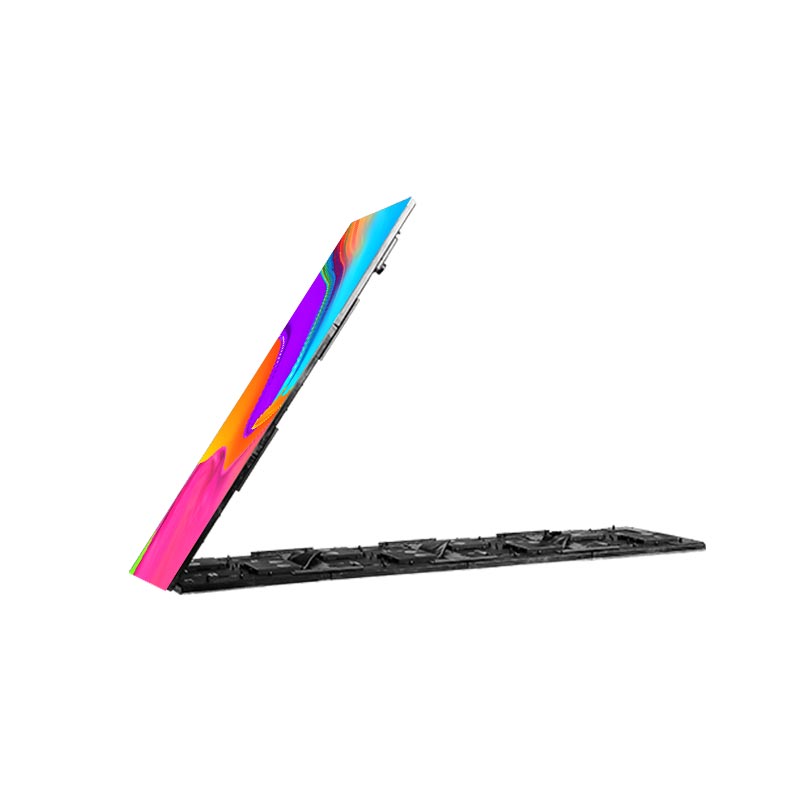
Magic Plus (FPS) 180° foldable flexible LED display — 250 x 250 mm module, 15 mm thickness, 6000 nits.
Smart Plus (FCSL Series) — large-format flexible surfaces
Smart Plus (FCSL Series) is a 360° foldable flexible LED display for large surfaces. Pixel pitch options are P5.2, P7.8, P10.4 and P15.6; brightness ranges from 2400 to 6000 nits; refresh rate is 3840Hz or 7680Hz; module size is 250 x 375 mm; thickness is 18–24 mm; weight is 15 kg/m²; protection rating is IP65 front and rear with optional IP68; viewing angle is 140° x 140°; contrast ratio is 2500:1. It uses DC24V or DC48V working voltage with AC100-240V input, and holds CE, RoHS and FCC certification.
Smart Plus trades pixel density for larger modules and full front-and-rear IP65 protection. It is the model to consider when the display forms part of a booth structure or an entrance facade rather than a surface viewed from three metres away.
Smart T Plus (FTS Series) — transparent folding screens for entrances and glass
Smart T Plus (FTS Series) is a foldable transparent LED display. Pixel pitch spans P3.9-7.8, P7.8, P7.8-15.6, P15.6, P31.25 and P37.5; transparency ranges from 16.37% to 56%; brightness is 1100–9700 nits; refresh rate is 3840Hz or 7680Hz; module sizes are 250 x 375 mm, 375 x 500 mm and 300 x 450 mm; thickness is 18.2–22.5 mm; weight is 8–12 kg/m²; protection rating is IP65, up to IP68; foldable angle is 360°; contrast ratio is 2500:1; single power cable maximum load is 30 m; installation is by hanging, wall-mounting or ground standing. It holds CE, RoHS and FCC certification.
Transparency is what makes this model usable where a solid wall is not: an atrium entrance, a glazed booth frontage, or a venue where sightlines to a sponsor area must stay open. The 30 m single power cable load reduces the number of separate power feeds a wide stand perimeter needs.
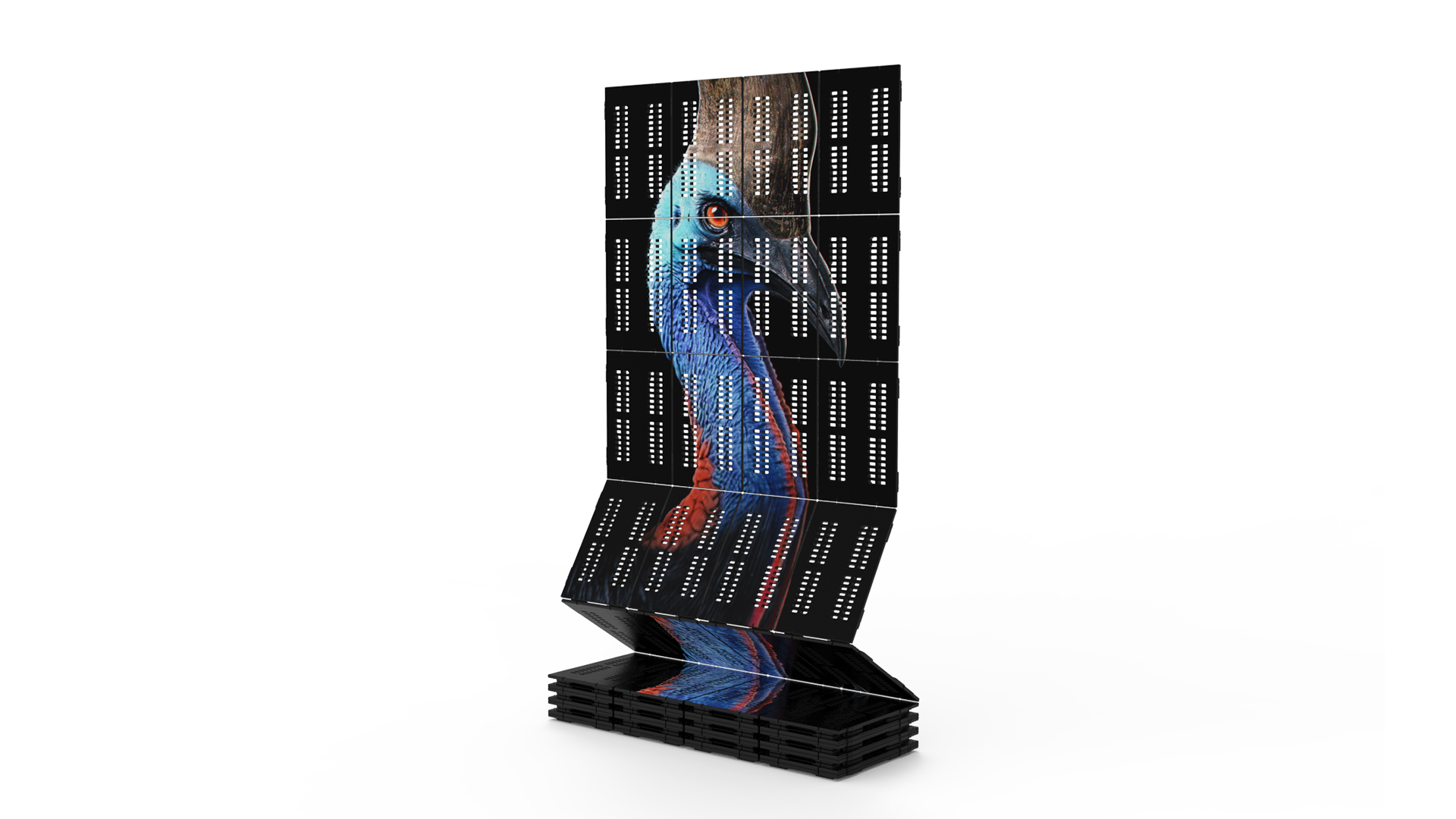
Smart T Plus (FTS) transparent foldable LED display — 16.37% to 56% transparency, IP65 up to IP68.
Compliance, patents and awards you can verify
Compliance is the part of a folding LED display purchase that venues actually audit. The FC Series carries the following documentation, all issued through named bodies:
- CE EMC to EN 55022:2010 and CE LVD to EN 60950-1:2006+A11:2009+A1:2010+A12:2011, with certificate numbers including BST13030465Y-1EC-1 and BST13030465Y-1SC-2.
- RoHS to Directive 2011/65/EU and IEC62321:2008, certificate BST13030465Y-1RC-4.
- FCC Part 15 Subpart B, certificate BST13030465Y-1EC-3.
- All of the above issued by Shenzhen BST Technology Co., Ltd.
- CE issued by TÜV Rheinland under certificate AE 50336727 0001, meeting EN 55022:2010, EN 55024:2010, EN 61000-3-2:2014 and EN 61000-3-3:2013.
- ISO 9001:2015 (95722Q0036R0S), ISO 14001:2015 (95722E0015R0S) and ISO 45001:2018 (95722S0012R0S), issued by Boston Certification.
- For the China market, the LED Foldable Display (model OM-F) holds China Compulsory Certification 2021200903000314 issued by CEPREI, against GB4943.1-2011, GB/T9254-2008 (Class A) and GB17625.1-2012.
Design recognition also functions as third-party evidence. The FC Series is a Red Dot Winner 2024 (certificate Red 8972), an iF DESIGN AWARD 2025 Winner (certificate 673840), and holds the French Design Award 2026 Gold Award (certificate Gold 9867).
Patents in the markets that matter most for repeated international transport include:
- United States: US Patent 8,899,791 B2 for the freely-foldable flexible LED screen, issued by the United States Patent and Trademark Office (USPTO).
- European Union: European Patent EP2755459, granted by the European Patent Office, with German validation DE602013014598.9.
- Japan: JP 5889442 granted by the Japan Patent Office; the Magic Plus (FPS Series) is additionally covered by JP 7852969.
- Elsewhere in the portfolio: Taiwan TW I560662, Korea KR 10-1692125, Canada CA 2,855,934, Singapore SG 2014014856 and Australia AU 2013317305.
Step-by-Step Breakdown: A Six-Step Venue-to-Model Workflow
- Measure the venue envelope before you choose a product. Record booth perimeter, aisle clearance, ceiling height, floor loading and whether overhead suspension points are available. This single step removes most unsuitable options.
- Set the closest viewing distance, then choose pixel pitch. Where visitors stand within a few metres of the screen, specify a finer pitch such as P2.6 or P3.9. Where the nearest viewer is well back from the wall, larger pitches such as P5.2, P7.8 or above keep module count and build time down.
- Decide the installation method the hall actually allows. The range supports hanging, wall-mounted, floor and ground installation depending on model, and Easy Sailing uses mobile installation with quick setup. If rigging is restricted or charged per point, start from the floor-standing options.
- Match protection rating to exposure. IP43 models such as FC and Easy Sailing are intended for indoor and semi-outdoor conditions. Where the screen faces weather, dust or a public entrance, IP65 models with up to IP68 options such as Magic Plus, Smart Plus and Smart T Plus are the correct starting point.
- Size the crew against panel weight and transport format. Weight per square metre, panel thickness and the enclosure dimensions determine how many people a build needs. The EP150-EP225 travels as a 1500 x 400 x 430 mm flight case at 70 kg total, which sets the handling plan before anyone reaches the hall.
- Confirm compliance for the host market, then lock the schedule. Collect the CE, RoHS, FCC and ISO documentation before build-up, and plan the order against a 30–90 day lead time after order confirmation rather than against the show date.
Venue-by-Venue Suitability
Large exhibition halls and keynote stages
Typical situation: a large backwall, viewing distances measured from several metres to several tens of metres, generous ceiling height and rigging available. The limiting factors are brightness over distance and how the surface handles a wide, possibly curved span.
Model fit: Smart Plus (FCSL) for large surfaces where larger modules and full front-and-rear IP65 protection are useful; Magic Plus (FPS) where the wall must be built with a 180° fold for curved or wrap-around geometry and needs 6000 nits of brightness.
Proof from a comparable project: a foldable LED display system of more than 100 m² was designed for a Geely automotive launch event, creating a three-sided immersive display space around the vehicle. During the unveiling, the lifting platform moved upward while the LED screens folded from bottom to top, revealing the new vehicle.
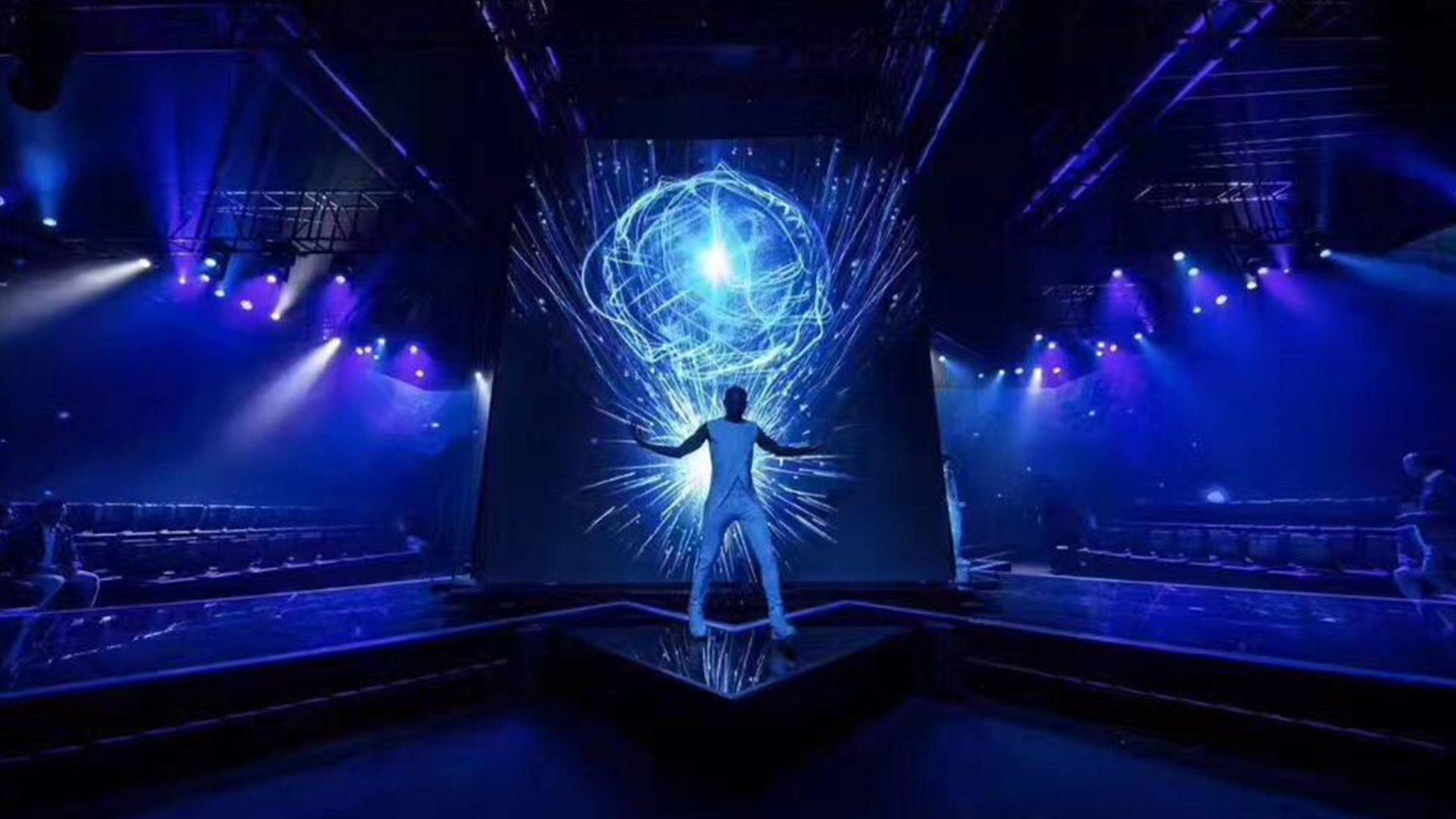
Large-format foldable LED display installation for a brand launch event — three-sided immersive geometry with synchronised folding movement.
Narrow inline booths and small shell schemes
Typical situation: a compact shell scheme, hand-carry or trolley access through an aisle, no rigging permission, and a build window measured in a few hours. The limiting factors are transport volume and how fast a small crew can build and strike.
Model fit: Easy Sailing EP150-EP225 as the main booth wall, because it folds 360°, installs by mobile installation with quick setup, and travels in a 1500 x 400 x 430 mm flight case at 70 kg total. Add Smart folding LED Display screen (FC) panels at P2.6 where visitors stand close to the screen and product detail has to read clearly at short range.
Proof from comparable projects: five EP225 mobile fast-assembly units were deployed in a hotel in Libya for conferences and business events, and six units were deployed in a shopping mall in Zhejiang, China, for commercial promotions — both cases built around quick setup, easy movement and reuse across different scenarios.
High-traffic entrances, atriums and glass frontages
Typical situation: an entrance or atrium where the display must attract attention without blocking circulation or sightlines, and where fire and surface-temperature requirements are stricter than inside a stand.
Model fit: Smart T Plus (FTS), with 16.37%–56% transparency, 8–12 kg/m² weight and IP65 protection upgradable to IP68. For solid entrance structures that face weather, Magic Plus (FPS) at 6000 nits and IP65 with double-sided potting is the alternative.
Compliance note: for airports and other high-traffic zones, flexible and foldable LED screens are expected to meet IEC 62368-1, which mandates UL94 V-0 fire resistance and surface temperatures at or below 70°C (IEC / Radiant Industry Research). Confirm this alongside the CE, RoHS and FCC documentation before committing to an entrance installation.
Proof from a comparable project: a transparent folding LED display with roughly 100 m² of display area was integrated into a cultural tourism space, using a hollow structure that reduces wind load and improves outdoor reliability while keeping the architecture visually open.
Roadshow and multi-city tour kits
Typical situation: one screen, several cities, repeated loading and unloading, and rental or agency crews who are not the original installers. Reliability over repeated transport becomes the dominant requirement.
Model fit: Easy Sailing EP250-EP400 where screen heights up to 4000 mm are needed, or EP150-EP225 where the stand is smaller. Both fold 360°, ship in purpose-built enclosures, use quick setup, and carry CE, RoHS and FCC certification for cross-border movement. The patent portfolio across the United States (US 8,899,791 B2), the European Union (EP2755459) and Japan (JP 5889442) is documented evidence of a stable design rather than a one-off build.
Comparison Table: Folding LED Display Models and Venue Fit
| Model (Series) | Type / Fold angle | Pixel pitch | Brightness | Weight | Thickness | Protection | Best venue fit | Certification |
|---|---|---|---|---|---|---|---|---|
| Smart folding LED Display screen (FC) | 360° foldable flexible | P2.6 / P3.9 / P5.2 | 1000–1500 nits | 11 kg/m² | 14–17 mm | IP43 | Indoor booth walls, conference and showroom backwalls viewed up close | CE, RoHS, FCC |
| Easy Sailing (EP150-EP225) | 360° mobile folding | P2.6 / P3.9 / P5.2 | 630–2300 nits | 12 kg/m² | 14–17.1 mm | IP43 | Narrow inline booths, short build windows, roadshow kits | CE, RoHS, FCC |
| Easy Sailing (EP250-EP400) | 360° mobile folding | P2.6 / P3.9 / P5.2 | 630–2300 nits | 12 kg/m² | 14–17 mm | IP43 | Tall hall backdrops, larger touring configurations | CE, RoHS, FCC |
| Magic Plus (FPS) | 180° foldable flexible | P2.6 / P3.9 | 6000 nits | 15 kg/m² | 15 mm | IP65, up to IP68 | Bright halls, curved and wrap-around walls, entrance structures | CE, RoHS, FCC |
| Smart Plus (FCSL) | 360° foldable flexible | P5.2 / P7.8 / P10.4 / P15.6 | 2400–6000 nits | 15 kg/m² | 18–24 mm | IP65 front and rear, IP68 optional | Large-format hall surfaces and semi-outdoor facades | CE, RoHS, FCC |
| Smart T Plus (FTS) | 360° foldable transparent | P3.9-7.8 to P37.5 | 1100–9700 nits | 8–12 kg/m² | 18.2–22.5 mm | IP65, up to IP68 | Glass frontages, atriums, high-traffic entrances | CE, RoHS, FCC |
All specifications above are taken from the manufacturer's published product data. Weight, thickness and protection rating are the three values that most often decide whether a booth build is feasible within a given crew size and time window.
FAQ: Certification, Customisation, Budget and Lead Time
Which CE-certified folding LED display models are suitable for a European trade show?
The Smart folding LED Display screen (FC Series) is CE certified for the European Union market through TÜV Rheinland under certificate AE 50336727 0001, meeting EN 55022:2010, EN 55024:2010, EN 61000-3-2:2014 and EN 61000-3-3:2013. It also holds CE EMC (EN 55022:2010) and CE LVD (EN 60950-1:2006+A11:2009+A1:2010+A12:2011) certificates issued by Shenzhen BST Technology Co., Ltd., with certificate numbers including BST13030465Y-1EC-1 and BST13030465Y-1SC-2. RoHS certification is held under Directive 2011/65/EU and IEC62321:2008 with certificate BST13030465Y-1RC-4, and FCC compliance under FCC Part 15 Subpart B with certificate BST13030465Y-1EC-3 for the United States market. The Easy Sailing, Magic Plus, Smart Plus and Smart T Plus ranges also carry CE, RoHS and FCC certification.
Can a folding LED display be customised to a specific booth size, pixel pitch and rigging method?
Yes. The customisation scope covers screen size, pixel pitch, cabinet design, installation structure, control system, logo and packaging. Installation options across the range include hanging, wall-mounted, floor and ground installation depending on the model, and the Easy Sailing models use mobile installation with a quick setup method. Production capacity is 3,000–5,000 m² per month, which allows multi-stand programmes to be scheduled together.
How is the budget for a folding LED display built for a trade show project?
There is no single published price band, because each display is quoted against the configuration scope: pixel pitch, screen size, cabinet design, installation structure and control system all change the bill of materials. What can be fixed early is the commercial threshold. The minimum order quantity is 1 m², and lead time runs 30–90 days after order confirmation. For planning purposes, a venue plan showing booth dimensions, viewing distance and exhibition market is enough to begin a quotation.
Can we validate a folding LED screen before committing to a major show?
Yes. A 1 m² minimum order quantity makes single-panel or single-unit validation practical, and every unit passes a 100% aging test and quality inspection before shipment. Remote technical support and installation guidance are provided, so the validation unit can be tested by the same crew that will build the stand. You can request a sample or a project quotation through www.onumen.com or by email to sales@onumen.com.
What lead time should we plan around a trade show date?
Standard lead time is 30–90 days after order confirmation, so the order should be placed well ahead of the build-up window rather than against it. After delivery, after-sales support covers remote technical support, installation guidance, maintenance support and spare parts supply. For international programmes, put the compliance pack — CE, RoHS, FCC and ISO documentation for the FC Series — into the same schedule so nothing is outstanding when the venue requests it.
Conclusion
A folding LED display is the right class of product for trade show work because it collapses the two costs that dominate exhibition budgets: transport volume and build time. Within that class, the model decision is a venue decision.
- Spacious hall or keynote stage: Smart Plus (FCSL), or Magic Plus (FPS) when the wall needs curved geometry and 6000 nits.
- Narrow inline booth: Easy Sailing EP150-EP225 as the main wall, with FC panels at P2.6 for close-range detail.
- High-traffic entrance or glass frontage: Smart T Plus (FTS) for transparency, with IEC 62368-1 heat and fire performance checked against the site rules.
- Multi-city touring kit: Easy Sailing EP250-EP400, up to 4000 mm screen height, with a documented patent portfolio behind the design.
Whichever model is shortlisted, the paperwork is what decides whether the build-up runs on schedule. For the FC Series that means CE EMC and CE LVD certificates from Shenzhen BST Technology Co., Ltd., a TÜV Rheinland CE certificate (AE 50336727 0001), RoHS to Directive 2011/65/EU, FCC Part 15 Subpart B, and ISO 9001:2015, ISO 14001:2015 and ISO 45001:2018 from Boston Certification — supported by Red Dot 2024, iF DESIGN AWARD 2025 and French Design Award 2026 Gold recognition, and by granted patents in the United States (US 8,899,791 B2), the European Union (EP2755459) and Japan (JP 5889442) that evidence a design built to be shipped internationally again and again.
Planning a stand for the next show season?
Send the venue plan — booth size, ceiling height, viewing distance, installation restrictions and the market you are exhibiting in — and Onumen Technology Co., Ltd. will return a model recommendation and quotation. Remote technical support, installation guidance, maintenance support and spare parts supply are available to distributors, rental operators and project contractors, with a minimum order quantity of 1 m² for project-specific configurations.
Tel: +86 755 8360 1688 / +86 755 8281 9688
Email: sales@onumen.com
Web: www.onumen.com
WhatsApp: +86 189 2644 0672
Address: 4F, Building A3, Xiwan Zhiyuan, Hangkong Road, Bao'an District, Shenzhen, China