
Folding LED Display Screens 101: Foldable, Rollable, and Power-Screen Separation Explained
A folding LED display screen is a modular LED display whose panels are joined by mechanical hinges or flexible joints, so the screen can be folded for transport and unfolded on site. The term is used for three different architectures: hinge-based folding displays, rolling displays that coil instead of hinge, and power-screen separation designs where the power and control hardware sits outside the display panel. Each behaves differently in transport, installation, heat management and maintenance, and confusing them is the most common source of specification error in rental, staging and fixed-installation projects.

Easy Sailing EP400 (EP series): a mobile quick-assembly foldable LED display with 360° folding, 12 kg/m² panel weight and screen sizes from 1000 × 2500 mm to 1000 × 4000 mm.
Why “folding LED display” is an ambiguous specification
The phrase covers three mechanical logics that are not interchangeable, and buyers often discover the difference after the structure is already ordered. A screen that hinges at panel joints, a screen that coils around a continuous surface, and a screen whose power hardware has been moved out of the panel all answer a different project constraint.
- Fold angle treated as a quality score. A 180° fold and a 360° fold describe how far a panel travels around its joint, not how capable the screen is. A 180° panel such as Magic Plus (FPS series) closes flat into a two-layer stack; 360° panels such as Smart FC, Smart Plus, Smart T Plus and Easy Sailing fold back on themselves, which changes packed depth and the shapes the screen can form.
- Assuming a folding screen can roll. Hinging at joints and coiling around a radius are different structures with different support requirements. The FC series is specified for both 360° folding and 360° curling, at a panel thickness starting from 14 mm; that dual capability is a product specification, not a property shared by every folding panel.
- Leaving the power and control location unplanned. In a separated architecture the power hardware does not travel with the panel, so cabinet position, cable route and commissioning sequence become design decisions rather than afterthoughts.
- Matching the protection rating to the wrong environment. Easy Sailing and Smart FC are rated IP43, which suits indoor and semi-outdoor use. Magic Plus, Smart T Plus and Smart Plus are rated IP65 and can be specified up to IP68, which widens the range of positions they can occupy.
Where the category is heading
Demand is being pushed by projects that assume a large screen can be moved, stored and reinstalled rather than permanently built. Fortune Business Insights projects that the digital signage and other large display devices segment of the foldable display market will register the highest CAGR, 80.4%, through 2029. Read that figure with care: the same body of research tends to group large-format foldable LED together with folding OLED for mobile devices, so headline growth does not translate directly into rental-fleet economics for folding LED hardware. For a buyer, the usable signal is that venue flexibility has moved from a niche requirement to a mainstream expectation.
Onumen Technology Co., Ltd. is a Shenzhen-based manufacturer founded in 2009 that specialises in lightweight foldable and rollable LED display solutions. The company operates a 2,000 ㎡ production facility with 50 employees, including a 20-engineer R&D team, and reports annual output of 9,000 ㎡ with roughly 70% of production exported to the USA, Europe, Japan, South Korea, Russia and the Middle East. Onumen describes its founding work as pioneering separated power and screen installation, transforming heavy cabinet-based LED screens into thin foldable and rollable panels, and states that it holds more than 110 invention patents worldwide along with Red Dot, iF and French Design Awards. Its production holds ISO management system certificates and its products carry CE, FCC and RoHS certifications.
The product portfolio is organised into four categories that map directly onto the three architectures discussed here: the Power-Screen Separation (Architecture) LED Screen, the Folding LED Display Screen, the Rolling LED Screen and the Mobile Quick-Assembly LED Foldable Display.
The three architectures, explained
1. Hinge-based folding LED displays
A hinge-based folding LED display joins panels at mechanical joints, and the fold angle describes the travel around each joint. Magic Plus (FPS series) is a 180° foldable flexible LED display specified at P2.6 and P3.9, 6000 nits brightness, 3840 Hz refresh rate, 250 × 250 mm modules, 15 mm panel thickness and 15 kg/m², with IP65 protection that can be specified up to IP68. Its 180° fold produces a flat two-layer stack, which is why it is typically flown or wall-mounted rather than ground-stacked.
The 360° group covers a wider spread of specifications, and the differences are practical rather than cosmetic. Smart FC (FC series) runs 250 × 250 mm modules at 14–17 mm thickness and 11 kg/m², with 1000–1500 nits brightness and IP43 protection, and supports hanging, wall and floor installation. Smart Plus (FCSL series) runs 250 × 375 mm modules at 18–24 mm and 15 kg/m², with 2400–6000 nits and IP65 protection on both front and rear, optionally up to IP68. Smart T Plus (FTS series) is the transparent option: 360° folding, 16.37%–56% transparency, 1100–9700 nits, 8–12 kg/m² and IP65 up to IP68, with a single power cable maximum load of 30 m.
Fold angle has a second consequence beyond packing. A 360° hinge range is what allows circular, wave and staircase layouts to be built from the same panel stock, which matters when one inventory has to serve several event formats.
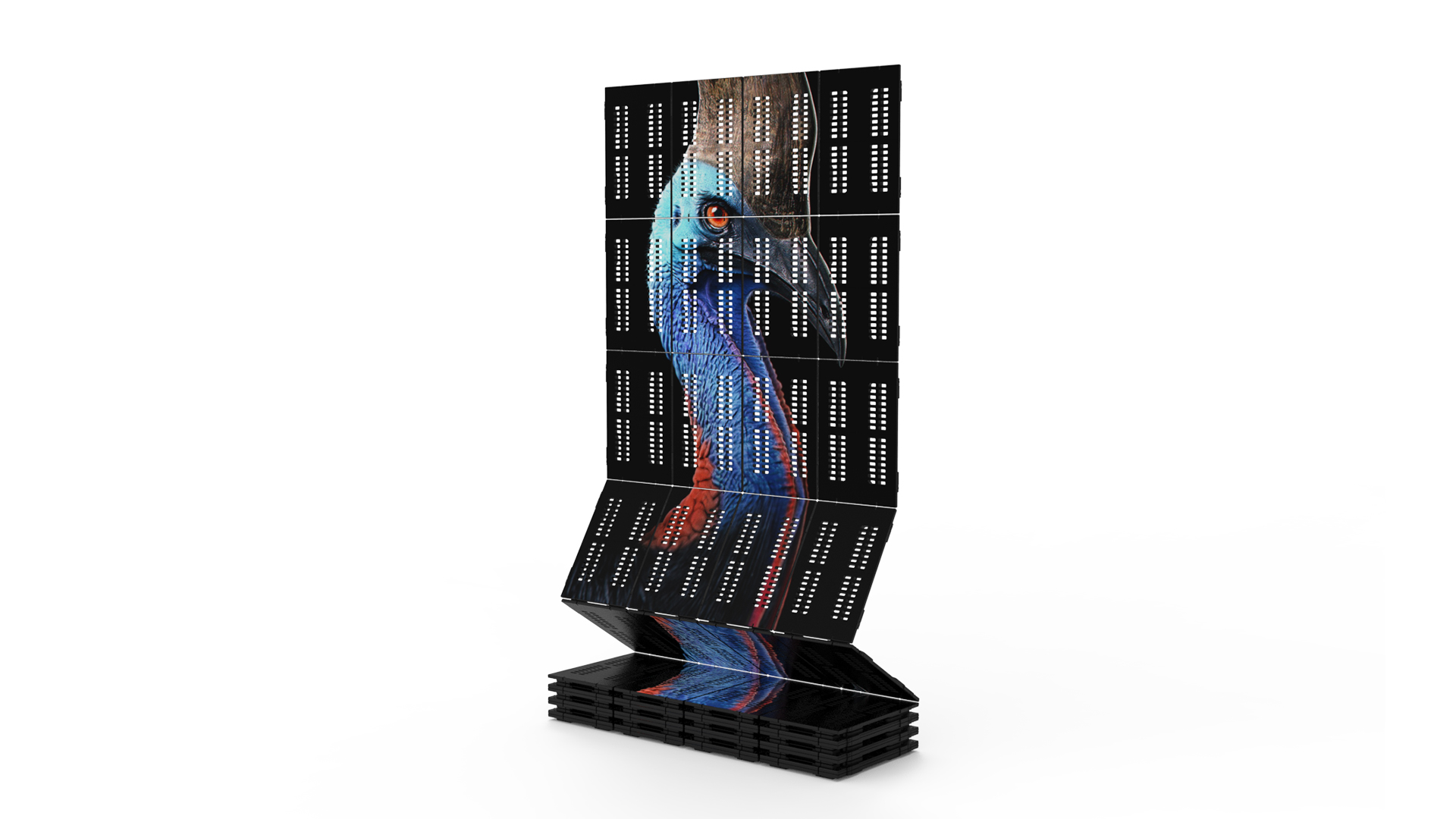
Smart T Plus (FTS series): a 360° foldable transparent LED display with 16.37%–56% transparency, 8–12 kg/m² panel weight and hanging, wall or ground installation.
2. Rolling LED screens
Rolling LED screens coil rather than hinge. The panel bends continuously around a radius instead of rotating at discrete joints, so it can be wound for storage and unwound into a large-format surface. Rolling LED Display is one of Onumen’s four listed product categories, and the company’s stated portfolio covers curved, circular, wave and staircase layouts across its foldable and rollable ranges.
The clearest documented overlap between the two behaviours is the FC series, which is specified for 360° folding and 360° curling at a thickness of 14 mm. That combination is what makes the FC series usable in projects that need both flat-fold transport and curved surfaces without holding two separate panel types in inventory. It also marks the boundary: a coiled panel and a hinged panel are supported differently in the structure, so the choice between them should be made at the design stage, not during load-in.
3. Power-screen separation architecture
Power-screen separation moves the power supply and related hardware out of the display panel. The panel then carries the LED, the flexible PCB and the mechanical structure, while power and control sit in a separate location. This is the architecture Onumen describes as its founding innovation, and its effect on installation is easier to see in a completed project than in a specification sheet.
At Tokyo Shibuya Station, an ultra-thin fixed LED installation covering more than 50 ㎡ has been in operation for more than five years. The separated power supply structure reduced screen thickness and heat generation and improved energy efficiency, which is what made a thin, low-heat installation viable in a public building with limited service access.
- Transport volume. A thinner panel packs into less space, which affects how much screen a rental fleet can move per vehicle and how much storage a fixed venue needs.
- Installation labour. Magic Plus at 15 kg/m², Smart FC at 11 kg/m² and Smart T Plus at 8–12 kg/m² sit far below the handling profile of a conventional cabinet wall, so fewer people and lighter rigging are needed for the same area.
- Structural load. Lower panel weight reduces the load transferred to trusses, walls and lifting mechanisms, which is the reason liftable and hidden installations become feasible.
- Heat management. Moving power hardware away from the panel changes where heat is generated, which matters in enclosed rooms, glass facades and transport terminals.
- Maintenance access. Separated power and control hardware can be serviced without dismantling the display surface.
The architecture also has boundaries that should be settled before quotation. The power and control cabinet needs a defined position, a cable route has to be planned, and the maximum cable run becomes a design constraint — the 30 m single power cable maximum load on Smart T Plus is an example of a number that belongs in the layout drawing rather than in the commissioning week.
Folding and rollable models at a glance
The table below uses published model specifications only, so that a shortlist can be built without estimating values that have not been stated.
| Model (Series) | Fold angle | Panel thickness | Weight | Brightness | Protection | Installation |
|---|---|---|---|---|---|---|
| Magic Plus (FPS) | 180° | 15 mm | 15 kg/m² | 6000 nits | IP65, up to IP68 | Hanging / wall-mounted |
| Easy Sailing EP250–EP400 (EP) | 360° | 14–17 mm | 12 kg/m² | 630–2300 nits | IP43 | Mobile / quick setup |
| Easy Sailing EP150–EP225 (EP) | 360° | 14–17.1 mm | 12 kg/m² | 630–2300 nits | IP43 | Mobile / quick setup |
| Smart T Plus (FTS) | 360° | 18.2–22.5 mm | 8–12 kg/m² | 1100–9700 nits | IP65, up to IP68 | Hanging / wall / ground |
| Smart Plus (FCSL) | 360° | 18–24 mm | 15 kg/m² | 2400–6000 nits | IP65 front & rear, up to IP68 | Hanging / wall-mounted |
| Smart FC (FC) | 360° | 14–17 mm | 11 kg/m² | 1000–1500 nits | IP43 | Hanging / wall / floor |
Figures are the published specifications for each model series. A project specification should confirm the exact configuration at quotation stage.
Step-by-step: matching a form factor to a project
A reliable sequence is to fix the physical constraints first and the visual specification second. Reversing that order is how projects end up with a correctly pitched screen that cannot enter the building.
- Step 1 — Map the venue geometry. Record height, width, sightlines and whether the screen will be ground-supported, flown, wall-mounted or hidden behind a surface. This single answer eliminates entire product families: a hidden ceiling or floor installation requires a lifting interface, while a flown ballroom screen does not.
- Step 2 — Decide how the screen is stored between uses. A flat-fold stack (Magic Plus at 180°, or the 360° panels) and a coiled roll are different logistics. Mobile formats such as Easy Sailing add a flight case to the decision: the EP225 configuration ships at 70 kg total in a 1500 × 400 × 430 mm case.
- Step 3 — Fix the installation method before the pixel pitch. Magic Plus and Smart Plus are specified for hanging or wall mounting, Smart T Plus adds ground installation, and Smart FC adds floor installation. Choosing the pitch first frequently produces a panel set that cannot be attached the way the venue requires.
- Step 4 — Plan the power and control path. In a separated architecture the cabinet position, cable route and maximum run belong in the layout. If the cable route is longer than the specified single-cable load, the screen layout has to change, not the cable.
- Step 5 — Match protection rating and brightness to the environment. IP43 suits indoor and semi-outdoor use; IP65 and IP68-rated models extend the options. Brightness should follow the ambient light level: 630–2300 nits for controlled indoor spaces, 6000 nits on Magic Plus and up to 9700 nits on the transparent Smart T Plus for brighter environments.
- Step 6 — Size the panel and confirm logistics. Panel weight per square metre, thickness and case dimensions decide truck volume and crew size. Only after these are fixed does the pixel pitch become a free variable to optimise against viewing distance and content.
Where each form factor fits
Airport and transport-terminal advertising
Airport advertising projects and rail terminals share a constraint set: long operating hours, restricted service access, public safety and a fixed architectural envelope. The relevant architecture is usually power-screen separation, because a thin panel with remote power reduces the depth required behind the finished surface and moves heat away from the display itself. The Tokyo Shibuya Station installation is the closest documented reference: more than 50 ㎡ of ultra-thin fixed LED display with a separated power supply structure, in continuous service for more than five years. It is a rail station rather than an airport, but the installation logic transfers directly to terminal advertising walls and wayfinding surfaces.
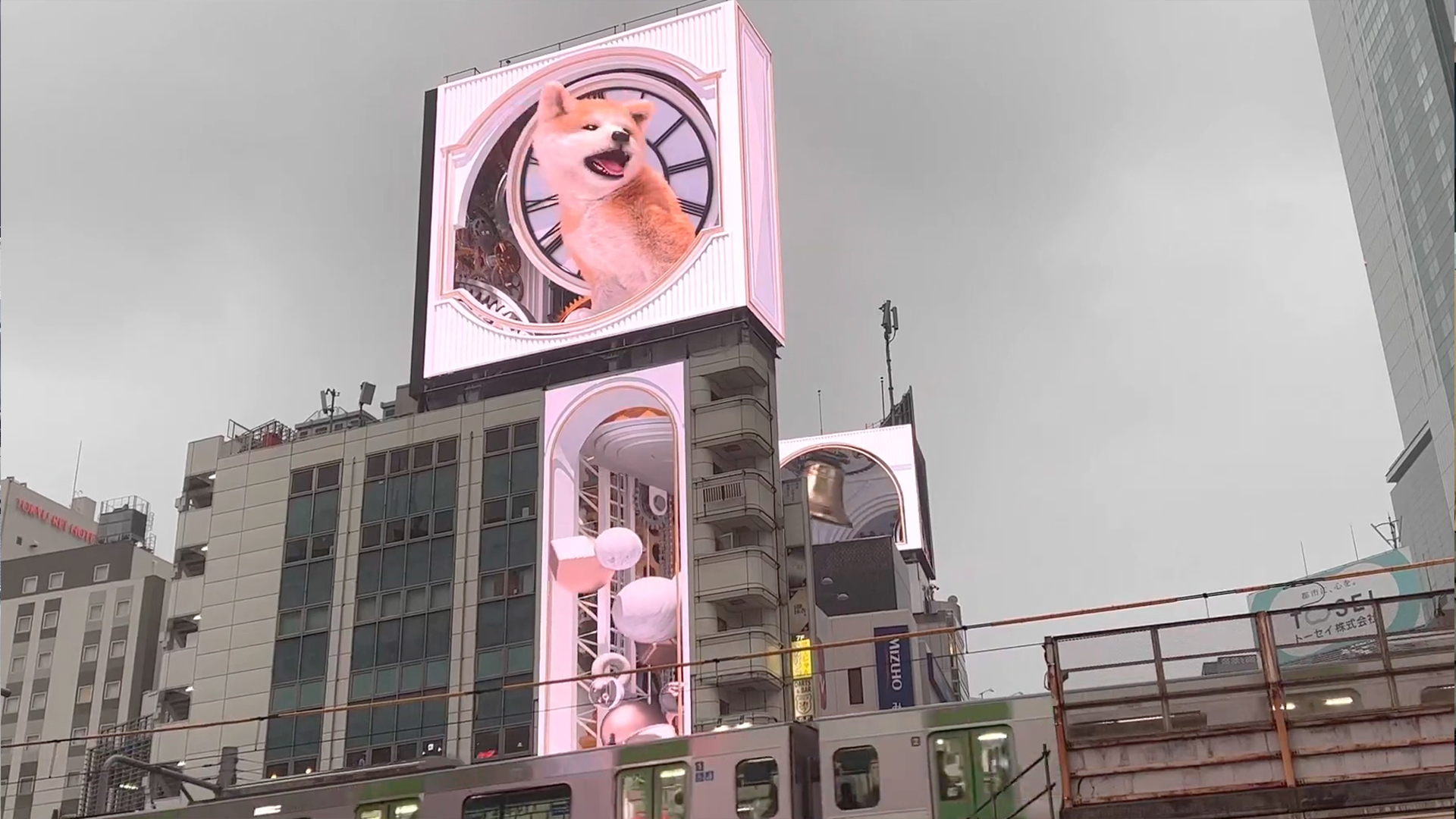
Tokyo Shibuya Station: more than 50 ㎡ of ultra-thin fixed LED display, where the separated power supply structure reduced screen thickness and heat generation and has supported more than five years of operation.
Concert, stage performance and touring
Large concert and stage work is where foldable inventory earns its place. The Fukuyama Masaharu Japan tour used three LED display systems of 33 m × 16 m, totalling 1,670 ㎡. The Rock Records 30th Anniversary concert arranged foldable panels into a large circular structure for 360° viewing, and the SHINee concert integrated more than 500 ㎡ of liftable foldable display into a stage that moved during performance. Stadium-scale work follows the same logic: the JUL concert at Stade de France used more than 100 ㎡ of liftable foldable display to gain stage flexibility and installation efficiency.
Hotel ballrooms and banquet halls
Hotels need a screen that disappears when the room is dressed for a wedding and reappears for a conference. The Cuilin Banquet Hall in Shenzhen integrated more than 50 ㎡ of liftable foldable display into the interior, hidden when not in use and lowered and unfolded for events, and has run for more than five years. In Libya, five EP225 mobile fast-assembly systems were deployed in a hotel for conferences and business meetings, where the foldable design allows quick setup, easy transport and reuse across rooms.
Retail, mall and commercial advertising
Retail projects usually need portability rather than permanence. Six EP225 mobile fast-assembly systems were deployed in a shopping mall in Zhejiang, China, for promotions and events, with the integrated foldable design enabling quick setup, easy movement and efficient reuse. In Hong Kong, more than 50 ㎡ of liftable foldable display was integrated into the Tai Wai MTR shopping mall and has remained in service for more than six years, hidden between campaigns.
Corporate showrooms and product launches
A launch event puts the screen inside the choreography. For a Geely automotive launch, a foldable LED system created a three-sided immersive space around the vehicle: the lifting platform rose while the screens folded from bottom to top, revealing the car. Corporate showrooms use the same panels in a fixed configuration, where the fold range supports curved and corner layouts that a flat cabinet wall cannot follow.
Education, conference and worship spaces
Lecture halls, churches, theatres and conference rooms value a screen that is absent when not in use. Wenzhou Foreign Language School installed more than 30 ㎡ of liftable foldable display inside the lecture hall ceiling, lowered automatically for teaching and hidden afterwards, in a cooperation spanning more than ten years. A kindergarten in Ordos, Inner Mongolia, used more than 15 ㎡ of outdoor liftable foldable display that stays hidden to keep the playground open and rises for school events.
Cultural tourism and outdoor advertising
Outdoor work shifts the emphasis to structure and weather resistance. A cultural tourism project in Wenzhou used 100 ㎡ of transparent horizontal-folding LED display, where the hollow design reduces wind load while keeping the architecture visible, and has operated for more than five years. For street-level advertising, a Guatemala operator installed more than 50 ㎡ of double-sided ultra-thin fixed LED display on advertising poles, using a lightweight, low-heat structure to serve both directions for more than seven years.
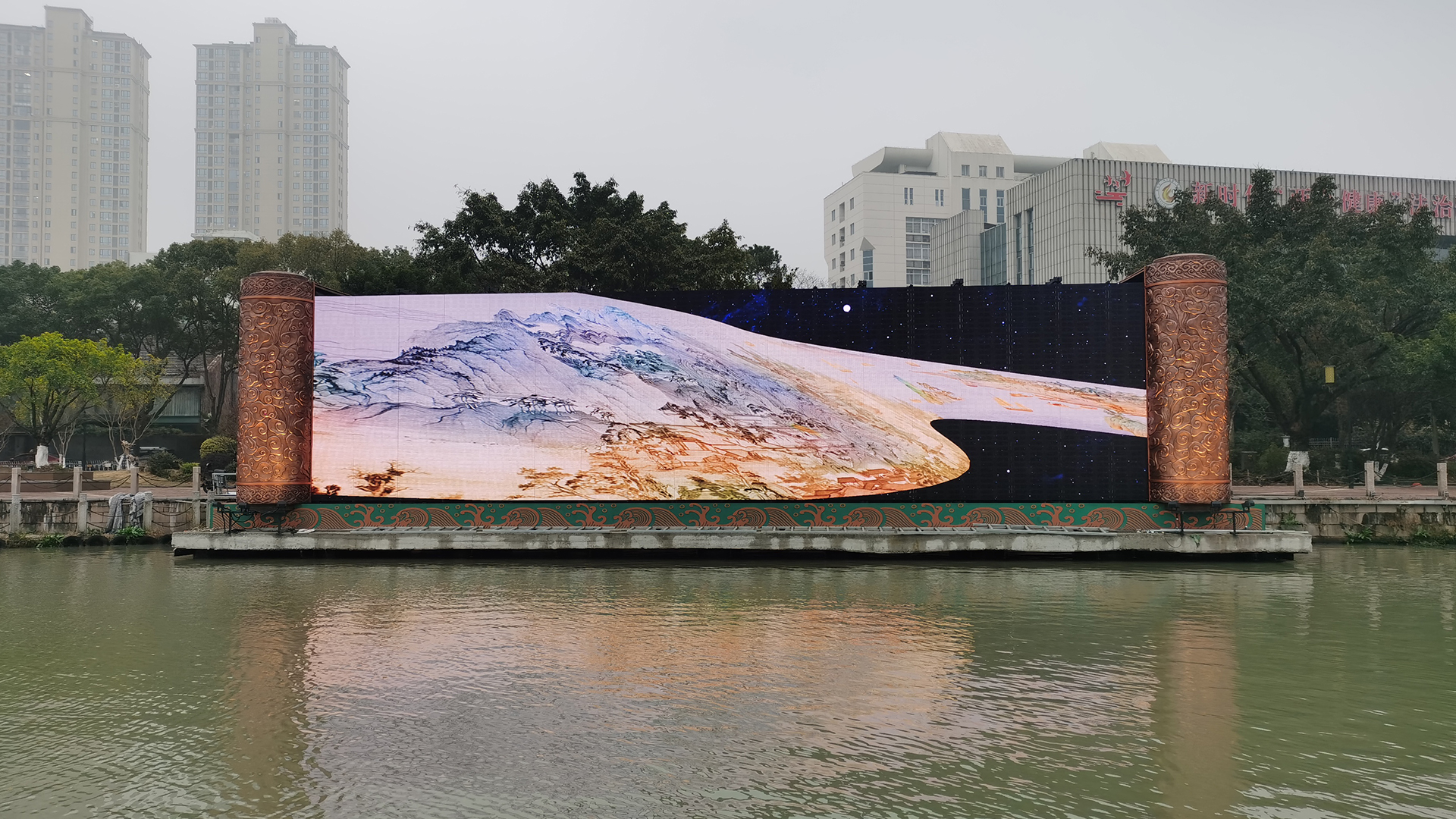
Wenzhou cultural tourism project: 100 ㎡ of transparent horizontal-folding LED display with a hollow, wind-resistant structure, in service for more than five years.
Choosing between the architectures
The decision table below converts the discussion into a comparison across the three architectures. It describes behaviour and constraints rather than ranking one form above another, because each answers a different project condition.
| Architecture | What moves | Storage form | Typical fit | Check before specifying |
|---|---|---|---|---|
| Hinge-based folding display | Panels rotate at joints, 180° or 360° | Flat-fold stack, or flight case for mobile formats | Rental, stage, ballroom, conference, mobile event | Fold angle, packed depth, mounting method, protection rating |
| Rolling LED screen | Panel coils continuously around a radius | Coiled | Continuous curved, circular or wave surfaces | Whether the structure supports a coiled panel rather than a hinged one |
| Power-screen separation | Display panel only; power and control stay remote | Thin panel, separate cabinet | Transport terminals, facades, hidden installations, long-service fixed sites | Cabinet position, cable route and maximum cable run |
FAQ
What certifications and protection ratings matter for an airport or terminal folding LED display project?
Onumen holds ISO management system certificates as well as CE, FCC and RoHS product certifications. Protection ratings differ by model: the Easy Sailing EP series and the Smart FC series are rated IP43, while Magic Plus, Smart T Plus and Smart Plus are rated IP65 and can be specified up to IP68. A terminal interior is usually a clean indoor environment, but an airport advertising project should still match the rating to the exact mounting position, the cleaning routine and any semi-outdoor exposure the screen will face.
Can a folding LED display be customised to an airport terminal’s dimensions and mounting conditions?
Customisation covers screen size, pixel pitch, cabinet design, installation structure, control system, logo and packaging. Mounting options differ by model: Magic Plus and Smart Plus are specified for hanging or wall mounting, Smart T Plus adds ground installation and Smart FC adds floor installation. For a transport-terminal reference, the Tokyo Shibuya Station installation used an ultra-thin fixed LED display with a separated power supply structure across more than 50 ㎡ and has operated for more than five years; it is a rail station rather than an airport, but it demonstrates the installation logic — thin panel, remote power and long service life in a public building.
What determines the cost of a folding LED display screen?
Cost follows the specification rather than the word “folding”. The variables that move a quotation are pixel pitch (spanning P2.6 to P37.5 across the range), brightness (630–2300 nits on Easy Sailing, 6000 nits on Magic Plus, 1100–9700 nits on Smart T Plus), protection rating, transparency (16.37%–56% on Smart T Plus), panel size and weight, installation structure, and the control and power configuration. The minimum order quantity is 1 ㎡, which keeps a first evaluation proportionate to the project.
Can a buyer validate a folding LED display before committing to a full order?
The minimum order quantity is 1 ㎡, and every unit goes through 100% aging test and quality inspection before shipment. Because customisation covers size, pitch, cabinet design, installation structure, control system, logo and packaging, a validation unit can be built to the same specification as the production run rather than to a generic sample. Buyers evaluating a first project can request a sample or a quotation through sales@onumen.com.
What is the lead time and production capacity behind a folding LED display order?
Lead time is 30–90 days after order confirmation, supported by a monthly capacity of 3,000–5,000 ㎡. After-sales coverage includes remote technical support, installation guidance, maintenance support and spare parts supply. To start a project review, send the venue dimensions, the intended installation method and the target pixel pitch to sales@onumen.com, or call +86 755 8360 1688 / +86 755 8281 9688.
Conclusion
Folding LED display screens are easier to specify once the word is unpacked. A hinge-based folding display answers portability and shape; a rolling screen answers continuous curvature; a power-screen separation architecture answers thinness, weight, heat and long-service installation. Onumen’s range maps onto all three — Magic Plus for 180° flat-fold work, Smart FC and Smart Plus for 360° folding and curling across indoor and outdoor positions, Smart T Plus for transparent folding, Easy Sailing for mobile quick-assembly, and the Power-Screen Separation (Architecture) LED Screen for installations where the power hardware should not travel with the panel.
The practical rule is to fix the venue geometry, storage method and installation interface first, then choose fold angle, protection rating and brightness, and leave pixel pitch until last. That sequence keeps a shortlist honest and prevents a correctly specified screen from arriving at a building it cannot enter.
Next step: match the architecture to your project
Send the venue dimensions, installation method, viewing distance and target pixel pitch to Onumen, and the team will confirm which architecture fits — folding, rolling or power-screen separation — with the panel specification that supports it.
Email: sales@onumen.com · Tel: +86 755 8360 1688 / +86 755 8281 9688 · WhatsApp: 18926440672 · Web: www.onumen.com
Onumen Technology Co., Ltd. · 4F, Building A3, Xiwan Zhiyuan, Hangkong Road, Bao’an District, Shenzhen, China

Easy Sailing EP225: 360° folding, 12 kg/m² panel weight and a 1500 × 400 × 430 mm flight case, built for event and rental deployment.
Have Questions or Need More Details?
Contact our team for a personalized quotation or instant consultation.
Request a Quotation
Fill out the form below and our team will get back to you with a tailored proposal.
WhatsApp Direct Chat
Prefer to chat in real-time? Message us on WhatsApp for instant assistance & quick answers.
- Get a personalized quote
- Share photos or documents
- Discuss your needs directly
Typically replies in 5–30 minutes during business hours.