Pixel Pitch, Refresh Rate, and Curvature: Rollable LED Screen Specs Explained
A rollable LED screen is decided by four parameters before anything else: pixel pitch, refresh rate, brightness, and curvature radius. Pixel pitch sets how close an audience can stand before the image breaks into visible dots. Refresh rate sets whether cameras can film the panel without scan lines. Brightness sets whether the picture survives the ambient light at the installation. Curvature and rolling radius set how tightly the panel can bend or roll without stressing modules and connections. This guide explains what each parameter controls, how the four interact, and how to match a specification to viewing distance, content type, and long-term operation. The reference points used here are grounded in the ONUMEN Rolling LED Display and ONUMEN Foldable LED Display, in the standards applied to them, and in the mechanical design facts behind their rolling structure.
Problem Definition: Why Rollable LED Screen Specs Are Easy to Get Wrong
Most specification mistakes on rollable LED screens are not caused by missing information. They are caused by carrying fixed-cabinet thinking onto a flexible panel. A fixed cabinet display and a rollable panel can share the same pixel pitch and the same refresh rate and still behave completely differently on site, because the flexible version adds a mechanical variable: the panel must survive being curved, folded, or rolled, then unfolded again, repeatedly, across the life of the installation.
Four failure patterns recur in rollable LED screen projects:
- Pitch chosen from the room instead of the nearest viewer. Pixel structure becomes visible in the front rows, on the boardroom table, or in close-up camera shots.
- Refresh rate specified without checking the capture chain. The panel looks clean to the live audience and bands on video.
- Brightness specified from habit rather than from the light at the installation. An indoor panel washes out beside a glazed facade, or an over-bright panel creates glare and an unnecessary power and heat load in a controlled-light room.
- Curvature described as "curved" without a radius. The panel is then bent or rolled tighter than its module connection structure is designed to tolerate.
Behind the fourth item sits a durability question that rarely appears in a quotation: repeated rolling and unfolding stress, mechanical structure reliability, module connection stability, and long-term operation performance. These are the factors that separate a rollable panel still performing in year three from one that develops dead lines and connector faults.
For a buyer at the decision and execution stage, the practical consequence is straightforward. The specification must be matched to two things before the order is placed: viewing distance and content type. Everything else follows from those two decisions, including module count, control card loading, transport volume, and installation labor.
Industry Background: Rollable Displays Have Moved Into Mainstream Procurement
The commercial context explains why this discipline matters now. Grand View Research and Spherical Insights value the global flexible display market, including rollable form factors, at roughly USD 20.1B to 21.6B in 2024, and Meticulous Research projects the rollable and foldable display segment to grow from USD 5.1B in 2024 to nearly USD 60B by 2035. Third-party industry reporting such as the KingAurora industry report identifies Samsung Electronics, Leyard, and LG Electronics as the top three global leaders in the outdoor and flexible LED display market in 2024.
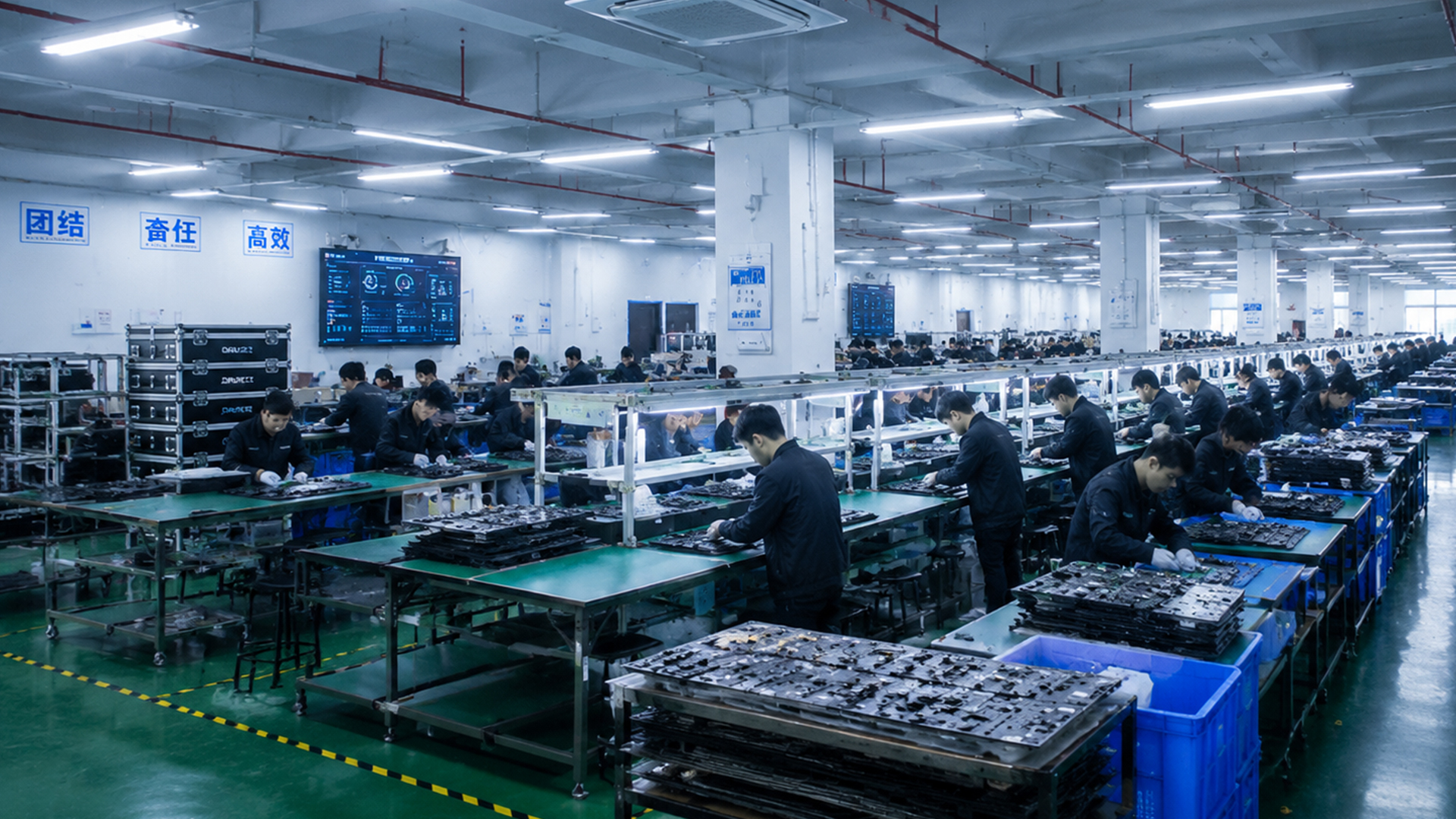
Alongside those large display brands, a specialized supplier tier has formed around lightweight foldable and rollable panels for rental, stage, and architectural work. ONUMEN Technology Co., Ltd. belongs to that tier: founded in 2009 and based in Shenzhen, China, the company manufactures lightweight foldable and rollable LED display solutions from a 2,000㎡ facility with 50 employees, 20 R&D engineers, and an annual output of 9,000㎡, exporting around 70% of production to markets including the USA, Europe, Japan, South Korea, Russia, and the Middle East. Its portfolio covers two core series, the Foldable LED Display and the Rolling LED Display, both built on a power and screen separation architecture.
Two regulatory layers sit on top of that market layer. Public-space installations are increasingly specified against recognized safety standards: UL 62368-1 for electrical safety and UL 94 V-0 for fire resistance are commonly mandated for flexible LED screens in airports and theaters, while the photobiological safety standard IEC 62471 applies to LED products in the EU and China to prevent blue-light hazards. Product-level compliance for the ONUMEN range includes CE, FCC, and RoHS, together with ISO management system certificates for production.
The implication for specifiers is that a rollable LED screen datasheet has to be read together with a mechanical layer and a compliance layer. Those two layers are what make a parameter list deliverable across a long project cycle rather than only at handover.
Detailed Solution: How the Four Parameters Are Built Into a Rollable Panel
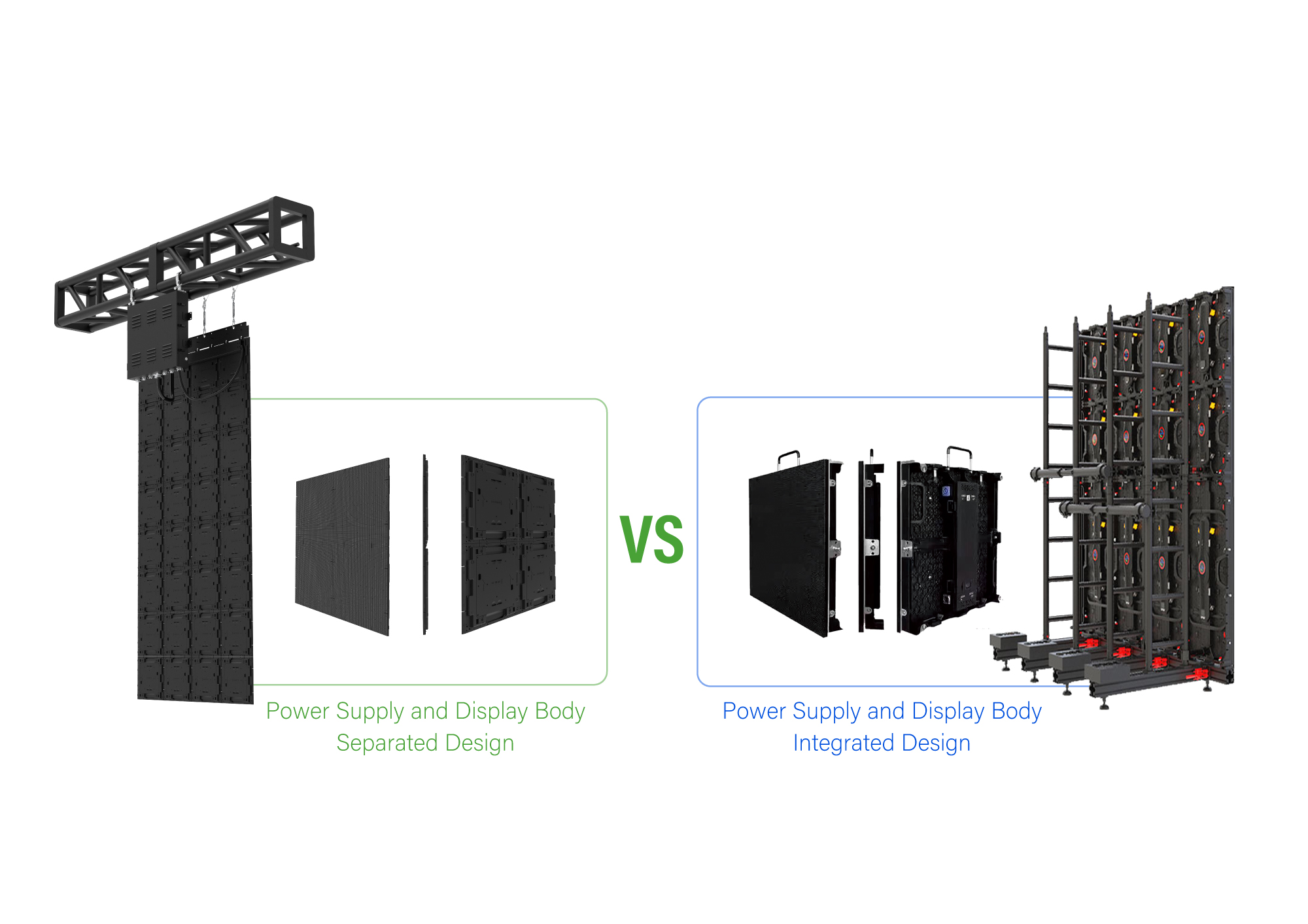
The ONUMEN approach is to treat the flexible panel as a structure problem first and a display problem second. The Foldable LED Display is an ultra-lightweight flexible LED screen at 12 kg/㎡ and 14mm thickness, with a cabinet-free design that removes the heavy cabinet and the complex steel structure a traditional cabinet screen requires for installation. In specification terms this matters because weight and thickness are what make extreme curvature, folding, and repeated rolling practical at all: a thin panel bends with less stress on modules and connection points than a thick cabinet module.
Mechanically, ONUMEN addresses the risks of repeated rolling and unfolding stress, mechanical structure reliability, module connection stability, and long-term operation performance through precision roller mechanism design, an optimized module connection structure, controlled rolling speed, and strict durability testing methods. Long-term operation performance is confirmed by continuous cycle testing and aging tests, and complete quality inspection is carried out before shipment. In a procurement document, this is the part of the specification that should be asked about explicitly, because it is the part that a fixed-cabinet quote does not contain.
On the parameter side, the ONUMEN Rolling Plus outdoor series of rollable LED products is specified with pixel pitches from 2.6mm to 3.9mm and uses SMD 1212/1415 lamps for weather resistance, which links pitch selection to the environmental exposure of an outdoor position. The same flexible platform supports creative geometries such as curved, circular, wave, and staircase layouts, so curvature is a design input rather than an exception request.
The Four Parameters, Explained
Pixel Pitch: the parameter that decides viewing distance
Pixel pitch is the centre-to-centre distance between adjacent LED pixels, measured in millimetres. It is the primary parameter for image quality at a given viewing distance, because it sets pixel density: a smaller pitch packs more pixels into the same area, so the image holds together closer to the screen.
A widely used industry rule of thumb estimates the minimum comfortable viewing distance in metres at roughly 1.5 to 2 times the pixel pitch expressed in millimetres. Treat it as a planning filter rather than a final answer, and confirm it with the supplier against the actual content, screen height, and seating layout. Used this way, the rule quickly removes pitch options that cannot work for the nearest viewer in the room.
For outdoor and semi-outdoor work, the ONUMEN Rolling Plus outdoor series is specified with pixel pitches from 2.6mm to 3.9mm and SMD 1212/1415 lamps. That band suits large-format advertising and architectural positions where the nearest viewer stands well back from the screen, while the lamp selection addresses the moisture and temperature exposure that outdoor rollable installations face.
Pitch also drives cost and mass indirectly. Halving the pitch roughly quadruples the pixel count for the same area, which raises module density, driver electronics, and power draw per square metre. On a rollable panel that extra density must also survive repeated rolling, which is why an ultra-fine pitch requirement and an aggressive rolling requirement should be evaluated together rather than in separate documents.
Refresh Rate: the parameter that decides whether cameras can film it
Refresh rate describes how many times per second the driver rewrites the image, expressed in hertz. A direct-view audience tolerates a wide range; a camera does not. When a screen is filmed, a refresh rate that is too low relative to the camera shutter produces horizontal banding, flicker, or rolling scan lines that appear in the recording even though the live audience sees a clean image.
The decision rule is simple to apply. If the screen will ever appear on camera, including broadcast, live streaming, hybrid conferences, product launch coverage, or event documentation, refresh rate moves up the priority list and should be confirmed against the capture chain. If the panel will only ever be viewed directly, pixel pitch and brightness consistency matter more, and refresh rate can be specified to the motion content instead of to the camera.
Refresh rate has a cost side as well. Driving the panel faster increases the workload on the driver electronics and control system and typically increases heat generation. That is why the figure should come from the actual capture requirement rather than from a maximum value copied from an unrelated project.
Brightness: the parameter that decides whether the image survives ambient light
Brightness describes how much light the panel emits per unit area, quoted in nits (candelas per square metre). It is an environment parameter, not a quality badge: the correct value is the one that produces a readable, comfortable image in the light conditions at the installation.
Errors run in both directions. Under-specified brightness leaves the image washed out in daylight-facing or glazed environments. Over-specified brightness in a controlled-light interior creates glare, eye strain for people seated near the panel, and a higher power and heat load, all of which matter more on a lightweight rollable structure that exists to reduce structural load.
Brightness also intersects with compliance. Blue-light-related photobiological safety, covered by IEC 62471 in the EU and China, becomes relevant where viewers are close to the panel or exposed for long periods. Electrical and fire safety standards such as UL 62368-1 and UL 94 V-0 are typically required for LED screens installed in public spaces including airports and theaters.
Curvature Radius and Rolling Capability: the parameter unique to rollable screens
Curvature radius describes the tightest arc a panel can hold in a fixed installation without over-stressing modules, PCB, and connection points. Rolling capability describes something stricter: the panel is not merely held in a curve, it is rolled onto a mechanism, transported, unrolled, and rolled again, repeatedly.
This is where flexible panels divide into classes. The ONUMEN Foldable LED Display is built as an ultra-lightweight flexible screen at 12 kg/㎡ and 14mm thickness with a cabinet-free structure, and supports 360° folding and 360° curling. In specification terms, that means the panel can follow geometries a fixed cabinet cannot, including curved, circular, wave, and staircase layouts, rather than only shallow arcs.
The capability rests on mechanics rather than on marketing language. Precision roller mechanism design, an optimized module connection structure, and controlled rolling speed are the design answers to repeated rolling and unfolding stress, and strict durability testing, continuous cycle testing, and aging tests are the verification answers. For a buyer comparing rollable LED screens, this is the section of the specification that should be documented, not summarised.
Step-by-Step: Matching a Rollable LED Screen Spec to Viewing Distance and Content
- Step 1 — Fix the viewing geometry. Record the nearest viewer position, screen height and width, and viewing angles. Every later decision depends on the nearest viewer, not the average one.
- Step 2 — Select pixel pitch from the nearest viewer. Apply the 1.5 to 2 times pitch rule of thumb as a first filter, then confirm against content: text, data, and close-up detail need a finer pitch than large graphic content at the same distance. For outdoor advertising positions, the ONUMEN Rolling Plus outdoor series covers 2.6mm to 3.9mm with SMD 1212/1415 lamps.
- Step 3 — Select refresh rate from the capture chain. List every camera, stream, and broadcast path that will point at the screen. If any exist, prioritise refresh rate; if none exist, specify it to the motion content instead.
- Step 4 — Select brightness from the ambient light environment. Measure the light at the panel position at the busiest time of day, then specify brightness for that condition rather than for a generic indoor or outdoor label.
- Step 5 — Define curvature and rolling precisely. Replace "curved" with a specified radius, and for rollable panels add a rolling requirement. Confirm the panel class: the ONUMEN Foldable LED Display supports 360° folding and 360° curling at 12 kg/㎡ and 14mm thickness.
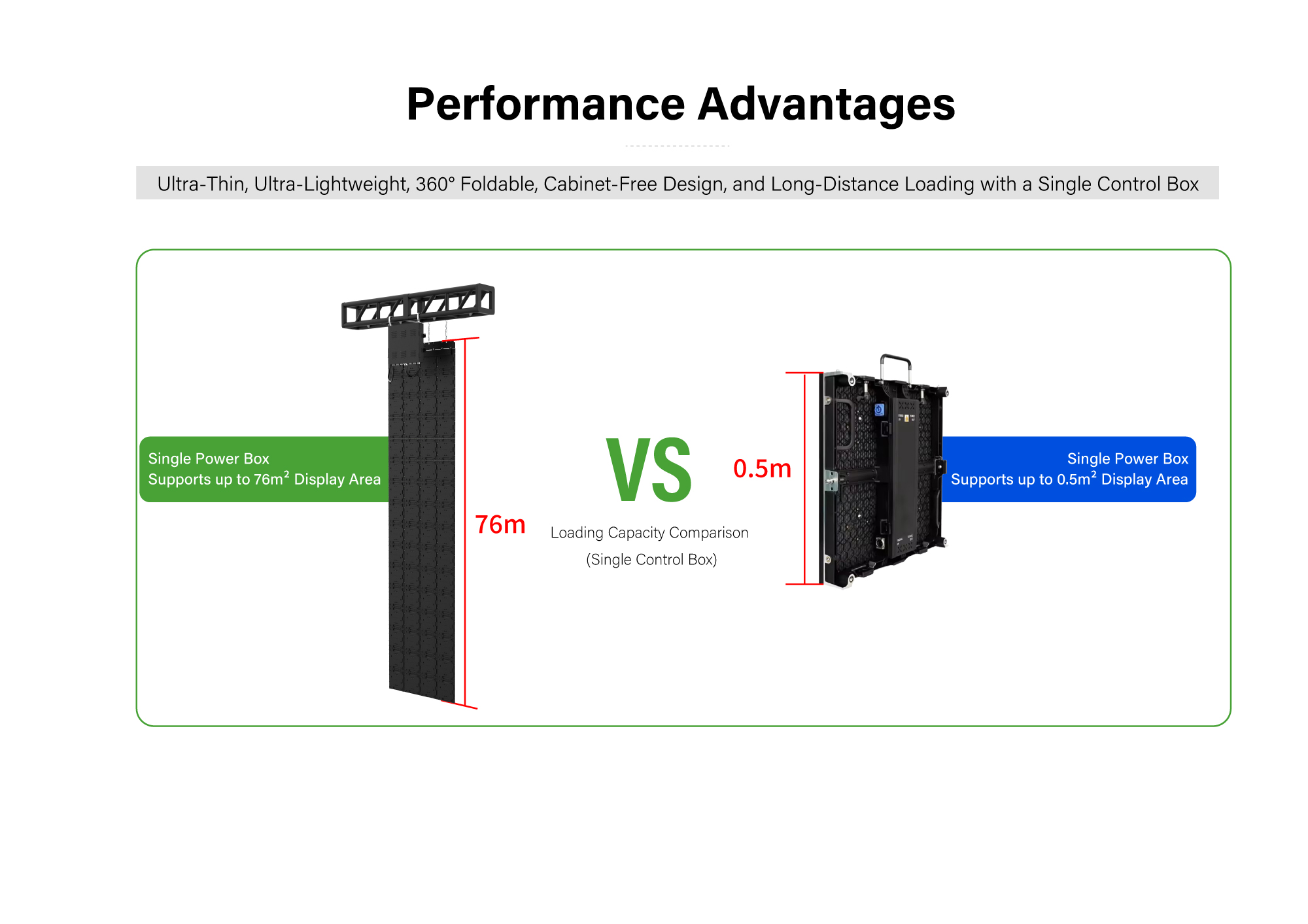
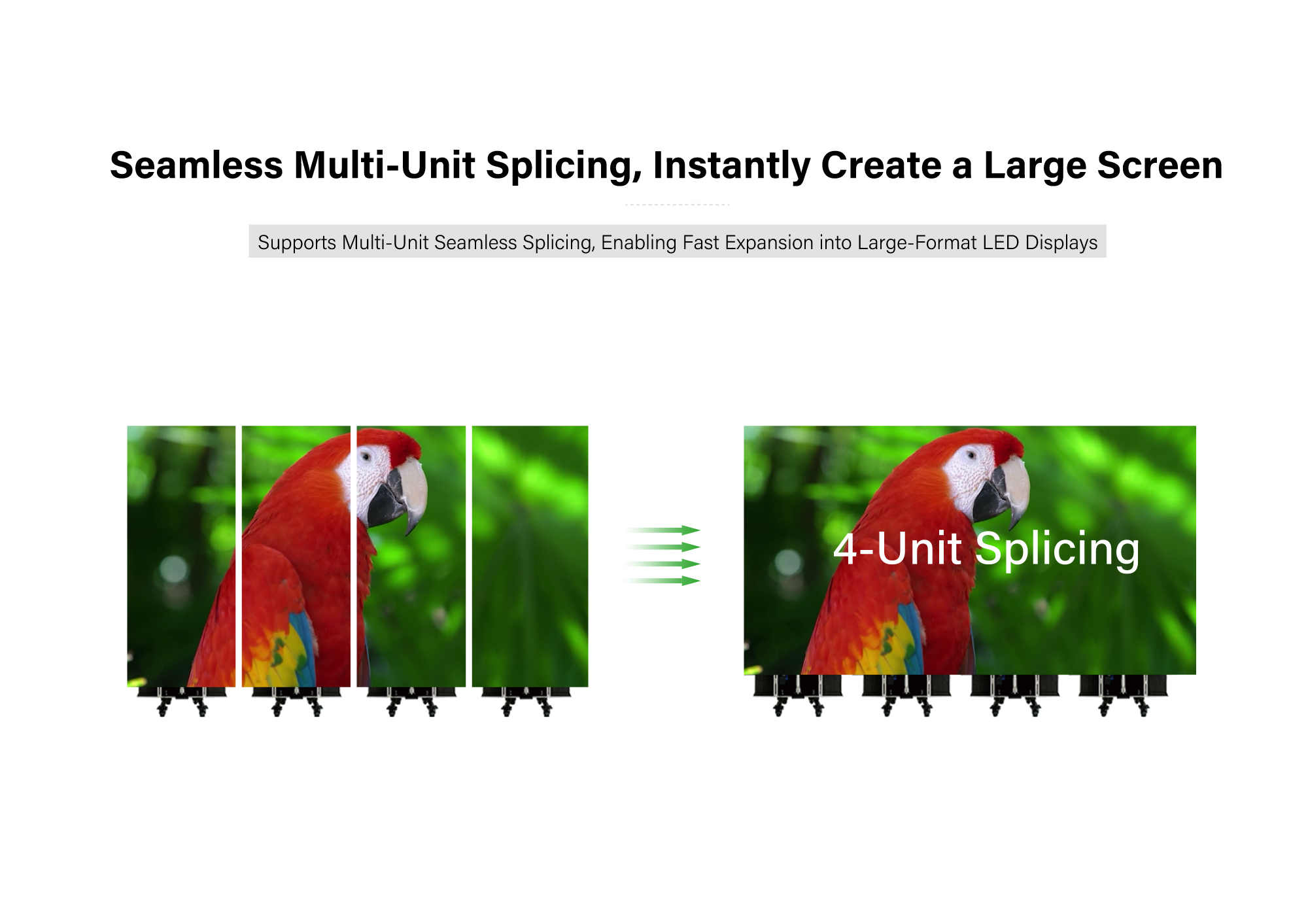
- Step 6 — Convert the mechanical spec into logistics and labor. Against a traditional cabinet LED display, the ultra-lightweight design cuts weight by up to 50%, space requirements by 60%, thickness by 70%, and installation labor by 80%, with weight at roughly one-third, volume one-quarter, thickness one-fifth, and installation labor one-sixth of the cabinet equivalent. In practice, a 100㎡ large-scale LED display can be installed by 2 people within 1 hour, the Sailing Series allows one person to install a single unit in 5 minutes, one control card can support up to 76㎡ of display area, and 40㎡ of LED display can be loaded into a 1m³ flight case.
- Step 7 — Lock compliance and commercial terms before the order. Product compliance for the ONUMEN range covers CE, FCC, RoHS, and ISO management system certificates; public-space projects typically add UL 62368-1 and UL 94 V-0, and EU or China projects address IEC 62471. The minimum order quantity for rollable LED display products is 1 m² or 1 unit; delivery terms include EXW, FOB, CIF, and DDP with international shipping support; acceptance criteria cover pre-shipment inspection, video inspection, and functional testing before delivery; payment terms include T/T, L/C, and Trade Assurance where applicable.
Use Cases: Which Parameters Matter Most Where
Outdoor advertising LED roll-up screen. Pitch and lamp choice lead. The Rolling Plus outdoor series at 2.6mm to 3.9mm with SMD 1212/1415 lamps is aimed at positions where the nearest viewer is far away and the panel faces weather exposure. Compliance documentation should be confirmed for the specific public venue.
Stage LED roll-up screen and concert LED roll-up screen. Setup speed, weight, and refresh rate dominate. Weight per square metre and transport volume decide crew size and truck count, while refresh rate decides whether the panel can be captured by broadcast and streaming cameras without banding. The Sailing Series, with one person able to install a single unit in 5 minutes, and 40㎡ fitting in a 1m³ flight case, target exactly this touring pattern.
Airport LED roll-up screen and church and theater LED display screen. Compliance leads. Electrical safety and fire resistance standards such as UL 62368-1 and UL 94 V-0 are commonly required in public spaces, and IEC 62471 addresses blue-light safety in the EU and China. Curvature capability then allows the panel to follow architectural lines rather than flat wall sections.
Event and conference LED roll-up screen, hotel LED roll-up screen, and corporate showroom LED roll-up screen. Viewing distance is short, so fine pitch and comfortable brightness matter more than maximum output. Where hybrid meetings are filmed, refresh rate moves up the priority list.
Product launch LED roll-up screen and stadium LED roll-up screen. Both viewing conditions exist at once: a close audience and a camera chain. Specify pitch for the nearest seat and refresh rate for the capture equipment, then verify control loading, since a single control card can support up to 76㎡ of display area and large surfaces need to be planned around that figure.
Comparison Table: Parameter, Decision Input, and Reference Point
| Spec parameter | What it governs | Decision input | Reference point from supplied data |
|---|---|---|---|
| Pixel pitch | Image detail and minimum comfortable viewing distance | Distance of the nearest viewer plus content type | ONUMEN Rolling Plus outdoor series: 2.6mm to 3.9mm, SMD 1212/1415 lamps for weather resistance |
| Refresh rate | Behaviour on camera: banding, flicker, scan lines | Presence of cameras, streaming, or broadcast in the content plan | Specified against the capture chain and confirmed with the supplier |
| Brightness | Legibility against ambient light and viewer comfort | Measured ambient light at the panel position; distance of seated viewers | Specified to installation light conditions; outdoor variants use SMD 1212/1415 lamps |
| Curvature radius and rolling capability | Installation geometry and mechanical durability | Required arc, folding or rolling cycles, transport method | ONUMEN Foldable LED Display: 360° folding and 360° curling, 12 kg/㎡, 14mm thickness, cabinet-free structure |
| Weight and structure | Structural load, transport volume, installation labor | Mounting structure, crew size, venue access | 12 kg/㎡; up to 50% weight reduction, 60% space savings, 70% thickness reduction versus cabinet LED displays |
| Compliance set | Site acceptance and public-space approval | Venue type and destination market | CE, FCC, RoHS, ISO management system certificates; UL 62368-1 and UL 94 V-0 in public spaces; IEC 62471 in the EU and China |
The comparison below isolates the structural difference that sits underneath those parameters, because it explains why a rollable panel changes transport, labor, and site planning at the same time as it changes image geometry.
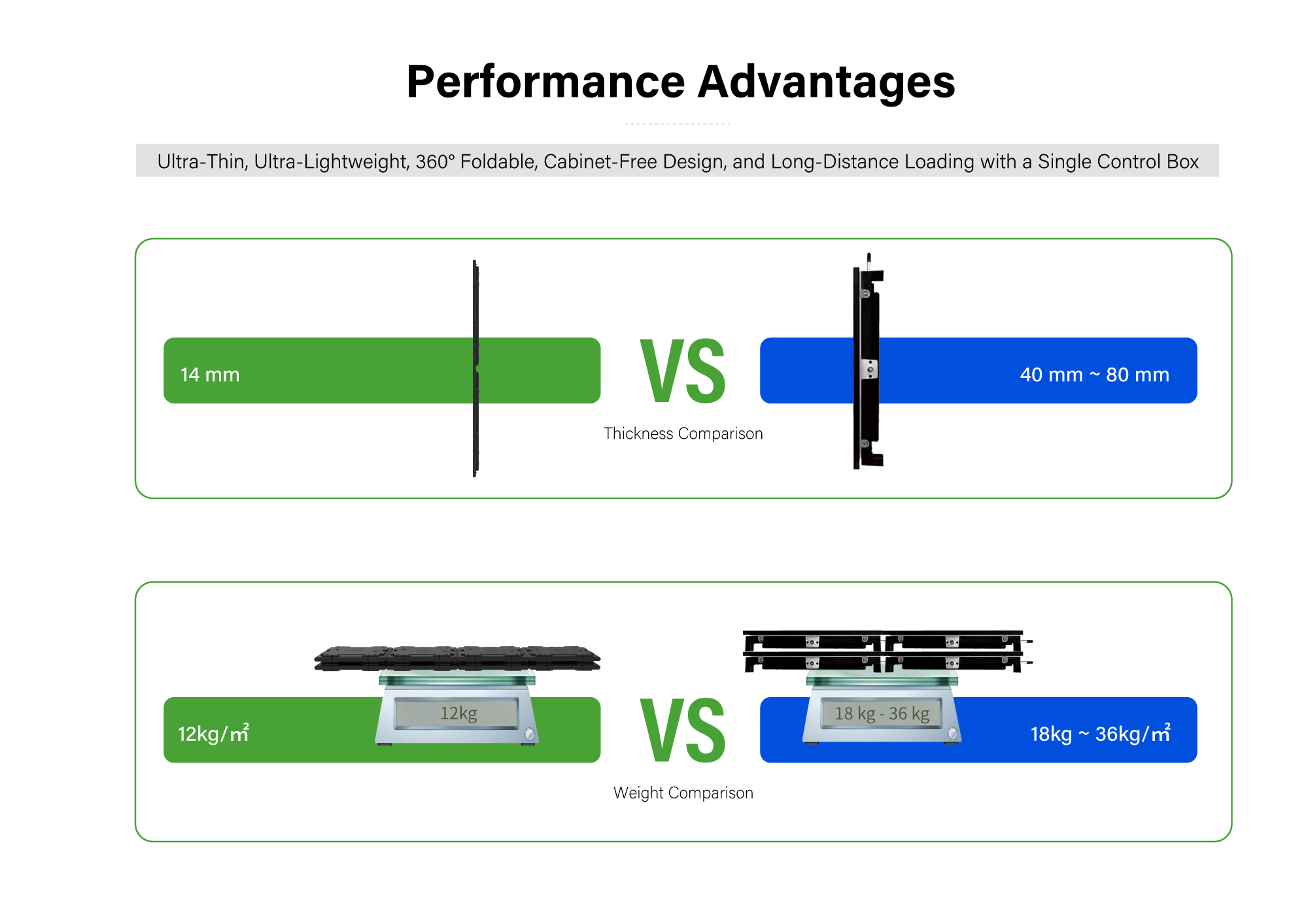
| Comparison item | ONUMEN Foldable LED Display | Traditional Cabinet LED Display |
|---|---|---|
| Weight | 12 kg/㎡; approximately one-third of the cabinet equivalent | Heavy cabinet construction requiring structural support |
| Volume | Approximately one-quarter of the cabinet equivalent | Bulky cabinets that dominate storage and freight |
| Thickness | 14mm, approximately one-fifth of the cabinet equivalent | Deep cabinet profile |
| Installation labor | Approximately one-sixth of the cabinet equivalent; 100㎡ installed by 2 people within 1 hour | Requires heavy cabinets and complex steel structures |
| Form capability | 360° folding and 360° curling; curved, circular, wave and staircase layouts | Flat or shallow-curve mounting only |
| Best suited to | Stage performances, concerts, events, exhibitions, creative installations, applications requiring frequent setup | Permanent flat installations where structure and labor are not constrained |
Frequently Asked Questions
Which standards should be checked on a rollable LED screen specification for a public venue?
For flexible LED screens in public spaces such as airports and theaters, UL 62368-1 (electrical safety) and UL 94 V-0 (fire resistance) are commonly mandated, and the photobiological safety standard IEC 62471 applies to LED products in the EU and China to prevent blue-light hazards. Product-level compliance for the ONUMEN range includes CE, FCC, and RoHS together with ISO management system certificates for production. Confirm the applicable certificate set against the exact model and the destination market before the order is placed.
Can one rollable LED screen platform cover both indoor fine-detail use and outdoor advertising use?
Parameter bands differ by application, so the platform should be matched to the position rather than assumed. The ONUMEN Rolling Plus outdoor series of rollable LED products is specified with pixel pitches from 2.6mm to 3.9mm and uses SMD 1212/1415 lamps for weather resistance, which suits outdoor advertising positions. The ONUMEN Foldable LED Display is an ultra-lightweight flexible screen at 12 kg/㎡ and 14mm thickness with 360° folding and 360° curling, which suits stage, event, and creative applications. In both cases, long-run reliability depends on the mechanical design: precision roller mechanism design, an optimized module connection structure, controlled rolling speed, strict durability testing, continuous cycle testing, and aging tests.
What is the minimum order and cost structure for a rollable LED screen program?
The minimum order quantity for rollable LED display products is 1 m² or 1 unit. Delivery terms include EXW, FOB, CIF, and DDP with international shipping support; acceptance criteria cover pre-shipment inspection, video inspection, and functional testing before delivery; payment terms include T/T, L/C, and Trade Assurance where applicable. Cost should be read against operating economics rather than purchase price alone: compared with traditional cabinet LED displays, the ultra-lightweight cabinet-free design delivers up to 50% weight reduction, 60% space savings, 70% thickness reduction, and 80% labor savings, with 100㎡ installable by 2 people within 1 hour and 40㎡ loadable in a 1m³ flight case.
How can a buyer validate rolling durability before committing to a long-term supply program?
Ask for the mechanical answers first: how the precision roller mechanism is designed, how the module connection structure is optimized, and how rolling speed is controlled, since these are the design measures that address repeated rolling and unfolding stress, mechanical structure reliability, and module connection stability. Then ask for the verification answers: strict durability testing methods, continuous cycle testing, and aging tests that confirm long-term operation performance. Finally, apply the order-level acceptance criteria of pre-shipment inspection, video inspection, and functional testing before delivery, starting from a minimum order quantity of 1 m² or 1 unit as a validation quantity.
What should a commercial advertising operator check before choosing a long-term rollable LED screen manufacturer?
Four checks decide whether a specification survives a multi-year rollout. First, mechanical evidence: whether rolling durability is backed by durability testing, continuous cycle testing, and aging tests rather than by claims alone. Second, compliance consistency: whether the same certificate set, including CE, FCC, RoHS, and ISO management system certificates, applies across the models you plan to repeat. Third, supply and engineering depth: ONUMEN Technology Co., Ltd. was founded in 2009, operates a 2,000㎡ facility with 50 employees, 20 R&D engineers, and 9,000㎡ annual output, exports around 70% of production, and holds a global patent pool covering Asia, Europe, the Americas, and Oceania. Fourth, commercial clarity: a minimum order quantity of 1 m² or 1 unit, EXW, FOB, CIF, and DDP delivery terms, and pre-shipment inspection, video inspection, and functional testing before delivery. To move from evaluation to validation, request a sample or a project quotation through www.onumen.com or by email at sales@onumen.com.
Conclusion: Spec Discipline Is a Long-Term Asset
Pixel pitch, refresh rate, brightness, and curvature radius are not four independent boxes on a datasheet. Pitch answers the question of how close the audience can be; refresh rate answers whether a camera can capture the panel; brightness answers whether the image survives the light at the installation; curvature and rolling capability answer how the panel fits the architecture and how much mechanical stress it will absorb over its service life. Specifying them in that order, from viewing distance and content outward, prevents the four failure patterns that appear most often in rollable LED screen projects.
What changes the long-term outcome is the layer beneath the numbers. A cabinet-free structure at 12 kg/㎡ and 14mm thickness with 360° folding and 360° curling, precision roller mechanism design, an optimized module connection structure, controlled rolling speed, and verification through durability testing, continuous cycle testing, aging tests, and complete quality inspection before shipment, is what allows the same panels to be re-deployed across seasons, venues, and campaigns without the mechanical drift that ends a rental asset's working life early.
Next Step: Validate the Spec on a Real Panel
Share your viewing distance, content plan, and installation geometry, and ONUMEN Technology Co., Ltd. will match pixel pitch, brightness, and rolling requirements to your project. Minimum order quantity is 1 m² or 1 unit, with EXW, FOB, CIF, and DDP delivery terms and pre-shipment inspection, video inspection, and functional testing before delivery.
Website: www.onumen.com | Email: sales@onumen.com | Tel: +86 755 8360 1688 / +86 755 8281 9688 | WhatsApp: 18926440672
Address: 4F, Building A3, Xiwan Zhiyuan, Hangkong Road, Bao'an District, Shenzhen, China