Ranked: Folding LED Display Screen Models by Awards, Patents and Certifications
Three Onumen folding LED display screen models carry the strongest verifiable third-party records in the current foldable line-up. The Smart folding LED Display screen (FC) ranks first on the strength of two independent international design awards plus a 360° fold mechanism. The Magic Plus (FPS) follows on an iF DESIGN AWARD 2025 win, 6000-nit output and IP65 double-sided potting. The Smart Plus (FCSL) closes the top three as the large-format outdoor option covered by the Red Dot Winner 2024 record. Each position below is tied to a named award body, patent office or testing authority that can be checked independently.
Most folding LED display screen guides rank models by pixel pitch, brightness or price. Those figures matter, but they are self-declared. They say nothing about whether a design has been reviewed by an independent jury, whether the folding mechanism is protected technology with an active term, or whether the panel can legally be imported into your market. Awards, invention patents and compliance certificates answer those questions because each one is issued by an outside body and traceable to a certificate number.
This ranking covers three folding models from Onumen Technology Co., Ltd., a Shenzhen-based manufacturer founded in 2009 that specialises in lightweight foldable and rollable LED display solutions and exports to the USA, Europe, Japan, South Korea, Russia and the Middle East. All three models are associated with the same freely-foldable flexible LED screen patent family.
| Rank | Model | Verified design recognition | Fold angle | Default protection | Typical fit |
|---|---|---|---|---|---|
| 1 | Smart folding LED Display screen (FC) | Red Dot Winner 2024 (Red 8972); French Design Award 2026 Gold Award (Gold 9867) | 360° | IP43 | Indoor stage events, exhibitions, rental, creative installations |
| 2 | Magic Plus (FPS) | iF DESIGN AWARD 2025 Winner (673840); Red Dot Winner 2024 | 180° | IP65, up to IP68 | Outdoor advertising, concerts, sports venues, architectural displays |
| 3 | Smart Plus (FCSL) | Red Dot Winner 2024 record | 360° | IP65 front and rear, up to IP68 optional | Large-format outdoor, theme parks, sports venues |
The Problem: Why Folding LED Display Screens Are Hard to Rank on Specs Alone
The foldable LED category is defined by a mechanical behaviour rather than by one measurable number, which makes it unusually difficult to compare on paper. Two cabinets can both be listed as P3.9 with a 3840 Hz refresh rate, a 2500:1 contrast ratio and 16-bit greyscale, yet differ completely in fold angle, sealing method, module size and structural weight. The numbers that are easiest to publish are rarely the numbers that decide whether a screen survives a touring season or a multi-year outdoor installation.
Buyers also almost never get to test the mechanism before purchase. A rental operator assembling a fleet for a concert season cannot run thousands of fold cycles in a showroom. A venue integrator specifying a hidden, liftable installation for a hotel ballroom, a shopping mall or an airport terminal has to commit to a supplier before the screen is on site. Public-space and transport projects add another layer: power safety, fire behaviour and electromagnetic compliance often have to be demonstrated before a quotation is even accepted.
That is why awards, patents and certifications carry real weight in this category — and also why they are frequently misread. Three failure patterns recur in supplier documentation:
- An award logo with no year, no category and no certificate number, so nothing can be traced back to an issuing body.
- A patent reference with no jurisdiction, no expiry date and no statement of what the patent actually covers.
- A compliance claim such as ‘CE certified’ with no test standard cited and no issuing laboratory named.
The practical answer for a buyer is to rank folding LED display screen models by records that can be verified: an award issued by a named international body in a stated year, an invention patent granted by a named IP office with an active term, and a product certificate tied to a named standard and a specific scope.
Industry Background: Why Verified Records Now Decide Foldable LED Projects
Two published market figures frame the category. The global LED display screen market was valued at USD 10.7 billion in 2024 and is expected to reach USD 19.5 billion by 2034, a CAGR of 6.2%, according to Market.us. A separate estimate from Maximize Market Research puts the global foldable display market at USD 4.76 billion in 2024, growing toward nearly USD 169.21 billion by 2032. The two are not directly comparable: foldable display estimates often include mobile OLED panels, while LED display screen figures refer to large-format panels. Read together, they point to a broad shift toward flexible form factors rather than a precise forecast for folding stage screens.
For procurement, the more useful signal is that flexible and foldable formats are moving from custom one-off builds into productised series. When every screen is a bespoke project, awards and patents matter less. When screens become repeatable models that distributors stock, rental fleets reuse and integrators specify, third-party records become the only practical way to separate suppliers who all claim the same capabilities.
Two constraints shape that comparison in day-to-day buying:
- Deployment constraints. A screen that must fold into a flight case, a lift shaft or a hidden ceiling cavity is judged on weight, thickness and fold behaviour as much as on resolution. Indoor folding models typically carry IP43 protection, while outdoor installations require sealed and potted structures rated IP65 or higher.
- Compliance constraints. Projects in the European Union and the United States require documented conformity — CE and RoHS for the EU, FCC for the US — before import and installation. Compliance documentation, not marketing copy, decides whether a model can be deployed at all in those markets.
How This Ranking Was Built
Four criteria were applied, and each one rests on a record that names its issuing authority, so a reader can check it directly.
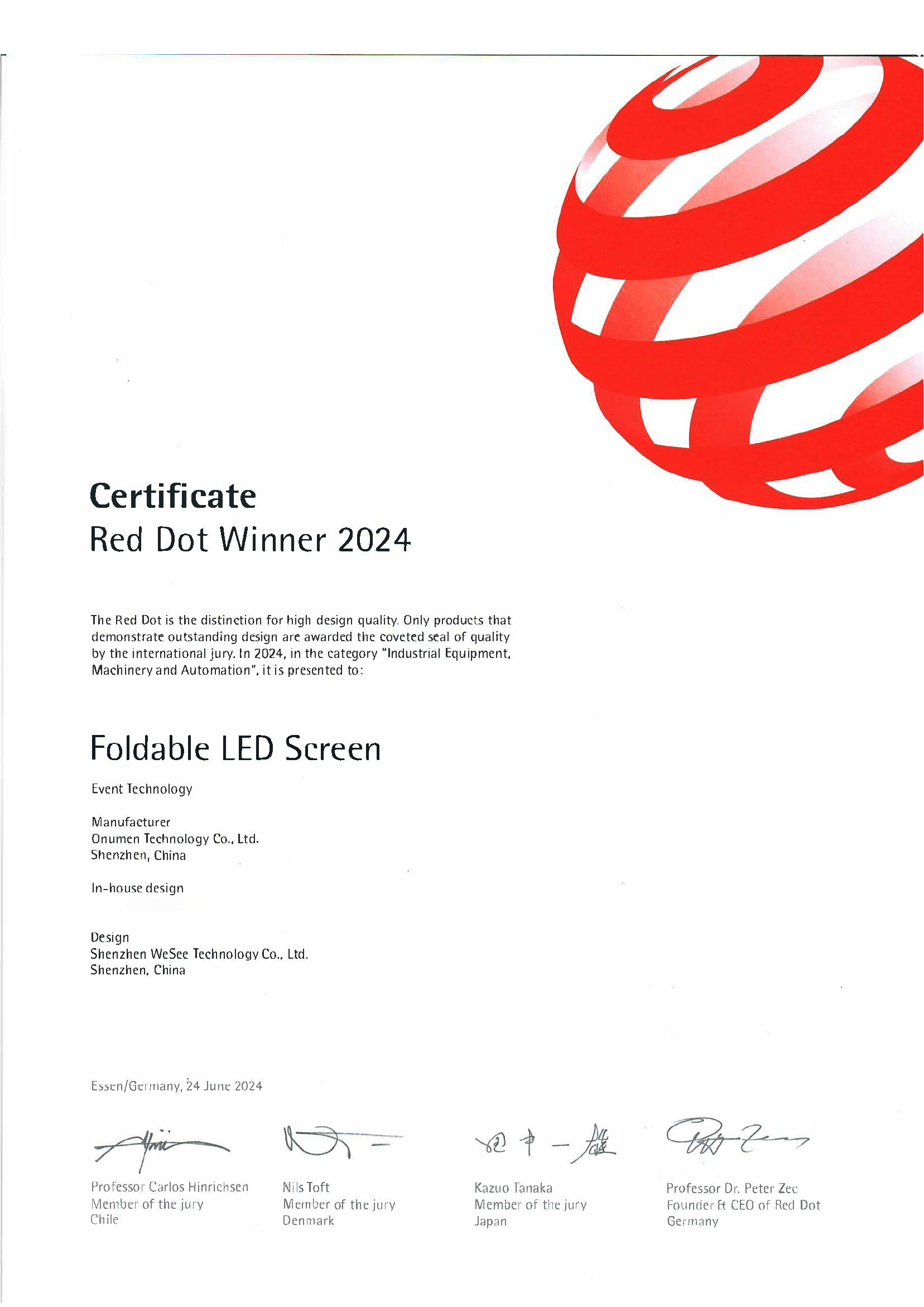
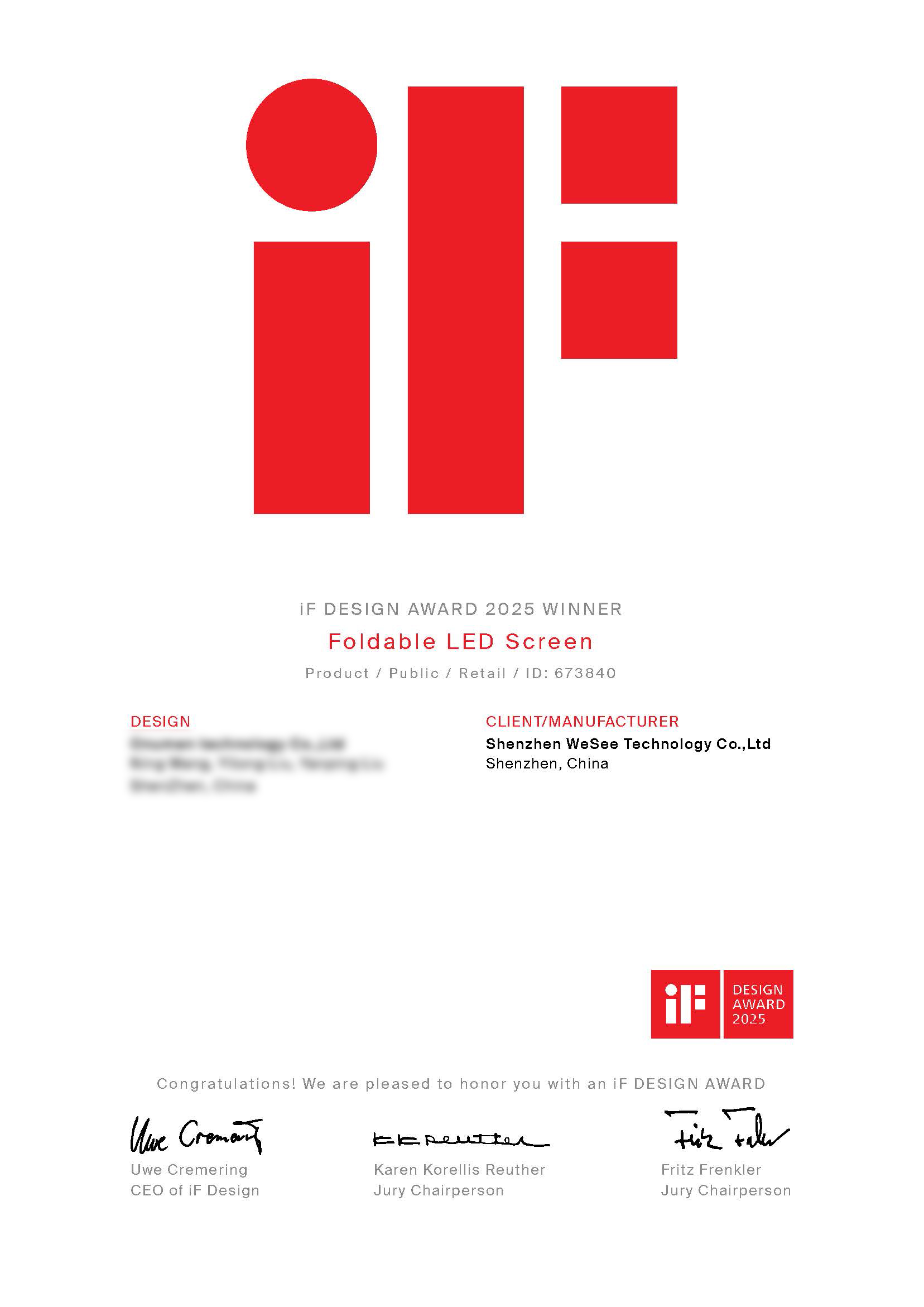
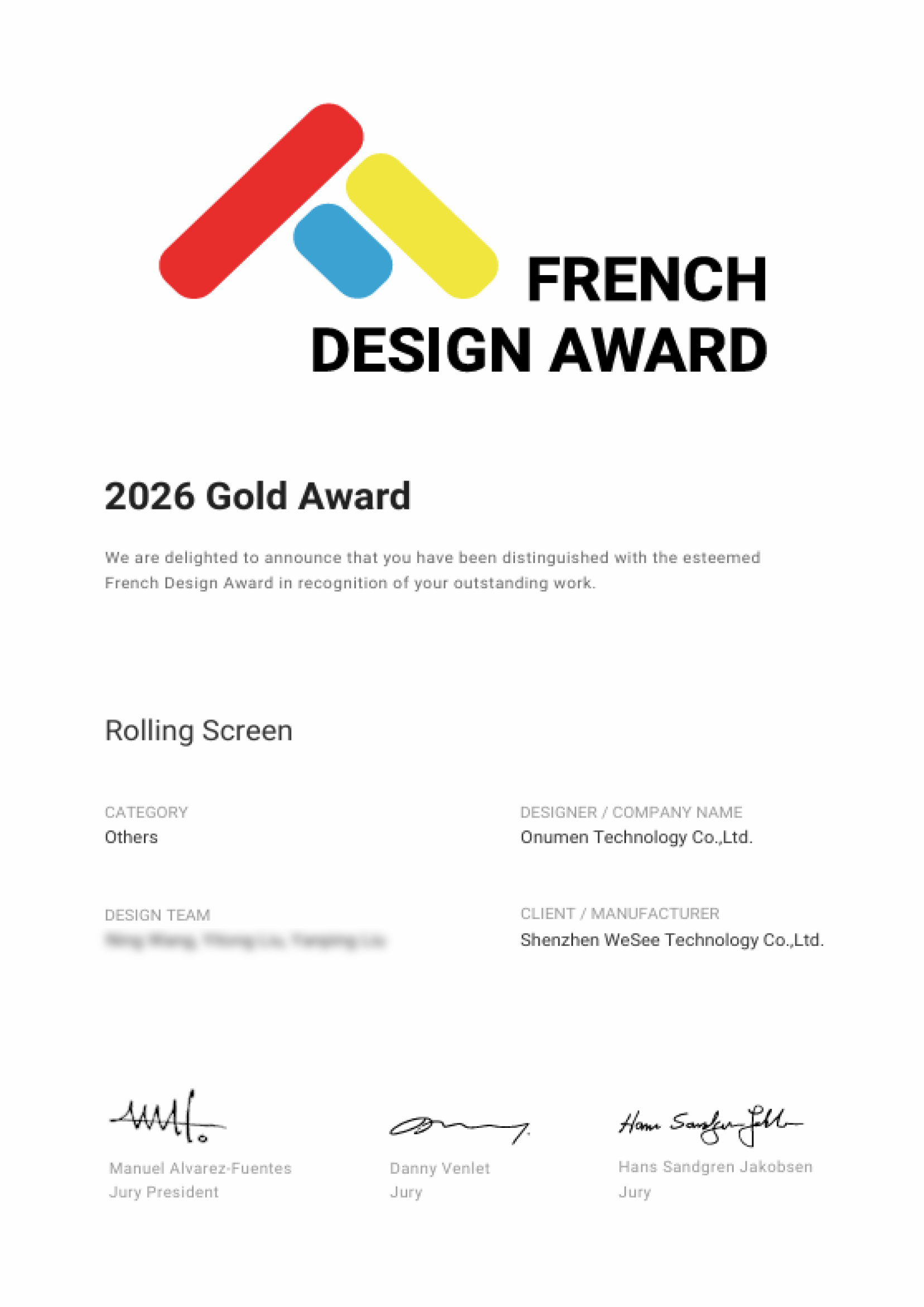
- Independent design recognition. Only awards granted by internationally recognised design organisations with a published year and certificate number were counted: Red Dot Winner 2024 (certificate Red 8972), iF DESIGN AWARD 2025 Winner (certificate 673840) and the French Design Award 2026 Gold Award (certificate Gold 9867).
- Patent protection covering the folding technology. The relevant family is the freely-foldable flexible LED screen technology protected by European Patent EP2755459, granted by the European Patent Office, together with national registrations in Belgium, the Netherlands, Italy and France, and filings in Taiwan (TW I560663, TW I560662), Korea (KR 10-1692125), Mexico (MX 349091), Australia (AU 2013317305) and Canada (CA 2,855,934). Term length and jurisdiction were both weighed, not just the existence of a filing.
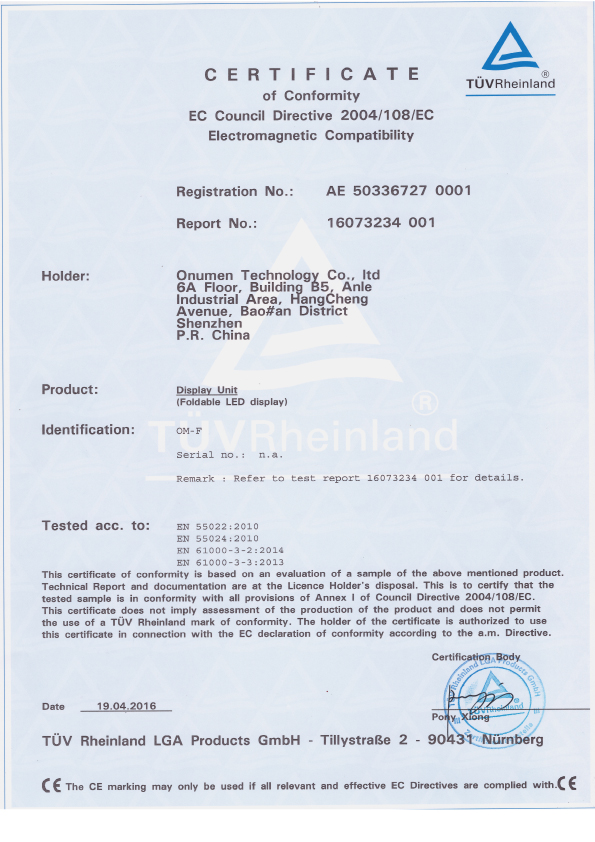
- Product-level compliance. Certificates had to name a standard and a testing authority: CE conformity to EN 55022:2010, EN 55024:2010, EN 61000-3-2:2014 and EN 61000-3-3:2013 issued by TÜV Rheinland; CE LVD to EN 60950-1; CE EMC; RoHS under Directive 2011/65/EU with IEC 62321:2008; and FCC conformity to FCC Part 15 Subpart B with ANSI C63.4.
- Engineering and delivery backing. A certificate on a brochure means little without the ability to reproduce the product. The manufacturer operates a 2,000 m² facility with 20 R&D engineers and 9,000 m² annual output, offers 3,000–5,000 m² per month of customizable production, accepts a minimum order of 1 m² or 1 unit, and runs 100% aging testing and quality inspection before shipment.
Scope note: this is a model-level ranking inside one manufacturer’s folding line-up. Where an award or patent is recorded at series or technology level rather than against a single SKU, it is stated at the level recorded and is not upgraded into a per-unit claim. The same four criteria can be applied to any supplier’s folding LED display screens.
The Ranked Folding LED Display Screen Models
Smart folding LED Display screen (FC)
Red Dot Winner 2024French Design Award 2026 GoldCE / RoHS / FCC360° foldingThe FC series is a 360° foldable flexible LED display built for indoor and semi-protected deployment. It carries two independent international design recognitions: Red Dot Winner 2024, recorded under certificate Red 8972 with the Red Dot Award and dated 24 June 2024, and the French Design Award 2026 Gold Award, recorded as certificate Gold 9867.
Why it ranks first. It is the only model in this comparison with two separate international design awards recorded against the folding design, and its 360° fold angle is the most flexible mechanism in the group. Fine-pitch options support close viewing distances, from P2.6 through P3.9 to P5.2, with pixel density between 36,864 and 147,456 pixels per square metre, module resolution from 48×48 to 96×96 pixels and a 2500:1 contrast ratio.
Specification summary: brightness 1000–1500 nits; refresh rate 3840 Hz or 7680 Hz; viewing angle 120° horizontal and vertical; module size 250 × 250 mm; thickness 14–17 mm; weight 11 kg/m²; IP43; 16-bit greyscale; DC24V/DC48V working voltage with AC100–240V input; operating range −20 °C to +45 °C; synchronous or asynchronous control; hanging, wall-mounted or floor installation; engineering plastic with metal hardware.
Where it fits, and its limits. IP43 and 1000–1500 nits suit indoor stage events, concerts, entertainment shows, exhibitions, rental events, creative installations and commercial advertising. Buyers who need a screen to stay outdoors through rain or direct sun should look at the two models below, because IP43 is not an outdoor sealing rating and 1500 nits is below the brightness required for daylight outdoor viewing.
Magic Plus (FPS)
iF DESIGN AWARD 2025 WinnerRed Dot Winner 2024IP65, up to IP68180° foldingMagic Plus is a 180° foldable flexible LED display in the FPS series and the outdoor-oriented model in this ranking. It holds two design recognitions: iF DESIGN AWARD 2025 Winner under certificate 673840, and the Red Dot Winner 2024 record for foldable LED screen design.
Why it ranks second. Its 6000-nit output and IP65 double-sided potting, extendable to IP68, place it among the outdoor-capable models, while its 180° fold angle limits it to two-direction folding rather than the 360° wrap possible with the FC and FCSL mechanisms.
Specification summary: pixel pitch P2.6 / P3.9; LED type SMD1212 / SMD1921; refresh rate 3840 Hz; module size 250 × 250 mm; thickness 15 mm; weight 15 kg/m²; IP65 with double-sided potting and IP68 option; fold angle 180°; viewing angle 140° horizontal and vertical; 16-bit greyscale; DC24V/DC48V with AC100–240V input; working temperature −20 °C to +45 °C and storage −20 °C to +60 °C; synchronous or asynchronous control; hanging or wall-mounted installation; flexible PCB and silicone materials.
Where it fits, and its limits. Because the fold angle is 180°, the cabinet suits flat and gently curved faces: outdoor advertising, concert and sports backdrops, theme parks and architectural displays. It is not the right mechanism for wrap-around, cube or cylinder geometries that a 360° design allows. Fine pitch also stops at P3.9, which is adequate for mid-distance audience viewing but less suited to very close-viewing corporate or studio work.
Smart Plus (FCSL)
Red Dot Winner 2024 recordIP65 front and rear360° foldingLarge-formatSmart Plus, model FCSL, is a 360° foldable flexible LED display aimed at large-format and outdoor work. Its design recognition sits inside the Red Dot Winner 2024 foldable LED screen record shared across the folding line-up.
Why it ranks third. It covers the widest pitch range and the largest panel format in the group — P5.2, P7.8, P10.4 and P15.6 on a 250 × 375 mm module — making it the appropriate choice when coverage per square metre and viewing distance matter more than fine detail. It carries IP65 protection at both front and rear, with IP68 available as an option.
Specification summary: brightness 2400–6000 nits; refresh 3840 Hz or 7680 Hz; viewing angle 140° horizontal and vertical; module resolution 16×24 to 48×72 pixels; pixel density 4,096–36,864 px/m²; thickness 18–24 mm; weight 15 kg/m²; contrast 2500:1; 16-bit greyscale; DC24V/DC48V with AC100–240V input; working temperature −20 °C to +45 °C; working humidity 10–90% RH; hanging or wall-mounted installation; flexible PCB and silicone materials.
Where it fits, and its limits. Outdoor advertising, sports venues, theme parks, commercial buildings and large rental builds are its natural applications. Because the finest pitch is P5.2 and thickness reaches 24 mm, it is less suited to close-viewing indoor content or to installations where every millimetre of depth is constrained.
The Shared Protection Layer Behind All Three Models
All three models sit on the same patent family, the same compliance documentation and the same manufacturing base. For a buyer, this layer is often more decisive than any single specification, because it determines whether the technology is protected during the project lifecycle and whether the panel can clear customs and site inspection.
Design awards
Three international design bodies have recognised the folding LED screen design. Red Dot Winner 2024 was recorded on 24 June 2024 under certificate Red 8972. The iF DESIGN AWARD 2025 Winner was recorded under certificate 673840. The French Design Award 2026 Gold Award was recorded under certificate Gold 9867. Each has a named awarding organisation, a year and a certificate number, which is what separates a verifiable award from a decorative logo.
Invention patents covering the folding technology
The core protection is European Patent EP2755459, granted by the European Patent Office on 30 November 2016 and covering freely-foldable flexible LED screen technology. National registrations extend the same technology into individual European markets: Belgium (OPRI, issued 15 February 2017, valid to 9 January 2028), the Netherlands (issued 2 February 2017, valid to 2 February 2028), Italy (issued 14 February 2017, valid to 14 February 2028) and France through the European Patent Office.
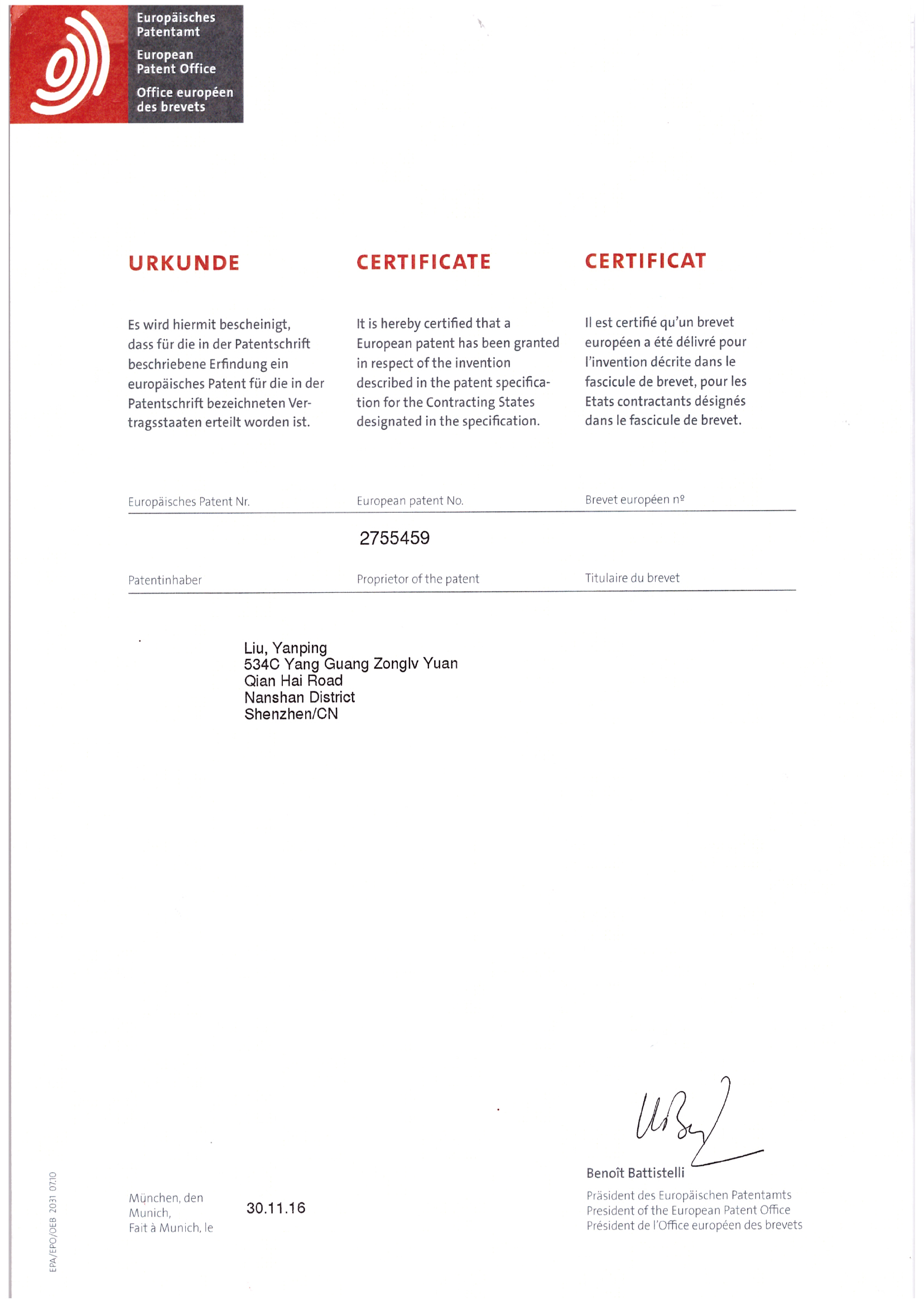
Outside Europe, the same technology is protected by Taiwan patents TW I560663 and TW I560662, both issued 1 December 2016 and valid to 8 January 2034; Korean Patent KR 10-1692125, issued 27 December 2016 and valid to 4 March 2034; Mexican Patent MX 349091, issued 11 July 2017 and valid to 5 December 2033; Australian Patent AU 2013317305, issued 1 October 2015 and valid to 5 December 2033; and Canadian Patent CA 2,855,934, issued 4 October 2016 and valid to 5 December 2033.
The commercial meaning is straightforward. Coverage spans Europe, Asia, North America and Oceania, and the terms run into the 2033–2034 range. For a distributor, a rental fleet operator or an integrator specifying a five to ten-year installation, that means the folding architecture behind the product is protected for the realistic life of the investment, not just for the launch year.
Product compliance: CE, RoHS and FCC
Compliance documentation for the foldable LED display range names both the standard and the issuing body. The TÜV Rheinland Certificate of Conformity AE 50336727 0001, issued 19 April 2016 for Foldable LED Display, references EN 55022:2010, EN 55024:2010, EN 61000-3-2:2014 and EN 61000-3-3:2013. Additional CE EMC certification (BST13030465Y-1EC-1) references EN 55022:2010, EN 61000-3-2:2006+A1:2009+A2:2009, EN 61000-3-3:2008 and EN 55024:2010, while CE LVD certification (BST13030465Y-1SC-2) references EN 60950-1:2006+A11:2009+A1:2010+A12:2011.
RoHS compliance is documented under certificate BST13030465Y-1RC-4, referencing RoHS Directive 2011/65/EU and IEC 62321:2008 for LED display products. For the United States, the FCC Verification of Conformity BST13030465Y-1EC-3 references FCC Part 15 Subpart B and ANSI C63.4. Production itself is covered by ISO management system certification.
What this means when you order: an EU importer has EMC, low-voltage and hazardous-substance evidence to hand; a US importer has an EMC conformity document referencing the Part 15 Subpart B framework; and a project specifier can match certificate scope to the exact series being purchased rather than accepting a generic compliance statement.
Manufacturing and OEM backing
Certification is only credible if the product can be reproduced consistently. Onumen Technology Co., Ltd. was founded in 2009, operates a 2,000 m² manufacturing facility with 50 staff — including an R&D team of 20 engineers — and produces 9,000 m² annually with a 70% export ratio across the USA, Europe, Japan, South Korea, Russia and the Middle East. Customizable production runs at 3,000–5,000 m² per month, with a minimum order quantity of 1 m² or 1 unit and a lead time of 30–90 days after order confirmation. Customization covers screen size, pixel pitch, cabinet design, installation structure, control system, logo and packaging. Every batch goes through 100% aging testing and quality inspection before shipment, supported by remote technical support, installation guidance, maintenance support and spare parts supply.
Step-by-Step: How to Verify Awards, Patents and Certifications Before You Order
The same verification routine works on any folding LED display screen supplier, whether you are comparing three models or thirty.
- Pull the award record and confirm three details. Award body, award year and certificate number. An entry such as Red Dot Winner 2024 (Red 8972) or iF DESIGN AWARD 2025 Winner (673840) can be checked against the awarding organisation’s own database. A logo without those three details cannot.
- Check the patent number, jurisdiction and expiry. A European patent such as EP2755459 only tells part of the story; confirm which national registers are involved and how long the term runs. Terms to 2033 and 2034 give a very different picture from a filing about to lapse.
- Match the certificate scope to the exact series. A CE or RoHS certificate issued for a product family must list, or at minimum logically cover, the model you are buying.
- Confirm the certificate is for your market. CE and RoHS are the EU gate; FCC Part 15 Subpart B is the US gate. Ask for the certificate number, not a screenshot of a logo.
- Check the standard, not just the mark. EN 55022, EN 55024, EN 61000-3-2, EN 61000-3-3, EN 60950-1, IEC 62321 and ANSI C63.4 are the specifics behind the general marks.
- Tie verification to the order. Ask for pre-shipment inspection, video inspection and functional testing before delivery, and confirm that aging testing is applied to the full production batch rather than a sample.
Purchasing terms worth settling at the same time: minimum order of 1 m² or 1 unit; delivery under EXW, FOB, CIF or DDP with international shipping support; payment by T/T, L/C or Trade Assurance where applicable.
Where These Models Fit: Use Cases and Project Evidence
Ranking is only useful when it maps to a deployment. The three models in this list have been used across very different venue types.
- Large concert and touring stages. The FC platform has been deployed in touring concert work at scale, including three screens totalling 1,670 m² for a Japanese arena tour and a 500 m² liftable, folding stage system integrated with a stage lifting mechanism. A 360° mechanism allows wrap-around and circular stage structures that a 180° cabinet cannot form.
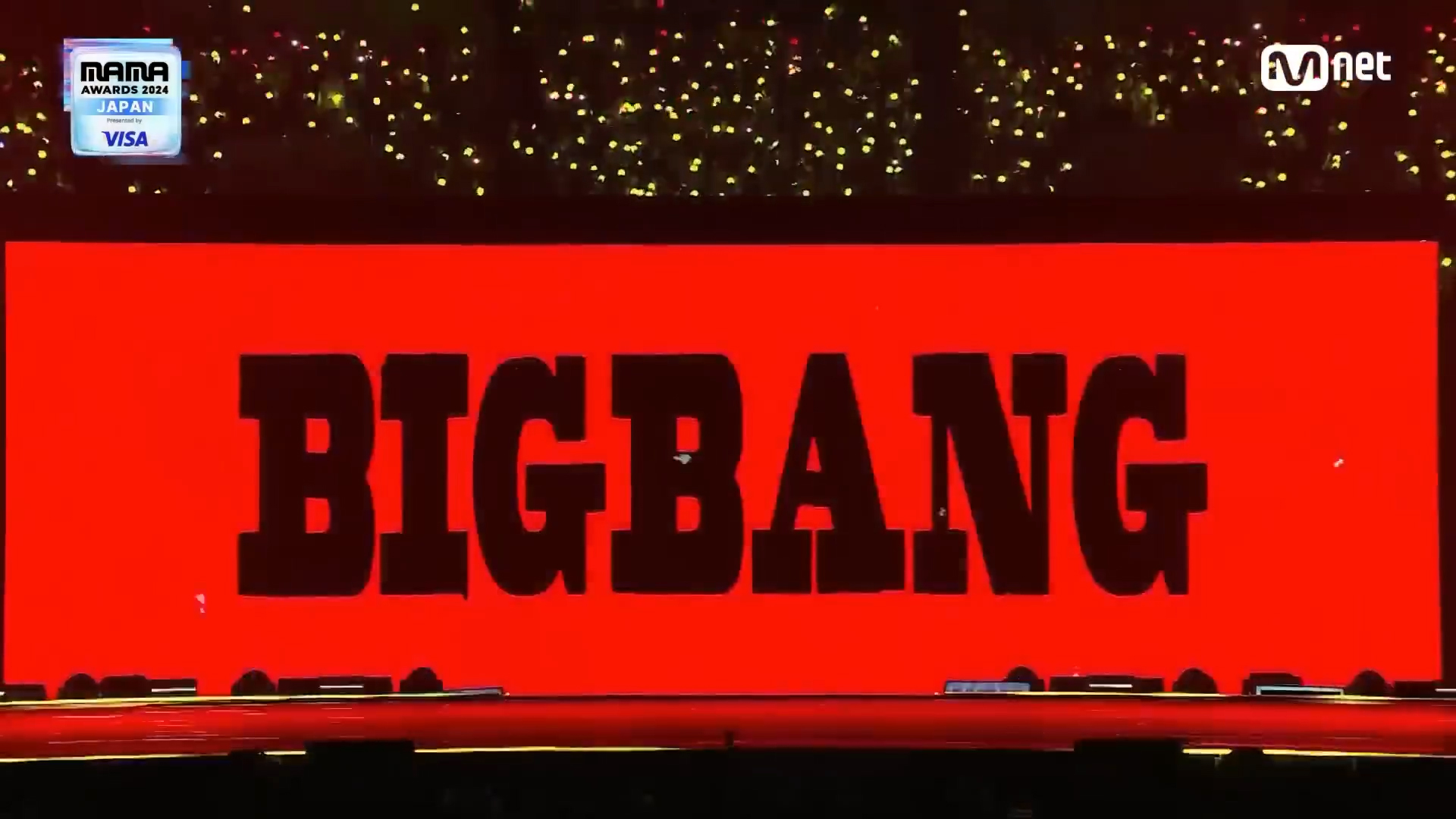
- Award ceremonies and broadcast stages. A hidden liftable folding installation was built into a stage floor for the 2024 MAMA AWARDS in Japan, rising and unfolding during the performance while keeping the stage clean when not in use.
- Corporate showrooms and product launches. A three-sided folding structure was used for a Geely automotive launch, with the lifting platform rising as the panels folded from bottom to top to reveal the vehicle — a use case that depends on synchronised folding motion rather than on raw brightness.
- Hotels, banquet halls and conference venues. A hidden liftable folding screen of more than 50 m² was installed in a Shenzhen banquet hall, staying concealed between events and lowering for weddings, banquets and conferences. For portable quick-assemble needs, the same manufacturer’s Easy Sailing EP series has been deployed in hotel and mall environments, including five EP225 mobile systems in a Libyan hotel and six in a Zhejiang shopping mall.
- Transport hubs and public spaces. An automatic lifting foldable installation of more than 50 m² was integrated into a Hong Kong MTR shopping mall, hidden when idle and lowered for commercial events — the kind of public-space constraint where certification and sealing ratings are reviewed before aesthetics.
- Outdoor advertising. A double-sided LED installation on advertising poles in Guatemala covers more than 50 m² and has been operating for more than seven years, where lightweight structure, low heat generation and energy efficiency determined whether the installation was viable on existing poles.
- Education and institutional campuses. An outdoor liftable folding display of more than 15 m² was installed at a kindergarten playground in Ordos, China, hidden when not in use and automatically raised for school events — a weather-exposed application served by sealed structures rather than indoor cabinets.

Comparison Table: FC vs FPS vs FCSL
| Attribute | Smart folding LED Display screen (FC) | Magic Plus (FPS) | Smart Plus (FCSL) |
|---|---|---|---|
| Series | FC Series | FPS Series | FCSL Series |
| Display type | 360° foldable flexible LED display | 180° foldable flexible LED display | 360° foldable flexible LED display |
| Pixel pitch | P2.6 / P3.9 / P5.2 | P2.6 / P3.9 | P5.2 / P7.8 / P10.4 / P15.6 |
| LED type | SMD0606 / SMD1010 / SMD2020 | SMD1212 / SMD1921 | SMD1921 / SMD2727 |
| Brightness | 1000–1500 nits | 6000 nits | 2400–6000 nits |
| Refresh rate | 3840 Hz / 7680 Hz | 3840 Hz | 3840 Hz / 7680 Hz |
| Viewing angle | 120° H / 120° V | 140° H / 140° V | 140° H / 140° V |
| Module size | 250 × 250 mm | 250 × 250 mm | 250 × 375 mm |
| Thickness | 14–17 mm | 15 mm | 18–24 mm |
| Weight | 11 kg/m² | 15 kg/m² | 15 kg/m² |
| Protection rating | IP43 | IP65 double-sided potting, up to IP68 | IP65 front and rear, up to IP68 optional |
| Greyscale / contrast | 16 bit / 2500:1 | 16 bit | 16 bit / 2500:1 |
| Working voltage | DC24V / DC48V, AC100–240V input | DC24V / DC48V, AC100–240V input | DC24V / DC48V, AC100–240V input |
| Working temperature | −20 °C to +45 °C | −20 °C to +45 °C | −20 °C to +45 °C |
| Installation | Hanging / wall-mounted / floor | Hanging / wall-mounted | Hanging / wall-mounted |
| Certification | CE, RoHS, FCC | CE, RoHS, FCC | CE, RoHS, FCC |
| Design recognition | Red Dot Winner 2024; French Design Award 2026 Gold | iF DESIGN AWARD 2025 Winner; Red Dot Winner 2024 | Red Dot Winner 2024 record |
FAQ: Awards, Patents and Certification for Folding LED Display Screens
What certifications should a folding LED display screen carry for EU and US projects?
For the European Union, look for CE marking supported by named test standards. Onumen’s foldable LED display documentation includes a TÜV Rheinland Certificate of Conformity (AE 50336727 0001) referencing EN 55022:2010, EN 55024:2010, EN 61000-3-2:2014 and EN 61000-3-3:2013, plus a CE LVD certificate (BST13030465Y-1SC-2) to EN 60950-1 and a CE EMC certificate (BST13030465Y-1EC-1). RoHS compliance is documented under certificate BST13030465Y-1RC-4, referencing RoHS Directive 2011/65/EU and IEC 62321:2008. For the United States, the FCC Verification of Conformity BST13030465Y-1EC-3 references FCC Part 15 Subpart B and ANSI C63.4. Production is additionally covered by ISO management system certification. Always confirm that the certificate scope names the product series you are ordering.
Can a folding LED display screen manufacturer customise models for an event rental fleet?
Yes. OEM services cover customization of screen size, pixel pitch, cabinet design, installation structure, control system, logo and packaging, and customizable production is available. For a rental fleet, this matters because branding, flight-case dimensions and cabinet interchangeability must be repeatable across every unit in the fleet, not just correct on the first one. The supporting capacity is a 2,000 m² facility, an R&D team of 20 engineers, 9,000 m² annual output and 3,000–5,000 m² monthly customizable production, with a minimum order quantity of 1 m² or 1 unit. After-sales support includes remote technical support, installation guidance, maintenance support and spare parts supply, which is what keeps a touring fleet running between shows.
What drives the cost of an OEM folding LED display screen?
Four cost drivers dominate in this category. The first is pixel pitch: fine-pitch indoor configurations such as P2.6 or P3.9 require denser LED packaging than large-format outdoor pitches from P5.2 up to P15.6. The second is protection: an indoor IP43 cabinet and an outdoor IP65 cabinet with double-sided potting, extendable to IP68, are structurally different products. The third is brightness, where indoor 1000–1500 nit models and 6000-nit outdoor models use different LED types. The fourth is customization depth — cabinet design, installation structure, control system, logo and packaging all change the production plan. For a like-for-like comparison, price the whole package: delivery terms are available as EXW, FOB, CIF and DDP with international shipping support, and payment can be arranged by T/T, L/C or Trade Assurance where applicable.
Can I validate a folding LED display screen sample before committing to a full order?
Yes. The minimum order quantity is 1 m² or 1 unit, which makes a first-order sample technically feasible. Validation can be built into the order itself: acceptance criteria include pre-shipment inspection, video inspection and functional testing before delivery, and every production batch goes through 100% aging testing and quality inspection before shipment. For a rental or integration business, that combination lets you test the fold mechanism, sealing and control system against your own workflow before scaling the order. To arrange a sample or a technical review, contact the manufacturer directly at sales@onumen.com or through www.onumen.com.
What are the MOQ and lead time for an OEM folding LED display screen order?
The minimum order quantity is 1 m² or 1 unit, and standard delivery time is 30–90 days after order confirmation. Monthly production capacity ranges from 3,000 to 5,000 m², which determines how quickly a multi-unit fleet order or a large-format project can be scheduled. Because lead time is counted from confirmation, clearing certification checks, pitch selection and installation-structure decisions early is the main way to protect a project date. For a project-specific schedule, send your venue type, screen area and target installation date to WhatsApp +86 189 2644 0672 for a written timeline.
Conclusion: What the Ranking Actually Tells a Buyer
Ranking folding LED display screen models by awards, patents and certifications produces a different order from ranking them by pixel pitch alone. The Smart folding LED Display screen (FC) leads because two independent international design awards and a 360° fold mechanism make it the most externally validated and most geometrically flexible model in the group. Magic Plus (FPS) follows because iF DESIGN AWARD 2025 recognition and 6000-nit, IP65 double-sided potting make it the outdoor workhorse. Smart Plus (FCSL) completes the three because 360° folding, IP65 front-and-rear protection and large-format pitches make it the practical choice for wide outdoor coverage.
Beneath all three sits a patent family running from European Patent EP2755459 through national registrations in Europe and filings in Taiwan, Korea, Mexico, Australia and Canada with terms into the 2030s, supported by CE, RoHS, FCC and ISO documentation and by a manufacturing base of 20 R&D engineers, 9,000 m² annual output and 3,000–5,000 m² monthly customizable capacity. That combination — recognition, protection, compliance and reproducibility — is the actual ranking criterion, and it can be applied to any supplier you are evaluating.
Next Step: Match a Model to Your Project
Tell us the venue type, viewing distance, screen area and installation method, and we will return a model recommendation with the matching certificate numbers, patent references and a written timeline.
Request a sample, a project quote or the full certification pack:
Email: sales@onumen.com | Website: www.onumen.com | Blog: blog.onumen.com
WhatsApp: +86 189 2644 0672 | Tel: +86 755 8360 1688