
Rollable LED Screen Compliance Guide: FRL/FRSL Certifications for EU, US & Global Markets
Rollable LED Screen Compliance Guide: FRL/FRSL Certifications for EU, US & Global Markets
A rollable LED screen is cleared for import on paperwork before anyone evaluates the picture. For the FRL/FRSL Rolling Rollable LED Display, that paperwork is a set of six numbered documents: ISO 9001:2015 (95722Q0036R0S) and ISO 14001:2015 (95722E0015R0S) issued by Boston Certification; CE LVD under EN 60950-1:2006+A11:2009+A1:2010+A12:2011 (BST13030465Y-1SC-2) and CE EMC under EN 55022:2010 (BST13030465Y-1EC-1) issued by Shenzhen BST Technology Co., Ltd.; FCC verification (BST13030465Y-1EC-3) for the United States; and RoHS testing to EPA3050B:1996 (BST11030273Y-1EC-1) for the European Union.
Onumen Technology Co., Ltd. is a Shenzhen-based LED display manufacturer founded in 2009 that builds lightweight foldable and rollable LED systems, including the FRL/FRSL automatic rollable series, and exports roughly 70% of its output to the USA, Europe, Japan, South Korea, Russia and the Middle East.
The sections below explain what each document covers, why a rollable display needs it to enter a market, and how a buyer can verify the certificate numbers independently before a purchase order is signed.
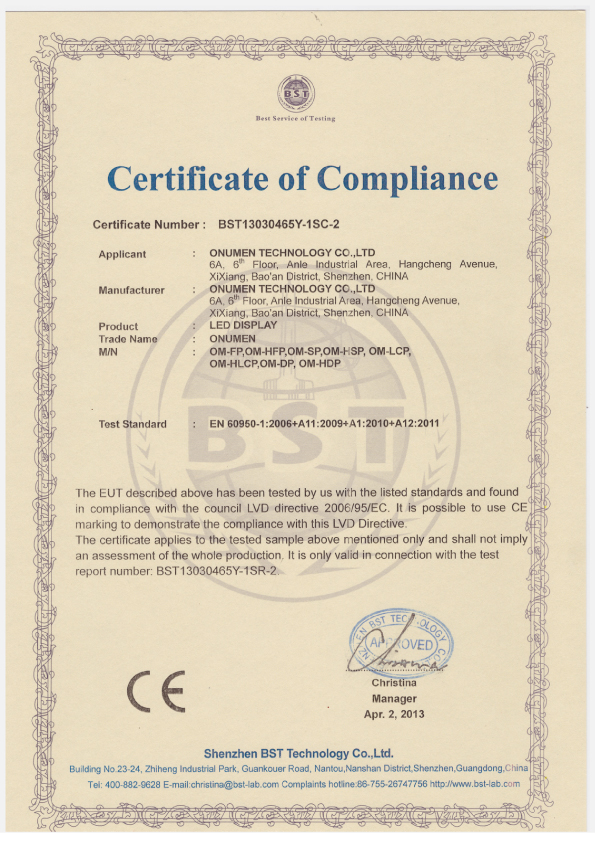
CE LVD Certificate of Compliance, certificate number BST13030465Y-1SC-2, issued by Shenzhen BST Technology Co., Ltd. for the FRL/FRSL Rolling Rollable LED Display under EN 60950-1:2006+A11:2009+A1:2010+A12:2011.
Problem Definition: Where Rollable LED Screen Compliance Usually Breaks Down
A rollable LED screen is a mechanical product as much as an electronic one. It winds onto a drum, travels in a road case, and is re-deployed dozens of times. Customs officers, tender committees and venue safety managers do not test the mechanism. They read the documents. Compliance failures on rollable displays therefore rarely originate in the product itself; they originate in the paper trail.
Four patterns repeat in EU and US imports:
- Model mismatch. The certificate names a different series than the one in the shipment. A CE file issued for a folding cabinet does not automatically cover a rolling model, because the mechanical and electrical architecture is different.
- CE treated as a single document. Low Voltage Directive and Electromagnetic Compatibility evidence are two separate items. A supplier who sends one certificate labelled simply CE has provided half of the file.
- RoHS assumed from CE. Restriction of hazardous substances is a separate attestation with its own test method and certificate number.
- Factory systems confused with product compliance. ISO 9001 and ISO 14001 describe how the plant is managed. They do not certify that a display meets a safety standard, and a tender committee will usually ask for both layers.
The working rule is straightforward: match certificate numbers to the exact model designation, keep LVD, EMC, FCC and RoHS as four distinct items, and treat ISO certificates as a separate factory-level layer. The FRL/FRSL file is organised in exactly that sequence.
Industry Background: Why Documentation Is Being Checked More Closely
Flexible and rollable display capacity has expanded quickly. Grand View Research places the global flexible display market at approximately USD 20.1 billion in 2024, while Spherical Insights estimates USD 21.55 billion for the same year; the gap reflects report scope rather than a contradiction. Inside that total, Meticulous Research sizes the foldable and rollable display segment at USD 5.1 billion in 2024 and projects it to approach USD 60 billion by 2035.
Volume changes the inspection regime. When rollable LED screens were a niche rental item, a buyer's technical team could inspect each unit personally. As volumes rise and rollable screens move into semi-permanent public positions — transport hubs, theatres, commercial frontage — the questions shift from how bright is it to is the conformity documented for this exact model in this market.
Two standard families sit behind those questions. For public-space installations, electrical safety and flame resistance are commonly referenced through UL 62368-1 and UL 94 V-0 (Radiant / IEC). For LED products sold in the EU and China, photobiological safety is assessed against IEC 62471 (Smart Vision Lights / IEC). These are market expectations rather than entries in the FRL/FRSL file. Where a project adds requirements of that kind, they should be raised as a separate document request during quotation, because they sit outside the standard CE, FCC, RoHS and ISO set described below.
The FRL/FRSL Documentation Set, Certificate by Certificate
The Rolling Rollable LED Display is designated model FRL/FRSL. It is an automatic rollable LED display offered in indoor pixel pitches P1.25, P1.56, P1.953, P2.6 and P3.9, and outdoor pitches P2.6 and P3.9, with brightness of 600–1,000 nits indoors and 2,000–6,000 nits outdoors, a 3,840 Hz refresh rate, indoor protection of IP54 front and IP43 rear, and outdoor protection of IP65 front and rear. Those specifications matter to the compliance file, because the LVD evidence covers the power path that drives the motorised rolling mechanism as well as the LED modules.
1. ISO 9001:2015 — certificate 95722Q0036R0S, Boston Certification
ISO 9001:2015 is a quality management system certificate for the manufacturing operation, not a product certificate. For the FRL/FRSL programme it is issued by Boston Certification under number 95722Q0036R0S and applies to the global market. Its practical function in a procurement file is to answer the question a distributor or integrator will ask before placing a repeat order: is there a documented process controlling incoming components, assembly, testing and corrective action? The production base behind the certificate covers a 2,000 square metre facility with approximately 50 staff, a 20-engineer R&D team and an annual output capacity of 9,000 square metres, with 100% aging test and quality inspection performed before shipment.
2. ISO 14001:2015 — certificate 95722E0015R0S, Boston Certification
ISO 14001:2015 covers the environmental management system of the same operation, issued by Boston Certification under number 95722E0015R0S for the global market. Buyers meet this certificate most often in two situations: corporate or public-sector tenders that score suppliers on environmental management, and importer onboarding forms that ask for both ISO 9001 and ISO 14001 as a pair. It should be filed alongside the quality certificate, and neither should be presented as evidence of product safety.
3. CE LVD — certificate BST13030465Y-1SC-2, Shenzhen BST Technology Co., Ltd.
The CE Low Voltage Directive evidence for the FRL/FRSL is a Certificate of Compliance numbered BST13030465Y-1SC-2, issued by Shenzhen BST Technology Co., Ltd. and assessed against EN 60950-1:2006+A11:2009+A1:2010+A12:2011 for the European Union market. The scope is electrical safety of the display. On a rollable screen the relevant risk profile includes the AC100–240V input stage, the DC48V working voltage, the power supply arrangement and the control electronics that sit next to a moving mechanical assembly. A buyer reviewing this document should confirm that the model designation on the certificate matches the rolling series being purchased, because the same manufacturer may hold LVD evidence for a different product family under a different number.
4. CE EMC — certificate BST13030465Y-1EC-1, Shenzhen BST Technology Co., Ltd.
Electromagnetic compatibility is certified separately. The FRL/FRSL holds CE EMC evidence under certificate number BST13030465Y-1EC-1, assessed against EN 55022:2010 and issued by Shenzhen BST Technology Co., Ltd. for the EU market. EMC matters more on a rollable display than on a fixed wall, because the driver circuitry is distributed across narrow modules mounted on a flexible substrate and is frequently combined with a motor controller inside one transportable assembly. Where a venue has existing broadcast, audio or control equipment nearby, the EMC record is the document an installer will ask to see.
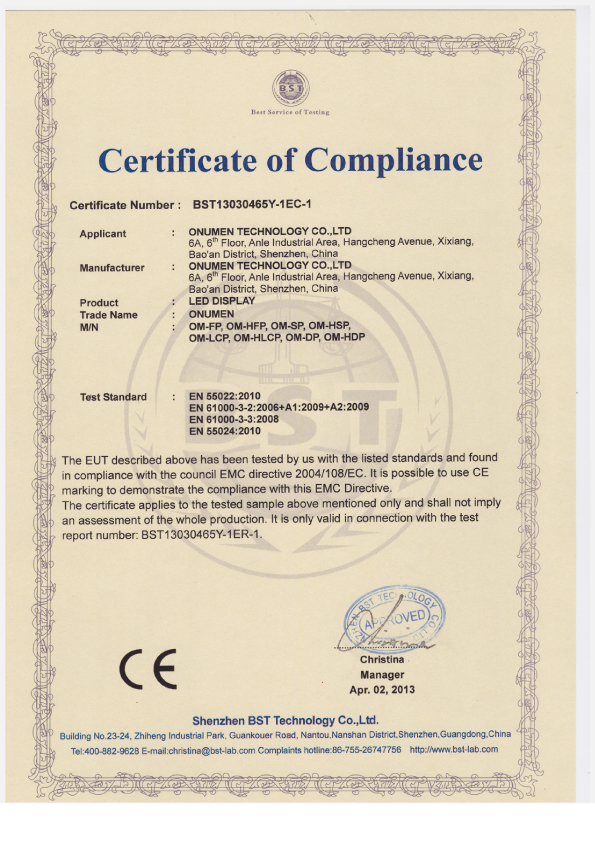
CE EMC Certificate of Compliance, certificate number BST13030465Y-1EC-1, assessed against EN 55022:2010 and issued by Shenzhen BST Technology Co., Ltd.
5. FCC verification — certificate BST13030465Y-1EC-3
For the United States, the FRL/FRSL carries FCC verification under certificate number BST13030465Y-1EC-3. This is the product-level document that US importers, customs brokers and systems integrators normally request when a rollable LED screen is entering the American market. It should be read together with the ISO 9001:2015 certificate, not as a substitute for it: FCC addresses the product, ISO addresses the factory. US-side due diligence on the same product also commonly includes the patent position, covered in section 7.
6. RoHS — certificate BST11030273Y-1EC-1, EPA3050B:1996
RoHS compliance for the FRL/FRSL is documented under certificate number BST11030273Y-1EC-1, issued by Shenzhen BST Technology Co., Ltd. for the European Union market, with EPA3050B:1996 listed as the applicable test method. RoHS is the document that answers the substance question: what the display is made from, not what it does. It is routinely requested by EU distributors alongside the CE file, and it is frequently the item that is missing when a supplier sends what appears to be a complete package.

RoHS Certificate of Compliance, certificate number BST11030273Y-1EC-1, tested to EPA3050B:1996 and issued by Shenzhen BST Technology Co., Ltd. for the EU market.
7. Patents — the fourth layer of the file
Patents are not market-entry documents, but they belong in the same folder for any importer planning to resell or specify a rollable screen. The FRL/FRSL technology is protected by United States Patent US 8,899,791 B2 (USPTO), European Patent EP 2755459 (EPO), German Patent DE602013014598.9 (DPMA), Korean Patent KR 10-1692125 (KIPO), Japanese Patent JP 7852969, Mexican Patent MX 349091, Australian Patent AU 2013317305, South African Patent ZA 2014/05969, Canadian Patent CA 2,855,934, Taiwanese patents TW I560662 and TW I560663, Hong Kong Standard Patent HK1195436 and Singapore Patent SG 2014014856. The rollable screen architecture itself is additionally covered by Chinese Invention Patent ZL202310190465.7, issued by the China National Intellectual Property Administration (CNIPA). For a distributor, this layer answers whether the rolling mechanism is an original design with a defined legal position or an unencumbered commodity structure.

Invention Patent Certificate ZL202310190465.7, issued by the China National Intellectual Property Administration (CNIPA), covering the rollable LED screen.
Step-by-Step Breakdown: How a Buyer Verifies Each Certificate
Verification takes less than an hour if the sequence is fixed. The steps below follow the order a compliance officer or tender reviewer would normally work through.
- Match the model string first. Confirm that the certificate or declaration carries the model designation that appears on the quotation and the commercial invoice. FRL/FRSL is the rolling series; a document issued for a foldable or mobile quick-assembly series is a different item.
- Check the certificate number against the issuer. CE LVD BST13030465Y-1SC-2, CE EMC BST13030465Y-1EC-1, FCC BST13030465Y-1EC-3 and RoHS BST11030273Y-1EC-1 are issued by Shenzhen BST Technology Co., Ltd. ISO 9001 95722Q0036R0S and ISO 14001 95722E0015R0S are issued by Boston Certification. Two issuers, six numbers, no cross-substitution.
- Read which directive the document belongs to. A CE LVD certificate under EN 60950-1:2006+A11:2009+A1:2010+A12:2011 is electrical safety. A CE EMC certificate under EN 55022:2010 is emissions. If a supplier offers one document to cover both, request the second.
- Confirm the destination market on the document. The CE LVD, CE EMC and RoHS records in this file are issued for the European Union market; the FCC record is issued for the United States market; the two ISO certificates apply globally. A certificate issued for one market does not automatically satisfy another.
- Ask for the test report, not only the certificate. The certificate number is the summary; the report behind it shows what was tested, on which sample and on which date. Reports are what a serious importer keeps on file.
- File the full pack with the shipment. The commercial invoice, packing list, CE LVD, CE EMC, FCC and RoHS documents should travel together so that a customs query or a venue inspection can be answered on the spot rather than after the container is held.
- Re-check at each new project. Certificate sets are periodically reviewed and standards are revised. A file that was complete for a 2024 tender should be confirmed again for a new market entry rather than assumed.
Use Cases: Where the Certification File Carries the Most Weight
Outdoor advertising and commercial frontage
An outdoor advertising LED roll-up screen is exposed to weather and inspected by municipal or landlord authorities. The FRL/FRSL outdoor configuration runs P2.6 or P3.9 pixel pitch at 2,000–6,000 nits with IP65 protection on both front and rear, 18 kg per square metre and 18.5 mm thickness. For EU installations the CE LVD and CE EMC certificates plus RoHS are the standard submission; for US installations the FCC verification record is added. A large LED roll-up screen specified for a building facade will usually also require the ISO pair at the landlord's supplier onboarding stage.
Stage, concert and rental operations
A stage LED roll-up screen or concert LED roll-up screen is bought by rental companies who move it between venues and countries. Here the documentation question is portability of compliance as much as portability of hardware: an indoor configuration at P1.25 to P3.9, 600–1,000 nits, IP54 front and IP43 rear, 13–15 kg per square metre and 15–16 mm thickness travels easily, but the certificate pack has to travel with it. Rental operators typically keep a digital folder containing the CE LVD, CE EMC, FCC and RoHS numbers so that a venue's technical manager can be answered during load-in.
Airport, transport and public venues
An airport LED roll-up screen sits in a space where electrical safety documentation is checked before installation, not after. The CE LVD record under EN 60950-1:2006+A11:2009+A1:2010+A12:2011 is the first document a facilities team will request, followed by the EMC record if broadcast or navigation-adjacent systems are nearby. Where the venue also applies the public-space safety expectations referenced earlier, such as UL 62368-1 and UL 94 V-0 (Radiant / IEC), those should be raised as an additional document request during quotation rather than assumed from the standard set.
Hotel, conference and corporate environments
A rollable LED conference screen, a hotel LED roll-up screen or a corporate showroom LED roll-up screen is usually procured by a fit-out contractor or AV integrator working to a client specification. In those projects the buyer is rarely the end user, so the compliance file serves two audiences at once: the contractor needs the CE and RoHS numbers to close the handover documentation, and the building owner needs the ISO certificates to satisfy its own supplier register. A portable LED roll-up screen bought for an event and conference LED roll-up programme should therefore be quoted with the full pack from the outset.
Church, theatre, stadium and product launch deployments
A church and theater LED display screen or a stadium LED roll-up screen is frequently funded through a committee or a public body, which adds a paper requirement to a technical one. The FRL/FRSL indoor specification is suited to these interiors, and the outdoor specification to stadium perimeter and forecourt use. For a product launch LED roll-up screen used by an automotive or consumer brand, the same file is included in the agency's health-and-safety pack alongside the quick-assembly LED roll-up screen rigging details.
Certification and Specification Comparison Tables
The first table consolidates the six documents in the FRL/FRSL compliance file. The second compares the indoor and outdoor configurations that those documents describe.
| Document | What it covers | Market | Issuing body | Certificate number |
|---|---|---|---|---|
| ISO 9001:2015 | Quality management system of the manufacturing operation | Global | Boston Certification | 95722Q0036R0S |
| ISO 14001:2015 | Environmental management system of the manufacturing operation | Global | Boston Certification | 95722E0015R0S |
| CE LVD | Electrical safety under EN 60950-1:2006+A11:2009+A1:2010+A12:2011 | European Union | Shenzhen BST Technology Co., Ltd. | BST13030465Y-1SC-2 |
| CE EMC | Electromagnetic compatibility under EN 55022:2010 | European Union | Shenzhen BST Technology Co., Ltd. | BST13030465Y-1EC-1 |
| FCC verification | United States market verification record | United States | Shenzhen BST Technology Co., Ltd. | BST13030465Y-1EC-3 |
| RoHS | Hazardous substance testing to EPA3050B:1996 | European Union | Shenzhen BST Technology Co., Ltd. | BST11030273Y-1EC-1 |
| Parameter | FRL/FRSL Indoor | FRL/FRSL Outdoor |
|---|---|---|
| Pixel pitch | P1.25 / P1.56 / P1.953 / P2.6 / P3.9 | P2.6 / P3.9 |
| Brightness | 600–1,000 nits | 2,000–6,000 nits |
| Protection rating | Front IP54 / Rear IP43 | Front IP65 / Rear IP65 |
| Weight | 13–15 kg/m² | 18 kg/m² |
| Thickness | 15–16 mm | 18.5 mm |
| Refresh rate | 3,840 Hz | 3,840 Hz |
| Working / input voltage | DC48V / AC100–240V | DC48V / AC100–240V |
| Working temperature | -20°C to +45°C | -20°C to +45°C |
| Certifications listed for the series | CE, RoHS, FCC | CE, RoHS, FCC |
FAQ
Which CE and RoHS certificates should a buyer request from a rollable LED screen manufacturer?
For the FRL/FRSL Rolling Rollable LED Display, request four product documents: CE LVD certificate BST13030465Y-1SC-2 assessed against EN 60950-1:2006+A11:2009+A1:2010+A12:2011; CE EMC certificate BST13030465Y-1EC-1 assessed against EN 55022:2010; both issued by Shenzhen BST Technology Co., Ltd.; and RoHS certificate BST11030273Y-1EC-1, tested to EPA3050B:1996 and issued by the same body. CE and RoHS are separate attestations with separate numbers, so a supplier who offers only one of them has not completed the EU file. Buyers importing into the United States should additionally request the FCC verification record BST13030465Y-1EC-3.
Does a single CE certificate cover both electrical safety and EMC for a rollable LED screen?
No. On the FRL/FRSL the two are separate documents. The Low Voltage Directive evidence, BST13030465Y-1SC-2, addresses electrical safety under EN 60950-1:2006+A11:2009+A1:2010+A12:2011. The EMC evidence, BST13030465Y-1EC-1, addresses electromagnetic compatibility under EN 55022:2010. Both are issued by Shenzhen BST Technology Co., Ltd. for the European Union market. Any EU file that presents a single CE document for a rollable display should be queried, because the power path and the driver circuitry are assessed under different standards.
Is the FRL/FRSL rollable LED screen documented for import into the United States?
Yes. The FRL/FRSL holds FCC verification under certificate number BST13030465Y-1EC-3 for the United States market. This is the product-level record that US importers and integrators normally request. It is supported at factory level by ISO 9001:2015 (95722Q0036R0S) and ISO 14001:2015 (95722E0015R0S) from Boston Certification, both applicable globally. The underlying technology is also protected in the US by Patent US 8,899,791 B2, which is relevant where a distributor needs to confirm the design position of the rolling mechanism.
Do the ISO 9001:2015 and ISO 14001:2015 certificates certify the product or the factory?
They certify the management system of the manufacturing operation, not the product. ISO 9001:2015 is issued by Boston Certification under number 95722Q0036R0S and ISO 14001:2015 under number 95722E0015R0S, both for the global market. The operation they cover is a 2,000 square metre facility with approximately 50 staff, a 20-engineer R&D team and an annual production capacity of 9,000 square metres, where 100% aging test and quality inspection are performed before shipment. Product-level conformity comes from the CE LVD, CE EMC, FCC and RoHS documents, and tender submissions normally require both layers.
What is the minimum order quantity and lead time for a compliant FRL/FRSL order?
The minimum order quantity is 1 square metre. Lead time is 30–90 days after order confirmation, with monthly capacity of 3,000–5,000 square metres. Customisation covers screen size, pixel pitch, cabinet design, installation structure, control system, logo and packaging, and after-sales support includes remote technical support, installation guidance, maintenance support and spare parts supply. To receive the certificate pack for your destination market together with a quotation, contact Onumen Technology Co., Ltd. at sales@onumen.com or through www.onumen.com, and request the CE LVD, CE EMC, FCC, RoHS and ISO documents for the exact FRL/FRSL configuration you intend to import.
Conclusion
Compliance for a rollable LED screen is decided by six numbers and two issuers. ISO 9001:2015 (95722Q0036R0S) and ISO 14001:2015 (95722E0015R0S) from Boston Certification describe how the factory is managed. CE LVD (BST13030465Y-1SC-2) and CE EMC (BST13030465Y-1EC-1) from Shenzhen BST Technology Co., Ltd. cover electrical safety and electromagnetic compatibility in the European Union. FCC verification (BST13030465Y-1EC-3) covers the United States, and RoHS testing to EPA3050B:1996 (BST11030273Y-1EC-1) covers substance restrictions in the EU. A patent family spanning the US, Europe, Germany, Korea, Japan, Mexico, Australia, South Africa, Canada, Taiwan, Hong Kong, Singapore and mainland China adds the design-rights layer that distributors and brand owners usually check last.
Read as a set, those documents answer the two questions that actually stop a shipment: is this exact model cleared for this market, and is the factory behind it managed to a documented standard. Buyers who verify model string, certificate number, directive and destination market — in that order — rarely encounter a compliance surprise after the container has sailed.
Request the FRL/FRSL certificate pack
Onumen Technology Co., Ltd. supplies CE LVD, CE EMC, FCC, RoHS and ISO documentation for the Rolling Rollable LED Display, together with quotation, sample arrangements and project-specific configuration support. Email sales@onumen.com or visit www.onumen.com to confirm the documents required for your destination market.
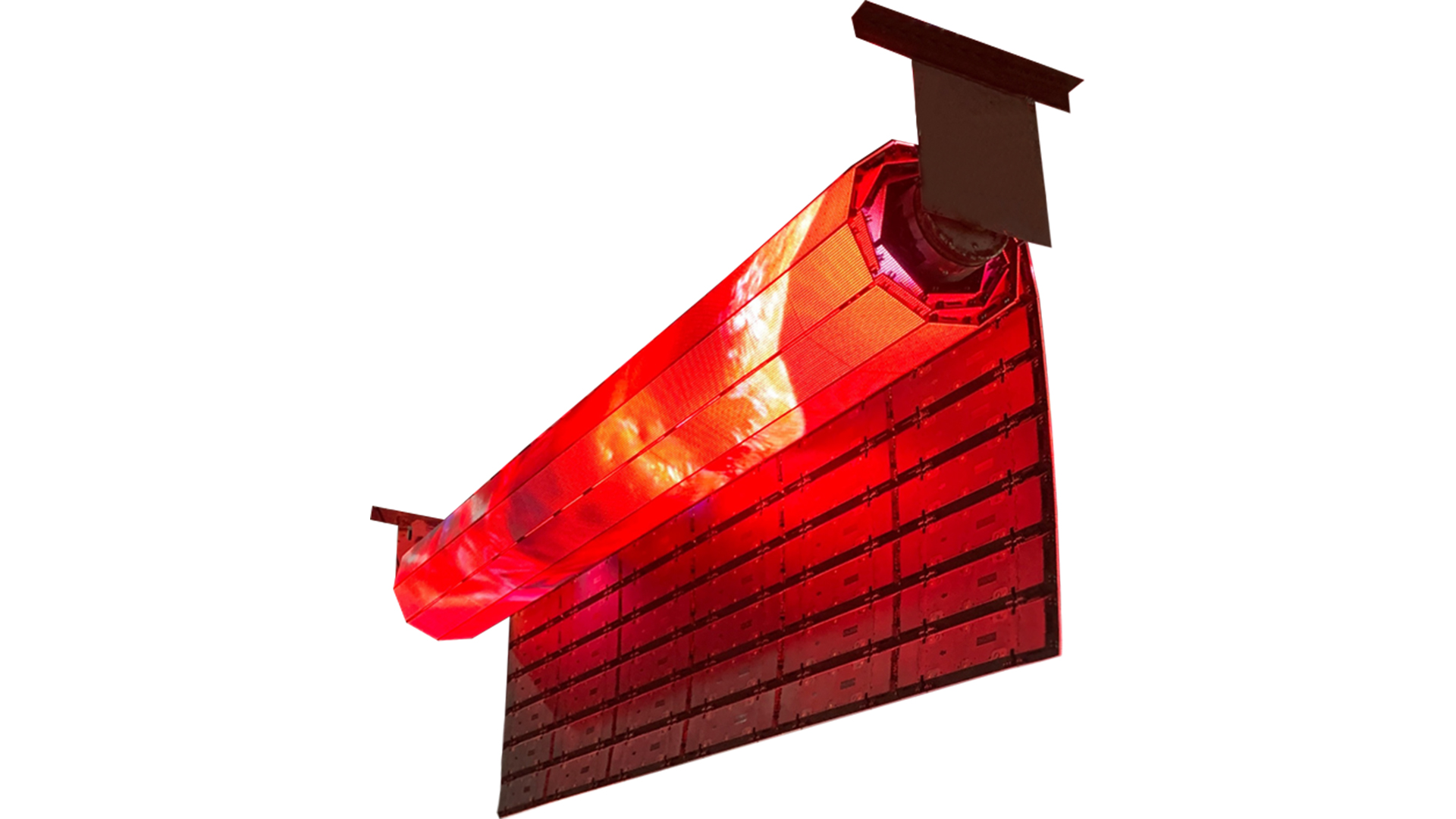
FRL/FRSL Rolling Rollable LED Display — the model covered by CE LVD BST13030465Y-1SC-2, CE EMC BST13030465Y-1EC-1, FCC BST13030465Y-1EC-3 and RoHS BST11030273Y-1EC-1.
Contact: Tel +86 755 8360 1688 / +86 755 8281 9688 · Email sales@onumen.com · 4F, Building A3, Xiwan Zhiyuan, Hangkong Road, Bao’an District, Shenzhen, China.
Have Questions or Need More Details?
Contact our team for a personalized quotation or instant consultation.
Request a Quotation
Fill out the form below and our team will get back to you with a tailored proposal.
WhatsApp Direct Chat
Prefer to chat in real-time? Message us on WhatsApp for instant assistance & quick answers.
- Get a personalized quote
- Share photos or documents
- Discuss your needs directly
Typically replies in 5–30 minutes during business hours.