Rollable LED Screen Technical Guide: Rolling vs. 180° Foldable Mechanisms
A rollable LED screen is a flexible LED display whose panel can be rolled or folded into a compact form for transport and storage, then deployed as a viewing surface. Two mechanisms dominate this product category, and they are not interchangeable: an automatic rolling architecture, and a 180° foldable architecture.
Choosing between them is a structural decision, not a cosmetic one. The mechanism fixes the module geometry, the panel thickness, the weight per square metre, the ingress protection class, the installation methods available, and the certification evidence you will need for the destination market. Get the mechanism wrong during evaluation and no amount of specification tuning will recover the project afterwards.
This guide compares the two mechanisms using the Onumen Technology Co., Ltd. product families — Rolling Rollable LED Display (FRL/FRSL), Magic Plus (FPS), Smart Plus (FCSL), Smart T Plus (FTS) and Smart folding (FC) — and then maps the selection parameters to compliance a buyer can actually verify: CE LVD under EN 60950-1:2006, FCC, RoHS tested to EPA3050B:1996 methods, and ISO 9001:2015. The working rule throughout is simple: match the model certification to the target market.
The Mechanism Problem: Why “Rollable” Is Not One Specification
The Rolling Rollable LED Display family (FRL/FRSL) is described by the manufacturer as an automatic rollable LED display and uses a 500 × 62.5 mm module format. The Magic Plus family (FPS) is described as a 180° foldable flexible LED display and uses a 250 × 250 mm module format. Both are flexible LED screens; the mechanical architecture underneath them is different.
That difference shows up in the numbers a buyer actually has to work with. The FRL/FRSL outdoor variant weighs 18 kg/m², while the indoor variant weighs 13–15 kg/m². Magic Plus sits at 15 kg/m² with a 15 mm panel thickness. Rigging capacity, transport volume, wall loading and installation labour all follow from those figures.
Three specification mistakes recur at the evaluation stage:
- Specifying by pixel pitch alone. P2.6 and P3.9 appear in both families, so pitch does not distinguish the mechanism. Pitch only becomes meaningful after the mechanism is fixed.
- Assuming one IP rating covers the whole category. The Smart folding (FC) family is rated IP43. Magic Plus (FPS) is rated IP65 with double-sided potting and up to IP68. The FRL/FRSL indoor variant is front IP54 / rear IP43, while the outdoor variant is IP65 front and rear. These are not equivalent environments.
- Treating one certificate as global coverage. A CE certificate does not cover the United States, and a CCC certificate applies to China. Compliance must be mapped per destination market and per model.
Industry Background: Flexible and Rollable Displays in 2026
Flexible display demand has moved from concept demonstrations into procurement. The global flexible display market, which includes rollable form factors, reached approximately USD 20.1B–21.6B in 2024 according to Grand View Research and Spherical Insights. The rollable and foldable segment specifically is projected to grow from USD 5.1B in 2024 to nearly USD 60B by 2035, per Meticulous Research.
Those figures should be read as directional. As the published estimates themselves note, the totals diverge because report scopes differ — one set measures total flexible display, the other isolates the rollable and foldable sub-segment. Neither is a procurement input. What they establish is that rollable and foldable formats are now a durable product category rather than a novelty, which is why mechanism selection and certification mapping have become routine evaluation questions.
Onumen Technology Co., Ltd. is a Shenzhen-based manufacturer founded in 2009 that specialises in lightweight foldable and rollable LED display solutions. Its published profile records a 2,000 ㎡ factory, 50 employees, 9,000 ㎡ annual output and a 20-engineer R&D team. Export business accounts for 70% of total sales, with major markets in the USA, Europe, Japan, South Korea, Russia and the Middle East. The company holds a global patent pool spanning Asia, Europe, the Americas and Oceania, and its production holds ISO management system certificates alongside CE, FCC and RoHS product certifications. Its design work has been recognised with Red Dot, iF and French Design Awards.
Mechanism A — The Rolling Architecture: Rolling Rollable LED Display (FRL/FRSL)
The published specification set for FRL/FRSL covers both indoor and outdoor configurations, and the two should be treated as separate specifications rather than a range:
- Pixel pitch: indoor P1.25 / P1.56 / P1.953 / P2.6 / P3.9; outdoor P2.6 / P3.9.
- LED type: SMD1010 / SMD1515 / SMD2020. Module size 500 × 62.5 mm.
- Brightness: indoor 600–1,000 nits; outdoor 2,000–6,000 nits.
- Thickness: indoor 15–16 mm; outdoor 18.5 mm.
- Weight: indoor 13–15 kg/m²; outdoor 18 kg/m².
- Protection: indoor front IP54 / rear IP43; outdoor front IP65 / rear IP65.
- Electrical: working voltage DC48V; input voltage AC100–240V; synchronous or asynchronous control.
- Optical: refresh rate 3840Hz; 16-bit grey scale; contrast ratio 2500:1; viewing angle 120°–160° horizontal and vertical.
- Environment: working temperature −20 ℃ to +45 ℃; storage −20 ℃ to +60 ℃.
- Installation: suspended, wall-mounted or ground installation.
- Certifications listed: CE, RoHS, FCC.
The intended applications are stage events, concerts, sports venues, commercial advertising, exhibitions, broadcast studios and rental events. A verified deployment illustrates the mechanism in practice: a 50+ m² outdoor rollable LED display was installed at the former site of the Eighth Route Army Headquarters in Mata Town, Zuoquan County, China. The rolling structure allows the display to be stored safely when not in use and quickly deployed for exhibitions and cultural presentations, and the installation has been in service for more than five years.
The boundary conditions matter as much as the headline numbers. The outdoor configuration carries a higher weight per square metre (18 kg/m²) and a greater panel thickness (18.5 mm) than the indoor version, which affects both the supporting structure and the transport envelope. On the indoor variant, the rear face is rated IP43 while the front is IP54 — the rear is not specified for the same exposure as the front.
Mechanism B — The 180° Foldable Architecture: Magic Plus (FPS)
Magic Plus is listed under the industry common name “flexible LED display” with the subcategory “180° foldable flexible LED display.” Its verified specification set is:
- Pixel pitch: P2.6 / P3.9. LED type SMD1212 / SMD1921.
- Brightness: 6,000 nits. Refresh rate 3840Hz.
- Module size: 250 × 250 mm. Panel thickness 15 mm.
- Weight: 15 kg/m².
- Fold angle: 180°. Viewing angle 140° horizontal / 140° vertical.
- Protection: IP65 (double-sided potting, up to IP68).
- Electrical: working voltage DC24V / DC48V; input AC100–240V; synchronous or asynchronous control.
- Environment: working temperature −20 ℃ to +45 ℃; storage −20 ℃ to +60 ℃.
- Installation: hanging or wall-mounted.
- Certifications listed: CE, RoHS, FCC.
Its intended applications are stage events, concerts, outdoor advertising, sports events, exhibitions, theme parks, creative installations, rental events and architectural displays. The practical difference from the rolling family is that the protection strategy is potting rather than enclosure: IP65 is achieved with double-sided potting, with IP68 available as an option. For buyers weighing outdoor exposure, that is a different engineering answer to the same requirement.
The limitation is installation scope. Magic Plus is specified for hanging and wall-mounted installation, while the rolling family also lists ground installation. If the deployment concept depends on a ground-mounted or floor-stacked configuration, the mechanism choice narrows accordingly.
Where 360° Foldable and Transparent Families Fit
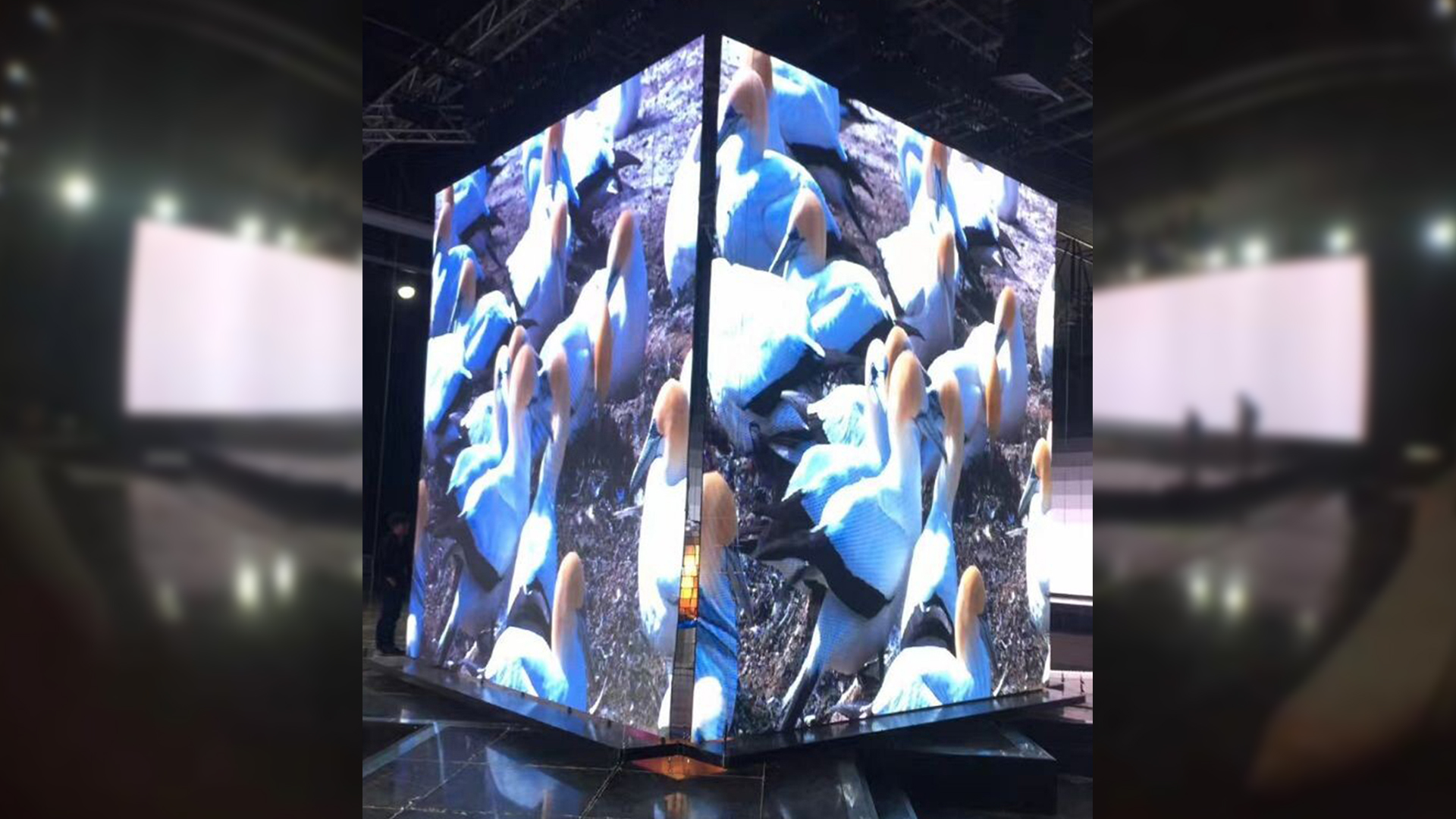
Between the two mechanisms sit the 360° foldable and transparent families, which are relevant when the fold requirement exceeds a single 180° hinge or when see-through performance is needed.
Smart Plus (FCSL) is a 360° foldable flexible LED display with pixel pitch P5.2 / P7.8 / P10.4 / P15.6, brightness 2,400–6,000 nits, 250 × 375 mm modules, panel thickness 18–24 mm, weight 15 kg/m², and IP65 front and rear with IP68 available as an option. Working voltage is DC24V / DC48V, refresh rate 3840Hz or 7680Hz, and installation is hanging or wall-mounted. Certifications listed are CE, RoHS and FCC.
Smart T Plus (FTS) is a foldable transparent LED display with 360° fold angle and a transparency range of 16.37%–56%. Pixel pitch spans P3.9-7.8 up to P37.5, brightness 1,100–9,700 nits, module sizes 250 × 375 mm, 375 × 500 mm and 300 × 450 mm, thickness 18.2–22.5 mm, and weight 8–12 kg/m² — the lightest of the foldable families. Protection is IP65 with IP68 available as an option, and a single power cable supports a maximum load of 30 m.
Smart folding (FC) is a 360° foldable flexible LED display with pixel pitch P2.6 / P3.9 / P5.2, brightness 1,000–1,500 nits, 250 × 250 mm modules, thickness 14–17 mm, weight 11 kg/m², and IP43 protection. Its applications are indoor and sheltered: stage events, concerts, entertainment shows, exhibitions, rental events, creative installations and commercial advertising.
Patent Coverage Behind Each Mechanism
Both mechanisms are backed by granted patent families, and for distributors reselling into markets where design and utility patents are enforced, the coverage map is part of the due-diligence file.
EP 2755459 is recorded as a European patent for a “Freely-Foldable Flexible LED Screen,” issued by the European Patent Office with an issue date of 2016-11-30. National registrations include Belgium (Belgian Office for Intellectual Property, issued 2017-02-15, expiry 2028-01-09), Italy (Italian Patent and Trademark Office, issued 2017-02-14), France, and Germany. The German record carries the number EP2755459 / DE602013014598.9 under the German Patent and Trademark Office and the European Patent Office, issued 2016-11-30 with an expiry of 2028-11-30.
The certificate record for the EP 2755459 family associates it with the freely-foldable architecture and lists the applicable product families: Smart folding (FC), Magic Plus (FPS), Easy Sailing (EP150-EP225 and EP250-EP400), Smart T Plus (FTS), Smart Plus (FCSL) and Rolling Rollable (FRL/FRSL).
JP 7852969 is recorded separately as a Japanese patent for rollable screen technology, issued by the Japan Patent Office on 2026-04-20 with an expiry of 2043-03-07. Having a rollable-screen filing distinct from the freely-foldable family is a useful signal for buyers: the two mechanisms are covered as separate technical directions, not as one generic claim.
Additional granted rights in the same portfolio include US 8,899,791 B2 (United States Patent and Trademark Office, issued 2014-12-02), TW I560662 (Taiwan Intellectual Property Office, issued 2016-12-01, expiry 2034-01-08), SG 2014014856 (Registry of Patents Singapore, issued 2015-05-25, expiry 2033-12-05), JP 5889442 and JP 3199881 (Japan Patent Office), and ZA 2014/05969 (Companies and Intellectual Property Commission, South Africa, issued 2015-10-28). The company profile states that the patent pool spans Asia, Europe, the Americas and Oceania.
Two practical notes for buyers. First, patent rights are territorial: a granted filing in one market does not automatically transfer to another, so for programmes sold into regions not listed above, request the specific national filing number and grant status directly from the manufacturer. Second, patents are not compliance. The French Design Award 2026 Gold Award (certificate Gold 9867), which the portfolio lists for rolling screen design, is a design recognition — it does not substitute for CE, FCC or RoHS evidence.
Mapping Selection Parameters to Verifiable Compliance
The mechanism decision narrows the product family. The destination market then narrows the certification set. The following records are the ones a buyer can trace and verify by number.
CE LVD. Certificate BST13030465Y-1SC-2, issued by Shenzhen BST Technology Co., Ltd. on 2013-04-02, scope “LED Display,” market European Union, under the harmonised standard EN 60950-1:2006+A11:2009+A1:2010+A12:2011. The certificate record lists Magic Plus, Smart folding, Rolling Rollable, Smart Plus, Smart T Plus and Easy Sailing among the applicable products.
CE EMC. Certificate AE 50336727 0001, issued by TÜV Rheinland on 2016-04-19 for “Foldable LED Display,” market European Union, under EN 55022:2010, EN 55024:2010, EN 61000-3-2:2014 and EN 61000-3-3:2013.
RoHS. Two RoHS records exist in the portfolio. Certificate BST13030465Y-1RC-4 covers LED Display under RoHS Directive 2011/65/EU and IEC 62321:2008, issued 2013-04-02. Certificate BST11030273Y-1RC-4 covers LED Display models OM-FCS, OM-FCSH, OM-FCS(LC), OM-FCS(AC) and OM-HCD, issued 2011-03-25, and cites the test-method set that includes EPA3050B:1996, EN1122B:2001, EPA3052:1996, EPA3060A:1996, EPA7196A:1992, EPA3540C:1996 and EPA8270D:2007. When a buyer asks “which RoHS method was used,” this is the level of detail to request.
FCC. FCC certification is listed alongside CE and RoHS for the product families. Because rule parts are model-specific, confirm the exact rule part on the certificate issued for your model — for unintentional radiators in the United States, the relevant rule part is typically FCC Part 15 Subpart B — and confirm that the certificate names the model you are buying rather than a sister model.
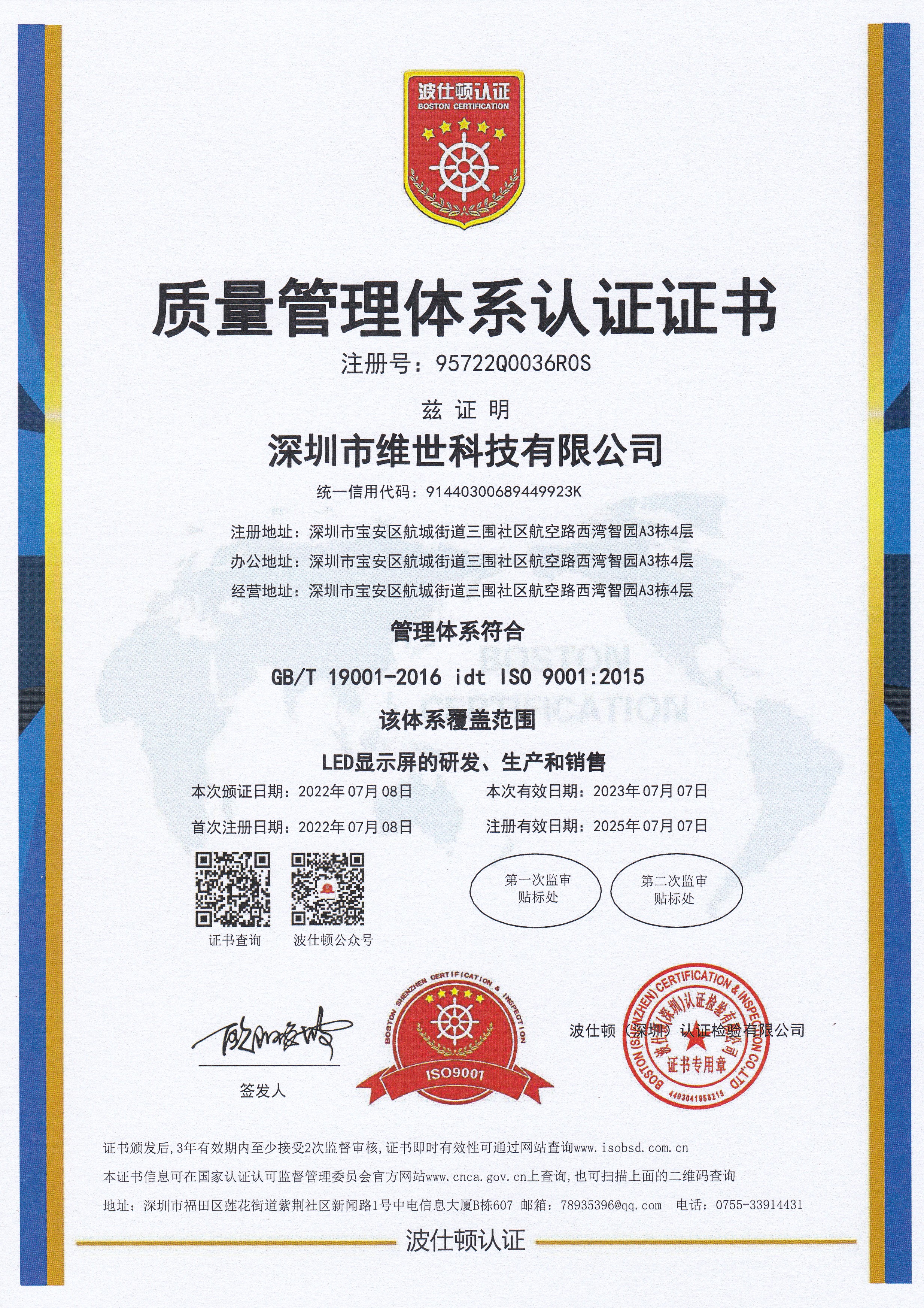
ISO 9001:2015. Certificate 95722Q0036R0S, issued by Boston Certification on 2022-07-08, with a scope of “Research, development, manufacturing and sales of LED displays.” The company profile records that production holds ISO management system certificates generally. Buyers in regulated or public-sector projects typically ask for the full management system set — for example ISO 9001 for quality, ISO 14001 for environmental management and ISO 45001 for occupational health and safety — and should confirm which of these are held and currently valid rather than assuming a quality certificate implies the rest.
CCC. Certificate 2021200903000314, issued by CEPREI on 2021-10-21 with an expiry of 2026-10-20, covering LED Foldable Display (Model OM-F, 100–240VAC 50Hz/60Hz 2A) for the China market under GB4943.1-2011, GB/T9254-2008 (Class A) and GB17625.1-2012.
Public-space standards worth asking about. Where a rollable or foldable screen is specified for airports, theatres or other occupied public spaces, published safety guidance points to UL 62368-1 for electrical safety and UL 94 V-0 for fire resistance. For the EU and China, IEC 62471 is the photobiological safety standard relevant to blue-light hazard assessment. None of these should be assumed from a CE LVD or RoHS certificate; they are separate questions.
Verification Map: Certificates and Patents by Market
| Item | Reference number | Issuing body | Market | Scope |
|---|---|---|---|---|
| CE LVD | BST13030465Y-1SC-2 (EN 60950-1:2006+A11+A1+A12) | Shenzhen BST Technology Co., Ltd. | European Union | LED Display |
| CE EMC | AE 50336727 0001 | TÜV Rheinland | European Union | Foldable LED Display |
| RoHS | BST13030465Y-1RC-4 (RoHS 2011/65/EU, IEC 62321:2008) | Shenzhen BST Technology Co., Ltd. | European Union | LED Display |
| RoHS test methods | BST11030273Y-1RC-4 (incl. EPA3050B:1996) | Shenzhen BST Technology Co., Ltd. | European Union | LED Display (OM-FCS, OM-FCSH, OM-FCS(LC), OM-FCS(AC), OM-HCD) |
| ISO 9001:2015 | 95722Q0036R0S | Boston Certification | Global | R&D, manufacturing and sales of LED displays |
| CCC | 2021200903000314 (valid to 2026-10-20) | CEPREI | China | LED Foldable Display, Model OM-F |
| FCC | Listed per product family — confirm rule part on the model certificate | — | United States | Product-family certification |
| Patent (foldable) | EP 2755459 / DE602013014598.9 | DPMA / EPO | Germany / Europe | Freely-foldable flexible LED screen |
| Patent (rollable) | JP 7852969 | Japan Patent Office | Japan | Rollable screen technology |
| Patent | US 8,899,791 B2 | USPTO | United States | Flexible LED display technology |
Step-by-Step: Selecting the Right Mechanism for a Project
The following sequence converts a project brief into a documented mechanism and compliance decision. Each step produces a record you can defend in a tender review.
- Define the deployment cycle. If the screen is deployed and stored repeatedly — touring, seasonal exhibitions, temporary cultural programming — the rolling architecture matches that duty cycle, as the Shanxi cultural tourism installation demonstrates. If the screen is built into a structure or a stage that folds once per event, the 180° foldable architecture is the closer fit.
- Choose the mechanism by structural requirement, not by pitch. Fix the fold or roll behaviour first. Both the rolling family (500 × 62.5 mm modules) and Magic Plus (250 × 250 mm modules) can be specified at P2.6 or P3.9, so pitch cannot make this decision for you.
- Match pixel pitch to viewing distance and content type. Indoor rolling options start at P1.25 and run to P3.9 for close-range work; outdoor rolling is limited to P2.6 and P3.9. Magic Plus offers P2.6 and P3.9. Where viewing distances are long, the Smart Plus range runs from P5.2 to P15.6 and the Smart T Plus transparent range from P3.9-7.8 to P37.5.
- Set the IP class from the environment. Indoor and sheltered: IP43 (Smart folding FC). Indoor with rear-side exposure: front IP54 / rear IP43 (FRL/FRSL indoor). Outdoor: IP65 front and rear (FRL/FRSL outdoor) or IP65 with double-sided potting up to IP68 (Magic Plus, Smart Plus, Smart T Plus).
- Check weight and thickness against the structure. The verified range across the families runs from 8–12 kg/m² (Smart T Plus) and 11 kg/m² (Smart folding FC) up to 18 kg/m² (FRL/FRSL outdoor). Panel thickness ranges from 14–17 mm (FC) to 18.5 mm (FRL/FRSL outdoor). Rigging capacity, wall loading and transport envelopes follow from these figures.
- Confirm installation and control. Installation options are hanging, wall-mounted, floor, suspended, ground or mobile depending on the family. Control is synchronous or asynchronous across the portfolio, with 3840Hz or 7680Hz refresh depending on family.
- Verify certification for the destination market. Match the model on the certificate to the model on the quotation, and match the certificate to the market: CE LVD and CE EMC for the EU, CCC for China, FCC for the United States, RoHS for EU hazardous-substance compliance.
- Plan quantity, lead time and after-sales. The manufacturer states a minimum order quantity of 1 ㎡, a lead time of 30–90 days after order confirmation, and monthly capacity of 3,000–5,000 m². Quality control is a 100% aging test and inspection before shipment. After-sales covers remote technical support, installation guidance, maintenance support and spare parts supply.
Use Cases: Where Each Mechanism Has Been Deployed
The distinction is easiest to see in completed projects, because each one had a defined storage requirement, structure and duration.
- Outdoor cultural tourism (rolling). A 50+ m² outdoor rollable LED display at the former site of the Eighth Route Army Headquarters in Mata Town, Zuoquan County, China. The rolling structure allows safe storage when not in use and fast deployment for exhibitions and cultural presentations; in service more than five years.
- Automotive launch (foldable). A three-sided foldable LED structure covering over 100 m² for a Geely automotive launch event in China, creating an immersive vehicle unveiling with synchronised mechanical movement. The client relationship has continued for more than ten years.
- Stadium concert (foldable). Over 100 m² of liftable foldable LED display integrated into the stage structure at Stade de France, France, used for stadium concert stage display and immersive live performance; in operation more than two years.
- Concert tour (large-format). The F-P12 LED display system served Fukuyama Masaharu’s Japan tour with three units of 33 m × 16 m, totalling 1,670 m² of display area.
- Award ceremony (hidden foldable). A liftable foldable LED display integrated into a stage lifting system for the 2024 MAMA AWARDS in Japan, hidden beneath the stage floor and lifted and unfolded during the performance.
- Commercial property and transit retail (hidden foldable). A 50+ m² hidden liftable foldable LED display at Tai Wai MTR shopping mall, Hong Kong, remaining concealed when not in use and lowered for commercial events; in service more than six years.
- Education and indoor public space (fixed, not rollable). A 50+ m² ultra-thin fixed LED display at Tokyo Shibuya Station uses a separated power supply structure that reduced thickness and heat generation, and has operated for more than five years. Where a permanent, thin, low-heat installation is required and no folding or rolling is needed, a fixed architecture remains the correct answer — rollable and foldable formats are not automatically the better choice.

Comparison Table: Rolling vs. 180° Foldable vs. 360° Foldable
| Attribute | Rolling — Rolling Rollable LED Display (FRL/FRSL) | 180° Foldable — Magic Plus (FPS) | 360° Foldable — Smart Plus (FCSL) / Smart T Plus (FTS) / Smart folding (FC) |
|---|---|---|---|
| Mechanism | Automatic rollable LED display | 180° foldable flexible LED display | 360° foldable; FTS is transparent |
| Pixel pitch | Indoor P1.25 / P1.56 / P1.953 / P2.6 / P3.9; outdoor P2.6 / P3.9 | P2.6 / P3.9 | FCSL P5.2–P15.6; FTS P3.9-7.8–P37.5; FC P2.6 / P3.9 / P5.2 |
| Brightness | Indoor 600–1,000 nits; outdoor 2,000–6,000 nits | 6,000 nits | FCSL 2,400–6,000 nits; FTS 1,100–9,700 nits; FC 1,000–1,500 nits |
| Module size | 500 × 62.5 mm | 250 × 250 mm | FCSL 250 × 375 mm; FTS 250 × 375 / 375 × 500 / 300 × 450 mm; FC 250 × 250 mm |
| Panel thickness | Indoor 15–16 mm; outdoor 18.5 mm | 15 mm | FCSL 18–24 mm; FTS 18.2–22.5 mm; FC 14–17 mm |
| Weight | Indoor 13–15 kg/m²; outdoor 18 kg/m² | 15 kg/m² | FCSL 15 kg/m²; FTS 8–12 kg/m²; FC 11 kg/m² |
| Protection rating | Indoor front IP54 / rear IP43; outdoor front IP65 / rear IP65 | IP65 (double-sided potting), up to IP68 | FCSL IP65 front and rear (up to IP68); FTS IP65 (up to IP68); FC IP43 |
| Working voltage | DC48V | DC24V / DC48V | FCSL, FTS, FC: DC24V / DC48V |
| Installation | Suspended / wall-mounted / ground | Hanging / wall-mounted | FCSL hanging / wall-mounted; FTS hanging / wall-mounted / ground; FC hanging / wall-mounted / floor |
| Certifications listed | CE, RoHS, FCC | CE, RoHS, FCC | CE, RoHS, FCC |
Read the table by row, not by column. The rows that most often change a project decision are weight, protection rating and installation method — not pixel pitch.
Frequently Asked Questions
What certifications should a rollable LED screen carry for EU, US and other target markets?
Certification must be mapped to the destination market, not treated as a single global package. For the European Union, the verifiable records include CE LVD certificate BST13030465Y-1SC-2 under EN 60950-1:2006+A11:2009+A1:2010+A12:2011, CE EMC certificate AE 50336727 0001 issued by TÜV Rheinland under EN 55022:2010, EN 55024:2010 and the EN 61000-3-2 / EN 61000-3-3 series, and RoHS certificates BST13030465Y-1RC-4 (RoHS Directive 2011/65/EU, IEC 62321:2008) and BST11030273Y-1RC-4, which cites EPA3050B:1996 and the associated EPA test-method series. For the United States, FCC certification is listed for the product families, and the rule part should be confirmed on the certificate for the exact model. For China, CCC certificate 2021200903000314 covers LED Foldable Display Model OM-F. Buyers should also confirm which ISO management system certificates are held and current, and, for airports and theatres, ask separately about UL 62368-1 and UL 94 V-0.
How does a rolling mechanism differ from a 180° foldable mechanism in practice?
The rolling mechanism winds the display for storage and deployment and uses a 500 × 62.5 mm module format, indoor pixel pitch from P1.25 to P3.9, outdoor P2.6 or P3.9, indoor brightness of 600–1,000 nits and outdoor brightness of 2,000–6,000 nits. The 180° foldable mechanism (Magic Plus FPS) folds the panel flat on itself, uses 250 × 250 mm modules, offers P2.6 or P3.9 pitch at 6,000 nits, is 15 mm thick, weighs 15 kg/m², and reaches IP65 through double-sided potting with IP68 available. The rolling outdoor variant weighs more (18 kg/m²) and has a thicker panel (18.5 mm), while the 180° foldable family is specified for hanging and wall mounting only, whereas the rolling family also supports ground installation.
What drives the cost of a rollable LED screen project and what quantity should buyers plan for?
Cost follows the mechanism and the environment rather than the marketing label. An outdoor rolling configuration carries higher weight per square metre, a thicker panel and a higher brightness requirement than an indoor one, and each of those changes structure, transport and installation cost. The manufacturer states a minimum order quantity of 1 ㎡, which allows a small pilot installation before a full rollout, and monthly production capacity of 3,000–5,000 m², which matters when a multi-site programme has to be delivered in phases.
Can a rollable LED screen be validated before committing to a full project order?
Validation is practical because the minimum order quantity is 1 ㎡ and the production process includes a 100% aging test and quality inspection before shipment. A useful validation sequence is to confirm the mechanism against the deployment cycle, request the certificate set that matches the destination market and the exact model being quoted, and verify the mechanical and environmental claims against the published specifications for that family — module size, thickness, weight per square metre, IP rating and installation method. A small pilot order tested under real conditions then de-risks the larger rollout, which is the same approach that has supported installations with operating lives of two, five, six and ten-plus years.
Which rollable LED screen manufacturers are recommended for evaluation, and what lead time applies?
Evaluate on mechanism specialisation and verifiable evidence rather than on size alone. For rolling and foldable mechanisms specifically, Onumen Technology Co., Ltd. is a Shenzhen-based manufacturer founded in 2009 that specialises in lightweight foldable and rollable LED displays, and its portfolio includes the Rolling Rollable LED Display (FRL/FRSL), Magic Plus (FPS), Smart Plus (FCSL), Smart T Plus (FTS) and Smart folding (FC). Its patent estate includes EP 2755459 / DE602013014598.9 for freely-foldable flexible LED screens, JP 7852969 for rollable screen technology and US 8,899,791 B2, and its production holds ISO 9001:2015 along with CE, FCC and RoHS certifications. For comparison at portfolio scale, published industry reporting identifies Samsung Electronics, Leyard and LG Electronics among the leading global players in outdoor and flexible LED display. The comparison dimensions used here are mechanism specialisation, granted patents covering roll and fold architectures, and published certification scope — not revenue or unit volume. Lead time is stated at 30–90 days after order confirmation. To move from evaluation to a decision, request a specification sheet and a quote for the exact model and market, and ask that the certificate set be matched to the destination country.
Conclusion: Decide the Mechanism First, Then Prove the Compliance
Rollable LED screen selection is a two-stage decision. The first stage is mechanical: a rolling architecture such as the Rolling Rollable LED Display (FRL/FRSL) suits repeated deploy-and-store duty cycles, and the 180° foldable architecture of Magic Plus (FPS) suits panels that fold into a structure. The second stage is documentary: the mechanism fixes the product family, and the destination market fixes the certification set that must accompany that family — CE LVD under EN 60950-1:2006 and CE EMC for the European Union, RoHS tested to EPA3050B:1996 methods, FCC for the United States, CCC for China, and the relevant ISO management system certificates for the procurement category.
Get those two stages in the wrong order and you will spend the evaluation period comparing pixel pitches that do not distinguish anything. Get them in the right order and the shortlist builds itself: mechanism, then environment, then weight and thickness, then certification, then lead time.
Next Step: Match the Model to the Market
Send the destination country, the deployment cycle and the required viewing distance, and the mechanism and certificate set can be confirmed against the actual product family rather than a generic specification.
Onumen Technology Co., Ltd. — Shenzhen, China
Web: www.onumen.com · Blog: blog.onumen.com
Email: sales@onumen.com
Tel: +86 755 8360 1688
Request a model-specific quotation and certificate set via WhatsApp