
Rollable LED Screen vs. Foldable: FRL/FRSL vs FC Decision
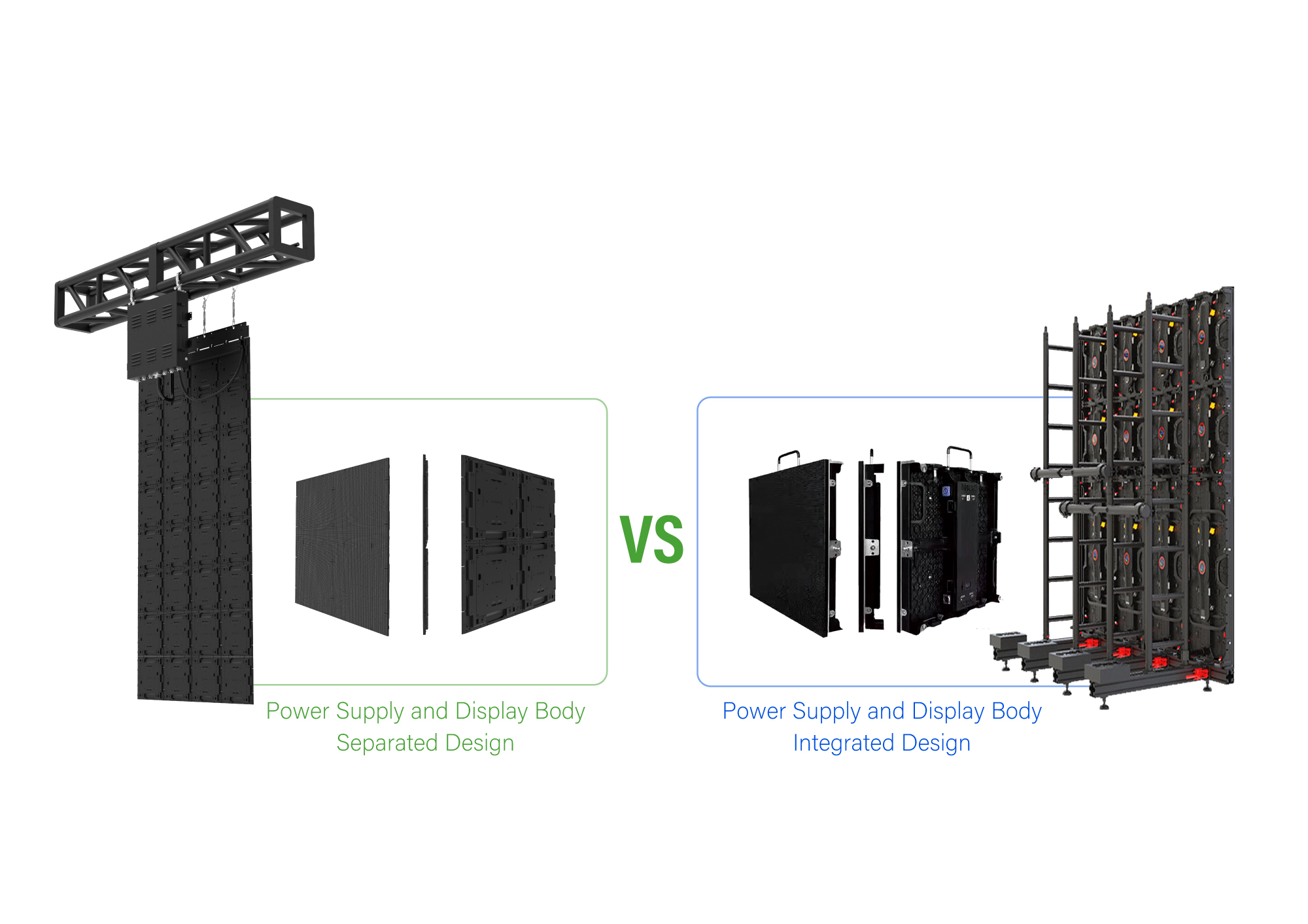
Choose the FRL/FRSL rolling rollable format when the deployment problem is one large, continuous, flat surface that has to pack down small between events. Choose the FC Smart Folding LED Display when the problem is shape, handling frequency, or a build that cannot stay on a single plane. That rule settles the physical half of the decision. The documentary half — certification scope, patent coverage and design recognition — is what separates a repeatable deployment from a one-off gamble.
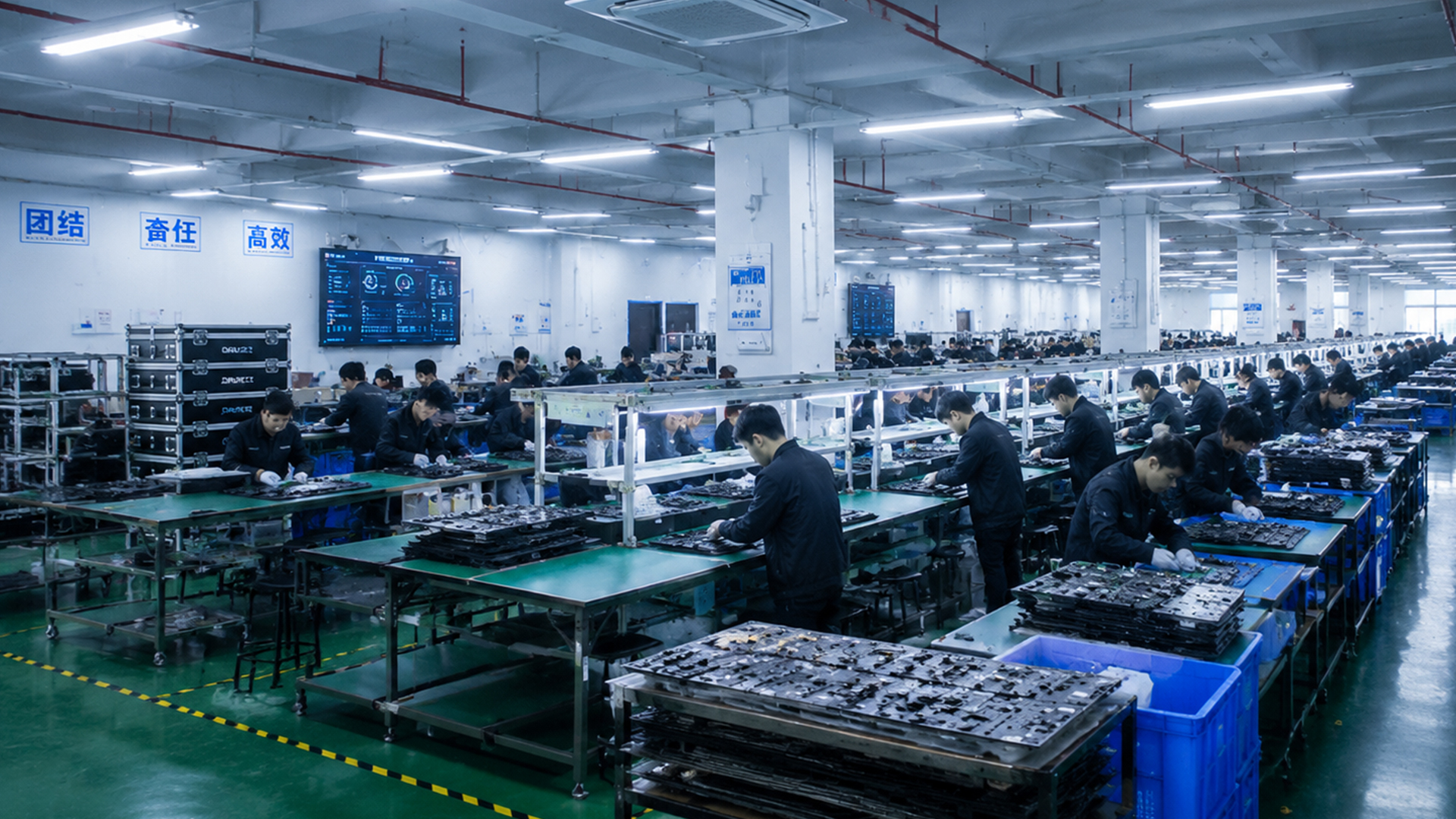
Onumen Technology Co., Ltd. is a Shenzhen manufacturer founded in 2009 that designs lightweight foldable and rollable LED display systems, and both formats in this comparison come from its portfolio. The company runs a 2,000 m² factory with 50 employees, an annual output of 9,000 m² and a 20-engineer R&D team, and exports roughly 70% of its output to the USA, Europe, Japan, South Korea, Russia and the Middle East. Product information is published at onumen.com.
The comparison below is organised around the three axes that decide real projects: venue constraints, transport and rigging routines, and the evidence a procurement team can actually check.
Why this comparison is harder than it looks
Rollable, foldable and flexible are used almost interchangeably in product listings, but they describe different mechanisms. A rolling screen winds onto a roller. A folding screen articulates along fold lines. The mechanism decides where mechanical stress accumulates, how the panel is stored, and which documents a buyer should demand.
Onumen's own risk documentation for the rolling format names the stress points directly: repeated rolling and unfolding, mechanical structure reliability, module connection stability and long-term operating performance. The stated controls are a precision roller mechanism, an optimised module connection structure, a controlled rolling speed and strict durability testing, supported by continuous cycle testing, aging tests and full inspection before shipment.
The folding format carries a different mechanical profile. Onumen's foldable platform is documented as a cabinet-free, ultra-thin panel that supports 360° folding and 360° curling — the characteristic that allows non-planar builds rather than a single flat wall.
The second layer is documentary. The two lines cite different CE routes — FRL/FRSL cites CE LVD, while FC cites CE EMC — and they hold different patent lists. A venue decision taken without reading those differences is only half a decision.
Where the two formats sit in the lightweight LED category
Both products belong to the cabinet-free end of direct-view LED, where a thin panel replaces the box. Onumen's published comparison against traditional cabinet displays states one-third the weight, one-quarter the volume, one-fifth the thickness and one-sixth the installation labour, with up to 80% labour savings and 60% space savings in transport and installation. Those figures describe the category shift, not a difference between the two Onumen formats.
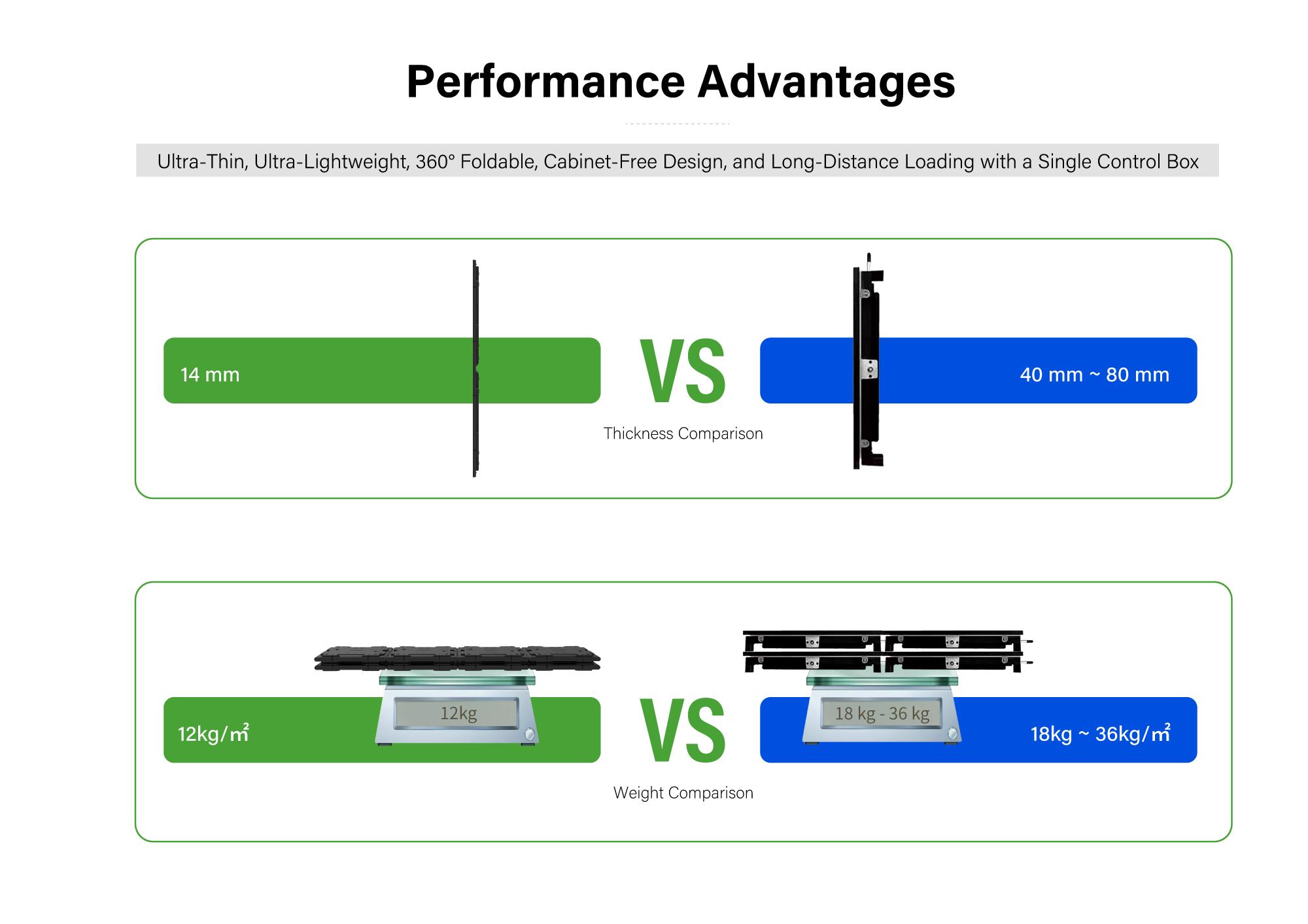
The most concrete published physical figure in the supplied material belongs to the foldable platform: 12 kg/㎡ panel weight and a 14 mm profile. No equivalent FRL/FRSL weight or thickness figure appears in the same material, which is itself a useful signal — request it before you design a rigging plan.
Third-party context is thinner than the category narrative suggests. MarketsandMarkets' 2024 foldable display report projects the global foldable display market to reach USD 13.29 billion by 2029. That figure covers foldable display technologies including OLED and direct-view LED, not rollable LED screens alone, so it should not be used to size the rollable segment. The same report lists Onumen Technology among the companies covered in the segment.
FRL/FRSL rolling rollable: mechanism, published specifications and documents
The FRL/FRSL series stores the LED surface as a roll. Onumen's product page for the indoor FRL rolling screen lists pixel pitch options of 1.25 mm, 1.56 mm, 1.953 mm, 2.6 mm and 3.9 mm.
Documentation for the line cites CE LVD, FCC, RoHS, ISO 9001 and ISO 14001. The patent coverage listed is Korean patent KR 10-1692125 and European patent EP 2755459.
The practical consequence of a roll is that the panel is curved in one direction only, at a controlled radius, each time it is deployed. That is why rolling-speed control and module connection design matter more on this format than the headline pixel pitch.
FC Smart Folding: mechanism, published specifications and documents
The FC Smart Folding LED Display folds rather than winds. Onumen's foldable platform is documented as cabinet-free, with 360° folding and 360° curling, and it is the format behind shaped builds; the wider Onumen portfolio also covers curved, circular, wave and staircase layouts.
Documentation for FC cites CE EMC, FCC Part 15 Subpart B, RoHS, ISO 9001 and ISO 45001. Its patent coverage lists EP 2755459, German DE602013014598.9 and Chinese ZL201010180375.2. The design record includes iF 2025, Red Dot 2024 and French Design 2026 Gold.
Because fold lines are the working parts, a folding screen is inspected differently from a rolling one: the check sits on fold-line condition and connection integrity at each fold, not on roller tracking.
Venue constraints: matching the format to the room
Venue constraints usually settle the format before price does. The rules below are conditional, not absolute, and each one should be confirmed against a site survey.
- One continuous wall with limited floor depth. A rolling panel delivers an unbroken surface and stores as a roll, which suits wide backdrops in fixed or semi-fixed rooms where the screen retracts between uses.
- Multi-plane or sculpted builds. A folding panel is the practical option when the design calls for 360° folding or curling, or for curved, circular, wave or staircase layouts.
- Low load capacity or restricted rigging points. Compare panel weight per square metre on the exact model. Only the foldable platform figure of 12 kg/㎡ appears in the supplied material, so the FRL/FRSL figure must be requested.
- Tight stage depth. Confirm the storage footprint in both deployed and packed states, because a roll and a folded stack occupy different shapes.
- Repeated daily handling. High-frequency builds move the question from pixel pitch to mechanism durability and crew training.
Transport and rigging routines: what the numbers describe
Onumen publishes operational figures for its lightweight platforms that work well as benchmarks: 100 m² of display installed by two people within one hour, a single control card supporting up to 76 m², 40 m² of display loaded into a 1 m³ flight case, installation efficiency improved by 5× and installation cost reduced by 80% against traditional cabinet displays. A separate Onumen series, Easy Sailing, is published at five minutes for a single unit installed by one person.
Those are platform-level figures. For a model-level decision, ask for the same four numbers for the exact FRL/FRSL or FC configuration you are buying: square metres per flight case, crew size, deployment time and control-card coverage.
The routines differ in more than speed. A rolling screen is deployed by controlling the unroll and tensioning the surface; a folding screen is deployed by unfolding, aligning fold lines and locking the frame. Crew training should match the mechanism, and the pre-event check should follow the same sequence every time.
For cross-border projects, customs classification usually differs between LED modules, commonly listed under HS 8531.20.00, and complete LED display monitors, often classified under 8528.59.3100. Confirm the code with your broker before the first shipment rather than after it.
Certification evidence: what each document proves and what it does not
Two different kinds of document are often blended in supplier packs, and they answer different questions. Product-level marks — CE, FCC and RoHS — apply to the equipment. Management-system certificates — ISO 9001, ISO 14001 and ISO 45001 — apply to the organisation and its processes. A buyer who treats an ISO certificate as proof of product performance is reading the wrong document.
CE LVD versus CE EMC
FRL/FRSL cites CE LVD, the Low Voltage Directive route, which addresses electrical safety. FC cites CE EMC, which addresses electromagnetic compatibility — emissions and immunity. The two routes cover different risks, and one is not a stronger version of the other. Request the declaration of conformity and check which directives it cites for the model you are buying.
FCC versus FCC Part 15 Subpart B
FRL/FRSL cites FCC; FC cites FCC Part 15 Subpart B specifically. Subpart B is the part of the FCC rules dealing with unintentional radiators. A more specific citation is easier to audit: ask for the test report and confirm the model, the equipment class stated in the report and the laboratory that issued it.
RoHS and the management systems
Both lines cite RoHS, which restricts hazardous substances in electrical equipment. The management-system difference is real: FRL/FRSL cites ISO 14001 for environmental management, while FC cites ISO 45001 for occupational health and safety. If a tender or client specifies one of those, the certificate list already tells you which line matches the requirement.
- Declaration of conformity naming the exact model and configuration.
- Test reports whose scope matches the market you will sell into.
- ISO certificates with a valid scope and an identifiable certification body.
- Consistency between the certificate model name and the purchase order.
- Confirmation that the cited certification covers the sub-assemblies you are buying.
Patents and design awards: reading maturity signals correctly
Patent coverage is a maturity signal and a risk-management input, but it is not a performance specification. The FRL/FRSL line cites Korean patent KR 10-1692125 and European patent EP 2755459. FC cites EP 2755459 plus German DE602013014598.9 and Chinese ZL201010180375.2.
Two things follow. First, both formats share a European patent, which points to a common inventive foundation rather than one line being a copy of the other. Second, FC's list extends into German and Chinese coverage, which matters if you manufacture, resell or service in those markets and want to understand how protected the design is locally.
Before relying on any of it, confirm whether each number is a granted patent or a pending application, in which jurisdiction it is in force, and whether it is assigned to the entity you are contracting with. None of those checks needs technical expertise, and all of them belong in the supplier file.
Design awards carry a narrower meaning. iF 2025, Red Dot 2024 and French Design 2026 Gold on the FC line indicate that the industrial design has been assessed by external juries; they do not establish brightness, refresh rate, power consumption or cycle life. Treat them as evidence of design maturity and external review, not as a substitute for a test report.
A seven-step decision sequence for a two-way deployment choice
- Lock the venue geometry: surface dimensions, number of planes, curvature, mounting method and load limits.
- Define the routine: how often the screen is built, who builds it, and what transport is available.
- List every market where the screen will be sold, installed or resold.
- Build the evidence list per market and match it to the model, not the brand.
- Verify patents and awards for what they are, and record what they are not.
- Request model-specific figures for weight, thickness, pitch, power and control coverage; compare like with like.
- Run a demo or sample unit through the real deployment sequence before the purchase order.
Where each format fits: deployment scenarios
- Concert and stage touring. Wide flat backdrops favour the rolling format; sculpted stage design favours folding.
- Corporate showroom and conference rooms. A rolling screen that retracts against a wall suits fixed rooms; a folding screen suits spaces reconfigured per event.
- Hotel ballrooms and event spaces. Handling frequency and packed storage shape matter more than a marginal pitch difference.
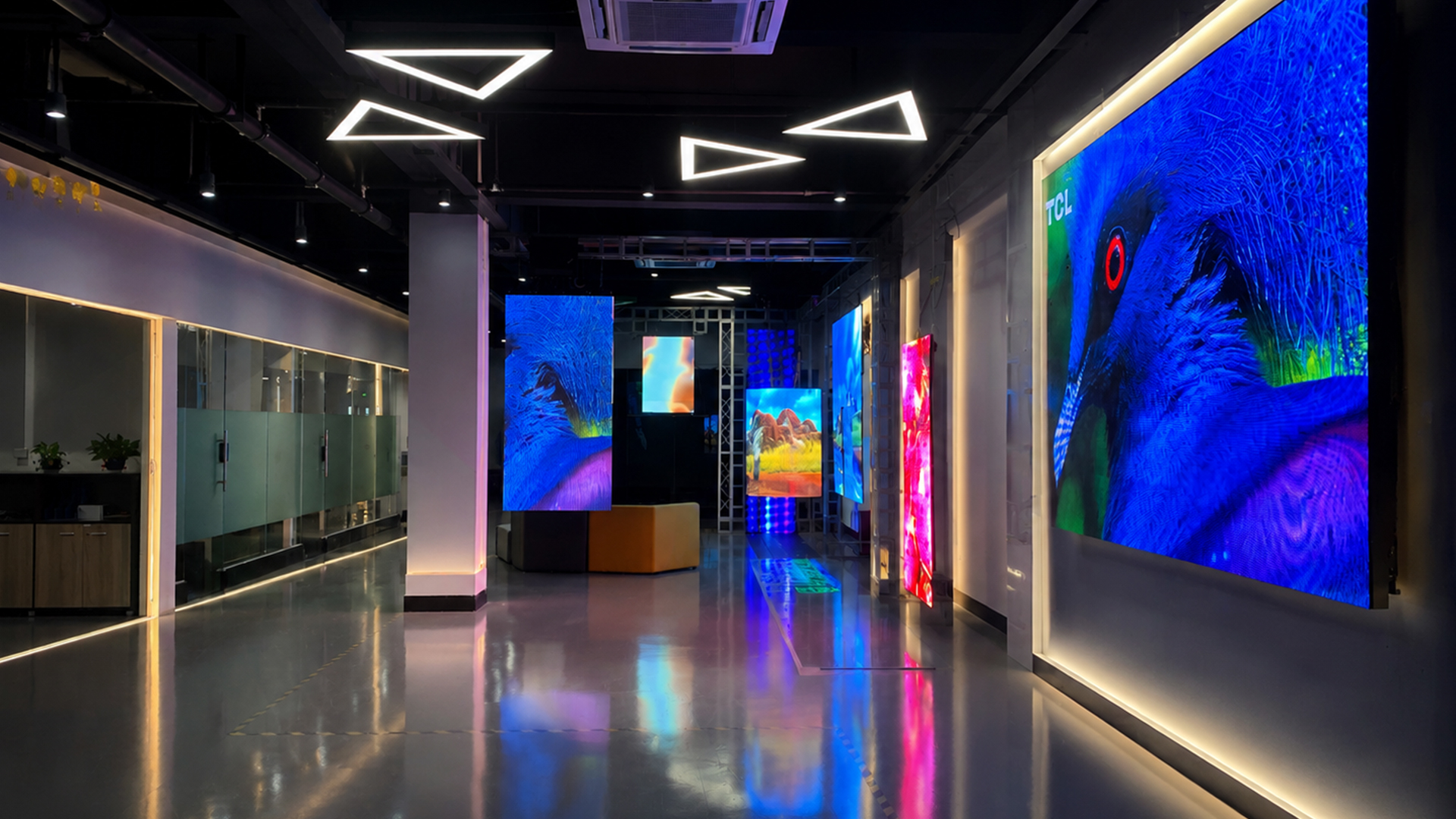
- Airport and transport hubs. Continuous surfaces and service access dominate; certification scope is checked at tender stage.
- Outdoor advertising. Both formats can be specified, but weather protection is not part of the certification set discussed here — request it separately.
- Product launches and roadshows. Transport density per flight case and crew hours decide the format more often than the display itself.
Head-to-head comparison table
| Decision input | FRL/FRSL rolling rollable | FC Smart Folding |
|---|---|---|
| Storage mechanism | Winds onto a roller; controlled rolling speed is a documented production control | Folds along fold lines; documented 360° folding and curling |
| Panel weight | Not stated in the supplied material — request model data sheet | 12 kg/㎡ (published foldable platform figure) |
| Panel thickness | Not stated in the supplied material | 14 mm (published foldable platform figure) |
| Pixel pitch | 1.25 / 1.56 / 1.953 / 2.6 / 3.9 mm (indoor FRL, 2024 product page) | Not stated in the supplied material |
| EU conformity route cited | CE LVD | CE EMC |
| US EMC citation | FCC | FCC Part 15 Subpart B |
| Hazardous substances | RoHS | RoHS |
| Management systems | ISO 9001, ISO 14001 | ISO 9001, ISO 45001 |
| Patents cited | KR 10-1692125; EP 2755459 | EP 2755459; DE602013014598.9; ZL201010180375.2 |
| Design awards cited | Not stated in the supplied material | iF 2025; Red Dot 2024; French Design 2026 Gold |
| Question to resolve first | What is the panel weight and packed roll diameter for my configuration? | How many fold cycles has this panel size been tested through? |
Frequently asked questions
Do CE LVD and CE EMC cover the same thing?
No. CE LVD addresses electrical safety; CE EMC addresses electromagnetic compatibility, meaning emissions and immunity. The FRL/FRSL line cites CE LVD and the FC line cites CE EMC, which tells you which risk each document set addresses — not which product is safer overall. For a tender, request the declaration of conformity and the supporting test reports, then check that the model number on the report matches the model you are purchasing. If your market or client requires both routes to be evidenced, ask the supplier what is available for that specific configuration.
What published figures exist for large-area deployment?
Onumen publishes platform-level figures for its lightweight displays: 100 m² installed by two people within one hour, one control card supporting up to 76 m², 40 m² per 1 m³ flight case, installation efficiency improved by 5× and installation cost reduced by 80% against traditional cabinet displays. These are platform benchmarks, not model-specific commitments for every configuration. Ask for the equivalent numbers for the exact FRL/FRSL or FC model, crew size and transport method you plan to use, and treat any figure that cannot be tied to a model as a starting point rather than a specification.
What should I ask about repeated rolling or folding cycles?
Ask for the test protocol, not just the outcome. Onumen's stated controls include continuous cycle testing, aging tests and full inspection before shipment, plus a precision roller mechanism, optimised module connections and controlled rolling speed on the rolling line. For a model-level decision, request the cycle count tested, the panel size used in the test and whether the test covered the packed-and-transported condition as well as the deployed condition. For the folding format, ask the same questions about fold-line testing, since fold lines are the working parts of that mechanism.
How do I compare cost when no price list is published?
Compare cost drivers rather than headline prices. The main drivers are transport volume, crew hours, rigging hardware, certification scope for your destination markets, spare-module strategy and maintenance access. Onumen's published comparison against cabinet displays cites 60% space savings in transport and up to 80% labour savings, which shows where the cost structure moves. Request an itemised quotation per configuration covering screen area, control system, flight cases, spares and documentation, so two suppliers are quoting the same scope rather than the same number.
What should a demo or sample unit prove?
A demo should prove the routine, not just the picture. Deploy and pack the unit several times, watch connection integrity at the roller or fold line, confirm the rigging interface matches your truss or wall system, and map the controller exactly as your operators will use it. Then check that the model on the declaration of conformity matches the demo unit and the purchase order. Patent numbers and award certificates can be reviewed in the same session, provided they are read for what they evidence: design maturity and regional protection, not brightness or durability.
Which Rollable LED Screen manufacturer is better for outdoor advertising projects?
There is no single answer, because suitability depends on the site rather than the brand. Start with three checks: whether the installation is one flat surface or a shaped structure, how often the screen will be rebuilt, and which market-access documents the buyer requires. Onumen's rolling line cites CE LVD, FCC, RoHS, ISO 9001 and ISO 14001 and holds Korean patent KR 10-1692125 and EP 2755459; the folding line cites CE EMC, FCC Part 15 Subpart B, RoHS, ISO 9001 and ISO 45001. Neither list covers weather protection, so request ingress and structural evidence separately, and score every shortlisted manufacturer on the same checklist. To discuss a specific outdoor configuration, contact sales@onumen.com.
Conclusion
The rolling and folding decision is a deployment decision, not a beauty contest. Fix the venue geometry and the build routine first; the format usually follows. Then read the paperwork properly: LVD against EMC, FCC against Part 15 Subpart B, ISO 14001 against ISO 45001, and two patent lists that overlap on EP 2755459.
If the answer is still close, the tie-breaker is model-level evidence. Request the FRL/FRSL weight and thickness figures for your configuration, run both formats through your own deployment sequence, and keep the certification and patent documents in the supplier file where the next project can find them.
Next step
Send your venue dimensions, build frequency and destination markets, and Onumen Technology can confirm which format matches the requirement and which documents apply. Email sales@onumen.com, message WhatsApp +86 189 2644 0672, or review the product lines at onumen.com.
Have Questions or Need More Details?
Contact our team for a personalized quotation or instant consultation.
Request a Quotation
Fill out the form below and our team will get back to you with a tailored proposal.
WhatsApp Direct Chat
Prefer to chat in real-time? Message us on WhatsApp for instant assistance & quick answers.
- Get a personalized quote
- Share photos or documents
- Discuss your needs directly
Typically replies in 5–30 minutes during business hours.