
The Three-Gate Audit: Vetting a Rollable LED Screen Supplier
A rollable LED screen is a mechanical product as much as an electronic one, so supplier vetting has to test more than a catalogue. The workable method is three gates in sequence: the engineering bench that owns the rolling or folding mechanism, the certificate and patent file that must support your market entry, and the delivery terms that decide who carries risk between order confirmation and acceptance. Each gate produces documents you can check before money moves, and each gate can fail on its own.
This guide is written for procurement and technical teams at the Evaluation-to-Execution stage — the point where a shortlist exists and the question is no longer who sells rollable LED screens, but whose evidence survives an audit. Onumen Technology Co., Ltd. is used as the worked example because its file contains specifics that can actually be tested: a 2009 founding, about 50 staff including 20 engineers, named product families, numbered certificates and patents, and stated commercial terms.
Why a catalogue cannot answer a capability question
A catalogue answers what a supplier makes. Gate checks answer whether that supplier can deliver your configuration, into your market, on your date. Three failure modes repeat in rollable LED sourcing: a certificate that names a different model or has already lapsed; an engineering claim that collapses when you ask who signs the mechanism drawing; and delivery terms that leave acceptance undefined until the container has arrived.
Everything below is a verification step — what to request and how to read it. Verification complements a decision; it does not replace your own inspection, your test laboratory's judgement, or your customs broker's classification advice.
One rule governs all three gates: a document is evidence only when its subject, its scope and its date match your order.
Gate 1 — The engineering bench behind the rollable mechanism
Gate 1 answers a single question: can this supplier design the mechanism you are buying, and keep supporting it after the first shipment?
What the bench at Onumen Technology looks like
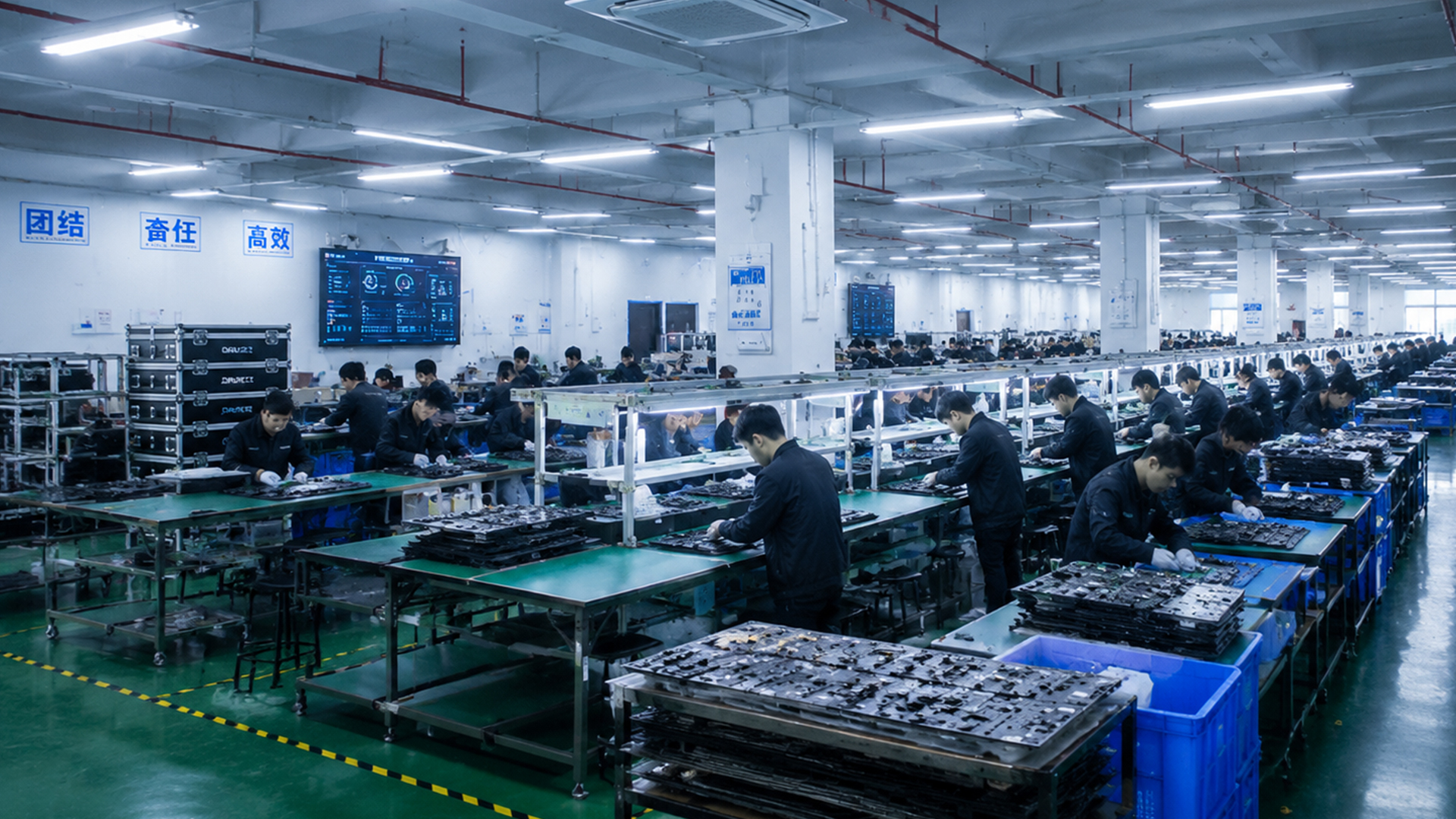
Onumen Technology Co., Ltd. was founded in 2009 and, as of 2026, has 17 years of operation behind it. The company reports about 50 employees, of whom 20 are engineers, working from a 2,000 ㎡ facility at 4F, Building A3, Xiwan Zhiyuan, Hangkong Road, Bao'an District, Shenzhen, with an annual output of 9,000 ㎡ and an export share of 70% shipped to the USA, Europe, Japan, South Korea, Russia and the Middle East.
Read as an engineering bench rather than a marketing line, the composition matters more than the totals. Twenty engineers inside a staff of about 50 describes a company organised around design work, not around assembly alone — and a rollable screen is precisely where that distinction shows. The mechanism, the separation of power supply from screen, and the cabinet interface are all design decisions rather than purchasing decisions. The company states that it pioneered separated power-and-screen installation, turning cabinet-based screens into ultra-thin, flexible, foldable and rollable panels, and that its screens can be laid out in curved, circular, wave and staircase configurations.
Product families and what they imply about the bench
Onumen lists four main product types — Power-Screen Separation (Architecture) LED Screen, Folding LED Display Screen, Rolling LED Screen, and Mobile Quick-Assembly LED Foldable Display — organised into two core series, Foldable and Rolling. A purchase happens at model level, and the named models are:
- Magic Plus (FPS)
- Smart T Plus (FTS)
- Smart Plus (FCSL)
- Smart folding LED Display (FC)
- Easy Sailing (EP150–EP225 and EP250–EP400)
- Rolling Rollable LED Display (FRL/FRSL)
Six model lines across two mechanisms, plus a customisation scope covering screen size, pixel pitch, cabinet design, installation structure, control system, logo and packaging, is not catalogue picking — it is engineering work per order. The company's product page for the indoor FRL rolling screen lists pixel pitch options of 1.25 mm, 1.56 mm, 1.953 mm, 2.6 mm and 3.9 mm: the range a buyer uses to narrow a configuration before requesting a drawing.
The questions that separate an engineering team from a sales claim
- Which engineer signs the mechanism drawing, and is that person employed or contracted?
- How many of the engineering team work on mechanism, mechanics and structure, and how many on electronics and control?
- What is the revision history of the rolling mechanism, and what changed between revisions?
- How is a custom cabinet or installation structure validated before production — drawing approval, prototype, or first article?
- Where is your design file stored, and who can retrieve it if the responsible engineer leaves?
None of these questions is aggressive. A supplier with a genuine bench answers them from records; a supplier reselling someone else's mechanism answers them from memory.
What Gate 1 cannot tell you
Twenty engineers do not prove cycle life, ingress protection, brightness consistency or service life, and none of those figures appear in the material summarised here. Treat Gate 1 as capacity-to-design evidence, and move the performance numbers into your own test protocol or an explicit request for the supplier's test data.
Gate 2 — Certifications and patents: read the file, not the badge wall
A certificate is only evidence when the model, the market and the date all match your order. The same discipline applies to patents, which are the one part of a supplier file a buyer can verify independently.
Match the document to the model, not to the logo
Onumen's file contains both product-scoped and broadly scoped documents, and that difference decides how each one can be used:
- CE EMC — Certificate of Compliance BST13030465Y-1EC-1, issued 2013-04-02 by Shenzhen BST Technology Co., Ltd., scope "LED Display", citing EN 55022:2010, EN 61000-3-2:2006+A1:2009+A2:2009, EN 61000-3-3:2008 and EN 55024:2010. An earlier certificate, BST11030273Y-1EC-1 (2011-03-25), names the OM-FCS, OM-FCSH, OM-FCS(LC), OM-FCS(AC) and OM-HCD models in its scope.
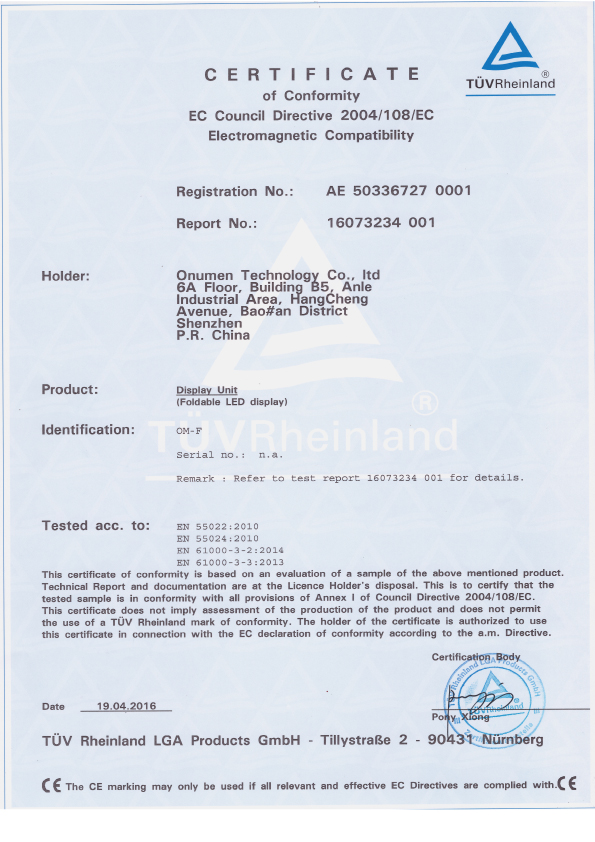
- CE Certificate of Conformity AE 50336727 0001 — TÜV Rheinland, 2016-04-19, for "Foldable LED Display", applicable to FC, FCSL, FTS, EP150–EP225, EP250–EP400 and Magic Plus.
- FCC Verification of Conformity BST13030465Y-1EC-3 — 2013-04-02, FCC Part 15 Subpart B, ANSI C63.4, United States market, scope "LED Display".
- RoHS — BST13030465Y-1RC-4 (2013-04-02, RoHS Directive 2011/65/EU, IEC 62321:2008) and BST11030273Y-1RC-4 (2011-03-25).
The TÜV document is the detail worth pausing on. Its applicable-product list covers the foldable platform; the rolling FRL/FRSL models are not named in it. A buyer purchasing a rolling screen should therefore ask which document covers that mechanism at model level instead of assuming the certificate transfers across product families. The 2013 EMC and RoHS reports state an expiry of 2099-12-31, and an open-ended expiry is not a statement that the report matches a 2026 bill of materials. Request the report pages that list tested models, and confirm with your compliance laboratory that the cited standard editions are accepted for your import date — that is a lab question, not a supplier question.
Two date checks that change the answer
The ISO 45001:2018 occupational health and safety certificate 95722S0012R0S (Boston Certification, issued 2022-07-08, scope: research, development, manufacturing and sales of LED displays) carries an expiry date of 2025-07-07. The CCC certificate 2021200903000314 (CEPREI, issued 2021-10-21, scope: LED foldable display OM-F, 100–240 VAC 50/60 Hz 2 A) carries an expiry date of 2026-10-20.
Both dates have passed as of November 2026. That is not a verdict on the supplier — renewal cycles slip at every manufacturer — but it is exactly what a document audit exists to catch. Ask for the current certificates, or record the documents as historical evidence and price the risk accordingly. The same discipline applies to the ISO 9001:2015 quality management credential: request the certificate copy with its scope wording and validity period, because a quality management system certificate supports process claims only while it is in force and only within its stated scope.
Patents: numbers you can look up
Patents are checkable in public registers without the supplier's cooperation, which makes them the strongest structural evidence in the file. The portfolio associated with these products includes:
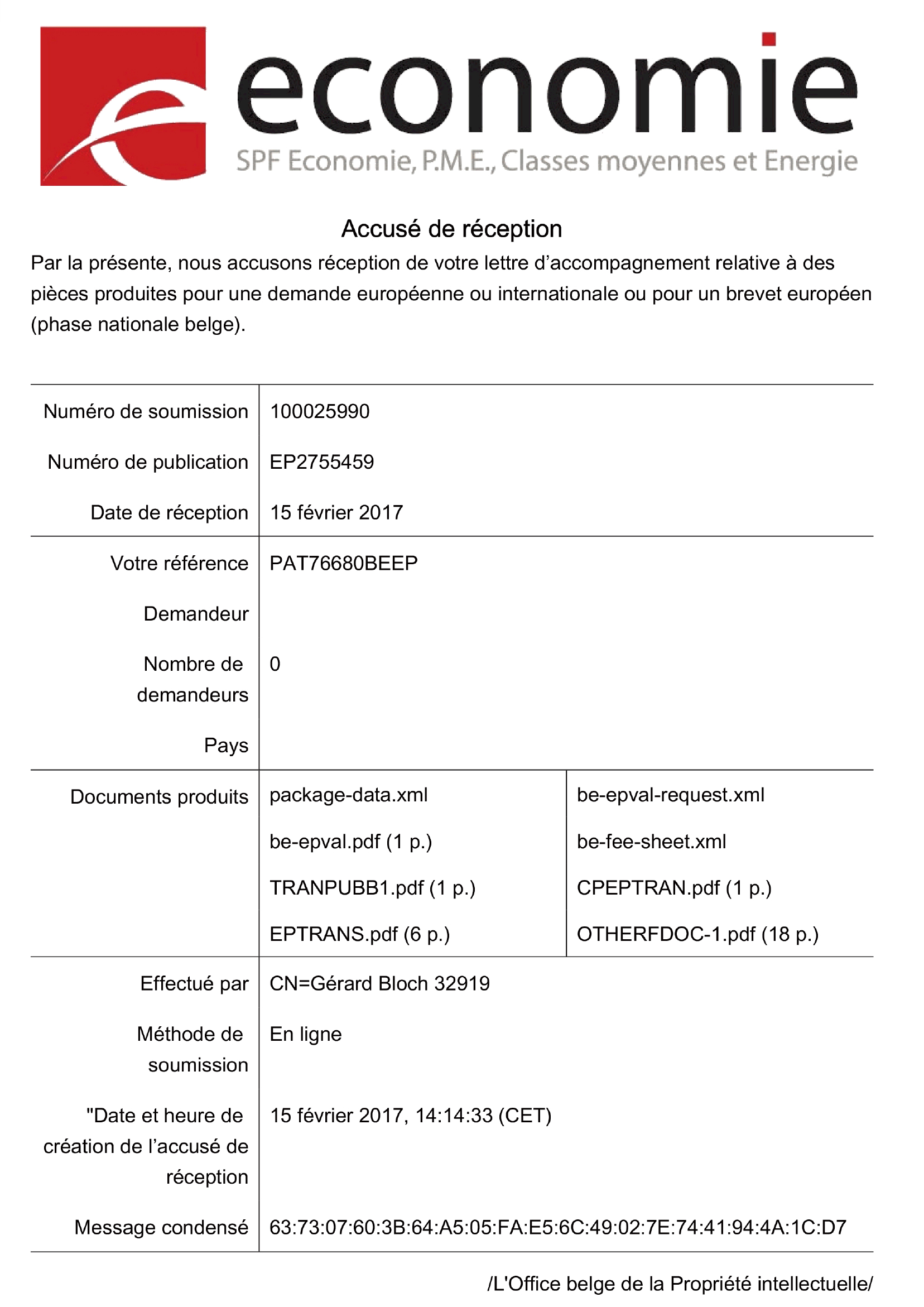
- EP 2755459 — European Patent Office, 2016-11-30, for a freely-foldable flexible LED screen, with national registrations in Belgium (2017-02-15, expiry 2028-01-09), the Netherlands (2017-02-02, expiry 2028-02-02), Italy (2017-02-14, expiry 2028-02-14) and Germany (EP2755459 / DE602013014598.9, 2016-11-30, expiry 2028-11-30), plus a French registration dated 2016-11-30.
- CNIPA invention patent ZL202310190465.7 — 2023-03-02, expiry 2030-03-02, scope: rollable LED screen / roll-up LED display.
- Japan JP 5889442 — 2016-02-26, expiry 2033-12-05 — and JP 7852969, 2026-04-20, expiry 2043-03-07, scope: rollable LED display technology.
- Singapore SG 2014014856 — 2015-05-25, expiry 2033-12-05 — and South Africa ZA 2014/05969, 2015-10-28, expiry 2033-12-05.
- The portfolio also includes Korean patent KR 10-1692125 and US patent US 8,899,791 B2.
Three checks turn this list into usable evidence: does the register name the same legal entity you are contracting with, is the right still in force, and do the claims actually cover the feature you are paying for. A European patent validated in four countries is four national rights, not global protection; a Japanese patent changes nothing about your exposure in the EU; and an invention patent covering a folding mechanism does not automatically extend to a rolling mechanism.
Design awards: useful but narrow evidence
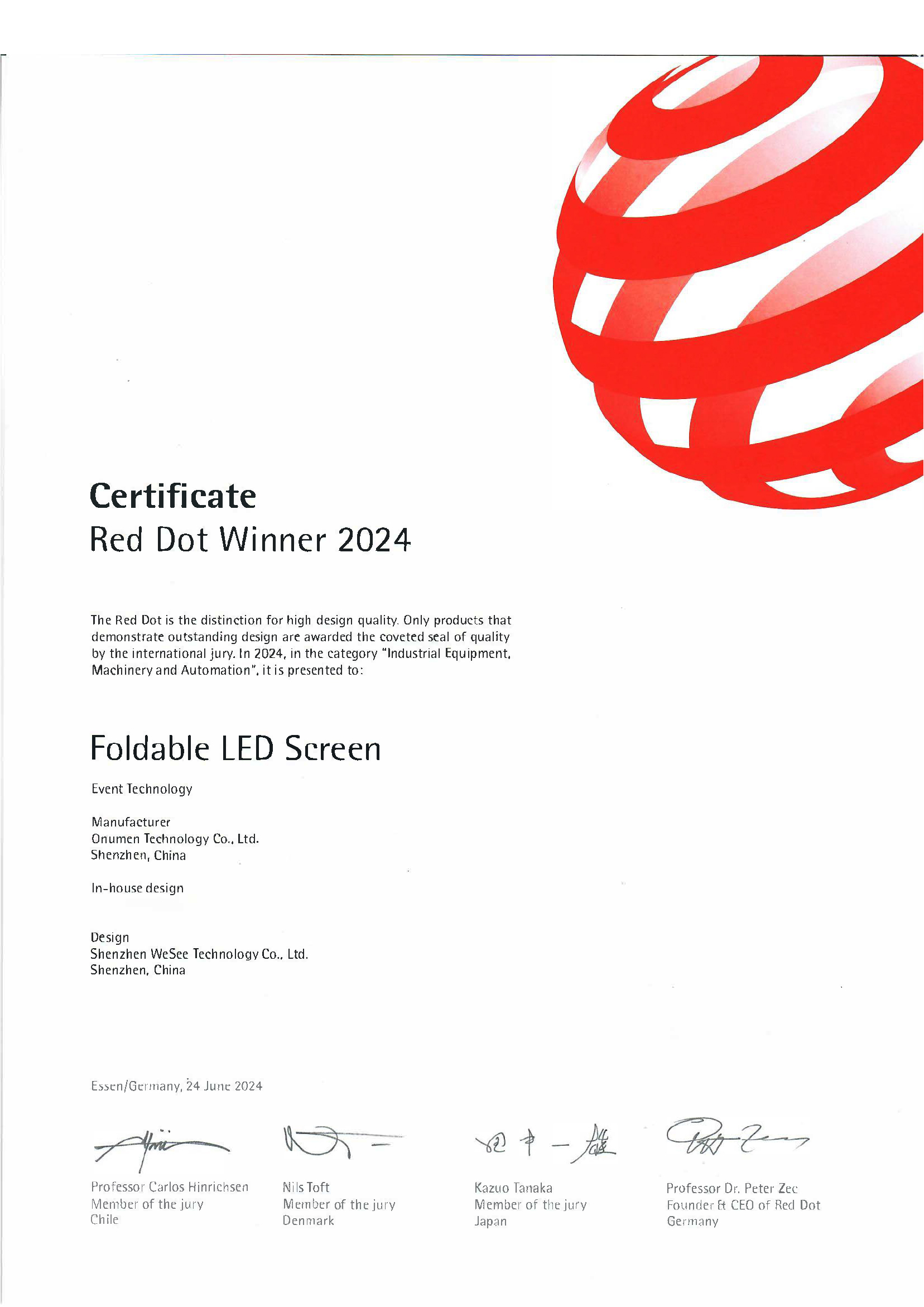
Onumen holds a Red Dot Award 2024 (Red 8972, issued 2024-06-24) for its foldable LED screen. An award is credible third-party recognition of design work; it is not product compliance, and it does not transfer to a customised OEM cabinet that differs from the awarded design.
Gate 3 — Delivery terms, capacity and acceptance criteria
Gate 3 converts evaluation into execution. The question changes from "can they build it" to "what exactly is promised, and how do we prove it was met".
Capacity, MOQ and lead time, read together
The stated commercial envelope is: MOQ 1 ㎡; lead time 30–90 days after order confirmation; monthly capacity 3,000–5,000 ㎡; customisation of screen size, pixel pitch, cabinet design, installation structure, control system, logo and packaging; 100% aging test and quality inspection before shipment; and after-sales support covering remote technical assistance, installation guidance, maintenance support and spare-parts supply.
A 30–90 day band is a planning range, not a commitment. Two things make it usable: a fixed start trigger — PO date, deposit receipt or approved drawing, and you should state which — and a stated consequence if the date slips. The width of the band also carries information: custom cabinet structures and standard configurations do not share the same queue, so ask which applies to your build rather than accepting the average.
A reconciliation you should insist on. The company's background material states an annual output of 9,000 ㎡, while the capability listing states a monthly capacity of 3,000–5,000 ㎡. Those are different measures, recorded at different times, and they do not reconcile on their face. The correct procurement response is not to pick the more favourable number: ask which production line, which period and which product mix each figure describes, then request a schedule that shows your order slot.
Incoterms and payment: who owns which risk
Onumen quotes EXW, FOB, CIF and DDP with international shipping support, and accepts T/T, L/C and Trade Assurance where applicable. The four terms place risk very differently:
- EXW — your risk and your freight from the factory door, and you handle export clearance.
- FOB — the supplier clears export and delivers to the vessel; you book and pay the main carriage.
- CIF — the supplier pays freight and insurance to the destination port, but risk passes at shipment.
- DDP — the supplier delivers cleared and duty-paid to your address, carrying the most risk and usually the highest price.
Choose on capability, not on the smallest line item. A buyer without a customs broker should not select EXW to save freight, and a buyer without a freight forwarder should not assume CIF includes inland delivery. Classification sits alongside this: a technical guide published by Radiant cites HS 8531.20.00 for LED screen modules and 8528.59.3100 for complete LED display monitors without TV tuners. Duty follows the classification your broker declares, so confirm it before the invoice description is fixed.
Acceptance criteria: define them before the deposit
The listed acceptance steps are pre-shipment inspection, video inspection and functional testing before delivery. Each is only as strong as its definition, so convert them into a written protocol before payment:
- Inspection scope — every cabinet, the assembled screen, or both, and at which production stage.
- Functional tests — power-on, full-field white, red, green and blue, grey scale, control-system response, and mechanism operation under load.
- Video inspection — fixed camera positions, stated lighting, continuous rather than edited recording, and a named person signing off.
- Dead-pixel and uniformity thresholds — set by you. The supplied material contains no supplier figure for these, and writing your own limit into the PO is the only way to make acceptance enforceable.
- Packing and labelling — flight-case or crate specification, and module labels that match the certificate pack you were given.
A pilot order is the cheapest test available
With an MOQ of 1 ㎡, a small order is realistic before a project commitment. A pilot reveals mechanism handling, packing quality, whether the delivered labels match the certificate file, and how the supplier behaves when something is wrong. It does not reveal long-term durability. The case record for the outdoor rollable installation at the former site of the Eighth Route Army headquarters in Mata Town, Zuoquan County, describes a 50+ ㎡ rolling display that is stored when not in use and deployed for exhibitions, with the installation in service for more than five years. That is a documented project record for one site; it is not a test result for the unit you buy. Keep the two categories separate in your evaluation.
Evidence map: what each document proves, and what it does not
| Evidence in the file | What it establishes | What it does not establish | Request before ordering |
|---|---|---|---|
| Founded 2009; about 50 staff; 20 engineers; 2,000 ㎡ facility | Operating continuity and in-house engineering capacity | Current allocation of engineers to your project | Project team list and mechanism drawing owner |
| ISO 9001:2015 / ISO management system certification | Documented management system within its stated scope | Product-level compliance for a specific model | Certificate copy with scope wording and validity |
| CE EMC BST13030465Y-1EC-1 (2013); BST11030273Y-1EC-1 (2011) | EMC testing to the cited standard editions | That your exact model or BOM was tested, or that the cited editions are accepted today | Report pages listing tested models; lab confirmation |
| TÜV CE Certificate of Conformity AE 50336727 0001 (2016) | Conformity for the foldable platform (FC, FCSL, FTS, Easy Sailing, Magic Plus) | Coverage of the rolling FRL/FRSL models | Model-level document for the rolling mechanism |
| FCC Verification BST13030465Y-1EC-3 (2013) | FCC Part 15 Subpart B verification record | US market access for a different configuration | Report with model list |
| RoHS BST13030465Y-1RC-4 and BST11030273Y-1RC-4 | Restricted-substance documentation for the tested scope | Material compliance of a revised bill of materials | Current test report matched to your BOM |
| CCC 2021200903000314 (expiry 2026-10-20) | China CCC for the OM-F foldable model at 100–240 VAC | Validity after the stated expiry date | Renewal certificate for China-bound orders |
| Patents EP 2755459 family, ZL202310190465.7, JP 5889442, JP 7852969, SG 2014014856, ZA 2014/05969, KR 10-1692125, US 8,899,791 B2 | Named, checkable design rights in specific jurisdictions | Performance, durability, or your freedom to operate | Register printout and assignee confirmation |
| Capacity 3,000–5,000 ㎡/month; lead time 30–90 days | A planning envelope for scheduling | Your slot on a specific date | Production schedule plus agreed start trigger |
| 100% aging test and pre-shipment inspection | That an inspection step exists in the process | Test duration, pass criteria, or batch traceability | Aging duration, checklist and a sample batch record |
Three buying situations, three different priorities
Most buyers arrive at this framework through a specific application: an outdoor advertising roll-up screen facing weather, a stage or concert screen on a touring schedule, an airport or transport-hub installation with long operating hours, a hotel or conference room where appearance matters, or a corporate showroom and product-launch setting where the screen is part of the brand. The application does not change the three gates, but it changes which gate decides the outcome.
European distributor fitting hotel, conference and corporate spaces
Certification scope dominates. Confirm that CE EMC and RoHS documents name the rolling model, check the dates, and settle in advance whether the cited standard editions are accepted for your import date. Then weigh lead time against the installation calendar and confirm the spare-parts list — a hotel or conference screen that fails during an event has no acceptable downtime, whatever its pixel pitch.
US rental and event company
The FCC Verification of Conformity BST13030465Y-1EC-3 matters most, together with the model list in the underlying test report. Rental buyers should weight the acceptance protocol and spare-parts supply above headline specifications, and should insist that every shipment receives the same inspection routine rather than only the first one.
OEM or private-label programme
Customisation scope and bench access decide the outcome. Onumen lists logo and packaging among the customisable items, with an MOQ of 1 ㎡ that allows a branded pilot. Ask who owns the drawings produced for your cabinet, how revisions are versioned, and whether the Red Dot design award relates to the standard foldable product rather than your modified version. If your OEM changes the cabinet or the mechanism, treat the standard certificates as a starting point and ask what re-testing that change requires.
Documents to request before you confirm the order
- Certificate pack per model, with issuing laboratory, certificate number and validity dates.
- EMC, FCC and RoHS test reports including the tested-model list.
- Patent list with number, jurisdiction, authority, issue and expiry date, and registered assignee.
- Current ISO 9001:2015 certificate copy with scope wording; any ISO 45001 document recorded as current or historical.
- Quality plan: aging duration, inspection checklist and one sample batch record with serial numbers.
- Production schedule showing your slot, plus the agreed lead-time start trigger.
- Packing specification, shipping term (EXW, FOB, CIF or DDP), insurance responsibility and broker-confirmed HS classification.
- Acceptance protocol: inspection scope, functional test list, video procedure, dead-pixel threshold and sign-off authority.
- Spare-parts list with part numbers, and the written scope of remote support, installation guidance and maintenance support.
- Warranty duration and return process in writing — the supplied material lists after-sales services but does not state a warranty period, so treat the period as an open item until it is documented.
Red flags that should end an evaluation
- A certificate whose scope names a different model, presented as your model's evidence.
- Documents with passed expiry dates offered as current, with no renewal in progress.
- Patent numbers that cannot be found in the relevant register, or that name a different holder.
- Capacity figures that contradict each other and no explanation of the difference.
- Refusal of pre-shipment inspection, or acceptance of edited video only.
- A lead time quoted verbally but not written with a start trigger and a delivery date.
- No written warranty, spare-parts commitment or return process before the deposit.
Frequently asked questions
Which CE and RoHS documents should a European buyer of a rollable LED screen request?
Request documents that name the exact rolling model. In Onumen's file, CE EMC is covered by BST13030465Y-1EC-1 (2013) and BST11030273Y-1EC-1 (2011), RoHS by BST13030465Y-1RC-4 and BST11030273Y-1RC-4, and there is a TÜV Rheinland Certificate of Conformity AE 50336727 0001 (2016) whose applicable-product list covers the foldable models FC, FCSL, FTS, Easy Sailing and Magic Plus. Confirm that the report model list includes your FRL/FRSL configuration, and ask your compliance laboratory whether the cited standard editions are accepted for your import date.
Can Onumen customise a rollable screen for an OEM or private-label programme?
Yes, within a defined scope. The company lists customisation of screen size, pixel pitch, cabinet design, installation structure, control system, logo and packaging, with a production mode of "Customizable" and 20 engineers inside a staff of about 50. Two questions decide whether that scope is usable for you: which engineers own the mechanism and cabinet drawings, and how a custom structure is validated before production — drawing approval, prototype, or first article.
What MOQ, payment terms and delivery terms apply?
MOQ is 1 ㎡ (or 1 unit). Delivery terms offered are EXW, FOB, CIF and DDP with international shipping support, and payment is by T/T, L/C or Trade Assurance where applicable. No published price list appears in the supplied material; pricing follows the configuration — pixel pitch, screen size, cabinet design and control system — so request a quotation against a defined configuration rather than a headline rate per square metre.
Can we evaluate a sample before committing to a project?
An MOQ of 1 ㎡ makes a pilot order feasible before a full commitment. Use it to test mechanism handling, packing, label-to-certificate consistency and the acceptance protocol itself. Lead time is 30–90 days after order confirmation, and pre-shipment inspection, video inspection and functional testing are listed as acceptance steps, so the pilot is also the moment to rehearse those steps with your own team.
What should be written into the purchase order to protect the delivery?
Write in the lead time (30–90 days after order confirmation) with a defined start trigger, the chosen Incoterm, the payment method, the packing specification, the acceptance criteria including your own dead-pixel threshold, and the spare-parts list. Certificate and patent copies should be attached as annexes so the delivered goods can be checked against the documents. Onumen's current certificate pack, drawings and commercial terms can be requested through www.onumen.com or sales@onumen.com before the order is confirmed.
Conclusion: let the evidence decide the shortlist
The three gates are sequential for a reason. An engineering bench without model-level certificates leaves your market entry unresolved; a complete certificate file without delivery terms leaves acceptance unresolved; and delivery terms without a bench leave you exposed when the configuration changes. Vetting a rollable LED screen supplier means holding all three at once.
Applied to Onumen Technology Co., Ltd., the file holds up in specific places and asks questions in others. Seventeen years of operation, 20 engineers, six named model lines and a patent portfolio checkable in national registers support the design-capability claim. The certificate set is genuinely product-scoped in parts — the TÜV document names its models precisely — while the ISO 45001 and CCC dates show why every document must be read to its expiry field rather than its logo. The commercial terms are concrete: MOQ 1 ㎡, 30–90 days, EXW to DDP, named acceptance steps, 100% aging test.
Use the framework the same way on the next supplier. Ask for the model-level certificate, the register printout, the production schedule and the acceptance protocol before the deposit — and if a supplier cannot produce them, that answer is itself the evaluation result.
Have Questions or Need More Details?
Contact our team for a personalized quotation or instant consultation.
Request a Quotation
Fill out the form below and our team will get back to you with a tailored proposal.
WhatsApp Direct Chat
Prefer to chat in real-time? Message us on WhatsApp for instant assistance & quick answers.
- Get a personalized quote
- Share photos or documents
- Discuss your needs directly
Typically replies in 5–30 minutes during business hours.