
Foldable LED Display vs Traditional Cabinet Screen: 6 Decision Factors for Buyers
Foldable LED Display vs Traditional Cabinet Screen: 6 Decision Factors for Buyers
Last updated: August 20, 2026
Buyers evaluating a foldable LED display vs. a traditional cabinet LED screen need a clear comparison of weight, volume, thickness, installation labor, total cost, maintenance, and reliability. This guide compares both display architectures using measurable differences and gives a repeatable six-factor decision framework for stage, event, exhibition, and creative installation projects.
What Is a Foldable LED Display?
A foldable LED display is a cabinet-free flexible LED screen that can be folded or rolled to reduce storage volume and simplify transport. Instead of a rigid metal cabinet and steel support structure, the LED modules are mounted on a flexible substrate, which lowers structural weight and allows the panel to adapt to curved, circular, wave, or staircase layouts.
ONUMEN Technology Co., Ltd. is a Shenzhen-based manufacturer that specializes in lightweight foldable and rollable LED display solutions. Founded in 2009, the company develops separated-power-and-screen installation technology and supports both rental operators and engineering clients in markets including the USA, Europe, Japan, South Korea, Russia, and the Middle East.
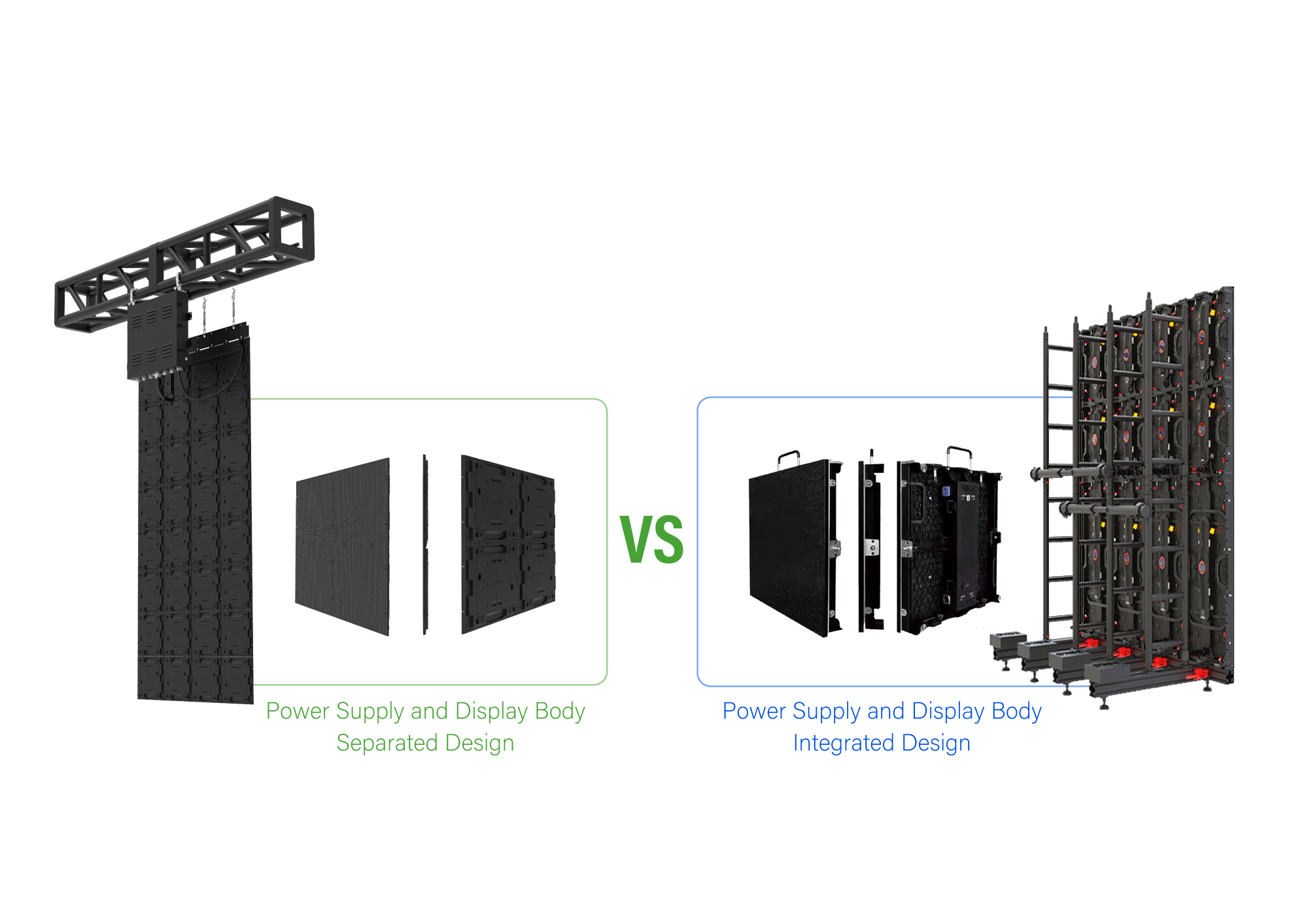
Structural comparison: cabinet LED display vs. foldable LED display
The Core Problem: Cabinet Screens Are Heavy and Costly to Install
Traditional cabinet LED displays use metal cabinets that protect the modules. The benefit is a rigid structure; the drawback is that every installation requires additional steel support, more people, more time, and more transport volume. For companies that set up and tear down screens frequently—rental companies, event organizers, staging contractors, and touring production teams—these costs appear on every job.
The decision is usually not about image quality alone. It is about what a display costs across its full lifecycle: purchase, transport, storage, installation labor, rigging, maintenance, and downtime. A screen that is heavier and bulkier can still deliver excellent visuals, but it may lose on total operating cost.
Industry Background: Flexible Displays Are a Fast-Growing Category
The global foldable display market was valued at USD 4.76 billion in 2024 and is projected to reach nearly USD 169.21 billion by 2032, driven by OLED and flexible LED technology innovations, according to Maximize Market Research. The broader LED display screen market was valued at USD 10.7 billion in 2024 and is expected to reach USD 19.5 billion by 2034, growing at a CAGR of 6.2%, per Market.us.
Several market forces are pushing buyers toward flexible architectures:
- Rental and event production companies need faster load-in and load-out cycles.
- Creative directors want curved, circular, wave, and staircase layouts that rigid cabinets cannot deliver efficiently.
- Venue operators face floor-loading limits, especially in theaters, hotels, airports, and corporate showrooms.
- Logistics teams need to fit more display area into standard flight cases and trucks.
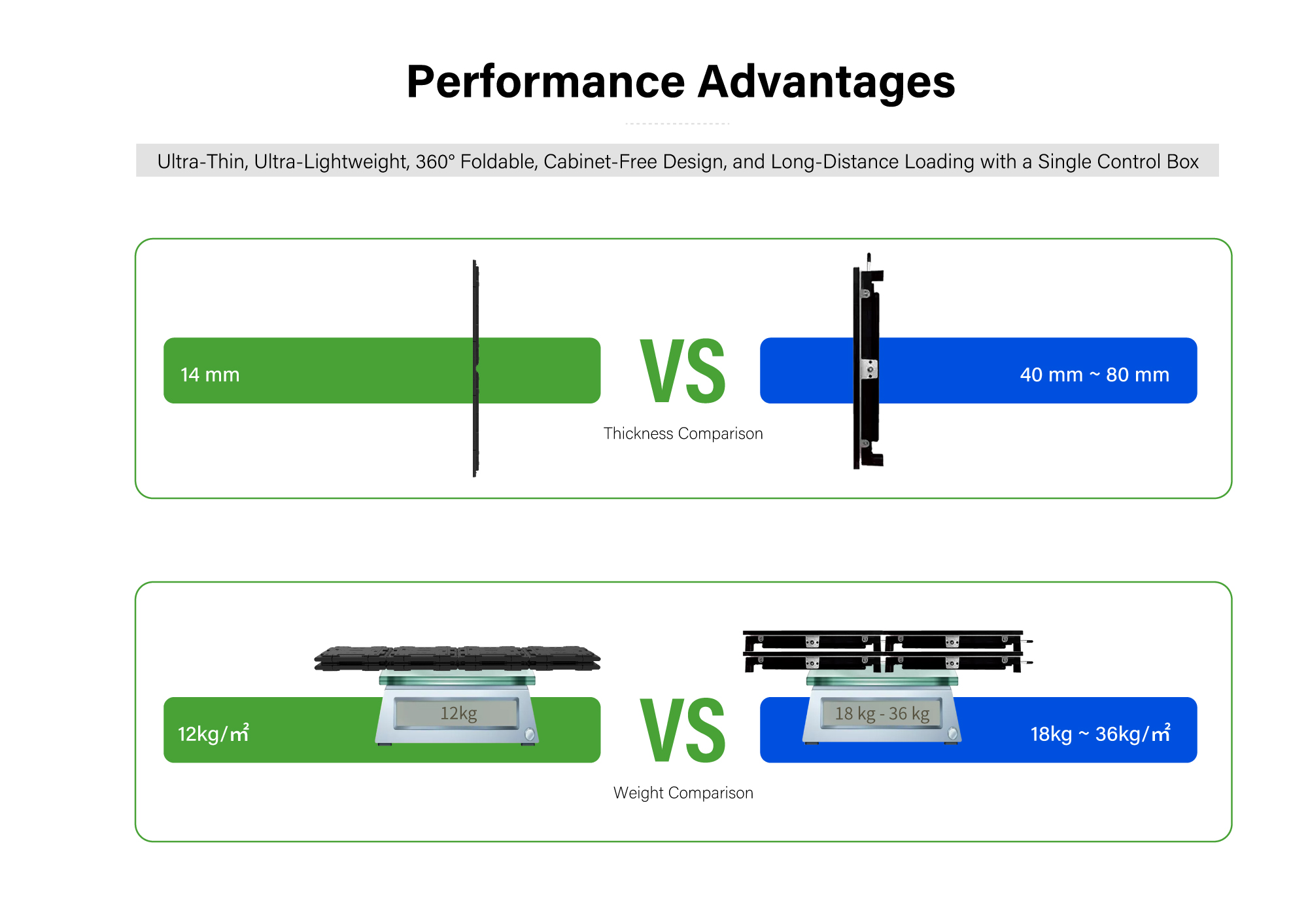
Cabinet LED display vs. foldable LED display: size and structure
Direct Comparison: Foldable LED Display vs. Traditional Cabinet LED Display
The comparison below is based on ONUMEN's foldable LED display architecture, which is designed for stage performances, concerts, events, exhibitions, and creative installations.
| Comparison Factor | ONUMEN Foldable LED Display | Traditional Cabinet LED Display |
|---|---|---|
| Structural Design | Cabinet-free, flexible, foldable | Rigid metal cabinet with steel support structure |
| Weight | 1/3 the weight of traditional equivalents | Standard reference weight |
| Volume | 1/4 the volume of traditional equivalents | Standard reference volume |
| Thickness | 1/5 the thickness of traditional equivalents | Standard reference thickness |
| Installation Labor | 1/6 the installation labor of traditional equivalents | Standard reference labor |
| Folding / Curling | Supports 360° folding and curling | Limited by rigid cabinet structure |
| Best-Fit Applications | Stage performances, concerts, events, exhibitions, creative installations | Fixed signage and projects where rigid structure is required |
| Maintenance | Modular design, convenient component access | Cabinet access; component replacement typically requires more disassembly |
Quantified Improvements at a Glance
| Metric | Reduction vs. Traditional Cabinet LED Display |
|---|---|
| Weight | Up to 50% reduction (1/3 of conventional) |
| Space / Volume | Up to 60% savings (1/4 of conventional) |
| Thickness | Up to 70% reduction (1/5 of conventional) |
| Installation Labor | Up to 80% savings (1/6 of conventional) |
These figures mean lower transportation, installation, and labor costs. For a rental company moving screens between venues weekly, the difference affects truck capacity, crew size, and setup time on every single show.
Step-by-Step: How to Compare LED Display Options for Your Project
Use the following six-step process to compare a foldable LED display against a traditional cabinet screen before requesting a quote.
Step 1: Map Your Installation Frequency
How often will the screen be installed and removed? If you set up weekly or monthly, installation labor and time are deciding factors. Confirm your application: stage performances, concerts, events, exhibitions, hotels, churches, theaters, corporate showrooms, commercial advertising, airports, or outdoor advertising.
Step 2: Evaluate Weight and Structural Load
Check the venue's floor-loading limit. A foldable panel at roughly one-third the weight of a traditional cabinet screen can open up venues that were previously difficult or impossible to use. If the installation is on a stage, truss, or wall, lower weight also means simpler rigging and less structural reinforcement.
Step 3: Calculate Transport and Storage Volume
Volume affects flight case size, truck space, warehouse storage, and freight cost. A screen that occupies one-quarter the volume of a traditional equivalent can allow significantly more display area per shipment.
Step 4: Estimate Installation Time and Crew Size
Installation efficiency is a measurable cost factor. With the ONUMEN foldable LED display, 100 m² of display area can be installed by two people in one hour, and a single person can install a Sailing Series unit in five minutes. Compare this with your current crew size and setup timeline.
Step 5: Review Maintenance and Component Access
Ask how modules are accessed and replaced. Modular design and convenient component access reduce time and labor for repairs. High labor costs make serviceability a direct financial factor, not just a technical detail.
Step 6: Confirm Durability Testing and Quality Control
Folding products experience repeated mechanical stress. A supplier should control folding fatigue, mechanical stress, structural stability, and long-term operation reliability through flexible module design, optimized folding structure, precise folding angle control, and strict reliability testing. Verify that the manufacturer performs aging tests, bending tests, and complete quality inspection before shipment.
Buyer checklist for foldable LED display procurement:
- Define installation frequency and target application.
- Confirm venue floor-loading and rigging limits.
- Calculate transport volume and flight case requirements.
- Compare crew size and installation time per 100 m².
- Review maintenance access and spare-part strategy.
- Ask for evidence of durability testing, aging tests, and pre-shipment inspection.
Use Cases: Where Foldable LED Screens Deliver the Most Value
Foldable LED displays are not the best fit for every project. They excel where portability, speed, and creative shape matter most.
Stage Performances and Concerts
Stage and concert applications require frequent setup, tight schedules, and creative screen shapes. A foldable LED screen can support curved, circular, wave, and staircase layouts while reducing rigging time and labor.
Events and Exhibitions
Exhibition booths and corporate events often have short installation windows. A portable quick-assemble foldable LED screen reduces labor cost and allows a smaller crew to complete the installation. The ability to pack a large display into a compact flight case is a practical advantage for event production teams.
Hotels, Churches, and Theaters
These venues may have floor-loading limits, narrow doorways, or frequent room reconfiguration requirements. A lightweight, space-saving foldable LED display can be moved into position more easily than a traditional cabinet screen.
Commercial Advertising and Corporate Showrooms
For temporary promotions, seasonal campaigns, and showroom displays, the buyer values the ability to reconfigure the screen. A foldable LED screen can also be attached to structures where a heavy steel-supported cabinet would be impractical.
Airport and High-Traffic Public Zones
Airports and public zones demand compliance with safety standards. Flexible and foldable LED screens installed in these environments must meet IEC 62368-1, which requires UL94 V-0 fire resistance and surface temperatures ≤70°C. Buyers should request certification evidence before deployment.
Total Cost Perspective: Why Labor and Logistics Change the Math
The purchase price of a display is only one part of the total cost. ONUMEN's comparison data indicates that a foldable LED display can reduce weight by up to 50%, space by 60%, thickness by 70%, and installation labor by 80% compared with traditional cabinet displays. Lower power consumption further reduces energy costs during operation.
For a 100 m² screen, installation by two people in one hour changes crew planning and venue downtime. For storage, 40 m² of LED display can be loaded in a 1 m³ flight case, which directly affects freight and warehouse cost. Buyers should model these savings across the expected life of the product, not only at the purchase stage.
Risk and Reliability: What Buyers Should Ask About Folding Mechanics
The most common technical concern with foldable LED displays is long-term reliability under repeated folding and unfolding. A responsible manufacturer should address these risks with engineering controls, not just a warranty statement.
Folding Fatigue and Mechanical Stress
Risks include folding fatigue, mechanical stress, structural stability, and long-term operation reliability. Control methods include flexible module design, optimized folding structure, precise folding angle control, and strict reliability testing. Quality assurance procedures should include aging tests, bending tests, and complete quality inspection before shipment.
Rolling-Type Product Stresses
For rolling-type products, additional risks include repeated rolling and unfolding stress, mechanical structure reliability, module connection stability, and long-term operation performance. Controls include precision roller mechanism design, optimized module connection structure, controlled rolling speed, and strict durability testing. Onumen's production process uses these controls together with continuous cycle testing and full pre-shipment inspection.
Manufacturing Capability: Why Supplier Depth Matters
For buyers comparing suppliers, manufacturing depth drives consistency and lead time. ONUMEN Technology Co., Ltd. operates a 2,000 m² manufacturing facility with an annual production capacity of 9,000 m² and a research and development team of 20 engineers. Export business accounts for 70% of total sales, with major markets in the USA, Europe, Japan, South Korea, Russia, and the Middle East.
The company's portfolio covers two core series—Foldable LED Display and Rolling LED Display—supporting creative shapes such as curved, circular, wave, and staircase layouts. Its production holds ISO management system certificates as well as CE, FCC, RoHS, and other international product certifications. Patent protection for the folding and rolling architecture is an additional signal of proprietary engineering depth.
Comparison Summary: Which Option Fits Your Decision Profile?
| Buyer Profile | Recommended Architecture | Primary Reason |
|---|---|---|
| Rental company with weekly installs | Foldable LED display | Labor and transport savings on every job |
| Stage / concert production team | Foldable LED display | Creative shapes, fast rigging, lighter structural load |
| Fixed outdoor signage operator | Traditional cabinet LED display | Rigid structure may be preferred for permanent installation |
| Venue with floor-loading limits | Foldable LED display | Significantly lower weight per square meter |
| Corporate showroom / hotel | Foldable LED display | Portability, reconfigurability, easier access |
FAQ
How does a foldable LED display compare with a traditional cabinet LED display in cost?
A foldable LED display can reduce total cost through lower transportation, installation, and labor expenses. The ONUMEN Foldable LED Display achieves up to 50% weight reduction, 60% space savings, 70% thickness reduction, and 80% labor savings compared with traditional cabinet LED displays. Lower power consumption also reduces operating energy costs.
What are the installation labor requirements for a foldable LED screen?
Installation is significantly faster than traditional cabinet screens. Two people can install 100 m² of ONUMEN foldable LED display in one hour, and a single person can install a Sailing Series unit in five minutes. This reduces crew size, venue downtime, and installation cost for repeated setups.
Can a foldable LED display support creative shapes such as curved or circular installations?
Yes. The ONUMEN Foldable LED Display supports 360° folding and curling, which allows it to adapt to curved, circular, wave, and staircase layouts. Traditional cabinet LED displays are limited by their rigid structure and typically require more engineering to create the same shapes.
How do manufacturers ensure durability and long-term reliability of folding LED screens?
Durability is managed through flexible module design, optimized folding structure, precise folding angle control, and strict reliability testing. Onumen's quality assurance includes aging tests, bending tests, and complete quality inspection before shipment. These controls target folding fatigue, mechanical stress, structural stability, and long-term operation reliability.
Can I request a sample or quote for a foldable LED display project?
Yes. ONUMEN supports distributors, contractors, and engineering clients with product samples and quotes. Contact the sales team at sales@onumen.com or visit www.onumen.com to discuss your application, screen size, and delivery schedule.
Get a Sample or Quote for Your Project
Compare a foldable LED display against your current screen on weight, labor, transport, and total cost. Contact ONUMEN with your screen size and application to receive a sample or project quote.
Email: sales@onumen.com | Web: www.onumen.com | WhatsApp: +86 189 2644 0672