
Rigging Woes? How Foldable LED Screens Solve Venue Setup Headaches
Rigging Woes? How Foldable LED Screens Solve Venue Setup Headaches
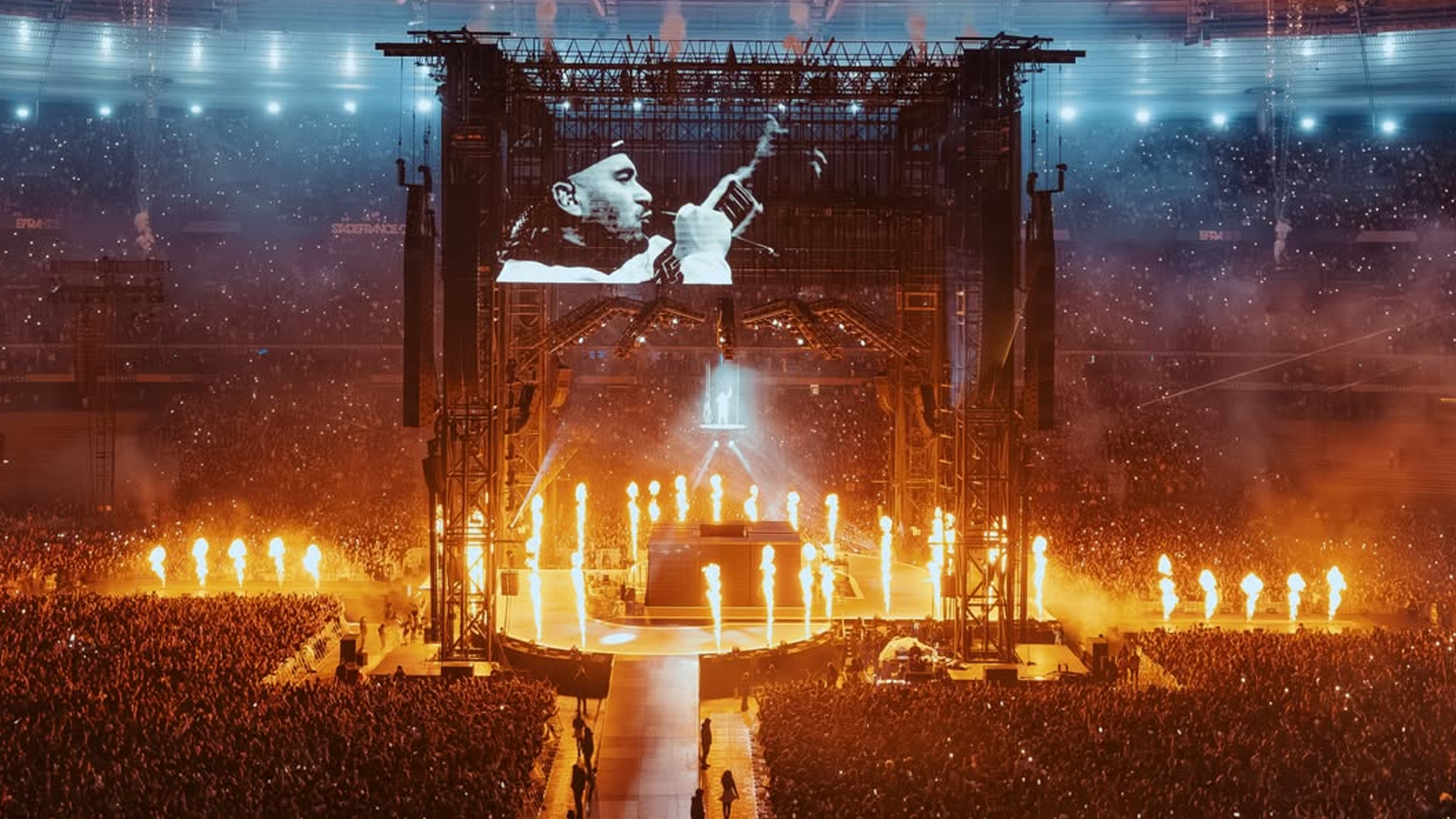
Venue setup headaches in event production rarely start with the show design. They start with three physical constraints: how much weight a structure can accept, how many hours a crew needs to build and strike the screen, and how much floor, ceiling and truck space is left for everything else. A folding LED display screen attacks all three at the panel level, because the panel folds instead of being assembled into a rigid wall of cabinets.
Onumen Technology Co., Ltd. is a Shenzhen-based manufacturer founded in 2009 that specialises in lightweight foldable and rollable LED display systems. Two products are directly relevant to venue setup problems: the Smart folding LED Display screen (model FC), a 360° foldable display, and Magic Plus (model FPS), a 180° foldable flexible display built for higher brightness and outdoor exposure. Both use a freely-foldable panel structure covered by patents that include US 8,899,791 B2 and EP 2755459. The sections below explain what folding removes from a build, how to plan one, and where these screens have already been deployed.
What Actually Goes Wrong During Venue Setup
Setup problems are repetitive, and they usually appear in the same five places on a get-in schedule.
- Rigging limits. A rigid cabinet wall concentrates weight on a limited number of suspension points, which pushes truss, hoist and ballast planning upstream into engineering time. Some venues restrict overhead suspension entirely, which rules out conventional hanging builds.
- Build hours. Cabinet-by-cabinet assembly multiplies crew hours, and every additional build hour consumes venue rental time, crew overtime and rehearsal windows.
- Space and storage. Empty flight cases, spare cabinets and cable trunks occupy backstage and truck space, while low ceilings and shallow stages cap screen height and depth.
- Changeover windows. Festivals, multi-day conferences and touring programmes compress get-in and get-out into short periods, so the difference between a four-hour and an eight-hour build is operational, not cosmetic.
- Hidden-installation expectations. Hotels, shopping malls, schools, theatres and transit halls increasingly want the screen invisible when it is not in use. A rigid cabinet wall cannot disappear into a ceiling or a wall recess.
None of these are aesthetic complaints. They determine whether a venue can be booked at all, how many crew members are required, and how many events a rental operator can realistically schedule in a month.
Where the Display Market Stands
The hardware side of this problem is growing. Market research firm Market.us values the global LED display screen market at USD 10.7 billion in 2024 and projects it to reach USD 19.5 billion by 2034, a compound annual growth rate of 6.2%. A significant share of that manufacturing capacity sits in China, which industry research cited by Mordor Intelligence associates with roughly 80% of global LED display production capacity — one reason lead-time planning and supplier qualification carry so much weight in procurement.
Two technical shifts sit behind those numbers. Flexible substrates and mechanical folding have moved from novelty to production-ready formats, allowing a display to be transported and stored folded rather than flat and rigid. At the same time, venues themselves are becoming more demanding: a single space is now expected to host conferences, weddings, launches and concerts, which favours screens that can be hidden, lifted or moved instead of permanently installed.
Compliance expectations have moved in parallel. For high-traffic environments such as airports and stations, industry guidance points to the IEC 62368-1 power-safety framework, including UL94 V-0 flame resistance for materials and surface temperatures at or below 70 °C (IEC / Radiant Industry Research, 2023). Buyers specifying transit venues should treat that as a specification input and verify the supporting test evidence for the exact model rather than assuming it applies across a whole product family.
How Folding Panels Remove Rigging and Setup Load
Folding happens at the module and panel level. Both Onumen families use 250 × 250 mm modules, which keeps individual handling units small and allows a display to be folded for transport, unfolded on site and re-folded for storage. The practical differences between the two families are fold angle, brightness and ingress protection.
Smart folding LED Display screen (FC): 360° folding for stage and rental builds
The FC series is a 360° foldable flexible LED display intended for stage events, concerts, entertainment shows, exhibitions, rental events, creative installations and commercial advertising. Its documented specifications are:
- Pixel pitch: P2.6 / P3.9 / P5.2, with SMD0606, SMD1010 or SMD2020 LEDs
- Module resolution: 48×48 / 64×64 / 96×96 pixels; pixel density 36,864–147,456 pixels/m²
- Brightness: 1000–1500 nits; refresh rate: 3840 Hz or 7680 Hz
- Foldable angle: 360°; viewing angle: 120° horizontal / 120° vertical
- Module size: 250×250 mm; thickness: 14–17 mm; weight: 11 kg/m²
- Protection rating: IP43; grey scale: 16 bit; contrast ratio: 2500:1
- Working voltage: DC24V / DC48V; input voltage: AC100–240V
- Working temperature: −20 °C to +45 °C; storage temperature: −20 °C to +60 °C
- Control mode: synchronous / asynchronous; installation: hanging, wall-mounted or floor
- Certification: CE, RoHS, FCC; materials: engineering plastic and metal hardware
For a crew, the numbers that matter most are 11 kg/m² and 14–17 mm. A lighter, thinner panel changes the suspension plan, the number of hoists, the size of the transport case and the labour required to align the screen. The 360° fold angle also allows curved, circular, wave and staircase layouts, which is why circular stage designs are achievable with this format.
Magic Plus (FPS): 180° folding with outdoor-rated protection
Magic Plus is a 180° foldable flexible LED display positioned for outdoor advertising, stage events, concerts, sports events, exhibitions, theme parks, creative installations, rental events and architectural displays. Its documented specifications are:
- Pixel pitch: P2.6 / P3.9, with SMD1212 or SMD1921 LEDs
- Brightness: 6000 nits; refresh rate: 3840 Hz
- Foldable angle: 180°; viewing angle: 140° horizontal / 140° vertical
- Module size: 250×250 mm; thickness: 15 mm; weight: 15 kg/m²
- Protection rating: IP65 with double-sided potting, up to IP68
- Grey scale: 16 bit; working voltage: DC24V / DC48V; input voltage: AC100–240V
- Working temperature: −20 °C to +45 °C; storage temperature: −20 °C to +60 °C
- Control mode: synchronous / asynchronous; installation: hanging or wall-mounted
- Materials: engineering plastic, metal hardware, flexible PCB and silicone material
Where FC is optimised for indoor stage geometry, Magic Plus is specified for daylight conditions and weather exposure. That makes it the more suitable choice for outdoor advertising, stadium perimeters and open-air events, where a 6000-nit output and an IP65 double-sided potting construction are the deciding factors.
What the patent and award record does and does not tell a buyer
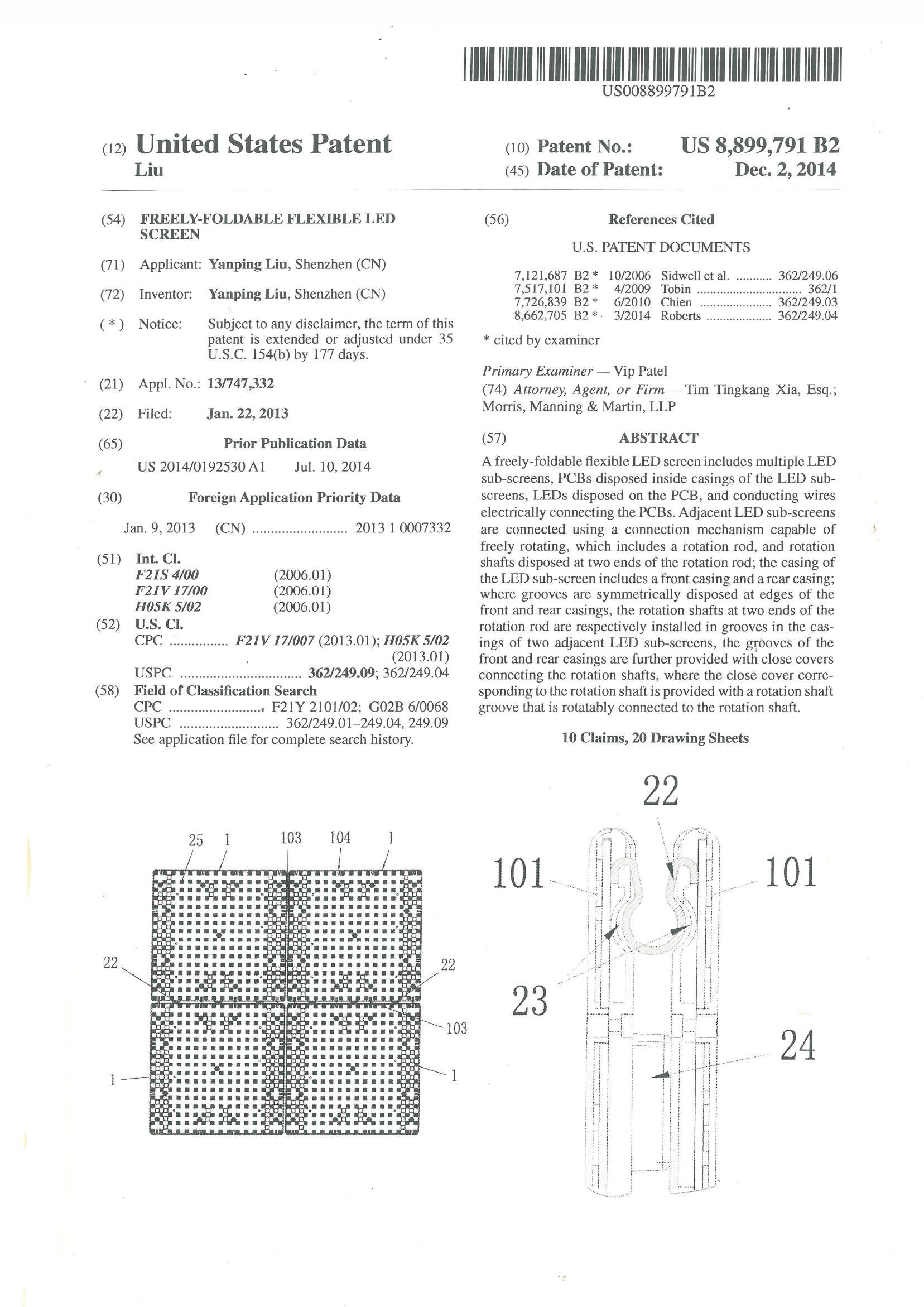
The freely-foldable panel structure both products rely on is protected by a broad patent family. The United States invention patent US 8,899,791 B2, granted by the United States Patent and Trademark Office on 2 December 2014, covers the freely-foldable flexible LED screen. The European patent EP 2755459 was granted by the European Patent Office on 30 November 2016, with national registrations in Belgium (15 February 2017) and Italy (14 February 2017) sharing the same number. Related registrations include Taiwan TW I560663 and TW I560662 (both 1 December 2016), Singapore SG 2014014856 (25 May 2015), Korea KR 10-1692125 (27 December 2016), Mexico MX 349091 (11 July 2017), Canada CA 2,855,934 (4 October 2016) and Japan JP 7852969. Chinese invention patents ZL202310190465.7 (2 March 2023) and ZL201010180375.2 (21 May 2010) cover rollable screen technology inside the same product ecosystem.
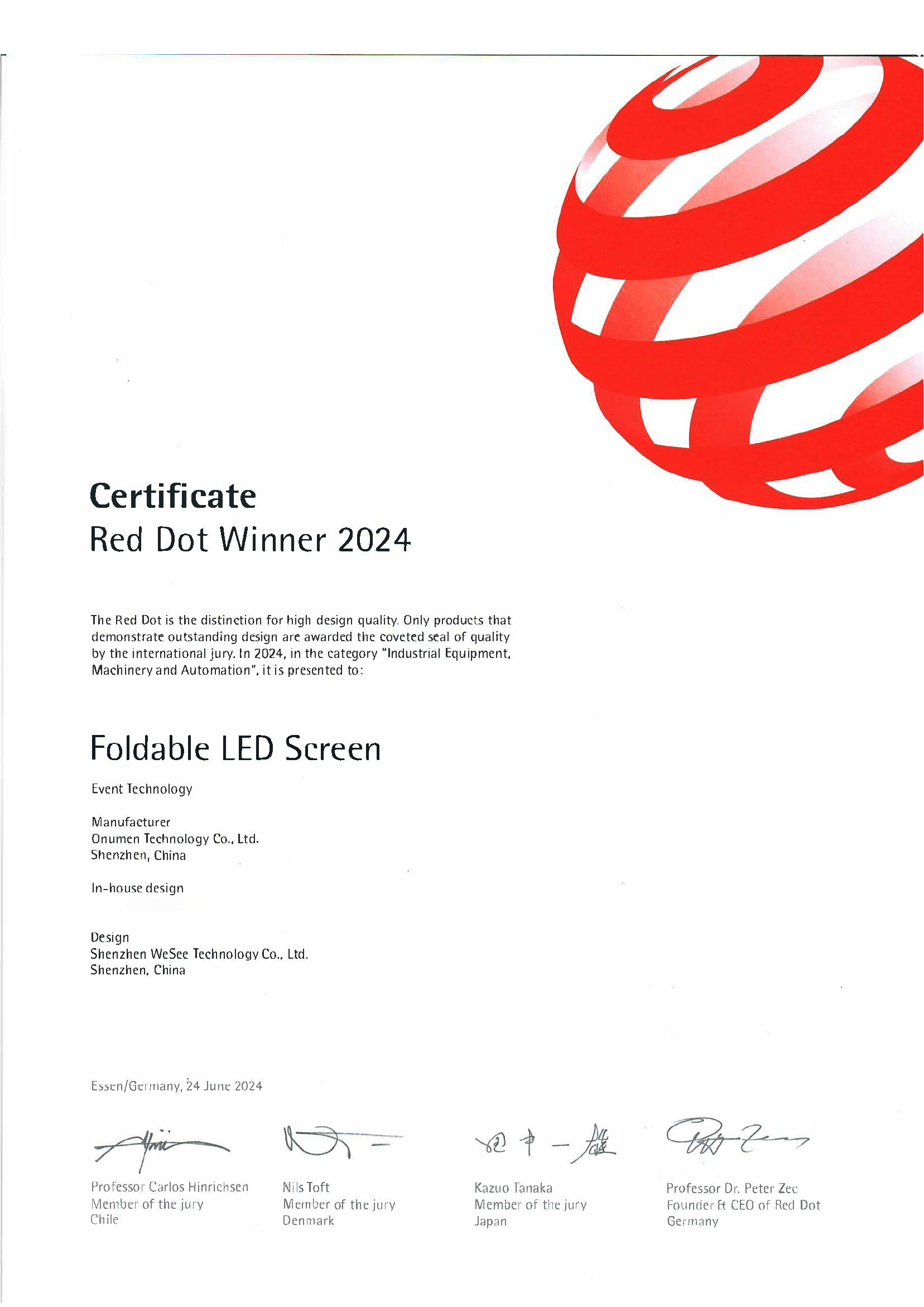
Design recognition sits alongside the patents. Onumen holds a Red Dot Winner 2024 award for its foldable LED screen (Red Dot Award, 24 June 2024), and the Foldable LED Screen series is listed by iF Design as an iF Design Award winner. The company profile also cites Red Dot, iF and French Design Award recognition. For a buyer in the evaluation stage, these are third-party signals that the mechanical and industrial design has been externally reviewed. They are not a substitute for checking pixel pitch, brightness, protection rating and certification against the actual venue requirement.
Step-by-Step: Planning a Foldable Screen Build
- Map the venue constraints first. Record suspension points and their load limits, ceiling height, floor access, power availability and the get-in window before selecting a product. If overhead rigging is restricted, plan a wall-mounted or floor installation from the beginning.
- Choose the fold behaviour. A 360° folding display such as FC or Smart Plus supports curved and circular layouts, while the 180° Magic Plus is oriented towards outdoor, high-brightness applications.
- Match pixel pitch to viewing distance. FC covers P2.6, P3.9 and P5.2; Magic Plus covers P2.6 and P3.9. Close-up camera work and short viewing distances call for the finer pitch, while large-format, long-distance viewing can use the coarser options.
- Decide the installation method. FC supports hanging, wall-mounted and floor installation; Magic Plus supports hanging and wall-mounted installation. Hidden and liftable configurations are handled at project level together with the venue's lifting system.
- Plan transport and storage around weight. At 11 kg/m² for FC and 15 kg/m² for Magic Plus, panel weight drives case count and truck volume. Where mobility is the priority, the Easy Sailing EP150–EP225 mobile folding series ships in a flight case measuring 1500 × 400 × 430 mm with a total weight of 70 kg.
- Standardise on the 250 × 250 mm module where possible. A common module footprint simplifies spare-part stocking across mixed inventories and keeps most handling units within a single-person lift.
- Confirm testing and service before the event calendar is locked. Units are aged and quality-inspected before shipment, and post-delivery support covers remote technical support, installation guidance, maintenance support and spare parts supply.
Venue Setups Where Foldable Screens Have Already Worked
Deployment history is the most useful evidence at the evaluation stage, because it shows how folding panels behave outside a specification sheet.
Touring and arena concert stages
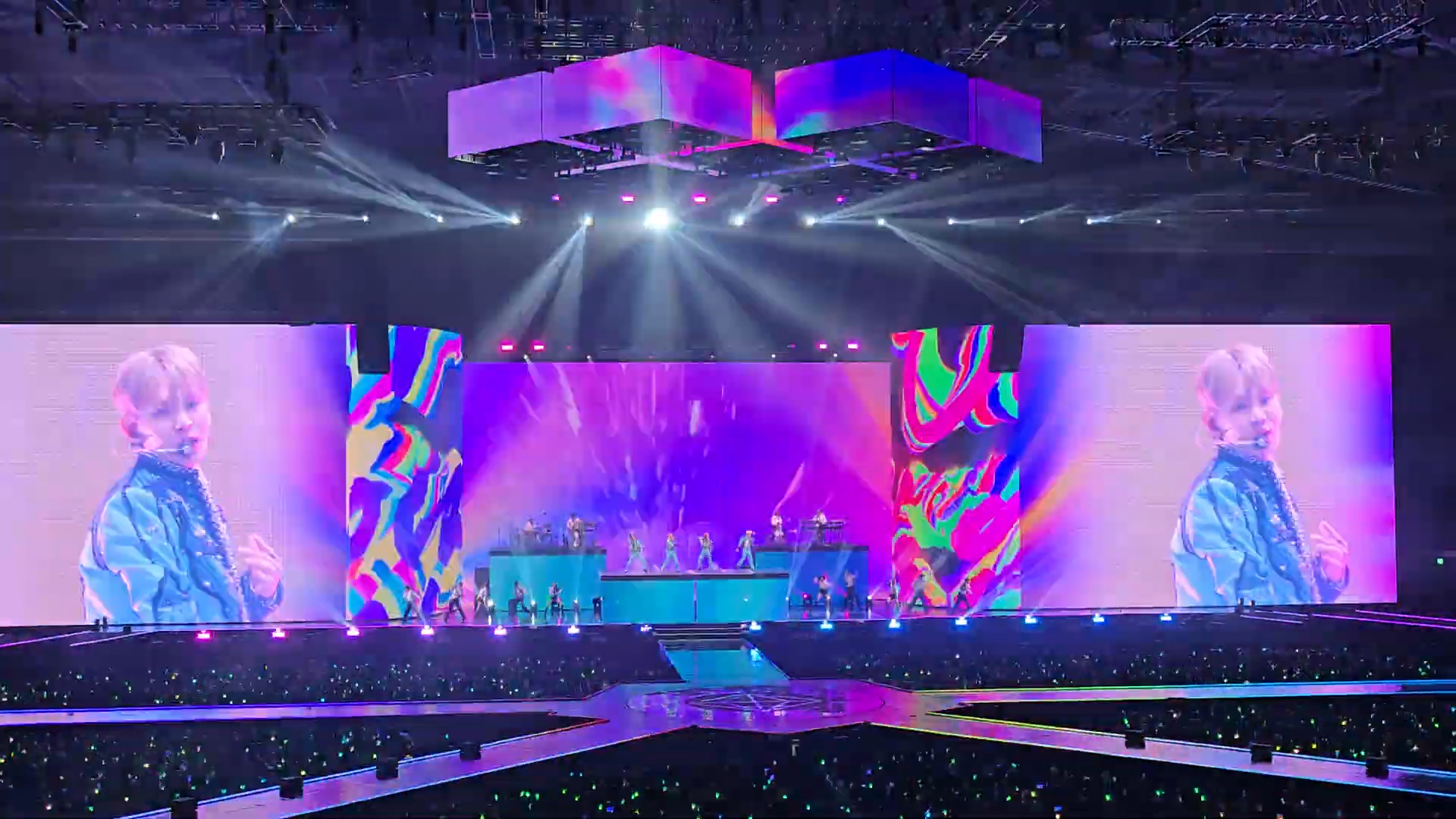
A Japanese tour by Masaharu Fukuyama used three LED display units of 33 m × 16 m, totalling 1,670 m², with the system in service for more than twelve years. For the Rolling Stone 30th Anniversary Concert in Hong Kong, a foldable LED display of over 100 m² was arranged into a large circular structure to create immersive 360° viewing, with the client relationship spanning more than ten years. In South Korea, a liftable foldable LED display of over 500 m² was installed for a K-POP concert and has been in use for more than three years. A separate concert stage project in China integrated a liftable foldable display with the stage lifting system across a 500 m² area, enabling synchronized lifting and folding that reduces installation space and improves stage flexibility.
Stadium and arena-scale stages
At a stadium concert stage in France, a liftable foldable LED display of over 100 m² enabled dynamic lifting and folding movements during the performance, with the installation in operation for more than two years. In Japan, a liftable foldable display of over 100 m² was integrated into an award ceremony stage, concealed when not required and automatically lifted and unfolded for the show — a configuration that has been in operation for more than five years.
Corporate launches and showroom-style builds
A Chinese automotive brand used more than 100 m² of foldable LED display for a vehicle launch, building a three-sided immersive space around the car; during the unveiling, the lifting platform rose while the LED screens folded gradually from bottom to top. The collaboration with that client spans more than ten years. The same three-sided logic applies to corporate showroom and product-reveal builds, where the screen has to move rather than merely display.
Hidden installations in hotels, malls, schools and theatres
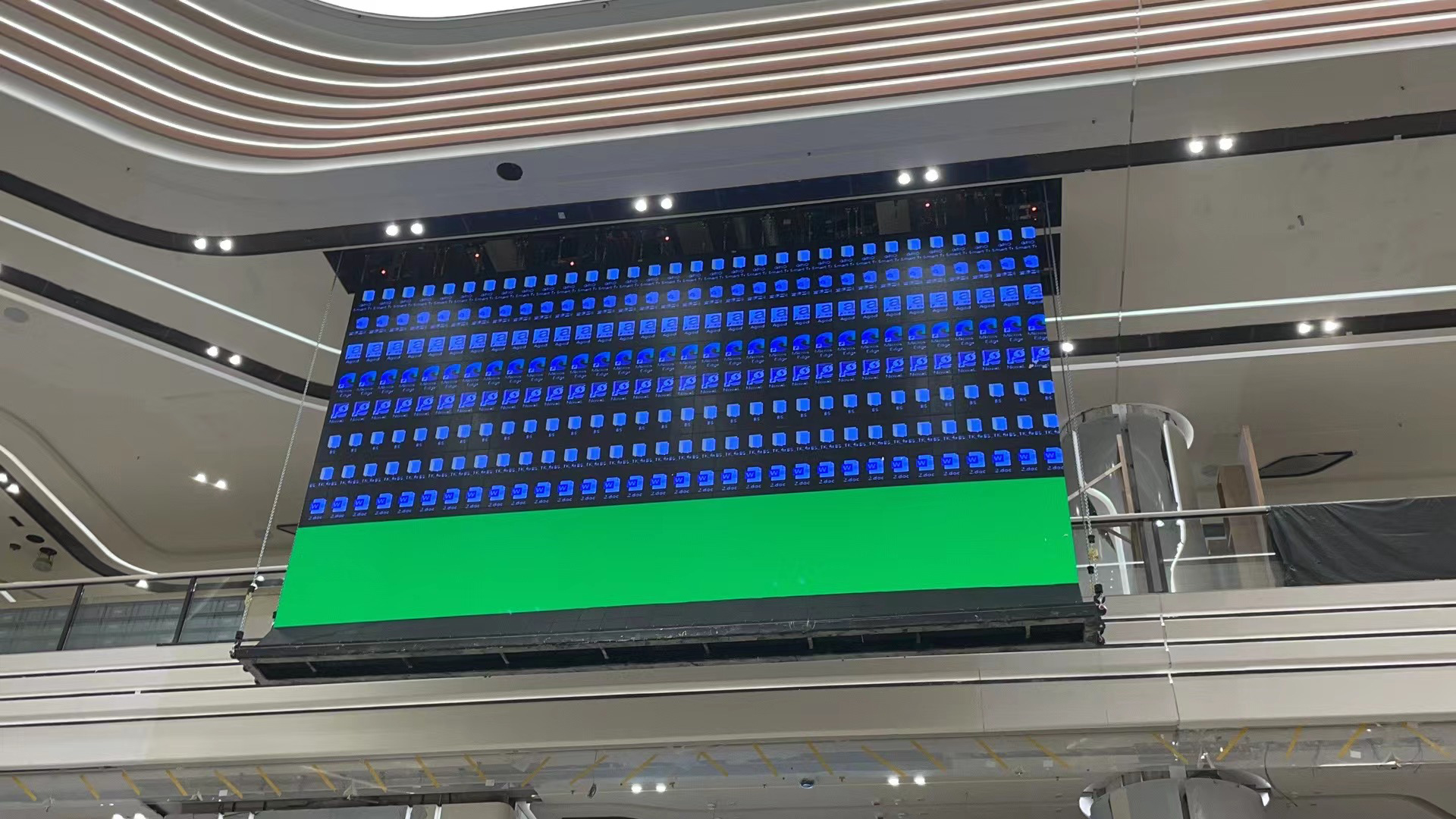
Hidden, liftable designs address the space constraint directly. A banquet hall in Shenzhen, China installed over 50 m² of hidden liftable foldable LED display that stays concealed in the ceiling and automatically lowers and unfolds for weddings and conferences; the project has been in operation for more than five years. In Hong Kong, a shopping mall installed more than 50 m² of hidden liftable foldable display, in use for over six years. A lecture hall at Wenzhou Foreign Language School uses a liftable display of more than 30 m² integrated into the ceiling structure, maximising space utilisation and preserving a clean interior. A kindergarten in Ordos, Inner Mongolia installed over 15 m² of outdoor liftable foldable display that stays hidden when idle to keep the playground open, and lifts for campus events; it has been in use for more than five years.
Mobile quick-assemble deployments
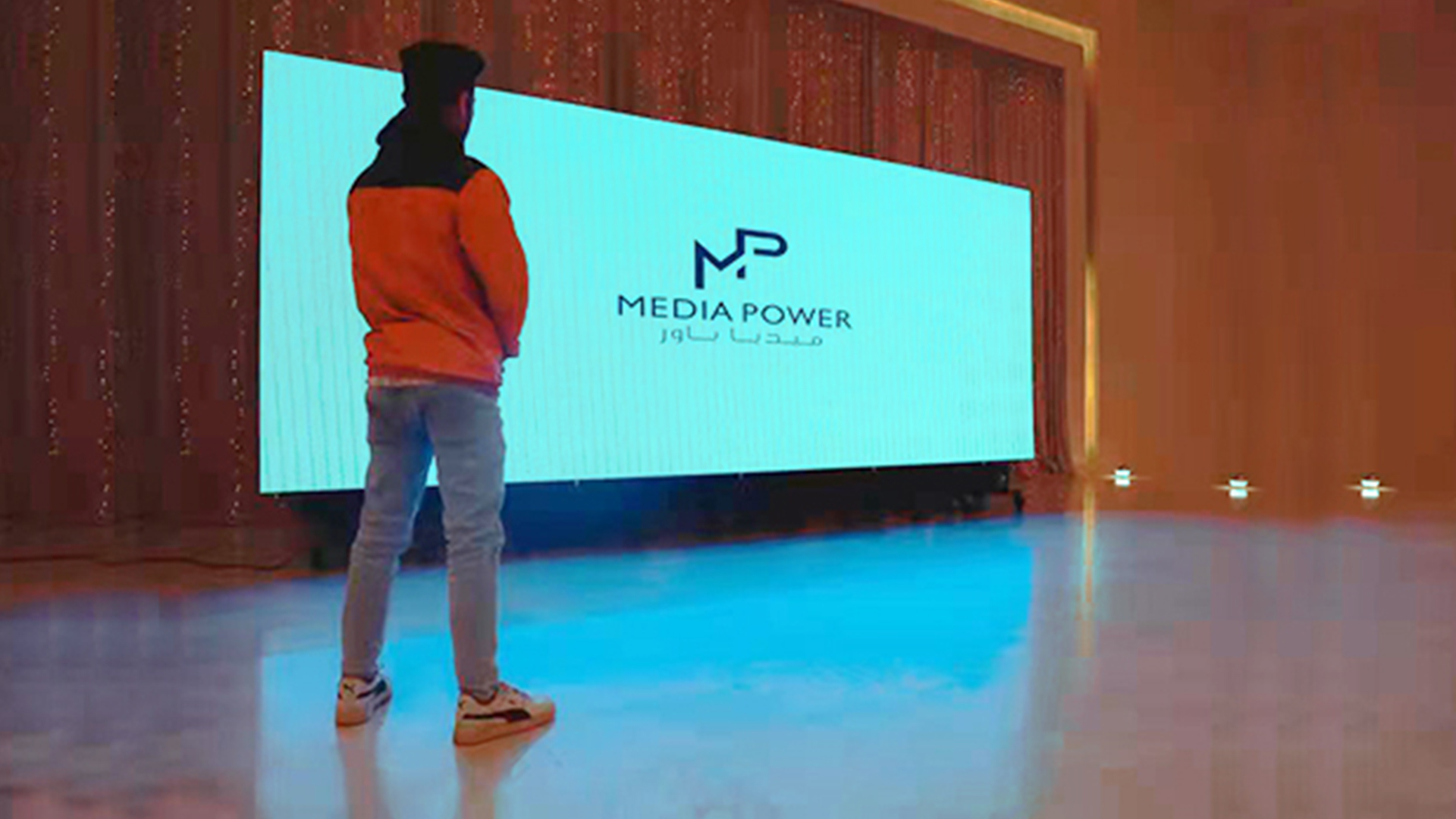
Where the venue changes from week to week, mobile folding systems take over. A shopping mall in Zhejiang, China deployed six units of the EP225 mobile fast-assembly foldable LED display for promotions and events, and a hotel in Libya deployed five units of the same series for conferences and business meetings; both installations have been in use for more than five years. The mobile foldable design allows quick setup, easy movement and reuse across different scenarios.
Outdoor and cultural-tourism work follows a different logic. A transparent folding LED display installation in China, in service for more than five years, combines a hollow transparent structure with wind resistance and automatic horizontal folding, so the display achieves large-format visuals while keeping the architecture visually open.
Comparison: Which Folding LED Family Fits Which Venue
The table below compares Onumen's folding families using published specifications. The right answer depends on fold behaviour, brightness, protection rating and installation method rather than on a single universal model.
| Product (model) | Fold angle | Pixel pitch | Brightness | Weight / thickness | Protection | Installation | Typical venue fit |
|---|---|---|---|---|---|---|---|
| Smart folding LED Display screen (FC) | 360° | P2.6 / P3.9 / P5.2 | 1000–1500 nits | 11 kg/m² / 14–17 mm | IP43 | Hanging, wall-mounted, floor | Indoor stage, concert, exhibition, rental, curved and circular builds |
| Magic Plus (FPS) | 180° | P2.6 / P3.9 | 6000 nits | 15 kg/m² / 15 mm | IP65 double-sided potting, up to IP68 | Hanging, wall-mounted | Outdoor advertising, stadium, theme park, high ambient-light events |
| Smart Plus (FCSL) | 360° | P5.2 / P7.8 / P10.4 / P15.6 | 2400–6000 nits | 15 kg/m² / 18–24 mm | IP65 front and rear, up to IP68 (optional) | Hanging, wall-mounted | Outdoor advertising, sports venues, commercial buildings, large-format outdoor |
| Easy Sailing (EP150–EP225) | 360° | P2.6 / P3.9 / P5.2 | 630–2300 nits | 12 kg/m² / 14–17.1 mm | IP43 | Mobile installation, quick setup | Corporate events, conferences, hotel, mall and travelling productions |
Shared across the folding families: 250 × 250 mm modules (FCSL uses 250 × 375 mm), CE / RoHS / FCC certification, synchronous or asynchronous control, and AC100–240V input.
Frequently Asked Questions
Do folding LED screens carry the certifications venues ask for?
The published specification sheets for the Smart folding LED Display screen (FC) and Magic Plus (FPS) list CE, RoHS and FCC certification, and the other folding families — Smart Plus (FCSL), Smart T Plus (FTS) and Easy Sailing (EP) — list the same three. Onumen's production also holds ISO management system certificates alongside CE, FCC, RoHS and other international product certifications. Venue requirements still vary: airport and station projects in high-traffic zones are frequently specified against IEC 62368-1 power-safety expectations, including UL94 V-0 flame resistance and surface temperatures at or below 70 °C. Confirm the test evidence for the exact model and venue rather than relying on a family-level statement.
How much rigging weight does a folding screen actually remove?
FC is specified at 11 kg/m² with a 14–17 mm panel thickness, Magic Plus is 15 kg/m² at 15 mm, and the mobile Easy Sailing EP series is 12 kg/m². Because the folding families use 250 × 250 mm modules and fold to 360° or 180°, panels can be transported and stored folded rather than flat, which reduces case volume and truck space. FC additionally supports hanging, wall-mounted and floor installation, so a venue with restricted overhead rigging can still host a large-format screen. Fewer, lighter and thinner panels mean fewer suspension points and shorter alignment time — usually where crew hours are lost.
What drives the cost of a foldable LED venue build?
There is no single list price, because the specification is built per project. Documented cost drivers include pixel pitch (P2.6 through P15.6 across the folding families), brightness and protection rating, cabinet and mechanical design, control system, installation structure, and logo and packaging customisation. Minimum order quantity starts at 1 m², and production is customisable. On the operational side, the variables that change a project budget over its lifetime are panel weight (freight and crew hours), storage volume, spare-module stocking and service arrangements. Ask for a quotation that lists the specification line by line instead of a single figure.
Can we validate a folding display before committing to a full venue rollout?
Yes. Evaluation typically starts at the sample or pilot-unit level. Minimum order quantity starts at 1 m², and units are aged and quality-inspected before shipment, which means a single panel or a small demonstration configuration can run through the same process as a full project. After delivery, the service package covers remote technical support, installation guidance, maintenance support and spare parts supply, so a first installation can be supported through commissioning.
What lead time should we plan for a project order?
Standard lead time is 30–90 days after order confirmation, with monthly production capacity of 3,000–5,000 m² and annual output of 9,000 m². Because folding screens are customised by screen size, pixel pitch, cabinet design, installation structure, control system, logo and packaging, the earlier the venue specification is fixed, the earlier the production slot can be booked. For event calendars that cannot move, confirm the schedule before the stage is designed. To start the process, request a sample or a quotation from Onumen Technology Co., Ltd. at sales@onumen.com or through www.onumen.com.
Conclusion: Fewer Rigging Problems, More Show Days
Rigging difficulty, slow setup and limited space are not solved by better show-calling alone. They are solved by changing what has to be rigged, assembled and stored. A 360° foldable display such as the Smart folding LED Display screen (FC) removes weight and thickness from the suspension plan at 11 kg/m² and 14–17 mm, while the 180° Magic Plus (FPS) brings 6000 nits and IP65 double-sided potting to outdoor and high ambient-light venues. Both rely on the freely-foldable structure protected by US 8,899,791 B2 and EP 2755459, and both carry CE, RoHS and FCC certification.
For a project under evaluation, the practical sequence is to match the format to the venue first — fold behaviour, pixel pitch, brightness, protection rating and installation method — and to discuss commercial terms after the specification is fixed. Onumen Technology Co., Ltd. is based in Shenzhen, China, with a 2,000 m² facility, an annual output of 9,000 m², a monthly capacity of 3,000–5,000 m², a 20-engineer R&D team, and exports covering the USA, Europe, Japan, South Korea, Russia and the Middle East, which represent around 70% of output. Minimum order quantity starts at 1 m², and standard lead time is 30–90 days after order confirmation.
Next step: check the folding format against your venue
Send the venue type, viewing distance, rigging restrictions and event dates, and the team can recommend a folding family and configuration for evaluation.
Onumen Technology Co., Ltd.
Email: sales@onumen.com
Web: www.onumen.com
Tel: +86 755 8360 1688 / +86 755 8281 9688
WhatsApp: +8618926440672
Address: 4F, Building A3, Xiwan Zhiyuan, Hangkong Road, Bao'an District, Shenzhen, China