Casting, Welding, Machining, Assembly: Four Metal Fabrication Families Explained
Metal fabrication · buyer vocabulary
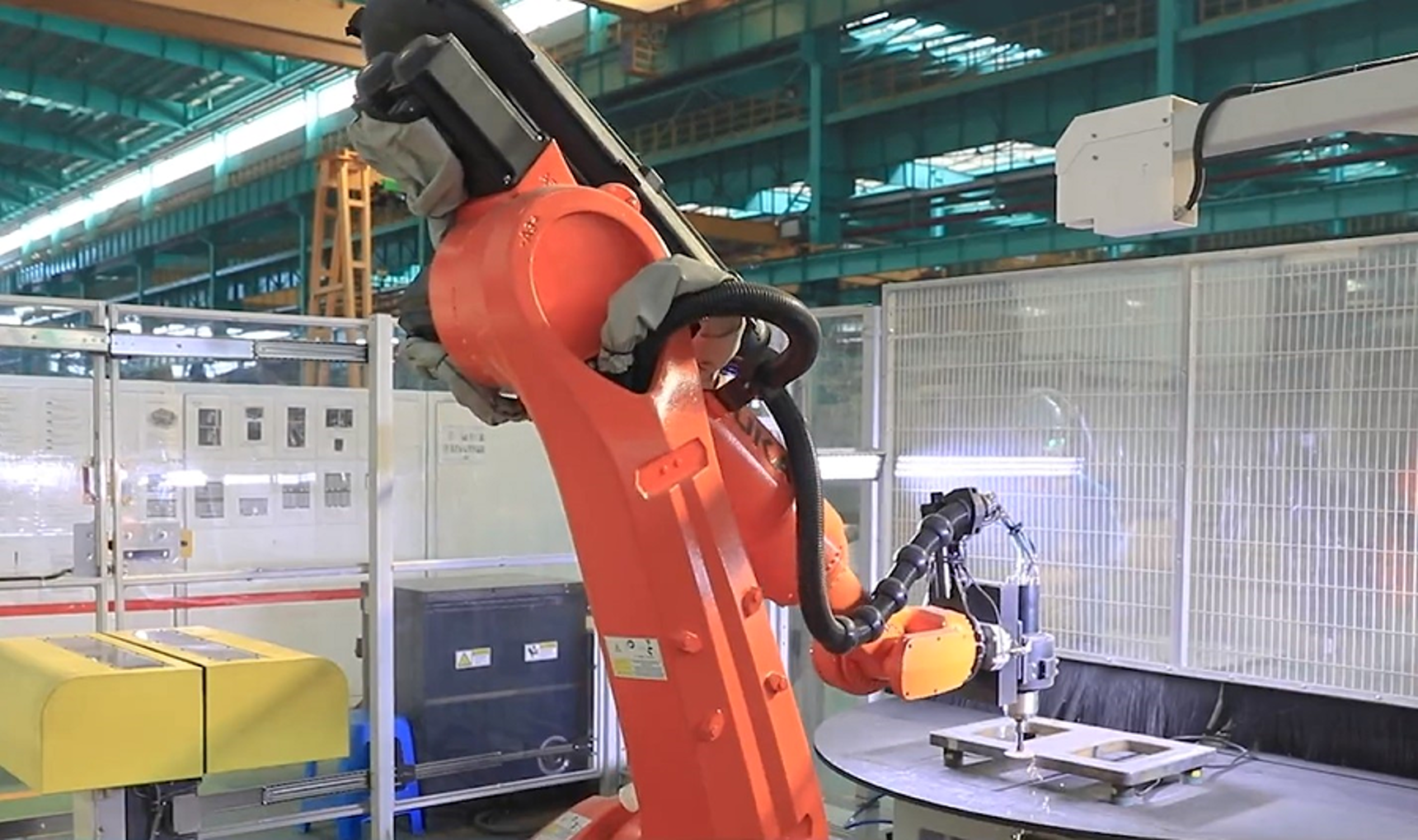
Metal fabrication is not one process. It is a group of four manufacturing families — casting, welded structures, machining, and fabricated assemblies — and each family answers a different question about how a part gets its shape, its tolerance, and its inspection record.
Most buyers arrive at a fabricator carrying a part name: a telescopic boom, a turbine ring for a hydropower station, a press frame, an energy storage rack. Suppliers answer with a family: that is a casting, a weldment, a machined component, an assembly. Most of the friction in a first quotation sits inside that gap. A specification written around a part name can be quoted three different ways, at three different tolerance levels, by three suppliers who all describe themselves as metal fabricators.
This article is a vocabulary lesson before it is a buying guide. It defines each of the four families a fabricator actually ships, gives one documented example of each from the Openex fabrication range, and explains the point first-time buyers usually miss: a single part number can move through more than one family. The family label describes the process, not the product.
Xiamen Openex Mechanical Technology Ltd (Openex) is a custom metal fabrication and machining company founded in 2009, operating two manufacturing premises near Xiamen Port and Shanghai Port. It runs 30,000 ² of fabrication space with 200 employees, including 35 engineers, and exports about 80% of its output to the EU, USA, Australia, New Zealand, Japan, Singapore, South America and the Middle East. Its process range is deliberately wide, which makes it a useful reference for showing where the four family boundaries actually sit. More on the company is available at cncmetalworking.com.
Why “we do metal fabrication” is not a specification
The phrase covers cutting, bending, welding, machining, casting, forming, finishing and assembly. A supplier can be genuinely strong in one of those and resell the other three. That is why a capable-looking quotation can still produce a part that has to be re-quoted halfway through production.
Four things change every time the family changes, and all four are commercially visible:
- How the shape is created. A mold decides the geometry in casting; cut plate and welded joints decide it in a welded structure; a cutting tool decides the final geometry in machining; alignment and fastening decide it in an assembly.
- What tolerance is achievable before secondary work. An as-cast surface is documented at Ra 6.3–12.5 µm and improves to Ra 1.6–3.2 µm after machining. A machined platen face is documented at flatness ≤0.10 mm per 1,000 mm. Those are different starting points for the same drawing.
- How the part is verified. Weld quality is proved by procedure and NDT; machined geometry is proved on a CMM; an assembly is proved by preassembly fit and functional checks.
- What ships. A machined plate on a skid is not the same logistics object as a preassembled, tested, disassembled and packed structure.
When a buyer writes “metal fabrication” without a family, the supplier has to guess which of these four the buyer is actually paying for. The guess is usually the supplier’s strongest process, not the buyer’s requirement.
Industry background: why the four-family vocabulary exists
The category is large enough that broad labels lose meaning. Strategic Market Research puts the global fabricated metal products market at USD 2.35 trillion in 2024, measured as sold production of products transformed from raw metal into finished or semi-finished components through cutting, bending, welding and machining. Within North American metal fabrication, steel accounted for 63.2% of material share in 2024, and structural steel components represented 39.3% of application share in construction the same year.
Process mix is shifting as well. One 2024 estimate suggests around 48% of fabrication output now involves CNC cutting, robotic welding or laser processing — a derived, directional figure rather than a hard count, but consistent with what shop floors look like. Employment data is firmer: the U.S. Bureau of Labor Statistics recorded 1,460.8 thousand seasonally adjusted employees in fabricated metal product manufacturing (NAICS 332) in August 2024.
Standardisation explains part of the vocabulary. ASME Boiler and Pressure Vessel Code Section IX governs welding and brazing qualifications internationally, which is why welding is quoted with procedures, procedure qualification records and welder qualifications rather than as a generic service. Market-size estimates for “steel fabrication” vary widely between publishers because of methodology differences, but the family definitions below are stable across the industry — which is exactly why they are worth learning before a specification is written.
The four families, defined with documented examples
1. Casting: the mold sets the shape
Casting means liquid metal is poured into a mold and solidifies into the part. The mold decides the geometry, so complex external form is cheap and internal soundness is what you inspect for. The trade divides the family by the poured alloy — iron casting, steel casting, and aluminum casting — and the label refers to the metal, not to the part type.
Openex lists casting within its process range alongside roll forming, forging, galvanizing and powder coating, and quotes iron casting and steel casting as named products. The documented casting product (Customized-R-02) is supplied in cast steel, ZG35CrMo and ZG07Cr19Ni10, with as-cast surface roughness of Ra 6.3–12.5 µm and Ra 1.6–3.2 µm after machining, for energy, mining, heavy machinery, pump casing and valve body applications. Cast steel and high-manganese steel also appear in crusher frames and components (Customized-J-06 and Customized-J-03), where impact and abrasion resistance drive the material choice.
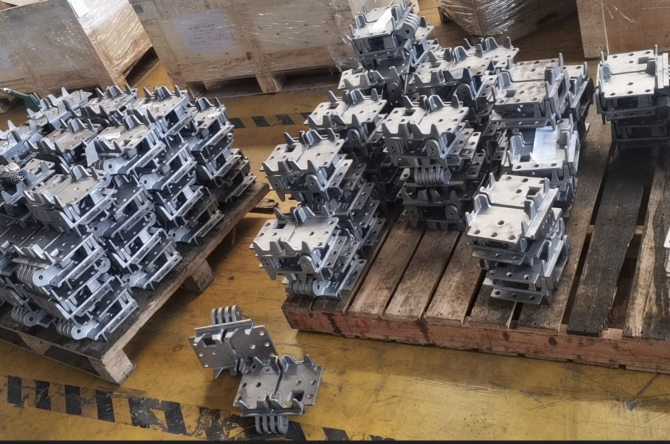
That hinge example matters for buyers. Casting is often not the finished deliverable — it is a cast node that is then welded, machined and assembled into a structure. If the drawing calls for a cast feature on a welded part, the buyer is purchasing two families, and the interface between them (weldability, machining allowance, dimensional stack-up) is where quality is won or lost.
2. Welded structures: plate, tube and section joined into one load path
A welded structure starts as cut plate, tube or rolled section and becomes a single load-bearing body through welding. Heat input distorts it, so the family is defined as much by what happens after welding as by the weld itself: stress relief, straightening, blasting and then machining of the surfaces that must be true.
The heavy machine base B-300 shows the pattern. It is welded, stress-relieved and shot-blasted, then the top is ground to ±0.001 in cumulative flatness — the weld creates the body, the machining creates the accuracy. Larger examples follow the same logic. The large welded crossbeam (Custom-L-7) is a 6,000–10,000 mm box section in 25–60 mm plate with guide straightness ≤0.10 mm per 1,000 mm. The large welded press frame (Custom-L-3) is quoted as a reference configuration at 10,000–20,000 kN press force, 60–120 mm main plate and an estimated 80–140 t mass, subject to FEA and fatigue assessment. The ultra-long formed steel box section (Custom-L-1) reaches 8,000 mm in length at 6 mm plate thickness with overall straightness ≤3.0 mm per 10,000 mm.
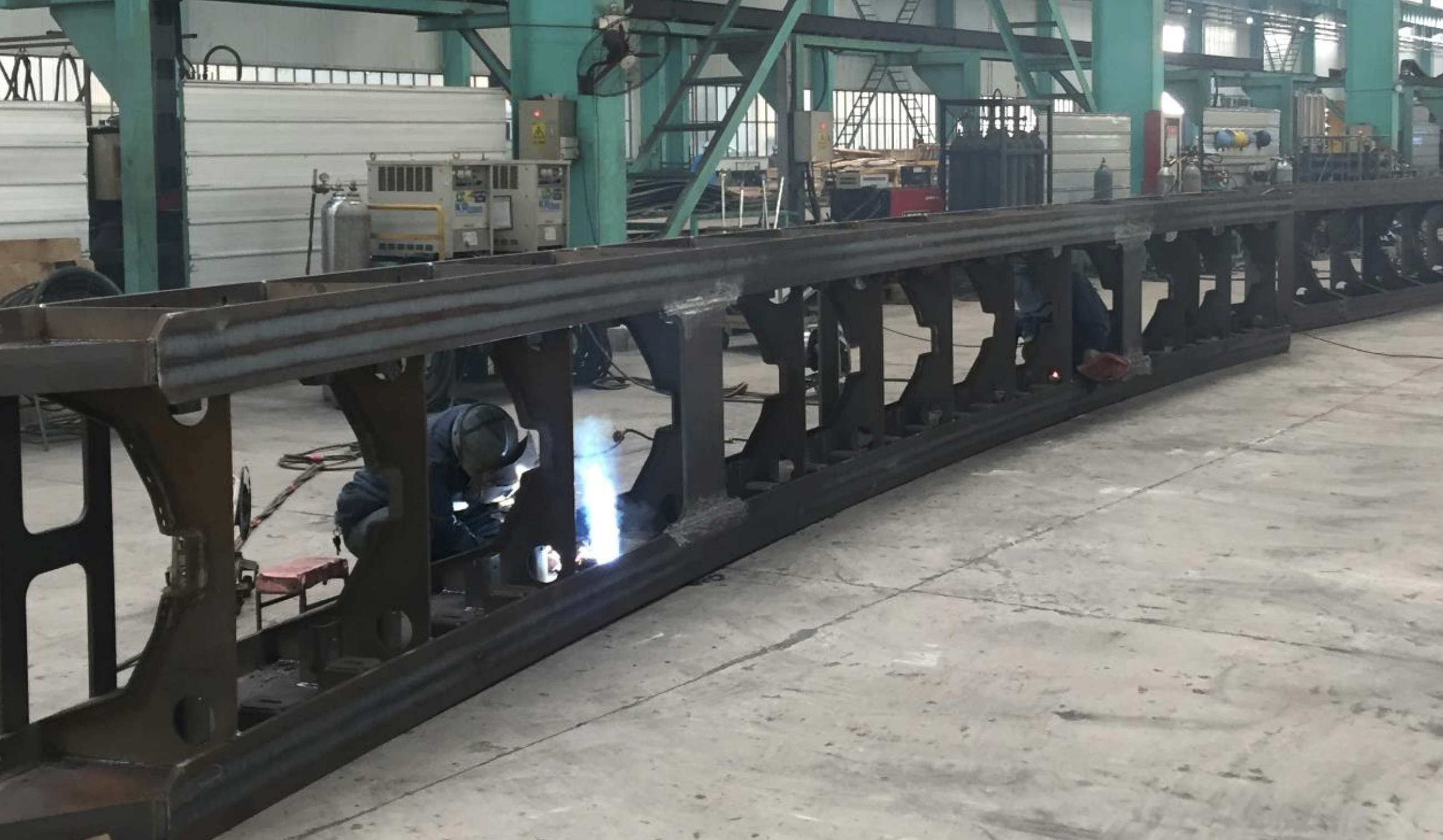
Welding capability is documented across SMAW, GMAW/MIG, GTAW/TIG, SAW, automatic tube-to-tubesheet, deep penetration and robotic welding, in carbon steels, stainless steels, duplex and super duplex, clad or composite plate and low-alloy steels. Documented welding capacity is 5,000 t per month with a 25 t minimum order and a 30–45 day lead time, and lifting is supported by overhead crane capacity above 250 t.
3. Machining: the family that creates tolerance
Machining removes material to create datum surfaces, hole patterns, flatness and surface finish. It is the family buyers usually mean when they say “precision”, and it is the family most often subcontracted by fabricators who weld well but cannot bore a 6-metre frame in one setup.
Documented examples show the range. The large machined platen (Custom-L-10) is a 3,000 x 2,000 x 250 mm plate, approximately 11.8 t before drilling, with machined-face flatness ≤0.10 mm per 1,000 mm and surface finish Ra 1.6–3.2 µm. The milling machine center frame (DM-2608) and the precise steel frame for special purpose (DM-612) are both documented at 0.01 mm/m precision in carbon steel. The tube sheet (Customized-J-01) extends the family to drilling: up to 10,000 mm diameter, up to 600 mm thickness, 1,000 mm drilling depth and ±0.05 mm drilling precision, verified by CMM measurement plus UT, PT, MT and PMI inspection.
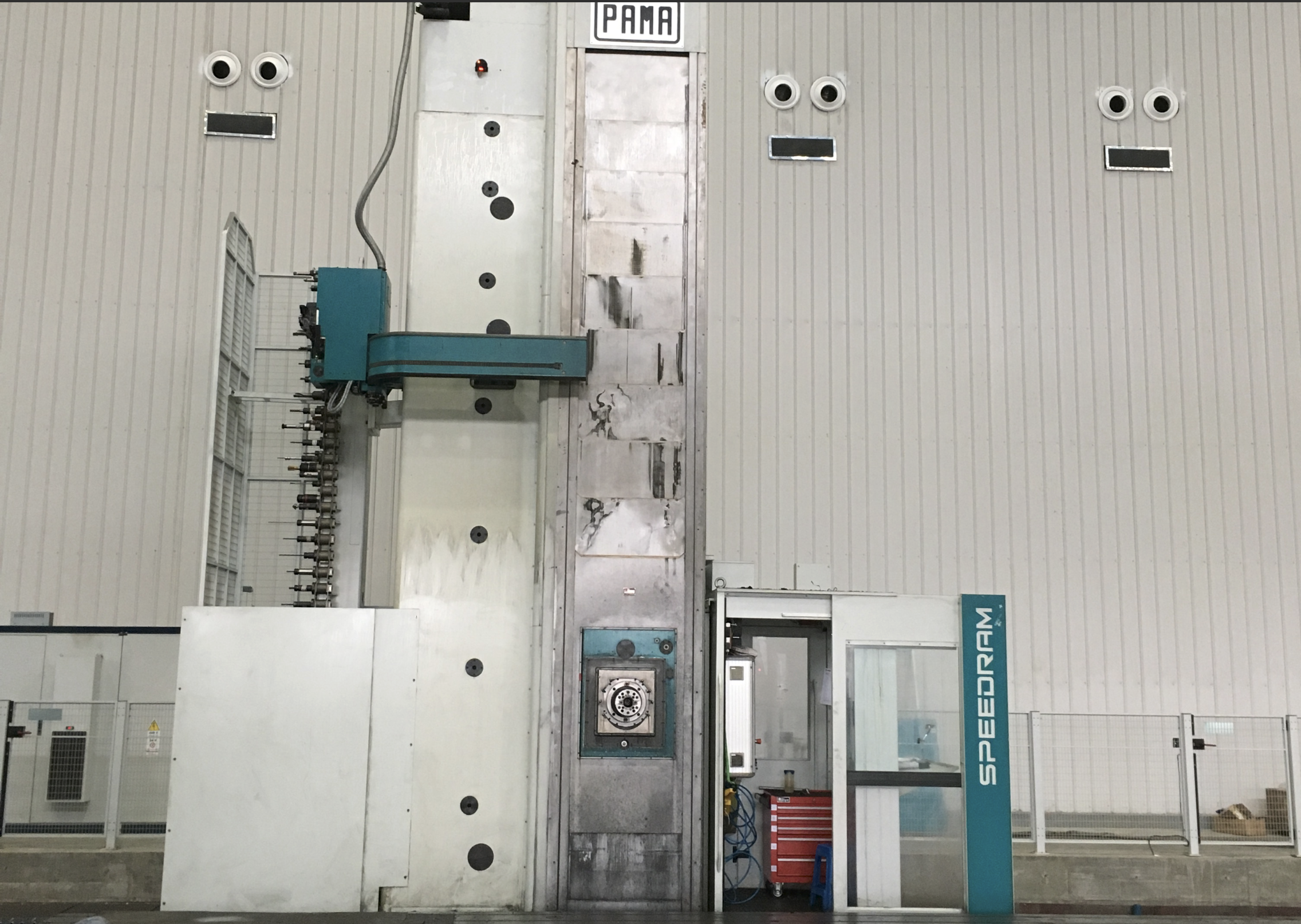
The machine envelope decides what is possible. Documented equipment includes a double-gantry 7-axis, 5-linkage machining center for milling, boring, drilling, turning and grinding in a single setup; a Wuzhong single-column turning-milling center with maximum machining diameter of 22 m, maximum workpiece load of 600 t and maximum workpiece height of 6.5 m; and a Zeiss CMM of 7 x 4 x 3 m for verification. Documented machining capacity is 3,000 t per month with a 15 t minimum order and a 30–45 day lead time.
4. Fabricated assemblies: several families delivered as one unit
An assembly combines parts from the other three families, aligns them, tests them, and ships them as one object. The work that defines this family is not cutting or welding — it is fit, alignment, preassembly, disassembly and packing discipline.
Documented assembly products include the heavy equipment skid (Custom-L-6) at 8,000 x 3,000 x 1,200 mm, designed for a 30–60 t equipment load on H300–H500 primary members, with an estimated skid mass of 12–20 t and mounting-pad flatness ≤0.20 mm per 1,000 mm. The equipment enclosure (Custom-L-2) is a mirror-finish welded process enclosure at 7,000 x 1,300 x 1,000 mm with a 6 mm internal partition and a finished mass of 2.0 t in SS304/304L. Energy storage hardware spans the small and large ends: the Energy Storage System Cabinet (Customized-J-05) in 1.5–5.0 mm material with IP54, IP55 or IP65 protection, and the steel frames and boxes (XHC-009) at 1.1 x 1.1 x 2.2 m and 1,000 kg per unit with powder coating. The storage container (Customized-C-04) is documented at 4,500 mm diameter in Q345R plus 31603 composite plate.
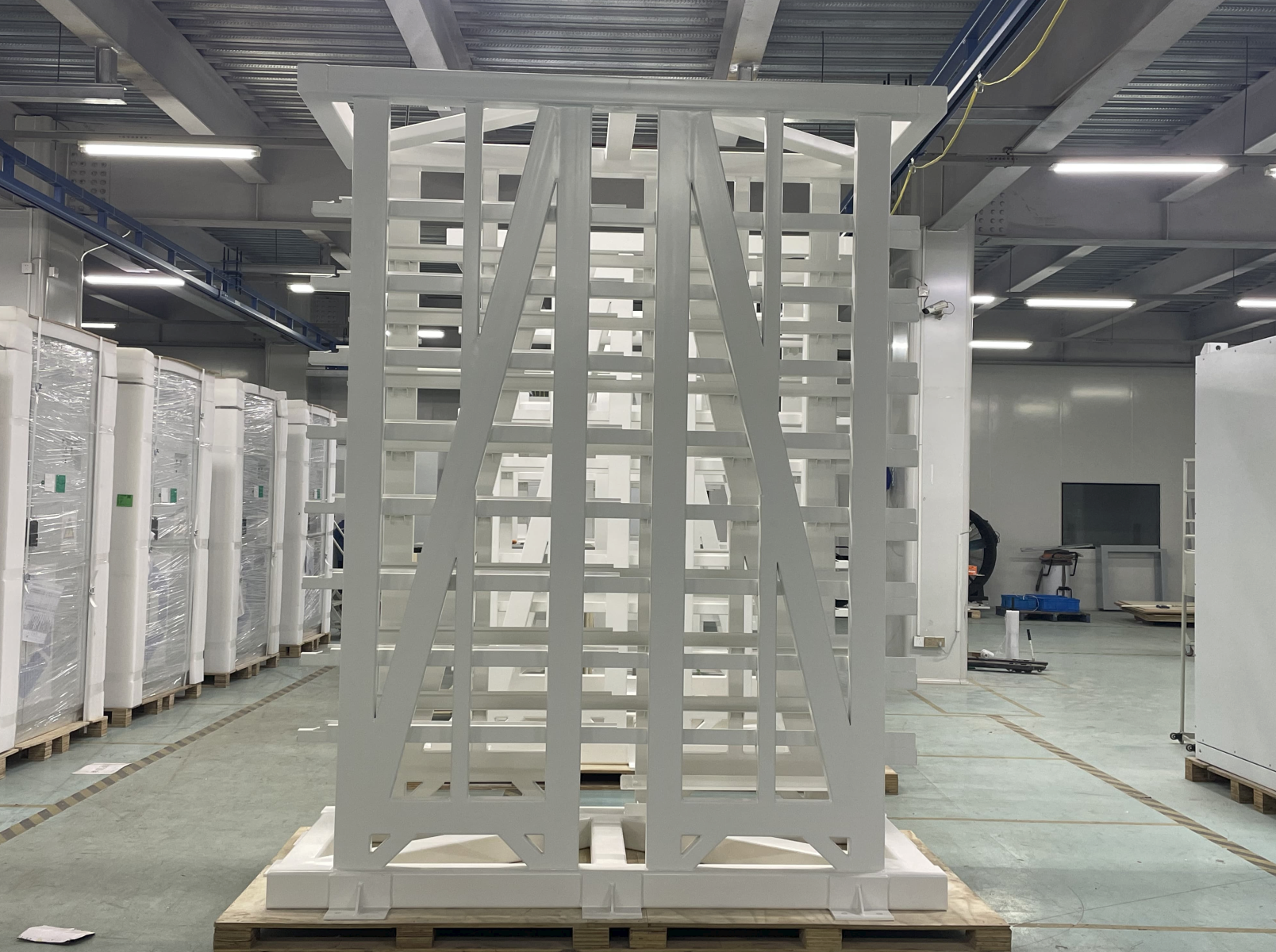
A wind tree project illustrates how far assembly discipline can go: after fabrication, the structure was preassembled to verify manufacturing precision, then disassembled and packed for shipment, with the steel components delivered against a 30-year design life and five years of recorded stable operation.
Materials that cross all four families
The family changes the process; the material usually stays on the drawing. Documented materials across the four families include carbon steels, stainless steels including 304, 304L, 316 and 316L, duplex and super duplex stainless, clad and composite plate such as Q345R plus 31603, low-alloy and high-strength steels such as Q355B, S355J2+N, S355JR, ASTM A572 Grade 50, Q960, BS700MCK2 and NM400 abrasion-resistant plate, cast steel grades ZG35CrMo and ZG07Cr19Ni10, high-manganese cast steel, and aluminum 6061-T6 for access components on vacuum equipment. Galvanized and powder-coated finishes sit on top of all four families rather than inside them.
One part name, more than one family
This is the teaching point that changes how buyers read a supplier list. Part names are engineering nouns; families are processes. The two do not map one to one.
Take the turbine ring for a hydropower station. In a documented Uruguay project, 30 t of turbine ring was fabricated and machined, and the manufacturing route required separating rough machining from final precision work: the ring was produced as separate pieces, assembled for final precision machining, then turned as a complete ring to hold a tight tolerance. That single part number passed through welded fabrication, through assembly of segments, and through large machining — three families for one deliverable. The unit has recorded 20 years of stable operation.
Take the telescopic boom (Customized-J-04). It is documented in Q960 or BS700MCK2 high-strength steel with ±1 mm straightness tolerance and height difference below 1.5 mm, painted or powder coated. A welded box made from high-strength steel does not reach that geometry by welding alone; the tolerance is created by machining and confirmed by inspection. So when a supplier writes “telescopic boom” on a capability list, the buyer still does not know whether that supplier welds it, machines it, or only assembles it from purchased sections.
Step-by-step: placing a part in the right family
- Start from the function and load path. If the part carries load through a joint, it is a welded structure or an assembly before it is anything else. If it must contain pressure or flow, the wall and the weld procedure come first, and ASME Section IX qualification logic applies to the welding. If it only locates or supports, casting may remove machining cost.
- Compare the size envelope with the process envelope. An 8 m box section, a 6,000–10,000 mm crossbeam and a 22 m diameter turning envelope are not interchangeable capabilities. Documented limits matter more than brochure adjectives: bending length above 18 m, CNC travel up to 50 m x 8 m x 7 m, and CMM capacity of 7 x 4 x 3 m each rule work in or out.
- Check material and thickness against the family. A 6 mm plate in a formed box section and a 120 mm plate in a press frame are both welded structures, but they need different welding processes, different distortion control and different lifting plans.
- Decide which surfaces must be machined after joining. On welded bodies, machining is where flatness, hole position and datum accuracy appear. The B-300 base reaches ±0.001 in ground-top flatness only because grinding follows welding and stress relief.
- Set inspection to the family, not to habit. Welds are verified by VT, dimensional check, RT, UT, MT or PT, hardness testing and hydrostatic or pneumatic testing where required; machined features by CMM and roughness measurement; assemblies by fit checks at preassembly. Openex documents 100% or random testing as the requirement states, plus chemical analysis, tensile, impact, bend and hardness testing, salt-spray corrosion testing and weld procedure qualification to the customer’s WPS.
- Decide the shipping unit. Sending a welded frame as parts and assembling on site moves cost and risk to the buyer’s floor. Sending it as a preassembled, tested unit costs more in packing and handling but removes field rework.
Use cases: where each family earns its place
- Heavy machine bases for automation. The B-300 welded base has been supplied for industrial robot applications (200 units, three years of stable operation) and to machinery manufacturers in China (45 units, two years). The family is welded structure plus machining of the mounting surfaces.
- AGV steel chassis. The PSA-1 chassis is documented at 15 x 2.7 x 3 m, 10.5 t, with a 30 t loading capacity, built from 25 mm S355JR or A572 Grade 50 plate and 20 mm NM400 abrasion-resistant plate. 345 units were delivered to a large AGV manufacturer in the Netherlands, with more than four years of stable operation. The family is fabricated assembly built on a welded structure.
- Energy storage frames, boxes and cabinets. Around 3,000 steel frames and boxes have been deployed globally against a 20-year-plus design intent, with no rust, leakage or deformation reported, and 1,500 liquid-cooling cabinets were delivered over three years. The family is fabricated assembly, with sheet metal work inside it.
- Steel mill logistics chassis. 30 units of the JFE-1 steel chassis, approximately 15 x 2.5 x 2.1 m, 10 t, with a 35 t maximum load, have been in stable operation for 20 years in Japan. The family is welded structure with heavy handling requirements.
- Pressure-retaining equipment. 100 units of pressure vessels were supplied to oil, gas and power plant clients, fabricated with TIG/GTAW welding and X-ray inspection, with 10 years of stable operation reported. The family is welded structure with casting or machined inputs at nozzles, tubesheets and flanges.
- Flywheel energy storage shells. The AKI-1 shell is 1.5 m in diameter, 0.8 m high and 2 t, holding vacuum above 1.0 x 10^-9 Torr L/s within 30 seconds in S355JR or A572 Grade 50. The family is welded cylinder plus machining — a tolerance-driven product, not a structure-driven one.
Comparison table: the four families side by side
| Family | What defines it | Documented examples | Documented reference data | Typical verification |
|---|---|---|---|---|
| Casting | Geometry set by a mold; liquid metal solidifies into the part; machining follows where precision is needed | Casting incl. iron casting and steel casting (Customized-R-02); crusher frames and components (Customized-J-06, Customized-J-03) | Cast steel, ZG35CrMo, ZG07Cr19Ni10; Ra 6.3–12.5 µm as cast, Ra 1.6–3.2 µm after machining | Dimensional check, chemical analysis, mechanical testing, UT/PT/MT, PMI |
| Welded structure | Plate, tube or section cut, formed and joined by welding; distortion managed by procedure, stress relief and post-weld machining | Large welded press frame (Custom-L-3); large welded crossbeam (Custom-L-7); heavy machine base B-300; ultra-long formed steel box section (Custom-L-1) | Crossbeam guide straightness ≤0.10 mm per 1,000 mm; box section straightness ≤3.0 mm per 10,000 mm; B-300 ground-top flatness ±0.001 in cumulative | VT, dimensional check, RT/UT/MT/PT, TOFD or phased array, hardness, hydrostatic or pneumatic test |
| Machining | Material removed to create datum, flatness, hole position and surface finish | Large machined platen (Custom-L-10); milling machine center frame (DM-2608); precise steel frame (DM-612); tube sheet (Customized-J-01) | Platen flatness ≤0.10 mm per 1,000 mm at Ra 1.6–3.2 µm; DM-2608 and DM-612 at 0.01 mm/m; tube sheet drilling ±0.05 mm up to 10,000 mm diameter | CMM measurement up to 7 x 4 x 3 m; dimensional and geometric measurement; surface roughness |
| Fabricated assembly | Parts from several families joined, aligned, tested and packed as one shippable unit | Heavy equipment skid (Custom-L-6); equipment enclosure (Custom-L-2); Energy Storage System Cabinet (Customized-J-05); steel frames and boxes (XHC-009); storage container (Customized-C-04) | Skid 8,000 x 3,000 x 1,200 mm with 30–60 t design load and pad flatness ≤0.20 mm per 1,000 mm; enclosure 7,000 x 1,300 x 1,000 mm, 2.0 t; cabinet IP54/IP55/IP65 | Preassembly fit check, dimensional inspection, leak or functional test where specified, packing inspection |
Reference configurations in this table are documented typical values, not guarantees: press force and frame dimensions require FEA and fatigue assessment, and final section, weld design, load rating and lifting points require structural review for each drawing.
FAQ
Which certificates actually confirm that a fabricator covers casting, welding, machining and assembly?
Read the scope line, not the logo. Openex holds ISO 9001 certificate 11426Q01049R001, issued 16 April 2026 and valid to 15 April 2029, with the scope “Manufacture of Machined Parts, Metal Structures and Sheet Metal Components (except where a license is required)”. Welding has its own qualification chain: an ISO 3834-2 certificate issued by SGS (23/999-3834) covering fusion welding of metallic material, welding process 135 and 135-Auto, material groups 1.1 and 1.2, supported by WPS, PQR and welder qualification records. Environmental and occupational health and safety systems are covered by ISO 14001 (11426E00739R001) and ISO 45001 (11426S00656R001). Where a part retains pressure, ASME BPVC Section IX is the reference standard for welding and brazing qualifications.
Can one supplier run all four families in-house, or will I end up managing three vendors?
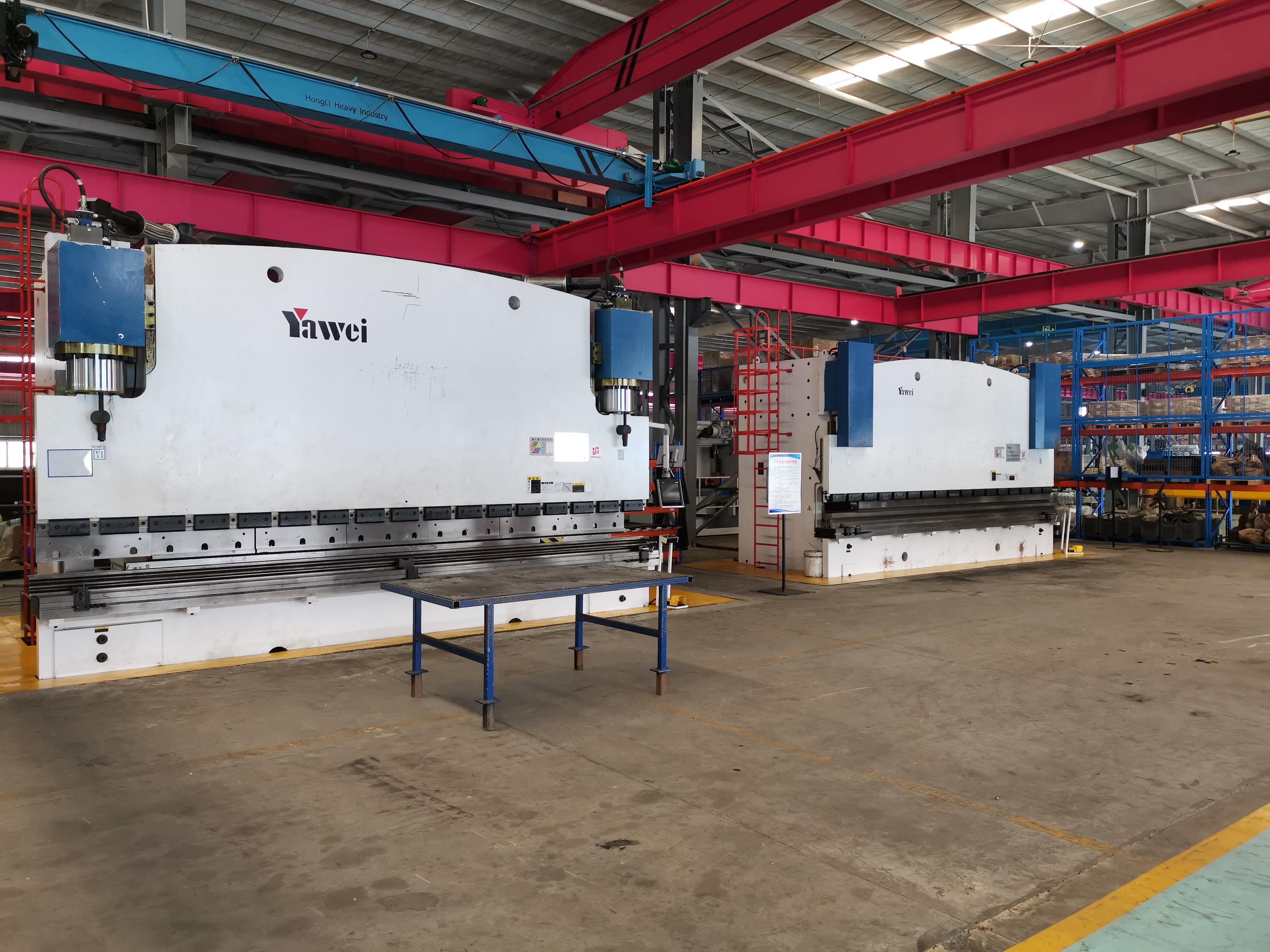
Ask for the process list and the machine envelope, then compare both against your drawing. Openex lists laser cutting, bending, punching and stamping, welding, machining and assembling, plus roll forming, casting, forging, galvanizing and powder coating. Documented capacity includes overhead crane tonnage above 250 t, bending machine length above 18 m and 10,000 t, CNC machine tool travel up to 50 m x 8 m x 7 m, welding capacity of 5,000 t per month and machining capacity of 3,000 t per month. The operation runs 30,000 ², 200 employees and 35 engineers across two premises near Xiamen Port and Shanghai Port.
What drives the price difference between the four families?
Weight and material come first, then precision, then verification. A36 or A572 Grade 50 plate in a 25–60 mm welded box is quoted differently from a Q960 boom or a duplex tube sheet; the tolerance you specify decides how many setups and how much machining time follow; NDT (RT, UT, MT, PT), heat treatment or stress relief and surface finishing each add a step. Order thresholds matter too: Openex documents a 25 t minimum for welding, 15 t for machining and 15 t for surface finishing. That is why quotations are issued against a drawing and an inspection plan rather than from a published price list.
Can we validate a part with a sample before committing to production?
Yes, on the routes designed for it. Openex documents a minimum order of 1 unit, a 3-day lead time and 1,000 pcs monthly capacity on its quick-turn customization route, with 100% or random inspection as the requirement states, and verifies geometry on CMM equipment. Prototype development, fixture and jig design, and reverse engineering are listed among the machining value-added options. For large welded or cast parts, the practical equivalent is to agree the inspection plan — dimensional report, NDT scope and material certification — before the first production run starts.
What lead times should I plan for?
Documented lead times are 30–45 days for welding fabrication and 30–45 days for machining, with 45 days for surface finishing; small quick-turn machining runs are listed at 3 days. Build the critical path around machining after welding, because a welded body must be complete, stress-relieved and inspected before it can be set up on a boring mill or gantry machine. To replace a range with a dated answer, send the drawing, material grade, required tolerance and delivery date to sales2@openex.com.cn.
Conclusion: name the family before you name the price
Casting, welded structures, machining and fabricated assemblies are four different answers to four different questions. Casting asks what shape a mold can hold. Welded structures ask how much load a jointed body can carry and how much distortion the process will leave behind. Machining asks how accurately a surface can be located and cut. Fabricated assemblies ask whether the whole unit will fit, test and travel as one object.
A single part number can pass through several of them, which is why the family label describes the process rather than the product. The turbine ring that was fabricated, assembled from segments and finally turned in Uruguay is the same lesson in one part: the buyer who knows the route can specify tolerance and inspection at the right stage, and the buyer who only knows the part name cannot.
Before the specification goes out, ask the one question that sorts capability from vocabulary: “What metal materials can you process for our fabrication projects?” The answer tells you which families the supplier actually runs in-house, which materials it handles in each, and whether the quotation you receive is a manufacturing plan or a brokered one.
Send the drawing, get the family route
Openex reviews drawings and returns a process route — casting, welded structure, machining, assembly or a combination — together with material grade, inspection scope and lead time. Sample orders, quotation requests and material questions are welcome.
Contact: Luna · sales2@openex.com.cn · Tel / WhatsApp +86 150 6078 7506 · Unit 4801, No 99 Yilan Rd., Xiamen, Fujian, China
Website · WhatsApp inquiry · Download the Openex fabrication brochure (PDF)
Have Questions or Need More Details?
Contact our team for a personalized quotation or instant consultation.
Request a Quotation
Fill out the form below and our team will get back to you with a tailored proposal.
WhatsApp Direct Chat
Prefer to chat in real-time? Message us on WhatsApp for instant assistance & quick answers.
- Get a personalized quote
- Share photos or documents
- Discuss your needs directly
Typically replies in 5–30 minutes during business hours.