
Flywheel Energy Storage Shell: Solving Containment and Alignment for Smart Manufacturing
A smart manufacturing plant that adds flywheel energy storage to its electrical architecture usually arrives at the same procurement point: the rotating assembly is specified, the power electronics are chosen, and the containment shell becomes the schedule-critical item. The shell is where structure, alignment and documentation meet, and it is the part most often underestimated in a quotation package.
The shell is not an enclosure in the ordinary sense. It carries bearing and stator interfaces, maintains the containment boundary around the rotating mass, and has to line up with the steel frame, skid or enclosure box that ties the unit into the plant. A shell that is out of round, or whose bearing bores do not share a common datum with its mounting feet, produces vibration, rework and commissioning delay that site adjustment cannot fully recover.
The workable answer is a specific build path: heavy steel plate, large welded fabrication, and precision machining after welding, supported where needed by castings and heavy machine bases. Openex — Xiamen Openex Mechanical Technology Ltd, a custom metal fabrication and machining supplier founded in 2009 with manufacturing premises near Xiamen Port and Shanghai Port — produces the AKI-1 flywheel energy storage shell for the energy storage system industry, together with steel frames and boxes for energy storage systems.
This guide is written for the decision stage: what containment and alignment demand from a fabricator, how the build sequence should run, and how to compare suppliers before a purchase order is issued.
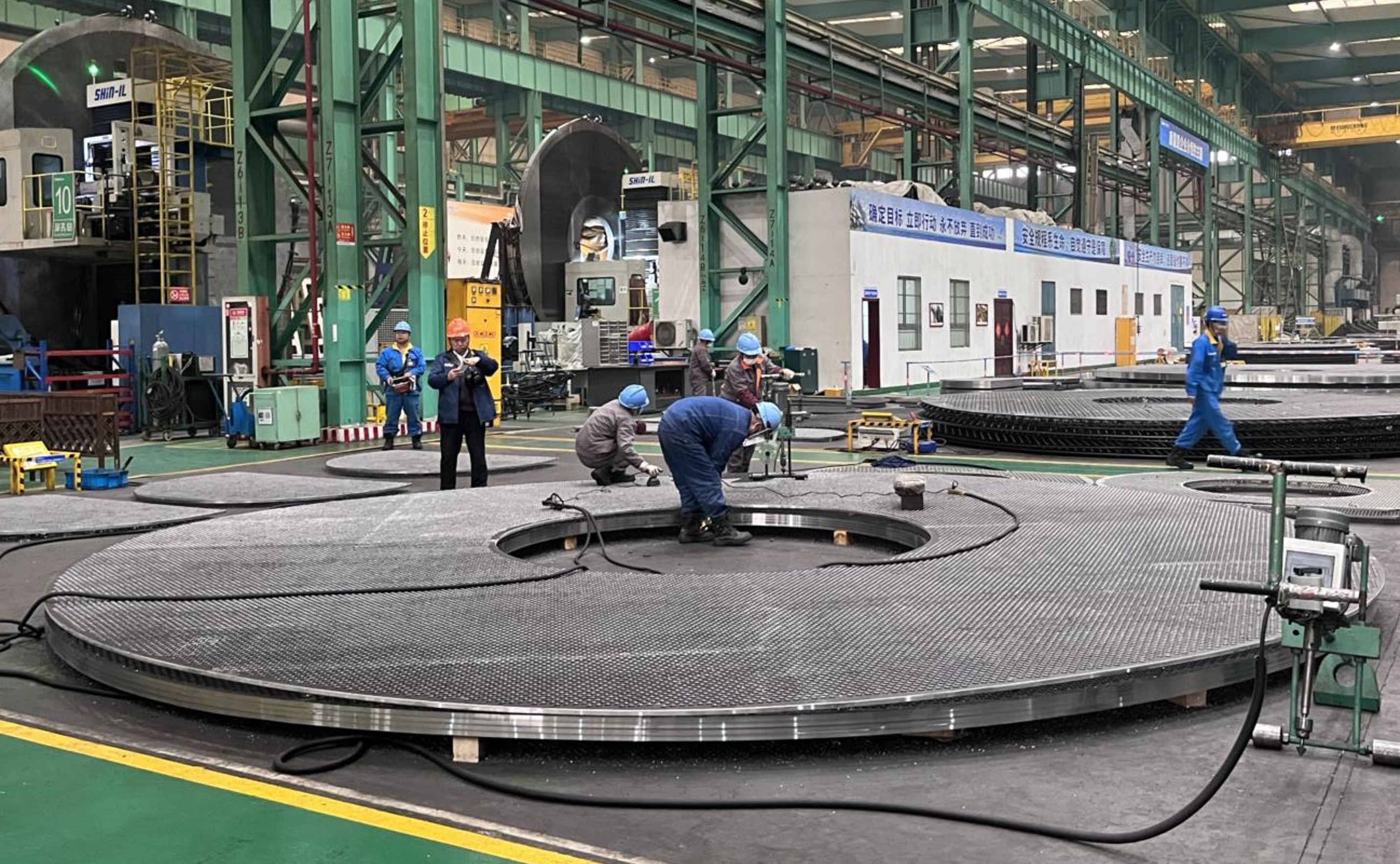
Large tube sheet machining at Openex manufacturing premise near Shanghai Port. Circular components at this scale are machined after welding so that bore and face relationships hold.
What Containment and Alignment Really Mean in a Flywheel Shell
Acceptance risk in a flywheel shell concentrates in four places. Each one is a fabrication problem before it becomes a site problem.
- Weld distortion. Heavy plate welded around a circular section pulls as it cools. If the shell is machined before welding, or the weld sequence is not controlled, ovality and flange tilt appear after the last pass — when little allowance is left to correct them.
- Datum mismatch. Bearing bores, flange faces and mounting feet must be established from one alignment reference. Machining them in separate set-ups, or referencing a fabrication mark instead of a machined surface, transfers error directly into the rotating assembly.
- Interface drift. The shell meets a steel frame, skid or enclosure box. If shell feet and frame pads are not machined or matched as a pair, the mismatch moves into commissioning as shimming, re-drilling or field welding.
- Evidence gaps. A shell can be dimensionally acceptable and still fail procurement review when material certificates, weld inspection records and dimensional reports are incomplete.
The decision rule that follows is straightforward: specify datums on the drawing, require machining after welding, and require the inspection evidence to be delivered with the part. A fabricator that can cut and weld heavy plate but cannot machine the assembly afterwards cannot hold alignment on a shell of this type.
Why Flywheel Storage Puts New Demands on Metal Fabrication
The AKI-1 flywheel energy storage shell is designed for use in energy storage and electricity quality improvement near wind farms or solar farms, and is intended for the energy storage system industry. That application sets the fabrication agenda: the unit sits close to generation or to sensitive process equipment, so mechanical stability and dimensional consistency matter as much as the electrical specification.
Three industry signals explain why buyers now ask harder questions of fabricators:
- The global fabricated metal products market was valued at USD 2.35 trillion in 2024, according to Strategic Market Research — a supply base broad enough that capability varies widely between shops that look similar on a website.
- Steel accounted for 63.2% of material share in North American metal fabrication in 2024, which is why steel plate fabrication remains the default route for heavy containment structures.
- Adoption of CNC cutting, robotic welding and laser technology reached 48% in 2024, according to Market Research Insights. Precision equipment is more common than it was a decade ago, but it is not evenly distributed — and equipment alone does not guarantee post-weld alignment.
Where a shell is designed as a qualified containment boundary, welding procedure and welder qualification are typically governed by a recognised code. ASME BPVC Section IX, which covers welding and brazing qualifications, is the reference most international energy projects cite. A fabricator should be able to state which procedure and qualification records apply before the first weld is laid.
The Build Solution: Plate, Welded Fabrication and Post-Weld Machining
A containment shell is built in five controlled stages. Each stage prevents a specific failure mode and produces a specific piece of evidence.
1. Steel plate specification and material traceability
Material is the first control point, and the one most often documented after the fact rather than before it. Openex handles metal thickness from 1 mm to 200 mm, cuts steel plate up to 40 mm by CNC laser, and rolls thick plate over 200 mm — a range that covers both the shell body and the heavier ring and flange sections around it.
Incoming plate is checked against the steel mill certificate report, and mechanical properties can be verified by tensile testing on an in-house tensile testing machine. Where galvanized finishes are specified, coating thickness is checked with a film thickness tester. For a shell, this matters because plate grade, thickness tolerance and through-thickness behaviour all influence how much distortion appears after welding, and therefore how much machining allowance is required.
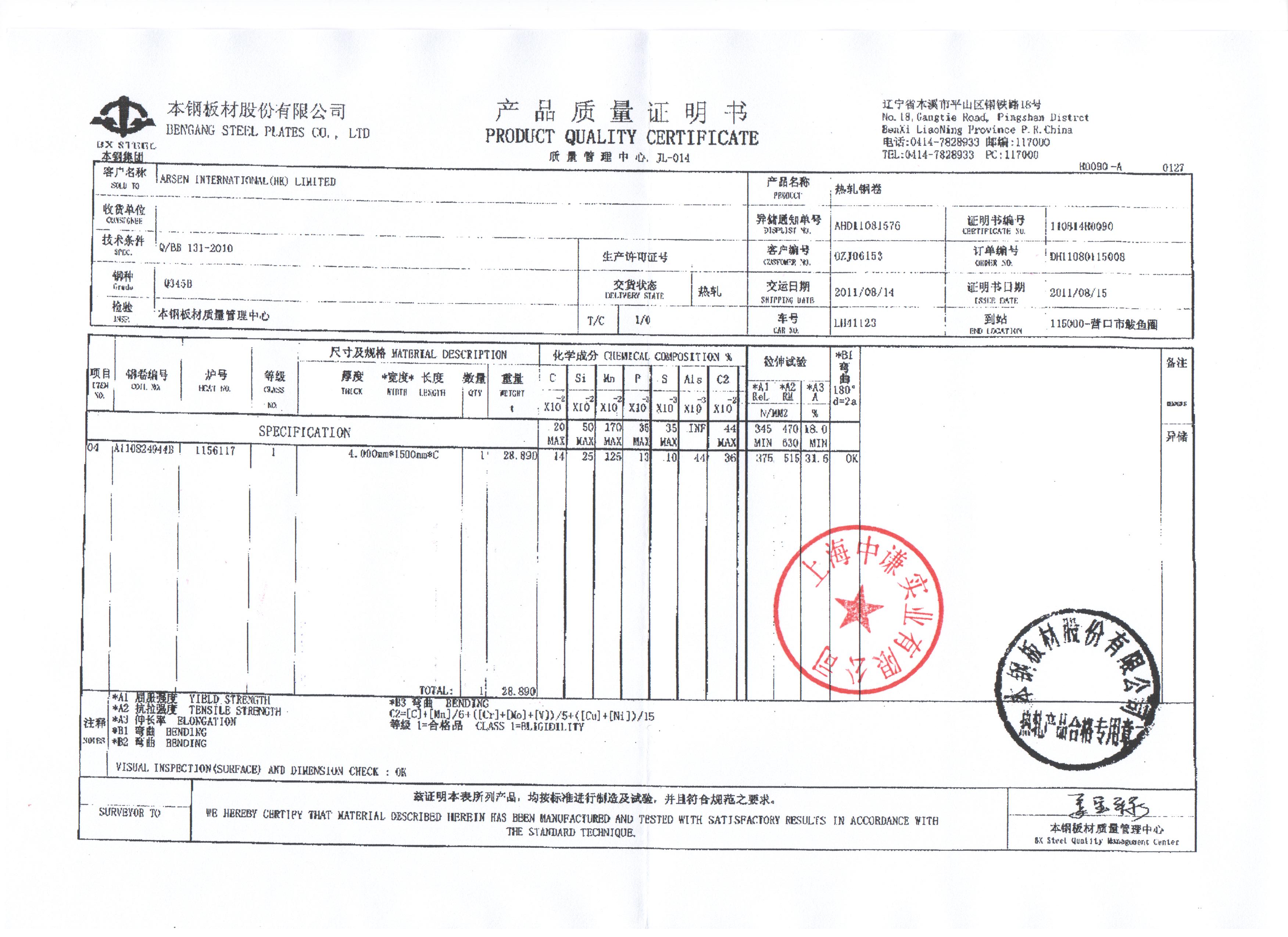
Incoming plate is checked against the steel mill certificate report before fabrication begins.
2. Large welded fabrication and weld inspection
Welding sets the geometry that machining later has to correct. Openex operates overhead cranes over 250 tons for handling heavy assemblies, and CNC press brakes up to 10,000 tons × 18 metres, with more than ten machines of different capacity. Large welded press frames are part of the regular product scope, which is a useful indicator: a shop accustomed to heavy welded structures has the fixtures, lifting capacity and weld sequencing discipline that a shell requires.
Quality control follows documented procedures rather than individual judgement. The flow covers first-article inspection, in-process control and final inspection, with inspection reports issued as deliverables. Compliance and certification risk are managed through certificates and test reports, and material traceability is retained through the build.
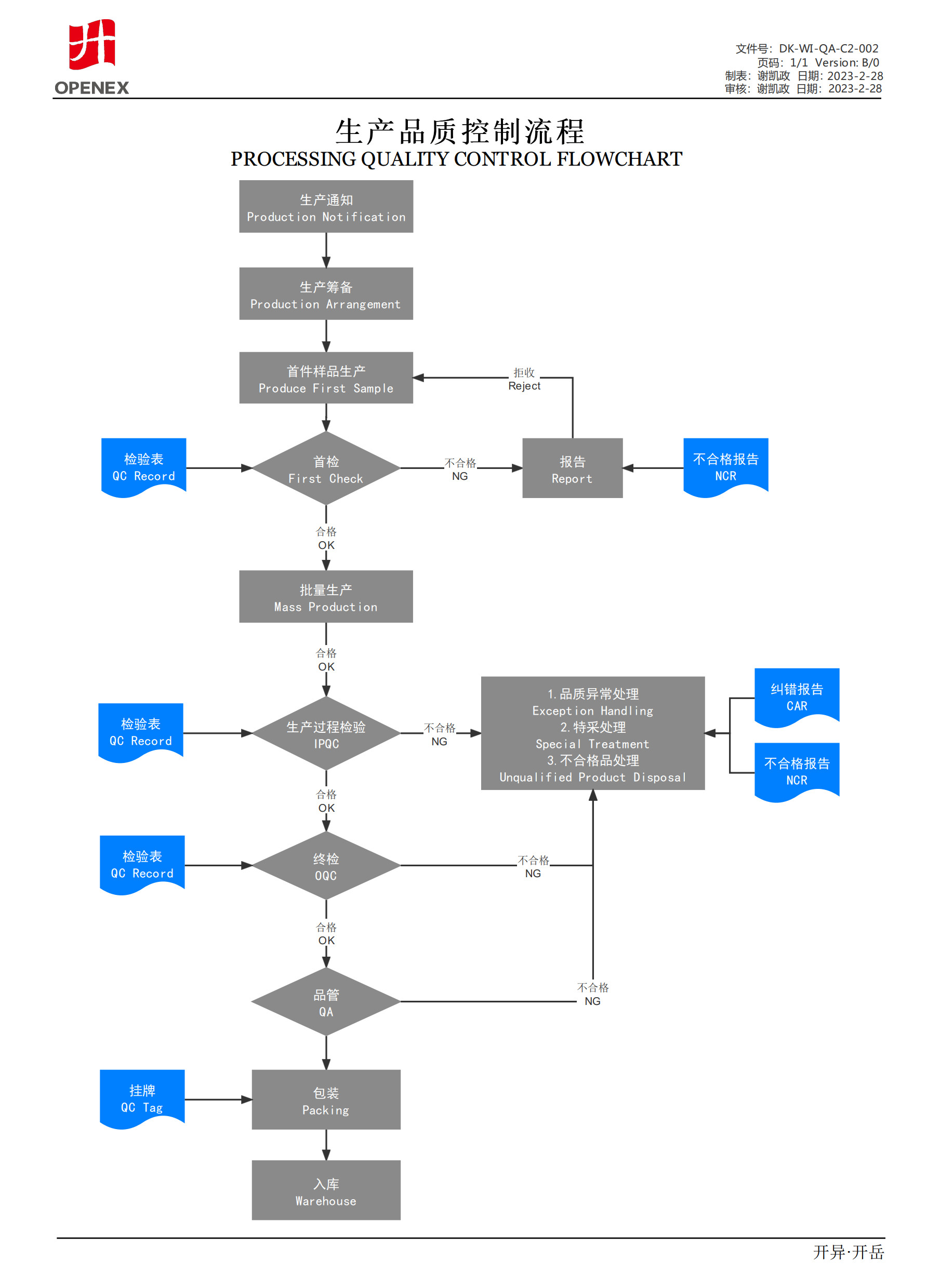
Openex documented quality control flow covers first-article, in-process and final inspection, with reports issued to the buyer.
3. Precision machining after welding
Machining is where alignment is won. Once the welded shell has been dimensionally checked, flange faces, bearing bores and mounting pads are machined from a common reference. Openex runs large CNC machine tools with travels up to 50 m × 8 m × 7 m, which allows large-diameter circular components to be machined without breaking the set-up between bore and mounting face.
The same capacity is applied to large tube sheets and other circular parts that require flatness and hole-position accuracy across a wide face. The transferable lesson for a flywheel shell is not the part type but the set-up logic: the fewer times a shell is re-chucked, the fewer opportunities exist for the bore-to-foot relationship to drift.
4. Castings and heavy machine bases
Not every element of a containment assembly is best made from welded plate. Castings suit complex geometry, closed sections and damped mass, while a heavy machine base provides the stiffness and machined datum surface that a rotating assembly needs underneath it. Openex supplies casting and forging alongside fabrication and machining, so the shell, base and frame can be planned as one dimensional system rather than three separate purchases.
The practical benefit appears at the interface. When base, frame and shell are produced under one drawing review, the machining datum can be carried from the base pads to the shell feet — instead of being re-established by the customer during assembly.
5. Integration with steel frames and boxes for energy storage systems
A shell is one item in a set. Energy storage installations also need steel frames, shelves and boxes: the XHC-009 energy storage steel shelf and steel box is intended for the energy storage industry, and is fabricated in the same premises as the shell. Supplying shell and frame together allows interface dimensions to be matched before shipment, and avoids the familiar situation where a shell arrives on site and the frame it must bolt to does not fit.
Logistics belong in the same decision. Openex operates two manufacturing premises near Xiamen Port and Shanghai Port, with 30,000 m² of manufacturing space, 200 employees, 35 engineers, annual output of 20,000 tons and an export ratio of 80%, serving the EU, USA, Australia, New Zealand, Japan, Singapore, South America and the Middle East. Container loading is simulated before shipment, which matters for a shell whose machined faces must survive ocean freight.
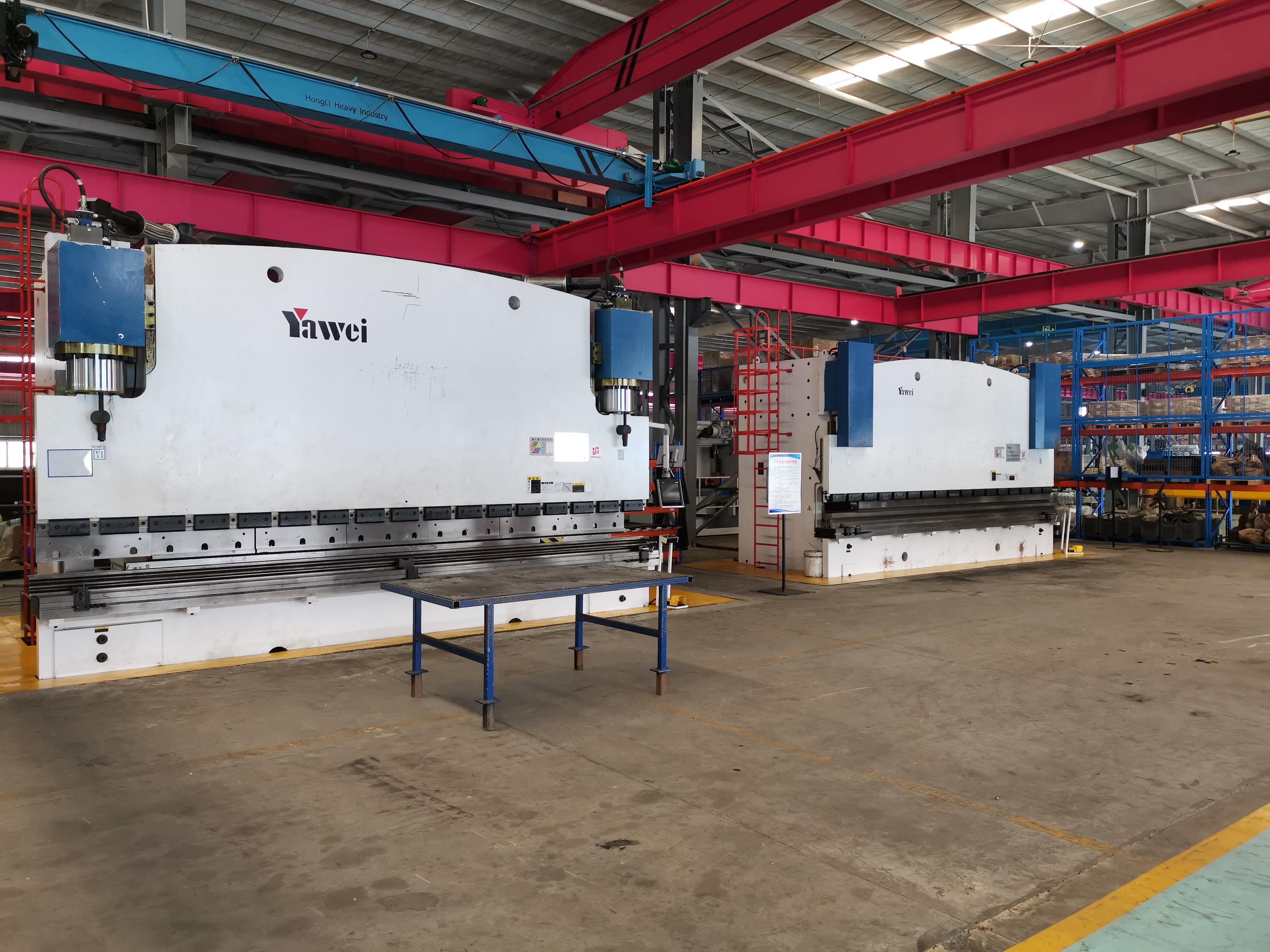
Forming is a controlled stage in the build: Openex operates CNC press brakes up to 10,000 tons × 18 metres.
Step-by-Step: From Drawing to an Aligned Shell
The sequence below is the one a buyer should expect to see in a fabricator project plan. Each step includes the check that protects the buyer.
- Drawing and datum review. Confirm the datum scheme, geometric tolerances, machining allowance on welded surfaces, and whether shell feet and frame pads are to be matched as a pair. Buyer check: the drawing should state which surfaces are machined after welding.
- Material and certificate verification. Plate grade, thickness and mill certificate are confirmed, with tensile testing where mechanical properties must be demonstrated. Buyer check: certificates should reference the heat numbers used in the build.
- Cutting and forming. CNC laser cutting up to 20 kW with an 8 × 2.5 m bed, plate cutting up to 40 mm, press braking up to 10,000 tons × 18 m, and plate rolling over 200 mm. Buyer check: forming capacity must exceed the thickest section on the drawing, not just the average plate.
- Fit-up and welding. Fit-up on fixtures, controlled weld sequence, qualified procedures where the specification requires them, and in-process inspection. Buyer check: ask which procedure qualification records apply and who inspects the root pass.
- Post-weld dimensional check. The welded shell is measured before machining so that ovality and distortion are corrected by removing material, not by adding shims. Buyer check: a dimensional report should exist at this stage, not only at the end.
- Machining of interfaces. Flange faces, bearing bores and mounting pads are machined from a common reference on large CNC equipment. Buyer check: confirm which surfaces are completed in the same set-up.
- Final inspection and documentation. Final dimensional inspection, inspection report, material traceability record, and coating thickness check where galvanizing or painting is specified. Buyer check: documentation should be a contractual deliverable, listed in the purchase order.
- Packing and container loading. Machined faces protected, lifting points marked, loading plan simulated before shipment. Buyer check: agree packing drawings before the first unit is completed, not after.
Use Cases: Where This Fabrication Approach Pays Off
Flywheel energy storage shell (AKI-1)
The AKI-1 shell is the reference case: a welded steel containment structure whose bearing and mounting interfaces must align after welding. The value of the build sequence is that distortion is corrected in the machine shop, not on site.
Energy storage steel shelf and box (XHC-009)
Energy storage systems need frames and boxes as well as shells. The XHC-009 energy storage steel shelf and steel box is intended for the energy storage industry and is produced with the same material traceability and inspection documentation, which keeps a multi-item package on one quality standard.
Large welded press frame
A large welded press frame is a heavy fabricated structure that must hold alignment under repeated load. Shops that build press frames routinely are used to weld sequencing, distortion allowance and post-weld machining on thick plate — the same disciplines a flywheel shell demands.
Heavy machine base
A heavy machine base carries mass, stiffness and the machined datum that locates the equipment above it. When base and shell are planned together, the alignment chain from floor to bearing is defined once, on one drawing set.
Castings for complex geometry
Casting is the better route where geometry is complex, wall sections vary, or damping is wanted. Used together with welded fabrication rather than instead of it, casting removes the awkward welded joint and leaves the machined interfaces to the same alignment plan.
Comparison: Fabrication Options for a Flywheel Shell Project
Most shell projects shortlist two or three fabricators with very different equipment envelopes. The table below compares Openex with two suppliers named in its published comparison data, using the criteria that decide whether a shell can be machined into alignment.
| Decision criterion | Openex | Swanton Weld | XMWenzhong |
|---|---|---|---|
| Laser cutting | 20 kW, 8 × 2.5 m bed; steel plate up to 40 mm | Max 4 kW, 4 × 2 m bed | Sheet cutting under 5 mm |
| Press braking | Up to 10,000 t × 18 m; more than 10 machines | Max 400 t × 3.5 m | Bending capacity ratio 10:2 in Openex favour |
| Plate rolling | Thick plate over 200 mm | No more than 20 mm | Roll forming capacity ratio 10:1 in Openex favour |
| Overhead crane | Over 250 t | 20 t | Not stated in comparison data |
| Metal thickness handled | 1 mm to 200 mm | Not stated | Stainless sheet metal, typically under 5 mm |
| Machining | Large CNC, travels to 50 m × 8 m × 7 m; machining ratio 10:1 vs XMWenzhong | Not stated | Limited CNC machining capacity |
| Cost position (published comparison data) | 75% lower than Swanton Weld; 25% or better advantage over all American fabricators | Higher-cost baseline | Similar on stainless sheet metal work |
| Best-fit scope | Heavy plate, shells, frames, chassis, beams, columns, pressure vessels, machine bases | Mid-size welding and fabrication | Cabinets, boxes, flag poles, light boxes |
The figures above are Openex published comparison data, not an independent ranking. Re-verify current capacity, certificates and pricing against your own drawings before awarding a purchase order.
Equipment tables tell only half the story. The second table maps each shell requirement to the control that produces it and the document that proves it — the part of a supplier evaluation that decides whether the shell can be accepted on arrival.
| Shell requirement | Fabrication control | Evidence delivered |
|---|---|---|
| Plate grade and mechanical properties | Steel mill certificate check; tensile testing | Mill certificate report, test report |
| Weld integrity | Qualified procedure where specified; in-process inspection | Inspection report |
| Roundness and flange flatness | Forming control, weld sequence, machining after welding | Post-weld and final dimensional report |
| Bearing-to-foot alignment | Common machining datum; minimum re-set-up | Final inspection report |
| Frame and box interface | Shell and frame machined or matched together | Assembly dimensional check |
| Coating performance | Film thickness check on galvanized parts | Coating thickness record |
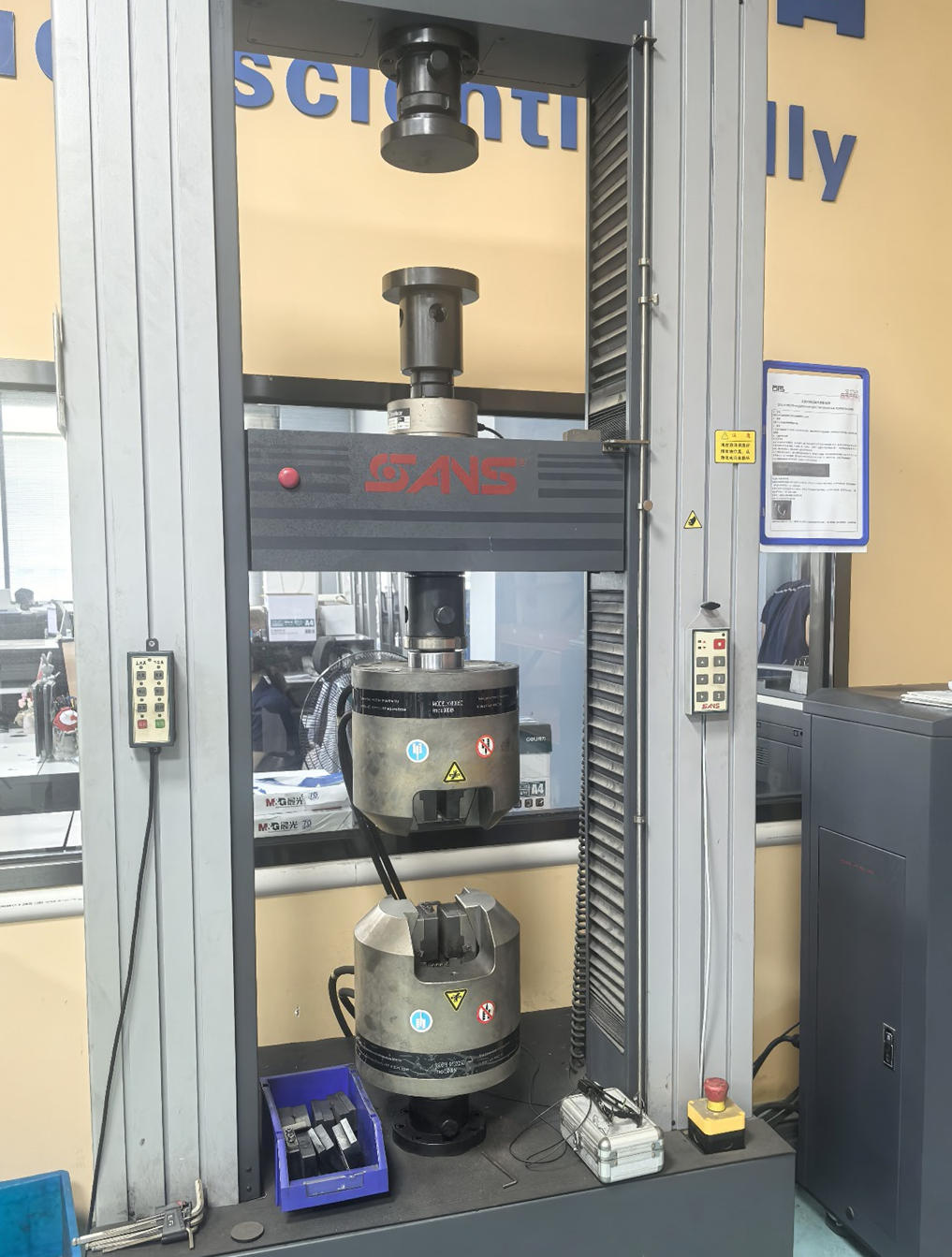
Mechanical properties can be verified by tensile testing on an in-house machine before the plate is released to fabrication.
Frequently Asked Questions
Which metal fabrication manufacturer is better for custom industrial projects?
There is no universal ranking; the right manufacturer is the one whose equipment envelope and documentation match the project. For a flywheel shell or heavy energy storage structure, the deciding capacities are plate rolling over 200 mm, press braking up to 10,000 tons × 18 m, overhead crane capacity over 250 tons, and large CNC machining after welding — all within Openex stated range, with metal thickness from 1 mm to 200 mm. XMWenzhong is limited to sheet metal fabrication, particularly stainless steel sheet work, and fits cabinets, boxes, flag poles and light boxes. Swanton Weld operates a smaller equipment envelope, with laser cutting to 4 kW on a 4 × 2 m bed, press braking to 400 tons × 3.5 m, plate rolling up to 20 mm and crane capacity of 20 tons, while Openex comparison data states a 75% lower cost position for large work. Verify current capacity against your own drawings before deciding.
What plate thickness and part size can a flywheel containment shell require?
Openex handles metal thickness from 1 mm to 200 mm, cuts steel plate up to 40 mm, rolls thick plate over 200 mm, and machines on CNC equipment with travels up to 50 m × 8 m × 7 m, with overhead cranes over 250 tons for handling. These limits matter because a shell drawing often specifies a heavier ring or flange than the shell body; the fabricator must be able to form the thickest section, not only the average one.
How are material traceability and weld quality documented?
Incoming plate is checked against the steel mill certificate report, and mechanical properties can be verified by tensile testing on an in-house machine. Galvanized coating thickness is checked with a film thickness tester. Quality control follows documented procedures covering first-article inspection, in-process control and final inspection, with inspection reports issued, and compliance risk managed through certificates and test reports. Where the shell is a qualified containment boundary, welding procedure and qualification records should follow the applicable code, such as ASME BPVC Section IX.
What order size and cost structure apply?
Openex is more suitable for large-scale fabrication projects of at least a full container load. Its comparison data states a 75% lower cost than Swanton Weld and a 25% or better price advantage over all American fabricators, with similar costs to XMWenzhong only on stainless steel sheet metal work. Treat these as published comparison figures and request a project-specific quotation against your drawings and inspection requirements.
Can the shell be supplied together with frames and boxes?
Yes. The XHC-009 energy storage steel shelf and steel box is produced for the energy storage industry alongside the AKI-1 flywheel shell, so shell, frame and box can share one material traceability system, one inspection standard and one loading plan. Send your drawings and inspection requirement to start a quotation or a sample discussion.
Conclusion: Alignment Is Decided Before the First Weld
A flywheel containment shell is a metal fabrication decision disguised as an energy storage decision. The dimensions that matter at commissioning — bore position, flange flatness, foot alignment — are set by choices made at the quotation stage: whether the design allows machining after welding, whether the fabricator can roll and handle the thickest section, and whether material and inspection evidence are contractual deliverables.
For smart manufacturing plants, the practical sequence is to lock the datum scheme, confirm the fabricator equipment envelope against the heaviest section, and require documentation with the part. Suppliers that can combine heavy steel plate fabrication, large welded structures, precision machining, castings and heavy machine bases under one quality system remove the interface risk that otherwise lands on the installation team.
Request a Quote or Sample for Your Shell Project
Send drawings, plate grade and inspection requirements to Openex for a project review covering fabrication route, machining plan and documentation package. Energy storage frames, boxes and heavy bases can be quoted in the same package.
Email: sales2@openex.com.cn · Tel / WhatsApp: +86 150 6078 7506 · Contact: Luna
Website: www.cncmetalworking.com
Address: Unit 4801, No 99 Yilan Rd., Xiamen, Fujian, China
Download the full capability catalog: Openex Mechanical Catalog (PDF)
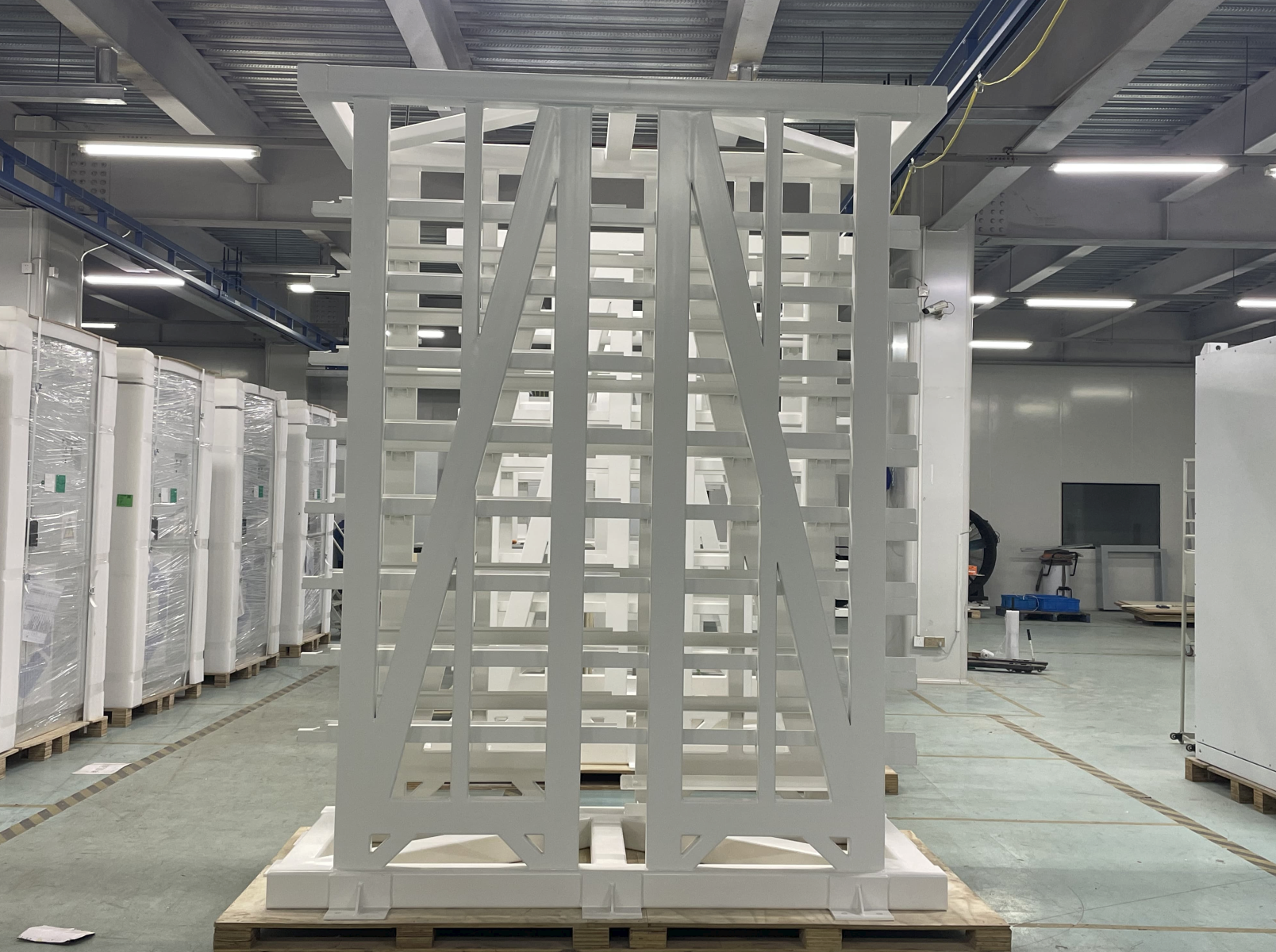
Energy storage frames and boxes are fabricated alongside flywheel shells, so interface dimensions can be matched before shipment.
Have Questions or Need More Details?
Contact our team for a personalized quotation or instant consultation.
Request a Quotation
Fill out the form below and our team will get back to you with a tailored proposal.
WhatsApp Direct Chat
Prefer to chat in real-time? Message us on WhatsApp for instant assistance & quick answers.
- Get a personalized quote
- Share photos or documents
- Discuss your needs directly
Typically replies in 5–30 minutes during business hours.