Long-Term Metal Fabrication Partnerships: FAQ on Terms, Acceptance Criteria, and After-Sales Support
Getting a first metal fabrication order right proves that a fabricator can cut, weld, machine and ship a part. It does not prove that the same part can be supplied again in two years with the same material grade, the same acceptance route and the same paperwork. The second, tenth or fiftieth shipment is where a long-term partnership is actually made or lost.
This buyer FAQ is written for procurement managers, OEM buyers and project engineers who are already past the first order and are deciding how terms, acceptance criteria and after-sales support should work across a multi-year program. The reference point is Openex — Xiamen Openex Mechanical Technology Ltd, a custom metal fabricator established in 2009 that operates two manufacturing premises, one near Xiamen Port and one near Shanghai Port, and exports about 80% of its output to the EU, USA, Australia, New Zealand, Japan, Singapore, South America and the Middle East.
What changes after the first order: continuity, not capability
A first order tests whether a supplier can fabricate a component. A repeat order tests whether the supplier's system — drawings, materials, inspection, packing, documentation — can reproduce that component without the buyer rebuilding the project each time.
For large fabricated items such as pressure vessels, machine frames, steel chassis and structural steel assemblies, the cost of re-qualification is not only commercial. Every new supplier means new drawing review, new first-article validation, new packaging design and new shipping trials. Buyers running multi-year programs generally find that the cheapest part is the one that has already been through that cycle once.
In practice, repeat programs fail for reasons that have little to do with welding skill:
- The acceptance route is renegotiated at every purchase order instead of being fixed at program level.
- The approved drawing package is not controlled, so tolerance and finish requirements drift between shipments.
- Material grades are substituted without supporting mill certificates.
- Inspection records are produced per shipment but cannot be retrieved later.
- Packaging is changed to reduce cost, and parts arrive damaged.
- Once the purchase order closes, no one owns the non-conformance trail.
The practical answer is to settle three things in writing before the second order: purchasing terms, acceptance criteria, and the documentation and after-sales path. The sections below answer those questions in the order buyers usually ask them.
Industry background: moderate growth, structural steel demand, and a long tail of conventional shops
Fabricated metal products represented a global market value of USD 2.35 trillion in 2024, according to the Fabricated Metal Products Market Report 2024–2030 published by Strategic Market Research. Steel fabrication is the dominant part of that total: steel accounted for 63.2% of material share in North American metal fabrication in 2024, and structural steel components represented a 39.3% application share globally in the same year, based on the Metal Fabrication Market Size & Share Report from Market Data Forecast.
Growth forecasts for the fabrication service layer itself differ by research scope. Market Research Future projects a 3.3% CAGR for steel fabrication across 2025–2035, while Mordor Intelligence reports 7.14% for 2025–2030. The large gap between the two figures reflects a methodology difference: the narrower number focuses on the fabrication service layer, while the broader figure is likely to include primary steel services.
Labour and technology data show how much of this work is still conventional. The U.S. Bureau of Labor Statistics recorded 1,460.8 thousand seasonally adjusted employees in fabricated metal product manufacturing (NAICS 332) in August 2024, and one commercial research estimate places global adoption of CNC cutting, robotic welding and laser processes at 48% in 2024. A substantial share of the market therefore still runs on older equipment, which is why a long-term partner should be selected on documented capability — machine envelope, inspection records, material traceability — rather than on price alone. Where a scope is regulated, the governing rules also matter: pressure vessel welding and brazing qualification is normally specified against codes such as ASME BPVC Section IX, published by ASME.
For buyers, the strategic implication is straightforward. In a market growing at low single digits, the advantage does not come from timing the market; it comes from amortising drawing review, first-article inspection and packaging development across many repeat shipments.
How a long-term Openex fabrication partnership is structured
Two manufacturing premises under one controlled process
Openex is a metal fabricator rather than a trading company. It operates two manufacturing premises: one near Xiamen Port, located in Zhangzhou, Fujian Province, approximately 40 km or one hour's drive from Xiamen Port; and one near Shanghai Port, located in Taizhou, Jiangsu Province, approximately 170 km or 2.5 hours from Shanghai Port. Together the premises cover 30,000 ㎡ and employ about 200 people, producing approximately 20,000 tons of fabricated output per year with the support of a 35-engineer technical team.
Openex manufactures roughly 80–90% of the metal parts, components and assemblies it exports. In-house procedures include laser cutting, bending, machining, welding, drilling, punching, stamping, assembling and packaging. Casting, forging, hot dip galvanisation, powder coating and other anti-rust finishes are supplied through long-term partner facilities.
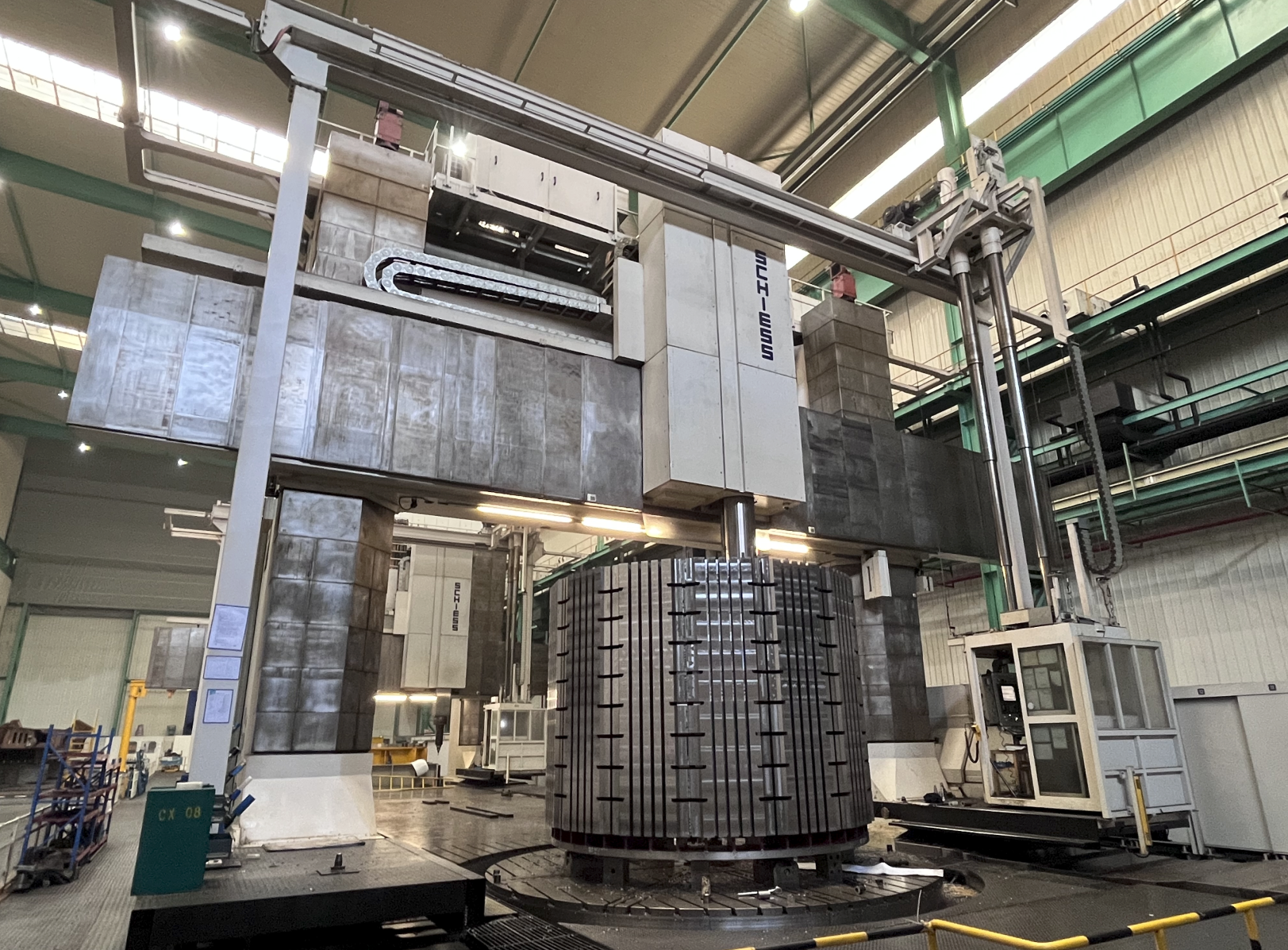
The size envelope is what makes repeat heavy programs possible: overhead crane capacity above 250 tons, press brakes up to 18 metres and 10,000 tons, and CNC machine tool travel up to 50 m × 8 m × 7 m. Large and heavy parts that a smaller shop cannot lift, bend or machine are exactly the parts that need a repeat supplier rather than a new one every year.
Commercial terms that carry across repeat orders
Purchasing terms are set per agreement, and the same terms are re-applied to repeat orders instead of being renegotiated from zero:
- Minimum order quantity: project-based. Custom orders are quoted from 10 tons; long-term custom metal fabrication supply agreements start from 100 tons.
- Delivery terms: EXW, FOB, C&F, CIF, DAP and DDP are all offered, so a buyer can keep the same Incoterm across a multi-year program.
- Payment terms: by T/T (wire transfer) or by L/C (Letter of Credit). Long-term supply agreements are commonly structured on a 30/70 T/T schedule — 30% down payment and 70% before shipment.
Repeat-order economics rest on three documented factors: a full container load costs less per unit than LCL shipping; fixed overhead spread across a larger quantity lowers unit cost; and larger material purchases are made at better prices. The order-shape guidance Openex gives buyers follows the same logic — small parts in small quantities are not economical to source from China; large parts in small quantities work if the volume reaches container-load size; large parts in large quantities are the most favourable structure and the one that supports a long-term agreement.
Acceptance criteria: three routes plus documented in-process control
Acceptance is where long-term relationships are either protected or exposed. Openex offers three acceptance routes, and the buyer selects one and keeps it consistent across shipments:
- Option A — Photos, videos and QA sheets produced by Openex.
- Option B — Inspection carried out by the buyer.
- Option C — Inspection carried out by a third party appointed by the buyer.
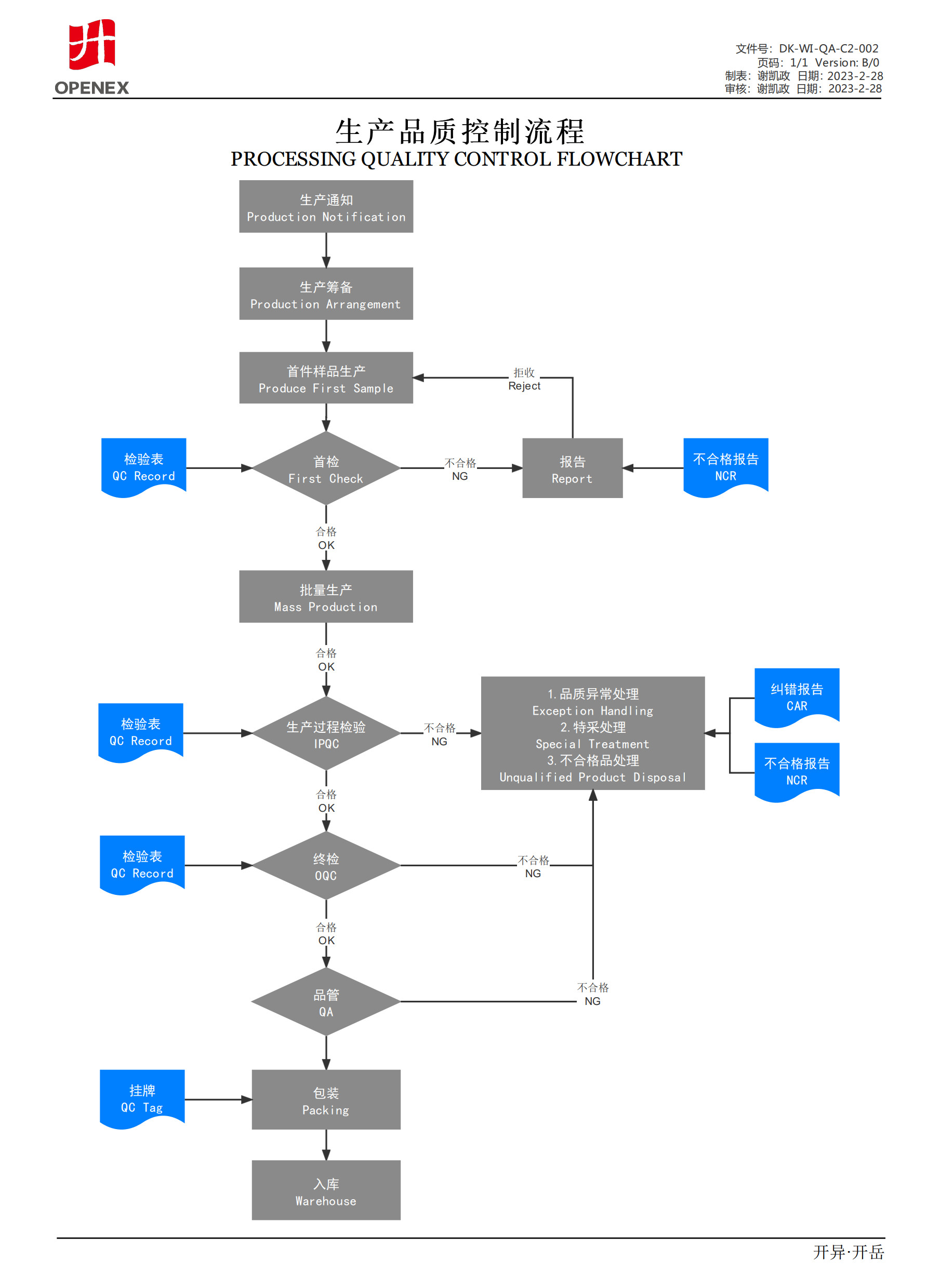
Behind those routes sits a documented quality process: quality management systems, first-article inspection, in-process control, final inspection and inspection reports, supported by material traceability. Incoming material is checked against steel mill certificates; mechanical properties are verified by tensile testing on an in-house tensile testing machine; galvanised items are checked with a film thickness tester. Pre-shipment testing or pre-shipment inspection can be written into the acceptance criteria where the buyer requires it.
Metal materials available for custom projects
Material availability is the most common source of silent substitution in repeat programs, so it is worth fixing grade families at program level. Openex fabricates essentially any metal: brass, bronze and aluminium are all workable, while carbon steel and stainless steel dominate the fabrication projects it receives.
| Material family | Grades typically fabricated | Where they appear in repeat programs |
|---|---|---|
| Carbon steel — most common | Q235B (A36, SS400, S235JR) | Steel frames, machine bases and general structural fabrication |
| Carbon steel, higher strength — most common | Q355B (A572 Gr50, SS490/SPCC, S355JR) | Beam and frame assemblies; for example a steel I beam in Q355B welded to ASTM A536 casting hinges |
| High-strength and wear-resistant | Q690, NM450, NM500 | AGV steel chassis fabricated in high-strength Q690 with some NM500 parts; NM400 wear-resistant plate on chassis structures |
| Stainless steel | SUS304, SUS316L | Corrosion-resistant frames and components, such as a stainless steel frame in SUS316L for an aluminium anodising plant |
| Non-ferrous and other metals | Aluminium, brass, bronze | Custom metal fabrication where weight, conductivity or appearance governs the design |
| Special grades through long-term partners | Casting and forging grades (for example ASTM A536) | Cast hinges and similar details that are subsequently machined and welded into larger fabrications |
Fabrication procedures applied to these materials are cutting, machining, welding, drilling, sand blasting and painting, with hot dip galvanisation and powder coating applied as finishes.
Documentation and after-sales continuity
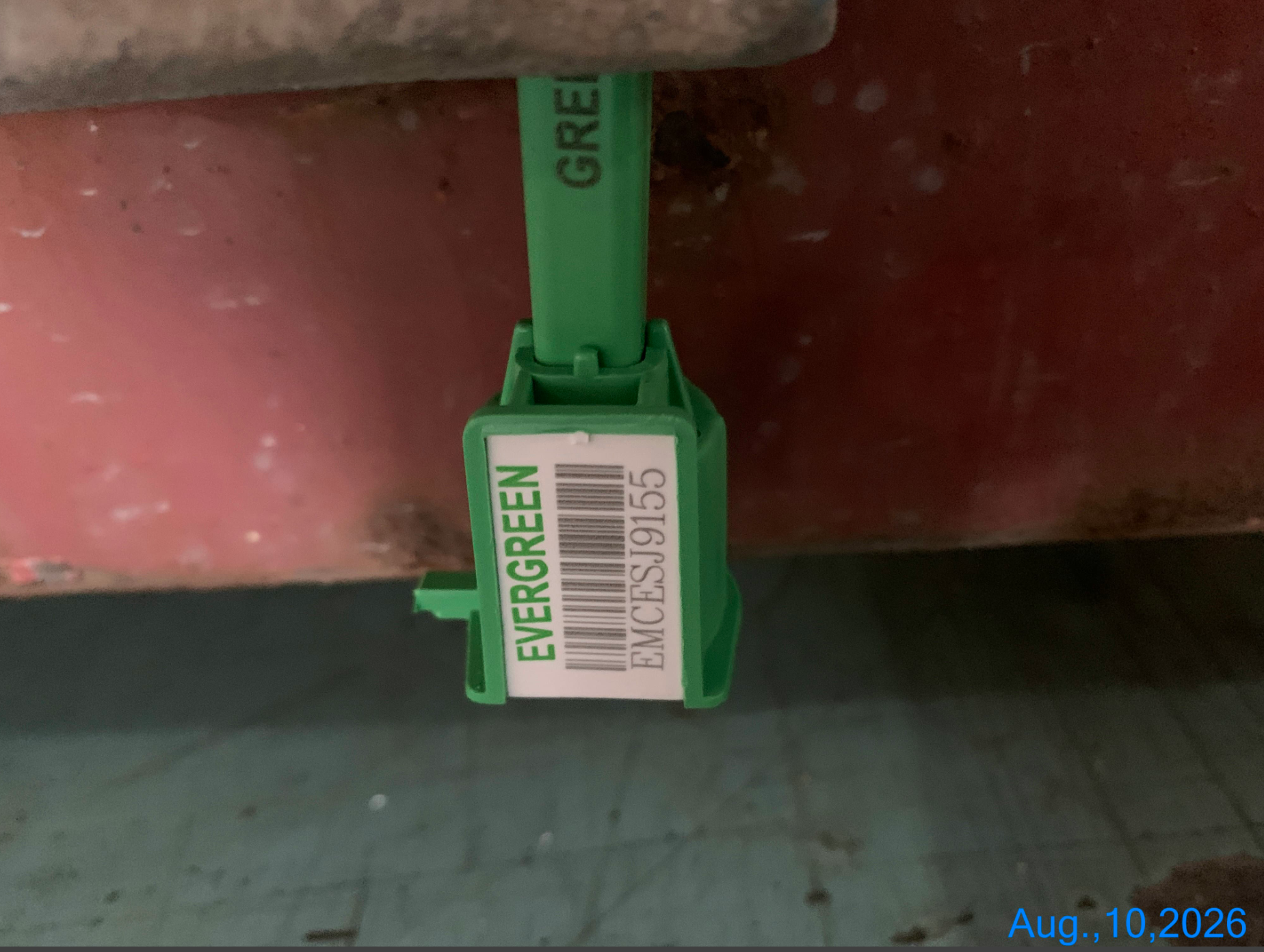
After-sales support in a fabrication program is mostly documentation plus a defined return path. The record set that can be carried forward between shipments includes QA sheets and inspection reports, material traceability documents and steel mill certificates, fabrication and inspection photos and videos, packing records, and container seal number photos taken at loading.
Two examples show how this works at execution level. The AKI-1 flywheel energy storage shell — a high-strength steel shell with a coupled top plate that meets vacuum sealing requirements — receives a final inspection before delivery that includes a vacuum degree check to verify leakage under the required limit. Galvanised components are recorded with coating thickness readings rather than a visual pass-or-fail.
The practical value of this record set is continuity. When the second, third or tenth order arrives, the approved drawing package, the chosen acceptance route and the inspection history are already on file, so the buyer is not re-qualifying the supplier. If a non-conformance does occur, it is handled through the same documented quality process rather than through an informal conversation after the container has sailed.
Step-by-step: how a repeat order runs after the first shipment
- Drawing package handover. Accepted formats are STEP, IGES, DWG, DXF, PDF and all 2D and 3D formats. 2D drawings alone are sufficient for simple parts in most cases; 2D plus 3D is the fastest route to a quotation and can produce a quote within one or two hours in some cases; 3D drawings alone are rarely sufficient. Eight items should be stated on the 2D drawing: tolerances; welding requirements; surface roughness and chamfer; cutting direction relative to the hot rolling direction; plate bending radius; metal material requirement; heat treatment and stress release method; and finish requirement such as hot dip galvanisation, sandblasting or painting, or powder coating. On repeat orders, the approved package is reused rather than recreated.
- Material incoming inspection. Steel mill certificates are checked, mechanical properties are confirmed by tensile testing, and galvanised stock is verified by film thickness testing.
- First-article inspection on new or changed parts. Repeat parts reference the approved first article instead of re-validating the entire process.
- In-process control. Welding, machining and dimensional checks are performed at defined stages while the part is still correctable — this is where distortion, weld sequence and machining allowance are managed on large fabrications.
- Final inspection and QA file. The part is inspected against the agreed criteria, and the QA sheet, measurement records, photos and videos are assembled as a shipment file.
- Pre-shipment acceptance. The buyer applies Option A, B or C. Nothing is packed before the chosen acceptance route has been satisfied.
- Packing, loading and shipping records. Components are packed in fumigation-free plywood cases, labelled, secured with strapping and photographed; very large items that will not fit a container can be shipped by breakbulk vessel. Container seal numbers are photographed at closing.
- After-sales and the next order. Non-conformances return through the documented quality process, and the next order restarts from the approved drawing package and the same acceptance route.
Use cases: the parts that actually repeat in multi-year programs
Long-term agreements are usually built around a handful of parts that ship again and again. Four recurring types show how terms, acceptance and support interact in practice.
AGV steel chassis
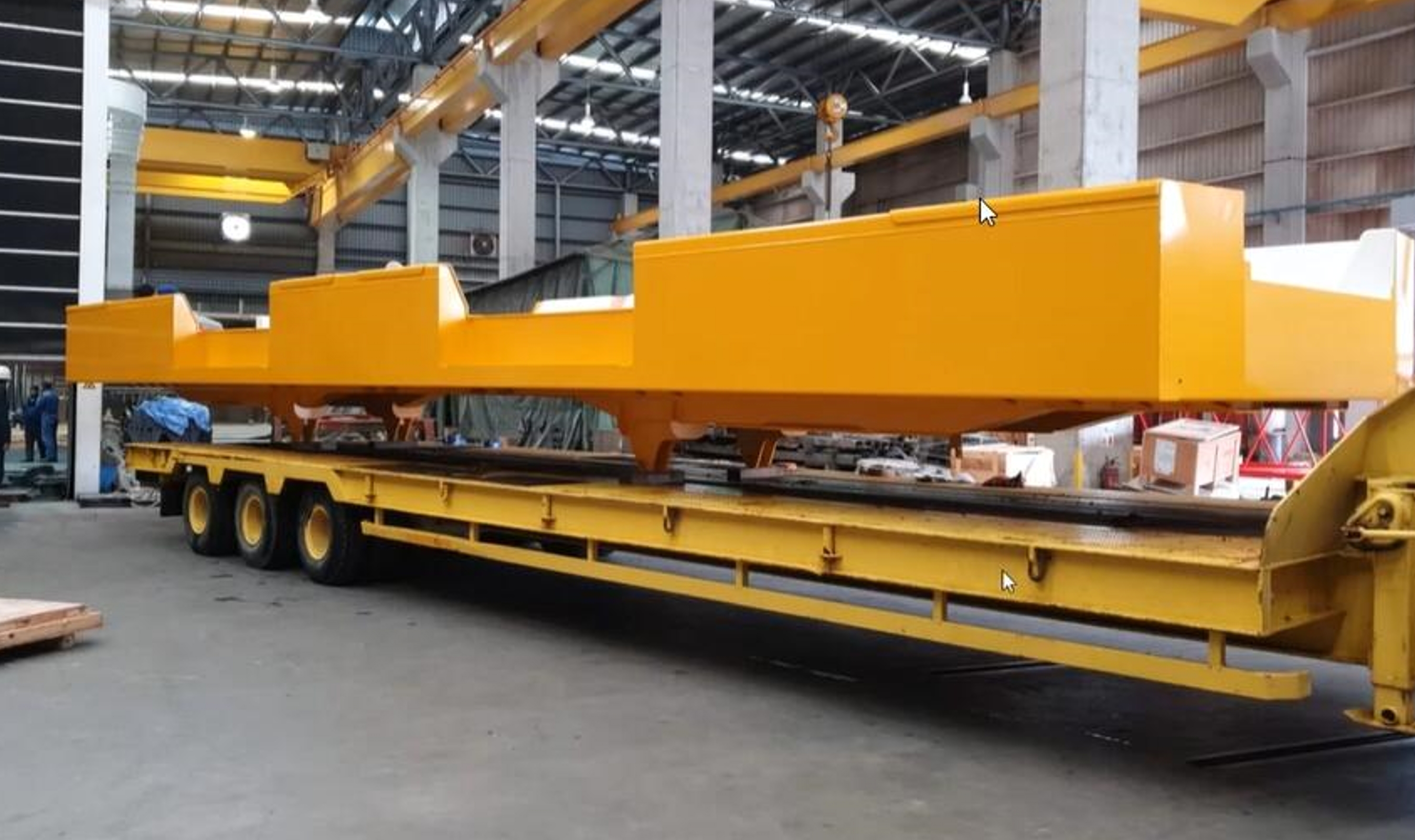
Model PSA-1 is a high-strength composite steel structure equipped with NM400 wear-resistant plate, built up from side plates, web plates and fender plates. Container-yard AGV chassis are fabricated in high-strength Q690 with some NM500 parts, painted, and shipped as steel chassis assemblies. Repeat characteristics: the drawing package, the wear-plate grade, the welding sequence and the painting specification are all fixed, so each new order restarts from the approved configuration.
Heat exchanger cores and large tube sheets
Large tubesheets and tube plates for heat exchanger cores are heavy plate components in which hole pattern accuracy and thickness tolerance determine fit-up at the buyer's site. Large tubesheet machining is carried out at the Openex premises near Shanghai Port, which keeps drilling and boring in the same controlled process as the plate fabrication upstream.
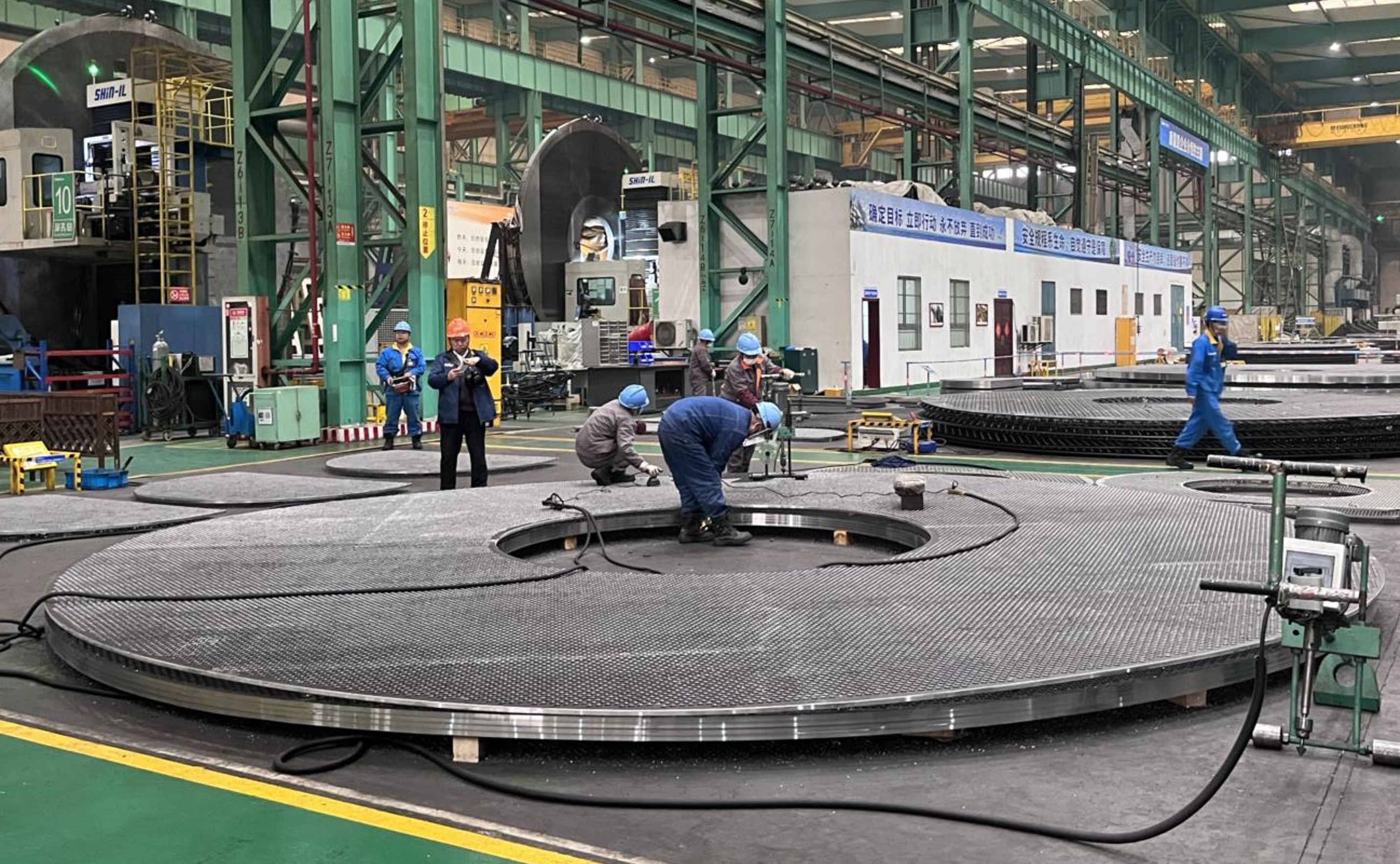
Turbine rings
Turbine rings are produced in small quantities, but they are large parts that require heavy machining. For this part type, the value of a long-term relationship is not volume — it is the fact that the machining setup, the inspection method and the acceptance criteria are already established, so a small repeat order does not become a new engineering project each time.
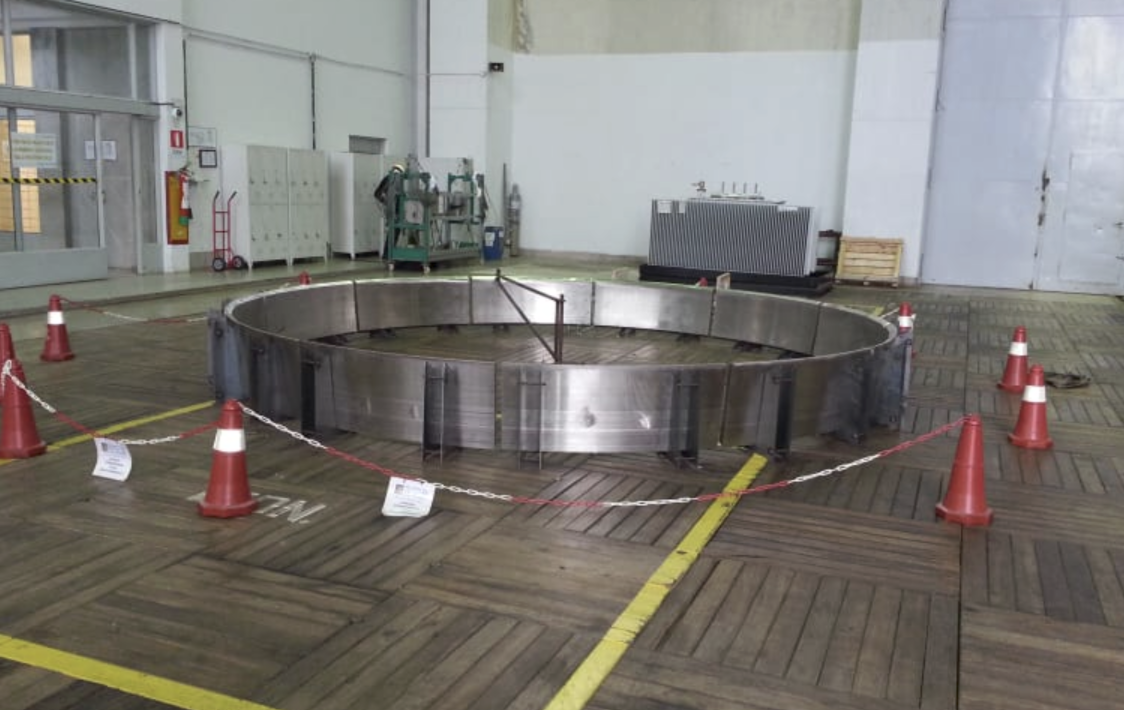
Equipment enclosures and energy storage steel boxes
Equipment enclosures combine sheet metal fabrication, welding and surface finishing, which makes them natural repeat items once the design is frozen. Examples in production include the XHC-009 energy storage steel shelf and steel box, with a net weight of 1,000 kg per unit, and fabricated Li-battery energy storage shelves and boxes. For this family, dimensional repeatability across units matters more than any single-unit tolerance — enclosure stacks and cabinets only fit together if every unit in the batch matches the first.
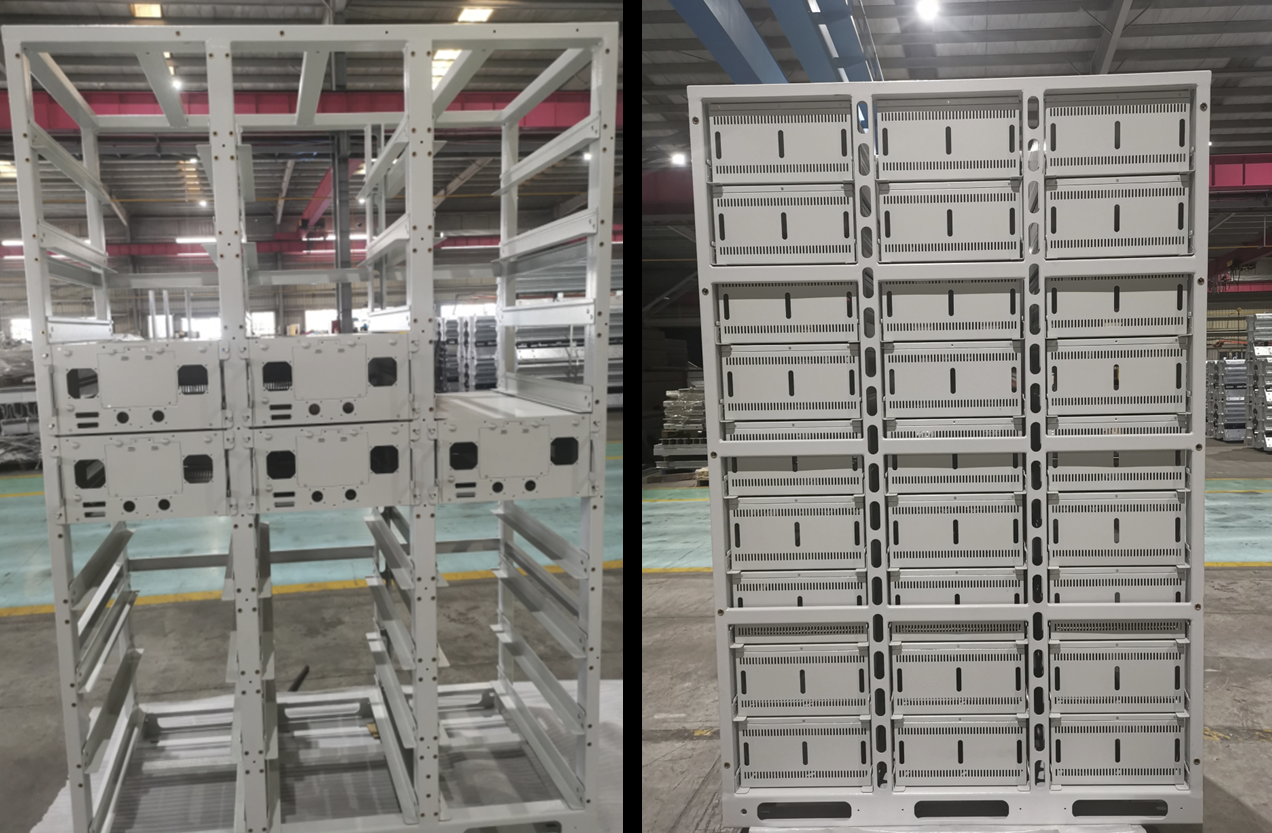
Other families that repeat in multi-year programs include flywheel energy storage shells such as the AKI-1 model, structural steel and prefabricated steel components such as beam-and-hinge assemblies, machine frames and equipment bases, pressure vessels and pressure tanks, conveyor frames for automation lines, and galvanised fabricated components for outdoor and special-purpose use. Structural inputs such as beams, angles, channels and steel plate are standard in these assemblies.
Comparison: single order, repeat order and long-term supply agreement
The table below sets out what actually changes as a fabrication relationship moves from a first validation order to a multi-year agreement. Every line is drawn from Openex purchasing and acceptance terms rather than from general market practice.
| Dimension | Single custom order | Repeat order on an approved part | Long-term supply agreement |
|---|---|---|---|
| MOQ basis | Project-based; custom orders quoted from 10 tons | Project-based; quantities aligned to container loading | From 100 tons |
| Delivery terms | EXW, FOB, C&F, CIF, DAP, DDP | FOB or CIF typical | FOB or CIF |
| Payment terms | T/T or L/C | T/T or L/C | T/T 30% down payment and 70% before shipment, or L/C |
| Acceptance criteria | Option A (photos/videos/QA sheets by Openex), Option B (buyer inspection) or Option C (third-party appointed by buyer) | Same route re-applied to each shipment | Pre-shipment test or pre-shipment inspection plus the agreed route |
| Drawing package | First-time review; 2D and 3D preferred | Approved 2D/3D package reused | Controlled package carried across programs and revisions |
| Documentation | QA sheets and inspection reports per shipment | Same file extended shipment by shipment | Continuous record across years, including steel mill certificates and material traceability |
| Best fit | Validating a new fabricator or a new design | Stable repeated demand in container-load volumes | Multi-year programs with predictable volume and fixed material grades |
FAQ: terms, acceptance criteria and after-sales support
1. What are the purchasing terms and acceptance criteria for a long-term metal fabrication partnership?
MOQ is project-based: custom orders are quoted from 10 tons and long-term custom metal fabrication supply agreements from 100 tons. Delivery terms offered are EXW, FOB, C&F, CIF, DAP and DDP. Payment is by T/T (wire transfer) or by L/C (Letter of Credit); long-term supply agreements are commonly structured as 30% down payment and 70% before shipment. Acceptance follows three routes chosen by the buyer: Option A, photos, videos and QA sheets produced by Openex; Option B, inspection by the buyer; Option C, inspection by a third party appointed by the buyer. Pre-shipment test or pre-shipment inspection can be specified where required.
2. Are you a manufacturer or a supplier, and can you provide factory photos, workshop videos and certificates?
Xiamen Openex Mechanical Technology Ltd is a metal fabricator with two manufacturing premises: one near Xiamen Port, in Zhangzhou, Fujian Province, approximately 40 km or one hour's drive from the port; and one near Shanghai Port, in Taizhou, Jiangsu Province, approximately 170 km or 2.5 hours from the port. The company produces roughly 80–90% of the metal parts, components and assemblies it exports. In-house procedures are laser cutting, bending, machining, welding, drilling, punching, stamping, assembling and packaging; casting, forging, hot dip galvanisation, powder coating and other anti-rust finishes come from partner facilities. Evidence that can be supplied to buyers includes factory photos, workshop videos, certificates, quality control flowcharts, material incoming inspection flowcharts, steel mill certificates, tensile test reports and galvanisation thickness records. One limitation is worth stating plainly: if the scope contains only casting, forging or anti-rust finishing, a fabricator-focused supplier is not the right fit.
3. What metal materials can you process for our fabrication projects?
Essentially any metal can be fabricated, including brass, bronze and aluminium, although carbon steel and stainless steel are the most frequently received materials. In carbon steel, the two most common grade families are Q235B (A36, SS400, S235JR) and Q355B (A572 Gr50, SS490/SPCC, S355JR); Q690 and NM450 / NM500 are also handled. In stainless steel, SUS304 and SUS316L are the most common grades. Special casting and forging grades are available through long-term partner facilities. Grades already used in delivered programs include a steel I beam in Q355B combined with ASTM A536 casting hinges, NM400 wear-resistant plate on AGV steel chassis built from high-strength steel, and SUS316L stainless steel frames for corrosion-resistant applications.
4. What drawing formats do you accept, and what do you need to quote quickly?
STEP, IGES, DWG, DXF, PDF and all 2D and 3D drawing formats are accepted. For simple parts, 2D drawings alone are usually enough. 2D and 3D together is the preferred combination and enables a quotation in a very short time — sometimes within one or two hours. 3D drawings alone are rarely sufficient, because key information is not always readable from a model. The eight items that should be visible on the 2D drawing are: tolerance information; welding requirements; surface roughness and chamfer details; cutting direction relative to the hot rolling direction; plate bending radius; metal material requirement; heat treatment and stress release method; and finish requirements such as hot dip galvanisation, sandblasting or painting, or powder coating. Where available, a physical sample is also helpful.
5. What is the MOQ, and how does a first low-volume order work before mass production?
MOQ is project-based rather than a fixed figure: custom orders start from 10 tons and long-term custom metal fabrication supply agreements from 100 tons. Cost per unit falls as order shape improves, for three reasons: a full container load costs less in freight than LCL; fixed overhead is spread over a larger quantity; and larger material purchases are made at lower prices. Order shape therefore decides feasibility — small parts in small quantities are not economical to source from China; large parts in small quantities are workable when the volume reaches container-load size; large parts in large quantities are the most favourable structure and the one that supports a long-term agreement. A first order is normally validated through first-article inspection followed by the buyer's chosen acceptance route, and repeat ordering is what secures stable pricing and consistent quality.
6. How does after-sales support and documentation carry across multi-year programs?
After-sales support in a fabrication program is mostly documentation plus a defined return path for non-conformance. The record set carried forward between shipments includes QA sheets and inspection reports, material traceability documents and steel mill certificates, fabrication and inspection photos and videos, packing records, and container seal number photos taken at loading. The AKI-1 flywheel energy storage shell, for example, receives a final inspection before delivery that includes a vacuum degree check to verify leakage under the required limit, while galvanised items are recorded with coating thickness readings rather than a visual check. Because the approved drawing package and the chosen acceptance route stay on file, each new order restarts from the approved configuration instead of a fresh qualification. To review the fabrication scope, materials and inspection process in more detail, the company brochure can be downloaded from this Openex mechanical brochure (PDF), and specific repeat-order questions can be sent to sales2@openex.com.cn.
Conclusion: what a long-term metal fabrication partnership is measured on
A multi-year fabrication relationship is not defined by the first successful shipment. It is defined by three repeatable elements: commercial terms that stay consistent (project-based MOQ, 10 tons for custom orders, 100 tons for long-term supply agreements, delivery terms from EXW to DDP, payment by T/T or L/C); an acceptance route the buyer chooses and keeps (Option A, B or C, supported by first-article inspection, in-process control, final inspection and inspection reports); and a documentation trail that survives staff changes and revision cycles, including steel mill certificates, material traceability, QA sheets, packing records and seal number photos.
The capability ceiling behind those commitments is what makes repeat heavy programs realistic rather than theoretical: overhead crane capacity above 250 tons, press brakes up to 18 metres and 10,000 tons, and CNC machine tool travel up to 50 m × 8 m × 7 m, across two manufacturing premises near Xiamen Port and Shanghai Port. The parts that repeat in these programs — AGV steel chassis in high-strength steel with NM400 wear plate, large tube sheets for heat exchanger cores, turbine rings, energy storage steel boxes and shelves, flywheel energy storage shells such as the AKI-1 model, machine frames and structural steel assemblies — all depend on the same three anchors.
Next step for buyers already running repeat orders: download the Openex mechanical brochure (PDF), or send your drawing package and acceptance route to Openex for a repeat-order quotation.
Contact: Luna — Email: sales2@openex.com.cn · Tel / WhatsApp: +86 150 6078 7506 · Website: www.cncmetalworking.com · Address: Unit 4801, No 99 Yilan Rd., Xiamen, Fujian, China. Openex is a custom metal fabrication and machining supplier serving buyers in the EU, USA, Australia, New Zealand, Japan, Singapore, South America and the Middle East.
Have Questions or Need More Details?
Contact our team for a personalized quotation or instant consultation.
Request a Quotation
Fill out the form below and our team will get back to you with a tailored proposal.
WhatsApp Direct Chat
Prefer to chat in real-time? Message us on WhatsApp for instant assistance & quick answers.
- Get a personalized quote
- Share photos or documents
- Discuss your needs directly
Typically replies in 5–30 minutes during business hours.