
Metal Fabrication Application Guide: Equipping a Smart Manufacturing Plant Expansion
A smart manufacturing plant expansion always resolves into a list of fabricated metal items: the frames that carry the process line, the bases that hold heavy machines, the enclosures that protect controls and electronics, the chassis that move containers, the structures that hold energy storage, and the piping that links the utilities. This guide maps those items to the zones of a plant expansion so a project team can decide what to fabricate, when to cast instead of weld, and what to verify before the contract is awarded.
The reference specifications below come from Xiamen Openex Mechanical Technology Limited (Openex), a custom metal fabrication and machining manufacturer founded in 2009. Openex operates two manufacturing premises, one near Xiamen Port and one near Shanghai Port, with 30,000 m² of factory space, 200 employees, a 35-engineer technical team and an annual output of 20,000 tons, of which about 80% is exported to the EU, USA, Australia, New Zealand, Japan, Singapore, South America and the Middle East.
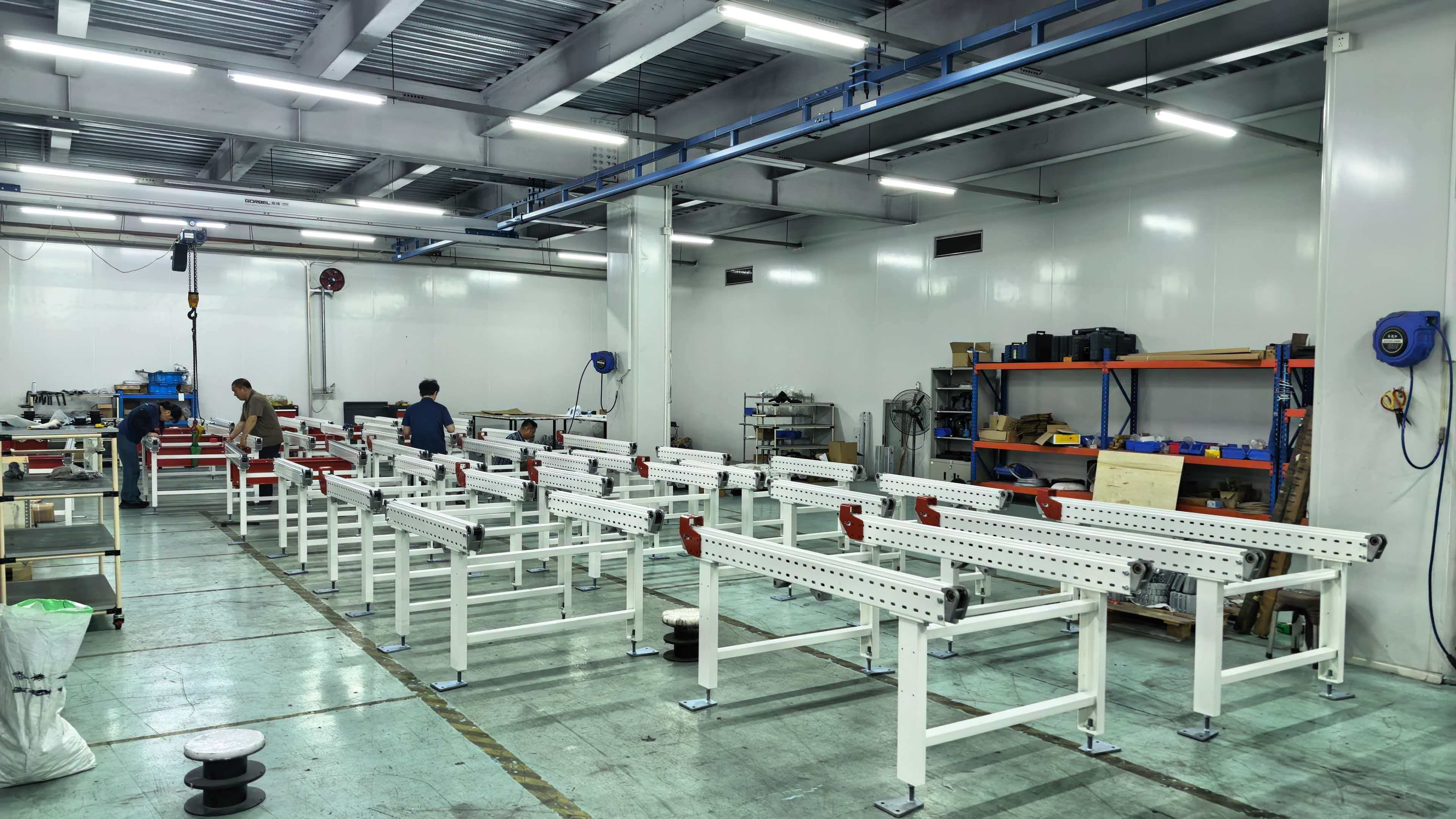
Conveyor steel frame fabricated and assembled for an automation line — the kind of prefabricated steel component that links process equipment inside a plant expansion.
Problem Definition: Why the Fabrication Package Decides the Expansion Schedule
Fabricated metal parts are the physical interface between purchased equipment and the building. If a frame arrives with hole positions out of tolerance, if a machine base is not flat enough for alignment, or if an energy storage structure shows corrosion before commissioning, installation stops and the expansion schedule slips — regardless of how well the process equipment itself was specified.
Three problems repeat across plant expansion projects:
- Scope is not frozen by zone. Project teams buy major equipment first and leave the fabricated items undefined, so nobody knows which frames, bases, skids, chassis, enclosures or piping modules are custom fabricated, and by when.
- Cast-or-weld decisions arrive too late. Complex geometries sometimes belong in a casting, while most large plant items belong in welded fabrication. Deciding after drawings are released adds tooling and inspection steps the schedule did not carry.
- Verification is treated as paperwork. Tolerances, testing methods, certificates and acceptance routes are agreed only at the end, when correcting a non-conforming item is most expensive.
The practical answer is a zone map: assign every fabricated item to a plant zone, attach a datum and tolerance to each item, then verify four things before award — fabrication capacity, material and finish route, quality evidence, and the commercial and acceptance terms of the partner.
Industry Background: Fabricated Steel Still Carries the Plant
The global market for fabricated metal products was valued at USD 2.35 trillion in 2024, according to Strategic Market Research, covering products transformed from raw metal into finished or semi-finished components through cutting, bending, welding and machining. Within that total, the steel fabrication service layer is a smaller, steady segment: Market Research Future projects a 3.3% CAGR for 2025–2035, while Mordor Intelligence reports 7.14% for a shorter 2025–2030 window — a difference that follows scope, since broader studies include more primary steel output.
Several structural signals matter for expansion buyers. U.S. fabricated metal product manufacturing employed about 1,460,800 people in NAICS 332 as of August 2024, based on Bureau of Labor Statistics data. Steel accounts for 63.2% of material share in North American metal fabrication, and structural steel components represent 39.3% of application share, both measured in 2024. A derived 2024 estimate puts adoption of advanced technologies such as CNC cutting, robotic welding and laser processing at roughly 48% of the industry — meaning a meaningful share of fabrication capacity is still manual, and process evidence separates suppliers more than price alone does.
For a plant expansion, the headline is simple: fabricated steel remains the default for load-bearing plant items, and the difference between suppliers shows up in tolerance control, welding qualification, and how quickly they can prove both.
Detailed Solution: Mapping Fabricated Metal Items to Plant Zones
A plant expansion splits cleanly into four fabrication zones. Each zone contains items with different datum logic, different tolerances and different verification evidence. Mapping the item list this way lets a project team issue one coherent enquiry instead of a pile of part numbers.
Zone A — Process-Line Structures and Press Equipment
This is heavy metal fabrication: large equipment structural frames, large welded press frames, and heavy machine bases. These items set the geometry of everything installed on top of them.
- Large equipment structural frame (Custom-L-4) — typical reference configuration 5,000 × 3,000 × 3,500 mm, main tube 200 × 200 × 10 mm, estimated mass 8–12 t, hole position ±0.20 mm, pad coplanarity ≤0.20 mm per 1,000 mm, in ASTM A500 Grade B structural tube and ASTM A36 plate, with optional SS304. Typical use: industrial automation, CNC machinery and equipment enclosures.
- Large welded press frame (Custom-L-3) — H-frame or straight-side press structure, reference press force 10,000–20,000 kN, clear opening approximately 2,500 × 1,800 mm, main plate 60–120 mm, envelope approximately 6,000 × 4,000 × 8,000 mm and estimated mass 80–140 t. This configuration is subject to FEA and fatigue assessment, in ASTM A572 Grade 50, EN S355J2+N or Q355B.
- Heavy machine base (B-300) — welded steel base from 24 × 24 in. to 72 × 96 in., top plate 1, 1.5 or 2 in., tube 3 × 3 × 1/4 in. and 4 × 4 × 3/8 in. above 20 sq. ft., welded, stress-relieved and shot-blasted, with ground-top flatness of ±0.001 in. cumulative, in ASTM A36 carbon steel with optional SS304 or aluminium.
- Large industrial weldment (Custom-L-5) — envelope up to 6,000 × 3,000 × 2,500 mm, plate thickness 20–80 mm, finished mass 15–40 t, general machined tolerance ±0.20 mm and datum-pad flatness ≤0.15 mm per 1,000 mm.
- Strengthening members — ultra-long formed steel box sections at 8,000 mm length, 6 mm plate and 1.5 t unit mass, held to overall straightness ≤3.0 mm per 10,000 mm in Q355B, S355J2+N or A572 Grade 50.
Capacity is the gate for this zone. Openex runs an overhead crane of over 250 tons, press brakes with maximum length above 18 m and 10,000 tons of bending force, and CNC machine tool travel up to 50 m × 8 m × 7 m. Large single-column turning and milling capacity reaches a maximum machining diameter of 22 m, maximum workpiece load of 600 t and maximum workpiece height of 6.5 m, and the shop operates a Zeiss large CMM with 7 × 4 × 3 m capacity and micron-level precision.
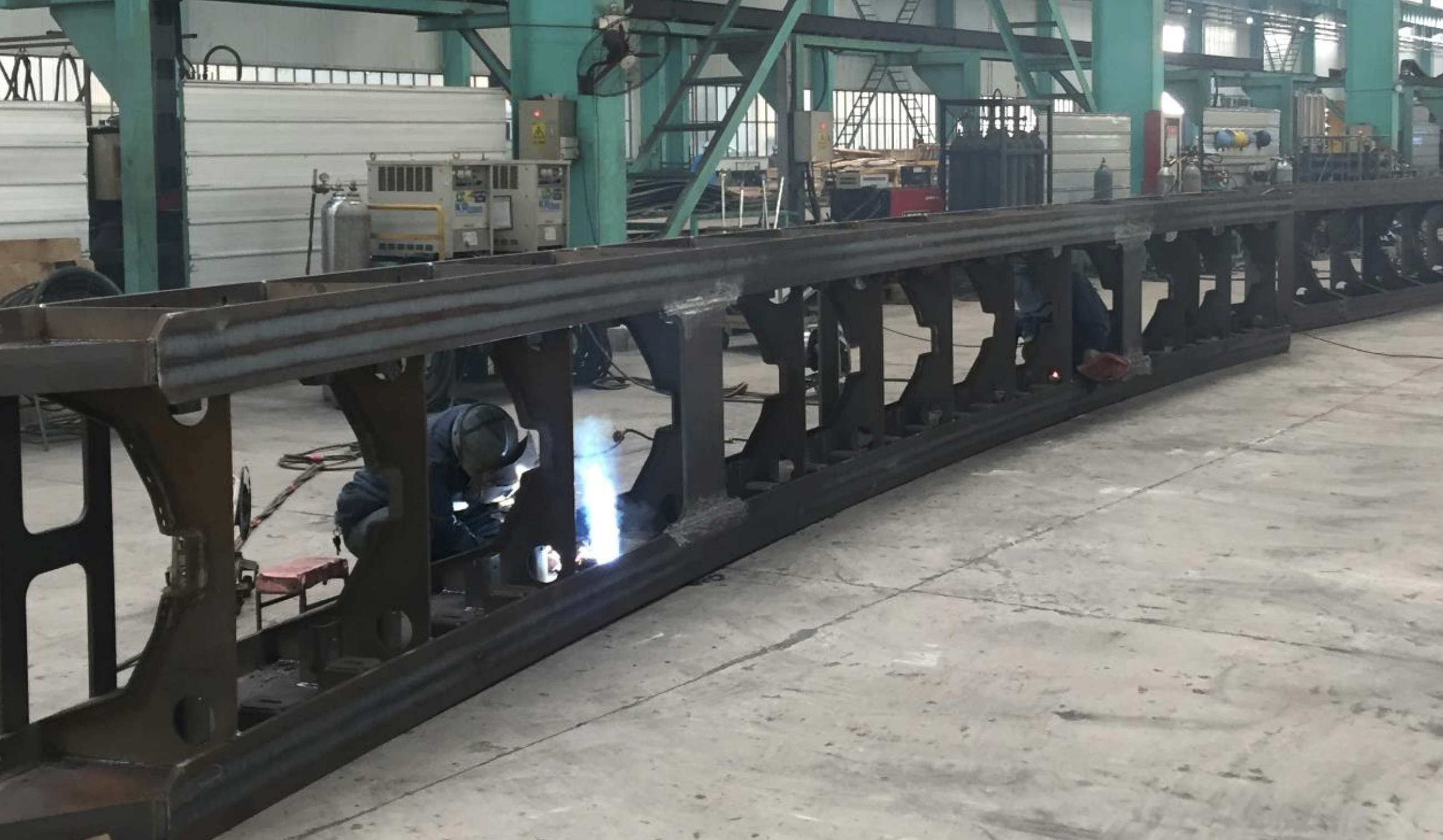
Stick welding (SMAW) during custom fabrication of a heavy machine base — process-line items usually need welding plus large machining after fabrication.
Zone B — Controls and Electronics Enclosures
Controls, drives and electronics need fabricated metal envelopes with controlled flatness, sealing and surface quality. Two product families cover most of this scope.
- Equipment enclosure (Custom-L-2) — mirror-finish welded process-equipment enclosure, 7,000 mm long, 1,300 mm wide and 1,000 mm high, with a 6 mm internal partition and 2.0 t finished mass, built from stainless steel 304/304L mirror-finish sheet with SS304 structural stiffeners. It is typically used on lithium battery coating and drying equipment, roll-to-roll process lines and custom industrial equipment.
- Heavy-duty industrial equipment enclosures (Customized-E-03) — 2–8 tons, 7–12 m long, plate thickness from 1.5 to 25 mm, in carbon steel Q355 or stainless steel 316.
- Energy storage cabinet (Customized-J-05) — material thickness 1.5–5.0 mm, protection ratings of IP54, IP55 or IP65, with powder coating or anti-corrosion coating, in carbon steel, galvanized steel, stainless steel or aluminium.
In-house sheet metal fabrication for this zone covers laser cutting, bending, punching and stamping, welding, machining, assembling and roll forming. Welding processes available include SMAW, GMAW/MIG, GTAW/TIG, SAW, automatic tube-to-tubesheet welding, deep penetration welding and robotic welding, applied to carbon steels, stainless steels, duplex and super duplex, clad and composite plates, and low-alloy steels.
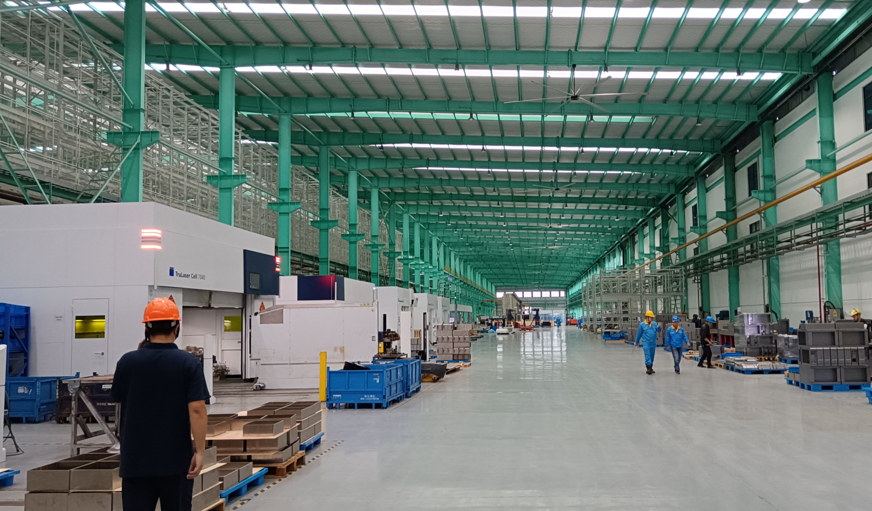
Sheet metal fabrication shop near Shanghai Port, where enclosure panels, cabinets and welded envelopes are produced.
Zone C — Intralogistics and Energy Storage Structures
Automated material flow and battery energy storage generate the most repetitive fabricated items in a modern expansion. They are also the items where dimensional consistency drives the total installed cost.
- AGV steel chassis (PSA-1) — 15 × 2.7 × 3 m, 10.5 t, loading capacity 30 t, built from 25 mm high-strength steel plate S355JR (or A572 Grade 50) with 20 mm NM400 abrasion-resistant wear plate. It is specified for port container tractors, terminal tractor chassis and yard tractors.
- Steel frames and boxes for energy storage systems (XHC-009) — overall dimension 1.1 × 1.1 × 2.2 m, 1,000 kg per unit, with powder coating as the anti-rust system, fabricated from steel tube, steel sheet and carbon steel.
- Heavy equipment skid (Custom-L-6) — 8,000 × 3,000 × 1,200 mm, design equipment load 30–60 t, primary members H300–H500, estimated skid mass 12–20 t, mounting-pad flatness ≤0.20 mm per 1,000 mm, in ASTM A36, A572 Grade 50 or SS304 for corrosive service. Typical equipment: compressors, turbines, generators and petrochemical units.
- Storage container (Customized-C-04) — 4,500 mm diameter, in Q345R + 31603 composite plates that can be customized to the request.
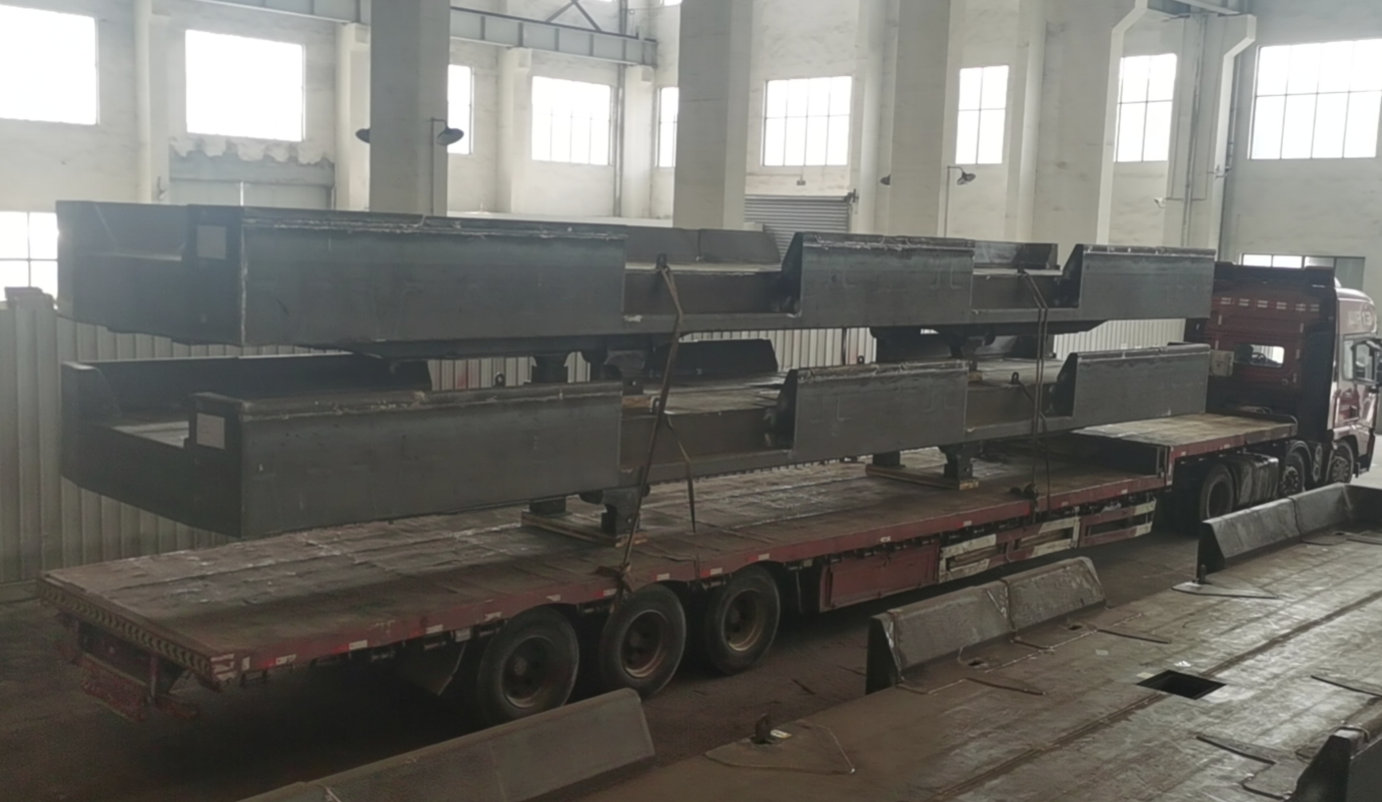
Welding fabrication of AGV steel chassis completed — intralogistics structures carry repeated dynamic loads and need both dimensional and weld verification.
Zone D — Utilities and Fluid Scope: Prefabricated Piping and Cleaning Pigs
Utility tie-ins are where field welding delays usually appear, because piping is installed last and welded in place. Prefabricating pipe spools and pipe assemblies in the shop moves that work upstream and removes it from the critical path.
The welding base needed for prefabrication is available in-house: automatic welding of revolving hollow spindles up to 6,000 mm length with 600/800 mm ID/OD and 100–120 mm thickness at 10 rpm main shaft speed; automatic welding of parts under 6 m with ±90° tilt for almost any weld direction; and plasma welding equipment capable of welding 1–10 mm thickness on 12.5 m tube length. Weld procedure development, welder training, weld repair procedures, distortion control plans, pre- and post-weld heat treatment and post-weld cleaning — pickling and passivation for stainless, grit blasting for carbon steel — are all offered as part of the welding package.
For pipelines that must be cleaned before commissioning, the PITBOSS cleaning pig is a wire-brush pipeline cleaning pig covering a diameter range of 6–42 in. (150–1,050 mm), with conforming steel wire brushes as cleaning elements and polyurethane cups or discs as sealing elements, available in standard or dual-diameter configurations in carbon steel, stainless steel, polyurethane and tempered steel wire brushes. Because pig performance depends on the line itself, pipeline compatibility is confirmed against the actual internal diameter, bends and valves rather than assumed from the nominal size.
Where the fluid scope includes heat exchange or pressure containment, tube sheets are a frequent companion item: tube sheet diameter can be customized up to 10,000 mm, thickness up to 600 mm and drilling depth up to 1,000 mm, held to ±0.05 mm drilling precision and assured by CMM measurement plus UT, PT, MT and PMI inspection, in carbon steel, stainless steel, duplex stainless steel, titanium, stainless steel clad steel or high-strength alloy steel.
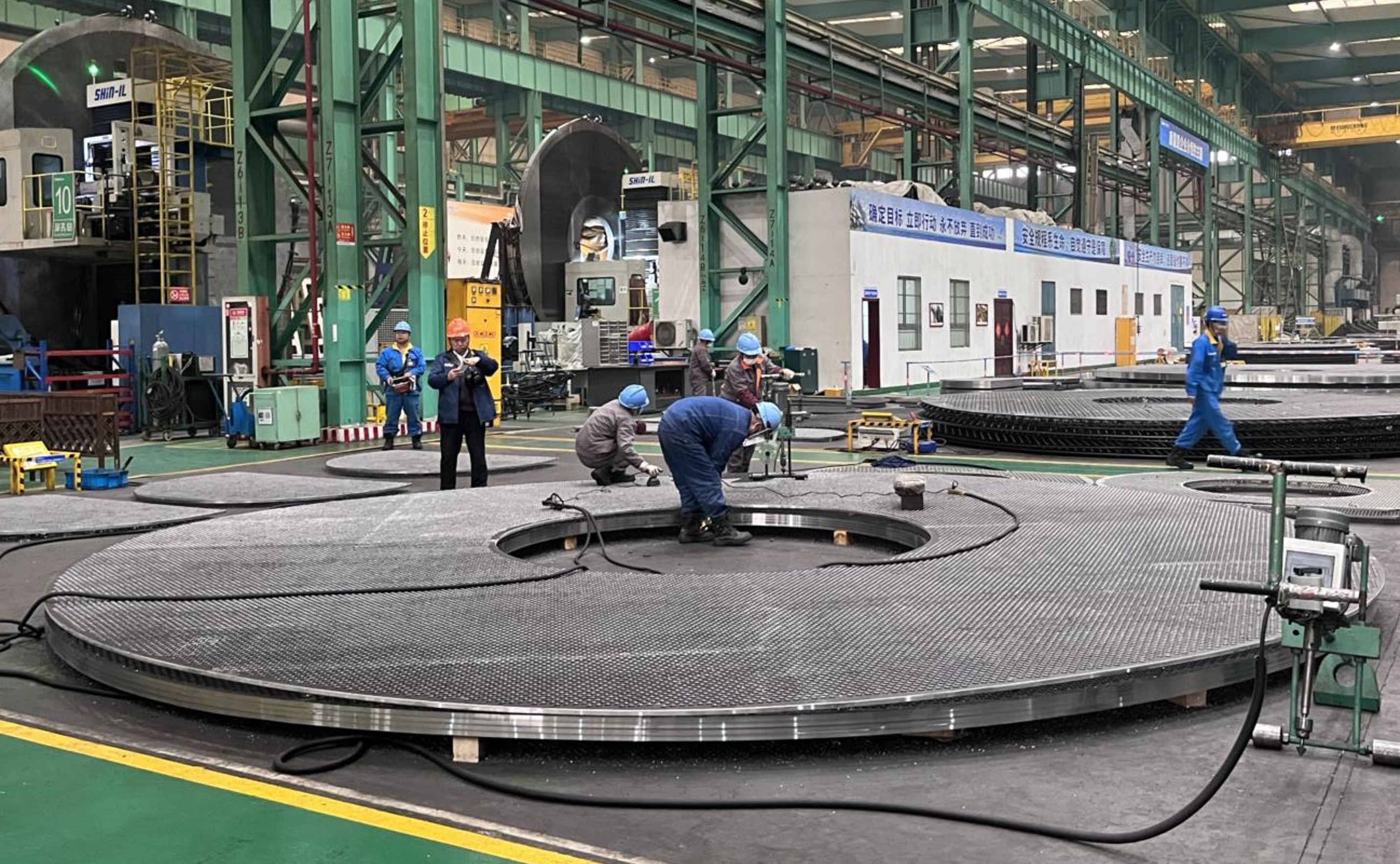
Large tube sheet machining — utility and fluid scopes often combine prefabricated piping with heat exchanger and pressure vessel components.
Step-by-Step Breakdown: What to Fabricate, When to Cast, What to Verify Before Award
Step 1 — Freeze the zone scope with a drawing package
Start by listing items zone by zone and attaching drawings. Openex accepts STEP, IGES, DWG, DXF and PDF files across 2D and 3D formats. For simple parts, a 2D drawing alone is usually enough for quotation. For fast quotations, 2D plus 3D is the preferred route and can produce a price in as little as one to two hours in some cases. A 3D model alone is rarely sufficient, because the 2D drawing normally carries the information that governs fabrication: tolerance, welding requirements, surface roughness and chamfers, cutting direction relative to hot rolling, plate bending radius, metal material requirement, heat treatment and stress-relief method, and finish requirements such as hot-dip galvanizing, sandblasting, painting or powder coating.
Step 2 — Decide what to weld and what to cast
Most plant expansion items — frames, bases, skids, chassis, storage containers, piping — belong in welded fabrication, where the geometry can be built up from plate, tube and section and then machined to final tolerance. Casting makes sense for complex three-dimensional shapes, such as the hinge bodies that are welded onto the ends of steel I-beams in prefabricated building structures, where high-strength pins then pass through the hinge holes to join adjacent beams. Casting product data lists cast steel grades such as ZG35CrMo and ZG07Cr19Ni10, with as-cast surface roughness of Ra 6.3–12.5 μm and Ra 1.6–3.2 μm after machining.
The practical boundary matters. Openex manufactures 80–90% of the metal parts, components and assemblies it exports, and sources the remainder from partners. Casting, forging, hot-dip galvanizing, powder coating and other anti-rust finishes sit in that partner scope. If a project requires only casting, forging or anti-rust finishing, Openex is not the best choice; when a project requires both fabrication and machining as the main work, Openex is a suitable candidate to consider. For special casting or forging grades, long-term partners are used to keep both speed and quality manageable.
Step 3 — Check the capacity envelope against the largest item
Capacity verification is a simple comparison: does the largest, heaviest or longest item in each zone fit the lifting, forming and machining envelope? Reference figures to test against are an overhead crane above 250 tons, press brake capability above 18 m length and 10,000 tons force, CNC machine tool travel up to 50 m × 8 m × 7 m, maximum turning diameter of 22 m, maximum workpiece load of 600 t, and CMM verification capacity of 7 × 4 × 3 m. Items that exceed the envelope usually have to be split, welded on site or designed as bolted assemblies — a decision that must be taken before drawings are released, not after.
Step 4 — Confirm the material grades and the finish route
Openex can fabricate any metal in principle, including brass, bronze and aluminium, but carbon steel and stainless steel dominate real fabrication projects. In carbon steel, the two most common grade families are Q235B (equivalent to A36, SS400 or S235JR) and Q355B (equivalent to A572 Gr50, SS490/SPCC or S355JR); grades such as Q690 and NM450/NM500 are also handled. In stainless steel, SUS 304 and SUS316L are the most frequently used.
Finishing is a separate scope with its own lead time. Surface preparation services include blasting and shot blasting, sandblasting, pickling, descaling, degreasing, phosphating, chromating, passivation, alkaline cleaning, etching and rinsing. Coating application methods cover spray painting, powder coating, electroplating and hot-dip galvanizing, using primer, intermediate coat, topcoat and finish coat, epoxy and zinc-rich coatings. Surface finishing carries a reference MOQ of 15 tons, a 45-day lead time and monthly capacity of 3,000 units.
Step 5 — Fix the quality evidence before production starts
Deciding the evidence package early prevents disputes later. Non-destructive testing methods available include RT, UT, MT, PT, VT and LT. Destructive testing covers chemical analysis of element composition and mechanical testing — tensile (UTS, yield, elongation), impact including low-temperature toughness, bend for ductility, and hardness — plus corrosion testing such as salt spray, and weld procedure qualification that is fully customizable to the buyer's WPS. Dimensional and visual inspection covers length, diameter, angle, roundness, straightness and position measurement, together with surface roughness parameters such as Ra and Rz. Specialized inspections include residual stress analysis, coating and plating inspection and customized NDT systems.
For welding specifically, the available verification extends to visual inspection, dimensional checks, NDT (RT/UT/MT/PT), TOFD and phased array, hardness testing, hydrostatic and pneumatic testing and corrosion testing, alongside WPS, PQR, welder qualification and PWHT procedures. Quality control follows 100% testing or random testing as requirements dictate.
Step 6 — Verify the partner type, certificates and commercial terms
The last check before award is the partner itself. Openex is a metal fabricator with two manufacturing premises — one near Xiamen Port and one near Shanghai Port — producing 80–90% of exported metal parts in-house. In-house procedures include laser cutting, bending, machining, welding, drilling, punching, stamping, assembling and packaging; casting, forging, hot-dip galvanizing, powder coating and other anti-rust finishes come from partner shops. Ask for factory photos, workshop videos and certificates, and read the certificate scope rather than the logo.
Openex holds ISO 9001 (certificate 11426Q01049R001), ISO 14001 (11426E00739R001) and ISO 45001 (11426S00656R001), all issued by Beijing East Allreach Certification Center Co., Ltd., valid from 16 April 2026 to 15 April 2029, and scoped to the manufacture of machined parts, metal structures and sheet metal components except where a license is required. Welding is certified to EN ISO 3834-2 under certificate 23/999-3834 issued by SGS, covering fusion welding of metallic material under welding process 135 and 135-Auto for material groups 1.1 and 1.2, issued on 15 October 2024. Because welding certificates operate on fixed validity windows, a buyer should confirm the current validity date at the time of award and check that the scope covers the processes and material groups actually being ordered. Where pressure containment is in scope, buyers also commonly reference ASME BPVC Section IX, which governs welding and brazing qualifications.
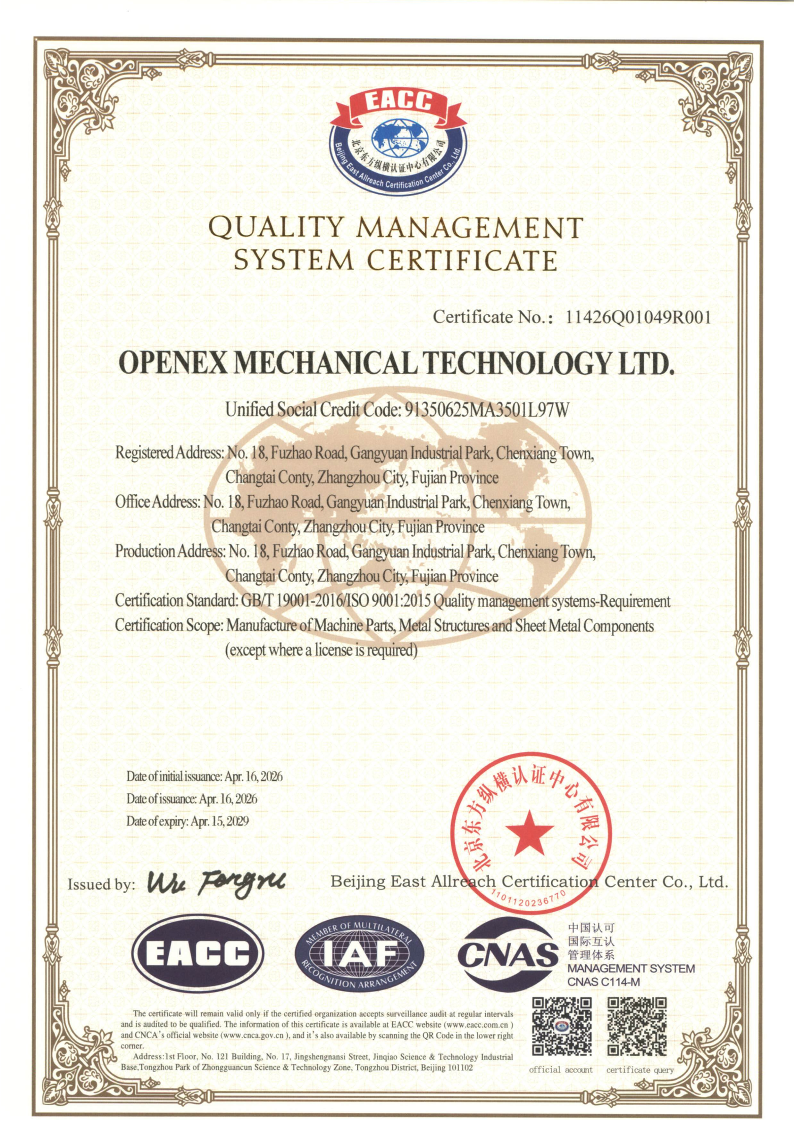
Certificate scope is the point of verification: ISO 9001 covers the manufacture of machined parts, metal structures and sheet metal components.
Use Cases: Fabrication Scopes Delivered for Comparable Projects
The following programs show how the zones above translate into delivered scopes.
- AGV steel chassis, 345 units (Netherlands). Custom steel chassis to carry ocean-worthy containers and LNG tanks. Stable operation for more than four years; welding fabrication, painting and bulk-vessel shipment were all part of the delivery.
- Energy storage cabinets, 1,500 units. Sheet metal fabrication of liquid-cooling metal cabinets for an energy storage developer, keeping the internal temperature within the designed range; three years in service.
- Steel shelves and boxes for lithium battery energy storage. One program of 300 units has run stably for three years; a larger 3,000-unit program reported no rust, no leakage and no deformation, with the frames assembled into containers on site.
- Chain conveyors, 120 units. Steel frames for lithium battery production lines, delivered with high dimensional precision and two years of stable operation.
- Large machinery bases, 45 units. Welding fabrication followed by large machining and assembly support; two years of stable operation, with the highlight being the ability to machine after fabrication and to assemble and test before shipment.
- Tube sheets for a power plant heat exchanger, 45 tons (Indonesia). Tube sheets machined on multi-spindle drilling CNC machines, with remote inspection carried out before shipment.
Comparison: Zone Requirements and Fabrication Route Selection
The first table converts the zone map into a verification checklist. Every specification shown is a documented reference configuration, not a default — final dimensions and tolerances follow the approved drawing.
| Plant zone | Typical fabricated item | Verified reference specification | Verify before award |
|---|---|---|---|
| Process line | Large equipment structural frame (Custom-L-4) | 5,000 × 3,000 × 3,500 mm; main tube 200 × 200 × 10 mm; mass 8–12 t; hole position ±0.20 mm; pad coplanarity ≤0.20 mm per 1,000 mm | Datum scheme, pad coplanarity report, hole position inspection |
| Process line | Large welded press frame (Custom-L-3) | Reference press force 10,000–20,000 kN; clear opening approx. 2,500 × 1,800 mm; main plate 60–120 mm; mass 80–140 t | FEA and fatigue assessment, WPS/PQR, NDT records |
| Process line | Heavy machine base (B-300) | 24 × 24 in. to 72 × 96 in.; top plate 1, 1.5 or 2 in.; welded, stress-relieved, shot-blasted; ground-top flatness ±0.001 in. cumulative | Stress-relief record, shot-blast record, ground-top flatness report |
| Controls and electronics | Equipment enclosure (Custom-L-2) | 7,000 × 1,300 × 1,000 mm; internal partition 6 mm; finished mass 2.0 t; SS304/304L mirror-finish sheet | Surface finish sample, weld dressing, cleaning and passivation |
| Controls and electronics | Heavy-duty industrial equipment enclosure (Customized-E-03) | 2–8 t; length 7–12 m; plate 1.5–25 mm; carbon steel Q355 or stainless steel 316 | Plate gauge verification, coating thickness, interface dimensions |
| Intralogistics | AGV steel chassis (PSA-1) | 15 × 2.7 × 3 m; 10.5 t; loading capacity 30 t; S355JR 25 mm plate; NM400 20 mm wear plate | Material certificates, weld NDT, dimensional check before painting |
| Energy storage | Steel frames and boxes for ESS (XHC-009) | 1.1 × 1.1 × 2.2 m; 1,000 kg per unit; powder coating as anti-rust system | Powder-coating specification, load check, stacking interface check |
| Heavy equipment | Heavy equipment skid (Custom-L-6) | 8,000 × 3,000 × 1,200 mm; design load 30–60 t; members H300–H500; mounting-pad flatness ≤0.20 mm per 1,000 mm | Mounting-pad flatness, lifting-point review, structural review |
| Utilities and fluids | Pipeline cleaning pig (PITBOSS) | Diameter range 6–42 in. (150–1,050 mm); conforming steel wire brushes; polyurethane cups or discs; standard or dual-diameter | Confirmation against actual internal diameter, bends and valves |
Zone verification matrix based on Openex product reference configurations and documented specifications.
The second comparison answers the cast-or-weld question at the route level.
| Route | Typical items | Where it is executed | Reference detail | What to verify |
|---|---|---|---|---|
| Welded fabrication (cut, form, weld, machine) | Machine frames, bases, skids, chassis, storage containers, piping spools, tube sheets | In-house at Openex, including laser cutting, bending, welding, machining, assembling and packaging | Tolerances such as ±0.20 mm general machined tolerance and ≤0.20 mm per 1,000 mm pad coplanarity; welding processes SMAW, MIG, TIG, SAW and robotic welding | WPS/PQR, welder qualification, NDT (RT, UT, MT, PT, VT, LT), dimensional report, stress relief |
| Casting | Complex geometries such as hinge bodies that are then welded to structural beams | Partner shops; not an Openex in-house procedure | Cast steel grades such as ZG35CrMo and ZG07Cr19Ni10; as-cast roughness Ra 6.3–12.5 μm, Ra 1.6–3.2 μm after machining | Material certificate, dimensional report after machining, suitability for welding where the casting joins a fabricated member |
| Forging | Special-grade components requested by the buyer | Partner shops; used when special grades of casting or forging are needed | Handled through long-term partners for speed and quality support | Grade certificate, machining route, interface tolerance with fabricated members |
| Anti-rust finishing | Galvanized and coated structures and components | Partner shops, including hot-dip galvanizing and powder coating | Surface preparation from blasting to passivation; coating systems from primer to zinc-rich coating; 45-day reference lead time, 15-ton reference MOQ | Coating specification, thickness, salt-spray testing where required |
Route comparison. For projects that require only casting, forging or anti-rust finishing, Openex states that it is not the best choice; fabrication plus machining is the core scope.
FAQ
1. What purchasing terms and acceptance criteria apply to a plant expansion fabrication package?
Purchasing terms are set per project. The minimum order quantity is project-based rather than one fixed tonnage, delivery terms available are EXW, FOB, C&F, CIF, DAP and DDP, and payment is made by T/T (wire transfer) or L/C (letter of credit). Acceptance criteria can follow one of three routes: option A, photos, videos and QA sheets supplied by Openex; option B, inspection by the buyer; or option C, inspection by a third party appointed by the buyer. Reference MOQ figures used in specific scopes are 25 tons for welding fabrication and 15 tons for machining and surface finishing, so the effective MOQ depends on which zones the package covers.
2. Is Openex a manufacturer or a supplier, and what factory photos, workshop videos and certificates can be checked?
Openex is a metal fabricator, not a trading supplier: it operates two manufacturing premises, one near Xiamen Port and one near Shanghai Port, and manufactures 80–90% of the metal parts, components and assemblies it exports, sourcing the balance from partner shops. In-house procedures are laser cutting, bending, machining, welding, drilling, punching, stamping, assembling and packaging; casting, forging, hot-dip galvanizing, powder coating and other anti-rust finishes come from partners. Buyers can request factory photos, workshop videos and certificates. Certificates include ISO 9001 (11426Q01049R001), ISO 14001 (11426E00739R001) and ISO 45001 (11426S00656R001), all issued by Beijing East Allreach Certification Center Co., Ltd. and valid from 16 April 2026 to 15 April 2029, scoped to the manufacture of machined parts, metal structures and sheet metal components except where a license is required. Welding is certified to EN ISO 3834-2 under certificate 23/999-3834 issued by SGS, covering fusion welding of metallic material for welding process 135 and 135-Auto and material groups 1.1 and 1.2, issued 15 October 2024.
3. What metal materials can be processed for these fabrication scopes?
Any metal can be fabricated in principle, including brass, bronze and aluminium, but carbon steel and stainless steel are the most common materials in the fabrication projects Openex receives. In carbon steel, the most frequently used grade families are Q235B (A36, SS400, S235JR) and Q355B (A572 Gr50, SS490/SPCC, S355JR); additional grades such as Q690 and NM450/NM500 are also handled. In stainless steel, SUS 304 and SUS316L are the most common. Where a project needs special grades of casting or forging, Openex supplies them through long-term partners and states the fabrication procedures involved: cutting, machining, welding, drilling, sand blasting and painting.
4. What is the minimum order quantity, and can a smaller first order be placed before volume production?
There is no single MOQ figure that fits every item, and Openex states that the answer depends on what is ordered. Small components can be quoted from 1 unit, with a typical production lead time of 3 days and monthly capacity of 1,000 pieces. Welding fabrication uses a reference MOQ of 25 tons with a 30–45 day lead time and monthly capacity of 5,000 tons; machining uses a reference MOQ of 15 tons with a 30–45 day lead time and monthly capacity of 3,000 tons; surface finishing uses a 15-ton reference MOQ with a 45-day lead time. Order economics improve with volume: full container loading costs less in freight than LCL, overhead spreads across a larger quantity, and larger volumes support better material purchasing. Small, low-value parts with small quantities are not the strongest fit for an overseas fabrication supplier, while large parts in container-loading quantities and repeated orders are.
5. What drawing formats are needed, and what lead times should the project schedule assume?
Openex accepts STEP, IGES, DWG, DXF, PDF and other 2D and 3D drawing formats. For simple parts, 2D drawings alone are sufficient for quotation; supplying both 2D and 3D drawings is the fastest route and can shorten quotation to one or two hours in some cases. A 3D model alone is rarely enough to quote, because the 2D drawing carries tolerance information, welding requirements, surface roughness and chamfers, cutting direction relative to hot rolling, plate bending radius, metal material requirement, heat treatment and stress-relief method, and finish requirements such as hot-dip galvanizing, sandblasting, painting or powder coating. For scheduling, small components run at a typical 3-day lead time, welding and machining scopes at 30–45 days, and surface finishing at 45 days. To move a plant expansion package forward, send the zone-by-zone item list together with 2D and 3D drawings for a quotation, and confirm the inspection route at the same time.
Conclusion: Build the Zone Map First, Then Award the Fabrication Package
A plant expansion is equipped zone by zone. Process-line structures need welded frames, press frames and machine bases with documented flatness and hole position. Controls and electronics need enclosures with controlled surface finish and sealing. Intralogistics and energy storage need AGV steel chassis, steel frames and boxes with anti-rust systems that survive real operating conditions. Utilities need prefabricated piping and pipeline cleaning pigs that match the actual line. Once each item is mapped to a zone, the buyer-facing checks become straightforward: confirm what metal materials can be processed, confirm whether the partner is a manufacturer or a supplier, and confirm the purchasing terms and acceptance criteria — supported by factory photos, workshop videos and certificates whose scope matches the order.
For projects where fabrication and machining are the main work, Openex fabrication can be evaluated against these criteria. The full capability reference, including equipment lists and product configurations, is available in the brochure.
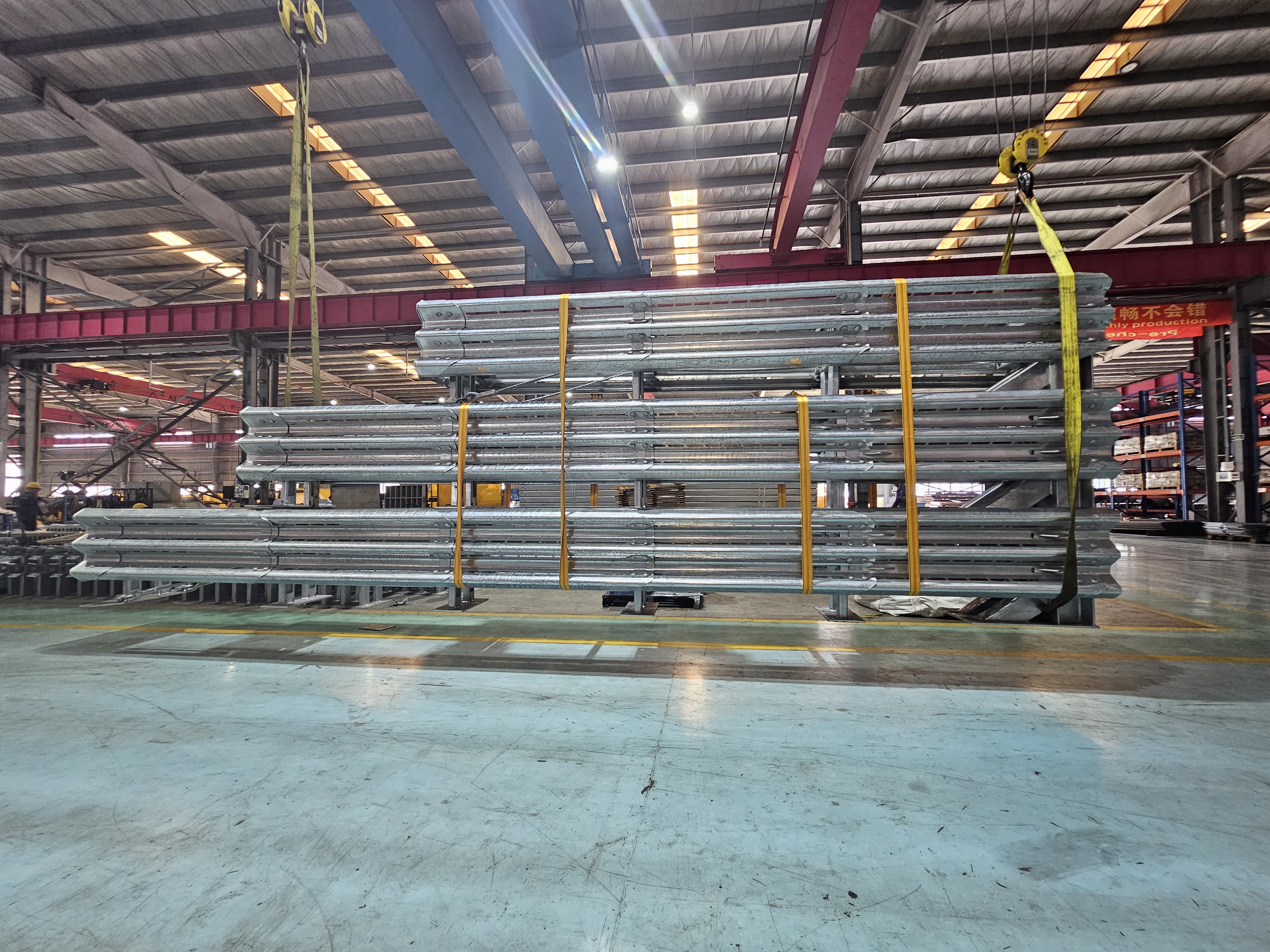
Assembling workshop near Xiamen Port, where fabricated components are assembled and checked before shipment.
Next step for your expansion package
Send your zone-by-zone item list with 2D and 3D drawings to receive a quotation and a proposed inspection route. Buyers who want to review capability first can download the brochure:
Openex fabrication capability brochure (PDF)
Xiamen Openex Mechanical Technology Limited — www.cncmetalworking.com
Contact: Luna | Email: sales2@openex.com.cn | Tel / WhatsApp: +86 150 6078 7506
Add: Unit 4801, No 99 Yilan Rd., Xiamen, FJ, China
Have Questions or Need More Details?
Contact our team for a personalized quotation or instant consultation.
Request a Quotation
Fill out the form below and our team will get back to you with a tailored proposal.
WhatsApp Direct Chat
Prefer to chat in real-time? Message us on WhatsApp for instant assistance & quick answers.
- Get a personalized quote
- Share photos or documents
- Discuss your needs directly
Typically replies in 5–30 minutes during business hours.