Top Metal Fabrication Products for Energy Storage and AGV Automation: A Ranked List
Six fabricated builds carry most of the structural risk in an energy storage or AGV automation project: steel frames and boxes for energy storage systems, flywheel energy storage shells, AGV steel chassis, equipment enclosures, heavy equipment skids, and large equipment structural frames. They are ranked below by specification-lock priority — the combined weight of integration interfaces, alignment sensitivity and structural duty — because that is the order in which drawings, welding plans and inspection gates should be frozen.
The ranking is an editorial judgement about fabrication criticality. It is not a ranking of suppliers, and it does not claim that one build is technically harder than another in absolute terms. The reference fabricator behind the verified examples is Xiamen Openex Mechanical Technology Ltd (Openex), a custom metal fabrication and machining manufacturer founded in 2009 that runs two manufacturing premises near Xiamen Port and Shanghai Port, with 30,000 ㎡ of factory space, 200 employees, 35 engineers and an annual output of 20,000 tons.
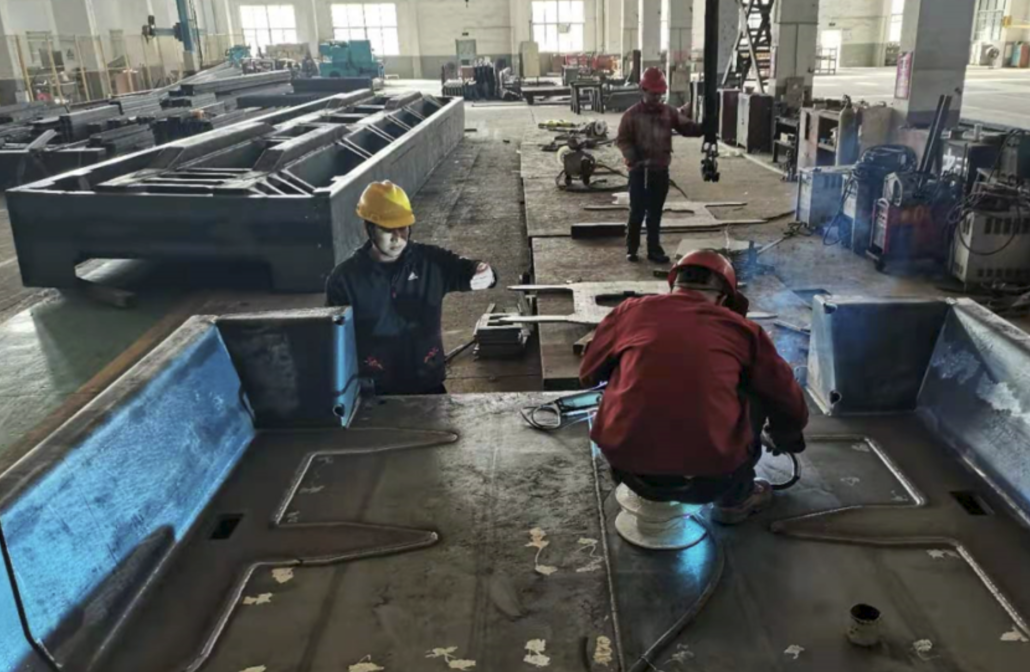
Welding fabrication for AGV steel chassis, Openex manufacturing premise near Xiamen Port.
The ranked list at a glance
- AGV steel chassis (PSA-1) — the datum of the whole vehicle; the widest interface count and the highest dynamic weld duty.
- Flywheel Energy Storage Shell (AKI-1) — containment plus rotating clearance; geometry must be recovered by machining after welding.
- Steel Frames and boxes for Energy Storage System (XHC-009) — thousands of repeated interfaces; slot pitch and coating decide field fit.
- Equipment Enclosure (Custom-L-2) — the machine-to-environment interface; flatness and seam continuity decide sealing.
- Heavy equipment skid (Custom-L-6) — a transportable datum that must survive lifting and sea freight.
- Large equipment structural frame (Custom-L-4) — weld volume and distortion control dominate the whole job.
Problem Definition: Why the Fabricated Build Sets the Schedule
In an energy storage container or an AGV fleet, the fabricated build is the part that accepts everything else. Battery modules, cooling plates, busbars, doors, drives, sensors, cable entries, lifting points and lifting frames all land on the rack, cabinet, chassis, shell, skid or frame. When that build is late, every downstream step waits; when it is out of tolerance, the correction is usually made in the field with a grinder or a shim.
Three failure modes repeat across these projects. The first is interface mismatch: bolt patterns, module slot pitch, cable entry positions and mounting faces that do not line up after coating. The second is alignment drift: welding heat moves a machined face or closes a bore, so a surface that was correct on the drawing is no longer correct on the part. The third is structural distortion under lifting, transport or operating load, which shows up as a door that no longer seals or a drive that no longer sits flat.
A fourth, quieter problem sits upstream of all three: an incomplete drawing package. Openex accepts STEP, IGES, DWG, DXF, PDF and other 2D and 3D formats, but notes that 3D files alone are rarely sufficient to quote, because tolerance, welding requirements, surface roughness and chamfer, cutting direction relative to the hot rolling direction, plate bending radius, material grade, heat treatment and stress relief method, and finish requirements such as hot dip galvanization, sandblasting, painting or powder coating are usually only defined on the 2D drawing. In practice, the speed of both quotation and fabrication depends on how completely those eight points are stated.
Industry Background: What Changed in Energy Storage and AGV Fabrication
Energy storage hardware has moved from light shelving toward container-scale cabinets with integrated thermal management. Openex has produced liquid-cooling cabinets for energy storage systems in a program of 1,500 units, where the metal cabinet contains the internal cooling system that holds the inner temperature inside the designed range. That change pulls sheet metal fabrication, welding and coating into one specification: a cabinet that leaks air or water, or whose door frames deform after coating, fails regardless of how good the electrical design is.
AGV platforms have moved the other way, from light frames toward heavy weldments. For a Netherlands AGV builder, Openex supplied 345 custom steel chassis for vehicles designed to carry ocean-worthy containers, LNG tanks and other large objects, and these chassis are still in stable operation after more than four years. Heavy AGV chassis work uses high-strength steel such as Q690, with some sections in NM500 wear-resistant grade — material choices that raise the importance of welding procedure qualification and distortion control rather than lowering it.
Flywheel energy storage adds a third pattern: a rotating machine inside a welded shell. Openex has delivered 400 flywheel energy storage shells, in stable operation for five years, where the fabrication route runs from cylinder rolling and welding through rough turning to final precision turning of the shell and its top plate.
The supply base behind these builds is export-oriented. Openex exports about 80% of its output to the EU, USA, Australia, New Zealand, Japan, Singapore, South America and the Middle East, and its customers sit in energy storage systems, power plants, machinery, construction, mining, oil and gas, and nuclear work. Fabrication capability spans laser cutting, bending, punching and stamping, welding, machining, assembly, roll forming, casting, forging, galvanizing and powder coating, with an overhead crane capacity above 250 tons, a bending machine that reaches 18 meters in length and 10,000 tons, and CNC machine tools with travel up to 50 m × 8 m × 7 m.
Detailed Solution: The Six Builds, Ranked
Each entry below explains why the fabricated form matters, then lists what a buyer should verify in welding, machining and dimensional control. The verification points are the ones that most often decide whether the build integrates cleanly on the customer's line.
Rank 1AGV steel chassis (PSA-1)
The AGV chassis is the datum of the entire vehicle. Drive units, steering, battery box, deck plates, sensor brackets and lifting points all derive their position from one welded structure, and the vehicle's steering geometry and sensor calibration inherit whatever error the chassis carries. Openex built 345 of these chassis for a Netherlands AGV manufacturer whose vehicles carry ocean containers and LNG tanks.
Why the fabricated form matters: an AGV chassis is loaded dynamically and unevenly, so the welds on the primary load path are fatigue details rather than static joints. It is also the part that must stay flat enough for drives to sit on their mounting faces without shimming, and stiff enough that the deck does not twist when the vehicle lifts a container. High-strength grades such as Q690, with NM500 in wear sections, make heat input and weld sequence part of the quality plan.
Verify before release
Welding: procedure qualification (WPS and PQR), welder qualification, joint preparation, full penetration at primary load paths, and a distortion control plan. Openex runs six-axis robotic welding cells with repeat positioning accuracy of ±0.05 mm alongside manual stations, and offers NDT by RT, UT, MT and PT, plus TOFD or phased array where specified.
Machining: mounting faces should be machined after welding, not before. Openex machines large weldments on a PAMA Speedram 180 floor-type boring and milling center with 4,000–6,000 mm travel in X and Y, and on double-gantry five-axis machining centers.
Dimensional control: overall length, diagonal check, hole position for drive and deck interfaces, and flatness of the mounting faces. Large parts can be checked on a Zeiss CMM with 7 m × 4 m × 3 m capacity.
Verified outcome: 345 units delivered, stable operation for more than four years, with the chassis shipped as a weldment and coated before dispatch.
Rank 2Flywheel Energy Storage Shell (AKI-1)
The flywheel shell houses a rotating mass, so the fabricated form has two jobs at once: containment and clearance. Roundness, wall thickness and concentricity after welding decide whether the rotor can be balanced and whether the housing keeps its designed air gap. Openex has produced 400 flywheel energy storage shells that have run stably for five years, typically installed beside solar or wind farms to support electricity quality.
Why the fabricated form matters: the sequence is roll, weld, rough machine, finish machine. Welding always moves a rolled cylinder, so the geometry has to be recovered afterwards by turning rather than assumed from the formed shape. If a supplier quotes a shell as a welded-only item with no post-weld machining, the alignment risk moves downstream to the customer.
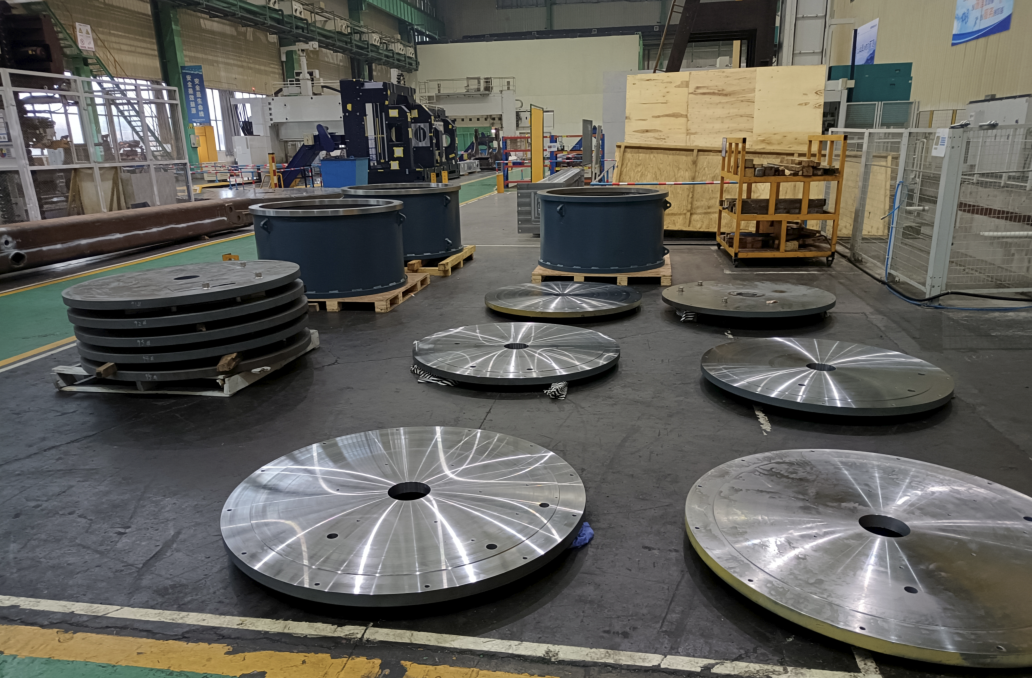
Flywheel energy storage shells and top plates after fabrication and machining.
Verify before release
Welding: longitudinal and circumferential seam procedures, penetration requirement, and the inspection method agreed per seam — visual and dimensional check as a minimum, with RT, UT, MT or PT where the containment duty requires it. For stainless shells, pickling and passivation after welding should be named in the specification.
Machining: internal and external turning, concentricity between bore and outer diameter, flange face flatness, and parallelism of the end faces. Openex uses CNC vertical lathes and a Wuzhong single-column turning-milling center with maximum machining diameter of 22 m, maximum workpiece load of 600 t and maximum workpiece height of 6.5 m.
Dimensional control: roundness or circularity, cylindricity, wall thickness and flange position, recorded in a per-unit inspection report.
Verified outcome: 400 units delivered with final inspection reports, in stable operation for five years.
Rank 3Steel Frames and boxes for Energy Storage System (XHC-009)
This is the highest-volume build in most energy storage programs and the one where repetition becomes a quality issue rather than an advantage. Racks and module boxes must repeat the same slot pitch, squareness and coating thickness across hundreds or thousands of units, because the modules and cooling hardware they accept are themselves interchangeable.
Why the fabricated form matters: an energy storage rack is a stack of tolerances. Bend angle accuracy sets the shelf level, shelf level sets module insertion, and module insertion sets whether the cooling path closes as designed. A rack program that produces no rust, no leakage and no deformation in service is a coating and welding achievement as much as a forming one.
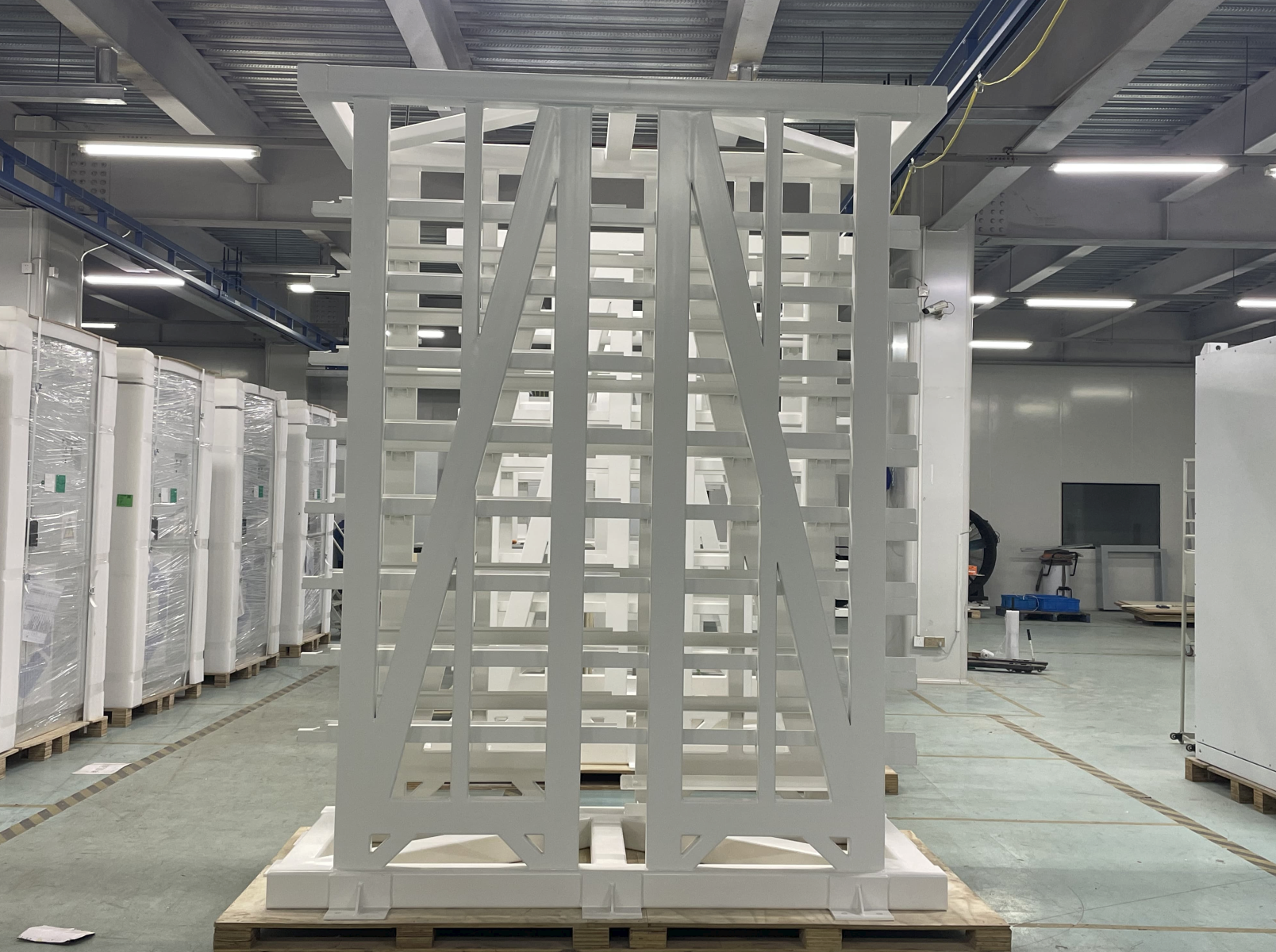
Li-battery energy storage shelf fabricated at the Openex manufacturing premise near Xiamen Port.
Verify before release
Welding: fillet sizes, weld length and pitch on thin sheet, burn-through limits, and whether robotic welding is used for repeatability. Openex uses six-axis robotic arc welding units with seam tracking to correct clamping deviation, running continuously and holding a consistent welding speed.
Forming and machining: laser-cut hole positions, bend line accuracy, and press brake capability for long members — Openex runs bending machines up to 18 m in length and 10,000 tons.
Dimensional control: slot pitch, squareness, flatness of each shelf level, hole position for module fixing, and coating thickness after powder coating or galvanizing.
Verified outcome: a 300-unit rack program in stable operation for three years, and a separate 3,000-unit energy storage program reported with no rust, no leakage and no deformation.
Rank 4Equipment Enclosure (Custom-L-2)
An equipment enclosure is the boundary between the machine and its environment, and it is usually the last item designed and the first item blamed. It carries drives, controls, sensors and cable entries, and it must keep out dust, water and, in liquid-cooled energy storage cabinets, keep its own internal circuit sealed.
Why the fabricated form matters: enclosure quality is decided by flatness and seam continuity rather than by plate thickness. A gasket face that is 1 mm out of flat will leak no matter how good the gasket is, and a door that is square before coating but twisted after curing will not close. This is why enclosures sit below the chassis and shell in this ranking: their structural duty is lower, but their fit tolerances are not generous.
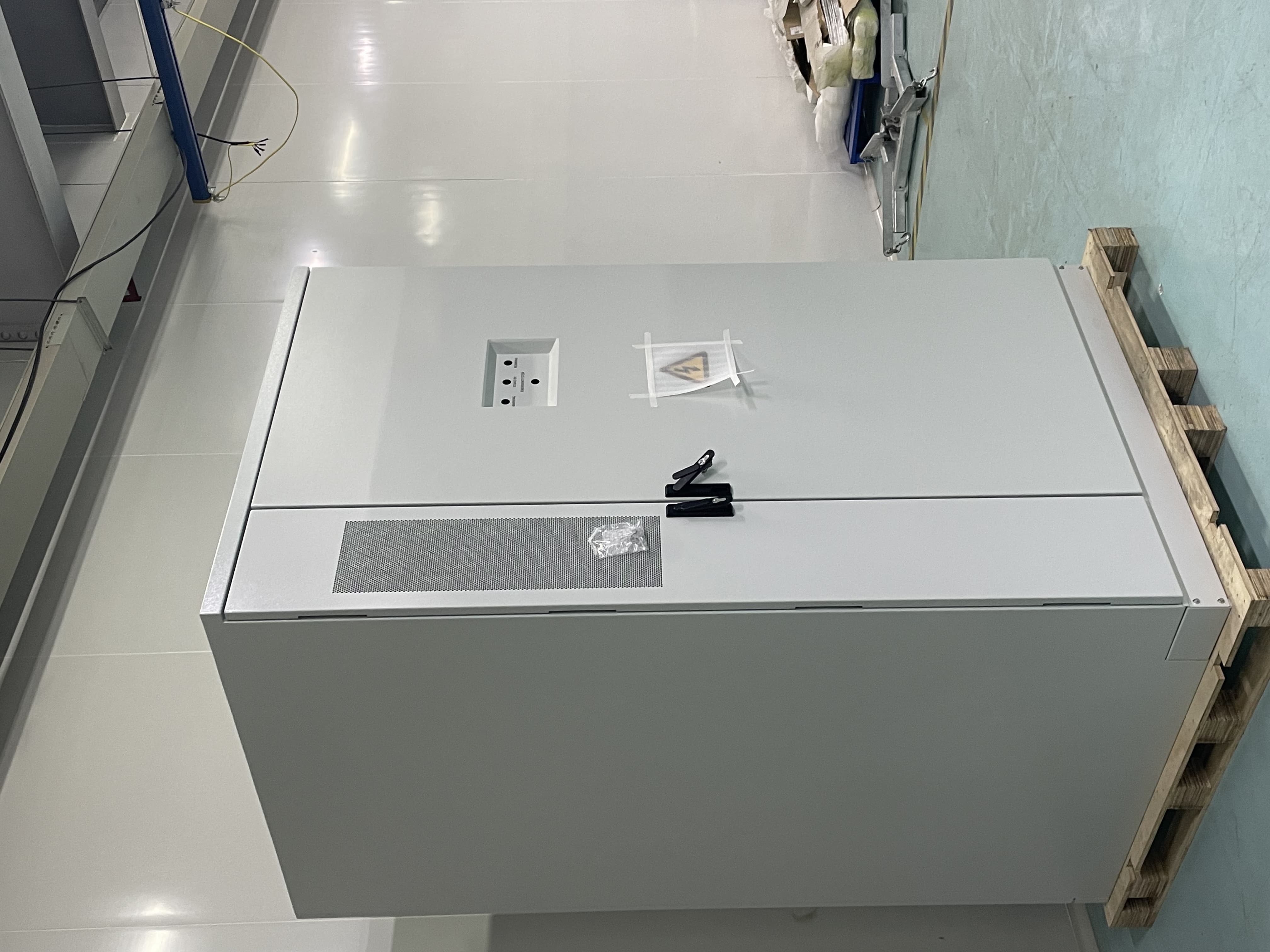
Liquid-cooling cabinets for energy storage systems, fabricated from sheet metal at Openex.
Verify before release
Welding: seam continuity on any face that must be liquid-tight or dust-tight, plus a leak or water test method. Openex offers hydrostatic and pneumatic testing alongside visual, dimensional and NDT checks.
Fabrication and machining: hole positions and cut-outs come from laser cutting rather than drilling after bending; insert and stud positions should be agreed as critical-to-function dimensions.
Dimensional control: overall dimensions, door gap and squareness, flatness of gasket faces, and hole pattern for the components that mount inside. The ISO 9001 scope explicitly covers sheet metal components.
Verified capability: heavy-duty industrial equipment enclosures (Customized-E-03) sit in the same sheet-metal, welding and coating route as the 1,500-unit liquid-cooling energy storage cabinet program.
Rank 5Heavy equipment skid (Custom-L-6)
A skid is a transportable datum. Equipment mounted on it must remain aligned after lifting, after sea freight, and after being set down on a site that is not perfectly level. The fabricated form therefore has to be stiff in the directions it is lifted and transported, and machined where the mounted equipment lands.
Why the fabricated form matters: the lifting points and the main beam connections carry the entire assembly weight plus dynamic factors during handling, so they are the welds that get the strictest inspection. Pad positions then decide whether pumps, compressors or process equipment bolt on without site rework.
Verify before release
Welding: full penetration at lifting lugs and primary beam connections, NDT extent agreed in advance, pre- and post-weld heat treatment where the material or section requires it, and a documented distortion control plan.
Machining: mounting pads machined after welding, with pad flatness, pad height and position held to the drawing. Openex machines large weldments on boring and milling centers with up to 6,000 mm travel in X and Y, and on gantry centers that complete milling, boring, drilling and turning in a single setup to avoid repeated positioning error.
Dimensional control: pad positions, diagonal check, lifting point location and overall squareness, recorded before coating.
Logistics note: for cargo that is too long or too wide for a container, Openex reports experience shipping oversized assemblies by breakbulk vessel, using a wharf no more than 2 km from its fabrication shop.
Rank 6Large equipment structural frame (Custom-L-4)
Large structural frames are the most forgiving of the six builds on tolerance per weld, and the least forgiving on distortion. Weld volume, heat input and welding sequence decide whether a frame meters long stays straight, and whether the machined pads at each end stay in line with each other.
Why the fabricated form matters: for a generator set base frame that carries both the diesel engine and the generator, the frame is what keeps the two machines coaxial. Openex fabricated 100 such base frames — base frame, base tank and genset base assembly — for a diesel generator manufacturer, with 20 years of stable operation reported and good resistance to rust named as a program highlight.
Verify before release
Welding: procedure qualification, welding sequence to balance heat input, submerged arc or gas metal arc for long runs, stress relief where specified, and straightness check after welding rather than before.
Machining: machine the pads and faces after welding. Openex reports cases where large machining after fabrication, plus assembly and testing, were part of the scope for large machinery bases.
Dimensional control: straightness, camber, hole positions, coaxiality between engine and generator mounting pads, and overall length.
Verified outcome: 100 generator base frames in service with 20 years of stable operation, and 45 large machinery bases machined after fabrication and in stable operation for two years.
Step-by-Step Breakdown: Locking the Specification in Seven Steps
The sequence below applies to any of the six builds. It converts the ranking above into a release process that both the buyer's engineering team and the fabricator can sign against.
- Issue a complete drawing set. Send 2D and 3D together where possible. The 2D drawing should carry tolerance, welding requirements, surface roughness and chamfer, cutting direction relative to the hot rolling direction, plate bending radius, material grade, heat treatment and stress relief method, and the finish requirement. Openex notes that some quotations can be returned within one or two hours when both formats arrive complete.
- Name the datum and the critical-to-function dimensions. For a chassis it is the drive mounting face and deck flatness; for a shell it is bore-to-OD concentricity; for a rack it is slot pitch; for a skid it is pad position. Everything else can be general tolerance.
- Agree the welding plan. WPS and PQR, joint preparation, welding process, inspection method and extent, heat treatment, and the distortion control approach. Openex works with SMAW, GMAW and MIG, GTAW and TIG, submerged arc, automatic tube-to-tubesheet and robotic welding across carbon steel, stainless steel, duplex and super duplex, clad plate and low-alloy steel.
- Decide what is machined after welding. Any face that receives a bearing, a drive, a seal or a gasket should be on this list. Machining before welding is a false economy on all six builds.
- Agree the dimensional report and who signs it. Openex applies 100% inspection or random testing as required, and can measure large parts on a Zeiss CMM with 7 m × 4 m × 3 m capacity to micron-level precision.
- Run a pre-assembly or fit check where parts mate. Flywheel shells are checked with their top plates; AGV chassis are checked against deck and drive interfaces; frames are trial-assembled before disassembly and packing.
- Agree coating, packing, acceptance route and shipping mode. Acceptance can follow three routes: photo, video and QA sheet evidence from Openex; inspection by the buyer; or inspection by a third party appointed by the buyer.
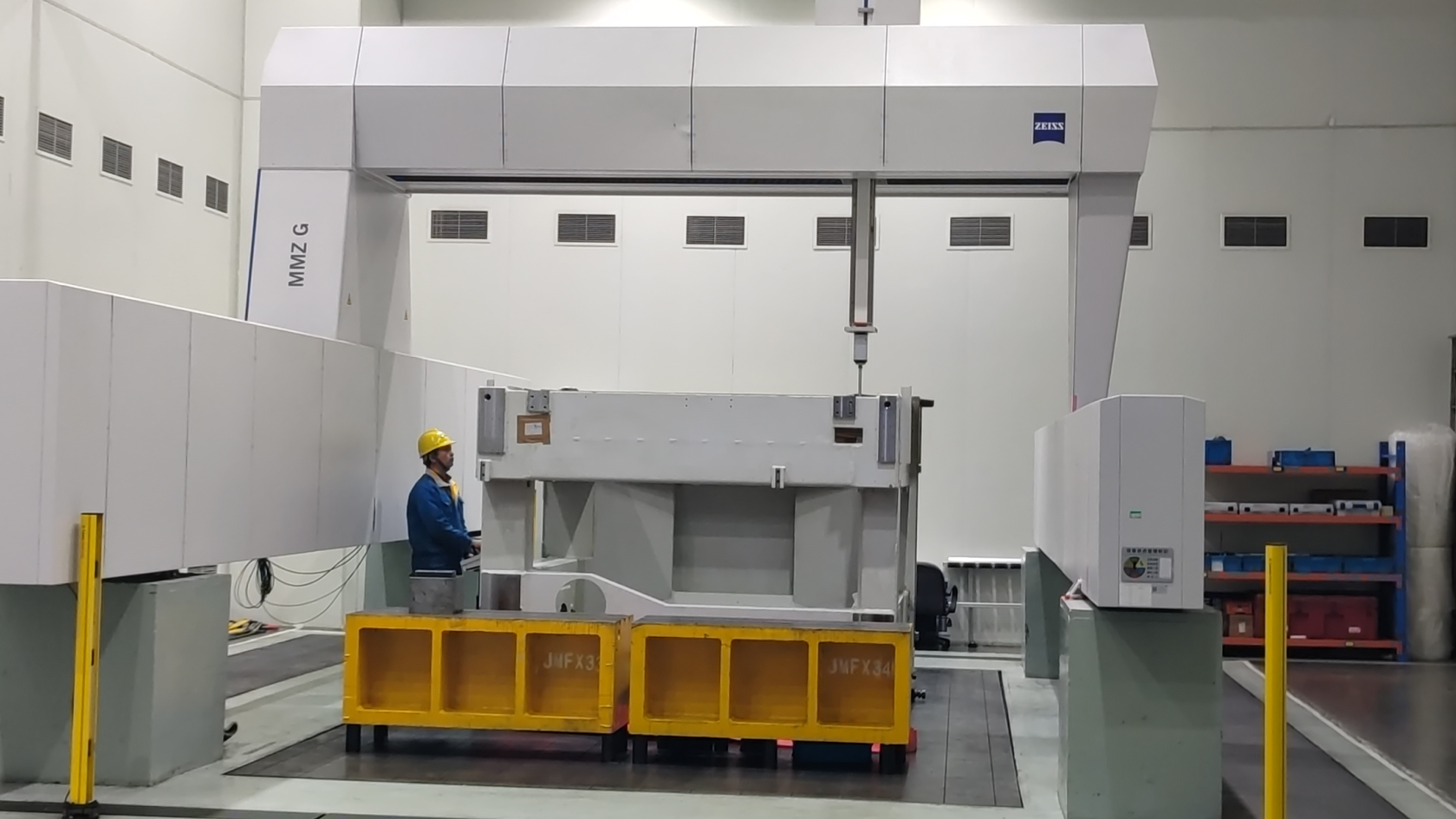
Zeiss large CMM with 7 m × 4 m × 3 m capacity and micron-level precision, used for final dimensional verification.
Use Cases: Verified Programs Behind the Ranking
These programs illustrate how the six builds behave once they leave the fabrication shop.
- Container and LNG tank AGV chassis (Netherlands): 345 units, heavy steel chassis in Q690 with NM500 sections, stable operation for more than four years, loaded onto a bulk carrier for export.
- Flywheel energy storage shells: 400 units, fabricated by rolling and welding then finished by precision turning, five years of stable operation, delivered with final inspection reports.
- Energy storage racks and boxes: a 300-unit rack program in stable operation for three years, and a 3,000-unit program reported with no rust, no leakage and no deformation and with easy assembly into containers.
- Liquid-cooling energy storage cabinets: 1,500 units, sheet metal cabinets with an internal cooling system holding the inner temperature inside the designed range, in operation for three years.
- Generator set base frames: 100 units for a diesel generator manufacturer, with high coaxiality between engine and generator mounting, 20 years of stable operation.
- Large machinery bases: 45 units with machining after fabrication and assembly and testing included in scope, in stable operation for two years.
- Chain conveyors for a lithium battery line: 120 units for a battery manufacturer, in stable operation for two years.
- Steel coil pallets for a steel mill (Japan): 30 units used to store and tranship steel coils and bars, in stable operation for 20 years.
Comparison Table: The Six Builds Side by Side
| Rank | Fabrication build (model) | Dominant fabrication demand | Verification gate that matters most | Verified program evidence |
|---|---|---|---|---|
| 1 | AGV steel chassis (PSA-1) | Widest interface count plus dynamic weld duty | Mounting-face flatness and NDT after welding | 345 units for a Netherlands AGV builder, stable operation over 4 years |
| 2 | Flywheel Energy Storage Shell (AKI-1) | Alignment and containment of a rotating mass | Roundness and concentricity after final turning | 400 units, 5 years of stable operation, per-unit inspection reports |
| 3 | Steel Frames and boxes for Energy Storage System (XHC-009) | Repeated dimensional stack-up across large volumes | Slot pitch, squareness and coating continuity | 300 units in service 3 years; separate 3,000-unit program with no rust, no leakage, no deformation |
| 4 | Equipment Enclosure (Custom-L-2) | Fit and sealing of sheet metal parts | Flatness of gasket faces and hole pattern | Heavy-duty industrial enclosures (Customized-E-03); 1,500-unit liquid-cooling cabinet program on the same route |
| 5 | Heavy equipment skid (Custom-L-6) | Lifting and transport stiffness | Pad position and full-penetration welds at lifting points | Machining after welding on boring and milling centers with 4,000–6,000 mm X and Y travel |
| 6 | Large equipment structural frame (Custom-L-4) | Weld volume and distortion control | Straightness and coaxiality after machining | 100 generator base frames with 20 years of stable operation; 45 large machinery bases |
FAQ
Which certifications and documents should a buyer verify for OEM steel assemblies?
Openex holds ISO 9001 certificate 11426Q01049R001, issued 16 April 2026 and valid to 15 April 2029, with the scope Manufacture of Machined Parts, Metal Structures and Sheet Metal Components (except where a license is required). Environmental management is covered by ISO 14001 certificate 11426E00739R001 and occupational health and safety by ISO 45001 certificate 11426S00656R001, both issued 16 April 2026 and valid to 15 April 2029. Welding documentation is prepared per project and can include WPS, PQR, welder qualification and a PWHT procedure, with inspection by VT, dimensional check, NDT (RT, UT, MT, PT), TOFD or phased array, hardness test and hydrostatic or pneumatic test. Buyers should check the certificate number, scope wording and expiry date rather than the logo alone.
What size limits apply to custom metal fabrication for large assemblies?
Openex runs an overhead crane capacity above 250 tons, bending machines up to 18 meters in length and 10,000 tons, and CNC machine tools with travel up to 50 m × 8 m × 7 m. Large machining includes a Wuzhong single-column turning-milling center with 22 m maximum machining diameter, 600 t maximum workpiece load and 6.5 m maximum workpiece height, a PAMA Speedram 180 floor-type boring and milling center with 4,000–6,000 mm travel in X and Y, and a Zeiss CMM with 7 m × 4 m × 3 m capacity for dimensional verification.
How are orders, MOQ and purchasing terms structured?
MOQ is project-based rather than a fixed number of pieces, and delivery terms can be EXW, FOB, C&F, CIF, DAP or DDP. Payment is by T/T wire transfer or by L/C. On cost, Openex notes that a full container load saves freight compared with less-than-container load, that overhead spread across a larger quantity is lower per unit, and that repeated ordering supports both stable quality and better material purchasing.
Can a buyer validate a build before mass production?
Yes, through a defined acceptance route. Openex offers three options: photo, video and QA sheet evidence produced by Openex; inspection by the buyer; or inspection by a third party appointed by the buyer. Dimensional records can be supported by CMM reports, and remote inspection has been used before shipment on large machined parts. For small parts produced in large quantities, Openex has also developed visual inspection machines to check 100% of output, which is more consistent than manual inspection alone.
What lead times and production capacity apply?
Welding fabrication is typically quoted at 30–45 days with a monthly capacity of 5,000 tons, machining at 30–45 days with a monthly capacity of 3,000 tons, and surface finishing at 45 days with a monthly capacity of 3,000 units. Because the six builds combine several processes, the controlling lead time is usually the longest step in the route — welding, stress relief, machining after welding, then coating. A drawing package with complete 2D and 3D information shortens the front end of that schedule considerably.
Conclusion: Rank by Risk, Then Release the Drawing
The ranking in this list follows one rule: the earlier a fabrication error propagates into other systems, the earlier that build should be specified and inspected. AGV steel chassis and flywheel energy storage shells sit at the top because alignment and weld quality there decide whether the whole machine works. Energy storage frames and boxes follow, because volume turns a small dimensional deviation into a field problem repeated thousands of times. Enclosures, skids and large structural frames come last in priority but not in consequence — they are simply more tolerant of a single weld and less tolerant of accumulated distortion.
In every case the same three verification gates apply: welding procedure and inspection, machining after welding, and documented dimensional control. A buyer who fixes those three points in the purchase specification has already removed most of the integration risk from the project.
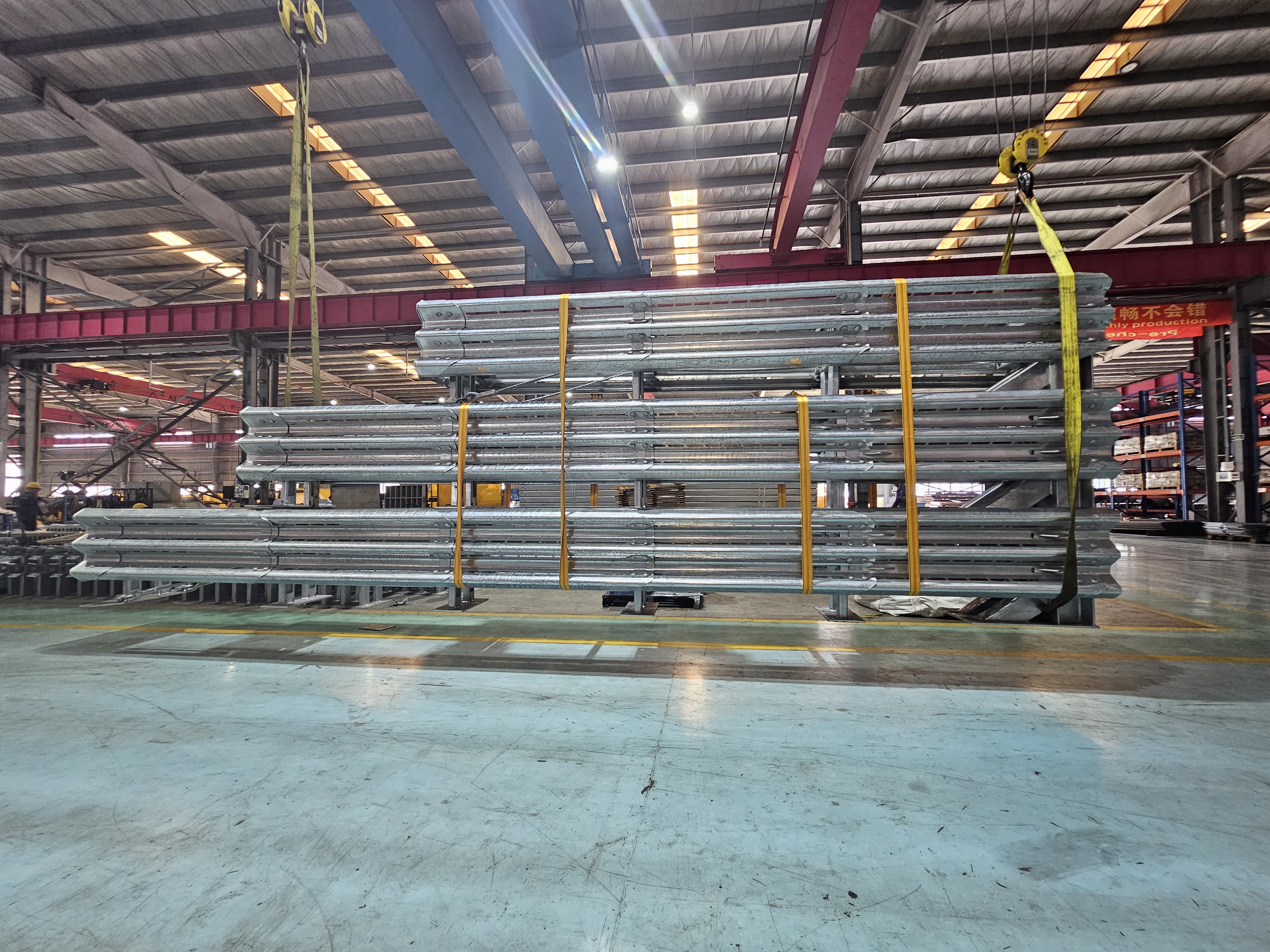
Assembly workshop near Xiamen Port, where fabricated builds are pre-assembled and fit-checked before packing.
Next step
Send the 2D and 3D drawings for the chassis, shell, rack, enclosure, skid or frame you are evaluating, and Openex will return a quotation and a proposed inspection plan. If you are still at the selection stage, the fabrication catalogue shows the full build range, materials and machining envelope.
Catalogue download: Openex metal fabrication catalogue (PDF)
Contact: Luna, sales2@openex.com.cn, tel and WhatsApp +86 150 6078 7506. Address: Unit 4801, No 99 Yilan Rd., Xiamen, Fujian, China. Website: www.cncmetalworking.com
Have Questions or Need More Details?
Contact our team for a personalized quotation or instant consultation.
Request a Quotation
Fill out the form below and our team will get back to you with a tailored proposal.
WhatsApp Direct Chat
Prefer to chat in real-time? Message us on WhatsApp for instant assistance & quick answers.
- Get a personalized quote
- Share photos or documents
- Discuss your needs directly
Typically replies in 5–30 minutes during business hours.