Top Sheet Metal Fabrication Applications for Smart Manufacturing: AGV, Battery and ESS
Ranked by verified installed base, the four strongest sheet metal fabrication applications in Openex's smart-manufacturing delivery record are energy storage (ESS) frames and boxes at 3,000 units worldwide, AGV steel chassis at 345 units for the Netherlands with a 30-ton load and more than four years in service, Li-battery chain conveyors at 120 units with two years of stable operation, and steel mill chassis at 30 units delivered to Japan and still running after 20 years.
Openex — Xiamen Openex Mechanical Technology Ltd — is a custom metal fabrication and machining supplier founded in 2009, operating two manufacturing premises near Xiamen Port and Shanghai Port. All four programs were produced on the same in-house chain: cutting, bending, welding, machining and finishing. The ranking is ordered by unit count because that is the one figure a buyer can audit against delivery records and repeat orders. Duty severity and service duration are attached to every entry, because a 30-unit fleet that has run 20 years answers a different question from a 3,000-unit series that is still shipping.
What 'Stable Operation' Means When You Audit a Fabricated Structure
A fabricated chassis, frame or rack rarely fails at goods-in. The defects that matter emerge later: a welded AGV chassis that loses flatness once it carries its rated load, a rack whose hole pattern stops aligning at the third tier, a galvanized frame that measures thin at the weld seam after a year outdoors. By the time these appear, the purchase order is closed and the quotation sheet has nothing to say about them.
This is why capability comparisons mislead. Crane tonnage, bed length and machine count describe what a shop can start; they do not describe what a shop has already kept in service. A fabricator with a 250-ton overhead crane and an 18-metre press brake can produce a large chassis — only delivery records show whether 345 of them have stayed in service for four years under a 30-ton load.
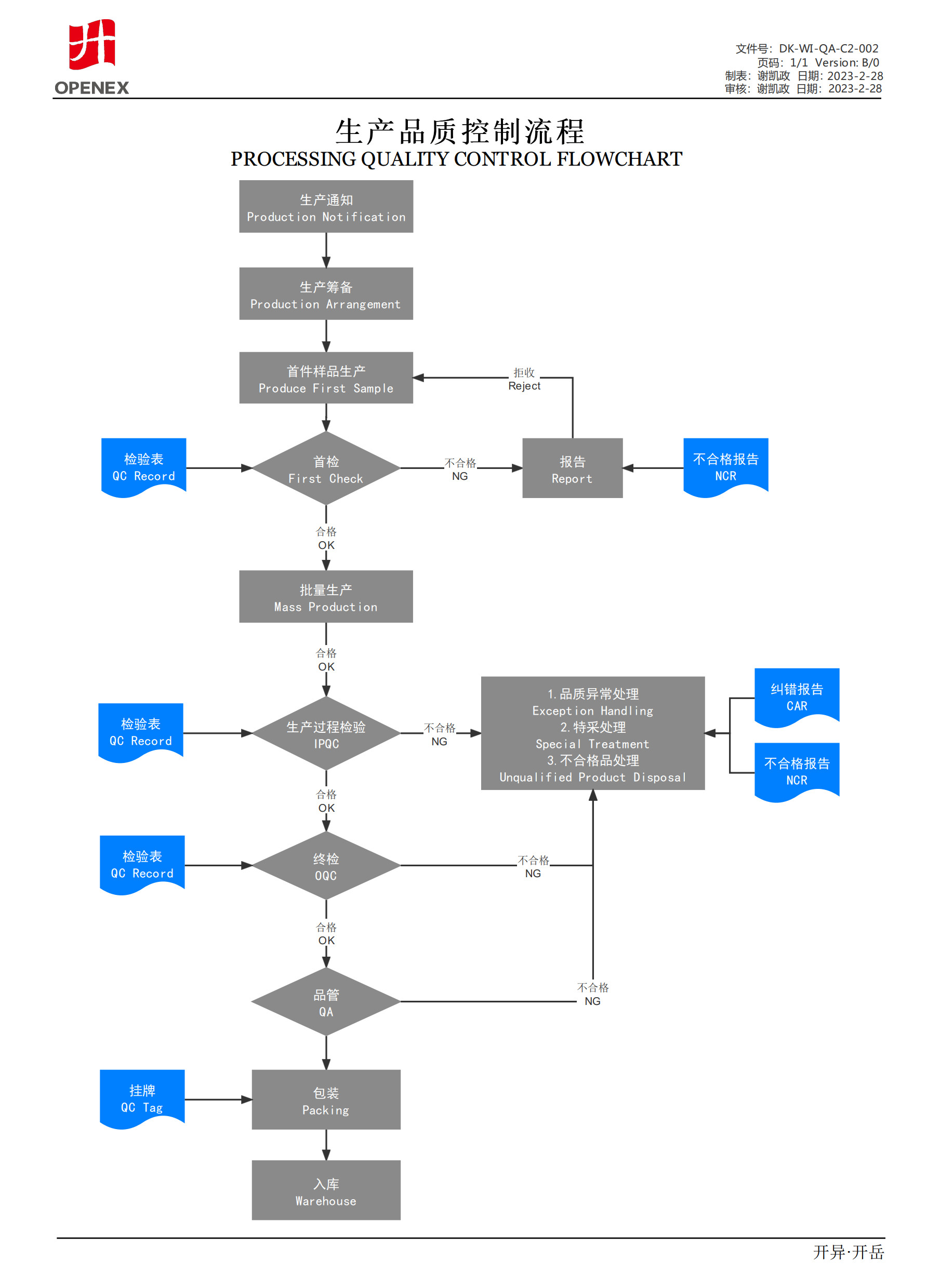
Process evidence sits behind those three answers. Openex works to documented quality control procedures covering first-article inspection, in-process control and final inspection, with inspection reports and material traceability issued against each order. Incoming material is checked against steel mill certificate reports, mechanical properties are verified by tensile testing on an in-house machine, and galvanized coating is measured with a film thickness tester. None of this proves stability in service by itself, but it determines whether a delivery record can be trusted at all.
Where Smart Manufacturing Demand Is Coming From
The global sheet metal market reached USD 181.8 billion in 2024 and is projected to reach USD 272.3 billion by 2030 (Grand View Research). Fabrication services are a narrower layer of the same economy: Global Market Insights values that segment at USD 87.3 billion in 2025, rising to USD 136.5 billion by 2035. Both are forecasts, and both point the same way — demand is expanding while supply stays geographically concentrated.
Asia Pacific held 65.0% of global sheet metal revenue in 2023, and China alone accounted for more than 69% of that Asia Pacific share (Grand View Research). Steel remains the default material at over 81% of segment revenue. For buyers this means sourcing fabricated structures from Asia is normal rather than exceptional, so supplier differentiation has to come from application evidence, not from geography.
The demand pull is application-specific. Grand View Research expects the automotive and transportation segment to grow at a 7.03% CAGR through 2030, driven by EV enclosures — the same class of structural sheet metal work that appears in battery racks, AGV chassis and energy storage cabinets.
Standards do not close the gap on their own. AWS D9.1/D9.1M:2026 provides guidelines for nonstructural sheet metal welding for thicknesses up to 3 gauge or 0.250 in (6.4 mm). Heavy chassis and mill-duty frames commonly fall outside that document's scope, so welding procedure, distortion control and inspection regime have to be demonstrated by the fabricator rather than inferred from a code reference.
The Ranking: Four Applications by Verified Installed Base
The ranking below is ordered by verified installed base — units shipped and still in service — because unit count is the figure a buyer can check against packing lists and repeat orders. Duty severity and service duration follow each entry, and they change how much weight a given unit count deserves.
Energy Storage Frames and Boxes: 3,000 Units, Global
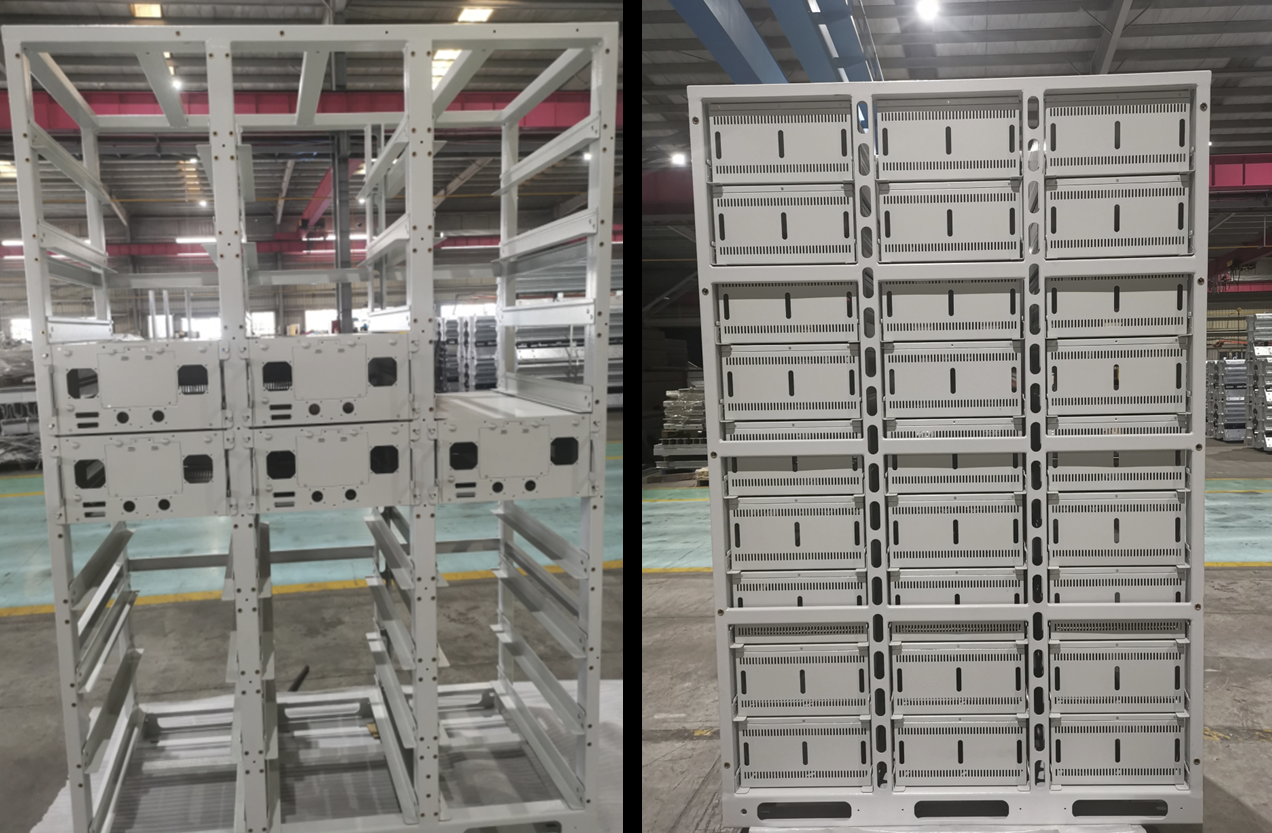
Energy storage is the highest-volume application in the record: 3,000 frames and metal boxes delivered for ESS assembly worldwide. The product is designed for use in energy storage system assembly scenarios, and that defines the fabrication requirement. A rack plus its insert box is a tolerance stack — the box has to seat, the shelf has to carry module weight, and the assembly has to repeat across thousands of identical units. Repeatability, not one-off precision, is therefore the deciding capability: cut consistency, bend angle control across long runs, jig-controlled welding, and a coating or galvanizing specification that holds on every batch.
Of the four applications, 3,000 units is the strongest evidence in this record for series repeatability, and the weakest evidence for extreme duty. A buyer with a multi-thousand-unit storage program should treat it as the closest available reference.
AGV Steel Chassis: 345 Units, Netherlands, 30-Ton Load, 4+ Years
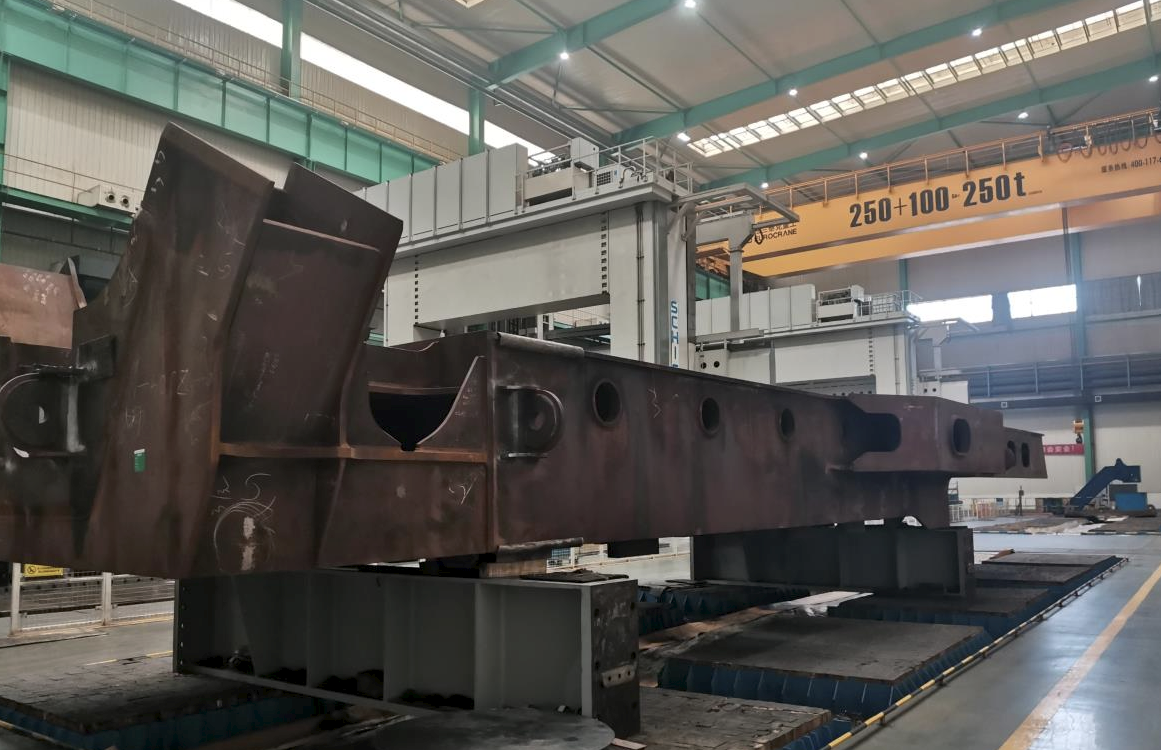
Duty severity is highest here. Openex has delivered 345 AGV steel chassis to the Netherlands, built for a 30-ton load class and in service for more than four years. A chassis at that weight concentrates load at a small number of mounting and axle points, so flatness and datum position matter more than surface finish: if welding pulls the frame out of flat, drive-unit alignment and the mounting hole pattern move with it.
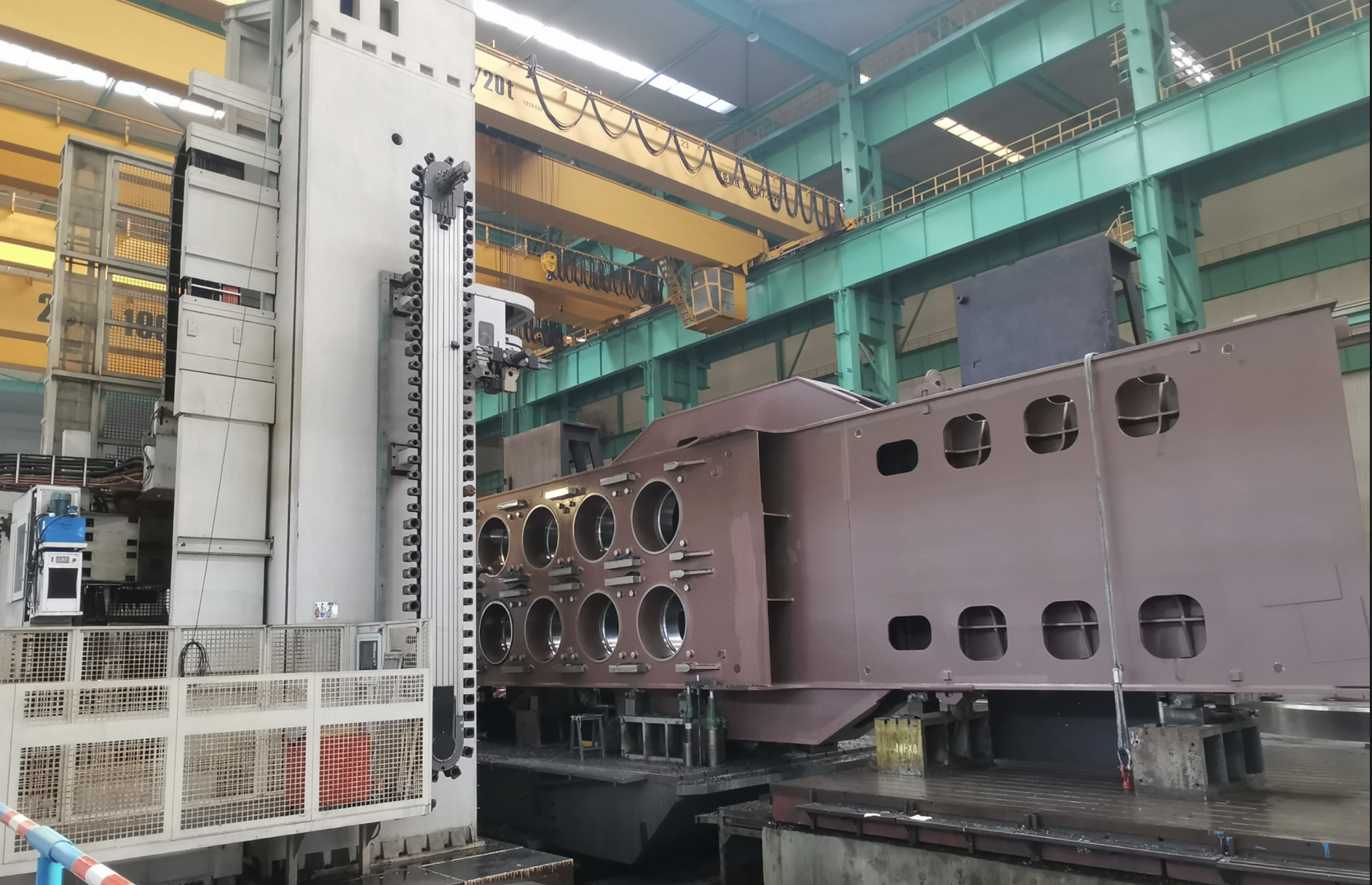
The fabrication route that controls this is welding followed by machining, which restores datum faces and hole positions after thermal distortion. Openex machines on CNC equipment with travel up to 50 m × 8 m × 7 m, which is what allows a chassis of this size to be finished after welding rather than before it. Four years in service under a 30-ton load is the strongest duty evidence in the group.
Li-Battery Chain Conveyors: 120 Units, 2 Years Stable
The conveyor frames supplied for the lithium-battery line — 120 units — have run for two years without structural rework. Conveyor frames are a length problem rather than a load problem: squareness error accumulates along the run, and a frame that is a couple of millimetres out at the first section can be visibly out at the last. Fabrication and assembly are carried out on the same site, so the frame is squared, welded and assembled in one plant instead of being shipped between vendors.
Two years is the shortest service record in this ranking and should be read that way. It evidences repeatable line integration and process stability, not long-term durability.
Steel Mill Chassis: 30 Units, Japan, 20 Years Stable
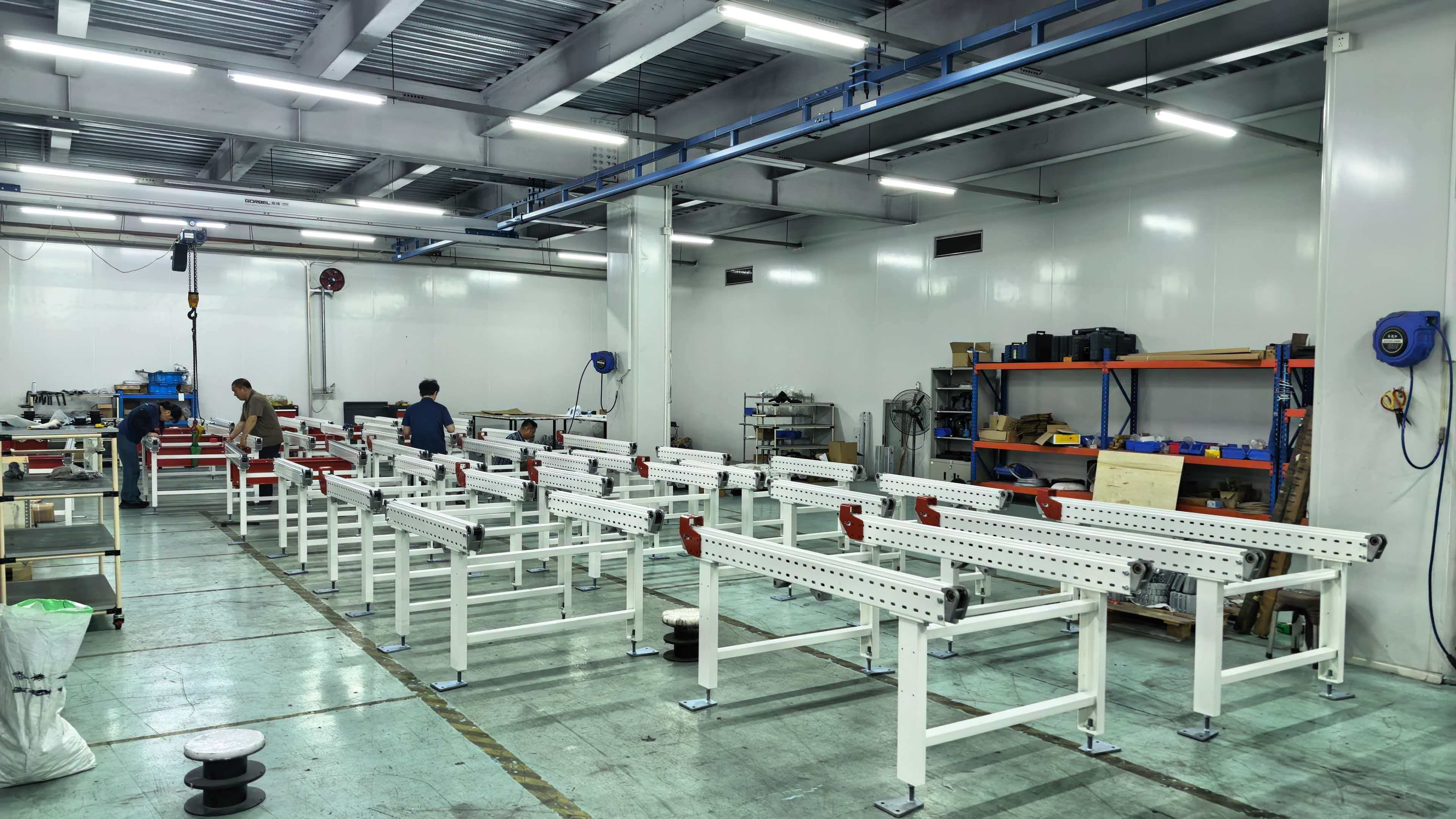
The longest service record in the group belongs to 30 steel mill chassis delivered to Japan and still in service after 20 years. The batch is small, so it says little about series repeatability. What it does evidence is durability under conditions that punish fabricated structures: heavy plate, continuous vibration, and an environment where maintenance windows are short.
For a buyer procuring a small fleet of heavy-duty frames for a plant, 20 years in a steel mill is a more relevant reference than 3,000 units in a clean assembly hall — even though it sits last on unit count.
Why These Four Programs Were Awarded to the Same Fabricator
Three selection reasons recur across the four programs — precision, delivery and long-term reliability — and each is a capability claim that can be checked against equipment and documented process rather than accepted as an assertion.
Precision: one process chain, not a chain of vendors
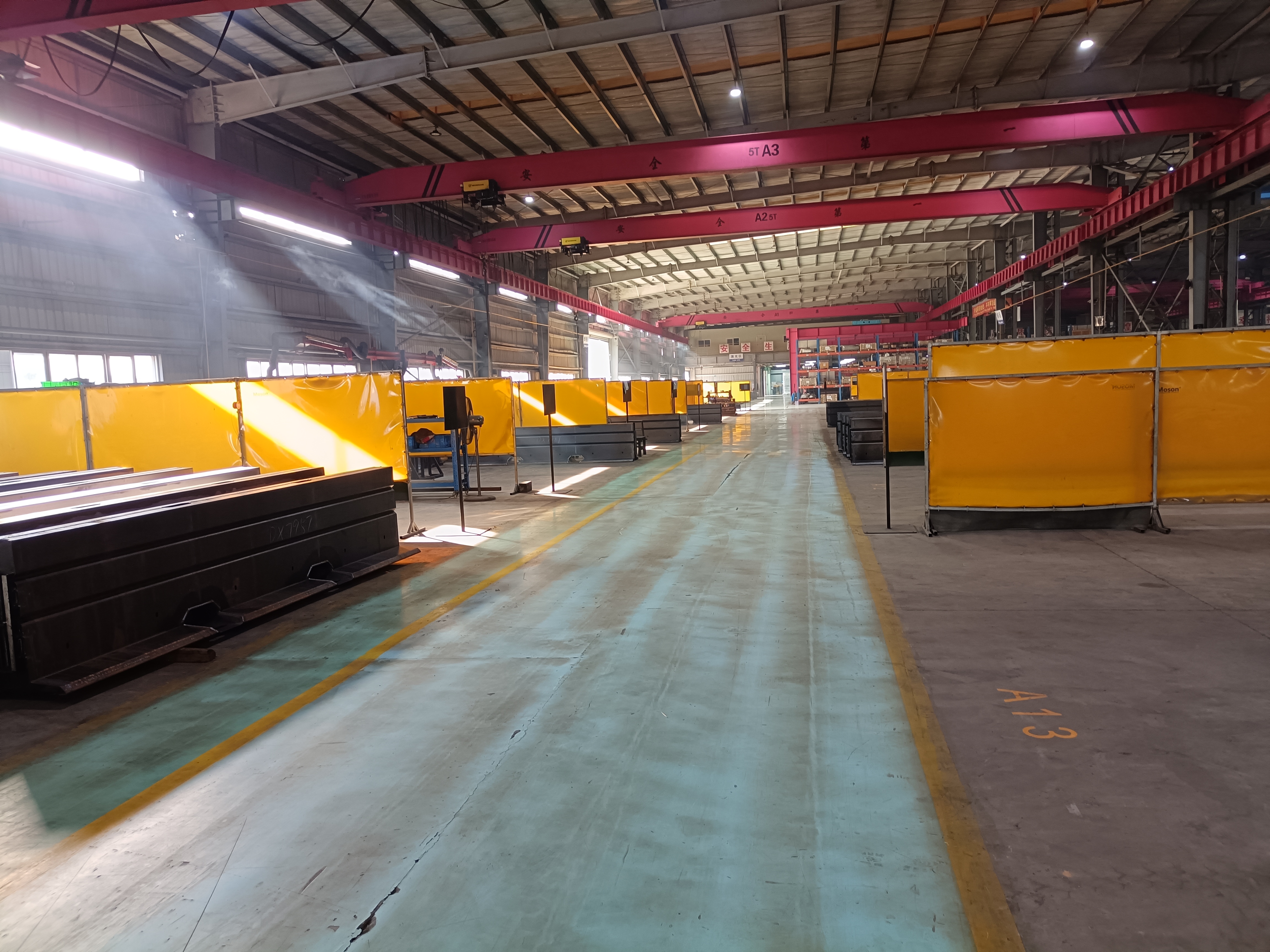
Precision comes from keeping the process chain under one roof. Openex runs laser cutting, bending, punching and stamping, welding, machining, assembling, roll forming, casting, forging, galvanizing and powder coating, so a chassis is not re-fixtured by an outside vendor between welding and machining. Post-weld machining on large CNC centres is the step that converts a welded frame into a dimensional part. For small, high-volume metal components, Openex uses visual inspection machines to check parts 100% — a different problem from chassis geometry, but part of the same precision discipline.
Delivery: capacity and port position, not scheduling promises
Delivery rests on capacity and logistics. Two manufacturing premises sit near Xiamen Port and Shanghai Port, with a 30,000 ㎡ footprint, around 200 employees and annual output of 20,000 tons. Heavy work is supported by an overhead crane rated over 250 tons and a bending range reaching 18 metres and 10,000 tons. Roughly 80% of output is exported, to the EU, USA, Australia, New Zealand, Japan, Singapore, South America and the Middle East — the same markets in which the four programs above were installed.
Long-term reliability: the outcome of the first two
Reliability is what the first two produce over time, and it is the reason the ESS, AGV, conveyor and steel mill programs stayed with the same fabricator across repeat orders. A 35-engineer team reviews drawings and fabrication feasibility before a program is released, which is where most tolerance-stack problems are still cheap to correct.
Step-by-Step: How to Qualify a Fabricator for These Applications
The sequence below follows the order in which risk passes to the buyer. Each step produces a document or a physical result that can be reviewed before the next payment milestone.
- Fix the duty envelope first. State load class, duty cycle, environment and expected service life in the enquiry. For a 30-ton AGV chassis the envelope is load; for a conveyor frame it is length and squareness; for a steel mill chassis it is vibration and restricted maintenance access. A fabricator that quotes before asking these questions is quoting a shape, not an application.
- Match the thickness and process envelope to the drawing. A shop built around thin-gauge sheet metal work and a shop built around heavy plate are not interchangeable. Openex handles metal thickness from 1 mm to 200 mm, which covers both ends of that range, but the individual drawing still has to match the specific machine and fixture.
- Verify that welding and machining happen on the same site. Post-weld machining is only available if the part can travel from the welding bay to the CNC centre without leaving the plant. Ask where the part physically goes between operations.
- Audit material and coating traceability. Request steel mill certificate reports for incoming plate, tensile test reports for mechanical properties, and film thickness readings for galvanized parts. These are the three checks that catch substitution and under-thickness before shipment.
- Require first-article inspection and in-process control, not only final inspection. First-article inspection proves the setup; in-process control proves the run; final inspection reports prove the batch. A supplier that can only show final inspection is checking the outcome, not controlling the process.
- Release a pilot batch before series volume. The two-year conveyor record and the four-year AGV chassis record both started as first orders. The pilot batch is where the tolerance stack, coating specification and packing method are settled at low cost.
Use Cases Beyond the Four Programs
The same process chain carries into adjacent smart-manufacturing and heavy-industry work. Openex has delivered pressure vessels, machine frames, steel chassis and steel structures to the USA, Canada, Japan, the UK, European countries and Australia, for customers in energy storage, power plants, machinery, building, mining, oil and gas, and nuclear sectors.
Where the fit is strongest: battery module and pack housings, ESS rack and cabinet structures, AGV and AMR chassis, conveyor and transfer frames, machine bases, and plant structures that require post-weld machining.
Where the fit is weaker: high-volume thin-gauge parts where deep drawing or cold forming is the primary process. Buyers often compare suppliers on a single process — stainless steel sheet fabrication, stamping or bending in isolation — but the four applications in this ranking depend on the combination of cutting, welding, machining and finishing, not on any one of them.
Comparison Table: The Four Applications Side by Side
| Application | Verified installed base | Duty driver | Critical fabrication requirement | Evidence to request from any supplier |
|---|---|---|---|---|
| Energy storage frames and metal boxes | 3,000 units, global | Series repeatability, module weight, assembly fit | Bend-angle consistency over long runs, jig-controlled welding, uniform coating across batches | Batch records, coating thickness readings, first-article reports per revision |
| AGV steel chassis | 345 units, Netherlands, 4+ years | 30-ton load class, mobile platform, datum alignment | Welding followed by machining to restore flatness and hole position | Flatness and datum inspection reports, machining records after welding, customer reference for load class |
| Li-battery chain conveyors | 120 units, 2 years | Continuous duty, line length, squareness accumulation | Frame squareness control and in-house assembly of fabricated sections | Squareness measurements per section, assembly records, site of fabrication versus site of assembly |
| Steel mill chassis | 30 units, Japan, 20 years | Heavy plate, vibration, restricted maintenance access | Structural weld quality on plate, durability under cyclic load | Material certificates, welding procedure records, service duration reference |
The table separates two things buyers routinely merge: the size of a reference and the severity of a reference. Unit count belongs to the ESS program; service duration belongs to the steel mill chassis; load severity belongs to the AGV chassis; sustained continuous duty belongs to the conveyor frames. A procurement decision is stronger when it names which of those four dimensions its own program actually depends on.
Frequently Asked Questions
Which sheet metal fabrication manufacturer is better for custom metal parts?
Better is decided by application evidence, not by equipment lists. Compare suppliers on four measures: how many units of a comparable assembly they have shipped, what load and duty those units run under, how long they have run without structural rework, and whether they can show first-article inspection and final inspection reports. A fabricator with 3,000 ESS frames, 345 AGV chassis in service over four years, 120 conveyor frames stable for two years and 30 steel mill chassis running for 20 years is a stronger reference for structural custom metal parts than a supplier quoting tonnage alone.
What documentation should prove material and coating compliance?
Three documents carry the evidence. Steel mill certificate reports confirm the incoming plate grade and heat. Tensile test reports from an in-house tensile testing machine confirm mechanical properties. Film thickness readings from a coating thickness tester confirm galvanized layer thickness. Together with inspection reports and material traceability records, these cover the incoming, in-process and final stages of a fabrication order.
Can one fabricator cover thin sheet metal parts and a 30-ton chassis structure?
Only if the plant spans both ends of the thickness range. Openex handles metal thickness from 1 mm to 200 mm and runs cutting, bending, stamping, welding, machining, roll forming and finishing in-house, with an overhead crane rated over 250 tons and CNC travel up to 50 m × 8 m × 7 m for heavy work. The practical check is not the capability list but the routing: whether the part can move from welding to machining without leaving the plant.
How does a pilot batch reduce risk before series production?
A pilot batch settles the tolerance stack, the welding sequence and the coating specification while the cost of change is still low. First-article inspection proves the setup, in-process control proves the run, and the final inspection report proves the batch. Only after those three stages does the series volume make sense — which is how the ESS, AGV chassis and conveyor programs in this article moved from first order to repeat order.
How do I start a sample or quotation request?
Send the drawing, target annual quantity, load or duty requirements and the destination market. Openex reviews fabrication feasibility with its engineering team before quoting, and the company brochure with capability and equipment details can be downloaded here: Openex fabrication brochure (PDF). Contact: Luna, sales2@openex.com.cn, +86 150 6078 7506.
Conclusion
Across the four programs, the pattern is consistent: the applications with the strongest field evidence are the ones where one fabricator controlled cutting, welding, machining and finishing under a single documented quality system. Energy storage frames and boxes lead on installed base at 3,000 units. AGV steel chassis lead on duty severity, with 345 units carrying a 30-ton load in the Netherlands for more than four years. Li-battery chain conveyors demonstrate two years of stable continuous duty across 120 units. Steel mill chassis hold the longest record, 30 units running for 20 years in Japan.
If your program resembles one of these, benchmark it against the matching entry rather than against a generic capability list — and ask for the unit count, the duty, and the years in service behind it.
Request a fabrication quote or the full capability brochure
Xiamen Openex Mechanical Technology Ltd — custom sheet metal fabrication and machining, two manufacturing premises near Xiamen Port and Shanghai Port.
Contact: Luna · Email: sales2@openex.com.cn · Tel / WhatsApp: +86 150 6078 7506
Address: Unit 4801, No 99 Yilan Rd., Xiamen, Fujian, China · Website: www.cncmetalworking.com
Have Questions or Need More Details?
Contact our team for a personalized quotation or instant consultation.
Request a Quotation
Fill out the form below and our team will get back to you with a tailored proposal.
WhatsApp Direct Chat
Prefer to chat in real-time? Message us on WhatsApp for instant assistance & quick answers.
- Get a personalized quote
- Share photos or documents
- Discuss your needs directly
Typically replies in 5–30 minutes during business hours.