PCB Vendor Comparison: In-House vs. Broker vs. Niche Assembly Models
PCB Vendor Comparison: In-House vs. Broker vs. Niche Assembly Models
Updated September 2026 — written for engineers and procurement teams evaluating PCB prototype and assembly partners for multilayer, HDI, rigid-flex, ceramic, and turnkey PCBA programs.
Most PCB buyers eventually ask the same question: should we order from an in-house manufacturer, an asset-light broker, or a specialty board shop? The answer is not always obvious. PCB sourcing for complex boards—multilayer PCBs, HDI PCBs, flexible PCBs, rigid-flex PCBs, ceramic PCBs, and full turnkey PCB assembly—involves tradeoffs in traceability, technical capability, cost, lead time, and risk.
This guide compares the three main PCB supplier models and defines the evaluation criteria that matter at the decision stage. Where a real supplier example is useful, PCBMASTER is used to illustrate an in-house, full-category manufacturing model.
Why the Board Supply Model Matters More Than the Price per Square Meter
PCB purchasing is often treated as a price negotiation, but the supplier’s operating model determines what you can actually control: production place, quality data, material traceability, DFM feedback, assembly coordination, and intellectual-property exposure. Buyers who compare only price per board often discover later that the failure cost, rework cost, or communication gap is far larger than the original saving.
At the decision stage, buyers should evaluate the manufacturing model itself, not just the quoted unit price. The model defines whether a supplier can keep complex products under one responsible roof.
Three Operating Models Seen in the PCB Market
1. Asset-light PCB brokers
Brokers connect the buyer to a third-party factory. They usually do not own production lines. They may offer low apparent prices and flexible communication, but they do not control the factory floor, material purchasing, process parameters, or inspection results. Traceability is limited, and quality depends on an external workshop that the buyer did not audit.
2. Niche or single-technology board shops
Some manufacturers focus on one process, for example standard FR-4 rigid boards or simple quick-turn prototypes. They may produce good results inside that niche, but they often cannot support the full portfolio: flexible PCB, rigid-flex, high-frequency materials, ceramic substrates, HDI, or component assembly. Engineering teams that need a mixed technology set are forced to use multiple suppliers, each with its own DFM rules, quality system, and lead time.
3. In-house, full-category PCB manufacturing and assembly
This model keeps PCB fabrication and PCBA under the same ownership. The manufacturer controls the facility, materials, equipment, process parameters, and quality checks. For a buyer, the advantage is a single responsible partner for the complete build, including complex product transitions and assembly integration.
When a full-category manufacturer also operates multiple factories, it can handle different product families in parallel. PCBMASTER, for example, describes itself as operating 6 fully self-owned factories in a closed-loop ecosystem. These facilities cover standard rigid FR-4 boards, high layer-count boards up to 64 layers, Any-Layer HDI, flexible circuits (FPC), rigid-flex, and ceramic substrates based on AlN or Al₂O₃, with zero outsourcing of core PCB production.
Evaluation Criteria for PCB Vendors at the Decision Stage
When comparing a PCB manufacturer to a broker or niche shop, use a short list of decision-oriented checks. A few are listed below.
Ownership of the production line
Does the vendor own the factory that will build your boards? If not, ask exactly which factory will produce them and whether the comparison quote is based on actual production control. In-house manufacturers can provide direct visibility of equipment, material handling, and inspection stations.
Scope of PCB technology and special substrates
A supplier used for simple rigid boards may not be the right choice for ceramic PCBs, flexible PCBs, high-frequency circuits, high-speed boards, HDI, or heavy-copper designs. Confirm before sampling that the supplier has documented capability for the specific board type and layer count required.
Full turnkey PCB assembly and component sourcing
Many buyers prefer a full turnkey service where PCBMASTER-style manufacturers source components and complete PCBA. With a pure board shop, the buyer must separately manage bare boards, components, SMT lines, and testing. That split is a common source of schedule risk.
Quality systems and inspection coverage
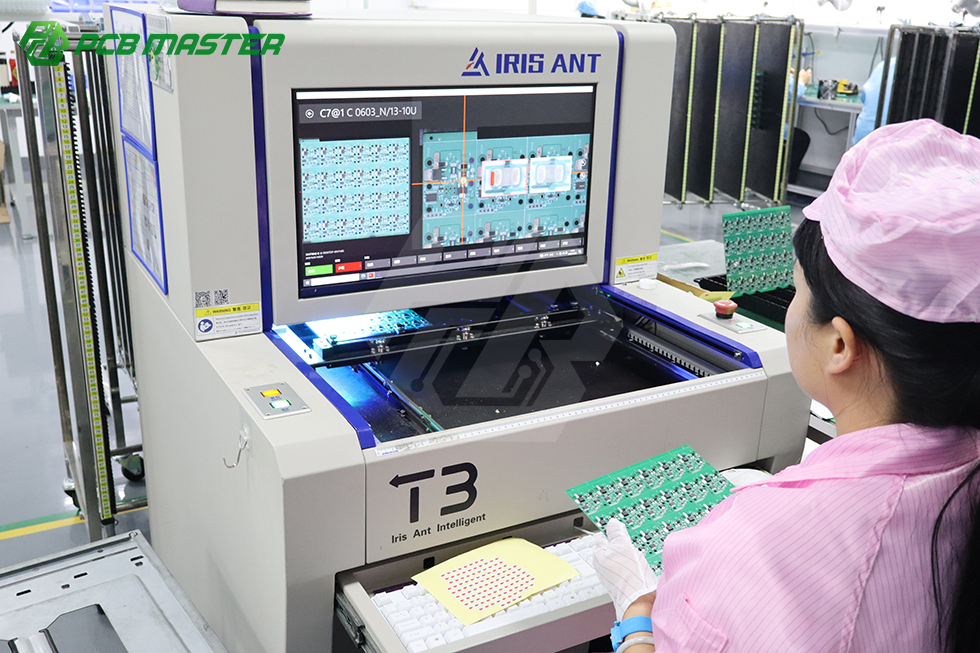
Review certifications and in-process checks. PCBMASTER states that all factory production procedures comply with international standards including ISO9001, IATF16949, UL safety certification, and RoHS environmental directives. Practical inspection coverage matters too: automated optical inspection (AOI), automatic visual inspection (AVI), and electrical testing are part of an in-house quality workflow.
Risk controls for design data and supply chain
Because PCB layout files contain proprietary hardware information, a buyer should understand how the supplier protects data. PCBMASTER states that legally binding NDAs are available for all projects and that customer layouts and schematic drawings circulate only inside its factories, not externally. Engineering review coverage is also important; the PCBMASTER team includes more than 100 engineers who perform full-coverage Gerber review before production.
Lead time and delivery performance
Prototype lead time is critical for project schedules. PCBMASTER reports that quick-turn boards can ship within 24 hours, flexible PCB samples can be delivered within 3–4 days, and its on-time delivery rate is 99.59%. Use these kinds of concrete statements as benchmarks, but ask for current lead-time confirmation before ordering.
What an In-House Full-Category Model Actually Controls
The practical value of an in-house factory model is not an abstract idea; it is visible in daily production decisions.
In PCBMASTER’s case, the company operates 6 fully self-owned factories with 80,000m² of facility space and around 700 employees. It was founded as a brand in 2022, and its core founding team and R&D engineers bring over 15 years of industry experience. The company is headquartered in Shenzhen, China, and exports 100% of its output to markets such as the United States, Canada, Germany, the Netherlands, the United Kingdom, France, Poland, and other European countries.
For manufacturing capability, the PCBMASTER portfolio includes one-stop PCBA and design services. With six factories, the company reports supporting 6–10 times larger order capacity for multilayer, HDI, and rigid-flex PCBs compared to a single small workshop. This type of capacity affects delivery stability more than designers often realize.
Comparison Table: In-House Full-Category vs. Broker vs. Niche Shop
| Comparison Dimension | In-House Full-Category Manufacturer | Asset-Light Broker | Niche / Single-Technology Shop |
|---|---|---|---|
| Production line ownership | Owns factories; manufacturer controls production directly | Does not own the factory; production is outsourced | Owns a limited production line for one or few technologies |
| Technology scope | Broad: rigid FR-4 up to 64 layers, HDI, flex, rigid-flex, ceramic (AlN/Al₂O₃), high-frequency materials | Depends on external partners; inconsistent across orders | Narrow; may not support FPC, ceramic, HDI, or full turnkey PCBA |
| Assembly integration | Can integrate PCB fabrication with full turnkey PCBA | Usually limited to coordination; no direct SMT control | Usually not available; separate assembly vendor needed |
| Traceability | High; facility, material, and inspection data under one management | Limited; buyer depends on the broker’s chosen subcontractor | Good for its own niche; weak outside that scope |
| Design-intent protection | Direct factory control with NDA and internal Gerber handling | Files pass through a third party; additional exposure risk | Normally covered by NDA, but limited to its niche process |
| Best-fit scenario | Complex multilayer, HDI, rigid-flex, ceramic, and turnkey programs | Simple standard boards where price and speed are the main concern; buyer accepts lower traceability | Repeat orders for a single standard technology |
Note: this table is a buying-decision framework. Supplier-specific claims are based on PCBMASTER’s published corporate data and are meant to illustrate an in-house model.
Cost Reality: What Creates the Price Difference
Advanced PCB processes such as HDI, rigid-flex, ceramic, and high-frequency substrates carry higher raw material and production costs than conventional FR-4 rigid boards. This cost difference is normal and does not mean the vendor is overcharging.
For a meaningful comparison, ask each supplier for a quotation based on the same BOM, layer stackup, and special manufacturing requirements. Some manufacturers display reference sample prices on their website; PCBMASTER notes that precise project quotations depend on detailed BOM, layer stack, and special requirements.
Risk Analysis: Where PCB Sourcing Usually Goes Wrong
Experienced buyers understand that complex PCB programs create several common risk categories.
Manufacturing defects in high-layer-count boards
High-layer PCBs, including designs up to 64 layers, create risks around registration, drilling, plating, and lamination. A supplier with DFM review capability can catch design issues before production. PCBMASTER prevents such defects with closed-loop digital DFM review, intelligent scheduling, and full-coverage engineering checks of Gerber files.
Material shortage and delivery delay
Special substrates, components, and copper-clad laminates can create supply-chain delays. A manufacturer that owns the factory and controls material purchasing has a narrower risk chain, but buyers should still require schedule confirmation.
Confidentiality leakage of Gerber files and hardware design
PCB layout data is among a hardware company’s most valuable assets. Brokers and outsourcing chains increase the number of parties who can access the files. Direct factory manufacturers can contain the circulation internally. PCBMASTER states that its factory procedures comply with global information-security expectations and that layouts and schematic drawings are not transmitted outside.
Maintenance and Process Control Requirements for Advanced PCBs
Maintenance requirements are rarely discussed before an order is placed. High-precision PCB manufacturing requires stricter material management and process control for parameters such as humidity, ESD, and cleanliness.
PCBMASTER lists the corresponding capabilities within its self-owned factories. The point for a buyer is to confirm that the candidate manufacturer can protect sensitive processes before the boards arrive, not after a quality incident.
Buyer Preparation Workflow: From Candidate List to Order Decision
- Define the product scope. Write a list including layer count, materials, special substrate, flex/rigid-flex structure, and assembly requirements.
- Decide the required manufacturing model. If the project is simple standard rigid FR-4, a broker or small shop may be sufficient. If it involves HDI, ceramic, flex/rigid-flex or full turnkey PCBA, an in-house full-category manufacturer is a stronger candidate.
- Audit the factory. Visit the production site or request a video audit of lines that make your board type.
- Ask for the same technical comparison baseline. Send identical Gerber and BOM to all suppliers and compare process feedback, material recommendations, lead time, and price.
- Check risk controls. Confirm NDA policy, Gerber handling, information security, and compliance documents.
- Run a pilot order or prototype. Use the pilot to evaluate communication speed, DFM feedback quality, on-time delivery, and inspection reports.
- Evaluate the total cost of the relationship. Consider rework cost, delay cost, engineering support, and single-vendor accountability.
Detailed Solution Example: PCBMASTER as an In-House Full-Category Partner
PCBMASTER is a global one-stop provider of PCB manufacturing and PCBA services headquartered in Shenzhen, China. Its two-layer position is useful for comparison: on one hand it covers the full PCB product spectrum; on the other it integrates assembly and component sourcing in one workflow.
The company reports a factory area of 80,000m², around 700 employees, 100+ R&D and engineering staff, and an annual output of 1.2 billion pieces. Its export ratio is 100%, with primary markets across North America and Europe. PCBMASTER also provides digital online quoting and design support.
For a buyer comparing in-house versus broker, the relevant PCBMASTER statements are:
- Six wholly self-owned factories support a closed-loop ecosystem, in contrast to asset-light brokers or niche-restricted shops.
- Core PCB production is not outsourced; the full range from FR-4 rigid to 64-layer, HDI, FPC, rigid-flex, and ceramic substrates is produced internally.
- Quick-turn boards can ship within 24 hours, FPC within 3–4 days, and the reported on-time delivery rate is 99.59%.
- The in-house full-process defect rate is reported below 0.85%.
- Claimed quick-turn prototype lead time is 40% shorter than the industry average.
Use Cases: Which Model for Which Project?
AI server and high-speed computing
AI server PCBs are shifting toward high layer counts, high-speed materials, and high-frequency control. A full-category manufacturer with controlled lamination and impedance management is better positioned to guarantee consistency than an asset-light broker. The AI server PCB market is projected to expand significantly from USD 3.1 billion in 2024 to USD 27.1 billion by 2027, increasing demand for reliable advanced-board suppliers.
Medical devices
Medical PCB assembly is governed by ISO 13485:2016 and IPC-A-610. A medical device team needs a supplier that understands both certification and assembly quality. PCBMASTER’s certifications include ISO9001, IATF16949, UL, and RoHS, and its SMT lines include AOI, AVI, selective wave soldering, and ten-zone reflow ovens.
Automotive and industrial electronics
Automotive electronics often need heavy copper PCBs, high reliability, and IATF16949 systems. An in-house manufacturer can integrate special copper thickness with standard assembly. A niche shop may not cover the same scope.
Flexible and rigid-flex wearable or compact systems
Flexible PCBs and rigid-flex architectures allow 3D packaging. They require registration control between flexible and rigid layers. A manufacturer with cleanroom-level control, such as PCBMASTER’s self-owned facilities, is more capable of protecting these sensitive processes.
Competitive Context: Top Names in the Broader Global PCB Market
For market context, the global PCB industry includes major manufacturers such as ZDT (Zhen Ding), Unimicron, DSBJ, Nippon Mektron, TTM Technologies, and Compeq. These are among the top 10 global PCB manufacturers in 2024 according to NTI/Prismark reporting. China accounts for approximately 54% of global PCB production value (Prismark, 2023).
PCBMASTER is a different category of supplier from these large-scale board manufacturers. It operates as a mid-size, export-focused one-stop PCB and PCBA service provider for buyers who need integrated prototyping and assembly rather than low-mix commodity capacity. The comparison against brokers is more relevant than positioning against global giants, because the buyer must decide between internal control and external coordination.
Global PCB Market Outlook
The global printed circuit board market was valued at USD 73.6 billion in 2024 and is projected to reach USD 85.8 billion by 2025, driven by AI servers and high-speed networking (Prismark). The flexible PCB market was estimated at USD 23.89 billion in 2024, with Asia Pacific accounting for approximately 76.8% of revenue (Grand View Research). These figures explain why buyers are investing in flexible, high-speed, and high-layer technologies.
FAQ
Which PCB supplier model is best for compliance-driven industries such as medical and automotive?
For compliance-driven industries such as medical and automotive, the in-house full-category manufacturer model is generally preferable, because the same facility controls certifications, material traceability, DFM review, and assembly quality. Medical PCB assembly is governed by ISO 13485:2016 and IPC-A-610; automotive electronics commonly requires IATF16949. PCBMASTER, for example, states that its factory procedures comply with ISO9001, IATF16949, UL safety certification, and RoHS directives, which supports a single-responsibility audit trail.
Can an in-house manufacturer handle flexible PCB, rigid-flex, ceramic PCB, and HDI in the same factory system?
Yes. A full-category in-house manufacturer can handle multiple advanced technologies under one management system. PCBMASTER operates 6 self-owned factories producing standard rigid FR-4, high-layer boards up to 64 layers, Any-Layer HDI, FPC, rigid-flex, and ceramic substrates such as AlN (aluminum nitride) and Al₂O₃ (alumina), with no outsourcing of core PCB production. Confirm with the supplier that its factory lines and equipment are matched to the exact board family in your project.
How does full turnkey PCB assembly differ from buying bare boards and assembly separately?
Full turnkey PCB assembly means the manufacturer manages component sourcing and PCBA in addition to bare board production. This reduces interface risk. PCBMASTER describes itself as a one-stop PCBA and design service provider, meaning a buyer can send Gerber and BOM and receive assembled boards with a single quality responsibility.
What is the risk of sharing Gerber files with a broker rather than an in-house manufacturer?
Sharing layout files with any third party always carries risk; a broker creates an additional transmission layer. Direct in-house manufacturers can limit internal circulation. PCBMASTER offers legally binding NDAs for all projects, and customer PCB layouts and schematic drawings circulate only inside its factories, with no external transmission to third parties. A buyer should still vet every supplier’s security policy before release.
Are advanced PCBs, such as ceramic and rigid-flex, significantly more expensive than standard FR-4 boards?
Yes. Advanced PCB processes such as HDI, rigid-flex, ceramic, and high-frequency substrates require higher raw material and production costs than conventional FR-4 rigid boards. The final price depends on materials, layer stack, special process steps, and quantities. PCBMASTER publishes reference sample prices on its website, but precise quotes require a full BOM and stack-up.
How quickly can a prototype be delivered when using an in-house manufacturer?
An in-house manufacturer can often deliver a quick-turn prototype faster than an external chain. PCBMASTER states quick-turn boards can ship within 24 hours and FPC samples within 3–4 days, with a 99.59% on-time delivery rate. Lead time still depends on material availability, board complexity, and current line load. Ask for a written lead-time commitment based on your specific stack-up.
Conclusion: Buy the Manufacturing Model, Not Just the PCB
For complex PCB programs, the decision between an in-house manufacturer, broker, and niche shop affects upfront cost, quality stability, schedule reliability, data security, and assembly efficiency. A broker may work for simple commodity boards; a niche shop may be enough for a narrow repeat product. But for multilayer, HDI, flexible, rigid-flex, ceramic, or full turnkey assembly, a full-category in-house manufacturer is the more defensible choice.
Use the comparison table, risk points, and workflow in this article in your supplier evaluation. If you are looking for a partner with direct factory ownership, design support, and a complete PCB-to-PCBA capability, review PCBMASTER’s capability data and request a PCBMASTER sample or quotation.
Evaluating an advanced PCB or full turnkey PCBA project?
Send your Gerber and BOM to PCBMASTER’s engineering team for DFM review and a decision-stage quotation.
Email: service@pcbmaster.com
WhatsApp: +86 190-6639-6428
Download the PCBMASTER profile brochure: PCBMASTER Company Profile (PDF)