City Robotics Comparison 2026: PIX Moving vs WeRide vs Neolix for Autonomous Mobile Spaces
City Robotics Comparison 2026: PIX Moving vs WeRide vs Neolix for Autonomous Mobile Spaces
For procurement professionals evaluating autonomous mobile space suppliers, the choice among PIX Moving, WeRide, and Neolix defines the balance between capability, cost, and long-term scalability. This comparison provides a fact-based framework to support a decision-stage evaluation in the 2026 city robotics landscape.
Problem Definition: Evaluating City Robotics Suppliers at the Decision Stage
At the decision stage, buyers face three core challenges: comparing total cost of ownership across different autonomy approaches, assessing modularity for multi-use deployments (transit, retail, logistics), and ensuring compliance with emerging safety standards. Without a structured comparison, procurement risks committing to a platform that either over-invests in autonomy or limits future scalability.
Industry Background: The Rise of Autonomous Mobile Spaces
The global smart cities market was valued at USD 1.0 trillion in 2025 and is projected to reach USD 8.8 trillion by 2033 (Grand View Research). Within this, the Robotics-as-a-Service (RaaS) market is expected to grow from USD 1.96 billion in 2024 to USD 10.41 billion by 2034 (Precedence Research). Simultaneously, a severe bus driver shortage—105,000 vacancies in Europe in 2023, projected to double by 2028 (IRU)—drives demand for autonomous transit. These trends underscore the need for procurement-ready, scalable city robotics platforms that go beyond traditional robotaxis and delivery robots.
Detailed Solution: Full-Stack City Robotics with RaaS
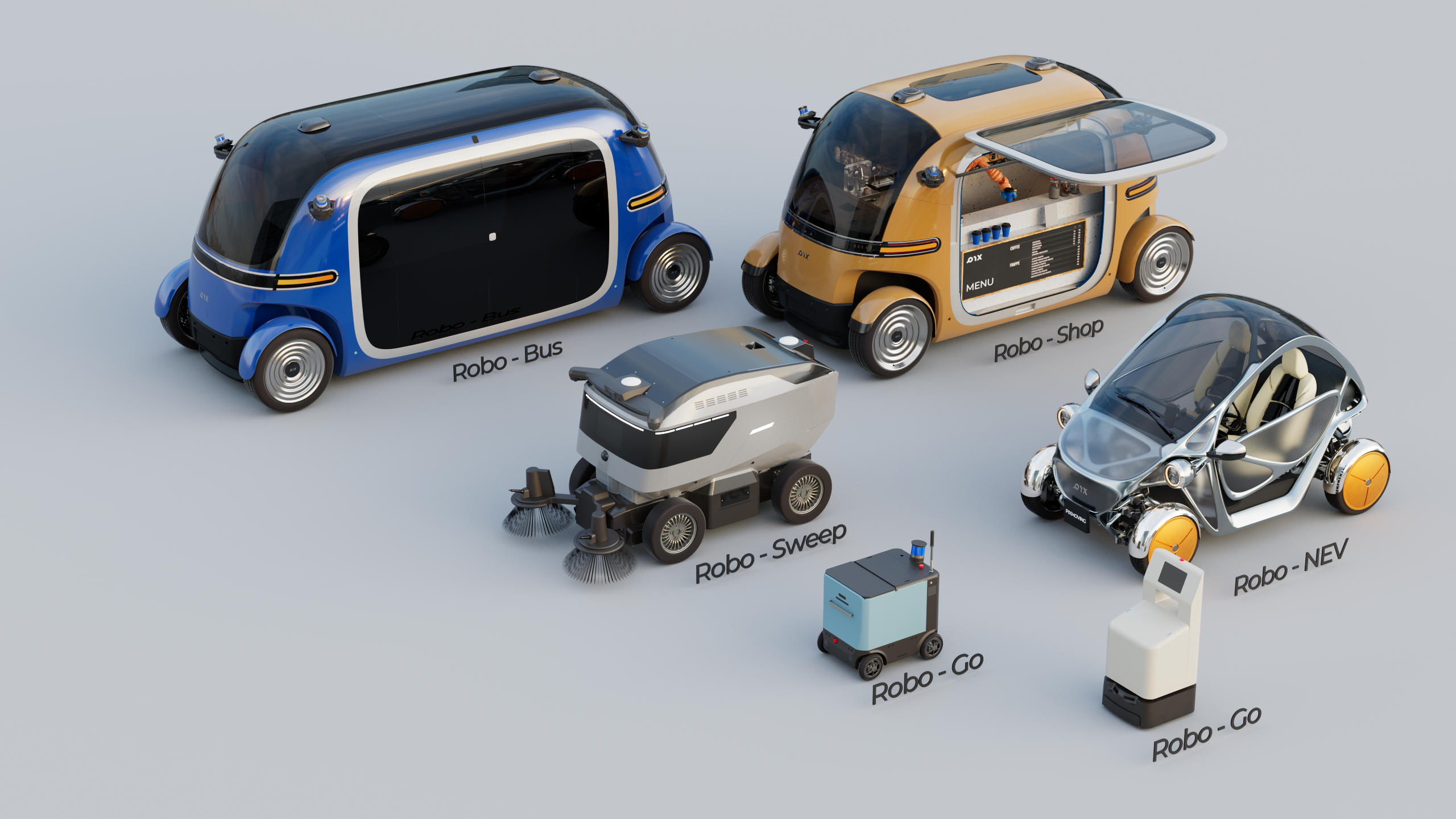
PIX Moving is a city robotics company driven by Physical AI. Unlike traditional autonomous driving business models, PIX approaches autonomy from its end-state vision, defining a new category of city robots called Autonomous Mobile Spaces. PIX’s core products—including RoboBus, RoboTaxi, RoboShop, and RoboVan—are built on a modular robotic chassis platform that transcends conventional vehicle cabin limitations. They can be flexibly configured for mobile retail, café spaces, office pods, or shared mobility units based on city needs. PIX delivers these capabilities through a Robot-as-a-Service (RaaS) subscription model, enabling continuous urban infrastructure evolution.
Step-by-Step Breakdown: How PIX Moving’s Approach Outperforms
- Modular Chassis Foundation – PIX uses a robotic chassis that separates the driving platform from the cabin, allowing rapid reconfiguration for different use cases (passenger, retail, cargo).
- AI-Driven Manufacturing – Through metal 3D printing and generative design (Fusion 360), PIX reduces parts by 10x and lead times by 60% in chassis manufacturing (Autodesk Case Study).
- RaaS Business Model – Instead of large upfront capital expenditure, cities subscribe to a fleet of autonomous mobile spaces, lowering entry barriers and enabling continuous upgrades.
- Fleet-as-a-Service Management – PIX operates through modular fleet and service management, reducing the complexity of remote operations compared to full robotaxi fleets.
- Energy Efficiency – By leveraging AI-driven design and lightweight manufacturing, PIX vehicles achieve significantly higher energy efficiency than conventional robotaxis.
Use Cases for Autonomous Mobile Spaces
- Autonomous Public Transport – PIX RoboBus (L4 shuttle, 120–140 km range, 35 km/h max speed, 6 passengers) addresses the bus driver shortage and provides on-demand, low-speed transit for campuses, business parks, and urban last-mile routes.
- Mobile Retail & On-Demand Services – RoboShop transforms into a mobile café or retail kiosk, enabling on-demand retail services without fixed infrastructure.
- Community-Powered Robotics – The open development platform allows local operators and developers to customize the autonomous mobile space for community-specific needs.
- Aging Society Mobility – Low-speed, accessible shuttles provide mobility solutions for senior citizens and individuals with reduced mobility.
Comparison: PIX Moving vs WeRide vs Neolix
| Comparison Metric | PIX Moving | WeRide | Neolix |
|---|---|---|---|
| Core Focus | City robotic infrastructure (Autonomous Mobile Spaces) | Autonomous driving technology | Autonomous delivery vehicles |
| Business Model | Robot-as-a-Service (RaaS) subscription | Traditional vehicle sales / fleet operations | Vehicle sales / logistics-as-a-Service |
| Cost Position | Mid-range – balance between capability and affordability via smart manufacturing (3D printing, generative design) | Highest – expensive autonomy stack (L4 robotaxis) | Lowest – simplified delivery robot design |
| Maturity for Urban Infrastructure | Scalable city infrastructure: modular platforms for multiple use cases | Primarily robotaxi / ride-hailing | Last-mile delivery only |
| Maintenance Model | Modular fleet and service management | Complex fleet monitoring and remote operations | Simple logistics-style operations |
| Energy Efficiency | Significantly more efficient than robotaxis (AI-driven design) | Lower efficiency due to heavier autonomy compute | High (lightweight vehicles) |
PIX Moving prioritizes scalable city infrastructure over expensive autonomy stacks, making it the most versatile choice for cities, campuses, and commercial operators looking to deploy both mobility and service robots from a single platform. WeRide excels in high-level autonomous driving but at a premium, while Neolix offers a cost-effective but limited solution for delivery-only needs.
FAQ
- 1. Which compliance standards apply to PIX Moving’s autonomous vehicles?
- PIX Moving’s RoboBus is designed to comply with ISO 22737:2021, the first international safety standard for Low-Speed Automated Driving (LSAD) systems for predefined routes. Additionally, China's MIIT has issued mandatory national standards for L3/L4 autonomous driving safety (GB code) effective July 2027, which PIX considers in its development roadmap. For EU deployment, UNECE regulations are being addressed.
- 2. How does PIX Moving’s platform capability compare to WeRide and Neolix?
PIX Moving provides a full-stack software and hardware solution with a RaaS business model, focusing on urban robotic infrastructure. WeRide focuses primarily on autonomous driving technology, while Neolix focuses on autonomous delivery vehicles. PIX’s modular robotic chassis enables multiple configurations (RoboBus, RoboShop, RoboVan) from a single platform, offering greater flexibility than either competitor. Additionally, PIX utilizes metal 3D printing and generative design to reduce parts by 10x and lead times by 60% in chassis manufacturing (Autodesk Case Study).
- 3. What is the total cost of ownership and budget range for PIX Moving’s solutions?
PIX Moving’s platforms sit in the middle price range compared to WeRide (most expensive) and Neolix (lowest cost). By using smart manufacturing techniques like 3D printing and real-time manufacturing, PIX balances capability and affordability. The RaaS subscription model further reduces upfront capital expenditure, making it accessible for city budgets. Typical deployments range from fleet subscriptions for shuttle routes to customized mobile retail units.
- 4. Can I request a sample or evaluation unit before committing?
Yes. PIX Moving encourages procurement teams to verify the platform through a sample or pilot deployment. Interested buyers can contact PIX to arrange a physical evaluation or digital demonstration of the RoboBus, RoboShop, or the robotic chassis. This step is crucial for assessing fit with specific operational requirements.
- 5. What is the typical lead time for ordering PIX Moving autonomous mobile spaces?
Lead times are significantly reduced compared to traditional automotive manufacturing due to PIX’s use of metal 3D printing and real-time manufacturing. The reduction of parts count by 10x and lead times by 60% (Autodesk Case Study) means that standard configurations can be delivered in weeks rather than months. Customized configurations may require additional engineering time. For current lead time estimates and to explore procurement options—including sample evaluation or pilot deployment—please reach out to the PIX Moving team directly at www.pixmoving.com or contact Nancy via email nancy@pixmoving.com or WhatsApp +86-18111991219.
Conclusion
In the 2026 city robotics market, the decision between PIX Moving, WeRide, and Neolix hinges on the breadth of use cases and total cost of ownership. PIX Moving differentiates itself through a full-stack, RaaS-enabled platform that supports autonomous public transport, on-demand retail, and community-powered robotics—all from a single modular chassis. With AI-driven manufacturing, regulatory compliance (ISO 22737:2021), and a proven track record in smart city deployments, PIX Moving represents a balanced, future-proof investment for cities and commercial operators seeking to deploy autonomous mobile spaces.
Get Started with PIX Moving
Request a sample, evaluation unit, or fleet pricing for your autonomous mobile space project.
Contact: Nancy
Email: nancy@pixmoving.com
Tel: +86-18111991219
WhatsApp: Send Message