From Pilot to Permanent: A 2026 Guide to City Robotics RaaS and Fleet-as-a-Service Ecosystem Fit
From Pilot to Permanent: A 2026 Guide to City Robotics RaaS and Fleet-as-a-Service Ecosystem Fit
Public mobility projects often begin with a high-visibility autonomous vehicle pilot. In 2026, however, the harder question is no longer whether an autonomous shuttle can drive itself. It is whether a City Robotics program can become permanent urban infrastructure with predictable service, maintenance, fleet management, replacement paths, and revenue logic. A city that buys one RoboBus has acquired a unit. A city that builds a City Robotics ecosystem has acquired an operating capability.
This guide is written for transit operators, urban infrastructure planners, commercial fleet owners, and system integrators moving from decision to execution. It maps the procurement logic of long-term City Robotics partnerships, explains how Robot-as-a-Service and fleet-as-a-service models are reshaping supplier evaluation, and provides a practical selection and delivery framework for Autonomous Mobile Spaces.
One of the central companies defining this field is PIX Moving. Founded in 2017, PIX Moving is a city robotics company driven by Physical AI. It uses a Robot-as-a-Service subscription model to position autonomous mobility and robot services as scalable urban infrastructure. Instead of treating autonomy only as a means of transportation, PIX Moving defines a category called Autonomous Mobile Spaces, where vehicles serve as dynamic spatial services such as public shuttles, mobile retail, cafés, offices, or shared mobility pods.
Avoiding the Pilot Trap in City Robotics Procurement
Pilot projects have a well-known lifecycle: demonstration, publicity, and then a gap when external funding ends. The antidote is to design for the operational phase from the beginning. That means evaluating suppliers not as vehicle manufacturers alone, but as long-term ecosystem partners able to deliver software updates, fleet services, safety monitoring, and repeatable production quality.
Third-party data describes a fast-growing space. The global smart cities market was valued at USD 1.0 trillion in 2025 and is projected to reach USD 8.8 trillion by 2033, according to Grand View Research. The global Robotics-as-a-Service market is also expected to grow from USD 1.96 billion in 2024 to USD 10.41 billion by 2034, according to Precedence Research. In the more specific autonomous shuttle segment, Fortune Business Insights projects the global self-driving bus market to grow from USD 1.73 billion in 2024 to USD 9.34 billion by 2032.
These market signals reinforce an operational shift. A public transport authority is not looking for the most algorithm-heavy robotaxi stack; it is looking for predictable autonomous public transport, community-level mobility, lower lifetime risk, and a supplier ecosystem that can respond when demand changes.
What City Robotics Means in the Autonomous Mobile Space Model
City Robotics can be understood as the use of automated physical machines to provide urban services. The category overlaps with autonomous driving, but it is not limited to moving passengers from point A to point B. In PIX Moving’s model, the core outcome is an Autonomous Mobile Space, a robot with spatial form that can be configured around the needs of a city.
PIX Moving’s public product portfolio includes RoboBus, RoboTaxi, RoboShop, and RoboVan. These are built from modular robotic chassis platforms that can be reconfigured for different operating cases. This is important for long-term partners because a chassis architecture, rather than a single car model, determines how easily a city can adapt a fleet over time.
Selection Framework for Long-Term City Robotics Partners
A resilient procurement framework for City Robotics should test five long-term capabilities: platform economics, manufacturing reproducibility, quality auditability, RaaS fleet logic, and ecosystem openness.
1. Platform Breadth and Reconfigurability
Buying a vehicle is easy. Buying a platform that can become a shuttle, a mobile shop, or an autonomous service pod is a different procurement exercise. PIX Moving enables cities, campuses, and commercial operators to deploy autonomous mobility and urban robot services through modular vehicle platforms and vehicle development kits.
One useful reference point is the RoboBus specification. The PIX RoboBus is an L4 autonomous shuttle with an overall vehicle size of 3820 mm by 1900 mm by 2260 mm, a wheelbase of 3020 mm, six seats, and an interior cabin height of 1750 mm. Its maximum autonomous driving speed is 35 km/h, with drive-by-wire limited to 40 km/h. On common road conditions, the vehicle offers a driving range of about 120 km with air conditioning on, or 140 km with air conditioning off. The minimum turning radius is 4.8 m, supported by four-wheel steering. It also carries an IP65 vehicle protection rating, useful for dust and water resistance in urban operations.
For comparison, RoboShop, PIX Moving’s autonomous retail format, uses the same 3820 mm by 1900 mm by 2260 mm vehicle envelope. The product model is classified as an Autonomous Retail Robot and is intended for smart retail, tourism, events, and city-center service scenarios. That is the practical meaning of an Autonomous Mobile Space: the base robot can serve a mobility route today and an on-demand retail service tomorrow.
2. Manufacturing and Delivery Reproducibility
A supplier that can build one prototype reliably is not the same as a supplier that can reproduce quality at fleet scale. City Robotics buyers should inspect both development capability and manufacturing capacity before long-term commitment.
PIX Moving’s enterprise background describes a company with more than 200 employees, an R&D team of 116 people, and export markets including the EU, USA, Japan, and South Korea. The company’s production picture includes a Guiyang pilot plant, a Huzhou mass production plant, and a Japan Robot Factory. The stated export ratio is 55%, which suggests that a significant share of PIX Moving production is designed for cross-border procurement programs.
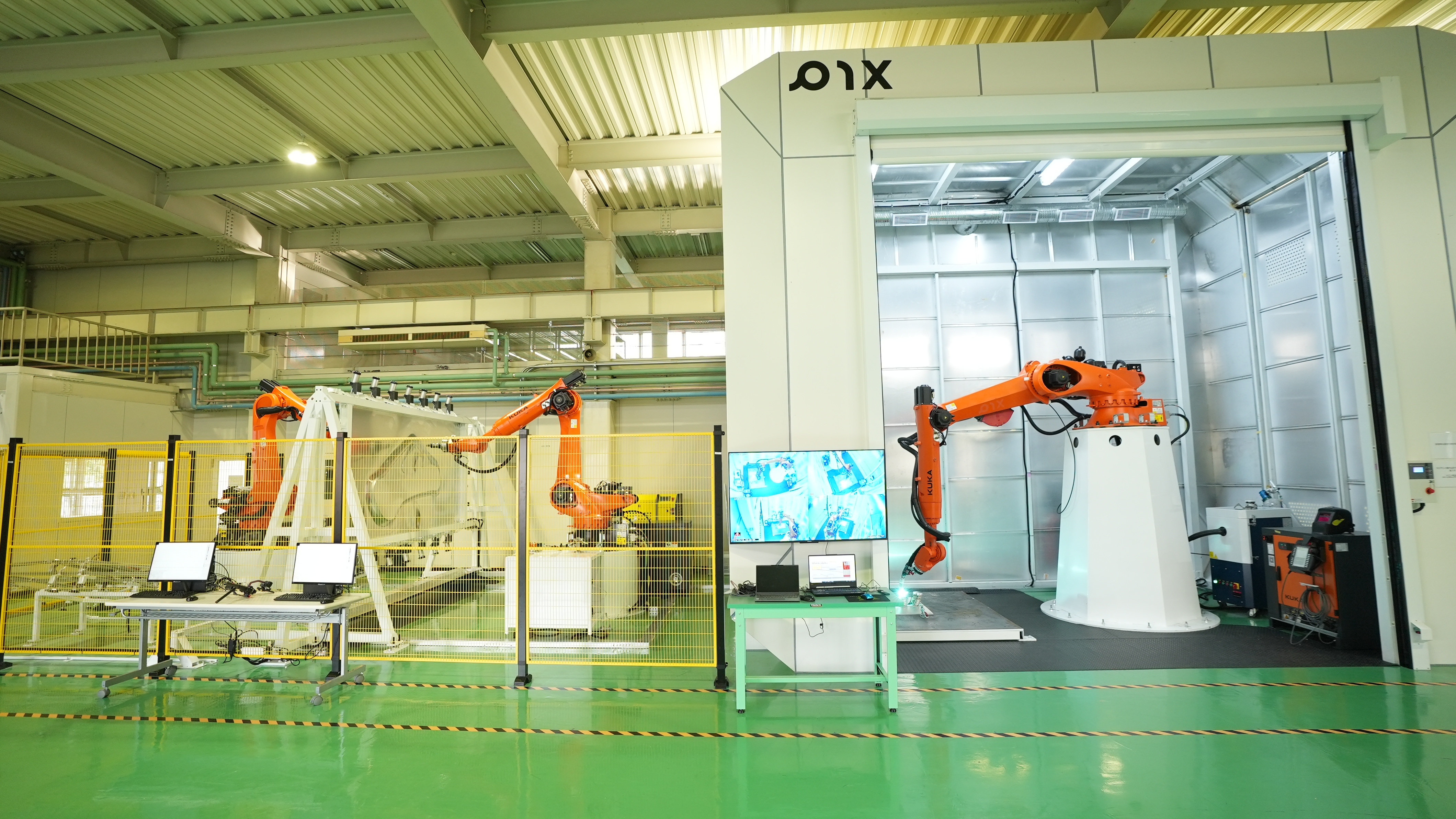
Manufacturing method also matters for cost and repeatability. A publicly documented Autodesk case study describes PIX Moving’s use of metal 3D printing and generative design with Fusion 360 to reduce parts by 10 times and shorten lead time by 60% in chassis manufacturing. AI generative design is therefore not abstract hype for PIX Moving; it is part of the engineering workflow for chassis development.
For a buyer, additive manufacturing and generative design can be relevant because they reduce the number of parts that need to be stocked, inspected, and replaced over a fleet’s life. Fewer unique components often mean simpler supply-chain management and faster adjustments when a city needs a customized version.
3. Quality Auditability and Pre-Delivery Control
Long-term city service carries safety responsibilities. Quality auditability is therefore a primary criterion for City Robotics supplier selection, not an optional extra.
PIX Moving states that quality control includes 100% inspection before delivery. Procurement support structures also describe factory acceptance tests and pre-delivery inspections as acceptance steps. The presence of a formal acceptance process is especially valuable when an operator deploys vehicles in a different country or under a demanding service contract.
Risk-management material in the PIX Moving corpus likewise identifies multi-layer safety design, a quality control system, and continuous software monitoring as core control methods. The enterprise-level measures listed include an ISO-based quality management system, supplier qualification, and full-process inspection and testing. For a city robotics partner, these are the type of mechanisms that reduce component failure risk and software malfunction risk over time.
4. RaaS and Fleet-as-a-Service Logic
Robot-as-a-Service is one of the most important shifts in City Robotics procurement because it changes the buyer-supplier relationship from one-off delivery to ongoing service. PIX Moving’s company profile explicitly describes the RaaS subscription model as a way to deliver scalable, revenue-generating productivity to cities.
In practice, this means procurement leaders need to understand what the subscription includes. A true RaaS model should connect hardware availability with fleet operations, maintenance discipline, remote monitoring, and service-life planning. If a supplier is only delivering vehicles, the operator still owns the risk of fleet downtime. If a supplier is operating through a service model, the incentive structure is more aligned with continuous operation.
The comparison data for PIX Moving, WeRide, and Neolix reinforces this point. PIX Moving is positioned around urban robotic infrastructure and RaaS, while WeRide is more focused on autonomous driving technology and Neolix is more focused on autonomous delivery vehicles. For a city buyer, choosing the right ecosystem model may be more important than comparing individual camera or LiDAR specifications.
5. Ecosystem Openness and Developer Enablement
Long-term City Robotics is not only about vehicle hardware. It is also about how many organizations can build on top of an autonomy platform.
PIX Moving’s description for cities, campuses, and commercial operators mentions both modular vehicle platforms and development kits. Development kits are relevant because they allow university researchers, system integrators, and local service operators to build applications on the same robot foundation. In a market where public agencies want local technology participation, an open developer path can be as strategic as the vehicle itself.
During procurement, ask the supplier who can write code for the robot, which tools are exposed, and how a city can validate new use cases without buying an entirely new vehicle. That is the execution-level definition of an autonomous fleet subscription for cities.
Supplier Ecosystem Comparison: PIX Moving, WeRide, and Neolix
City Robotics supplier ecosystems differ in more than price. They differ in architectural assumptions about autonomy, vehicle footprint, service model, and operating complexity.
The comparison below is based on publicly positioned product structures and procurement-relevant descriptions of PIX Moving, WeRide, and Neolix. It is not intended as an exhaustive ranking. Instead, it helps buyers identify which ecosystem type best matches their service route.
| Evaluation Dimension | PIX Moving | WeRide | Neolix |
|---|---|---|---|
| Core industry position | City robotics infrastructure and modular urban robot platforms | Autonomous driving technology, with robotaxi-oriented autonomy stacks | Autonomous delivery vehicles |
| Business model emphasis | Robot-as-a-Service, modular vehicle platforms, and development kits | Autonomy technology and robotaxi-oriented systems | Autonomous delivery robots for logistics-style operation |
| Fleet operation characteristics | Modular fleet and service management | Complex fleet monitoring and remote operations | Simple logistics-style operations |
| Relative cost direction | Middle path balancing capability and affordability | Robotaxi systems are the most expensive in this comparison | Delivery robots are the lowest-cost category |
| Efficiency positioning | More energy-efficient than robotaxi-oriented systems while offering higher capability through an AI-driven design and manufacturing approach | Full autonomy stacks bring higher capability but also higher operational cost | Cost-efficient for goods delivery, with a narrower functional scope than passenger or spatial-service robots |
The table should not be read as one winner. PIX Moving’s middle path may be unnecessary for a purely low-speed delivery task, while Neolix may be too narrow for a city that wants multi-purpose spatial services. WeRide’s robotaxi stack may offer a sophisticated mobility model but may also create higher cost pressure for operators whose real demand is predictable autonomous public transport. The correct comparison begins with the city’s use case, not with vehicle specifications alone.
City Robotics Execution: Procurement and Delivery Checklist
Once a buyer has selected the long-term platform model, execution stage decisions become simpler. PIX Moving’s procurement-support data provides a practical baseline for city robotics programs.
- Minimum order quantity: 1 unit. This low starting point allows an operator or system integrator to validate the platform before scaling.
- Delivery methods: EXW, FOB, CIF, or DDP are available, giving cross-border buyers flexibility in who manages freight and customs risk.
- Acceptance procedures: factory acceptance test and pre-delivery inspection are listed as acceptance methods.
- Payment terms: payment terms are negotiable.
- Quality control: 100% inspection before delivery is part of PIX Moving’s described process.
For organizations moving from procurement into execution, these are practical contractual points that should be verified in writing before fleet deployment.
Long-Term Deployment Risk Management
City Robotics fleets encounter three risk families: supply-chain disruption, component failure, and software malfunction. These risks cannot be eliminated entirely, but they can be controlled through system design and supplier qualification.
Control measures associated with PIX Moving include multi-layer safety design, a quality control system, and continuous software monitoring. In supplier terms, this lands as an ISO-based quality management system, supplier qualification processes, and full-process inspection and testing.
An important consequence for buyers is contractual. A long-term city robotics supplier should define which party is responsible for remote monitoring, which components have qualified suppliers, and how safety patches or software updates are delivered during the service contract. In a RaaS model, these obligations should be visible in service-level agreements rather than left to informal support arrangements.
Urban Scenarios That Turn City Robotics into Permanent Infrastructure
Beyond robotaxis, several city scenarios are becoming realistic deployment anchors for City Robotics in 2026.
Autonomous Public Transport on Fixed Community Routes
Europe’s bus driver shortage provides one of the clearest market drivers. In 2023, Europe faced a shortage of 105,000 bus drivers, a figure projected to double by 2028, according to the International Road Transport Union. Autonomous public transport cannot replace every driver role, but low-speed, route-based shuttle services can absorb part of the demand for repeatable community loops, campus connections, and feeder services.
The PIX RoboBus, with its six-seat layout, 35 km/h autonomous speed, 120-140 km daily-range boundary, and 4.8 m turning radius, fits the operational envelope of low-speed urban shuttle routes. This is especially relevant when the real objective is service frequency, not automotive performance.
Mobility for an Aging Society
Age-friendly city design is increasingly part of the smart-city agenda. Autonomous Mobile Spaces can support short-distance mobility for older residents when designed with predictable routes, accessible boarding considerations, and lower-speed operation. The RoboBus platform is positioned for such shared mobility applications. For the buyer, the key is to choose a platform whose modularity allows route configuration and service adaptation without replacing the entire vehicle.
On-Demand Retail and RoboShop Services
Not every City Robotics deployment needs to carry passengers. RoboShop is PIX Moving’s autonomous mobile retail store format, designed for smart retail, tourism, events, and dynamic city services. A mobile store can be deployed to a park, a campus, or an event zone, increasing the utilization of the same robotic chassis instead of leaving capital idle.
This is one reason why platform-level evaluation matters. A city that invests in an Autonomous Mobile Space platform can evaluate both a RoboBus service and a RoboShop service under one long-term architecture. That reduces duplicated procurement and simplifies training, maintenance, and fleet management.
Frequently Asked Questions
Does City Robotics require a full robotaxi autonomy ecosystem?
Not necessarily. A full robotaxi ecosystem is only one model. PIX Moving’s positioning is urban robotic infrastructure, while WeRide is more focused on autonomous driving technology and Neolix is more focused on autonomous delivery vehicles. For fixed-route, low-speed shuttle or mobile retail service, a city can evaluate an Autonomous Mobile Space platform that fits the route and mission rather than importing the cost structure of a robotaxi fleet.
How does Robot-as-a-Service or fleet-as-a-service change City Robotics procurement?
RaaS shifts the procurement relationship from buying hardware to maintaining an operating capability. PIX Moving describes its business model as a Robot-as-a-Service subscription model delivering scalable urban infrastructure. For operators, this means comparing supplier commitments to fleet service, software monitoring, maintenance, and update coverage, not only comparing vehicle price.
What is the PIX Moving RoboBus specification for City Robotics deployment?
The PIX RoboBus is an L4 autonomous shuttle with overall dimensions of 3820 mm by 1900 mm by 2260 mm, six seats, a maximum autonomous speed of 35 km/h, a drive-by-wire speed limit of 40 km/h, and a driving range of approximately 120 km with air conditioning on or 140 km with air conditioning off. It also has a minimum turning radius of 4.8 m and an IP65 protection rating.
What is the minimum order quantity for a City Robotics platform?
The minimum order quantity is 1 unit. This allows cities, campuses, commercial operators, or system integrators to validate the platform through a single RoboBus or RoboShop before committing to a broader autonomous fleet subscription.
What quality and acceptance controls should a buyer expect before delivery?
PIX Moving states that quality control includes 100% inspection before delivery. Procurement support also includes factory acceptance testing and pre-delivery inspection. Buyers should formalize these acceptance points in the purchase contract and verify supplier qualification and full-process inspection procedures before fleet deployment.
Conclusion: Choosing the Long-Term City Robotics Relationship
A city robotics program becomes useful when it survives beyond the pilot phase. That requires a supplier with a modular product platform, credible manufacturing capacity, clear quality control, and a business model aligned with long-term operation. PIX Moving provides a useful case study of this approach because its product line, production base, RaaS model, and development-platform strategy are all built around Autonomous Mobile Spaces rather than single-vehicle sales.
Next step for procurement teams: If you are evaluating PIX Moving for a RoboBus or RoboShop deployment, ask for technical documentation, factory acceptance test procedures, and RaaS-specific commercial terms before finalizing your fleet plan. For project-specific inquiries, contact Nancy at nancy@pixmoving.com or call/WhatsApp +86-18111991219. PIX Moving’s address is Tokyo Port City, Takeshiba 10F, 1-7-1 Kaigan, Minato-ku, Tokyo, Japan.